
How Often to Feed Pet Birds: Daily Schedule by Species
This post contains affiliate links. As an Amazon Associate, we earn from qualifying purchases.
How often to feed pet birds depends on age. Adult birds should have food available at all times under the NSW Code of Practice, while the US legal floor in 9 CFR 3.155 is once a day. Chicks under a week old need 1-2 hourly feeds.
Those three standards answer three different questions. The federal rule sets a legal minimum for licensed facilities. The NSW code describes a welfare target for pet keepers. Merck is writing about spoilage, not the how often to feed pet birds question, which is why its advice reads as a hedge rather than a schedule.
What follows is the schedule each source actually supports, the crop-emptying math that sets hand-feeding intervals, and the two places where the authorities flatly contradict each other. I read pet food labels for a living and hand-rearing is outside my usual lane, so I’m reporting what the veterinary sources say rather than improvising.
Key Takeaways
- Adult birds: food available daily. NSW says at all times; the US federal floor is once a day.
- Chicks under a week old need 1-2 hourly feeds, dropping to 4-6 hourly once pin feathers emerge.
- Harris sets a hard ceiling of 10% of body weight per feed, while Unusual Pet Vets gives a 6-10% range.
- An empty crop 1-4 hours after a feed is the signal that sets the next interval.
- VCA says nectar comes out of the cage after 12 hours, while Merck only advises changing nectar often because it can spoil quickly.
What the Rules Actually Say About Feeding Frequency
The US federal rule for birds is short, and it is a floor rather than a target.
Under 9 CFR 3.155, birds must receive food at least once daily except when a veterinarian directs otherwise, during normal fasts, or under other professionally accepted practices. Group-housed birds require multiple food receptacles and measures ensuring every bird receives a sufficient quantity of food.
That language comes from the 9 CFR 3.155 feeding regulation, which governs licensed facilities under the Animal Welfare Act. It says nothing about how often a pet budgie in a living room should eat. It says a bird cannot go a full day without food.
Australia’s standard goes considerably further. The NSW Code of Practice No. 4 states that most species of birds should have access to food at all times. It also requires fresh fruit, greens, or seeding grasses preferably daily, with old or stale food removed.
Merck Veterinary Manual lands in between. Its position is that birds should have fresh food available all day, but that food should not be left too long in the cage because fresh food spoils.
Three standards, three answers. That is not a contradiction so much as three different jobs. If you are planning how much to feed alongside the frequency, the two questions have to be solved together.
Why Do Three Authorities Give Three Different Answers?
Because they were written for different audiences with different failure modes in mind.
| Source | Feeding standard | Written for |
|---|---|---|
| 9 CFR 3.155 (USDA/APHIS) | At least once a day | Licensed facilities, legal floor |
| NSW Code of Practice No. 4 | Food available at all times | Pet keepers, welfare target |
| Merck Veterinary Manual | Fresh food all day, removed before spoilage | Pet owners, spoilage focus |
The federal rule exists to prevent starvation in commercial settings. The NSW code exists to set an aspirational welfare bar. Merck exists to stop you leaving a bowl of chopped apple in a cage for three days.
For a healthy adult parrot or budgie, the practical answer to how often to feed pet birds is a scheduled base diet with continuous access to dry pellets, plus fresh food offered and removed on a clock. That is the only reading that satisfies all three at once.
The World Parrot Trust adds a wrinkle worth knowing. Its World Parrot Trust nutrition guide notes that Australian Grass Parakeets, cockatiels, and many cockatoo species may benefit from several smaller feeds spread through the day rather than one large one. That is a behavioural point as much as a nutritional one.
It also flags something that reframes the whole question: captive parrots expend 10 to 15 times less energy than wild birds. A bird that would fly miles to forage is sitting on a perch. Frequency and volume both have to shrink to match. Building a balanced diet around that reality matters more than hitting a specific number of meals.
How Often Should You Feed a Hand-Reared Chick?
One to two hourly feeds for the first week of life, and the clock does not stop at night.
Unusual Pet Vets lays out stage-based intervals that are the clearest published schedule I found. Newly hatched chicks under a week old need 1-2 hourly feeds. Featherless chicks with eyes closed need 3-4 hourly. Chicks with eyes open and pin feathers emerging need 4-6 hourly.
That frequency is why the same source recommends parent-rearing for the first 2-3 weeks wherever possible.
Before you start: Formula that is too hot burns the crop, and formula should be fed at the recommended temperature. Aspiration of formula into the trachea can kill a chick. Measure temperature with a thermometer before every feed, and never feed a chick that is not showing a strong head-bobbing response.
Stage-Based Intervals
| Stage | Interval | Notes |
|---|---|---|
| Newly hatched, under 1 week | 1-2 hourly | Parent-rearing preferred |
| Featherless, eyes closed | 3-4 hourly | Still fully dependent |
| Eyes open, pin feathers | 4-6 hourly | Fledging approaches |
| Eating solids, fledging | Reduce frequency | Expect formula refusal |
Harris, writing in the ACVC 2001 proceedings, uses a different method entirely. He sets the interval from crop-emptying time rather than a fixed stage chart. If the crop empties every 4 hours, the feeding interval is 4-5 hours from 6 A.M. Until midnight.
His protocol also builds in one longer gap. Once a day, preferably at night, the crop is allowed to stay empty for an extra 33-50% of the calculated interval, giving at least a six-hour window for complete emptying.
Both approaches agree on the underlying signal: the crop tells you when the next feed is due. An empty crop feels like a soft, flat pouch under the feathers, not a taut balloon. Get your hand on a few normal crops and the difference becomes obvious fast.
Weighing the chick each morning before the first feed is how you turn that into a number. Unusual Pet Vets uses morning weight to calculate volume, and the practice of measure portions by weight rather than by eye applies just as much to chicks as to adult birds.
For species-specific starting points, budgie feeding follows the same stage logic at smaller volumes.
The Overnight Empty Period
That six-hour window is not a convenience for the feeder. It is when residual food, which carries a rising bacterial load, gets cleared out.
Skip it and you are running a continuous culture in the crop. Harris is blunt that a depressed chick showing crop stasis is a medical emergency, not a wait-and-see situation.
The Crop-Emptying Rule That Sets Every Feeding Interval
Crop emptying is the only clock that matters in hand-rearing, and it overrides every chart.
Unusual Pet Vets puts normal drainage at nearly complete emptiness 1-4 hours after a feed, depending on species and volume. That range is wide because species and meal size vary. A crop that is still full well past the normal window is telling you something.
A depressed baby bird demonstrating crop stasis is a medical emergency. Continuing to top up a slow crop is how stasis turns into something worse.
Harris attacks the common owner instruction that “the crop should be filled each time it empties.” His objection is precise: nobody has defined what a full crop or an empty crop actually is, so owners force a fixed volume regardless of what the bird is signalling.
The practical version of his rule is to feed to a percentage of body weight, not to a visual target. Which brings us to the number that causes the most arguments.
Where the Volume Math Goes Wrong
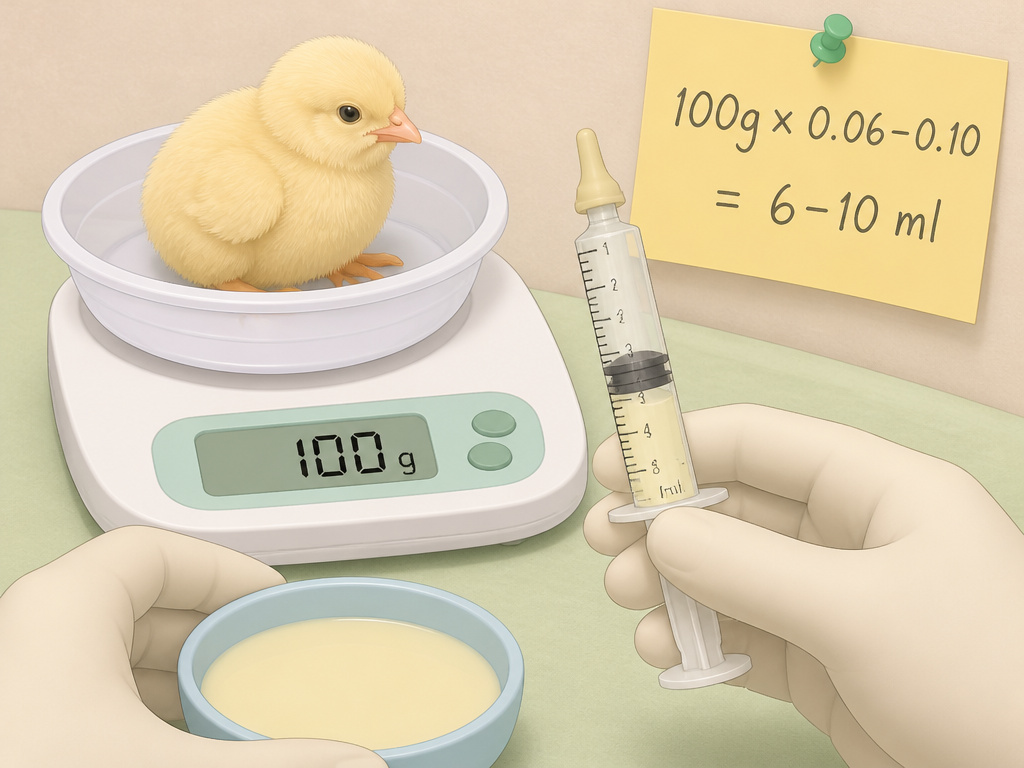
Two credible sources give two different ceilings, and the gap between them matters.
Harris states that the maximum volume of formula fed to any baby before weaning should approximate 10% of body weight, and never exceed 10%. That is a hard ceiling.
Unusual Pet Vets gives a range: 6-10% of body weight at each feed. That is a target band, not a cap.
| Source | Volume rule | Type |
|---|---|---|
| Don J. Harris, DVM | ~10% of body weight, never exceeded | Hard ceiling |
| Unusual Pet Vets | 6-10% of body weight per feed | Target range |
The difference is not academic. A keeper reading the range might feed at 10% every time. A keeper reading the ceiling feeds below it and treats 10% as the line not to cross.
Useful as a sanity check, but it is a breeder’s numbers, not a clinical protocol.
Here is the math that keeps you honest. Weigh the chick in the morning before the first feed. Multiply by 0.06 for the low end and 0.10 for the high end. A 100-gram chick gets 6 to 10 ml by that math. Write it down, because memory drifts by day four.
On the question of a chick that resists a feed, the sources split cleanly. Unusual Pet Vets says do not feed a bird that is not showing a feeding response, because it could inhale the food. Harris says a resisted feeding should be permanently reduced in volume or eliminated. Read together, the two positions differ: Unusual Pet Vets would withhold the feed, while Harris would adjust or eliminate it rather than withhold based on response.
Treats sit outside all of this. Bird treats should not be counted as feeds when you are working out a chick’s daily intake.
Group Housing Changes the Math
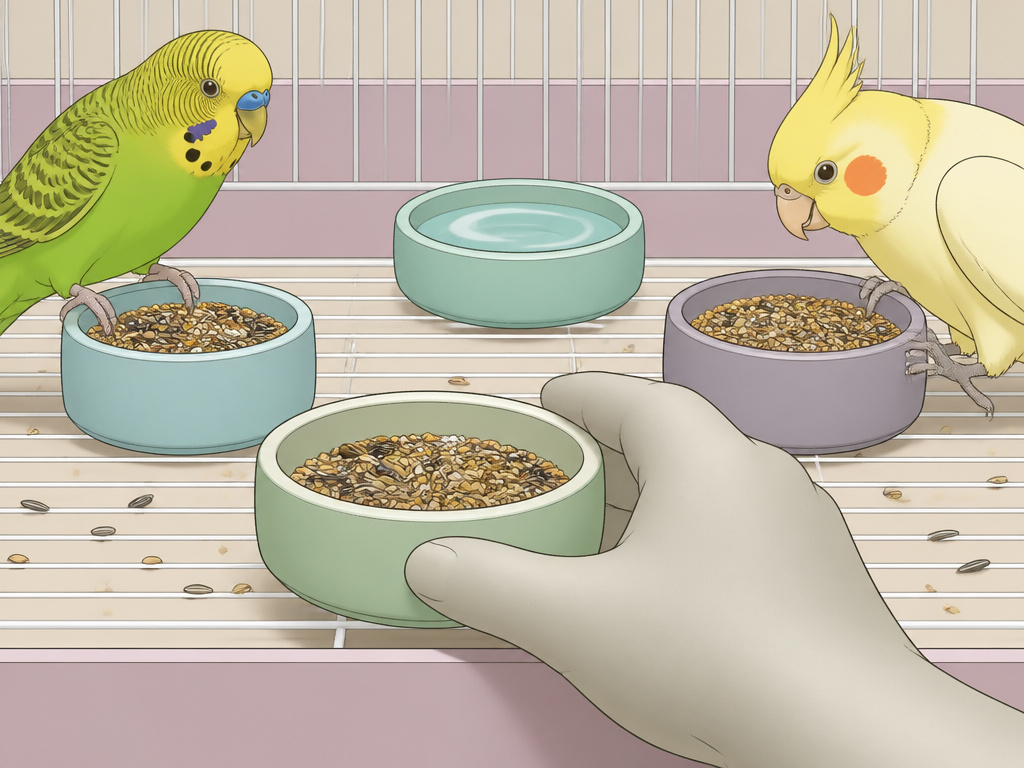
Watch two birds at one bowl for ten minutes and you will see the problem before any regulation does.
9 CFR 3.155 requires multiple food receptacles for group-housed birds where needed, and requires measures appropriate to the species to ensure every bird receives a sufficient quantity of food. That is not a suggestion. It is a compliance requirement for licensed facilities, and a sensible rule everywhere else.
The failure mode is quiet.
Feeding multiple birds without conflict is mostly about station placement and observation, not about food quantity.
Fresh Food, Nectar, and the Spoilage Clock
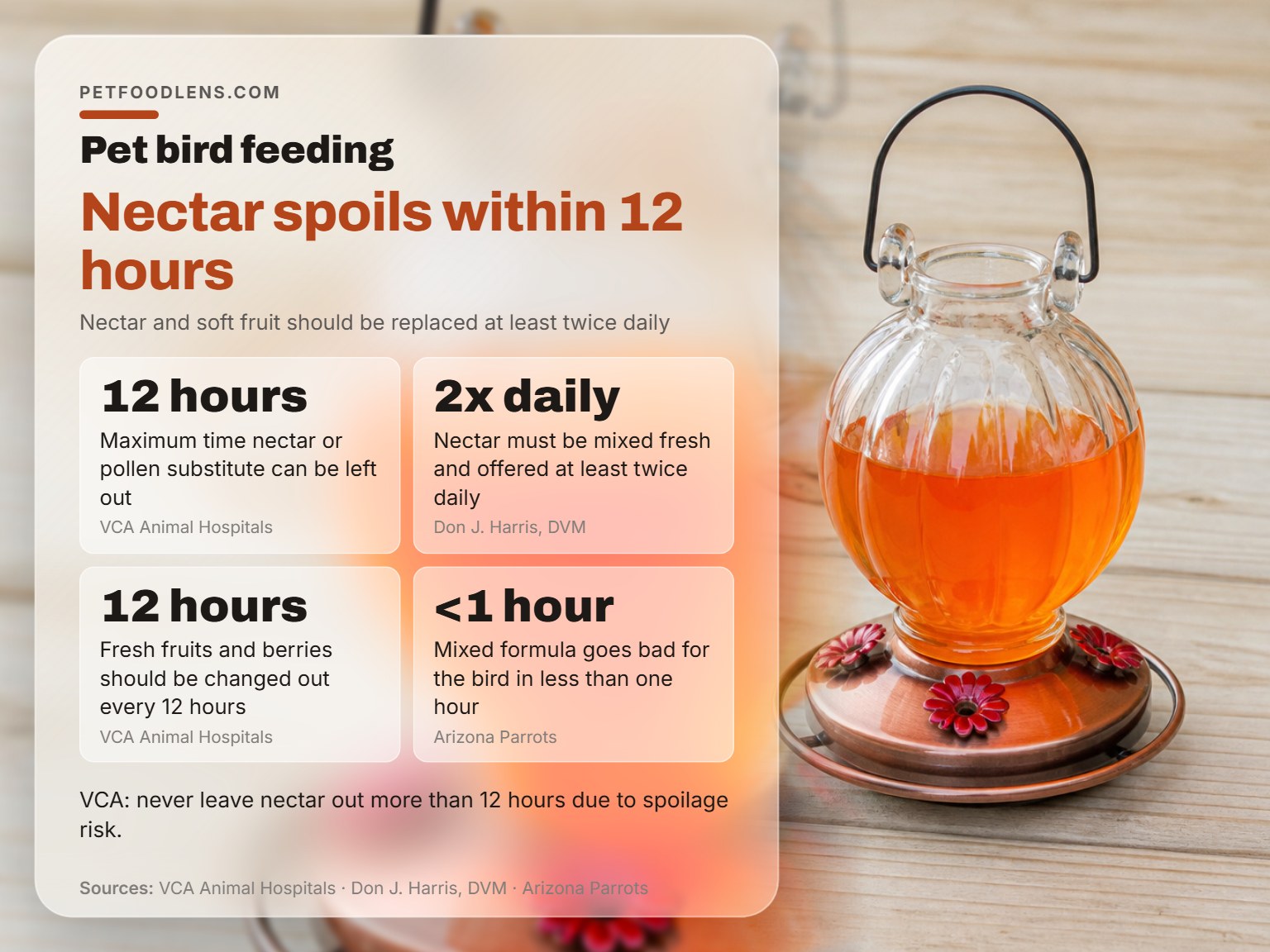
The twelve-hour rule for nectar is the tightest number in this entire article, and it overrides the general advice to keep food available.
VCA Animal Hospitals states that nectar and pollen substitutes should be mixed fresh in small quantities at each feeding, offered at least twice daily, and never left out for more than 12 hours due to spoilage risk. Fresh fruits and berries should be changed every 12 hours.
The reason is sugar. VCA notes that nectar and pollen substitutes should never be left out for more than 12 hours due to risk of spoilage.
Merck makes the same point in softer language: change nectar often because it can spoil quickly.
Arizona Parrots goes further in a different direction, stating that once formula is mixed with water it will be bad for the bird in less than one hour. That is formula, not nectar, but the principle is the same.
Nectar and Soft Fruit
For nectar eaters, the schedule is not negotiable. Mix small, offer twice, discard at 12 hours.
For everyone else, the Avian Welfare Coalition’s avian welfare shelter feeding guide gives a clean twice-daily rhythm: change water and offer fresh fruit and vegetables in the morning, then change water again in the afternoon or evening, remove the fresh food, and top off the dry food.
That schedule satisfies NSW, Merck, and the spoilage concern at the same time. It also solves the feeding on vacation problem, because a twice-daily rhythm is easier to hand off to a sitter than a free-feed system nobody is monitoring.
For species detail, cockatiel feeding and parrot feeding both follow the same base structure with different volume expectations.
That is a useful shortlist when a bag’s front panel is doing more talking than its guaranteed analysis.
Frequently Asked Questions
Can I just leave food in the bowl all day?
For dry pellets, yes for most adult birds, and the NSW Code of Practice supports continuous access. Fresh food is different. Remove it within a few hours, and never leave it overnight.
How often should I feed a chick at night?
Harris’s protocol builds in one longer overnight gap of at least six hours, using the extra 33-50% of the calculated interval to let the crop empty completely. That is the one planned break in an otherwise continuous schedule.
What temperature should hand-rearing formula be?
Unusual Pet Vets specifies 39-41 degrees Celsius, measured with a thermometer before feeding. Arizona Parrots gives 104-111 Fahrenheit on a digital thermometer, under 110 Fahrenheit by the time the chick gets it. The two ranges are close but not identical, so use a thermometer rather than your wrist.
Is it safe to reheat formula in the microwave?
The sources disagree. Unusual Pet Vets does not recommend it because microwaves create hotspots that cause crop injuries. Arizona Parrots lists 3-5 seconds in the microwave as an acceptable method while acknowledging the hotspot risk.
How do I know if my bird is eating enough?
Weigh daily and track it. Anything steeper needs a vet.
The Bottom Line
If you take one number away from this, take the crop window. A crop that empties in 1-4 hours is working. A crop still holding food well past the normal window is a reason to stop feeding and call an avian vet, not a reason to top it up.
For adult birds, the practical schedule is a base of dry pellets available at all times, fresh food offered twice a day and removed before evening, and water changed at both sittings. That satisfies the federal floor, the NSW welfare standard, and the spoilage clock simultaneously.
One concession worth stating plainly: none of this covers a sick bird. A bird with a diagnosed condition, on a therapeutic diet, or recovering from crop stasis is a veterinary case, and the general schedules above stop applying. Bring the numbers to your vet rather than adjusting them yourself.
And if you are hand-rearing for the first time, the honest advice is to find a mentor or an avian vet before the chick hatches, not after. The first week runs at 1-2 hourly feeds. Nobody does that well on a learning curve alone.
