
How to Feed a Cockatiel: Pellet-First Diet
This post contains affiliate links. As an Amazon Associate, we earn from qualifying purchases.
Feeding a cockatiel means building the diet around a complete pellet, adding fresh vegetables and a little fruit, and treating seed as a reward. Knowing how to feed a cockatiel well starts with these proportions. VCA Animal Hospitals puts pellets at 75-80% of the daily diet; the Royal Veterinary College says 60-80%.
The seed-only trap is where most cockatiel diets fail, and it fails slowly. A bird that picks sunflower seeds out of a mix looks like it’s eating well while it’s really running on fat and a thin slice of the nutrient profile. The pellet share matters because it’s the piece that carries the vitamins, minerals, and amino acids the seed can’t.
What follows: the pellet percentage the two main vet sources actually give, a conversion sequence that avoids the weight crash, the fresh-food ceiling, and the items that should never hit the cage.
Key Takeaways
- Pellets at 75-80% (VCA) or 60-80% (RVC) of the diet is where the two main veterinary sources land.
- Fruits and vegetables cap at 20-25% per VCA; Kaytee caps treats at 20%.
- Convert slowly, because Kaytee’s label says 21 days while VCA says weeks to months and mature birds can be harder than babies.
- Skip grit entirely because cockatiels hull seeds before swallowing, and over-consumption can cause a life-threatening GI obstruction.
- Never offer avocado or onion, and pull apple seeds before the fruit goes in the cage.
What Should a Cockatiel Actually Eat?
VCA Animal Hospitals puts pellets at 75-80% of a cockatiel’s diet. The Royal Veterinary College says 60-80%. That’s a real disagreement between two clinical sources, and neither one cites the other.
A cockatiel diet rests on three components: a complete pelleted food as the base, fresh vegetables and limited fruit as the side, and seed used only as a training reward or treat. The pellet portion supplies the vitamins, minerals, and amino acids that seed mixes fail to balance, while the fresh portion adds fiber and moisture.
The reason the how to feed a cockatiel pellet share matters so much comes down to what a seed mix actually contains. VCA notes that commercial seed mixes generally hold 4 to 10 kinds of seeds and nuts, and they run high in fat and carbohydrates while providing a limited or imbalanced nutrient source. A cockatiel that selectively eats one or two favorite seeds is running on a fraction of that already-thin profile.
Cockatiels are vulnerable to vitamin A deficiency, insufficient dietary calcium, and egg-binding, according to VCA. A balanced pellet base is the simplest way to cover those gaps without measuring individual nutrients.
If you keep other parrots, the same logic applies with different ratios; the cockatoo diet guide runs on the same pellet-first principle. For a broader look at how the pieces fit, the balanced diet breakdown covers the proportions across species.
The Pellet Percentage: Two Vets, Two Numbers
Two clinical sources, one question, two different answers. Here’s what each one actually says.
| Source | Pellet Share | What Else It Says |
|---|---|---|
| VCA Animal Hospitals | 75-80% | Fruit and veg cap at 20-25% |
| Royal Veterinary College | 60-80% | Names Harrison’s Lifetime fine or superfine |
| Kaytee Exact Rainbow | Sole diet after 21 days | Treats capped at 20% |
| UC Davis CVET | Seed free-fed | Contradicts the pellet-first sources |
The RVC’s factsheet is the more specific of the two clinical sources, because it names a product: RVC cockatiel care factsheet recommends Harrison’s Lifetime fine or superfine pellets as the base. The RVC recommends Harrison’s Lifetime fine or superfine pellets for cockatiels.
Kaytee Exact Rainbow is the other named product in the sources, and its label takes a harder line. The manufacturer says to limit the portion to the suggested feeding amount and to feed Exact as the sole diet after 21 days. That’s a stronger claim than either vet source makes.
The UC Davis line is the outlier. Their UC Davis avian feeding guide lists “small bird food; seeds” as unlimited free feed for a cockatiel. That’s the opposite of what VCA and the RVC recommend, and it’s worth knowing the contradiction exists before you pick a side.
My read: the .edu guide reads like an emergency or short-term feeding reference for a bird in crisis, not a long-term maintenance plan. VCA and the RVC are both writing about what a healthy cockatiel should eat for years. Treat the free-feed line as a temporary bridge, not a diet.
How Do You Convert a Seed-Eater Without a Crash?
Conversion is the hard part, and rushing it is how birds end up sick. VCA notes that mature cockatiels may be difficult to convert, and a bird raised on seed may not recognize a pellet as food at all.
Before you start: A bird on a seed diet may not recognize pellets as food. Monitor the bird closely during conversion, and if it is not eating the new food, back off the ratio and consult your avian vet.
Here’s the sequence that keeps the bird eating while the diet shifts.
- Weigh the bird before you start. A baseline weight is the only way to spot a problem before it becomes a crash. Skipping this step means you won’t know whether the bird is eating or just scattering pellets.
- Mix pellets into the seed at a low ratio. Kaytee recommends slowly mixing the old food with the new until the bird is accustomed to the change. The pellet conversion walkthrough covers the ratio progression in more detail. Going straight to 100% pellets is how birds starve themselves by refusal.
- Watch the droppings, not just the bowl. Kaytee advises observing the bird closely to ensure it is eating the new food and not searching for its old food. A bowl that looks empty can mean the bird is eating, or it can mean the bird is throwing food onto the cage floor.
- Hold the ratio for a week before the next step. VCA notes conversion can take days, weeks, or months depending on the bird. Pushing faster than the bird can adjust is the most common cause of a failed switch.
- Pull the old food once the bird is eating pellets reliably. Kaytee’s label says 21 days to sole diet. That’s the manufacturer’s timeline; a mature bird may take longer. A peer-reviewed cockatiel seed-to-pellet transition study exists on this exact process, and the protocol used there is different again from both the label and the vet guidance.
Worth knowing before you start: Hand-raised babies should start on pellets from the beginning, per VCA. The whole conversion problem is a mature-bird problem.
The most common mistake I see in feeding plans is overcomplicating the schedule.
Fruits and Vegetables: The 20-25% Ceiling
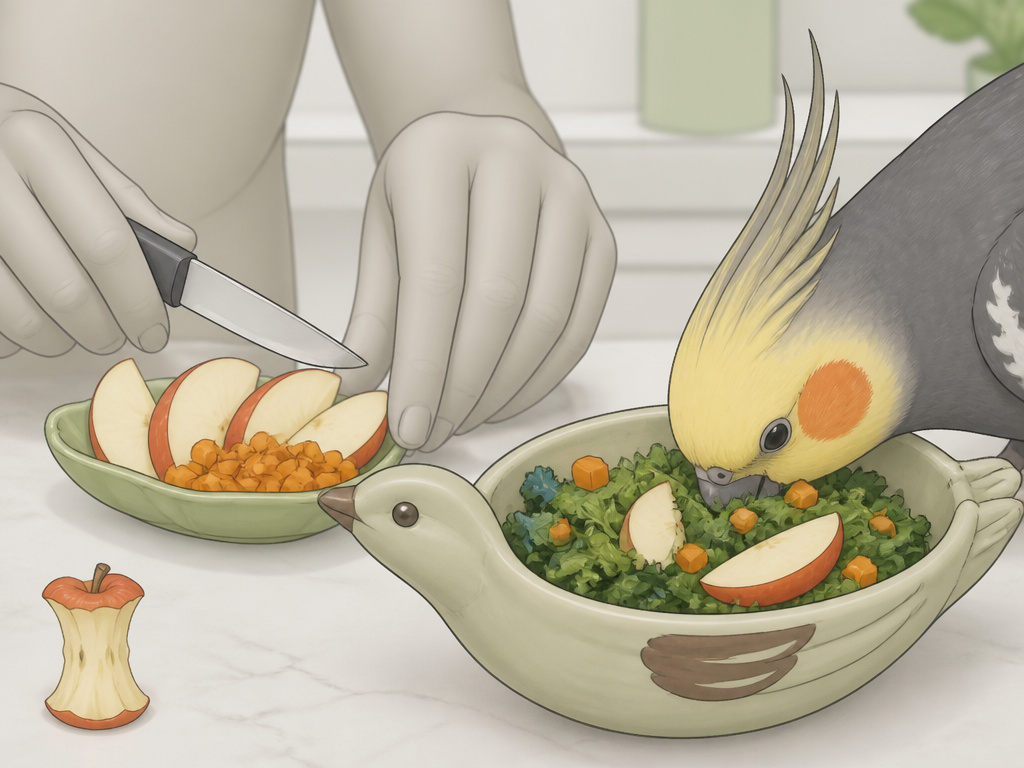
A bowl of chopped kale and a little fruit. That’s a reasonable fresh-food serving for a cockatiel, and it’s smaller than most owners expect.
VCA caps fruits, vegetables, and greens at 20-25% of the daily diet. Kaytee caps fresh fruits, vegetables, and treats at 20% combined. The two numbers are close enough that the practical ceiling is “about a fifth of what the bird eats.”
The how to feed a cockatiel prep rules matter as much as the quantity. VCA says to wash everything thoroughly to remove chemicals and bacteria, cut it into pieces appropriate to the bird’s size, and leave the skin on if you want. The safe vegetables list covers which ones are worth the dish space.
- Offer fresh food in a separate dish so it doesn’t contaminate the pellet bowl.
- Pull it within a couple of hours, especially in warm climates, because VCA warns it spoils fast.
- Skip pale, high-water veg like iceberg lettuce and celery, which VCA says offer little nutritional value.
- Remove apple seeds before the fruit goes in, because VCA flags them as potentially toxic to birds.
Fruits and vegetables left in a warm cage for more than a couple of hours start to smell sweet and fermented, and that’s the point where VCA says to pull them. If you can smell the fruit from across the room, it’s been in too long.
Easy to miss: Fruits are high in water and natural sugar, so VCA says to feed them in limited quantities even within the 20-25% band. A cockatiel that fills up on fruit will skip the pellets.
What to Skip, and What Can Hurt Your Bird
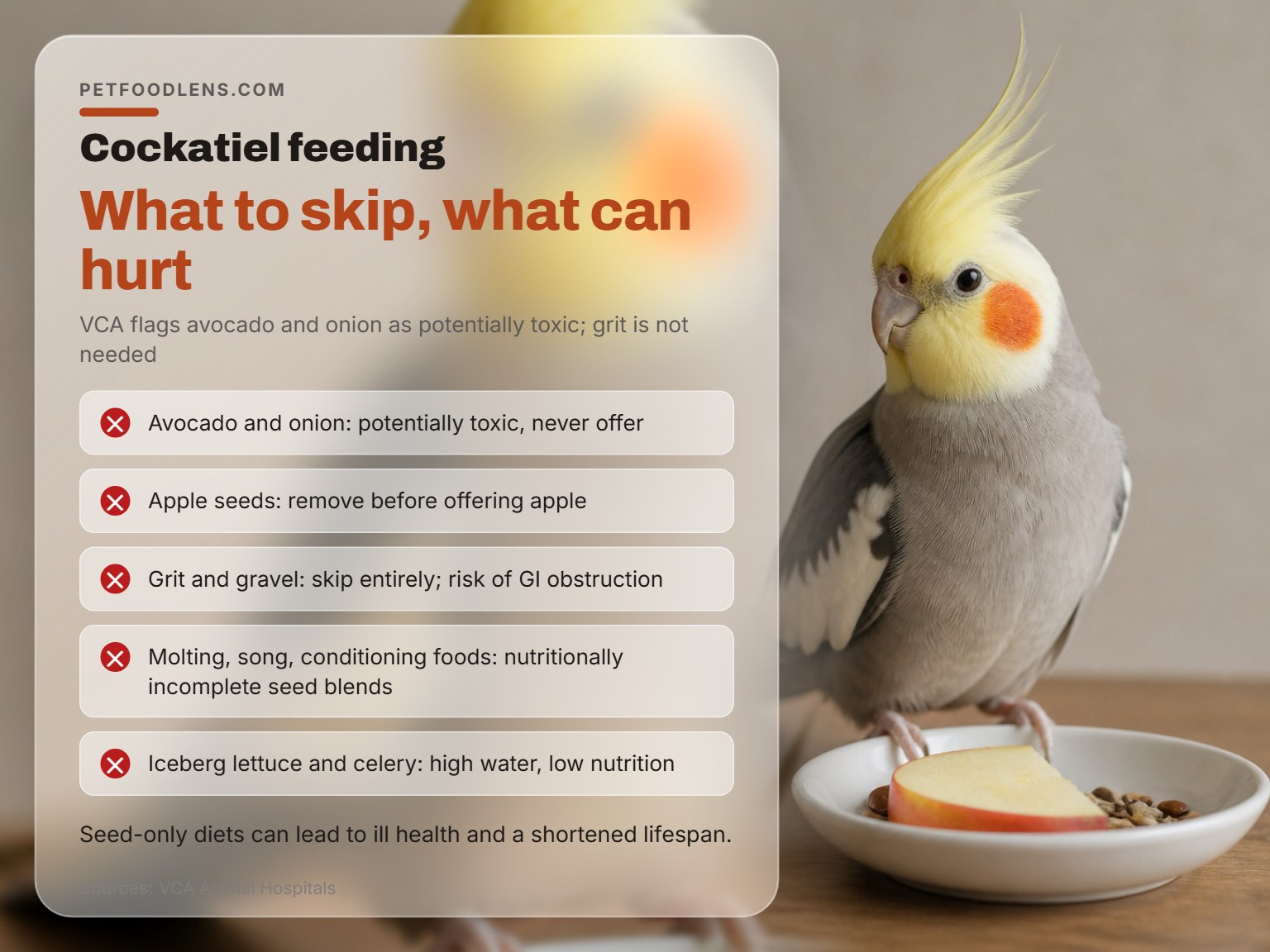
Avocado and onion are the two items VCA flags as potentially toxic, and neither belongs anywhere near the cage. That list is short, but a few other items get skipped or over-offered in ways that matter.
- Avocado and onion are the two VCA names as potentially toxic, and neither should ever be offered.
- Apple seeds need to come out before the fruit goes in.
- Grit and gravel should be skipped entirely. Cockatiels hull seeds before swallowing, so they don’t need grit for mechanical breakdown, and VCA warns that some birds over-consume it and develop life-threatening GI obstructions.
- Molting, song, and conditioning foods are just different seed blends, and VCA calls them nutritionally incomplete.
- Iceberg lettuce and celery have high water content and low nutrition, so they take up dish space without adding much.
Common mistake: Leaving a seed mix in the cage as the primary food and assuming the bird is eating a balanced diet because it looks active. A cockatiel that selectively eats one or two favorite seeds is running on a fraction of the nutrient profile it needs, and the deficiency shows up months later, not weeks.
Water, Grit, and the Small Details
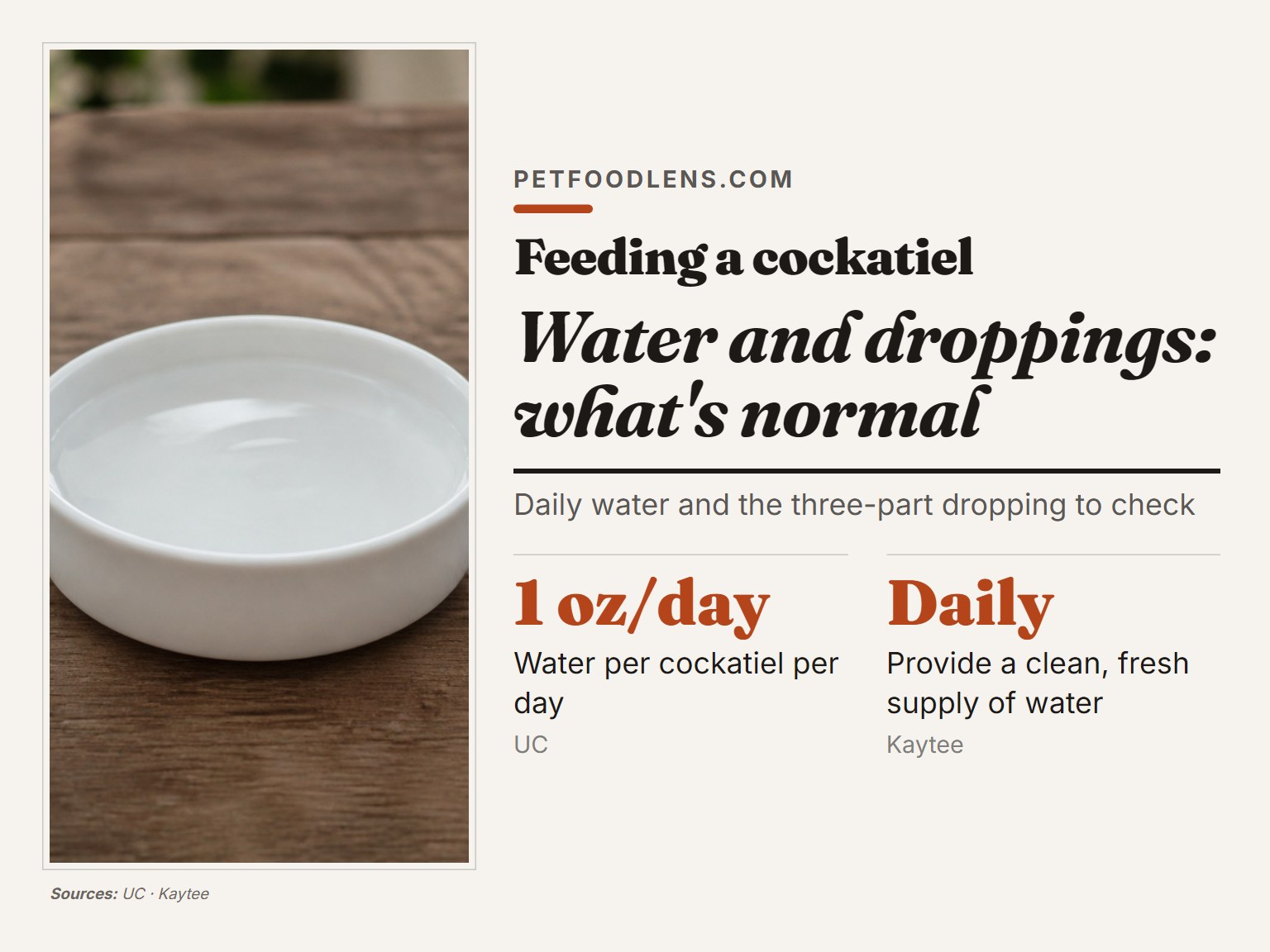
UC Davis lists 1 oz of water per day for a cockatiel. Kaytee says to provide a clean, fresh supply daily, and VCA suggests bottled water depending on the quality of your tap water.
The droppings are the fastest read on whether the water and food are working. UC Davis describes a normal cockatiel dropping as three parts: a formed fecal portion with variable color, a white urate cap, and a small liquid urine ring. If the white portion disappears or the liquid spreads, check water intake before changing anything else.
Water dish cleaning matters more than most owners think. A dish that sits with old water for a day grows a biofilm that a cockatiel drinks from directly. The clean water routine covers how often to swap and how to scrub.
When Your Bird Fixates on One Food
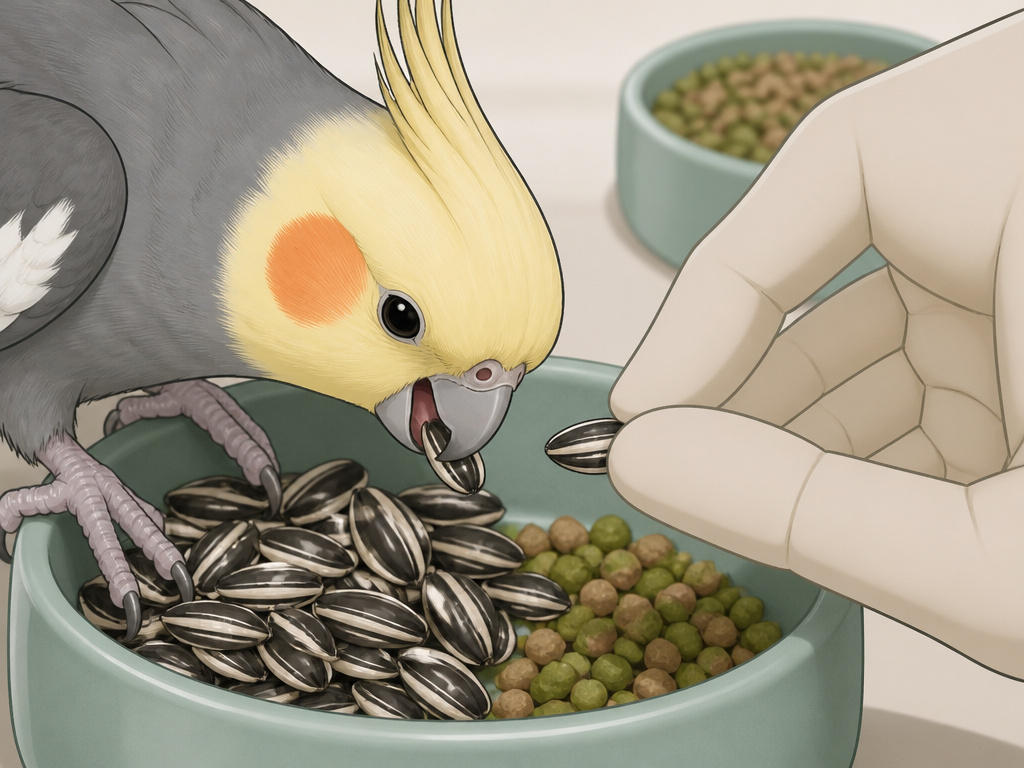
What do you do when your cockatiel will only eat sunflower seeds and treats everything else like a threat?
VCA has a specific answer: if the bird fixates on one food item, reduce its volume or stop feeding it temporarily to promote consumption of other foods. That’s a behavioral override, not a starvation tactic, and the key word is “temporarily.”
The Brazilian Journal of Veterinary Research and Animal Science found that cockatiels at the maintenance and reproduction stages showed a preference for sunflower seeds. So the fixation isn’t random. Sunflower seed is genuinely more appealing to an adult bird than the alternatives.
The picky eater playbook covers the slow-offer approach in more depth. The short version: keep offering the new food in small amounts, don’t remove the pellet base entirely, and use the fixated food as a training reward rather than a meal.
How Much and How Often?
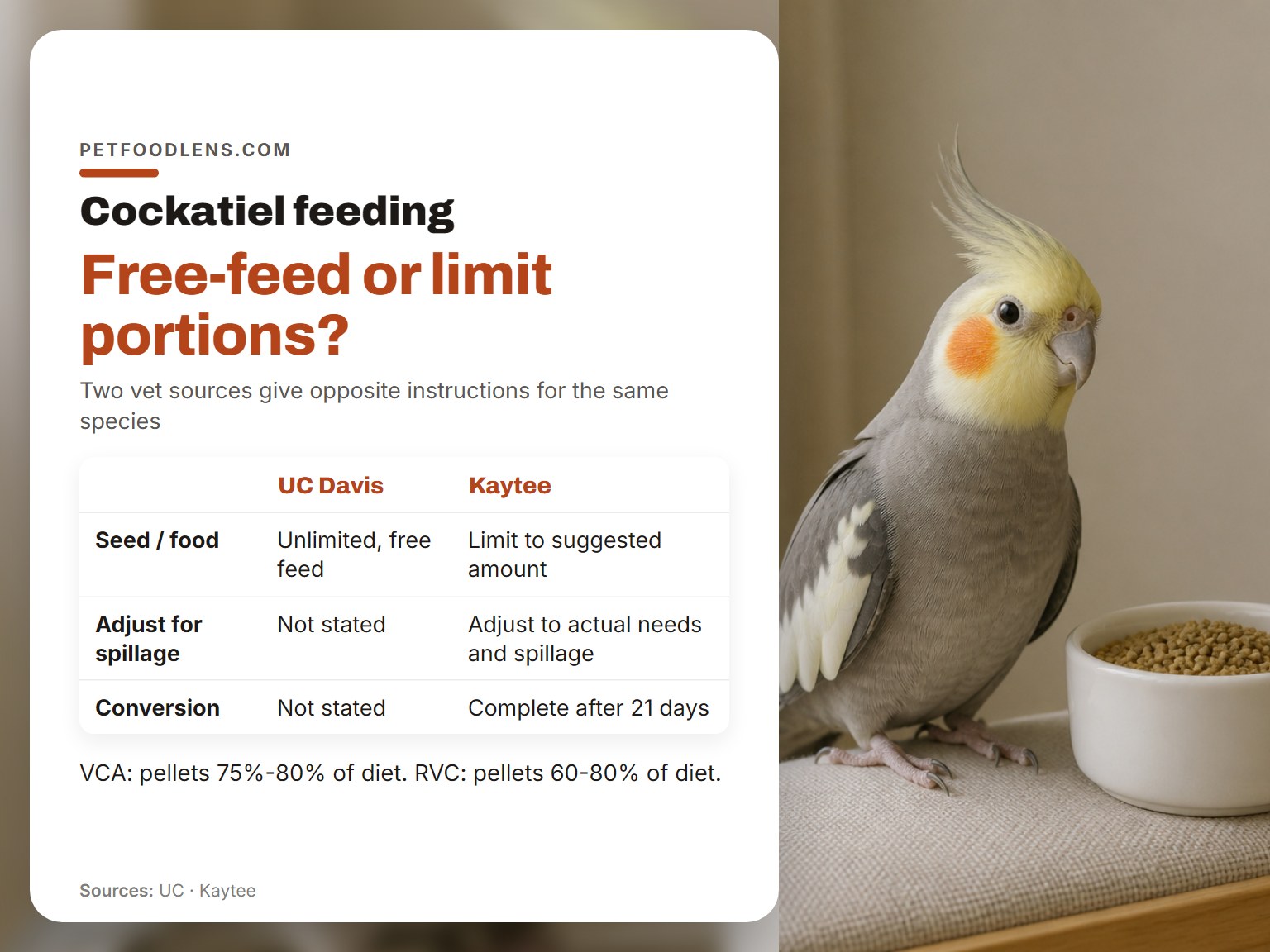
Kaytee says to limit the portion to the suggested feeding amount on the bag and adjust for the bird’s actual needs and spillage. UC Davis says to free-feed seed. Those are opposite instructions for the same species, and the gap between them is the whole portioning question.
| Symptom | Likely Cause | What to Do |
|---|---|---|
| Bird scatters pellets, eats little | Doesn’t recognize pellets as food | Mix with seed at a low ratio, hold a week |
| Droppings stay dark green, no color change | Conversion not complete | Continue mixing, check weight weekly |
| Bird fixates on one seed type | Selective feeding | Reduce that food’s volume per VCA |
| Fresh food spoils fast | Left in cage too long | Pull within a couple of hours per VCA |
For a healthy adult bird on a pellet base, Kaytee recommends limiting the portion to the suggested feeding amount, while UC Davis recommends free-feeding seed. The how much to feed guide covers portion sizing by species, and the feeding schedule breakdown covers how often to refill versus how often to swap the whole dish.
One honest gap: the long-term data on exact pellet percentages is thin. The two main vet sources give different ranges, and neither one cites the other. That’s a real limitation, and anyone who tells you there’s a settled number is overstating the evidence.
Frequently Asked Questions
Can a cockatiel live on seed alone?
No. VCA says a seed-only diet can lead to ill health and a shortened lifespan, and the Brazilian Journal of Veterinary Research found that captive cockatiels fed only seed mixes show nutrient deficiency and even obesity. Seed works as a treat, not a base.
How long does it take to switch a cockatiel to pellets?
Kaytee’s label says 21 days to sole diet. VCA says conversion can take days, weeks, or months depending on the bird, and mature cockatiels may be harder to convert than hand-raised babies. The 21-day figure is the manufacturer’s timeline, not a universal rule.
Do cockatiels need grit?
No. VCA says cockatiels hull seeds before swallowing, so they don’t need grit for digestion, and some birds over-consume it and develop life-threatening GI obstructions. Skip it entirely.
What fruits and vegetables are safe for a cockatiel?
Peas, broccoli, kale, spinach, carrot, and sweet potato are the ones the Royal Veterinary College names. Wash everything thoroughly, cut it small, and skip pale high-water veg like iceberg lettuce and celery.
Can I give my cockatiel avocado?
No. VCA lists avocado and onion as potentially toxic and says they should never be offered. Remove apple seeds before offering apple.
How much water does a cockatiel need?
UC Davis lists 1 oz of water per day. Change it daily and clean the dish, and VCA suggests bottled water if your tap water quality is in question.
The Bottom Line
If your bird is not eating the new food during conversion, stop the switch and go back to the previous ratio. A slower conversion that works beats a fast one that ends in a vet visit.
This all assumes a healthy adult bird. A hand-raised baby should start on pellets from the beginning per VCA, and a bird with an existing health problem needs a vet’s plan, not a blog post. If you want one answer and one brand: Harrison’s Lifetime fine as the base, a chopped vegetable mix on the side, and a small amount of seed for training.
Start this week. Weigh your bird, write the number down, and mix pellets into the seed at a ratio you can hold for a full week before changing anything.
