
How Much to Feed a Pet Bird: Grams, Cups, and Ratios
This post contains affiliate links. As an Amazon Associate, we earn from qualifying purchases.
To work out how much to feed a pet bird, start with body weight: Scenic Bird Food‘s protocol puts parrots at 15 to 20 percent of body weight daily, so a 200 to 400 g bird gets 20 to 40 g. Captive birds burn 10 to 15 times less energy than wild ones.
That energy gap is why a cage bowl is a different problem from a forest. A wild parrot flies between foraging sites all day. A companion bird crosses a living room and climbs back up. The same handful of food that keeps a wild bird flying hands a surplus to a bird that never leaves the perch, and the surplus lands as fat.
What follows is the arithmetic: the weight table, the pellet share the veterinary hospitals publish, the produce ceiling they argue about, and two conversion schedules for a bird that has eaten nothing but seed. Where the sources split, the split gets shown.
Key Takeaways
- Weigh the bird, not the scoop. A 200 to 400 g bird’s daily ration is 20 to 40 g under Scenic’s 15 to 20 percent protocol; a 900 g macaw gets 70 to 90 g.
- Pellets carry the base. VCA puts pellets at 75 to 80 percent of a macaw’s diet, and NC State calls a pelleted complete diet the majority of the bowl.
- Fresh produce is disputed: VCA’s general guidance caps it at 20 to 40 percent, while Merck gives only ‘small amounts’ and NC State describes produce as a supplement to a pellet base.
- Grit is disputed. VCA’s African grey and conure pages rule it out, while other sources do not address it the same way.
- Feed at least once daily and change the water daily. That is the floor set by 9 CFR 3.155 and by Merck’s clinical guidance.
Why a Captive Bird Burns a Fraction of the Calories a Wild One Does
A companion parrot climbs three feet of cage wire. A wild one covers miles between foraging sites.
Captive parrots expend an estimated 10 to 15 times less energy than wild birds of the same species, per the World Parrot Trust. A companion bird that flies nowhere burns a fraction of the calories a foraging wild bird burns. A bowl refilled to the top each morning therefore delivers far more energy than the bird can spend.
That ratio is the most useful number in bird feeding, and it does not appear on a bag. The World Parrot Trust’s own guidance on parrot diet leans on variety and measurement rather than a fixed scoop.
Scenic Bird Food turns the ratio into a daily figure: parrots eat 15 to 20 percent of body weight per day. For a 200 to 400 g bird that works out to 20 to 40 g of food.
UF/IFAS Extension makes the same point from the other direction. Its publication warns that letting a pet consume more than it requires can be as harmful as undernutrition, and that too much food offered too often, with too little variety, is a common cause of nutrition problems.
Overfeeding a bird is quiet. Nothing spills.
How Much to Feed a Pet Bird: The Gram Table and the Cup Measures
Scenic Bird Food publishes the only gram-per-gram table in this entire source set, and it is the one figure an owner can act on today.
| Bird Weight | Daily Food | Volume Measure |
|---|---|---|
| 20 to 50 g | 2 to 5 g | 1 to 3 tsp |
| 100 to 200 g | 10 to 20 g | 1/4 to 1/3 cup |
| 200 to 400 g | 20 to 40 g | 1/3 to 1/2 cup |
| 900 g macaw | 70 to 90 g | 1 to 1 1/3 cups |
A 900 g macaw gets 70 to 90 g a day, which is 1 to 1 1/3 cups by volume. That is a small bowl, not a full one.
Treat the table as a starting point with a commercial interest behind it. Scenic sells bird food. Merck Veterinary Manual gives no gram target at all, only “small amounts” of fresh food each day, and VCA’s pages give proportions rather than weights. The gram table is the only quantification available here, and it comes from a manufacturer.
Why a Cup Measure Drifts and a Gram Measure Does Not
Pellet size varies between brands and between formulas inside one brand, so a cup of one pellet weighs differently from a cup of another. VCA’s conure page puts the scale in human terms: a tablespoon of food for a conure is equivalent to a dinner-plate-sized portion for a person, and that is appropriate.
Here is the math. A 120 g conure at 15 to 20 percent needs 18 to 24 g a day. A level tablespoon of a mid-size pellet sits near 8 to 10 g, so two to three tablespoons covers it.
This is where measuring bird food portions stops being a rounding exercise. A kitchen scale settles the argument permanently.
What Percentage of the Bowl Should Be Pellets?
VCA puts pellets at approximately 75 to 80 percent of a macaw’s diet, with the remainder vegetables, nuts and small fruit. NC State’s veterinary hospital says the same thing in different words: the majority of a bird’s diet should be a pelleted complete diet, supplemented with fresh fruits and vegetables.
Merck explains what a pellet actually is. It is a mix of grains, seeds, vegetables, fruits and proteins with added vitamins and minerals, formed so the bird cannot pick out the tasty bits.
That last clause is the mechanism, and it is the whole reason pellets work. VCA’s African grey page describes what happens without them: birds pick through a bowl of seed mix and eat one or two favorite types, usually peanuts and sunflower seeds, which are high in fat and short on calcium and vitamin A.
The pellet percentage question and the protein requirements question pull in the same direction. A bird that sorts its bowl is not eating a balanced diet even when a balanced diet is sitting in front of it.
I would rather see a bird finish a boring pellet than sort through a premium blend. The sorting is the problem. A mixed bowl invites it.
The Produce Ceiling: 20 to 40 Percent, or “Small Amounts”?
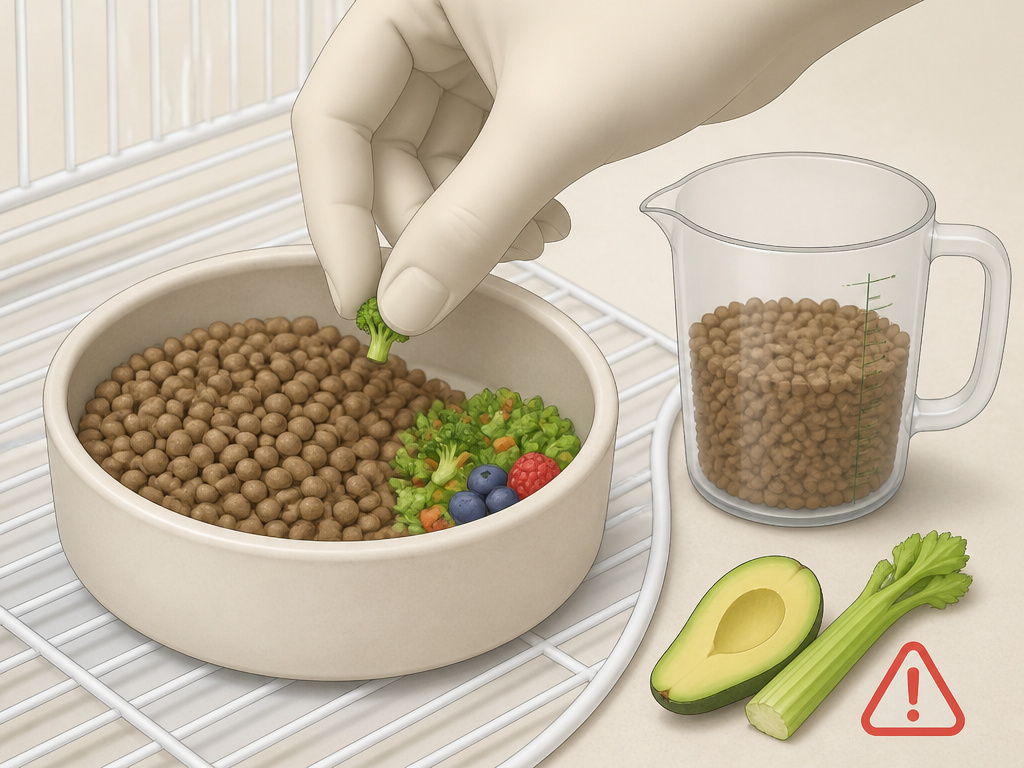
Four veterinary sources answer the produce question four different ways, and the gap between them is wide enough to change what you put in the dish.
| Source | Fresh Produce Share | What That Leaves for Pellets |
|---|---|---|
| VCA (general) | No more than 20 to 40 percent | 60 to 80 percent |
| VCA (macaws) | Remainder after 75 to 80 percent pellets | 20 to 25 percent |
| NC State vet hospital | “Supplemented with” fresh produce | Majority |
| Merck Veterinary Manual | “Small amounts” daily, no percentage | Unspecified |
The disagreement is real, and it deserves saying plainly: there is no single published produce percentage that every veterinary source endorses. VCA’s general page sets a ceiling of 20 to 40 percent. VCA’s macaw page arrives at 20 to 25 percent by a different route. NC State describes produce as a supplement to a pellet base. Merck declines to set a number at all.
What the sources agree on is direction: produce is not the base of the bowl. A balanced bird diet starts from that assumption and adjusts.
Fruit Is a Separate Number From Vegetables
VCA’s conure page splits the produce allowance: vegetables and greens at 20 to 40 percent of daily intake, fruit at 10 percent. Its African grey page is stricter on fruit, at 10 percent or less.
VCA also rules out several items outright. Iceberg and head lettuce are mostly water with little nutritional value. Celery has the same problem and should be fed sparingly. Canned fruits and vegetables are not recommended because they may be packed in salt or sugar. Frozen and thawed produce is acceptable, but fresh is the most nutritious, and cooking can deplete some of the value.
Before you start: Avocado is the hard stop. NC State reports that all parts, including skin, flesh and especially the pit, contain persins that can cause edema and death. Onion and garlic contain chemicals that may harm a bird’s blood cells. Salty snacks, chocolate, alcohol and caffeine are never appropriate.
A short list of handling rules covers most of the rest:
- Wash everything thoroughly. VCA and the World Parrot Trust both call for it before produce goes anywhere near the cage.
- Small pieces of many types beat one big piece. VCA’s phrasing: better to offer small pieces of many different foods than a big piece of one.
- No food on the cage floor. That is where droppings land.
- Skip iceberg lettuce entirely. Mostly water, little nutritional value.
- Celery: sparingly, same reason.
- Canned: no, because of the salt and sugar packing.
How Often Should the Bowl Be Filled?
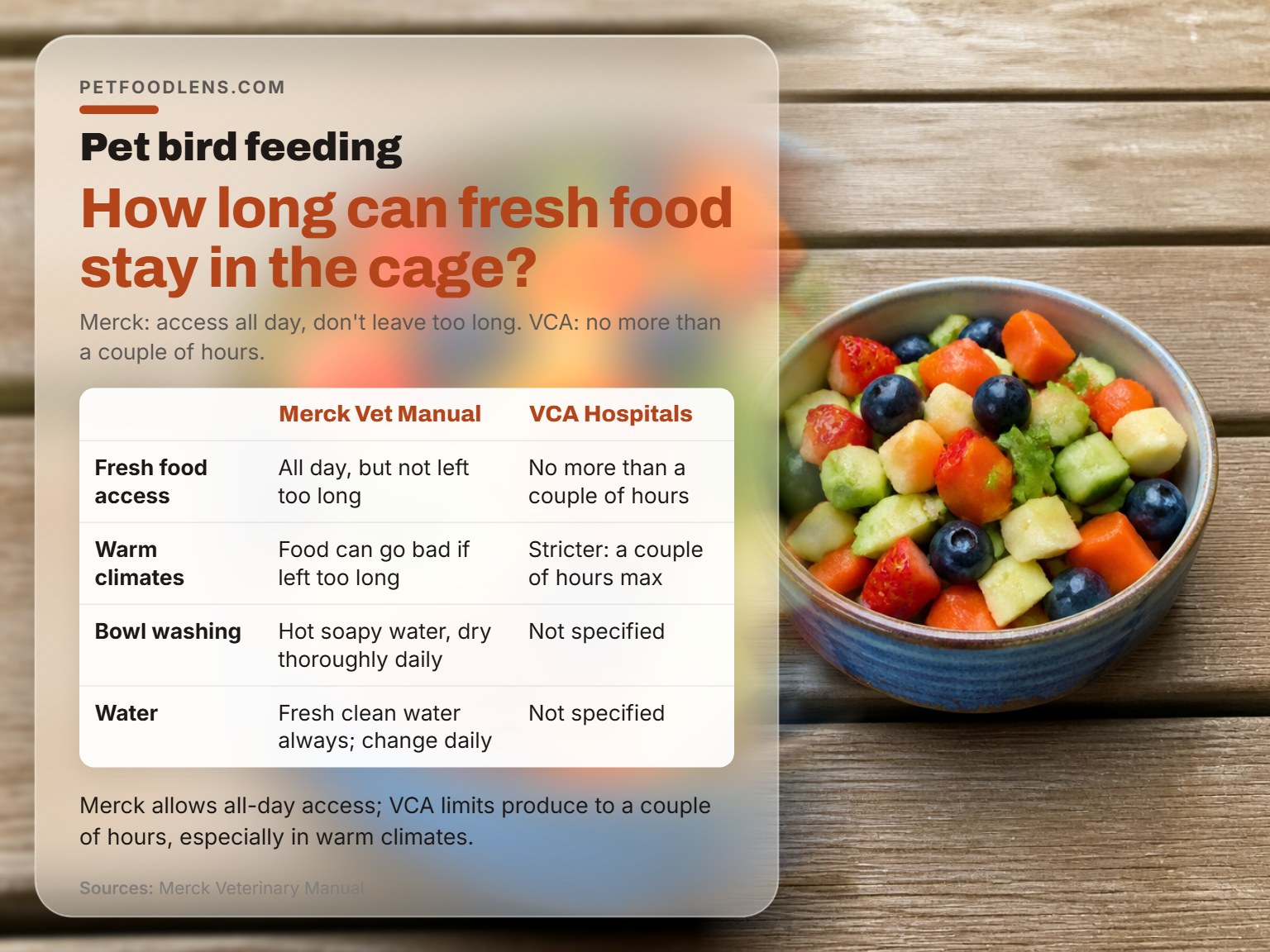
Once a day is the legal floor. 9 CFR 3.155 requires that birds be fed at least once a day, and it requires multiple food receptacles when birds are group-housed so every bird gets access.
NC State recommends offering food in several meals throughout the day to break up the bird’s routine. The World Parrot Trust goes further for specific groups, noting that Australian grass parakeets, cockatiels and many cockatoo species benefit from several smaller feeds spread across the day.
Then there is the question of how long the fresh portion stays in the cage, and here the two clinical sources part company. Merck says birds should have access to fresh food all day but that it should not be left too long because it can go bad. VCA’s conure page is stricter: no more than a couple of hours, particularly in warm climates.
Leave a dish of chopped papaya in a warm room for an afternoon and the smell turns sour well before any visible mold shows up.
The practical feeding frequency routine looks like this:
- Weigh the dry portion on a gram scale before it goes in the bowl. Eyeballing it is how a bird ends up on the wrong ration.
- Serve fresh produce in a separate dish. Mixing it into the pellets turns the whole bowl into a spoilage risk.
- Pull the produce after a couple of hours in warm weather. VCA’s warning about digestive upset is aimed at exactly this.
- Wash food and water bowls in hot soapy water and dry them thoroughly each day. Merck’s instruction, and it is daily, not weekly.
- Change the water and the water receptacle daily. Merck adds one more step for bottle users: check that the bottle actually works, because a stuck valve is silent.
Seeds, Nuts, and Treats: Where the Sources Actually Split
Merck is the lenient one here: it says occasional seeds are fine, while VCA and NC State treat high-seed diets as a health risk.
Merck’s position is that feeding a bird some seeds occasionally is fine, but that seeds shouldn’t make up most of the diet; VCA and NC State warn that high-seed diets are linked to ill health, cardiovascular disease, obesity, goiter and deficiencies. VCA’s African grey page is harsher: seed and nut mixes fed as a high percentage of the diet provide a poorly balanced source of nutrients and could lead to ill health and a shortened lifespan. NC State links high-seed diets to cardiovascular disease, obesity, goiter and deficiencies.
Three sources, three temperatures. The practical reading is that Merck permits occasional seed, while VCA and NC State warn that a seed-based bowl is a health risk.
Fat is not a flat ban, though. The World Parrot Trust notes that macaws require a higher-fat diet and that adding nuts such as Brazil nuts or walnuts should help. It also flags Amazons and some small cockatoos such as Galahs as prone to obesity, which means fat content has to be watched against the energy the bird actually spends.
That is the dietary fat question in one line: species first, then amount. And it is why treat limits belong in the plan rather than in a separate conversation.
The Peanut and Sunflower Problem
VCA names the two offenders directly. Birds pick peanuts and sunflower seeds out of mixes, and both are particularly high in fat and deficient in calcium, vitamin A and other nutrients. Selective appetite then does the rest.
NC State adds a sharper hazard. Moldy peanuts can contain aflatoxin, which is toxic, and birds are far more sensitive to small amounts than people are.
The part nobody mentions: supplement powders sprinkled on seed or dried food are of little value. VCA notes they fall off or get discarded with the seed hull, so the bird never receives them. Supplements belong on moist food.
Treat rules that hold up:
- Seed is a garnish, not a base. Merck permits it occasionally, while VCA and NC State warn against seed as the main event.
- Nuts are a macaw tool and an Amazon trap. Higher fat helps a macaw and works against an obesity-prone Amazon.
- Moldy peanuts are a hard no. Aflatoxin sensitivity in birds is the reason.
- Chocolate, alcohol, caffeine and salty snacks: never, per VCA.
Converting a Seed Eater Without a Hunger Strike
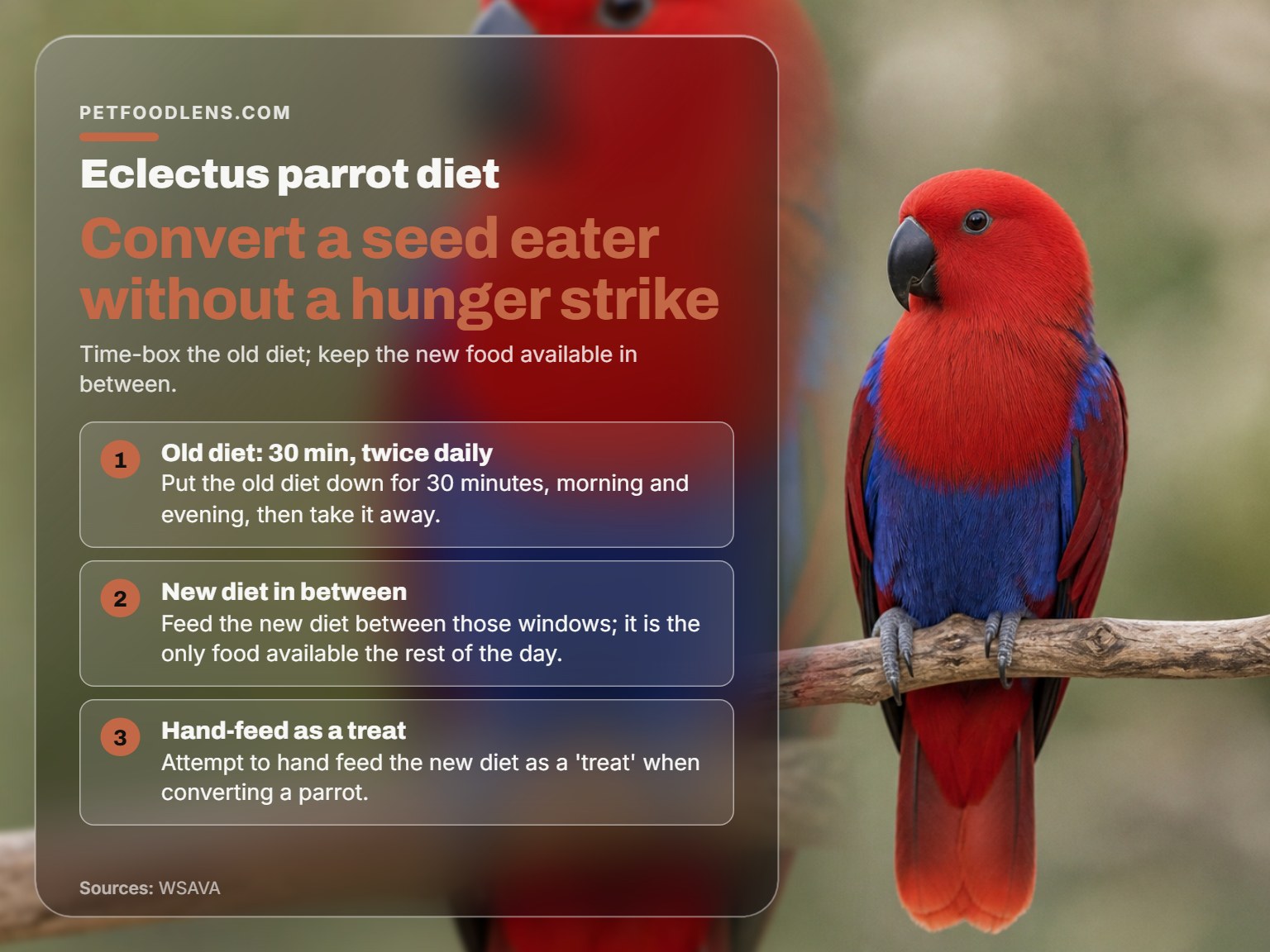
A conure that has eaten nothing but sunflower seed will not touch a pellet on day one. It will flip the bowl, then scream at it.
The Two Conversion Schedules VCA Publishes
The first option is a three-step ramp:
- Offer 75 percent seed and 25 percent pellets for 3 days. Skip the hold and the bird sorts the pellets out and leaves them.
- Move to 50/50 for 3 days. The middle step is where most conversions stall, because the bowl looks half empty and gets topped up with seed.
- Move to 25 percent seed and 75 percent pellets and hold there until the bird is fully converted. Holding is the step that finishes the job.
The second option is a slower daily slide:
- Day one: 90 percent seed, 10 percent pellets.
- Add 10 percent pellets each day, so day two is 80/20, and continue until the bowl is 0 percent seed on day 10.
- If the bird refuses to convert, stop at 20 percent seed and 80 percent pellets and hold until it does.
NC State’s version is gentler still: introduce new pellets or foods gradually in small amounts over a few weeks, and grinding pellets and mixing them with a favorite food can help.
The World Parrot Trust adds a presentation angle that the schedules miss. Food a parrot dislikes one way can become a favorite another way, so hanging foods on the cage wire, placing food on top of the cage, or using foraging toys can move a stubborn bird.
Where this goes sideways: pulling seed entirely on day one. A bird that stops eating is a veterinary call, not a stubborn-bird problem. Merck’s guidance is blunt: if the bird doesn’t eat well, have it checked by a veterinarian to make sure it isn’t sick.
Reading the Bowl: What Tells You the Portion Is Wrong
More than 8,000 bird species are alive today, and UF/IFAS Extension’s conclusion is that there will probably never be one ideal diet for all of them.
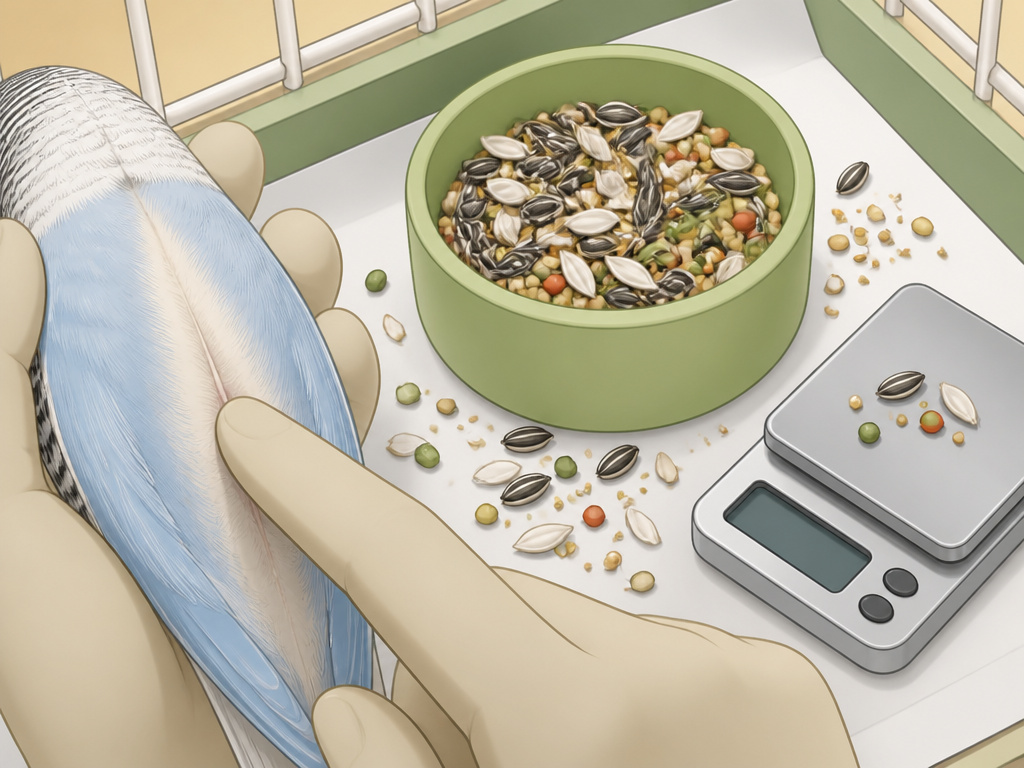
That is why the bowl has to be read rather than trusted. Start with the scale. NC State recommends training the bird to step on a gram scale so weight changes get caught at home, and the World Parrot Trust lists measuring amounts, watching how much the bird eats and monitoring weight as the three starting parameters.
Then listen. A bird working through a sunflower seed makes a soft crack, then the hull drops into the dish. A bird eating pellets makes almost no sound at all. If the dish comes back loud and full of hulls, the bowl is being sorted.
Run a finger along the keel, the ridge of the breastbone. A well-muscled bird feels rounded on either side. A bird losing condition feels sharp, and the change shows up there before it shows up in a photograph.
Watch the paper under the perch too. VCA notes that increased urine output when a bird starts eating more produce can be normal, but that it can also signal disease if the bird isn’t eating increased amounts of produce.
Merck’s rule closes the loop: if the bird doesn’t eat well, have it checked by a veterinarian. Merck also recommends a vet visit at least once a year regardless.
Frequently Asked Questions
How much should I feed my bird in grams?
Scenic Bird Food’s protocol puts daily intake at 15 to 20 percent of body weight. That is 2 to 5 g for a 20 to 50 g bird, 10 to 20 g for a 100 to 200 g bird, 20 to 40 g for a 200 to 400 g bird, and 70 to 90 g for a 900 g macaw. No veterinary source in this set publishes a competing gram figure, so treat the table as a starting point and adjust against the bird’s weight trend.
Should I leave food in the bird cage all day?
Merck says birds should have access to fresh food all day but that it should not be left too long because it can go bad. VCA’s conure page is stricter, capping fresh fruits and vegetables at a couple of hours, particularly in warm climates. The sources disagree on how long fresh food may stay in the cage.
Is it bad to feed a bird only seed?
The sources split on seed. Merck permits some seed occasionally but says it shouldn’t make up most of the diet. VCA warns that seed and nut mixes fed as a high percentage of the diet could lead to ill health and a shortened lifespan. NC State links high-seed diets to cardiovascular disease, obesity, goiter and deficiencies.
Do parrots need grit?
VCA’s African grey and conure pages both state that grit and gravel should not be offered, because these birds remove the seed’s outer hull before swallowing the kernel; the sources do not all address grit the same way. VCA’s African grey and conure pages both state that grit and gravel should not be offered.
How do I know if I’m overfeeding my bird?
Weigh the bird weekly on a gram scale and watch the bowl. UF/IFAS Extension notes that overnutrition can be as harmful as undernutrition. A bird that leaves pellets and eats only the seed is overfed on fat and underfed on calcium and vitamin A, even if the total volume looks right.
The Bottom Line
Buy a gram scale before you buy another bag of food. Weigh the bird, weigh the portion, and write both numbers down once a week. Everything else here is an adjustment to those two figures.
One threshold worth committing to memory: if the bowl comes back with pellets left and hulls gone, the bird is sorting, and the portion is wrong no matter what the bag says. Fix the sorting before you touch the total amount.
Here is where my own limits sit. I read labels and I run portion math for a living, but I am not a veterinarian and I cannot diagnose kidney disease, diabetes or a food allergy from a bowl photograph. How much to feed a pet bird with a diagnosed condition is a question for the vet who has examined the bird, and Merck’s advice to have a bird checked when it stops eating well is the one line here I would not soften.
For a healthy bird, the arithmetic is unglamorous and it works: 15 to 20 percent of body weight, pellets as the base, produce as the smaller half, seed as a garnish, and a scale that tells you the truth every week.
