
How Often to Give Birds Treats: What the Sources Say
This post contains affiliate links. As an Amazon Associate, we earn from qualifying purchases.
How often to give birds treats depends on which authority you follow: ZuPreem allows them daily as 10 percent of the diet, UK Pet Food says occasionally in small amounts, and PetSmart caps honey sticks and millet at once or twice a month.
Those three recommendations answer three different questions. ZuPreem is describing a daily calorie budget, UK Pet Food is describing a bonding and training tool, and PetSmart is describing a honey stick specifically. Read each frequency against the thing being recommended and most of the conflict falls away.
What follows is the frequency each source actually states, the ceiling that matters more than the calendar, the produce question nobody settles, and the four signals that tell you the treats have gone too far.
Key Takeaways
- Treat frequency is genuinely disputed. ZuPreem allows daily treats at 10 percent of the diet, PetSmart caps honey sticks and millet at once or twice a month, and UK Pet Food says occasionally in small amounts.
- The 10 percent ceiling does more work than the count. ZuPreem folds unsalted nuts, popcorn, crackers, and small pieces of bread inside that budget, so a “healthy” nut is still spending treat allowance.
- Sequence beats quantity. ZuPreem warns that treats offered before pellets let a bird fill up and skip the food carrying its vitamins.
- Seed is a treat for some sources, not a staple. ZuPreem calls seed high in fat and low in nutrients and limits it to occasional use, if at all, while PetSmart positions a pellet-seed blend as the primary diet for cockatiels.
- Fresh food comes out of the cage. Merck and UK Pet Food both call for prompt removal of uneaten produce, though they disagree on whether produce is a daily food or an occasional treat.
How Often to Give Birds Treats: What the Sources Actually Say
ZuPreem, UK Pet Food, PetSmart, and Simply Pets each publish a treat frequency, and they do not agree.
ZuPreem’s guide, written by a board-certified avian veterinarian, splits the daily diet into three tiers: at least 60 percent pellets, up to 30 percent fresh vegetables and fruit, and the remaining 10 percent for treats such as unsalted nuts, popcorn, crackers, small pieces of bread, and limited seed.
That is the most permissive position in the set, and it comes from a manufacturer with a veterinarian’s name on the byline. The most restrictive comes from a retailer care guide aimed at one species.
| Source | Stated treat frequency | Ceiling it states |
|---|---|---|
| ZuPreem (Dr. Laurie Hess) | Daily, after pellets | 10 percent of the diet |
| UK Pet Food | Occasionally, small amounts | No percentage given |
| PetSmart (cockatiel guide) | Once or twice a month | Limited quantity |
| Simply Pets | 3 to 4 times a week | No percentage given |
| Merck Veterinary Manual | Seeds occasionally, if at all | Seeds should not be most of the diet |
Read the left column alone and the how often to give birds treats spread looks enormous. Read the middle column and the picture changes, because PetSmart is talking about honey sticks and millet spray, while ZuPreem is talking about a slice of bell pepper or a single almond.
Simply Pets sits between them at three to four times a week, and that page sells a homemade baked treat, so its number describes a richer item than a vegetable. UK Pet Food gives no number at all and uses the word occasionally, which is the least useful instruction on the page and probably the most honest.
Easy to miss: “Occasional” and “once or twice a month” are not the same instruction, and a bird on the monthly schedule is getting far fewer treats than a bird on ZuPreem’s daily budget gets. Pick one framework and stay inside it rather than blending them.
The 10 Percent Ceiling Matters More Than the Calendar
Ten percent is the treat ceiling ZuPreem sets, and it’s the number to build around.
ZuPreem sets it explicitly. VCA Animal Hospitals gives no treat percentage at all, but caps fresh produce at 20 to 40 percent of the diet, which leaves the remainder for pellets and whatever else goes in the bowl. When one source publishes a ceiling and another publishes nothing, the ceiling is the safer thing to follow.
Here is the part owners miss. ZuPreem puts unsalted nuts, popcorn, crackers, and small bites of bread inside that 10 percent. A cashew handed over as a “healthy” alternative to a honey stick is still spending the same allowance. Flip the bag over on any packaged treat and check the ingredient order before assuming it is a light snack.
Common mistake: Treating nuts and plain popcorn as free food because they aren’t candy. They sit inside the same 10 percent budget as a honey stick, and a bird given both is eating well past the ceiling.
The pellet side of the ledger is where the real argument lives. ZuPreem says at least 60 percent of the diet should be nutritionally complete pellets, and the pellet share is what makes the treat share safe.
Are Fruit and Vegetables Treats or Part of the Diet?
Sources disagree: Merck and VCA treat produce as daily food, while UK Pet Food calls small quantities of fresh fruit and vegetables occasional treats.
UK Pet Food frames small quantities of fresh fruit and vegetables as occasional treats that add variety and enrichment. Merck Veterinary Manual says birds should be fed small amounts of fresh vegetables and fruit each day. VCA says the same thing with more detail: a variety of vegetables with a small offering of tropical fruit, every day, on top of a pellet base.
PetSmart lands in the middle with leafy greens, fruits, and grains every other day for cockatiels. Three schedules and no consensus: Merck and VCA put produce in the daily routine, PetSmart offers it every other day, and UK Pet Food treats it as an occasional treat.
The percentages don’t line up either. VCA caps fresh produce at 20 to 40 percent of the diet. ZuPreem says up to 30 percent. Those ranges overlap, and neither is wrong, because they’re describing different baselines and different species.
I’ve come around on treating produce as a food group rather than a reward. A bird that gets its vegetables at breakfast and its actual treat at dinner learns the difference fast, and the pellet bowl stops being a negotiation. If you’re rebuilding the whole split, the balanced diet walkthrough handles the proportions in order.
A bird that refuses a new vegetable has usually refused it once, not forever. VCA’s guidance is to offer the same item every day for three to five days before writing it off.
Pellets First, Then Produce, Then the Treat
Three things happen in this order, and the order carries more weight than the calendar does.
Before you start: Avocado causes fatal toxicity in some pet birds, and onions and garlic contain chemicals that may harm a bird’s blood cells. Chocolate, caffeine, alcohol, and anything with artificial sweeteners should never reach the cage. Nonstick cookware releases fumes that can kill birds, so move the bird out of the kitchen before you cook.
- Leave pellets in the bowl all day. ZuPreem recommends keeping pellets available so the bird can graze. Pull the bowl and a bird that was eating on instinct goes hours without the food carrying its vitamins.
- Offer produce in the morning and take it out by early afternoon. Merck and UK Pet Food both call for prompt removal. Soft food left past a few hours sours, and a bird that eats it ends up at the vet for something the vegetables didn’t cause.
- Give the treat last, after the pellet bowl has been worked on. ZuPreem’s reasoning is mechanical rather than moral: a bird that fills up on treats first has no room left for pellets.
- Skip the treat on days the bird won’t touch pellets. A bird that turns its beak up at pellets and waits for the reward is training you.
Why the Order Changes the Outcome
A bird’s crop fills in the order food arrives, and treats are denser than pellets by design. ZuPreem states the failure mode plainly: offer treats before pellets and the bird may fill up on treats and not want to eat pellets.
That’s the whole mechanism. The percentage rule assumes the pellets got eaten first. Break the sequence and a diet that looks correct on paper delivers the opposite of what it intended.
The feeding schedule for pet birds piece covers the timing side if you want to build the whole day around this rather than just the treat slot.
What Counts as a Treat, and What Never Goes in the Cage
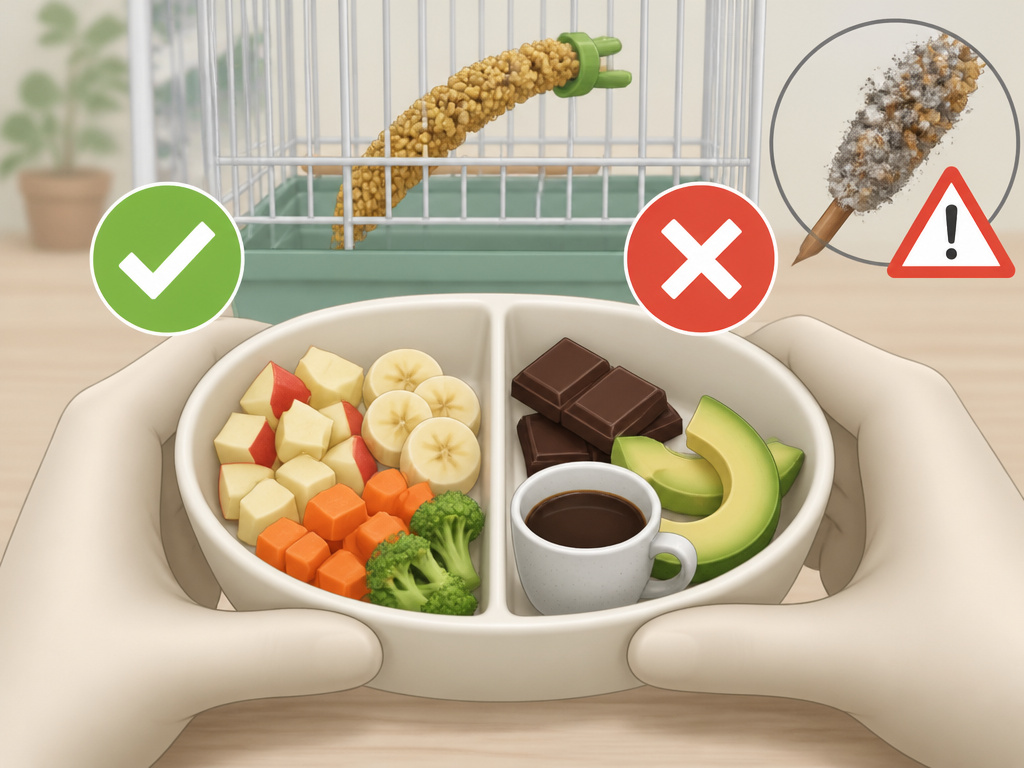
The safe list is longer than most owners expect, and the never list is shorter but absolute.
Suitable Treats
- Small pieces of apple, pear, banana, or grapes, which UK Pet Food lists by name.
- Vegetables cut to beak size: carrots, bell peppers, broccoli, snap peas, string beans, all rich in vitamin A per ZuPreem.
- A short length of millet spray, listed as a treat on the PetMD parakeet care sheet.
- Commercial treats with no added sugar, per UK Pet Food.
- Unsalted nuts, plain popcorn, a small piece of bread, all inside the 10 percent budget.
There’s a wider menu in the types of bird treats rundown, including where millet sits against the rest. And millet deserves its own caution: the millet treats pros and cons explain why a spray that disappears quickly isn’t the same as one that lasts much longer.
The Never List
- Chocolate, caffeine, alcohol, and anything containing artificial sweeteners. ZuPreem says never, and PetSmart says the same for chocolate and sugary food.
- Avocado. VCA reports that some parts cause fatal toxicity in pet birds.
- Onions and garlic, which contain chemicals that may be harmful to a bird’s blood cells.
- Chips, pretzels, pizza, fried food, and human junk food generally.
- Iceberg lettuce and celery in quantity, both mostly water with little nutritional value.
- Canned fruit packed in syrup or salted water.
Seed sticks occupy a strange middle ground. ZuPreem calls seed high in fat and low in nutrients and limits it to occasional use, if at all. PetSmart positions a pellet-seed blend as the primary diet for cockatiels. Both are published, and they can’t both be right for the same bird. The seed sticks guide walks through where the treat version ends and the staple version begins.
One physical detail worth knowing: a honey stick left in a warm room goes tacky and collects cage dust and feather dander on its surface. If it looks like it’s wearing a grey coat, it’s been in there too long.
Where this goes sideways: Hanging a treat from a piece of yarn and walking away. Simply Pets warns to remove the yarn as soon as the treat is gone, because a bird will chew and swallow the string once the food is finished.
Treats as Training Rewards: Five Minutes, Twice a Day
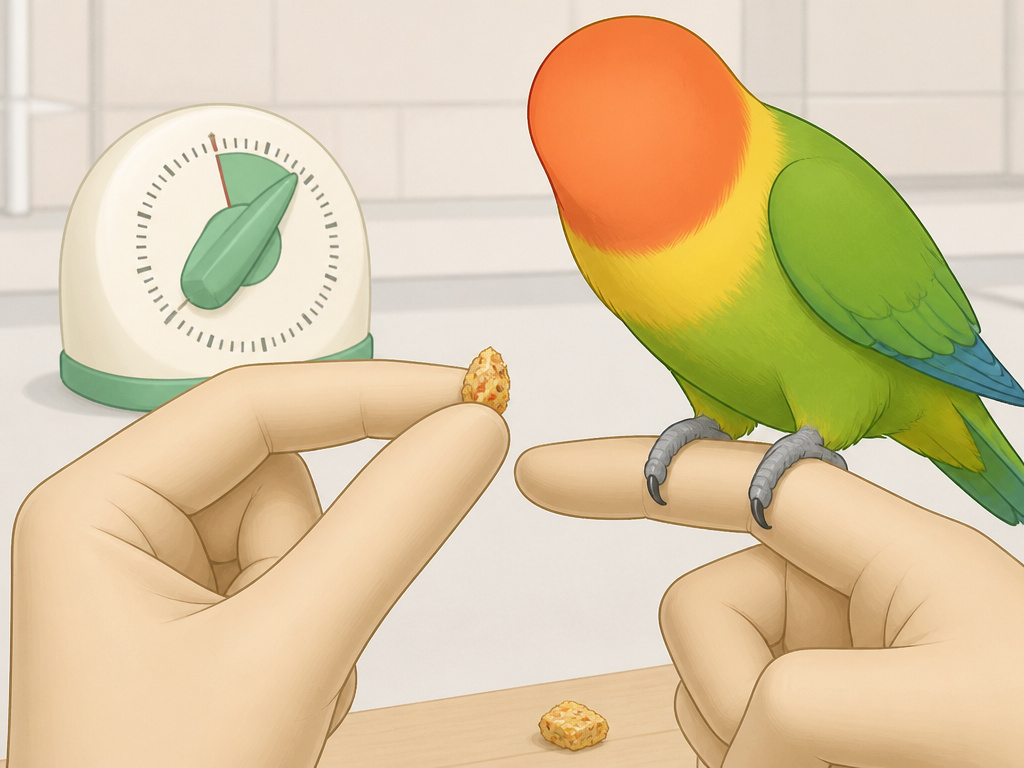
The bird is on your finger, the treat is in your hand, and long after the session should have ended neither of you has learned anything.
ZuPreem’s guidance is specific: keep sessions to no more than five to ten minutes, once or twice a day. The same page notes that if a food is only given during training, the bird is more motivated to learn. That’s the entire argument for separating training treats from cage treats.
There’s a second half to it that gets skipped. ZuPreem also says birds get tired or aren’t hungry and won’t obey commands even for a favorite food, and that the handler should stop and try again later. A bird that’s irritable at 3pm is not a stubborn bird. It’s a bird that already ate.
I keep the training reward small enough that it doesn’t count as a feeding, breaking a single treat into pieces so a bird works for a fragment as readily as for the whole thing. The using treats in bird training guide covers the reward schedule if you’re past the five-minute stage.
The five-minute cap isn’t about the bird’s attention span. It’s about yours. Sessions that run long teach the bird that the reward comes slowly.
When Over-Treating Shows Up: Four Signals to Watch
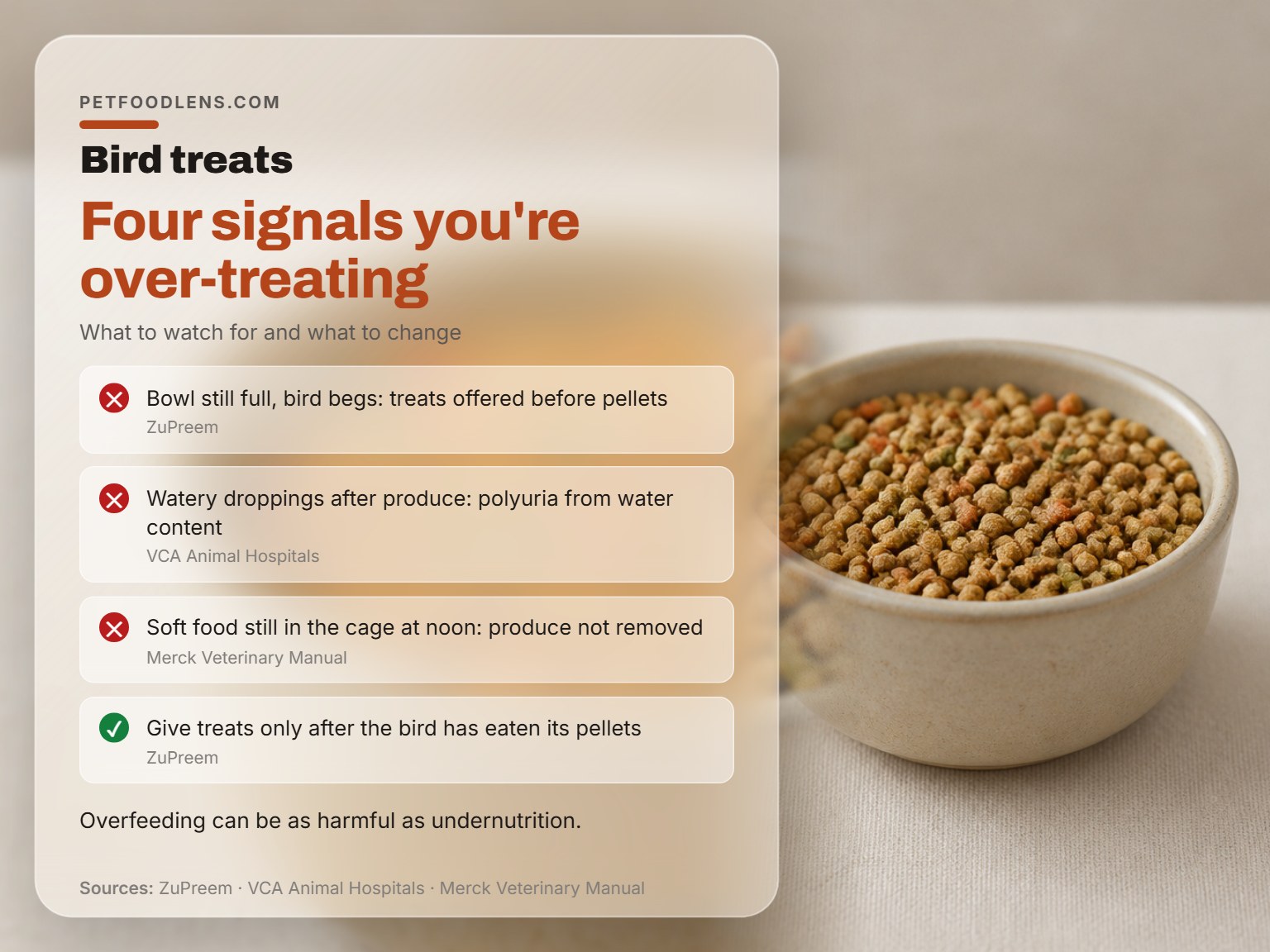
The food bowl is still mostly full late in the day, and the bird is screaming at the sound of a bag opening.
That combination is the classic picture, and it has a name in the literature. UF/IFAS Extension calls it overnutrition and puts it bluntly: many pet bird owners are killing their birds with kindness, and providing too much food, often called treats, too often is frequently the cause. The same document notes that overfeeding can be as harmful as undernutrition.
ZuPreem adds the behavioral layer. Caged birds spend much of the day sitting, expending little energy and eating out of boredom, which predisposes them to becoming overweight. A treat given to quiet a screaming bird rewards the screaming and adds calories the bird didn’t need.
| What you see | Likely cause | What to change |
|---|---|---|
| Bowl still full, bird begs | Treats offered before pellets | Move treats after the pellet meal |
| Bird picks out one item | Selective feeding on a mix | Balanced portions, introduce slowly |
| Watery droppings after produce | Polyuria from water content | Normal at first; call a vet if the bird isn’t eating produce |
| Soft food still in the cage at noon | Produce not removed | Pull it within a few hours |
That third row needs a note. VCA explains that the increased water output owners notice after feeding fruits and vegetables is actually increased urine output, driven by the water content of the produce. It can be normal when a bird first eats more produce. It can also indicate disease, so VCA’s instruction is to contact a vet if the bird isn’t eating increased produce and develops polyuria anyway.
The droppings themselves are the tell, so watch for changes after increasing produce. Wet, dark staining around the vent without a white cap is a different picture from the usual.
For the label side of this, the how to choose bird treats guide covers what to check before the bag comes home. Most of the work is reading the first four ingredients and the sugar line.
Frequently Asked Questions
Can I give my bird a treat every day?
ZuPreem allows it, provided treats stay inside 10 percent of the daily diet and come after the pellets. UK Pet Food says occasionally in small amounts, and PetSmart recommends once or twice a month for honey sticks and millet specifically. Daily is defensible on a calorie budget and aggressive on a behavior plan.
Is millet spray a treat or a food?
PetMD lists millet spray as a treat on its parakeet supply checklist, and UK Pet Food describes millet sprays as both entertainment and a healthy treat for indoor birds. It’s a treat with a job, not a staple.
Should I stop giving treats if my bird won’t eat pellets?
Stop the treats before you change anything else. ZuPreem’s warning is that a bird filling up on treats won’t want pellets, so pulling the treat and leaving the pellet bowl in place is the first move. VCA’s trick for stubborn eaters is to cut pellets or seeds back to about a quarter of the food bowl to push interest toward fresh food.
How do I know if my bird is getting too many treats?
Watch the bowl and the bird. A bowl that stays full while the bird begs is the clearest sign, and UF/IFAS Extension names overfeeding as a leading cause of nutrition problems in pet birds. Weight gain, selective picking, and a bird that eats from boredom all point the same direction.
Are fruit and vegetables counted as treats?
It depends on the source. UK Pet Food calls small quantities of fresh fruit and vegetables occasional treats. Merck and VCA both call for small amounts daily, and VCA caps fresh produce at 20 to 40 percent of the diet. For most species, produce belongs in the daily routine.
The Bottom Line
Here’s the trigger I’d use: if treats are more than 10 percent of what your bird eats in a day, cut the frequency before you touch the pellet bowl. The pellet share is the part doing the nutritional work, and shrinking it to make room for treats inverts the whole arrangement.
The first thing to do this week is smaller than it sounds. Pick one treat, weigh or measure it once, and hold that portion consistently. Most owners discover their “occasional” treat was happening far more often than they thought, and the bird was eating a lot of extras without anyone noticing.
One concession, because this topic deserves it. If you keep a species I haven’t covered, or a bird on a therapeutic diet for kidney, liver, or diabetic management, the frequencies here are a starting frame and nothing more. Avian veterinarians publish species-specific guidance for a reason, and a budgie, a cockatiel, and a lorikeet don’t share a treat ceiling, so matching the base diet to the bird matters more than any treat rule on this page.
