
Types of Bird Treats: What the Label Tells You
This post contains affiliate links. As an Amazon Associate, we earn from qualifying purchases.
Types of bird treats fall into five practical groups: millet sprays, seed sticks, honey-bound sticks, manufactured grain-and-fruit shapes, and fresh or sprouted produce. What separates a good one from a bad one is how much of the daily diet it pushes out, since pellets should hold at least 60 percent of the bowl.
That displacement math is why the types of bird treats aisle is harder to shop than it looks. A millet spray and a honey-bound stick sit on the same shelf and do completely different jobs in the bowl. One is a foraging object a bird has to work at. The other is mostly binder and sugar.
What follows walks through each type, the label checks that separate them, the places where the major sources openly contradict each other, and the short list of things that should never go in the bowl.
Key Takeaways
- Millet spray is the treat FAO names as a category staple, while ZuPreem says seed in general should be given only as an occasional treat, if at all.
- Judge a treat by what it displaces. ZuPreem puts pellets at 60 percent of the diet or more, fresh produce at up to 30, and everything else at 10.
- Honey and seed sticks are the sweet end of the shelf. Read the ingredient order before you read the front of the pack.
- Four categories are absolute. Chocolate, caffeine, alcohol and artificial sweeteners never go in a bird’s bowl.
- Fresh produce has a ceiling too, though sources disagree on it. VCA says fresh produce should be no more than 20 to 40 percent of the diet, while ZuPreem caps it at 30.
What Actually Counts as a Bird Treat
FAO defines the category narrowly: a supplementary foodstuff given to a caged bird to encourage active foraging behaviour. That definition is doing real work, because it makes the treat a behaviour tool rather than a nutrition delivery vehicle.
Millet sprays are intact heads of millet seed hung inside the cage or outside for wild bird feeding. Foxtail millet, Setaria italica, is the most important species in the category. Manufactured treats combine small grains, fruits, honey, vitamins and minerals, and are sold as sticks or as shaped pieces such as bells and hearts.
Sorting a shelf starts with the same questions as choosing bird treats in general: what sits first on the ingredient list, and what does the treat replace in the bowl.
The UF/IFAS pet bird nutrition guide is blunt about where this goes wrong. It names too much food offered too often, the thing most owners call treats, as a common cause of nutrition problems. It also makes a point that gets skipped: overnutrition does as much damage as undernutrition.
There are more than 8000 species of birds alive today, so no single ideal diet fits all of them. Treat advice is a starting point, and I’d rather you treat it that way than as a rule you can’t bend.
The Five Types and What Each One Does to the Bowl
Five types of bird treats cover nearly everything on a pet store shelf, and they behave very differently once they’re in the cage.
| Treat type | What it does | Main risk |
|---|---|---|
| Millet spray | Foraging work, weaning | Fat-heavy if it replaces pellets |
| Seed sticks | Slow chewing, cage time | Seed is high fat, low nutrient |
| Honey-bound sticks | Fast reward, bonding | Binder and sugar lead the label |
| Manufactured shapes | Portion control, training | Easy to over-feed |
| Fresh produce and sprouts | Vitamin A, enrichment | Pushes out pellets if overdone |
The table is a starting point, not a verdict. A millet spray and a seed stick are close cousins on paper and behave nothing alike in a cage, because one comes apart in the bird’s foot and the other comes apart in the bird’s beak.
Which Type Wins for Which Job
- Foraging and enrichment: millet spray, because FAO treats it as the category’s anchor and the bird has to work for it.
- Training: a single piece of the bird’s own pellet, or a small manufactured treat, because the reward has to be finishable in one bite.
- Chewing: the Wild Harvest Treat Stick with Tough Core, a rawhide-core chew coated in sunflower and safflower seed. It’s veterinarian-formulated and labeled for intermittent or supplemental feeding only.
- Vitamin A: fresh produce, not a stick.
For seed sticks specifically, the size and seed mix matter more than the brand, and seed sticks for birds covers which formats hold together in a cage.
Millet Sprays and Seed Sticks: Where the Sources Openly Disagree
Two credible sources look at a millet spray and reach opposite conclusions about whether it belongs in the cage at all.
FAO calls millet sprays one of the most important bird treats, hung in the cage so the bird has to strip the head to eat. ZuPreem says seed in general is high in fat and low in nutrients and should only be offered as an occasional treat, if at all. Both statements are about the same object.
The disagreement makes sense once you see what each source is measuring. FAO is describing a foraging behaviour, and a spray of millet is excellent at that. ZuPreem is describing a nutrient contribution, and seed is poor at that. A bird working over a spray gets exercise and enrichment. A bird filling up on one gets fat and skips the pellets.
There’s a third position worth knowing. FAO notes that old-fashioned canary food was typically 50 percent canary seed and 50 percent proso millet, which means seed was once the base of the bowl and not the garnish. Anyone who learned bird keeping in that era will tell you seed is fine. They’re describing a different diet than the one ZuPreem is writing about.
A millet spray being worked over makes a dry, papery rasp, and the husks end up in a little pile under the cage bars. That pile shows how much foraging actually happened.
I won’t hang a millet spray in a cage where the pellet bowl is still half full at the end of the day. The spray wins that contest every time, and a bird that fills up on millet is a bird that skipped the part of the diet carrying the vitamins a seed mix was already short on.
For the fuller case on both sides, millet treats for birds lays out the trade-offs without pretending there’s one answer.
Honey-Bound and Manufactured Treats: Read the Ingredient Order
A honey stick is a delivery system for binder, and the back of the pack says so more honestly than the front.
I keep one rule from years of reading pet food panels: if I can’t tell what the main ingredient actually is, I stop trusting the rest of the panel. I built that rule the slow way, chasing vague terms that never resolved into anything I could check. A honey stick is where that rule earns its keep, because the front advertises the honey and the back tells you what the honey is holding together.
FAO describes manufactured treats as a mixture of small grains, fruits, honey, vitamins and minerals, shaped into sticks, bells or hearts. Nothing in that list is harmful. The question is the order.
The Guaranteed Analysis, Line by Line
Manufacturers that publish real numbers make the comparison easier. ZuPreem Healthy Bites lists its full guaranteed analysis, and it’s worth reading next to the marketing claim:
- Protein (min) 20.00 percent, which is respectable for a treat.
- Fat (min) 14.00 percent, max 19.00 percent, against the manufacturer’s stated average of 15 percent per piece.
- Total carbohydrate (max) 50.00 percent, the number that explains why these are treats and not food.
- Dietary fiber (max) 10.00 percent, moisture (max) 12.00 percent, lauric acid (min) 2.00 percent.
- Contains peanuts and/or tree nuts, which matters if anyone in the house has a nut allergy.
The manufacturer positions these against traditional peanuts at 50 percent fat, which is the comparison the whole product category is built on. Feeding guidance is 1 to 2 pieces a day for medium and large birds, and 3 to 4 pieces a day for large birds, adjusted for size and activity.
The tactile tell on a honey-bound stick is the surface. Fresh ones are dry to the touch. Ones that have been sitting in a warm store go tacky at the edges, and that tackiness transfers straight to the cage bars.
Where this goes sideways: Handing out nut-based treats through the day and then topping up the pellet bowl at night. The bird arrives at dinner already full, skips the pellets, and the diet quietly loses the vitamins that a seed-heavy bowl was short on to begin with.
ZuPreem’s Real Rewards line comes in four varieties, Trail Mix, Tropical Mix, Orchard Mix and Garden Mix, and those are the sort of thing to keep as a portioned reward rather than a bowl filler. If you want to go further into nut-based options, nuts for birds covers which ones are safe and which are too rich for daily use. For the sugar side of the question, honey sticks for birds breaks down what the binder actually contributes.
How Much Fresh Produce Should a Bird Actually Get?
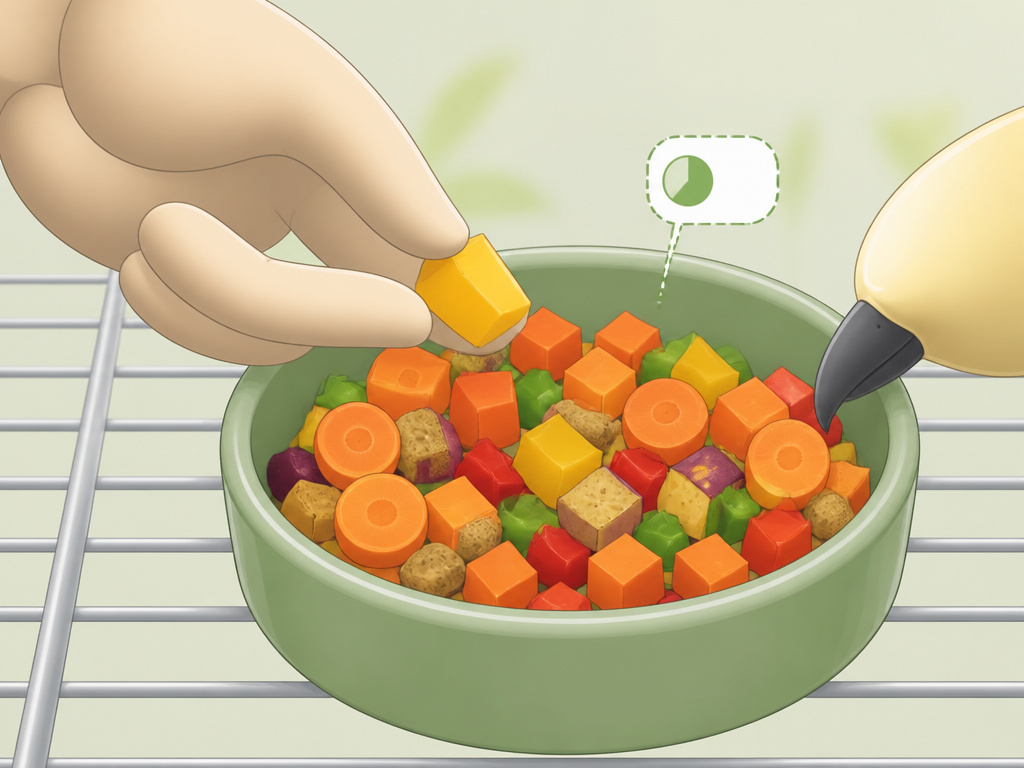
Two credible sources give different ceilings, and the gap between them matters more than either number on its own.
| Question | Position A | Position B |
|---|---|---|
| Fresh produce share of diet | ZuPreem: up to 30 percent | VCA: no more than 20 to 40 percent |
| Seed in the diet | ZuPreem: occasional treat, if at all | FAO: 50/50 canary seed and proso millet as a base mix |
| Cutting pellets to push vegetables | VCA: cut to a quarter of the bowl | ZuPreem: pellets stay in the cage all day |
| A fixed diet split | ZuPreem: 60 percent pellets, 30 percent produce, 10 percent treats | UF/IFAS: declines to endorse a numeric split |
VCA’s produce list is the more useful of the two for shopping. Bright yellow, red and orange vegetables carry vitamin A, so bell peppers, carrots, sweet potatoes, squash, mango and cantaloupe all earn a place. Avocados should be avoided because some parts cause fatal toxicity in pet birds. Onions and garlic contain chemicals that may harm a bird’s blood cells.
Iceberg lettuce is mostly water and adds little. Celery is the same story and should be fed sparingly. Canned produce is often packed in salt or sugar and isn’t recommended. Freeze-dried is less nutritious than fresh or frozen, and cooking depletes some of what you were feeding for in the first place.
Easy to miss: Produce left in the bowl past the day it was offered. VCA’s guidance is to clean food and water dishes daily, and a wet fruit piece sitting in a warm cage is the fastest way to grow something you never intended to feed.
If a bird rejects a vegetable, VCA’s advice is to offer the same one every day for 3 to 5 days before giving up. Rejection once means nothing. For birds that won’t touch produce at all, homemade bird treats is a way to bridge the gap without leaning on sugar.
How Often Should a Bird Get Treats, and in What Order?
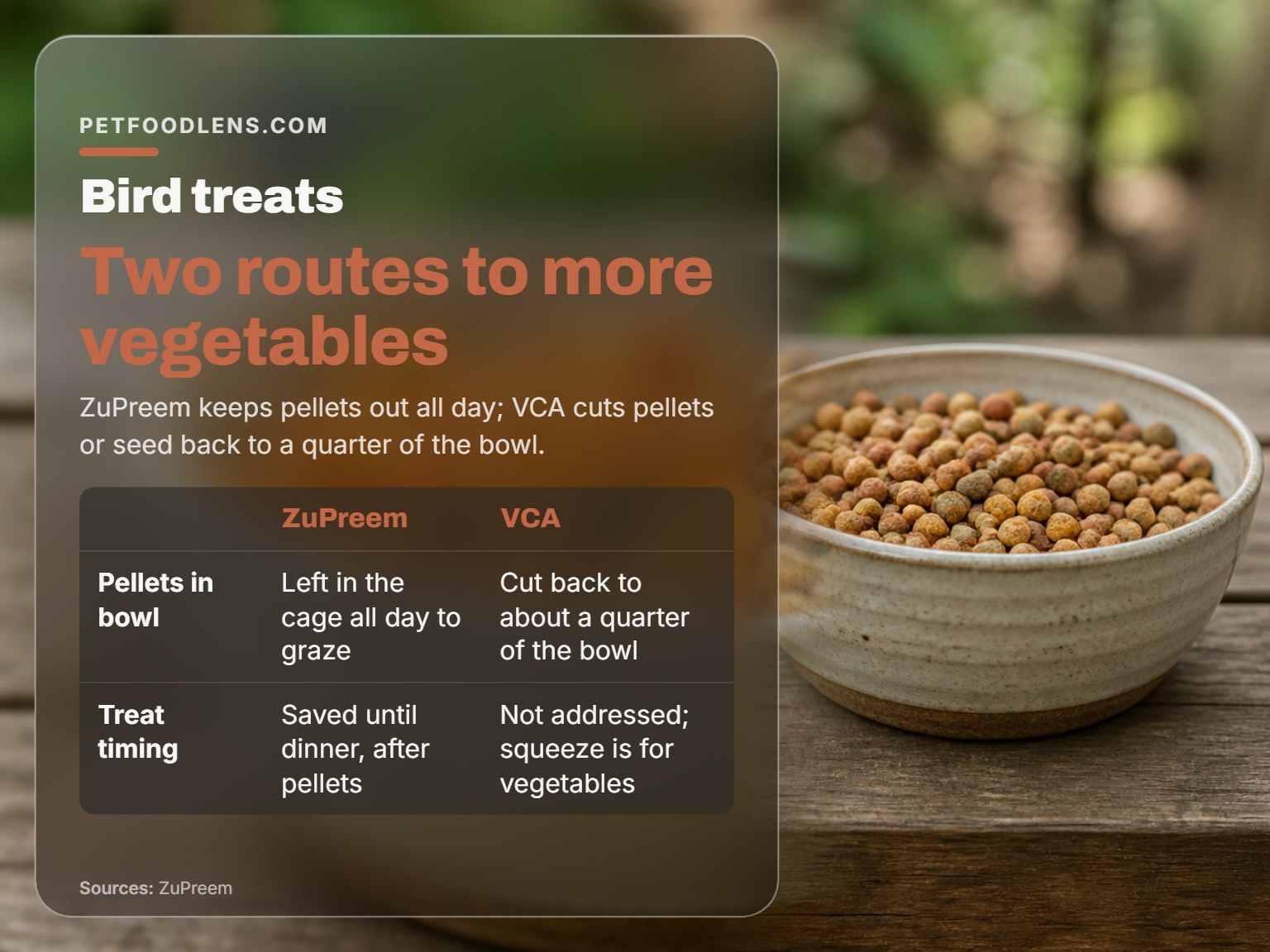
Order beats quantity.
ZuPreem’s sequence is pellets first, treats after, while VCA instead suggests cutting pellets or seed back to about a quarter of the food bowl each day to encourage vegetable eating. A bird that fills up on treats before its pellets has no reason to eat the pellets. Leaving pellets in the cage all day so the bird can graze, then saving treats for dinner, keeps the base diet doing its job.
VCA takes a different route to the same goal for vegetable intake. To push a bird toward fresh vegetables, VCA suggests cutting pellets or seed back to about a quarter of the food bowl each day, whereas ZuPreem holds that pellets should stay in the cage all day. That’s a deliberate, temporary squeeze, and it works against ZuPreem’s leave-pellets-out-all-day approach. Pick one method and stay with it rather than running both.
Before you start: Chocolate, caffeine, alcohol and anything containing artificial sweeteners may be toxic to birds and should never be given. Avocado can cause fatal toxicity. Never place food on the cage floor, where droppings fall, and wash every piece of produce before it goes in the bowl.
The Order of the Day
- Fill the pellet bowl in the morning and leave it. Skipping this is how a bird learns to hold out for the good stuff.
- Offer fresh produce in the middle of the day, cut to a size the bird has to work at rather than swallow.
- Save the reward treats for the training session, and keep that session to 5 or 10 minutes, once or twice a day.
- Clear and wash the dishes before you go to bed. A wet bowl left overnight is a bacterial culture with a perch.
Keep the treat in your hand smaller than the pellet in the bowl. A reward the bird finishes in one bite keeps a session moving; a reward that takes a minute to eat ends the session for you.
Training is where treats earn their keep, and using treats for training covers how to pick a high-value reward without turning it into a second diet. For the weekly math, how often to give birds treats works through the frequency question directly.
What Never Goes in the Bowl
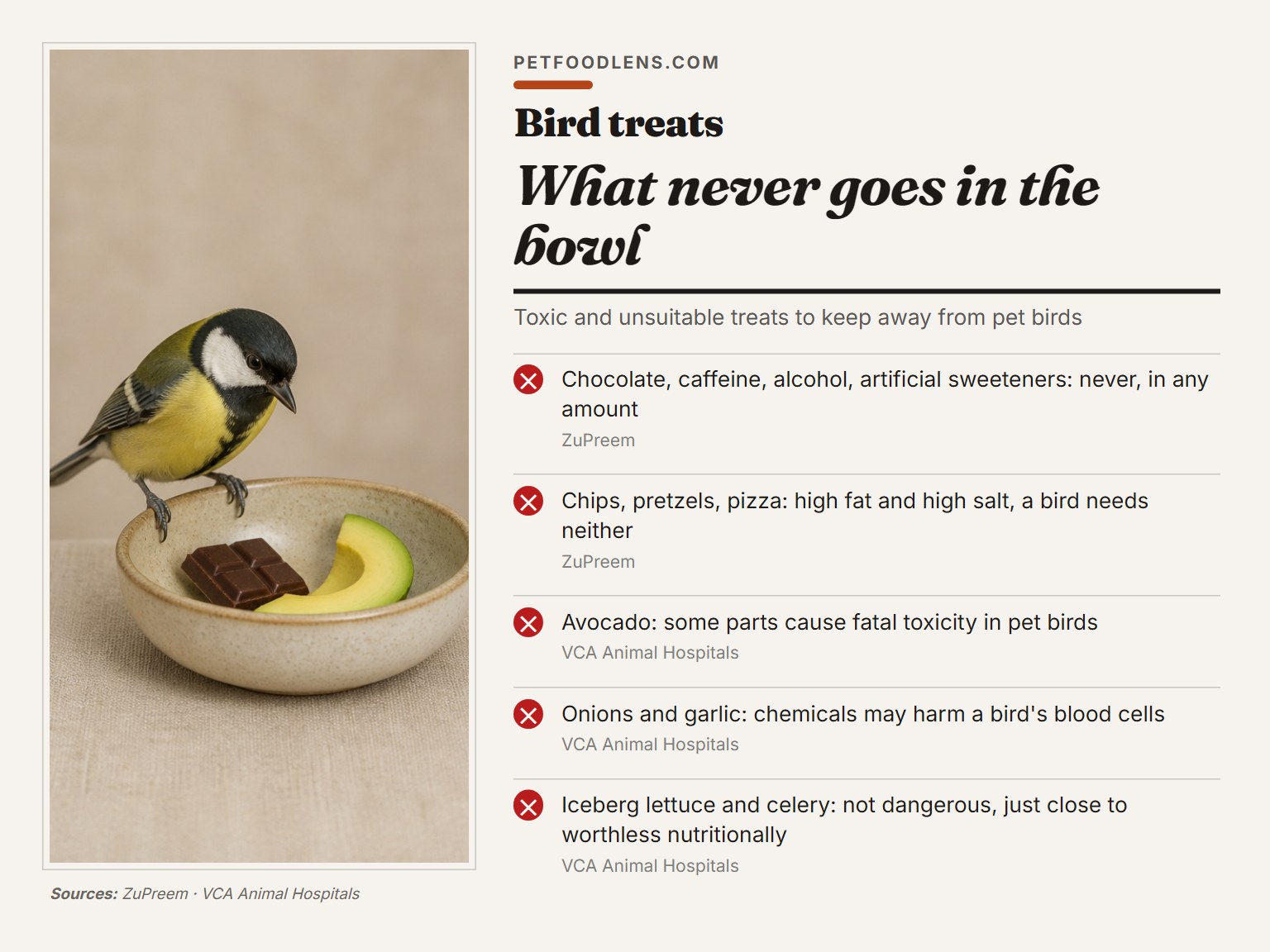
The dangerous treats are rarely the ones with a warning on the pack. They’re the ones on your plate.
ZuPreem’s list of items that may be toxic and should never be given as treats: anything containing artificial sweeteners, alcohol, chocolate and caffeine. High-fat, high-salt items such as chips, pretzels and pizza are also out, not because they’re toxic but because they’re the exact opposite of what a caged bird needs.
VCA adds two more to the avoid list. Avocado, because some parts cause fatal toxicity in pet birds. Onions and garlic, because they contain chemicals that may harm a bird’s blood cells.
- Chocolate, caffeine, alcohol, artificial sweeteners. Never, in any amount.
- Chips, pretzels, pizza. High fat and high salt, and a bird doesn’t need either.
- Avocado. Fatal toxicity risk.
- Onions and garlic. Harmful to blood cells.
- Iceberg lettuce and celery. Not dangerous, just close to worthless nutritionally.
The bird food ingredients to avoid list goes wider than treats, and it’s worth reading once before your next shopping trip.
Storage, Freshness, and a Recall That Crossed Brands
Kaytee recalled 17 SKUs of bird treats and greens over possible Salmonella contamination from parsley flakes supplied by Specialty Commodities, Inc., an outside supplier.
Read that detail again, because it’s the part that matters. The contamination risk came in through a third-party ingredient, not through Kaytee’s own process. Kaytee stated there were no positive Salmonella results on finished product and no reported human or pet illnesses.
The other detail is the one nobody mentions. The recall swept in Grreat Choice treat sticks, the PetSmart house brand, under UPCs 73725727166 and 73725727165. A store brand and a national brand shared a manufacturing lot. Brand separation doesn’t guarantee supply separation.
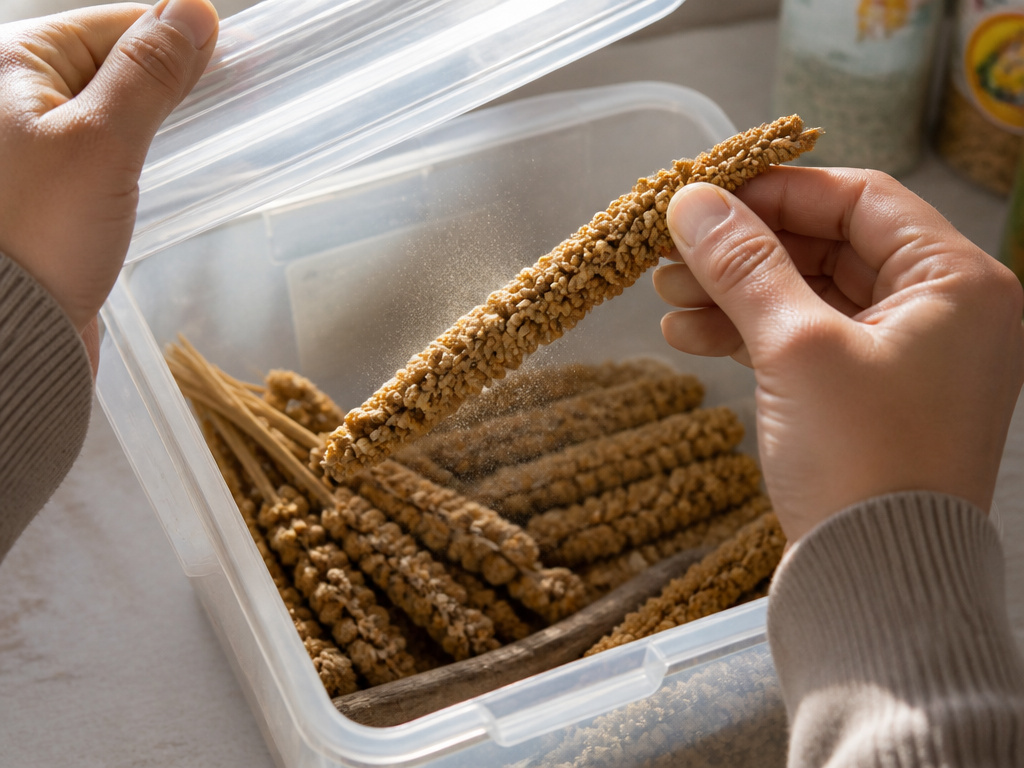
Stale seed announces itself before you see it. Fresh millet has a faint dry-grass smell. Old millet smells dusty and flat, like a cupboard that’s been shut too long, and that smell is the whole answer.
Wild Harvest’s guidance on its own treat stick is to store it in a dry place for maximum freshness and replace it when soiled or consumed. That’s the baseline for anything seed-based. For the longer version, storing bird treats covers containers, humidity and how long a spray actually holds up.
The part nobody mentions: A treat that arrives dusty or musty has already failed. FAO’s handling standard for seed mixtures is that they be free of dust and dirt, and a spray that fails that check isn’t worth hanging in a cage.
Frequently Asked Questions
Are millet sprays bad for birds?
No, but they’re high in fat and low in nutrients, which is why ZuPreem recommends seed only as an occasional treat, if at all. FAO treats millet sprays as a foraging tool rather than a food source. Hang one for enrichment, not as a replacement for pellets.
Is honey safe for birds?
Honey itself isn’t on the toxic list. The issue is what it does to the rest of the diet. A honey-bound stick is mostly binder and carbohydrate, and a bird that fills up on one skips the pellets carrying its vitamins and minerals.
How many treats should a bird get a day?
ZuPreem puts treats at roughly 10 percent of the daily diet, with pellets at 60 percent or more and fresh produce at up to 30, while UF/IFAS declines to endorse a numeric split and warns that too much food offered too often is a common cause of nutrition problems. For manufactured treats, follow the pack: 1 to 2 pieces a day for medium and large birds, 3 to 4 for large birds.
Can birds eat fruit every day?
Yes, within limits, though sources disagree on the ceiling: VCA says fresh produce should be no more than 20 to 40 percent of the diet, while ZuPreem caps it at 30 percent, so fruit belongs in the produce portion, not on top of it. Wash everything first, and skip canned fruit packed in syrup.
Are seed sticks better than honey sticks?
Neither is a health food. A seed stick gives a bird something to chew and strip, which is genuine enrichment. A honey stick is faster to eat and heavier on binder. If you’re choosing one, pick based on the job you want done, not on the label’s health language.
What’s the safest treat for a bird that’s new to treats?
Single piece of the bird’s own pellet, offered by hand. It adds nothing to the diet, it costs nothing nutritionally, and it builds the same hand-taming response a manufactured treat does. Move to millet or a commercial treat once the bird takes food from you reliably.
The Bottom Line
Here’s the threshold I’d actually use. If the treat bowl is empty before the pellet bowl is, the ratio is wrong, and it’s worth changing this week rather than next month.
I’ll be straight about where my depth runs out. I read ingredient panels for a living on the commercial pet food side, and avian nutrition is a field where I defer to the published guidance and to your vet. If your bird is unwell, on a therapeutic diet, or showing symptoms, none of this framework is the right tool. That’s a conversation for someone with a clinical picture in front of them.
The most underrated treat on this whole list is a single pellet held in your hand. It does the job of a reward without adding a calorie the bird didn’t need, and it costs you nothing but the walk to the cage.
Flip the bag over before you buy the next one. The front will tell you what the manufacturer wishes were true.
