
How to Choose Bird Treats: Read the Label First
This post contains affiliate links. As an Amazon Associate, we earn from qualifying purchases.
To choose bird treats, read the ingredient order before you trust the front of the pack: named seeds or grains first, no added sugar, honey, or dye, and a portion small enough that it never pushes out the base diet. Veterinary sources put fresh produce at no more than 20%-40% of the diet, and treats sit inside that share.
The ingredient list is where the how to choose bird treats question gets tested. A seed stick can print “natural” in three colors and still list honey third, and honey is sugar with a friendlier name.
What follows covers the treat categories worth buying, the label checks that separate food from candy, and the portion math that keeps treats from crowding out the bowl.
Key Takeaways
- Treats are extra calories, not a food group. Keep them a small share of the bowl, not a replacement for pellets or a species-appropriate seed mix.
- Read the first five ingredients. Named seeds or grains first; sugar, honey, or dye near the top is the tell.
- Millet sprays and plain seed sticks are the better commercial options; honey-bound sticks are candy with feathers.
- Fresh produce tops out at 20%-40% of the diet according to VCA Animal Hospitals, and treats count inside that share.
- Avocado, chocolate, onion, and garlic stay out of the bowl entirely.
What Counts as a Bird Treat?
A treat is anything that isn’t the base diet, and that definition covers more than the bag labeled “treats” at the store.
A bird treat is any food offered outside the base diet of formulated pellets or a species-appropriate seed mix. Commercial categories include millet sprays, seed sticks, pellet-based treats, and dried fruit or vegetable pieces. Fresh produce counts as a treat when it is offered as a supplement rather than as the main bowl.
The types of bird treats split into four rough groups: millet, seed sticks, pellet-based treats, and fresh produce. Each has a different job in the diet and a different failure mode.
Millet is a whole grain on the stem, and birds strip it fast. Seed sticks are seeds glued together with a binder, usually honey or sugar. Pellet-based treats are formulated pellets pressed into a treat shape. Fresh produce is whatever you chop that day.
The category that causes the most trouble is the one that looks like food but acts like candy. A honey-bound seed stick is a seed mix held together with sugar, and birds either pick the seeds out and leave the binder or eat the binder and skip the bowl.
Reading the Label: The First Five Ingredients Decide It
The guaranteed analysis on the back of a bird treat bag lists protein, fat, and fiber percentages. The ingredient order underneath it tells you where those numbers came from when you compare a how to choose bird treats.
Flip the bag over. Ingredients are listed heaviest first, so the top of the list is where the food actually is. If the first ingredient is “grain products” or “seed mix,” that’s a category, not an ingredient, and the label is hiding the source.
The lesson I brought over from cat food labels is that a single number on the front tells you almost nothing. The same holds for a seed stick: the protein percentage is a headline, and the ingredient order is the story.
If you want the full method, how to read bird food labels walks through the panel line by line.
The Three Label Checks That Matter
- First ingredient is a named seed or grain. Millet, oat groats, or sunflower seed is a real ingredient; “grain products” is a placeholder.
- No sugar, honey, or corn syrup in the top five. These are binders and palatants, and they add calories the bird doesn’t need.
- No artificial color in the list. The color is there to sell the bag to you, not to feed the bird.
What the Front of the Pack Skips
“Natural,” “premium,” and “holistic” have no fixed legal meaning on a bird treat bag. They tell you nothing about the formulation, and they’re the words most likely to appear in the largest font.
A honey-bound seed stick has a glossy, almost lacquered sheen. Set one on a paper towel and you’ll see the binder leave a sticky ring.
That ring is the sugar. It’s the same reason the bird goes back to the stick before it goes back to the bowl.
| Treat type | What it is | Watch for |
|---|---|---|
| Millet spray | Whole millet on the stem | Birds fill up and skip the bowl |
| Seed stick | Seeds bound with honey or sugar | Binder adds sugar; seeds are high-fat |
| Pellet-based treat | Formulated pellet in treat shape | Check it isn’t just dyed pellet |
| Fresh produce | Chopped fruit or vegetable | Remove promptly; it spoils |
How Much of the Diet Should Treats Be?
VCA Animal Hospitals puts fresh produce at no more than 20%-40% of a pet bird’s diet, and that’s the ceiling for the whole fresh-and-treat category, not a target to hit.
Merck Veterinary Manual is stricter on the treat side. It calls for small amounts of fresh vegetables and fruit each day alongside pellets, and it says seeds are fine occasionally but shouldn’t make up most of the diet because they’re high in fat and not very nutritious.
The how often to give bird treats question gets easier once you accept that treats are a percentage of the bowl, not a separate meal.
Treats are a percentage of the bowl, not a separate meal. If the treat dish is bigger than the pellet dish, the proportions are already upside down.
The balanced diet picture shifts by species. The UC Davis avian care and feeding guide lists small bird food and seeds as unlimited free-feed for parakeets and cockatiels, with vegetables and fruits sized to the bird.
UK Pet Food notes that small birds like finches and canaries may eat up to 30% of their body weight in seed daily to meet their energy needs, while Merck Veterinary Manual holds that seeds are fine occasionally but shouldn’t make up most of the diet.
Easy to miss: A bird that dunks its food in the water bowl will foul the water. Merck recommends a water bottle for those birds, checked daily and refilled daily.
The Treats Worth Buying (and the Ones I Skip)
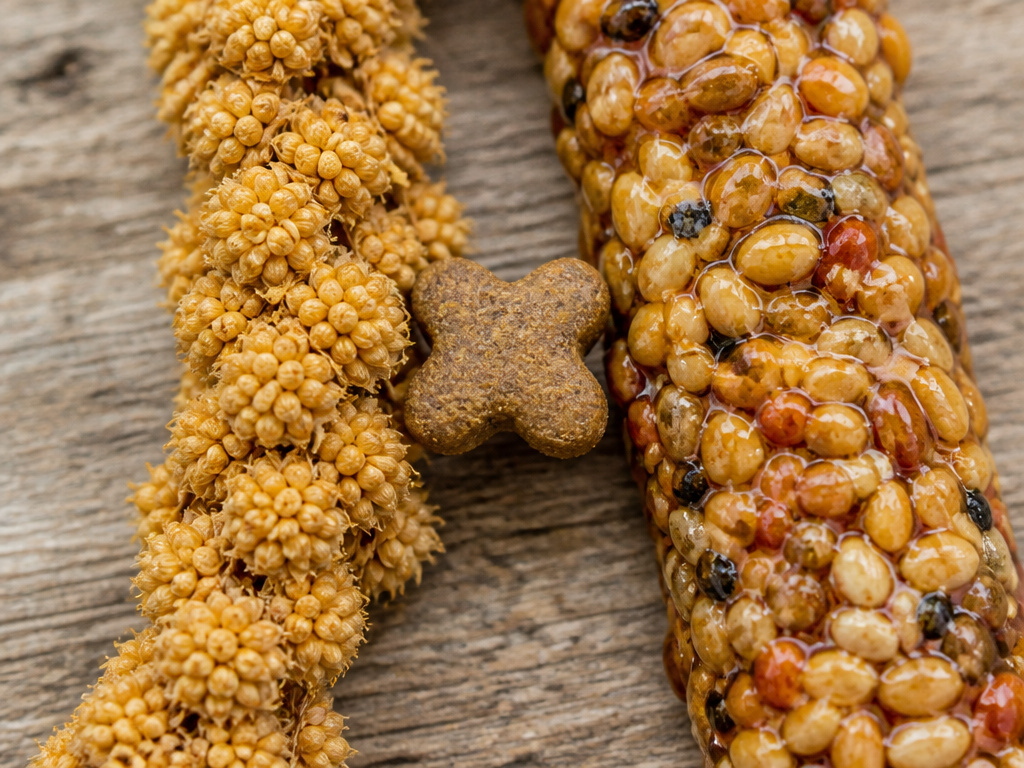
Millet sprays and plain seed sticks are the two commercial treats I’d actually buy.
For a pellet-based treat, choose a formulated pellet pressed into a treat shape before anything with a cartoon on the bag. Some pellet diets come in plain and fruit-flavored versions; the plain pellet formulas are the ones to look at, and the fruit-flavored versions are the ones I’d leave on the shelf.
The millet treats trade-off is simple: millet is a real grain, and birds love it enough to overeat it. The seed sticks for birds question is harder, because the binder is where the sugar hides.
A fresh millet spray smells dry and grassy, almost like hay, and it rattles when you shake it. A honey-bound seed stick smells sweet, closer to breakfast cereal than to a seed mix.
That smell is the difference between a treat and a dessert.
Where this goes sideways: Handing out a seed stick every morning because the bird likes it. The bird fills up on the binder and the high-fat seeds, then picks at the pellet bowl for the rest of the day.
Millet Sprays and Seed Sticks
Millet wins on ingredient quality. It’s one ingredient, and you can see it. Seed sticks win on convenience and enrichment, but only if you read the binder line first.
If the binder is honey, molasses, or corn syrup, treat the stick as a dessert. If it’s a plain seed mix with no sweetener, it’s closer to a real food.
Pellet-Based Treats
Pellet-based treats are the safest bet for a bird that’s already on a pellet diet, because the formulation is closer to the base food. The catch is that some “treat” pellets are just the regular pellet with dye and sugar added.
Check the ingredient list against the plain pellet version. If the treat version has color and sweetener the plain version doesn’t, you’re paying extra for marketing.
Where the Sources Disagree on Treats
The major veterinary sources don’t agree on how much of a bird’s diet should be seed, and the disagreement is bigger than most treat guides admit.
| Question | One position | Another position | Practical read |
|---|---|---|---|
| Produce share | VCA: 20%-40% of diet | UK Pet Food: occasional treats | VCA is the ceiling, not a target |
| Seeds as base | Merck: occasional only | UC Davis: unlimited for parakeets | Species matters; ask your vet |
| Celery | VCA: feed sparingly | UK Pet Food: lists it as suitable | Watery and low value |
| Citrus for nectar eaters | Merck: avoid (iron buildup) | VCA: lists citrus as vitamin-A produce | Follow Merck for lorikeets |
| Cooking produce | VCA: can deplete nutrients | UK Pet Food: endorses cooked corn | Raw by default; corn is the exception |
The bird food ingredients to avoid list is where most of these conflicts land. VCA says avocado should be avoided because some of its parts have been shown to cause fatal toxicity in pet birds, and that onions and garlic contain chemicals that may harm a bird’s blood cells.
The UF/IFAS pet bird nutrition guide is blunt about the underlying problem: there will probably never be an ideal diet for all bird species, because nutrient needs vary by age, health, and breeding status.
The UK Pet Food indoor bird feeding guides treat fresh produce as an occasional extra, not a fixed share of the bowl. That’s a real disagreement with VCA’s 20%-40% figure, and you should know which one you’re following.
For lorikeets and other nectar eaters, Merck warns against citrus because it causes iron to build up, while VCA lists citrus among recommended vitamin-A produce. Citrus drives iron accumulation in those birds, and the risk is specific enough that it’s worth following the stricter source.
How to Introduce a New Treat Without Wasting It
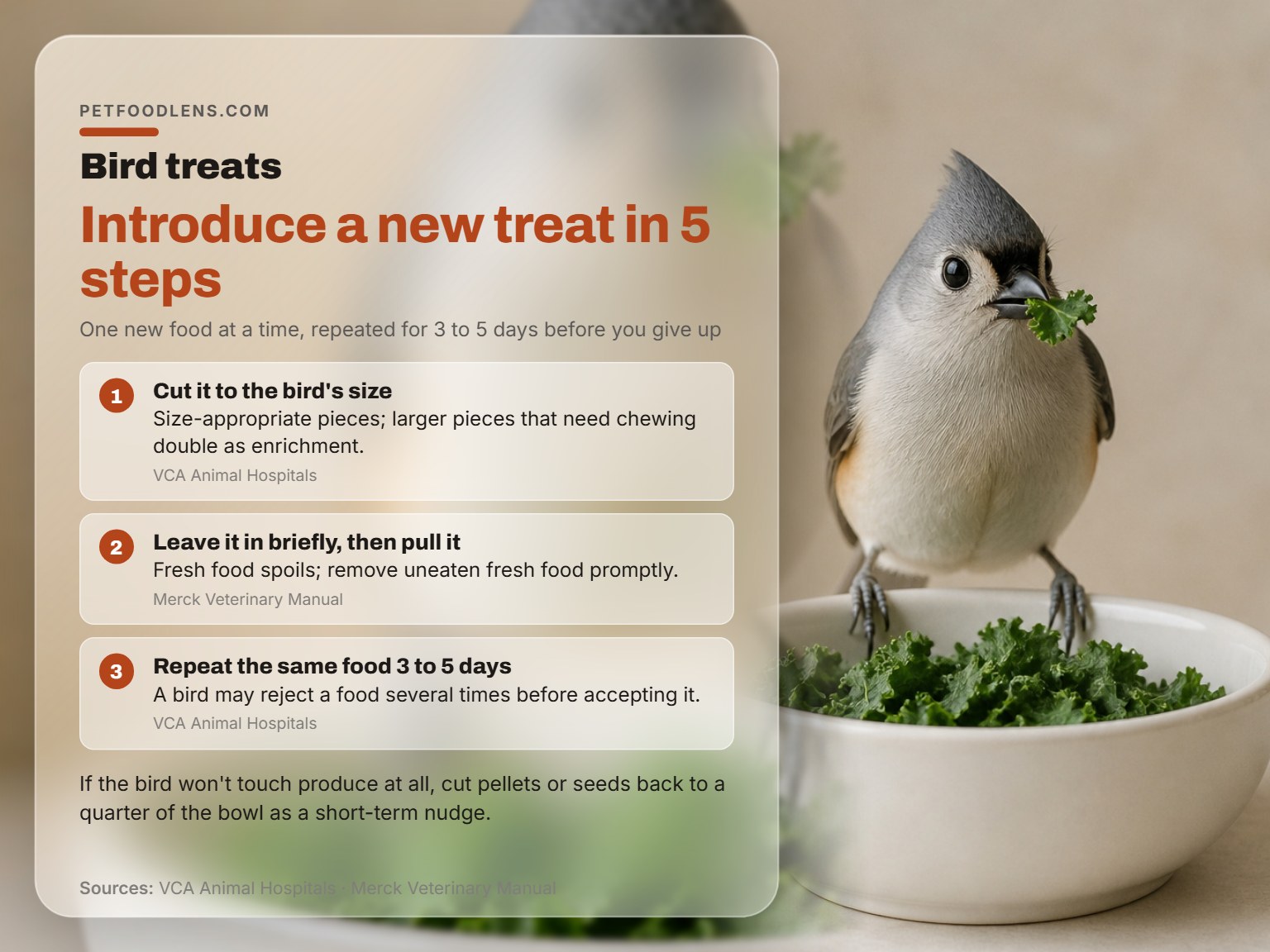
You’ve bought a bunch of kale, the bird looks at it like you’ve put a rock in the bowl, and you’re ready to give up.
Before you start: Wash every piece of produce under running water, because birds are very sensitive to pesticide residue and other sprays. Keep avocado, chocolate, onion, and garlic out of the bowl entirely. Remove uneaten fresh food promptly, since spoiled produce can make a bird sick.
Here’s the sequence that works:
- Offer one new food at a time, alongside the usual bowl. A bird that sees five new things at once will ignore all five.
- Cut it to the bird’s size. VCA recommends pieces appropriate to the bird, and larger pieces that need chewing double as enrichment.
- Leave it in for a short window, then pull it. Fresh food spoils, and spoiled food smells before it looks bad.
- Repeat the same food for 3 to 5 days. VCA’s guidance is that a bird may reject a food several times before accepting it.
- Cut the base diet back to a quarter of the bowl if the bird won’t touch produce at all. VCA suggests this as a short-term nudge, not a permanent change.
The storing bird treats question matters here, because a treat that sat in a warm cupboard for a month isn’t the same food you bought. The homemade bird treats route gives you control over the binder and the sugar, which is the whole point.
Training Treats, Foraging, and the Enrichment Angle
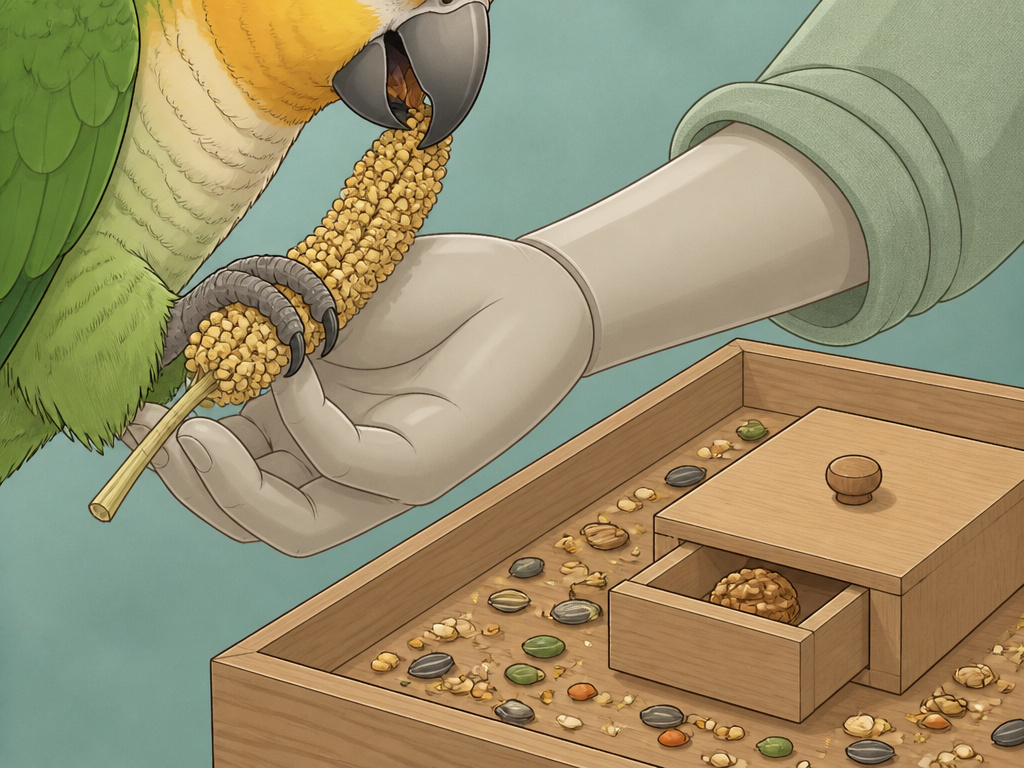
Three things make a treat useful beyond calories: it’s small, it’s quick to eat, and it isn’t the base diet.
For training, the treat has to be worth working for. A small piece of millet is enough; a whole spray is a meal.
The using treats for bird training approach works best when the treat is reserved for the behavior you’re shaping, not handed out on a schedule.
UK Pet Food recommends scatter feeding, puzzle feeders, and foraging trees to encourage the foraging behavior birds spend most of their time on in the wild. That’s the underrated version of a treat: it costs nothing extra in calories, and the bird still gets the interaction.
- Scatter feeding: sprinkle a portion of the daily ration in a foraging tray.
- Puzzle feeders: a small treat inside a closed drawer the bird has to open.
- Foraging trees: a branch with treats tucked into the crooks.
Frequently Asked Questions
Are seed sticks bad for birds?
Not automatically. A plain seed stick with no sweetener is a reasonable occasional treat. A honey-bound stick is closer to candy, and it should be a rare extra rather than a daily habit.
How many treats can a bird have in a day?
There’s no single number that fits every species. VCA’s 20%-40% produce ceiling is the closest thing to a guideline, and treats count inside that share. Merck’s language is “small amounts” alongside pellets.
Can birds eat fruit every day?
VCA recommends a small offering of tropical fruit daily alongside vegetables. UK Pet Food treats fruit as an occasional extra, so the two sources disagree on frequency. Either way, fruit is a supplement, not the base.
What treats should I never give a bird?
Avocado, chocolate, onion, and garlic are the consistent avoid list across VCA, Merck, and UK Pet Food. Avocado in particular has been shown to cause fatal toxicity in pet birds.
Do birds need treats for training?
They don’t need commercial treats. A small piece of the bird’s regular pellet works as a reward, and it doesn’t add calories the bird wasn’t already getting.
The Bottom Line
How to choose bird treats, in the end, is a label-reading exercise. The first step this week is simple: flip the bag over and read the first five ingredients on whatever treat is in the cupboard. If sugar, honey, or dye shows up in that window, the bag is candy and the bird can have it as an occasional extra.
Most treat guides lead with the toxic-food list. The bigger problem in most homes is the bird that fills up on millet by mid-morning and never touches the bowl.
This all assumes a bird on a complete base diet. If your bird is on a therapeutic diet for a medical condition, the treat math changes, and that’s a conversation for your vet, not a label.
