
How to Feed a Pet Parrot: A Vet-Sourced Plan
This post contains affiliate links. As an Amazon Associate, we earn from qualifying purchases.
To feed a pet parrot, build the bowl around formulated pellets at 75 to 80 percent, add 15 to 20 percent washed vegetables and fruit, and treat seed and nuts as occasional rewards. If you are wondering how to feed a pet parrot, University of Florida veterinarians say seeds should be strictly limited or cut out entirely, because seed-heavy diets cause obesity, fatty liver disease and heart problems.
That pellet figure is the closest thing to consensus in the how to feed a pet parrot question, though the agreement starts to fray. Three veterinary teaching sources put pellets between three-quarters and 80 percent of the bowl, while the World Parrot Trust declines to give a percentage at all. The same split runs through seeds, nuts, and whether a bowl should ever be left full.
What follows: the four published numbers side by side, the energy maths behind them, a week-by-week conversion schedule with a weight threshold that stops it, and the species that break the rule entirely.
Key Takeaways
- Pellets at 75 to 80 percent of the bowl is the nearest thing to a consensus, though the sources do not all agree.
- Seeds and nuts are the contested item. University of Florida wants them strictly limited or gone, UC Davis lists nuts in the standard adult diet, the RSPCA allows them only as occasional treats, and the World Parrot Trust adds nuts for macaws.
- Never starve a bird onto pellets. University of Florida warns this can kill the bird, and the switch runs four weeks at minimum and often months.
- Weigh the bird every morning before feeding, to the gram, and keep a daily record.
- Small species may get a seed allowance of no more than one-tenth of the diet, per the RSPCA, though University of Florida makes no small-species exception and would strictly limit or eliminate seeds.
The Pellet Percentage: 75, 80, or Three-Quarters?
Four published sources, four different ways of writing the same number, and one of them declines to give a number at all.
Formulated parrot pellets blend grains, seeds, vegetables and fruits into one baked piece, so a bird cannot sort out the fattier components. The Royal Veterinary College factsheet puts commercial pellets at 80 percent of the diet for exactly that reason: the ingredients are combined before the bird ever gets a choice.
| Source | Pellet share | Notes |
|---|---|---|
| University of Florida | 75-80% | 15-20% fruit and veg |
| RSPCA | About three-quarters | Rest is fresh fruit and veg |
| Royal Veterinary College | 80% | Names Harrison’s, Kaytee, Nutriberries |
| World Parrot Trust | No percentage | Variety over replication |
The University of Florida College of Veterinary Medicine is the most prescriptive of the four. Its UF pet bird care guide sets pellets at 75 to 80 percent and fruit and vegetables at 15 to 20, then adds that seeds and nuts should be strictly limited if not eliminated, though UC Davis lists nuts in the standard adult diet and the World Parrot Trust adds nuts for macaws.
The RSPCA lands in the same neighbourhood with softer edges: about three-quarters pellets, the rest fresh fruit and veg, while the World Parrot Trust declines to give a percentage at all. If you want the wider parrot diet picture rather than just the ratio, that split is the frame everything else hangs on.
The World Parrot Trust sits outside the argument. Its World Parrot Trust nutrition guide states plainly that a wild parrot diet cannot be replicated and should not be attempted, and that variety is the operating principle instead. No percentage, no pellet prescription, no brand.
Which one you follow matters less than the thing three of the four agree on. The bowl gets built around a formulated base, and seed stops being the foundation.
Why a Captive Parrot Burns 10 to 15 Times Less Energy
The energy gap between a wild parrot and a pet one is the most useful number in the entire how to feed a pet parrot subject. The World Parrot Trust puts it at 10 to 15 times: a wild bird flies to foraging and nesting sites all day, and a bird in a cage above a full bowl does not.
The World Parrot Trust makes the same point from the energy side: captive parrots expend 10 to 15 times less energy than wild parrots. So the calorie requirement drops, but the instinct to hunt down the fattiest seed in the bowl does not.
That mismatch is the whole mechanism behind seed-mix problems. A parrot given a mixed bowl will pick out the high-fat, high-salt pieces and leave the rest, which is precisely what Dr. Ian Tizard at Texas A&M calls one of the biggest misconceptions about parrot nutrition.
Fat content only means something next to energy expenditure. The World Parrot Trust flags Amazons and some small cockatoos such as Galahs as prone to obesity, so fat content should be watched relative to energy expenditure.
Working out how much to feed starts here rather than at a scoop size. A balanced bird diet is a ratio problem before it is a shopping problem.
In my experience the birds that gain weight fastest are the ones whose owners top the bowl up instead of emptying it. The bird never sees an empty dish, so it never has to work.
Free-Feeding or Rationed Portions? Where the Experts Split
Two veterinary schools, one country, opposite instructions. This is the disagreement that matters most in daily practice, and it does not resolve neatly.
The UC Davis avian feeding guide, last updated January 2025, lists parrot pellets and nuts as unlimited and free-fed for adult parrots larger than conures and cockatiels, plus vegetables and fruits, though Texas A&M and the World Parrot Trust advise measured portions instead. Parakeets and cockatiels get small bird food and seeds unlimited on the same table.
The Texas A&M parrot nutrition article goes the other way. Tizard argues that free food choice is a misconception, that parrots pick out the high-fat and high-salt components, and that a parrot should be fed only what it can eat in one day, while UC Davis recommends free-feeding.
The World Parrot Trust takes a third position that is really a method: measure amounts, watch how much the bird actually eats, monitor weight, and follow the guidelines printed on the commercial food, which conflicts with UC Davis’s free-feeding advice.
I ration pellets and free-feed vegetables. A permanently full pellet bowl is a bird that never has to work for anything, and the Texas A&M position matches what I see in practice: the bird eats the pellets it likes and leaves the rest. Vegetables get refilled because the volume is mostly water.
So what do you actually do? Measure. Pick a daily ration, put it in, and weigh what comes back out that evening. If the bird is cleaning up and holding weight, the ration is right. If pellets are sitting, the ration is too big.
Fair warning: this is the one place where two named veterinary institutions give you contradictory instructions, and neither is obviously wrong. Pick a method, then let the scale referee it.
How to Convert a Seed Junkie Without Starving It
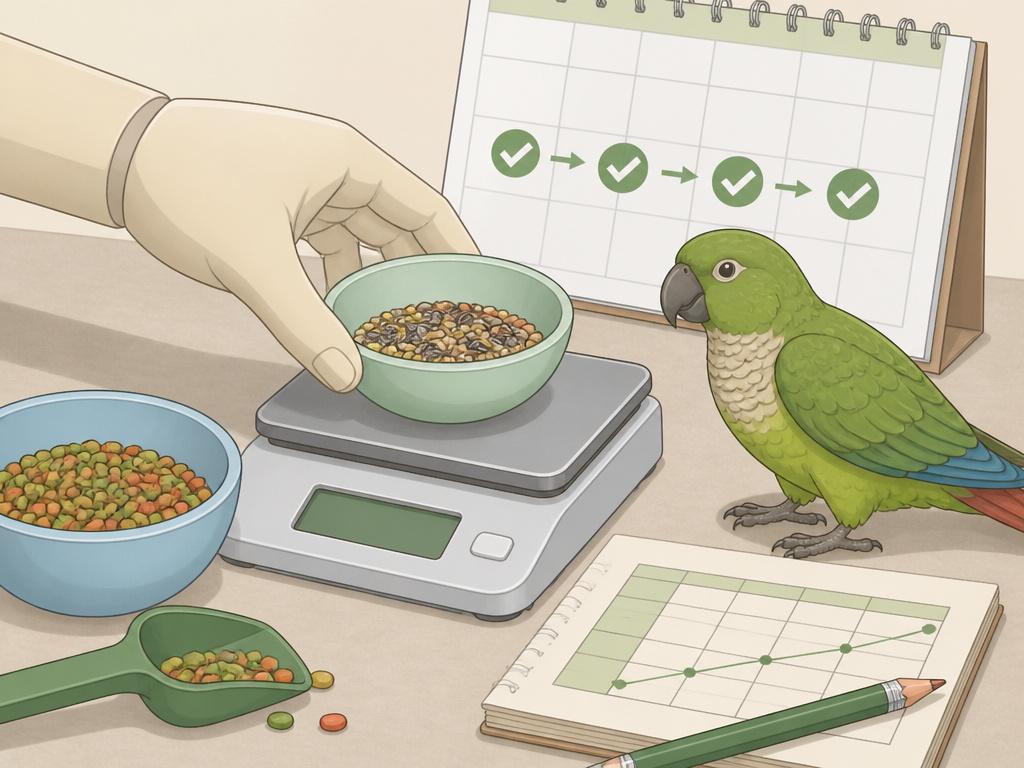
I once handed a bird owner a printed conversion plan with timings on it. She gave up inside two days and went back to the seed mix. I rebuilt it as three steps and it stuck, which taught me more about diet conversion than any handout has.
The constraint that governs everything is weight, not willpower. A parrot that stops eating burns through its reserve quickly, and University of Florida is blunt about the risk: never starve a bird into eating pellets, because it can lead to the death of the bird.
Before you start: A bird that refuses the new food can drop weight within days, and University of Florida warns that starving a parrot onto pellets can kill it. Book an avian vet check before you change anything, and put a gram scale on the counter before the first scoop.
The Four-Week Stepped Schedule
University of Florida’s method starts with measurement, not with food. Weigh what you give, weigh what is left after 24 hours, do that for 7 days, add the daily figures up and divide by 7. That average is the total daily intake everything else is built on.
- Hold the total constant and change the ratio. Week one is 75 percent of that daily intake as seed and 25 percent as pellets. Skipping the measurement step means you are guessing at portions for the whole conversion.
- Week two is 50/50. Same total weight, split evenly. A bird that stalls here is telling you the pace is too fast, not that pellets are impossible.
- Week three is 25 percent seed, 75 percent pellets. Most birds are eating pellets voluntarily by this point.
- Week four cuts seed further for larger parrots. For many birds the switch takes far longer than four weeks, and University of Florida says so directly.
The pellet conversion schedule is the part owners rush. The RSPCA’s version is slower still: two or three sessions a day of about 15 minutes each, with the bird’s usual food put back in place the moment each session ends.
Reading the Scale and the Droppings
Weigh the bird every morning before feeding, on a digital scale you can read to the gram, and keep a daily record. University of Florida’s conversion guidance is built on measuring daily intake and monitoring weight; if the bird is losing weight, you slow down.
| What you see | What it means | What to do |
|---|---|---|
| Weight stable in a week | Bird is eating around the pellets | Hold the ratio, do not push on |
| Weight dropping noticeably | Conversion is running too fast | Go back a week, call the vet |
| Droppings change colour or thickness | Possible illness, not fussiness | Vet check, pause the switch |
| Weight stable, pellets eaten | It is working | Move to the next step |
The RSPCA adds a daily droppings check during any conversion, watching for changes in colour, thickness, frequency or amount. A seed-only diet is the thing you are trying to leave behind, and the droppings are how you confirm the bird is actually eating rather than sorting.
Which Species Break the Standard Rule?
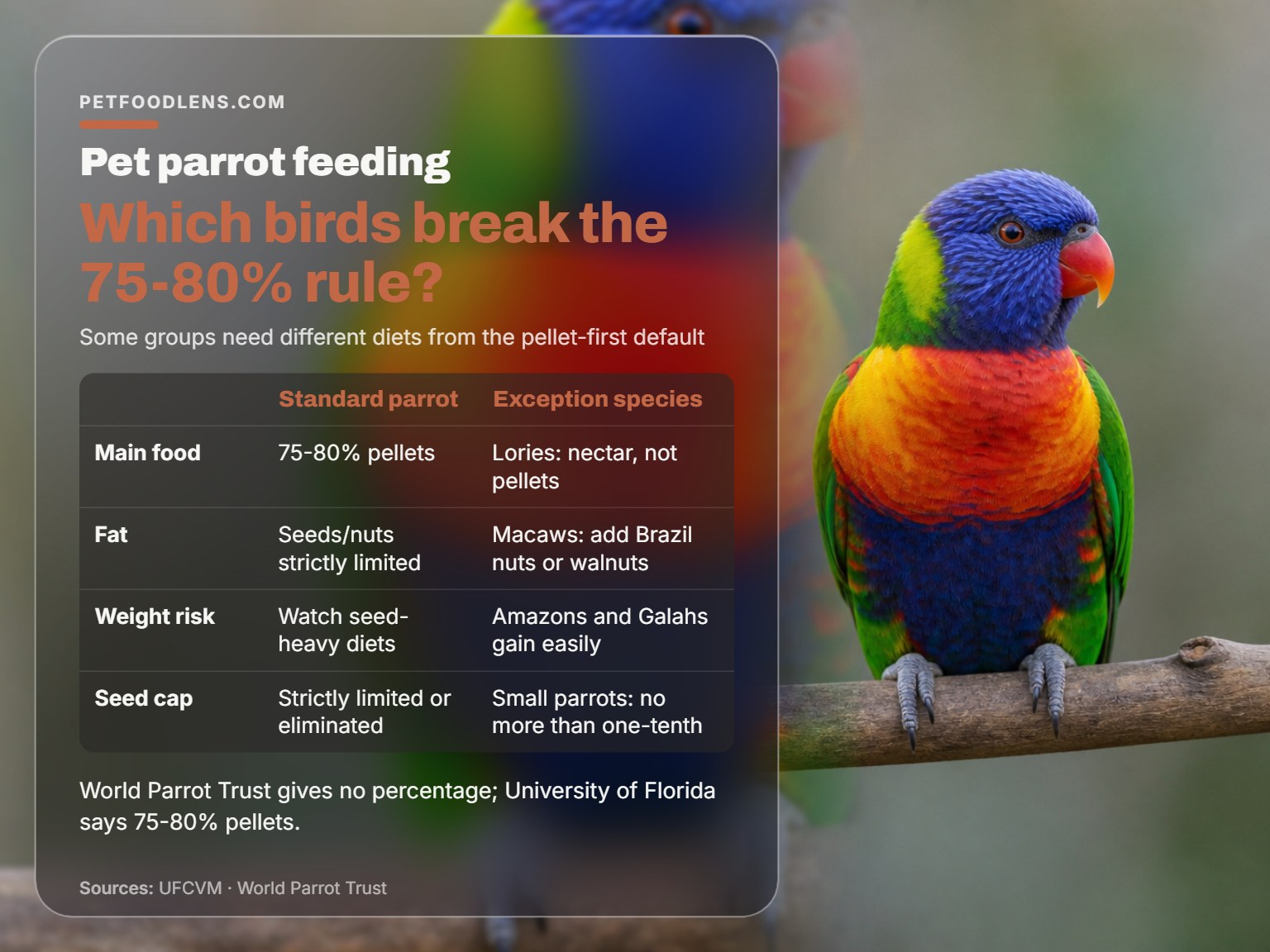
The 75 to 80 percent figure is a common default among several veterinary sources, though the World Parrot Trust declines to give a percentage at all, and at least five groups of birds sit outside it.
- Lories and lorikeets run on nectar, not pellets. The World Parrot Trust puts fruit, vegetables, pollen and commercial or homemade nectar at the centre of the diet, with seeds only sparingly. A pellet-first bowl is the wrong bowl for these birds.
- Macaws need more fat, and the World Parrot Trust suggests Brazil nuts or walnuts to get there. This is the one group where nuts belong in the plan rather than in the treat jar.
- Amazons and Galahs have the opposite problem and gain weight easily, so fat content gets watched against activity.
- Budgerigars, parrotlets, lovebirds and cockatiels get a seed allowance the RSPCA caps at no more than one-tenth of the diet, alongside free access to pellets and produce, though University of Florida would strictly limit or eliminate seeds for all parrots.
- Australian grass parakeets, cockatiels and many cockatoo species do better on several smaller feeds across the day, which keeps them foraging instead of sitting.
- Canaries and finches are conventionally fed seed, and the RSPCA suggests adding a good-quality pellet diet plus washed greens such as dandelion, chickweed or groundsel.
The reason is anatomy and ecology, not preference. A lorikeet’s gut is built around a liquid, sugar-rich food source, so a dry pellet does not match what the bird evolved to process. A macaw flies further and burns more, so a leaner bowl undershoots.
The Produce, Water, and Dish Rules Nobody Argues About
Every source here agrees on the boring parts, and the boring parts are where most problems actually live.
Start with avocado, the one item with a genuine certainty gap. The University of Florida guide says avocados may be toxic and should not be fed. The RSPCA goes further and calls avocado highly poisonous, to be withheld entirely. Different language, same instruction. Keep it out of the bowl.
Avocado, and How Certain the Sources Are
That gap between “may be toxic” and “highly poisonous” is worth noticing rather than smoothing over. Both sources tell you not to feed it, and neither publishes a dose threshold, so treat the precaution as absolute and move on.
The rest of the hygiene list is short and unglamorous:
- Wash everything, especially produce, and change dishes daily, discarding unused portions.
- Provide clean water every day for drinking and in a shallow dish for bathing, and change the receptacles daily.
- Skip salty and mouldy food entirely. Skip salty and mouldy food entirely, as UC Davis advises.
Water volume is species-scaled. UC Davis lists 1 to 4 oz per day for adult parrots larger than conures and cockatiels, and 1 oz per day for parakeets and cockatiels.
Change the food dish and the water dish at the same time every morning, before the first feed. A dish that gets topped up instead of emptied is a bacterial culture with a bird standing in it.
The list of safe fruits and vegetables is longer than most owners assume, and making chop for parrots in a Sunday batch is the easiest way to keep variety in the bowl without cooking every day.
What to Put in the Bowl, By Name
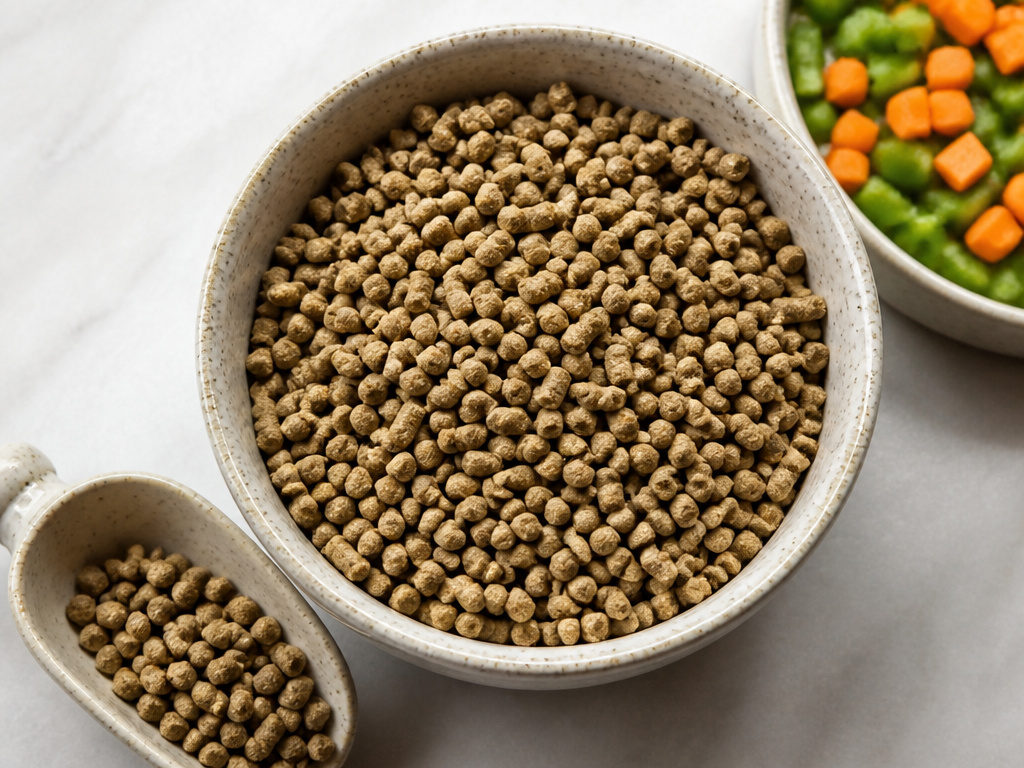
Harrison’s, Kaytee and Nutriberries are the three names the Royal Veterinary College parrot care factsheet puts on paper as commercial pelleted foods.
That is a soft disagreement in the profession. University of Florida recommends high-quality pellets without naming a brand. The RSPCA advises trying different brands because a bird may prefer a different shape, size, colour or flavour, and names none. Only the RVC commits.
Pellets Worth Naming
For a first bowl, a plain commercial pelleted food is a reasonable starting point, and the RVC names Harrison’s, Kaytee and Nutriberries as examples. Try a different brand when a bird refuses the first pellet on offer, since the RSPCA notes a bird may prefer a different shape, size, colour or flavour.
Two practical notes. Buy the smallest bag that lasts you a reasonable time, because pellets go stale and a stale pellet gets refused. And rotate shapes before you rotate brands, since the RSPCA’s point about shape and size is the cheaper variable to test.
The pellets vs seed mix argument is settled by the guaranteed analysis, not the picture on the bag. A bag with a parrot on the front tells you who the marketing is aimed at.
I would skip the brightly coloured fruit-flavoured pellets. The colour sells the bag, and none of the sources I checked gives a dyed pellet any nutritional credit over a plain one. That is my read rather than a published finding, so weigh it accordingly.
If you want one answer: a commercial pelleted food sized to your species as the base, with a chopped vegetable mix alongside and seed demoted to the training pouch.
Frequently Asked Questions
How much seed can I give my parrot?
It depends on the species, and the sources split. The RSPCA allows small species such as budgerigars, parrotlets, lovebirds and cockatiels up to one-tenth of the diet as seed. For larger parrots, University of Florida recommends seeds be strictly limited or eliminated, and the RSPCA suggests them only as occasional treats or training rewards.
Can I feed my parrot only pellets?
No source recommends an all-pellet diet. The University of Florida figure is 75 to 80 percent pellets with 15 to 20 percent fruit and vegetables, and the RSPCA puts pellets at about three-quarters with fresh produce making up the rest. Pellets are the base, not the whole bowl.
How long does it take to switch a parrot to pellets?
University of Florida publishes a four-week stepped schedule, but notes that for many birds the switch needs to be far more gradual. The RSPCA describes the change taking several weeks or even months. Weight, not the calendar, decides the pace.
Is avocado really dangerous for parrots?
Both sources that address it say not to feed it. The University of Florida guide says avocados may be toxic, and the RSPCA calls avocado highly poisonous to parrots. Neither publishes a safe dose, so treat it as a hard no.
Do I need to weigh my parrot?
Yes, if you are changing the diet. The RSPCA advises weighing every morning before feeding on a digital scale readable to the gram and keeping a daily record. University of Florida’s conversion method is built on measured intake, and monitoring the bird’s weight tells you whether to slow down.
Before You Go
One number matters more than the ratio, and it is not printed on any bag. Weigh your bird tomorrow morning before it eats, on a scale that reads to the gram, and write it down. That figure is your baseline for every diet decision that follows.
Everything above assumes a healthy adult bird with no diagnosed disease. If yours has liver or kidney problems, the pellet percentage becomes a clinical decision made by your avian vet rather than a number lifted from a factsheet. I am not qualified to override that, and neither is a blog post.
Start with the bowl you already have. Change one thing this week: measure what goes in, and measure what comes back out.
