
Pellets vs Seed Mix for Birds: What the Numbers Say
This post contains affiliate links. As an Amazon Associate, we earn from qualifying purchases.
Pellets vs seed mix for birds is a choice between a fixed formula and a variable one. A pellet puts the same nutrients in every bite; a seed mix lets the bird eat the sunflower and leave the millet. Measured intake shows pellets deliver fewer calories per gram and far more consistent nutrient intake.
Sunflower seed measures 2810 kJ per 100 g against 1547 kJ per 100 g for an extruded pellet in a controlled parakeet trial. That gap is the whole argument in miniature: a bird eating by volume takes in nearly twice the fuel on seed.
What follows: the manufacturing difference, the measured intake numbers, where the published recommendations conflict, and a conversion plan paced by a kitchen scale rather than a calendar.
Key Takeaways
- Pellets win on nutrient consistency. The measured energy gap runs the other way from what people expect, and that surprises people.
- A mixed bowl often fails because birds sort out the sunflower and leave the pellet sitting in the dish, though VCA and Lafeber both describe mixing methods for some birds.
- Published pellet shares run from 60% to a 70% minimum to about 80%, and the sources do not agree on which number is right.
- Weigh the bird daily through any conversion. A loss above 10% of starting body weight is a vet call.
- Seed still earns a place as enrichment and as up to 20% of the ration in Lafeber’s and Versele-Laga’s plans, though PetMD’s sanctuary source rules seed out for larger birds.
What Actually Separates a Pellet From a Seed Mix
A bound pellet is heated to 70-80°C and pressed through a die; an extruded one runs at 90-180°C under pressure. That temperature difference changes the starch, the fiber, and how readily a bird accepts the food.
Bound pellets are formed by heating the ground mix to 70-80°C and forcing it through holes with a roller, producing cylindrical particles of constant diameter cut to preset lengths. Extruded diets run hotter, between 90-180°C, with a dwell time from 30 seconds to several minutes and steam moisture from 0% to 20%.
Most products sold as pellets today are extruded diets. The mix is forced through an extruder plate under pressure and temperature, and intracellular water flashes off as the food leaves the die. That ruptures the plant cells and partially hydrolyzes the food, which is also why the cooking step kills infectious agents if any are present.
Bound pellets skip the cooking. They hold longer fiber chains, which can read as less palatable to a bird, and Chewy’s nutrition review flags exactly that split between the two formats.
Here is the part that matters for the comparison. A pellet is uniform by design, so the bird cannot sort it. LafeberVet states the advantage plainly: pellets make it difficult or impossible for a bird to pick out favorite foods and leave other items behind.
| Trait | Formulated Pellet | Seed Mix |
|---|---|---|
| Nutrient spread per bite | Fixed profile in every piece | Shifts with which seed gets eaten |
| Energy density | 1547 kJ/100 g (parakeet trial) | 2810 kJ/100 g (sunflower) |
| Sorting possible | No | Yes, and birds do it |
| Edible fraction | The entire piece | Hulls and rejected grains |
| Enrichment value | Low | High: shelling, foraging, manipulation |
A pelleted diet trades enrichment for consistency, and that trade is the entire decision. Everything below is a detail of how the trade plays out.
The Measured Numbers: Pellets vs Seed Mix for Birds
Eleven grams against eight.
In a crossover trial on rose-ringed parakeets, daily intake ran 11 ± 1 g/d on pellets against 8 ± 1 g/d on sunflower seed kernels, a difference significant at p=0.001. The birds ate more pellet by weight.
Energy went the other way. Intake was 175 ± 18 kJ/d on pellets and 213 ± 28 kJ/d on sunflower seed, at p=0.020, because measured energy density was 1547 kJ/100 g for pellets against 2810 kJ/100 g for sunflower. Voluntary energy intake came out 18% higher on seed.
That is the number to hold onto. A bird on seed eats less food and takes in more calories.
Marketing is not nutrition. The trial weighed food in and food out; the bag copy did neither.
Merck Veterinary Manual puts the same point in formulation terms. Extruded pellets fed for breeding carry 18-22% crude protein and 5-8% fat, against the higher fat load in seeds. The pellet is denser in the things a bird needs and lighter in the thing it overeats.
The boredom objection deserves a hearing, because it drives a lot of owner resistance. The parakeet trial’s preliminary data contradict it: energy intake on pellets was not higher than on sunflower seed, so birds were not overfeeding out of a lack of things to do.
Why Selective Feeding Defeats a Mixed Bowl
Adding pellets to a seed mix sounds like a compromise. It rarely behaves like one.
I dumped a cheap mix with red milo and cracked corn into a tray feeder and watched the ground underneath. Much of the volume ended up on the floor, and the red milo sat there until it sprouted or went moldy. Mourning doves and house sparrows cleaned up the filler, which is fine if that is what you were feeding for. It wasn’t.
The mechanism is not mysterious. A multi-component diet enables selective feeding, and selective feeding aggravates whatever imbalance was already in the bag. Ghent University’s trial authors make that point directly.
LafeberVet describes the same failure from the manufacturing side. Seed products that add a pellet to balance the mix require the bird to eat that pellet along with the seed. In practice the pellet gets left behind.
VCA Animal Hospitals documents the finch version. A commercial mix may contain two to five kinds of seed, and finches selectively eat only one or two of their favorites, with millet topping the list. Millet is devoid of several essential vitamins and minerals.
Common mistake: Topping up a seed bowl with pellets and calling it a mixed diet. The bird sorts out the sunflower inside a day, and the pellets sit in the dish going stale.
Merck lists what a seed mix runs short on: fat-soluble vitamins A, D3, E and K sit low, the calcium-to-phosphorus ratio is poor, and lysine and methionine come up insufficient. Those are not small gaps. They are the load-bearing parts of the diet.
The seed-only diet problem compounds from there, because every day the bird sorts is another day of the same deficiency.
How Much of the Diet Should Be Pellets?
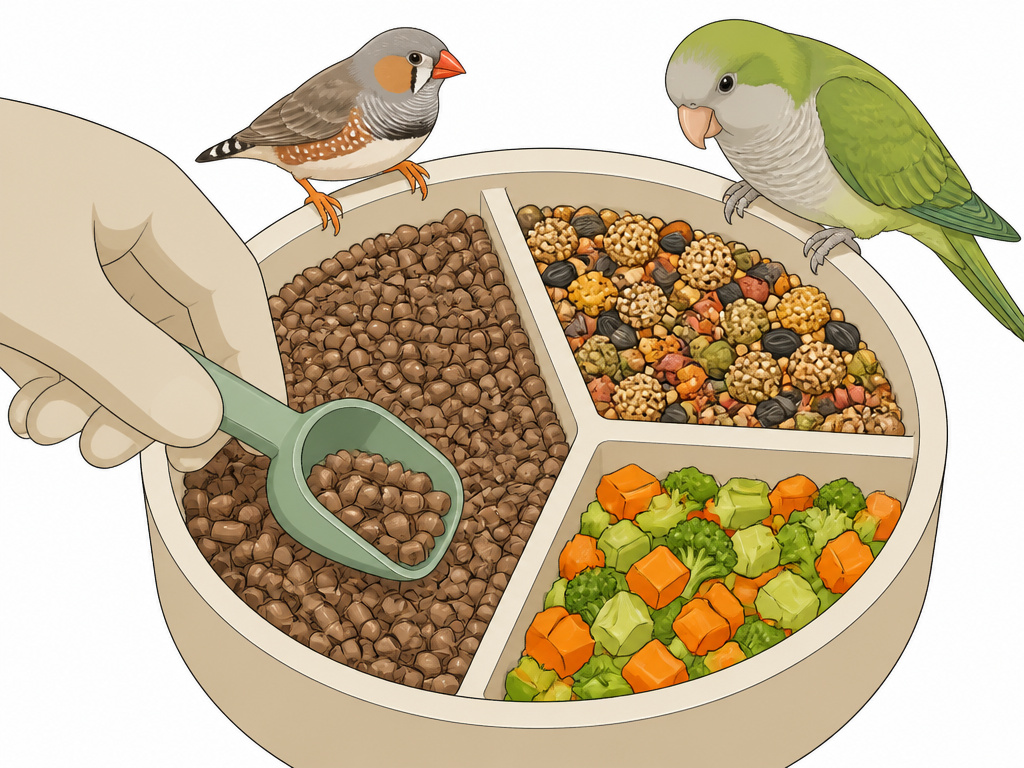
Several published answers exist, and they do not match.
The 60/20/20 Split
Lafeber’s maintenance ratio runs 60% good-quality pellets, 20% Nutri-Berries and/or Avi-Cakes or a high-quality seed mix, and 20% vegetables plus a small amount of fruit. Note that this plan keeps seed in the bowl on purpose.
The 80/20 Split
Lafeber’s alternative drops seed entirely: 80% pellets and 20% vegetables plus small fruit and nuts. Versele-Laga arrives near the same place from the other direction, capping seeds, vegetables, fruit and treats at no more than 20% of the total ration.
VCA Animal Hospitals sets a floor rather than a split, stating that pellets should ideally represent a minimum of 70% of the bird’s diet.
| Source | Pellet Share | What Else Goes In |
|---|---|---|
| Lafeber | 60% | 20% Nutri-Berries, Avi-Cakes or seed; 20% vegetables and small fruit |
| Lafeber (alternative) | 80% | 20% vegetables plus small fruit and nuts |
| VCA Animal Hospitals | 70% minimum | Remainder as produce and limited seed |
| Versele-Laga | About 80% | No more than 20% seed, vegetables, fruit or treats |
Read those side by side and the pellet percentage question stops looking like a single number. A finch keeper following VCA and a parrot keeper following Lafeber are answering different questions about different birds.
For a parrot that will not touch a bowl of pellets, Lafeber Avi-Cakes is the bridge most owners reach for. It is 50% seed and 50% pellet, so the bird is already eating half a formulated diet while it gets used to the texture.
Chewy’s guidance is to match pellet size to the bird to reduce choking risk. A balanced bird diet starts with getting that size right.
The Conversion Plan That Watches the Scale
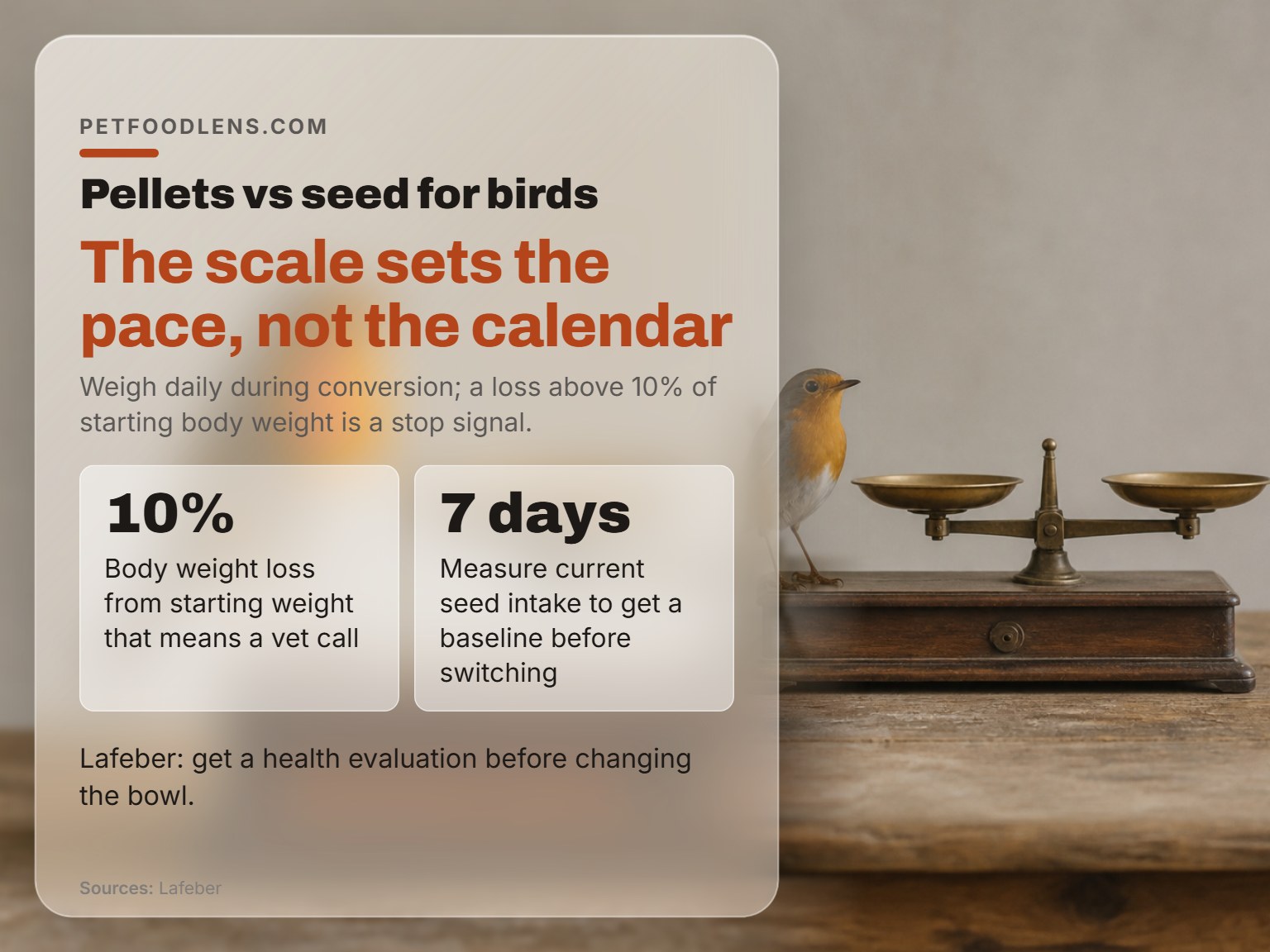
Day two. The bowl is full, the bird is on the perch, and nothing has been eaten.
I have watched the overnight swap fail more than once. The owner dumps the seed, fills the bowl with pellets, and by day two the bird is sitting on a perch eating nothing. A bird that drops more than 10% of body weight is not being stubborn. It is in trouble.
Before you start: Get a health evaluation before you change the bowl, because a bird with an underlying problem has no reserves for a diet change. Weigh daily on a gram scale and treat a loss above 10% of starting body weight as a stop signal. Watch the droppings too, since a bird eating less produces less, and that shows up before the scale moves.
The sequence below is slower than the fastest published ladder, on purpose, since the sources disagree on how long conversion takes.
- Book the vet check first. Lafeber puts a health evaluation ahead of any diet change, and that ordering exists because a sick bird will not convert.
- Weigh the bird and write the number down. Without a starting figure you cannot tell a normal dip from a refusal.
- Measure current intake over seven days. Weigh food in each morning, blow off the husks at night, weigh the leftovers, then add the seven days and divide by seven. Skip this and you have no baseline for spotting a real appetite drop.
- Start at 90% seed and 10% pellets in a bowl filled only a quarter full. A full bowl lets the bird sort without ever touching a pellet.
- Raise the pellet share by 10% a day. VCA’s ladder runs from 90/10 on day one to 10/90 by day nine, which is the fastest published schedule and not the one I would start with.
- Keep weighing daily through the whole change. More than 10% loss from the starting weight means a vet call, not another week of waiting.
On my own birds I pace it slowly, starting with a modest pellet share and stepping up as the weight holds. The scale sets the pace. The calendar does not.
The Separate-Bowl Alternative
VCA’s first method keeps pellets in a bowl of their own, offered first thing in the morning when birds are hungriest, and left available even when ignored. Seed gets weaned down over a few weeks.
Lafeber’s morning-only approach leans on the same timing. Offer only the new food in the morning, because that is when a bird wants to eat. If your bird prefers evenings, pull the old food an hour before the usual evening meal so only new food is there overnight.
Chewy’s version splits the difference: new food first thing, usual food after an hour or two, then extend the window gradually.
The 30-Minute Meal Window
Lafeber’s timed method puts the old food out for 30 minutes, three times a day, at morning, mid-day and evening, with pellets always in the dish. Shrink the seed windows as pellet intake climbs.
For ground-feeding species such as budgerigars and cockatiels, Lafeber suggests a plate of mixed old and new food on the cage floor instead of a hanging dish.
Anyone working through converting to pellets will hit the same wall around day three. Published conversion guidance exists in several forms because there is no single schedule that fits every bird.
When Is a Seed Mix Still the Right Call?
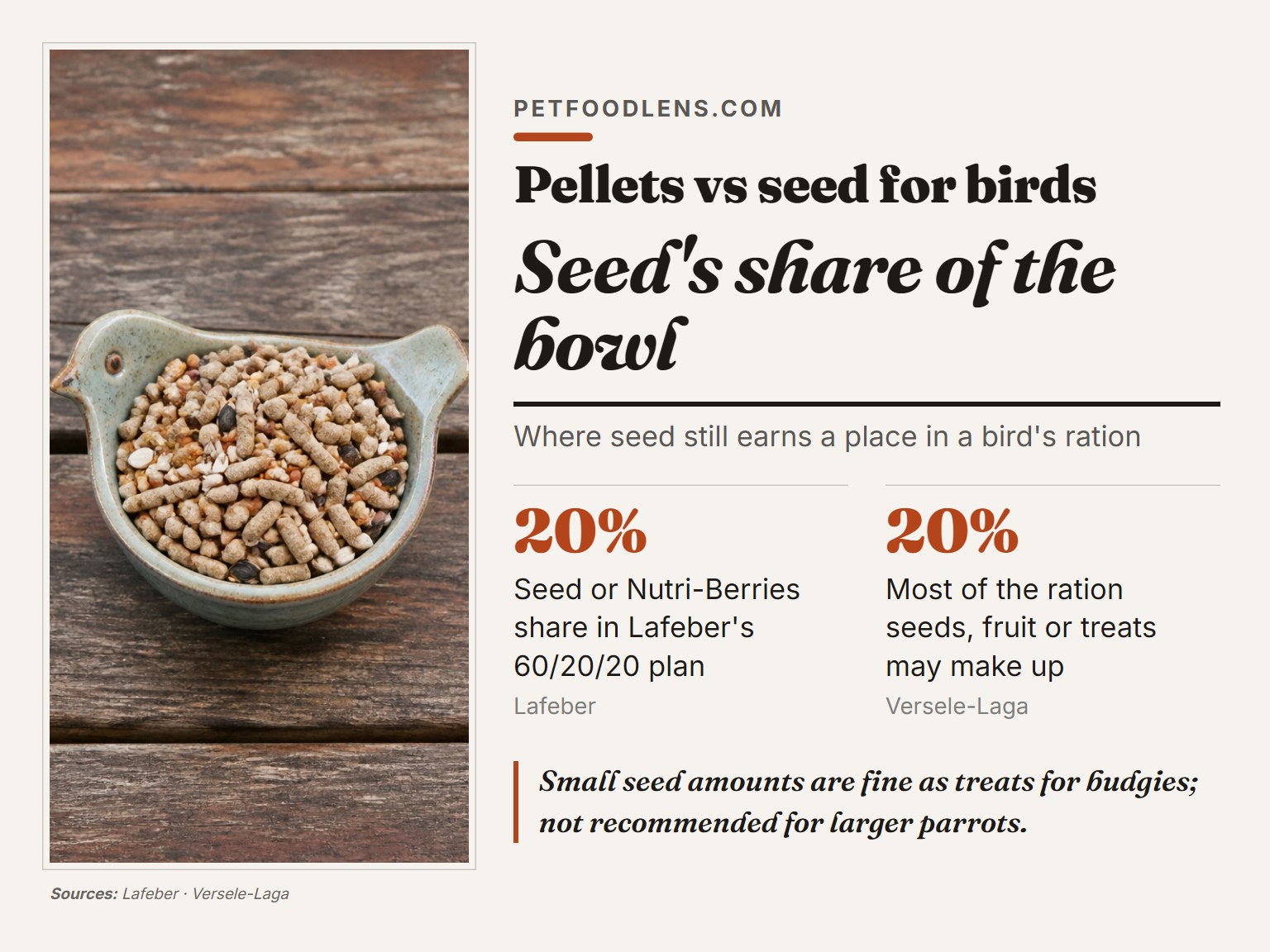
Seed has a legitimate place in a bird’s bowl.
Lafeber’s 60/20/20 plan gives seed a full 20% of the ration. Chewy quotes Kara M. Burns of the Academy of Veterinary Nutrition Technicians on why that is not just charity: seeds are enriching, because birds enjoy the work of opening and manipulating them, and that work promotes foraging behavior.
Wombaroo’s guidance runs along the same line from the breeder side. Small-seed mixes such as Budgie or Finch Mix more closely match the size and nutritional value of wild seed, and a Small Parrot Mix diluted 50/50 with Budgie Mix beats a sunflower-heavy blend.
Here is where seed earns its keep:
- As foraging work for a bird that spends too long on a perch with nothing to do.
- As a training reward, because a sunflower seed is a high-value item and a pellet is not.
- As a calcium vehicle for canaries and finches during egg-laying, where Merck recommends soluble grit such as oyster shell or cuttlebone.
- As sprouted seed, which Wombaroo notes carries more available protein, sugars and vitamins than dry seed. Soak in boiling water for 5 to 12 hours, rinse through a sieve, drain well.
Where this goes sideways: Leaving soaked or sprouted seed in the dish too long. Warm, damp seed grows bacteria and fungus fast, and a bird that eats it can go downhill quickly.
The counterweight matters. PetMD quotes Catherine Gwyer of Greyhaven Exotic Bird Sanctuary: a small amount of seed is fine as a treat for small birds like budgies, but seed is not recommended for larger birds such as African greys, Amazons, cockatoos or macaws.
A sprouted seed rotation is the best version of seed in the bowl. A canary egg food nutritional analysis in the Brazilian Journal of Poultry Science sets out the deficiency list that makes plain dry seed a weak base for a small bird.
Where the Published Advice Disagrees
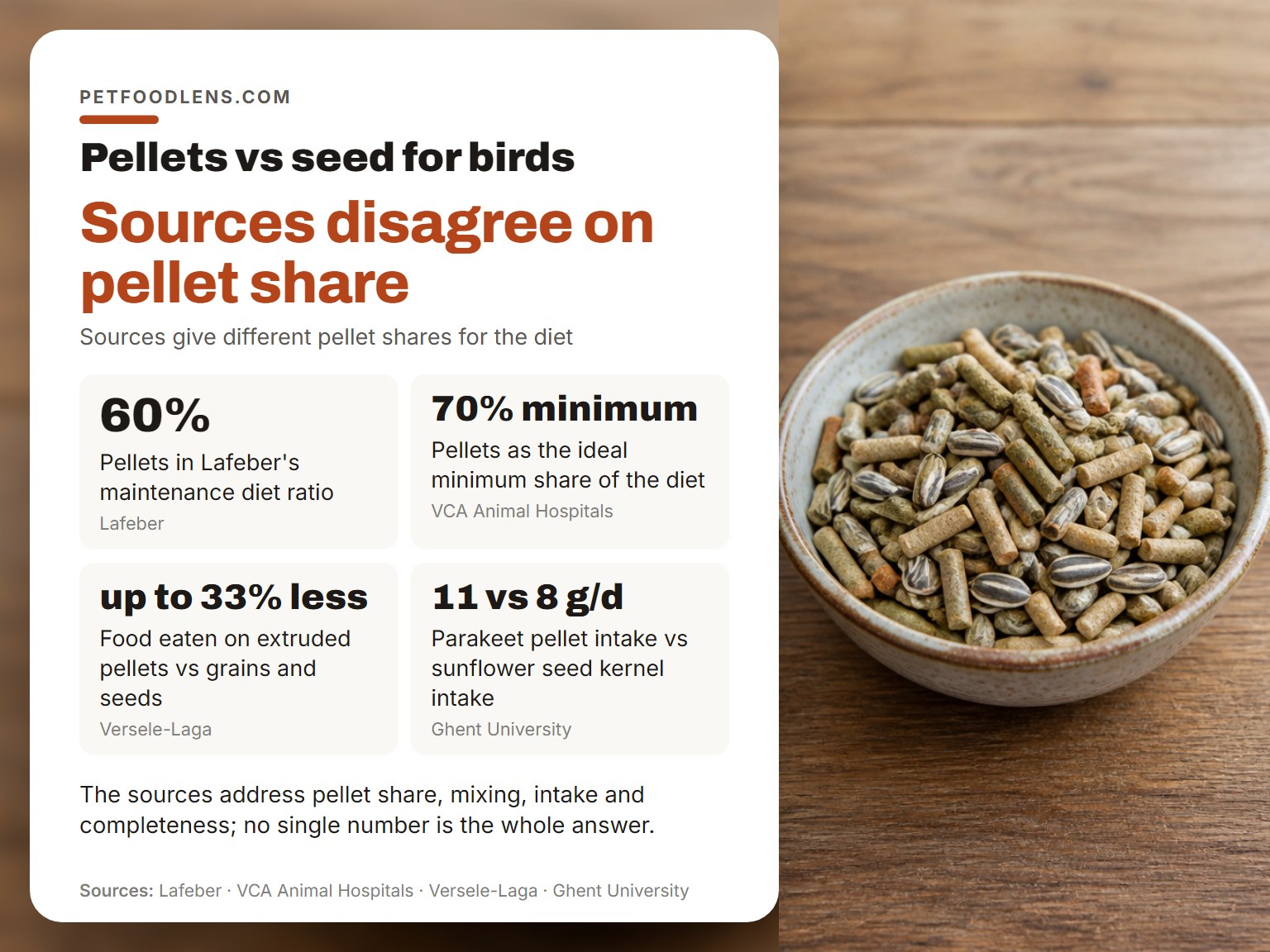
Several numbers get quoted for pellet share, and they do not match.
The conflicts are worth laying out rather than smoothing over:
- Pellet share: 60% from Lafeber, 70% minimum from VCA, roughly 80% from Versele-Laga. All three are published positions from credible sources.
- Whether to mix or keep separate: The sources disagree, VCA states flatly that pellets and seed should not go in the same bowl, then describes a method that mixes them in the same bowl at 90/10, while Lafeber suggests a mixed plate on the cage floor for ground-feeding species.
- Whether birds eat less on pellets: The sources disagree, Versele-Laga states birds eat up to 33% less extruded pellet than grain and seed, while the parakeet trial measured the opposite by weight, with higher gram intake on pellets.
- Whether pellets are complete: The sources disagree, Versele-Laga calls extruded pellets a complete food, while Lafeber’s own ratios still put 20% vegetables in the bowl and the rescue PetMD quotes adds fruit, vegetables and grains on top of the pellet meal.
- Whether supplements are needed: The sources disagree on supplements: VCA says birds eating pellets as the base diet generally need none, with calcium as the egg-laying exception, while Merck recommends soluble grit for canaries and finches regardless.
The Mixing Contradiction
The mixing question is the one that trips people up, because the same page gives both answers. VCA says not to mix pellets and seed because birds pick out the seeds, offering pellets in a separate bowl, but VCA also describes a same-bowl 90/10 ladder, and Lafeber suggests a mixed plate on the cage floor for ground-feeding species.
Lafeber’s ground-feeding exception is worth knowing. For budgerigars and cockatiels, a plate of mixed old and new food on the cage floor is the recommended route, which is neither of the two methods above.
Skip this if: Your bird is already eating pellets and holding weight. There is nothing to convert, and a needless diet change costs you a month of monitoring.
The peer-reviewed formulated diets versus seed mixtures comparison is where this debate started, and a captive Amazon parrot nutrition study asked the follow-up question about whether mixing seed, produce and pellets actually delivers a healthy diet.
Fair warning: the honest answer to the pellet-share question is that the sources disagree, and anyone who tells you otherwise is quoting one of them as if it were all of them.
Frequently Asked Questions
Can I just mix pellets into the seed and leave it?
That is the method most likely to fail for a bird that sorts. VCA warns that birds pick out the seeds they like best and leave the pellets and recommends a separate bowl first, though VCA also describes a same-bowl 90/10 ladder and Lafeber suggests a mixed plate on the cage floor for ground-feeding species. If you do mix, the bowl gets filled only a quarter full so the bird cannot sort without hitting a pellet.
How long does conversion actually take?
VCA puts it anywhere from days to weeks, or even months for a mature bird raised on seed. Lafeber describes percentage changes happening over several days to weeks. The fastest published schedule is a nine-day ladder, and it is not the schedule I would use on an older bird.
Are extruded pellets better than bound pellets?
Extruded pellets are made at high heat and pressure and tend to be more palatable. Bound pellets are not cooked, hold longer fiber chains, and can be a harder sell. Both deliver a fixed nutrient profile, which is the point of feeding a pellet at all.
Do I need to supplement a pellet diet?
The sources disagree on supplements: VCA says birds eating pellets as the base of the diet generally need none, with calcium as the egg-laying exception, while Merck recommends soluble grit such as oyster shell or cuttlebone for canaries and finches, particularly in the breeding period.
Is seed ever fine on its own?
For small birds, a small amount of seed as a treat is defensible, and Lafeber and Wombaroo allow a high-quality seed mix as part of a balanced diet, though PetMD’s sanctuary source rules seed out as the whole diet and for larger birds. Merck lists the shortfalls directly: low vitamins A, D3, E and K, a poor calcium-to-phosphorus ratio, and insufficient lysine and methionine. PetMD’s sanctuary source draws the line at small birds and rules seed out for macaws, cockatoos, Amazons and African greys.
The Bottom Line
Buy a gram scale before you buy a bag of pellets. That single piece of equipment turns the pellets vs seed mix for birds question from an opinion into something you can actually watch happen, because the bird’s weight tells you within days whether the plan is working.
One threshold to carry out of here: if the bird loses more than 10% of its starting body weight, stop the conversion and call a vet. That number comes from Lafeber and it is the one line in this whole process I would not bend.
I should be straight about my own limits. My background is commercial cat food formulation and ingredient quality, so I read a guaranteed analysis faster than I read a bird’s body condition. On a bird with kidney or liver disease, the general principles above are where my useful advice ends and a veterinarian’s diagnostic judgment takes over.
For a healthy bird, the practical version is short. Feed a pellet as the base, keep seed as work and reward rather than as dinner, and let the scale decide how fast you get there.
