
Sprouted Seed vs Dry Seed for Birds: Which Is Better?
This post contains affiliate links. As an Amazon Associate, we earn from qualifying purchases.
In the sprouted seed vs dry seed for birds question, sprouting converts stored starch to sugars, protein to amino acids, and oil to fatty acids, so the same seed delivers more available protein and less fat. Dry seed keeps longer; sprouts need rinsing every 12 to 24 hours and are ready in about 2 days.
That conversion is why a sunflower kernel that reads as pure fat on a dry-matter comparison comes out lighter after two days on a rinse cycle. The germ does the work. You keep it wet, drained, and cool enough that mould never gets a foothold.
What follows is the honest version: what changes inside the seed, the soak and rinse numbers the manufacturers actually publish (and where they disagree), and how to decide whether your bird’s bowl should hold dry seed, sprouts, or both.
Key Takeaways
- Soak times run from 5 to 24 hours depending on the source. For most mixes, 8 to 12 hours is the safe middle.
- Keep the layer under 2 cm and rinse every 12 to 24 hours. Deeper, wetter seed starves for oxygen and grows foul bacteria.
- Sprouts last about 2 days refrigerated, or 2 weeks frozen. Starting a fresh batch daily is the other valid approach.
- Dry seed still has a place. It stores for months and carries far less mould risk, though you should wash it before feeding.
What Actually Changes When a Seed Sprouts?
Germination wakes dormant enzymes inside the seed. Those enzymes break stored starch into simpler sugars, protein into amino acids, and oil into fatty acids. Nothing is added from outside; the seed rearranges what it already holds.
Germination activates enzymes inside the seed that break stored starch into simpler sugars, protein into amino acids, and oil into fatty acids. The result is a seed with more available protein and less fat than the same seed fed dry, though the size of the change depends on species and conditions.
The scale of the change depends on the seed. Benincasa’s 2019 review in Nutrients found that germination alters vitamins, amino acids, and antinutrients, but the results shift with species, method, and conditions. Buckwheat sprouted over 72 hours showed higher phenolics and lower phytic acid and trypsin-inhibitor activity. Sesame germinated for just 20 hours gained phenolics and antioxidant capacity without losing much oil.
Mung beans are the showiest case. Vitamin C climbs more than twenty-fold during sprouting while fat content falls, per the research review Pet Shop Direct cites.
For a bird, that matters most when the digestive system is still developing. Wombaroo’s technical guidance notes that young birds do not have a fully developed gut, which is why the more available protein and lower fat load in a sprout is easier to use than the same seed dry.
Think of a sprout as the same seed, partly digested before the bird touches it.
Sprouted Seed vs Dry Seed for Birds: The Head-to-Head
Compare it side by side and the trade-off is simple. Sprouting buys you digestibility and costs you shelf life.
| Factor | Dry Seed | Sprouted Seed |
|---|---|---|
| Moisture | Low; stores for months | High; fridge life about 2 days |
| Protein and fat | Higher fat, less available protein | More available protein, less fat |
| Prep time | None, though washing helps | About 2 days plus rinses |
| Mould risk | Low if kept dry | Real; needs airflow and rinsing |
| Best use | Base ration and foraging | Breeding, moult, weaning, sick birds |
The table hides one thing worth saying plainly: neither column is a complete diet on its own. The RSPCA’s position, as relayed by Pet Shop Direct, is that birds do best on a formulated base with vegetables, seed as a smaller part, and sprouts counted on the vegetable side. Breeders who sprout at volume push back on that. Royal Bird Company feeds over 100 pounds of sprouted seed, lentils, and peas a week and gives breeders very little dry seed.
So you have three positions, not two: the pellet-first camp, the sprout-first camp, and the dry-seed camp. The pellets vs seed mix argument is a separate decision from this one.
A pellet base like Vetafarm Finch and Budgie Crumbles is what the RSPCA-aligned pattern looks like in practice: crumble first, a little dry seed, sprouts and vegetables daily. That is a defensible default for a pet bird that is not breeding.
Bottom line: sprouts improve a seed; they do not replace a balanced bowl.
How Long Should You Soak Bird Seed Before Sprouting?
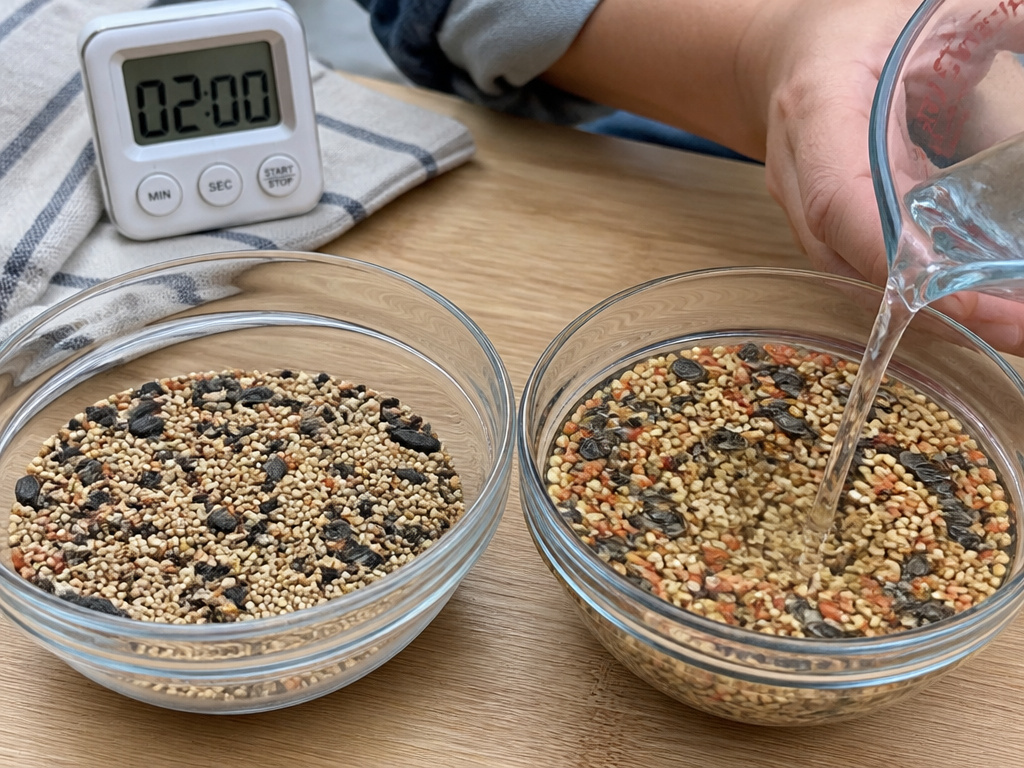
Five sources, five different soak times, and a spread that runs from 5 hours to 24. Here is what each one actually publishes.
| Source | Soak Time | Notes |
|---|---|---|
| Wombaroo (Appendix 6) | 5 to 12 hours | Boiling water first to sterilise |
| Wombaroo (sprouting guide) | 5 to 24 hours | Shorter in hot climates |
| Royal Bird Company | About 8 hours | Plain water, no boiling step |
| China Prairie | 8 to 10 hours | No more than 12 hours |
| PDS Parrot Shop | 6 to 8 hours | Up to 12 for large legumes |
The spread is real, so pick a middle and adjust for heat. I would run 8 to 12 hours for most mixes and shorten it when the room is warm. China Prairie is the strictest voice, recommending 8 hours and warning against going past 12.
One more split: Wombaroo covers the dry seed with boiling water first to sterilise it. Royal Bird Company soaks in plain water and skips that step. Both work; the boiling step just adds a margin against surface contamination.
Before you start: Wet seed is a microbial environment, and the risks are real. Mould and bacteria can grow inside the sprouting seeds if the batch is too wet or too warm, so keep the layer thin and the air moving. Wash your hands for 20 seconds before handling seed, and discard any batch that smells sour or feels slimy.
The Rinse, Drain, and Airflow Rules That Decide Success or Mould
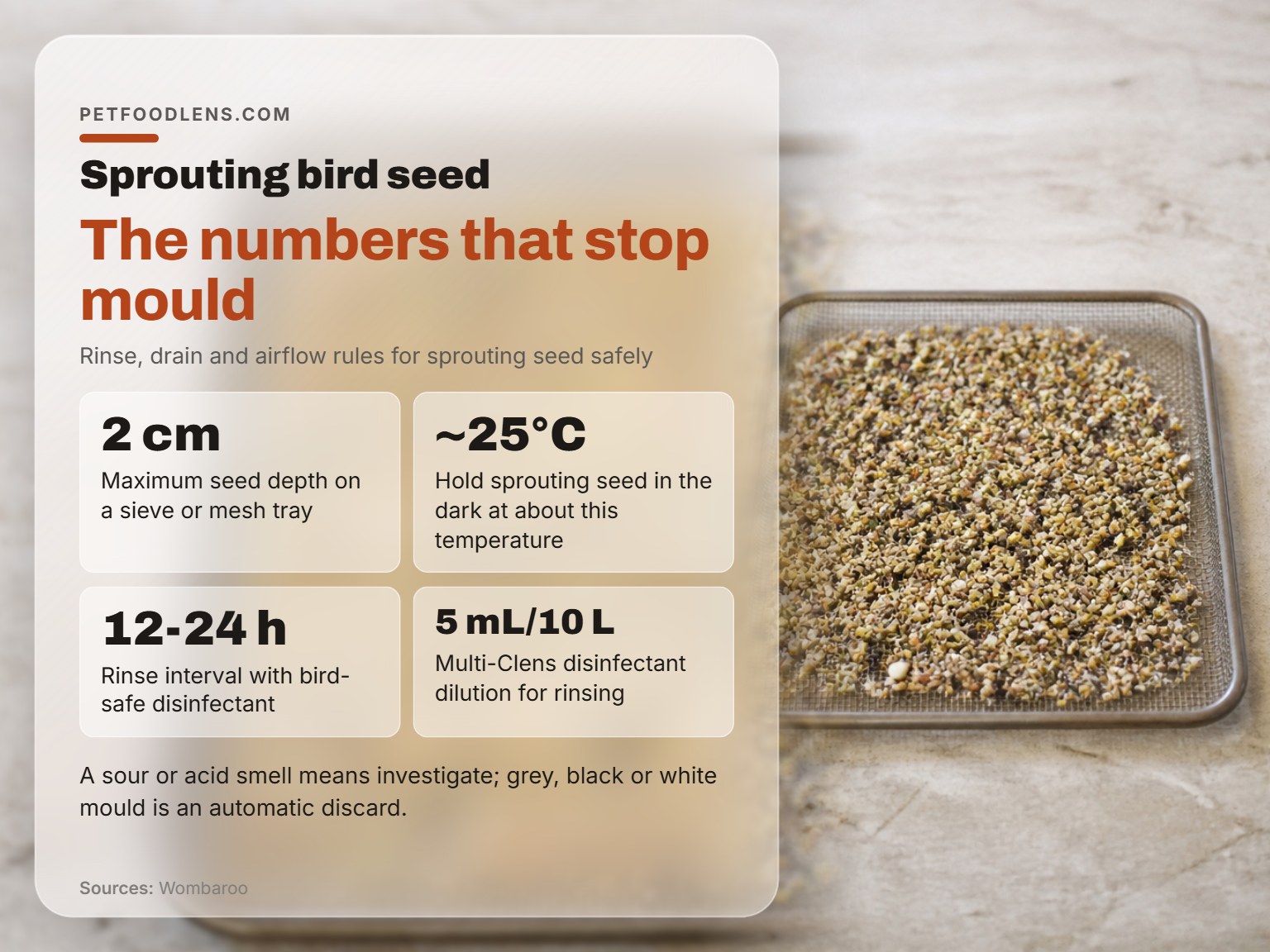
Rinsing is where most batches succeed or fail. The steps are short; the consequences of skipping them are not.
- Rinse and drain thoroughly. Leftover sugary residue feeds bacteria, and a batch that sits wet goes off within a day.
- Spread the seed no deeper than 2 cm on a sieve or mesh tray. Deeper than that and the seed packs down, oxygen starves, and foul-smelling bacteria form.
- Hold it at about 25°C in the dark. Cooler slows germination; warmer invites mould.
- Rinse every 12 to 24 hours, more often in hot climates. Wombaroo pairs the rinse with a bird-safe disinfectant.
- Feed when the tails are a few millimetres long, usually about 2 days in.
The disinfectant step has a published dose. Passwell Multi-Clens is diluted at 5 mL per 10 litres of water, and that is the rate Wombaroo specifies for rinsing sprouting seed.
The 2 cm Rule and Why Depth Matters
Depth is not fussiness. Seed piled deeper than 2 cm traps moisture and cuts airflow, and the seed in the middle runs out of oxygen. Wombaroo names the result directly: oxygen starvation in water-logged seed can produce foul-smelling, potentially toxic bacteria. A thin layer on a mesh tray keeps air moving through the whole batch.
Not every source rinses the same way. China Prairie argues that rinsing can itself introduce contamination if the water is not pure, and recommends rinsing twice daily only when you trust your water. Wombaroo rinses aggressively with disinfectant. The soaking and rinsing seeds schedule is where that difference actually shows up.
Wet seed is a disease vector as well as a mould risk, and researchers have examined how pathogens behave on soaked birdseed. That is one more reason the rinse schedule matters.
Where this goes sideways: A batch that smells sour or acid, rather than earthy, has a problem. China Prairie treats a wet-leather smell as normal and a sour smell as a signal to investigate, and any grey, black, or white mould is an automatic discard.
Which Seeds Sprout, and Which Just Sit There
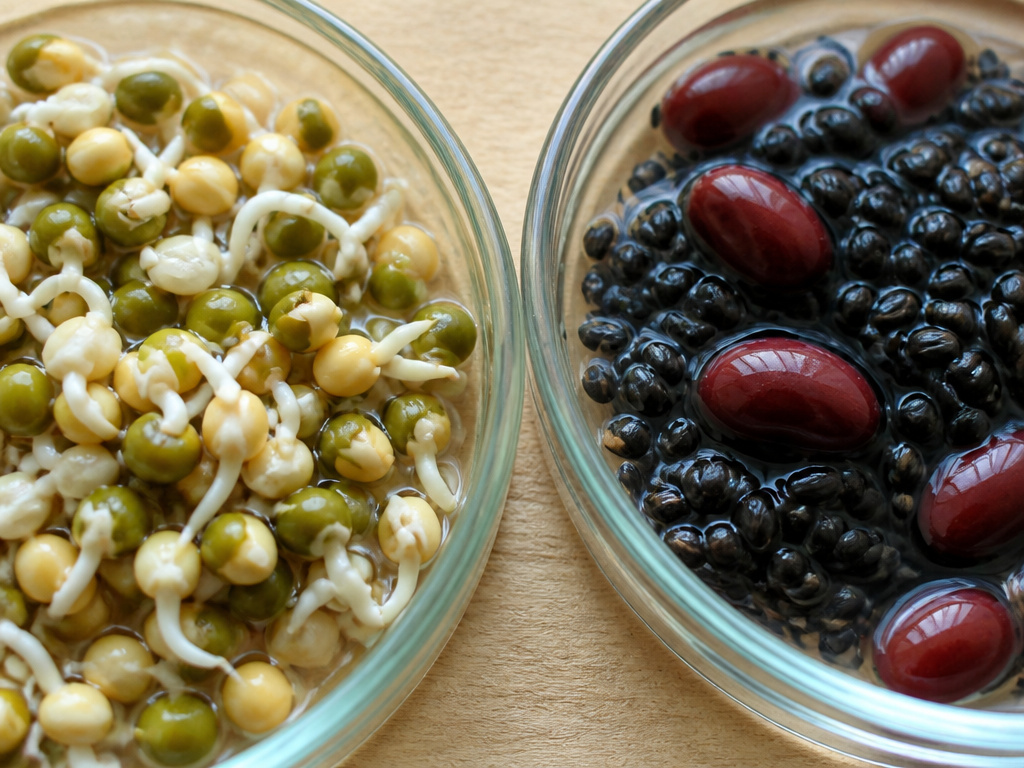
Niger, kidney beans, and old seed are the three that most often fail. Not every seed in the bag will germinate, and the ones that do not are the ones most likely to spoil. AFA Watchbird makes the point plainly: use seed with the highest germination rates, because ungerminated seed is what rots first.
- Millet, canary grass, sunflower, safflower, and most small seeds sprout readily.
- Legumes like mung beans and lentils sprout fast, often within a day or two.
- Kidney beans should never be sprouted for birds; they are toxic raw.
- Heat-treated imported niger will swell and then sit there, because the heat killed it.
The legumes for birds question deserves its own pass, since bean sprouting times differ from grain times. The same goes for whole grains for birds, where grain size changes how long the soak and rinse cycle runs.
Why Niger and Heat-Treated Seed Won’t Sprout
Most niger sold in Australia is imported and heat-treated on entry, so it will not germinate. Australian-grown niger is sprouting grade, and that is the version worth buying if you want sprouts rather than seed. The A Closer Look at Sprouts article still lists niger as a usable seed, but flags it as high in fat and best offered in small quantities, since excess can cause liver problems.
Garden seed is a separate trap. Sprouting seed has not been treated with fungicides, unlike garden seed, and planting seed may carry chemical or pesticide treatment. Buy seed labelled for human consumption or specifically for sprouting.
Easy to miss: A bag of seed more than half a year old loses viability. AFA Watchbird advises against buying packages older than that, because old seed sprouts poorly and the ungerminated fraction is what spoils.
Where Dry Seed Still Wins
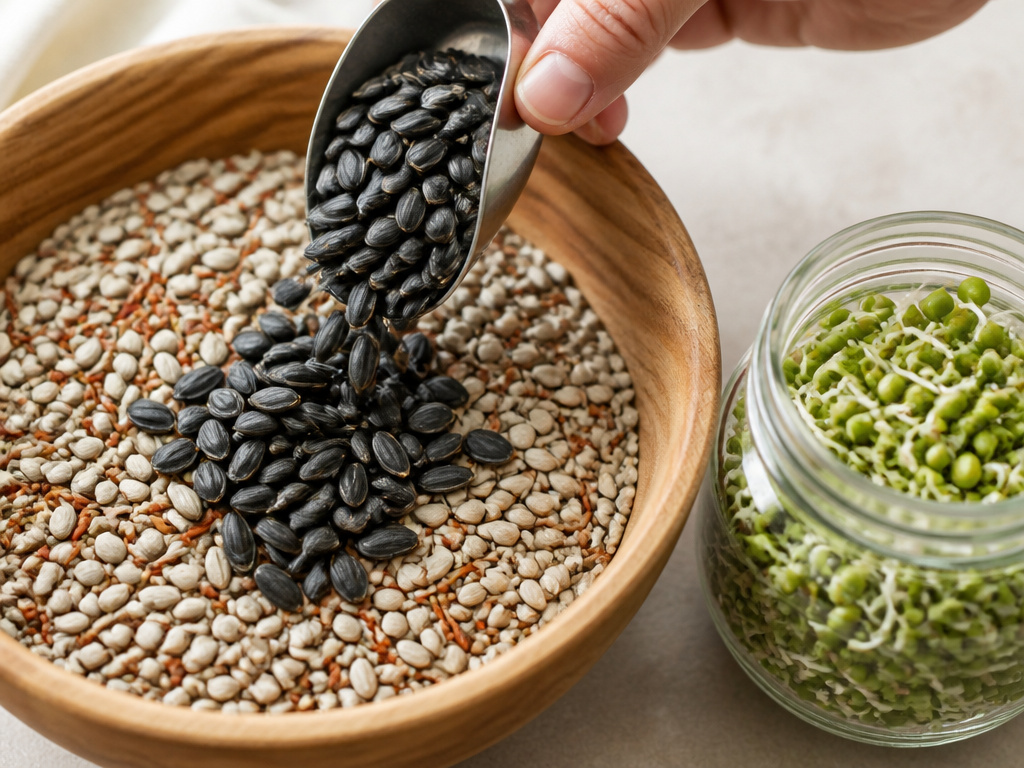
Dry seed is not the villain here. It stores for months, needs no rinsing, and carries far less mould risk than a wet batch. If your week is busy, dry seed is the practical base and sprouts are the occasional upgrade.
The fat numbers explain why that matters for some species. Per 1 ounce, dried sunflower kernels run 14.06 g of fat and 6.46 g of protein, according to USDA Handbook 8 figures. Safflower kernels come in at 10.91 g of fat and 4.59 g of protein per ounce. A bird that picks out the sunflower is eating mostly fat.
There is one hard rule about what you can sprout. Vitamin-coated or pelleted mixes must not be soaked or sprouted, because the pellets turn to mush and the added vitamins wash away and can turn rancid. Royal Bird Company is blunt about this, and it is the kind of thing a label will not warn you about.
Species matter too. Amazons tend to get over fat, so dry high-fat seed needs limiting for them. African Greys are the opposite case, and Royal Bird Company gives about an ounce of washed and soaked seed in the evening for the extra fat.
If you feed dry seed, at least wash it. Royal Bird Company rinses dry seed to remove dust and debris before feeding, and argues that opening a bag and pouring it straight into a bowl is not a good diet.
Skip this if: You are feeding a vitamin-coated pellet mix. Soaking it destroys the coating and the pellets, and you end up with a mushy, rancid bowl that is worse than dry.
The seed-based diet is what most bird owners actually run, and it is worth knowing how to improve it rather than abandoning it. A seed-only diet is the version to avoid, and the risks are well documented.
How Much Sprouted Food, and How Long Does It Keep?
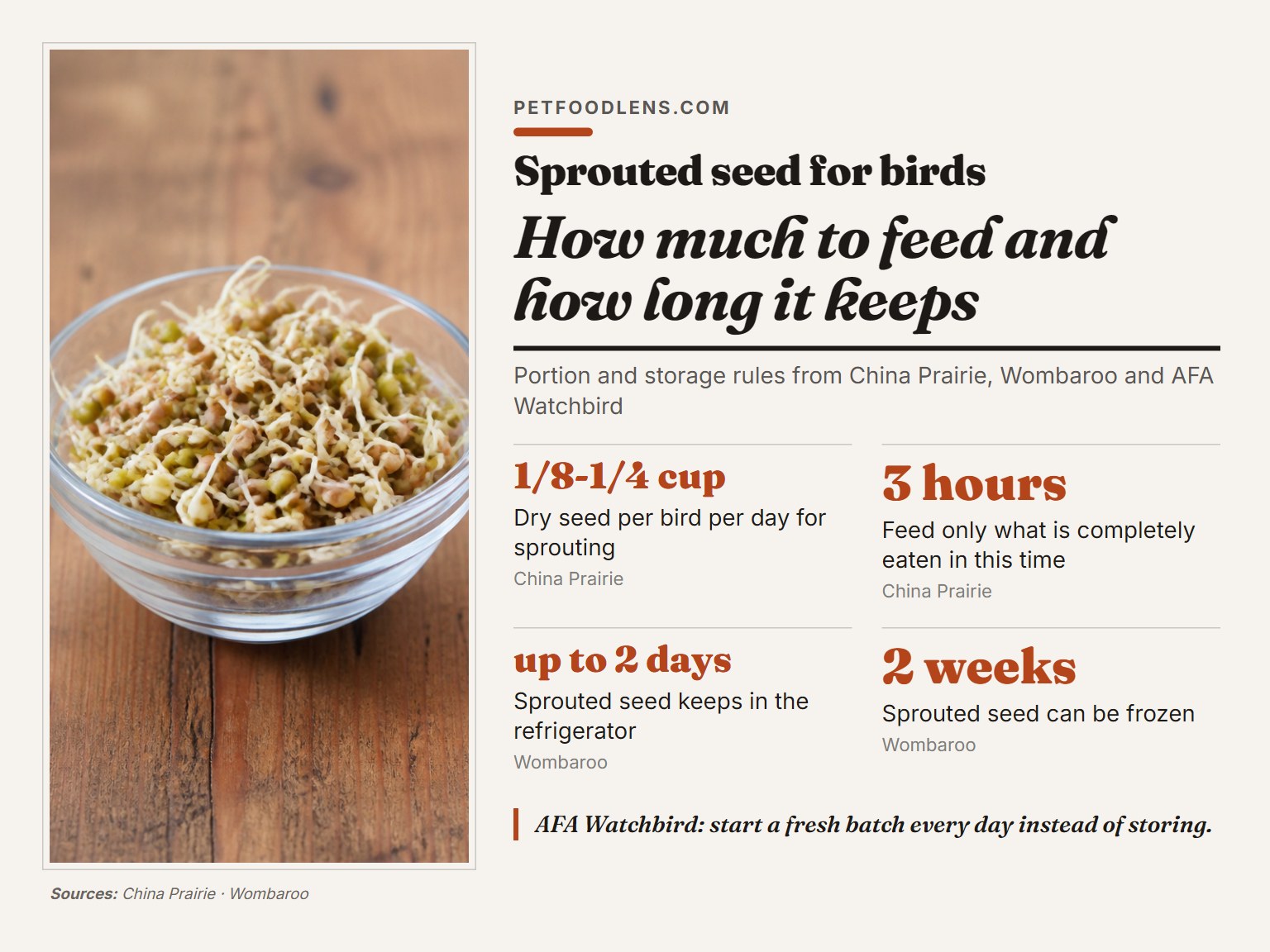
A quarter cup of dry seed per bird per day is the starting point China Prairie gives for a Grey-sized bird, with 1/8 to 1/4 cup as the general range. Portion control matters more with sprouts than with dry seed, because wet food spoils fast.
Feed only what the bird will finish. China Prairie’s rule is an amount completely eaten in three hours, assuming twice-daily feeding, and taking up the bowl after two to three hours if you can.
Storage is where the sources split again. Wombaroo says sprouted seed keeps in the refrigerator for up to two days, or frozen for two weeks. AFA Watchbird takes a different line: start a fresh batch every day, which sidesteps storage entirely.
Fridge, Freezer, or Fresh Batch Daily?
Both approaches work, and the choice is about your routine. If you sprout in small batches, the daily-fresh method is simplest and carries the least risk. If you sprout in volume, refrigerate for up to two days and freeze the surplus for up to two weeks.
The sensory test beats the calendar. Fresh sprouts smell earthy and clean, like wet grain. A batch that feels slimy or smells sour is done, regardless of how long it has been in the fridge.
For the broader picture on storing fresh bird food, the same rules apply: cold, dry, and short. Dry seed is more forgiving, and storing bird seed properly means keeping it cool, dry, and insect-free. If you find moths or grain weevils, freeze the product for at least three days.
Frequently Asked Questions
Is sprouted seed better than dry seed for birds?
Sprouted seed is more digestible and carries more available protein and less fat, which is why Wombaroo calls it nutritionally superior to dry and soaked seed. It is not a complete diet on its own, and the RSPCA pattern treats it as part of the vegetable portion. Dry seed stores longer and carries less mould risk.
Can I sprout any bird seed mix?
No. Vitamin-coated and pelleted mixes should never be soaked or sprouted, because the pellets break down and the vitamins wash away. Kidney beans are toxic raw and should not be sprouted at all. Heat-treated imported niger will swell but never germinate.
How do I know if sprouts have gone bad?
Smell and touch are the tests. Fresh sprouts smell earthy and clean, like wet grain. A sour or acid smell, a slimy feel, or any grey, black, or white mould means the batch is finished. China Prairie treats mould or sliminess as an automatic fail.
How long do sprouted seeds last?
Wombaroo gives up to two days in the refrigerator or two weeks frozen. AFA Watchbird’s method starts a fresh batch every day instead. Whichever you choose, discard anything that smells sour or feels slimy.
Do I need a disinfectant to sprout seed?
Wombaroo recommends one, using chlorhexidine at 5 mL per 10 litres of water, with Passwell Multi-Clens as the example product. China Prairie takes the opposite view and argues rinsing with impure water can introduce contamination, so it recommends rinsing twice daily only if the water is pure.
The Bottom Line
Here is the practical takeaway: if your bird is a healthy adult on a decent base diet, sprouts are an upgrade you can run a few times a week, not a daily obligation. If your bird is breeding, moulting, weaning, or recovering, sprouts earn their place in the bowl every day.
Start with one batch this week. Soak 8 to 12 hours, spread it no deeper than 2 cm, rinse every 12 to 24 hours, and feed when the tails are a few millimetres long. If it smells sour, throw it out and start again.
None of this fixes a seed-only diet. That is the bigger lever, and the whole sprouted seed vs dry seed for birds calculation only matters once the base bowl is sorted.
I would rather see a bird on a plain pellet base with a spoon of fresh sprouts than on an expensive seed mix dressed up with marketing. The bowl tells you more than the bag ever will.
