
How to Feed a Budgie: What the Numbers Actually Say
This post contains affiliate links. As an Amazon Associate, we earn from qualifying purchases.
The honest answer to how to feed a budgie is a formulated pellet base, not seed. Veterinary sources disagree on the pellet share: the RVC puts it at 80 percent, VCA at 60 to 80 percent, and PetMD at 60 to 70 percent, with the rest split between fresh vegetables and a measured amount of seed. Harrison’s High Potency Fine or Superfine is the pellet the RVC names by product.
That “formulated” word carries the weight. A pellet is grains, seeds, vegetables, fruit, and protein bound together with added vitamins and minerals, so a budgie can’t sort through the dish and eat only the bits it likes. A loose seed mix lets it do exactly that, and that is the main point of the how to feed a budgie question.
What follows is the bowl broken into its three parts, the places where the veterinary sources flatly disagree, and a conversion path for a bird that has eaten seed for years.
Key Takeaways
- Pellets are the base of the bowl. The Royal Veterinary College puts them at 80 percent of the diet, VCA says 60 to 80, and PetMD says 60 to 70.
- Seed gets rationed, not banned. The Association of Avian Veterinarians recommends free-choice pellets plus a daily meal-fed seed ration for budgies, because pelleted-only diets carry a kidney risk in small parrots.
- Produce has a clock on it. VCA allows a couple of hours in the cage, PetMD a few hours, and the AAV caps cooked food at one hour.
- A thumbnail of food equals a dinner plate for a person. That’s VCA’s scale, and it reframes every treat decision you make.
- No regulator certifies avian diets. “Complete Avian Nutrition” on a bag is a marketing line, not a certification.
What a Budgie Bowl Should Look Like
Three components, in this order of volume: a pellet base, fresh vegetables, and a small measured ration of seed.
Pellets and crumbles are a formulated mix of grains, seeds, vegetables, fruits, and proteins with added vitamins and minerals. Because the ingredients are bound together rather than offered loose, a bird cannot selectively eat only the pieces it prefers, which is the mechanism that makes a pellet base more reliable than a seed mix.
That mechanism is the whole argument. Budgies pick favourites. VCA notes they will selectively eat one or two seed types out of a mix and go for millet first every time. A dish of two to eight different seeds can look varied and still deliver a narrow, fatty slice of the nutrient range.
| Source | Pellets | Produce and treats | Seed |
|---|---|---|---|
| Royal Veterinary College | 80% of diet | remainder, plus sprouted seed | treats and training only |
| VCA Animal Hospitals | 60-80% of diet | 20-25% maximum | very small part, never the whole diet |
| PetMD | 60-70% of diet | 30-40% total, 10% max treats | not specified |
| Assoc. Of Avian Veterinarians | free choice | 25% or less | daily meal-fed ration |
Read that table twice. The spread is real, and none of these sources is careless. RVC, a veterinary teaching hospital, lands on a flat 80. VCA gives a range. PetMD sits lower still. Building a bowl somewhere in the middle of that spread and letting your vet narrow it is a defensible position.
There are more than 8,000 species of birds alive today, and the UF/IFAS pet bird nutrition publication notes there will probably never be one ideal diet for all of them. Budgies are a narrow slice of that problem, which is why the numbers above are worth more than the general advice you’ll find on a bag.
Portion control is where most of this falls apart. VCA’s scale is the one to memorise: a thumbnail-sized amount of food for a budgie is the equivalent of a dinner-plate portion for a person. If you’re working out portion sizes for the first time, start there before you touch the ratios. And if the three-part split feels abstract, the mechanics of a balanced bird diet are worth reading once before you build a weekly menu.
A budgie hulls every seed it eats and drops the empty shell straight back into the dish. The bowl looks full at a glance while the bird has eaten almost nothing. That’s why weighing the dish beats eyeballing it, and why a “full” bowl is one of the least reliable things in the cage.
Do Budgies Need Pellets or Can They Live on Seed?
Commercial seed mixes generally contain two to eight different types of seed, and almost none of them carry the vitamins a budgie needs in a usable ratio.
The AAV is blunt about the composition: seed and grain diets are high in fat and low in vitamins, minerals, and protein. The AAV goes further and states that seed and grain diets, though cheap and common, continue to result in malnutrition. Feeding seed as the base of the bowl isn’t a style choice. It’s a nutrient gap that shows up later.
The pellets versus seed mix comparison comes down to what the bird can’t do with a pellet: pick it apart. A pellet forces the whole formulation down in one bite. A seed mix hands the bird a menu and lets it order the same thing every night.
I’d rather see a bird on free-choice pellets with a measured seed ration than on a bowl of seed with three pellets buried in it. The first bird is getting vitamins. The second bird is getting millet and calling it dinner.
Here’s the part that gets skipped, and it’s the most important line here. The AAV specifically flags small parrot species, especially budgerigars, as prone to kidney problems on a pelleted-only diet. Their recommendation for this species is free-choice pellets plus some seeds meal-fed each day. That sits awkwardly beside RVC’s “seed only as treats” and VCA’s “very small part,” and you should know that before you pick a side.
Where this goes sideways: Pulling every seed out of a budgie’s dish on day one. The AAV’s kidney caveat exists precisely because this species doesn’t do well on pellets alone, so the target is free-choice pellets plus a daily measured seed feed, not zero seed.
Millet deserves its own note. VCA puts millet spray or branches at small quantities once or twice a month, because it’s the seed budgies choose first and one of the least nutritious. If you want the detail on millet for budgies, that’s a separate conversation. Short version: it’s a training tool, not a staple.
The risks of a seed-only diet are cumulative and quiet. A budgie on seed alone doesn’t collapse. It thins out, dulls, and develops the kind of problem you notice at the vet rather than at the dish.
How Much Produce, and How Long Can It Sit in the Cage?
A dish of chopped kale and grated carrot goes in the morning. By the afternoon it has wilted into a warm green mat, and the bird stopped touching it hours ago.
The share of the diet that produce should occupy is another place the sources don’t agree. VCA caps fruits and vegetables at 20 to 25 percent maximum. PetMD puts treats, vegetables, and fruit at 30 to 40 percent combined, with no more than 10 percent as treats. The AAV says healthy table foods should be 25 percent or less. The three figures differ, VCA caps fruits and vegetables at 20 to 25 percent, PetMD puts treats, vegetables, and fruit at 30 to 40 percent combined with no more than 10 percent as treats, and the AAV says healthy table foods should be 25 percent or less, but none of them says “free access.”
| Food type | Maximum time in the cage | Source |
|---|---|---|
| Cooked food | 1 hour | AAV |
| Fruit and vegetables, warm room | a couple of hours | VCA |
| Fresh produce, general | a few hours | PetMD |
| Dry pellets and crumbles | available all day, replaced daily | Merck / PetMD |
If you wouldn’t eat it after sitting out on the kitchen counter, don’t leave it in the cage. A budgie’s cage runs warmer than your counter and the dish is smaller.
Produce past its window smells faintly fermented, sweet turning sour at the edges, and that’s the point where a bird quits it. You’ll usually smell it before you see it.
Preparation matters as much as timing. VCA says fruits and vegetables must be washed thoroughly to remove chemicals and cut into pieces sized to the bird. PetMD adds that pits and seeds come out before anything goes in the dish. A full list of safe fruits and vegetables is worth keeping on the fridge.
RVC includes a small amount of sprouted seed in the remainder of the diet alongside vegetables. If you haven’t used it before, the difference between sprouted seed and dry seed is significant enough to read up on first, mostly because sprouted seed is a fresh food with a fresh food’s clock on it.
Easy to miss: Produce left in all day because “the bird grazes.” Merck notes fresh food shouldn’t be left too long in the cage because it goes bad, and PetMD says to discard the previous day’s leftovers when you put out the new portion. A grazing dish is a spoilage dish.
The Conversion Problem: Getting a Seed Junkie Onto Pellets
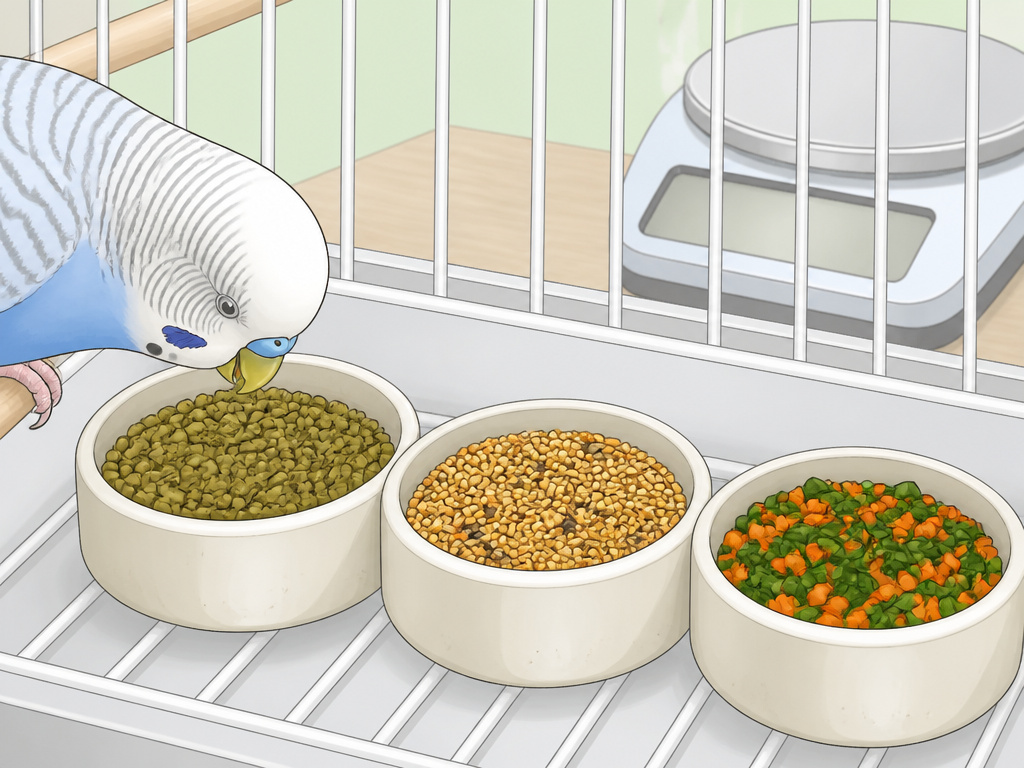
Converting an adult budgie off seed is the hardest part of this whole article, and VCA says plainly that mature birds can be challenging to convert.
Before you start: Two hazards sit around this process rather than in it. Non-stick cookware heated near a bird releases an odorless, colourless gas that PetMD lists as a hard no, and avocado appears on the AAV’s toxic list. Move the bird out of the kitchen before you cook, and keep the conversion slow enough that you can track the bird’s weight as you go.
The lesson I carry from years of adjusting diets is to change one variable at a time. Every time I’ve changed a food and a portion size in the same week, I couldn’t tell you which one produced the result. Same rule here: change the pellet-to-seed ratio, or change the produce, but not both in the same week.
Week One: Mix, Don’t Swap
- Put the pellet in beside the seed, not instead of it. A separate dish lets you see what the bird actually eats, and lets you pull the pellet back out if it spoils untouched.
- Keep the seed ration measured and visible. AAV’s model is a daily meal-fed ration, so the bird learns that seed arrives on a schedule rather than sitting there all day.
- Add chopped vegetables to a third dish. PetMD recommends separate dishes for dry food, fresh food, and water, and separate dishes also tell you which item the bird is avoiding.
- Track weight and droppings, not enthusiasm. A bird that picks at pellets but holds weight is converting. A bird that drops weight is not, regardless of what the dish looks like.
Skipping step four is how people lose birds. Budgies hide weight loss well, and a bird that looks active can be losing weight before anyone notices.
Reading the Droppings and the Scale
Droppings change when the diet changes, and that’s expected in the first days. What you’re watching for is a change that doesn’t settle, or a bird that goes quiet and stops eating. VCA notes that seeds should never be the entire diet, so keep seed in the bowl until the bird is confirmed eating pellets and produce, which is a much higher bar than “it tried a pellet.”
When to Call the Vet Instead
The AAV recommends performing a diet conversion with the help of an avian veterinarian, and Merck adds that a bird which doesn’t eat well should be checked to rule out illness. If your bird stops eating well, that’s a vet call, not a patience problem. A picky bird is a different animal from a sick one, and only a vet can tell you which you have.
The full mechanics of switching to pellets run longer than this section can hold, but the shape is always the same: slow, measured, and reversible.
What Never Goes in the Bowl
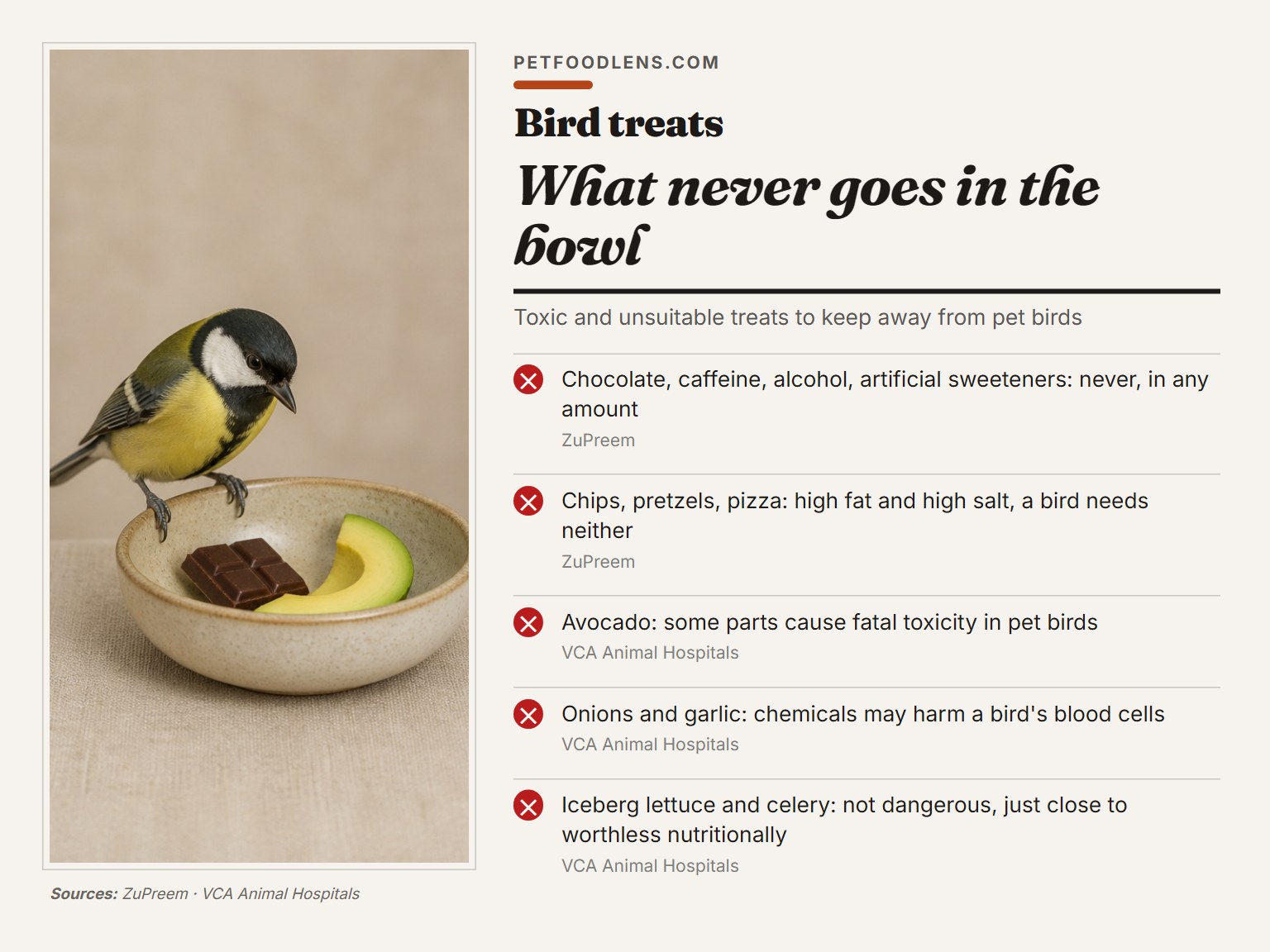
Chocolate, alcohol, caffeine, avocado, and heavily salted food are the five the AAV lists as must-avoid, and VCA names the same group in almost the same words.
- Salty snacks. Chips, pretzels, and popcorn are on VCA’s never-feed list. A budgie’s entire portion is thumbnail-sized, so even a small taste of a salty snack is a large dose.
- Dairy. VCA notes birds are lactose-intolerant and dairy should only ever be in moderation.
- Processed food and anything cooked in butter or oil. VCA rules both out directly.
- Honey sticks. VCA states most avian veterinarians don’t recommend them at all. They’re seeds bound with sugar and honey, which is candy with a beak-sized wrapper.
- Anything from your plate cooked in fat. Same rule as above, and it catches more food than people expect.
The AAV adds one more that isn’t a food at all: don’t put vitamins, supplements, or juice in the water unless a vet directs it. It encourages bacterial growth and can make the water unpalatable, which is a roundabout way of causing the problem you were trying to prevent.
Water, Bowls, and the Boring Stuff That Actually Matters
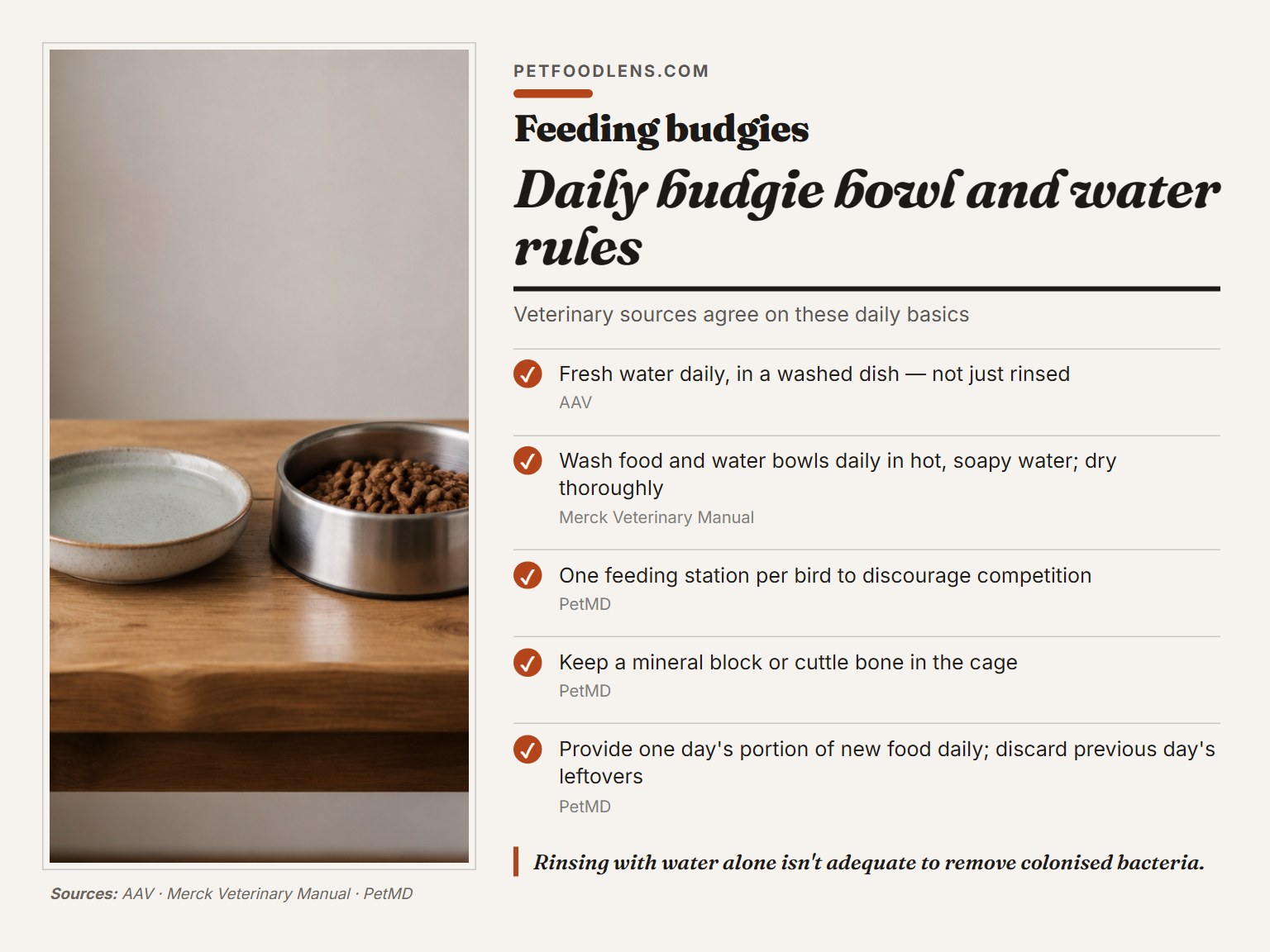
Nobody photographs the water bowl, and it’s where a lot of quiet problems start.
All four veterinary sources agree here, which is rare in this piece. Water should be available at all times and changed daily. RVC adds a shallow saucer for bathing alongside the drinking water. Merck recommends washing food and water bowls in hot, soapy water and drying them thoroughly, every day.
The AAV is the strictest on method: rinsing with water alone isn’t adequate to remove colonised bacteria, so dishes need soap and hot water or a dishwasher run. That’s a small difference in effort and a meaningful difference in what grows in the dish.
A daily routine that covers it:
- Fresh water in, old water out, every morning, in a dish you’ve actually washed rather than rinsed.
- One feeding station per bird. PetMD recommends this specifically to discourage competition when more than one budgie shares a cage.
- A mineral block or cuttle bone kept in the cage as a calcium and trace-mineral source, per PetMD.
- Dry food replaced daily, with the previous day’s leftovers discarded rather than topped up.
PetMD prefers filtered tap water or bottled spring water, which is a reasonable default if your tap water tastes strongly of anything. If you’re still working out a feeding schedule around work and sleep, the daily rhythm matters more than the exact hour.
Which Pellet, and How Do You Read the Bag?
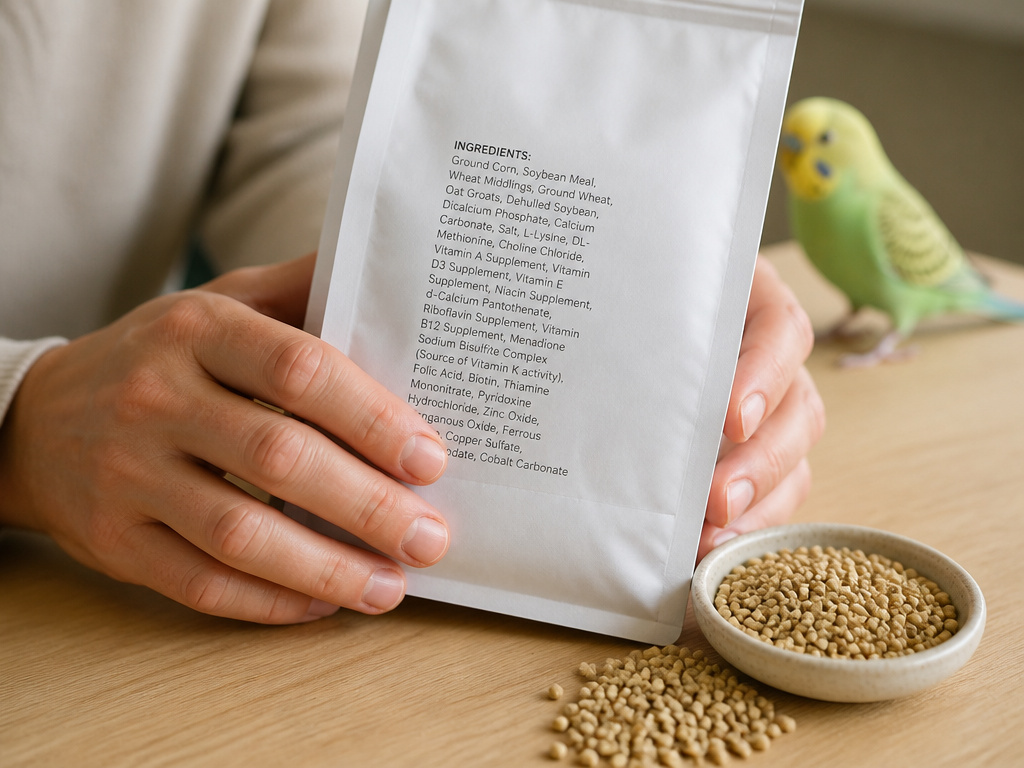
Flip the bag over. The front of a bird food package is marketing, and the back panel is the only part with anything checkable behind it.
RVC names Harrison’s High Potency Fine or Superfine by product, which is unusually specific for a veterinary handout and worth taking seriously. The Fine and Superfine sizes are the ones the RVC names for budgies. The AAV’s advice is simply to ask your veterinarian which pelleted diet is best for your bird.
Here’s the part the front never mentions. VCA states that no regulatory body certifies avian dietary products, which means a bag claiming “Complete Avian Nutrition” is making an unverified claim. There’s no AAFCO-style adequacy statement to check on the back of a bird food bag the way there is on cat food. That absence is the single biggest difference between reading a bird label and reading a cat label.
I’d skip the dyed fruit-and-nut blends. The colour and the dried fruit chunks are there for the person holding the bag. A plain, undyed pellet with a short ingredient list tells you more about what the bird is actually getting.
What to look for instead: a named manufacturer with a species-specific line, a pellet size matched to a budgie rather than a macaw, and a formulation your vet recognises. That’s a thinner checklist than you’d get with cat food, and pretending otherwise would be dishonest.
Frequently Asked Questions
Can a budgie live on seed alone?
No. VCA states seed should never be the entire diet, and the AAV notes seed and grain diets continue to result in malnutrition because they’re high in fat and low in vitamins, minerals, and protein. A seed-only budgie survives for a while and then develops problems that are expensive to treat.
How much of a budgie’s diet should be pellets?
The sources give three answers. RVC says 80 percent, VCA says 60 to 80 percent, and PetMD says 60 to 70 percent. Aim for the middle of that range, then let your vet adjust based on the individual bird.
Should I put vitamins in the budgie’s water?
Not unless a veterinarian tells you to. The AAV warns that adding vitamins, supplements, or juice to drinking water encourages bacterial growth and can make the water unpalatable, which can put a bird off drinking entirely.
How long can vegetables stay in the cage?
VCA says no more than a couple of hours, particularly in warm weather. PetMD says to discard fresh produce within a few hours. The AAV allows one hour for cooked food. VCA says no more than a couple of hours, PetMD says discard within a few hours, and the AAV allows one hour for cooked food; treat the shortest window as your default and you won’t go far wrong.
Do budgies need some seed even on a pellet diet?
For this species, the AAV suggests yes. They flag budgerigars as prone to kidney problems on a pelleted-only diet and recommend free-choice pellets plus a daily meal-fed seed ration. That’s the AAV’s position, which differs from the RVC’s “seed only as treats” and VCA’s “very small part” advice, and it applies to budgies more than to most parrots.
The Bottom Line
If your budgie already eats pellets and picks at vegetables, most of this article is maintenance. Feed the bowl, wash the dish, change the water, and stop reading diet articles for a while.
If the bird has eaten seed since before you got it, treat the conversion as the actual project and everything else as background noise. The trigger to stop and call an avian vet is simple: droppings that change and don’t settle, or a bird that goes quiet and stops eating. That isn’t a phase. That’s a bird losing weight it can’t afford to lose.
One concrete first step for this week: put a small dish of Harrison’s High Potency Fine next to the existing seed dish and change nothing else. Watch for a week before you touch the ratio. If the bird ignores it completely, you’ve learned something useful and lost a few grams of pellet.
