
How to Report a Pet Food Illness: Step by Step
This post contains affiliate links. As an Amazon Associate, we earn from qualifying purchases.
To report a pet food illness, file an electronic complaint through the FDA Safety Reporting Portal and include the exact product name, lot number, best-by date, UPC, and your vet’s diagnosis and records. Save the original packaging and stop feeding the suspect food. FDA can’t pay for private lab testing or reimburse vet costs.
The lot number is the field that decides whether your report does anything. FDA uses it to pin down the manufacturing plant and the production date, which is how one complaint gets tied to every other bag off the same run.
What follows is the field list FDA actually asks for, the three intake routes that don’t agree with each other, and where Vet-LIRN comes in when your vet wants testing done.
Key Takeaways
- Stop feeding the suspect product first, then report. FDA says not to feed it to your pet or any other animal, and to store the rest in its original packaging.
- The lot number sits next to the best-by date, usually as a mix of letters and numbers, and it’s the field that identifies plant and production date.
- Three intake routes exist, and the sources disagree on which to use: the Safety Reporting Portal (FDA’s complaint page), a CVM complaint coordinator line (FoodSafety.gov), and the Reportable Food Registry route through state feed control (FDA’s video).
- FDA’s complaint page says it can’t pay for private lab testing or reimburse vet bills, while Vet-LIRN says it can cover certain testing costs when investigating a case.
- Save the bag, not just the food. Without the original packaging you may lose the lot code entirely.
The Lot Number Is the Field That Decides Your Report
The lot number is stamped onto the packaging and sits in close proximity to the best by, best before, or expiration date. That’s FDA’s own description, and it’s the most useful sentence on their complaint page.
A pet food lot number is stamped onto the packaging as a combination of letters and numbers, positioned in close proximity to the best by, best before, or expiration date. FDA uses the lot number to determine the manufacturing plant and the production date of the specific product.
FDA also admits the number is often hard to find and difficult to read. Plan for that. The lot number is often hard to find and difficult to read.
That code turns your complaint into a traceable event. Without it, FDA has a story about a sick cat and a brand name, and the how to report a pet food illness question loses its anchor. With it, they have a plant and a production window.
Here’s where the code hides:
- The crimped end of a dry bag, near the best-by date.
- The bottom of a can, stamped into the metal rather than printed on it.
- The side seam of a pouch, where the print wraps around the curve and reads sideways.
- Under a tray label, which means peeling carefully instead of tearing.
Photograph it the day the bag comes home. That’s easier than reconstructing it later.
If you’ve never decoded one, the lot number format varies by manufacturer and it’s worth learning before you need it.
Three Intake Routes, and None of Them Agree
Three federal pages describe three different ways to file the same complaint, and none of them mentions the other two.
| Route | Where it lives | What it’s built for |
|---|---|---|
| Safety Reporting Portal | FDA complaint page | Full product and pet history, filed online |
| CVM complaint coordinator | State FDA coordinator line | Phone filing when the portal is a barrier |
| Reportable Food Registry | FDA video guidance | Animal food problems, plus state feed control |
The FDA pet food complaint process leads with the Safety Reporting Portal. The agency’s own video routes animal food problems through the Reportable Food Registry and tells you to also contact your state feed control official. FoodSafety.gov publishes a direct CVM complaint coordinator line at 240-402-3876, separate from the general FDA number at 1-888-463-6332.
Which one is fastest? No source says. Not one of them publishes triage times.
My read: use the portal if you have internet and a full field list, and use the phone route if you don’t. The FDA voluntary reporting video exists specifically because some people can’t file online.
A pet food recall notice will usually name the lot codes FDA already traced. If your bag is on that list, say so in the complaint. It moves your report from anecdote to confirmation.
How to Report a Pet Food Illness: What to Have Ready
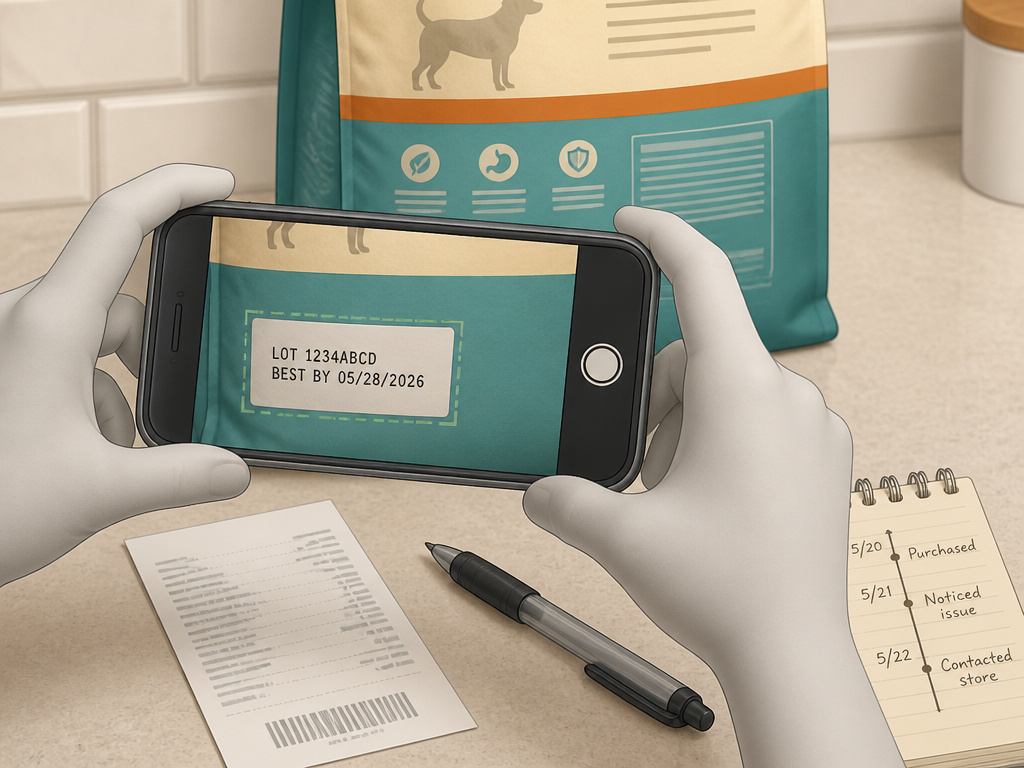
The cat vomited twice on a Tuesday, the bag is still in the pantry, and you’re holding a phone with a half-filled form on it. That’s the normal shape of this. FDA’s form asks for a lot, and most of it you can gather in ten minutes if the packaging is still around.
Before you start: Stop feeding the suspect product the moment you suspect it, because liver damage can progress with no outward signs and some pets die suddenly after continuing to eat contaminated food. Keep the rest in its original packaging, and wash your hands after handling any pet food or treats.
The Product Side
FDA wants the exact product name and description as printed on the label, not the name you use for it. “Chicken and rice adult” isn’t enough if the label says something longer.
Then container type and storage condition. Lot number, best-by date, UPC, and net weight. Purchase date and exact location. Any lab results on the product, plus how the food was stored, prepared, and handled.
The Pet Side
This half is longer. Species, age, weight, breed, and reproductive status. Prior health status and any pre-existing conditions. Other foods, treats, supplements, or drugs you give the animal.
Then the intake comparison: how much of the suspect product your pet normally eats versus how much came out of the suspect package. How much you still have.
Clinical signs come next, plus how soon after eating they appeared. Your vet’s contact information, diagnosis, and medical records. Any diagnostic lab results on the pet.
Two fields get skipped constantly: how many pets ate the product and showed signs, and whether any pets ate it and stayed fine. FDA asks for both. An unaffected dog in the same house is data.
If you’re still deciding whether the signs point to food at all, start with the signs of food poisoning and work backwards.
Gather in this order:
- Photograph the package front, back, lot code, and best-by date, before anything else moves.
- Pull the receipt from email, a banking app, or the store’s loyalty history.
- Call the clinic and ask them to send you the visit notes and any lab work.
- Write down the timeline in plain sentences, starting with the last normal day.
Skipping step 4 is the one that hurts. A timeline you reconstruct from memory two weeks later will be vague about onset, and onset is one of the fields FDA uses to connect cases.
Who Pays for the Lab Testing?
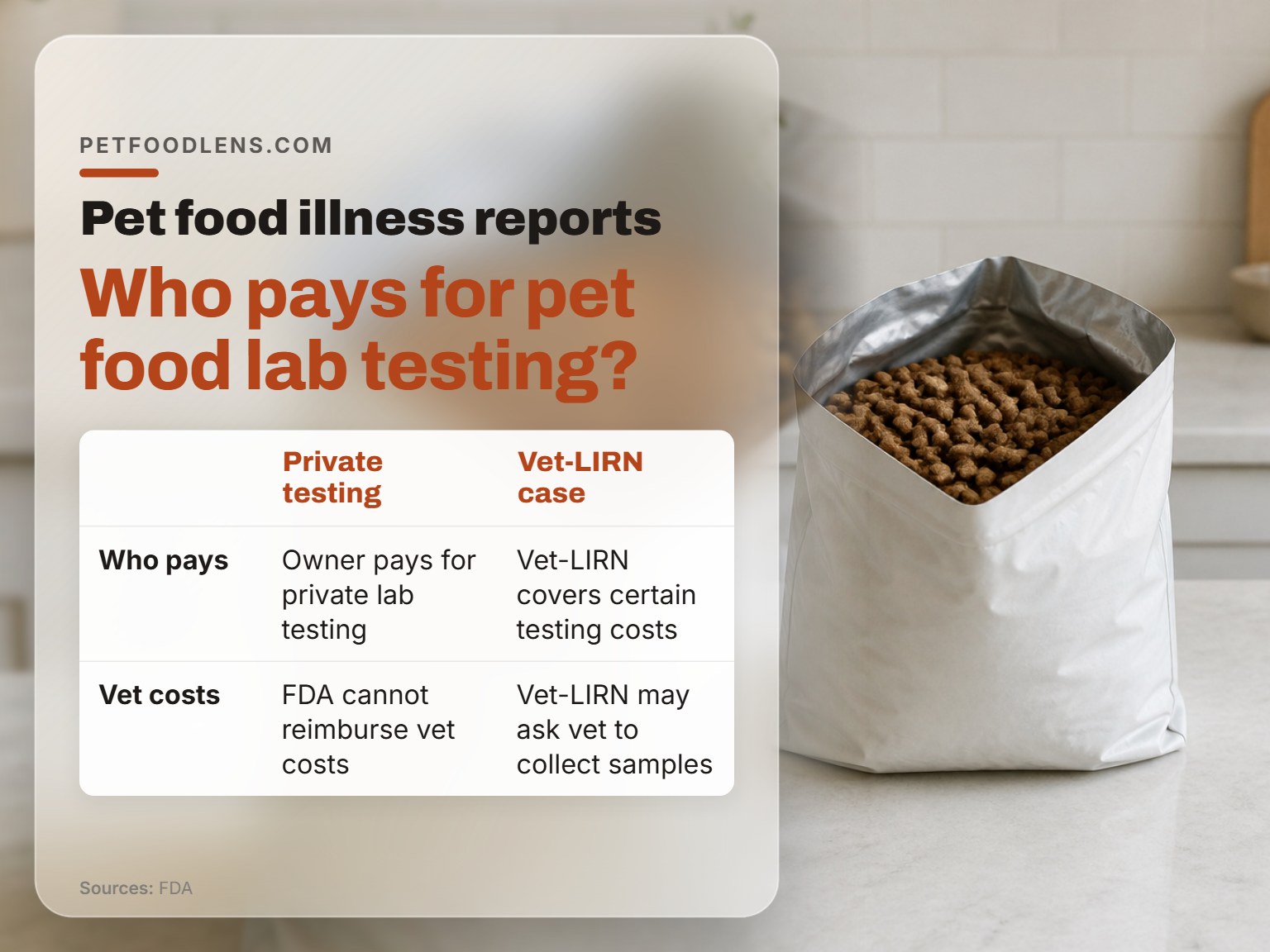
So who pays if you want the food tested?
FDA states on its complaint page that it cannot pay for private laboratory testing costs or provide reimbursement for veterinary costs tied to the illness, while Vet-LIRN says it can cover certain testing costs when investigating a case. The FDA Vet-LIRN pet illness investigation page says the network can cover certain testing costs when it’s investigating a case.
Those two sentences read like opposites. They aren’t, once you see the scope. Vet-LIRN covers testing inside a case FDA has already referred. Private testing you commission on your own is yours to fund.
I’d rather an owner file the free report and let FDA decide about referral than pay for a private panel before anyone has read the case. The report is what triggers the review. Skip it and nothing else happens.
That’s the practical order: report first, test second, and let the referral decision come from FDA.
Referred cases feed the same pipeline that produces recalls, which is why how pet food recalls are initiated is worth understanding before you file.
What Happens After You Hit Submit
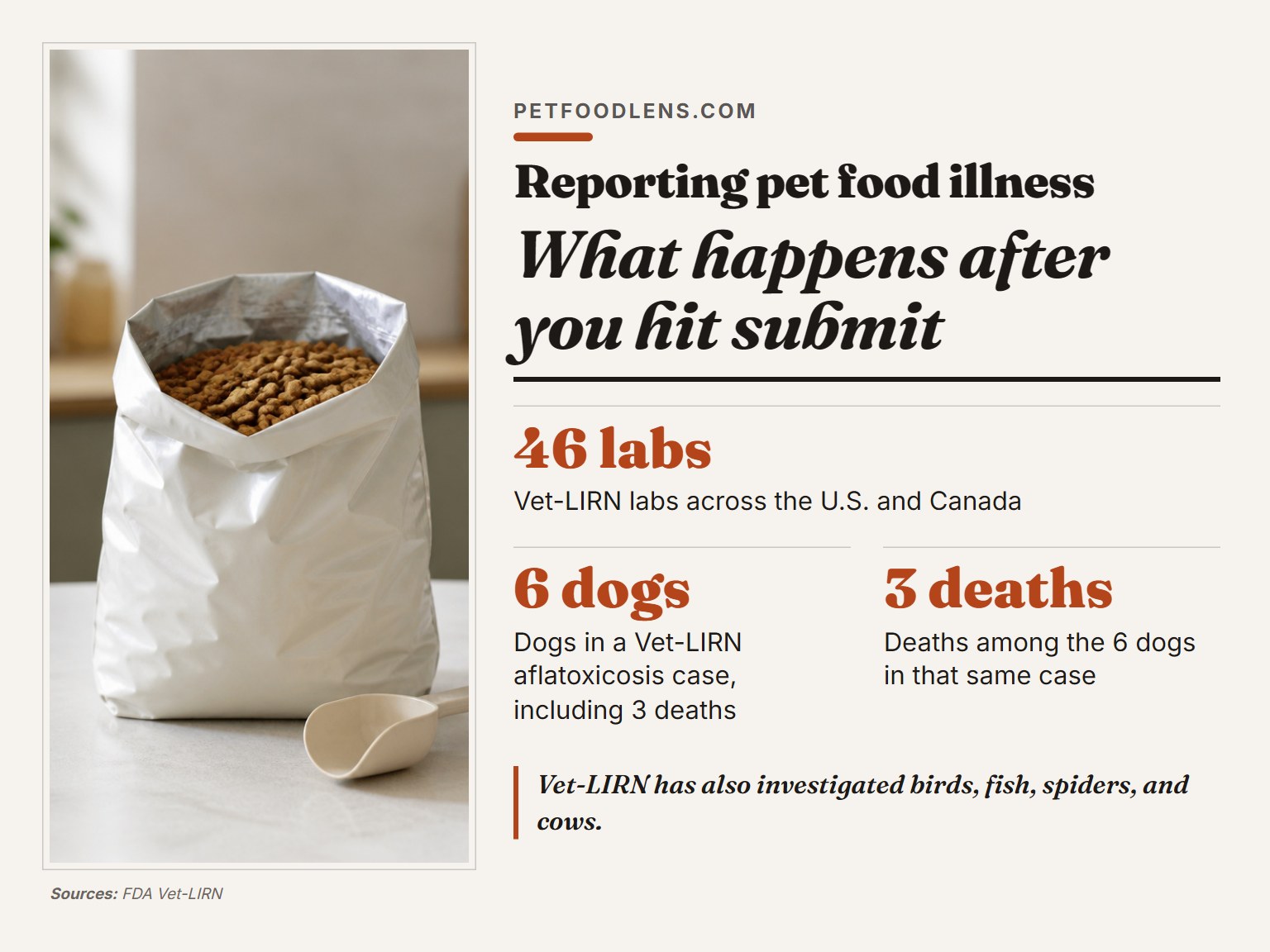
FDA veterinarians read each complaint and decide whether it could be tied to a product the agency regulates, like animal food or drugs. Then they decide whether the case goes to Vet-LIRN.
If it does, Vet-LIRN may contact you for more information and review the pet’s medical records, including diet history.
What Vet-LIRN Does With Your Case
Vet-LIRN is an FDA Center for Veterinary Medicine program that partners with state and university diagnostic laboratories. It operates 46 labs across the U.S. And Canada.
The network may ask your vet to collect diagnostic samples: blood, urine, or tissue. It tests those samples at one of its labs and reports findings back to the attending vet, who shares them with you.
If FDA needs regulatory testing on the food itself, a coordinator from the FDA office in your district contacts you directly. That coordinator may ask you to hold any open or unopened product.
The part nobody mentions: the district coordinator call is the point where your report stops being a form and becomes an investigation. Keep a phone number FDA can reach you on, and don’t throw out the food in the meantime.
Vet-LIRN’s work has led to inspections and recalls. It has also investigated birds, fish, spiders, and cows, so a rabbit or a parrot isn’t out of scope.
If you’d rather hear about the recall side before it reaches your bag, recall alerts are worth setting up now instead of later.
What Happens If the Bag Is Already in the Bin?
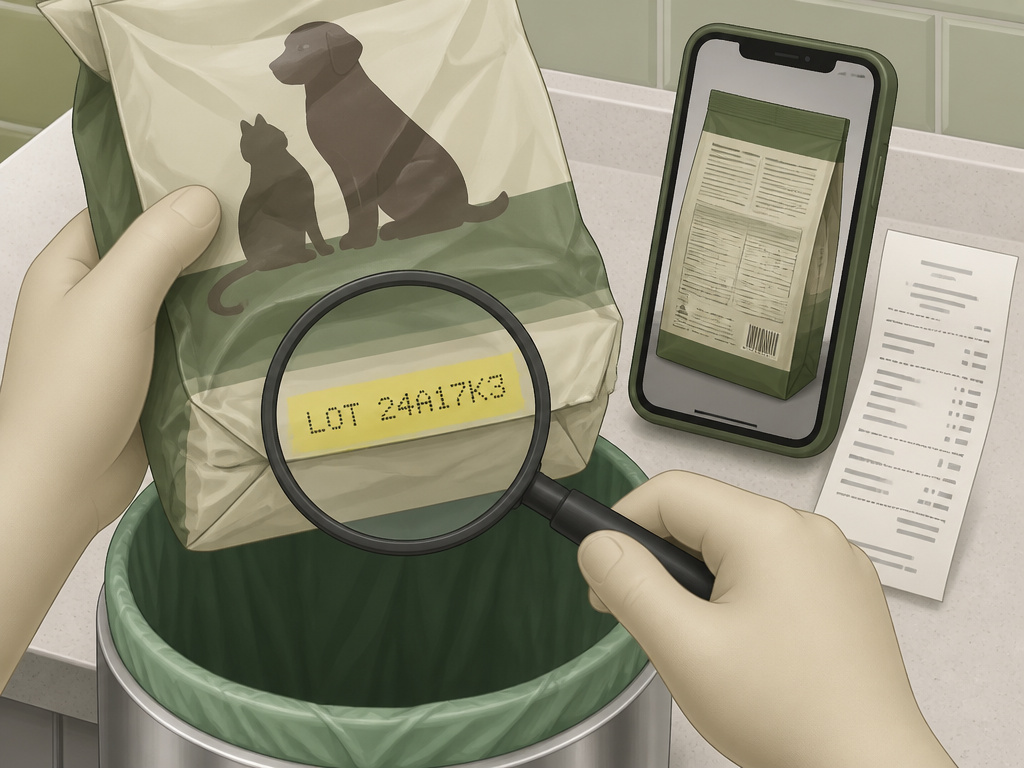
This is the section that decides whether your report is worth anything.
FDA notes that consumers often transfer dry food into other containers for easier handling. The agency’s advice is to save the original packaging until the food has been consumed, because the packaging carries the variety, the manufacturing plant, and the production date.
Once that bag is gone, you may not be able to recover the lot code at all. Gone is gone.
| Missing item | What you lose | Workaround |
|---|---|---|
| Original bag | Lot code, plant, production date | Photos of the bag, plus the receipt |
| Receipt | Purchase date and exact location | Card statement or store loyalty history |
| Vet records | Diagnosis and diagnostic results | Clinic can send records straight to you |
| Leftover product | A sample for testing | Note the quantity consumed and what’s left |
Here’s the other version of the problem. I’ve watched a large bag bought for one cat turn into a months-long supply. By month four you’re scooping out of a bag that’s been open since spring. The per-pound savings have already been eaten by oxidation, and by the cat refusing the last third.
That matters here for a reason that has nothing to do with freshness. A bulk bag spans months of feeding, so one lot code covers a long stretch of your pet’s diet. Buy what you’ll finish in a reasonable time and the traceability window stays short.
- No internet. The FDA video covers the phone route and your state feed control office.
- Multi-pet household. Count affected and unaffected animals separately, because FDA asks for both.
- A pet that died before the vet saw it. Call the clinic and ask whether a necropsy is appropriate; tissue can still be analyzed for toxins.
- A complaint with no illness. Foul odor, off color, a swollen can or pouch, a leaking container, or a foreign object in the product are all reportable on their own.
Where this goes sideways: Reconstructing a lot code from a photo of the front of the bag. The front panel doesn’t carry it. You need the back or the bottom, and you need it in focus.
If a recall has already been announced, handling a recall is a different job from filing a complaint, and the two overlap less than people expect. Checking pet food recalls regularly is the cheaper habit.
Aflatoxin: What 28 Dog Deaths Actually Triggered
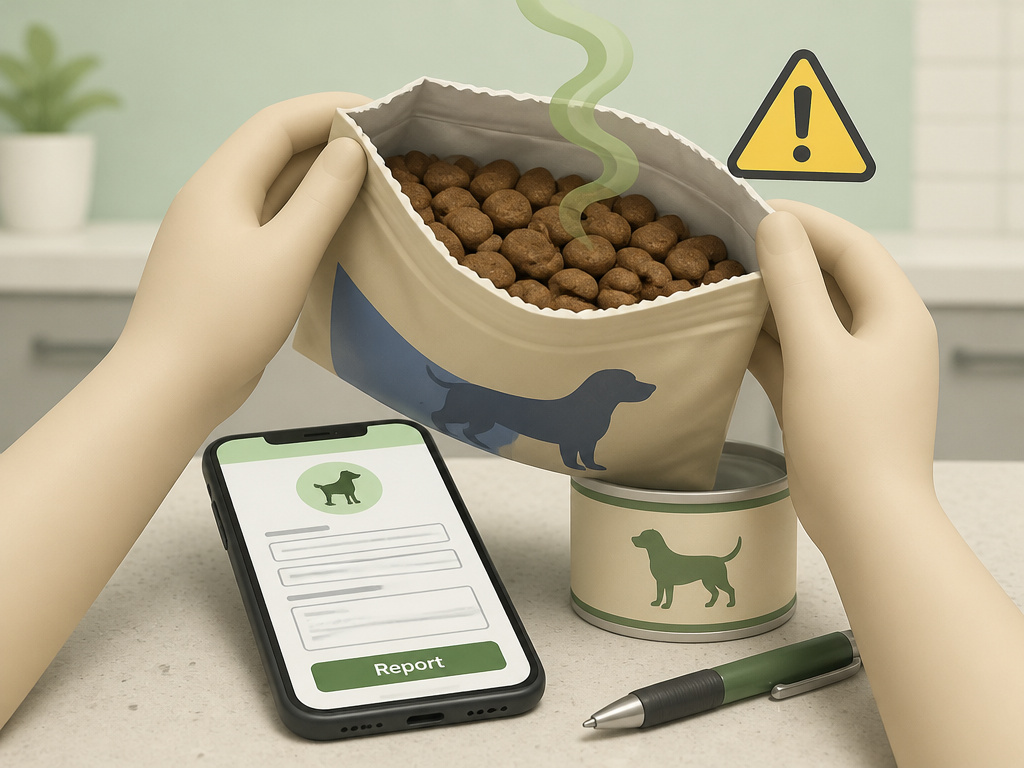
Twenty-eight dogs were dead and eight more were ill by December 30, 2020, in the Sportmix recall. FDA had notified the public that month about potentially fatal levels of aflatoxins in multiple recalled varieties made by Midwestern Pet Foods, Inc.
No cat deaths or illnesses were confirmed at that date, even though some of the recalled product was made for cats.
Aflatoxins are toxins produced by the mold Aspergillus flavus, which can grow on pet food ingredients like corn, peanuts, and other grains. At high levels they cause illness, liver damage, and death. The toxins can be present with no visible mold on the food at all.
That last point is why a smell test beats a look. A bag that hits you with a sharp musty or sour odor on opening is worth a complaint even when the kibble looks completely normal.
Pets are unusually exposed to this class of problem because they eat the same food continuously over long stretches. Unlike people, they don’t rotate through a varied diet, so a contaminated lot keeps hitting the same animal.
Signs FDA lists include sluggishness, loss of appetite, vomiting, jaundice, unexplained bruising or bleeding, and diarrhea. Some pets show nothing in the early stages and die suddenly. Only a veterinarian can diagnose it.
The earlier Sunshine Mills case shows the same pattern from the other direction. A retail product sample tested at an unsafe aflatoxin level in September 2020. FDA expanded the recall in October after determining more products made with the same corn were affected.
Both of those started with reports. The what causes pet food recalls side of this is mostly contamination, and contamination gets found by people who bothered to file.
The FDA aflatoxin poisoning in pets page carries the full sign list and the necropsy guidance.
Frequently Asked Questions
Can I report a pet food illness without a vet diagnosis?
Yes. FDA’s form asks for your vet’s contact information, diagnosis, and medical records, but it doesn’t require them to accept a report. Only a veterinarian can diagnose something like aflatoxin poisoning, so filing before a diagnosis is normal. Add the records when you have them.
Do I have to keep feeding the food to prove it caused the illness?
No, and you shouldn’t. FDA’s guidance is to stop feeding a suspected product immediately, especially if the pet is showing signs. Keep the remaining food in its original packaging in a safe place, away from your pet and any other animals, so it can be tested if the case gets referred.
Should I report to FDA or to the manufacturer?
Both, and to your state feed control official. FDA’s own guidance lists all three. The manufacturer may already have the lot data and can act on it faster. FDA is the one who can trigger a recall.
How long does FDA take to respond?
FDA doesn’t publish a timeline, and I won’t invent one. The agency reviews every report to decide whether follow-up is possible. If regulatory testing is needed, a coordinator from your district FDA office contacts you directly. Otherwise your report becomes part of adverse event surveillance.
Can I report a problem if my pet never got sick?
Yes. FDA lists product problems that are reportable on their own: foul odor, off color, a swollen can or pouch, a leaking container, or a foreign object in the product. A swollen can is worth a report whether or not anything ate from it.
The Bottom Line
Do one thing tonight: photograph the lot code and the best-by date on every bag and can in your pantry. That’s the whole habit.
Everything above assumes you still have the packaging. If you don’t, file anyway and describe what you remember. A partial report beats a silent one, and FDA’s own page says a report joins surveillance even when no testing follows.
Here’s the concession. If your pet is fine, the food is gone, and you have no lot code, there isn’t much left to file. Spend the effort on the next bag instead.
And a last opinion I’ll defend: a “recall-free” brand list is worth less than the bag in your hand. Small brands with light testing look clean because nobody is looking. Save the code.
