
How Pet Food Recalls Work: 3 Routes and the Lot Code
This post contains affiliate links. As an Amazon Associate, we earn from qualifying purchases.
Pet food recalls work three ways: a firm pulls product on its own, the FDA requests a recall, or the FDA orders one under Section 423 of the FD&C Act. Understanding how pet food recalls work helps owners respond quickly. An order requires a reasonable probability the food is adulterated or misbranded and will cause serious harm.
That “serious harm” bar is why most pet food comes off shelves without anyone ordering it. The FDA’s guidance on how pet food recalls work sets the threshold at a reasonable probability of serious adverse health consequences or death to humans or animals, shortened to SAHCODHA, and the test applies to the food itself rather than to the paperwork around it.
What follows walks the three routes, the one code that decides whether your bag is in scope, and what a plant has to record before the food ever reaches the tube.
Key Takeaways
- Three routes exist: firm-initiated, FDA-requested, and FDA-ordered. The third is rare and narrowly defined.
- Only the FDA Commissioner can issue a Section 423 order, and a company gets 2 days to request an informal hearing.
- Infant formula is carved out of the mandatory recall authority entirely, handled under a different section.
- Lot numbers aren’t required on pet food, but they’re the only code that identifies the plant and the date.
- Freezing doesn’t fix a recalled bag. Neither does refrigeration.
What Gives the FDA Power to Order a Pet Food Recall
Before FSMA, the FDA relied on companies to pull violative food voluntarily. Infant formula was the exception, handled separately under section 412 of the FD&C Act.
The mandatory recall authority in Section 423 applies where there is a reasonable probability that an article of food is adulterated or misbranded and that use of or exposure to the food will cause serious adverse health consequences or death to humans or animals. Only the FDA Commissioner may issue the order.
Read that as two tests stacked on top of each other. The food has to be adulterated or misbranded, and exposure has to be capable of serious harm or death. Fail either one and the mandatory path closes, which pushes the agency back to asking nicely.
The procedural clock is short. After an order issues, the responsible party may request an informal hearing not later than 2 days after issuance. Two days to get a hearing request in front of the agency that just ordered your product off the market.
Infant formula sits outside all of this. Section 423 explicitly carves it out, which means the one category with the most vulnerable consumers runs on a different statutory track entirely. You can read the full reasoning in the FDA mandatory food recall guidance.
When voluntary compliance doesn’t happen, the agency uses a progressive enforcement strategy including FDA-requested recall, mandatory recall, administrative detention, suspension of food facility registration, seizure, injunction, and criminal prosecution.
Why Does the Lot Number Matter More Than the UPC?
That matters because the lot number is the piece that identifies when the product was made and which plant made it. It lets a company pull one batch instead of emptying every shelf in the country, which is central to how pet food recalls work.
Here’s the awkward part. Lot numbers aren’t required on pet food. Most companies include them anyway, which is a courtesy rather than an obligation.
The UPC is the other code people grab by mistake. It identifies the company and the product, and it says nothing about which plant ran your batch. Companies aren’t required to print UPCs on pet food either.
Easy to miss: Less than half of the reports the FDA receives include the product’s lot number. If you’re filing a complaint, that missing string of characters is often the difference between the agency finding your batch and finding nothing.
When you can’t tell which code is the lot number, report all of them. The FDA works with the company to sort it out. A partial code beats a blank field.
The sources don’t fully agree on how optional lot codes really are, and the split is worth seeing:
| Position | Who holds it | What it means in practice |
|---|---|---|
| Lot numbers are voluntary | FDA consumer guidance | Most firms print one, but nothing forces them to |
| Lot-level records define scope | Nebraska Dept. Of Agriculture plan example | Records decide which batches get pulled |
| Traceability sets recall reach | Feed HACCP manual | Distribution network marks the boundary |
So the regulator calls it customary and the operational documents call it essential. Both are describing the same code from different chairs. If you want the mechanics of decoding one, there’s a full walkthrough on reading a lot number, and the FDA’s own consumer page on why lot numbers matter in recalls covers what to do when the print is ambiguous.
For context on how often this actually comes up: there are more than 135 million pets in the U.S., and the FDA describes pet food recalls as relatively rare given the volume produced.
The Three Ways a Pet Food Leaves the Shelf
Weight matters here. A firm pulling its own product and an FDA order under Section 423 look identical on a shelf and mean very different things.
| Route | Who starts it | When it applies | What you’ll see |
|---|---|---|---|
| Firm-initiated | The company | Company finds or suspects a problem | Company press release, often first |
| FDA-requested | FDA asks, firm acts | FDA has evidence, firm cooperates | FDA advisory naming the lots |
| FDA-ordered | FDA Commissioner | Section 423 threshold met, firm refused | Formal order under statutory authority |
Firm-Initiated Recall
This is the common case. The company finds the problem through its own testing or a complaint, and it pulls the product before anyone has to ask. Speed varies enormously, and so does how clearly the announcement states which codes are affected.
FDA-Requested Recall
The agency has enough evidence to act and asks the firm to pull the product. Most of these resolve without escalation. When they don’t, you get the situation described in the next section.
FDA-Ordered Recall
The narrow path. Reasonable probability of adulteration or misbranding, plus SAHCODHA, plus a firm that hasn’t acted. This is where the Commissioner’s signature matters and where the 2-day hearing window applies.
The FDA’s FDA pet food recalls page lists all three types together, which is why the list reads as one thing when it’s really three.
What Happens When the Company Does Not Recall
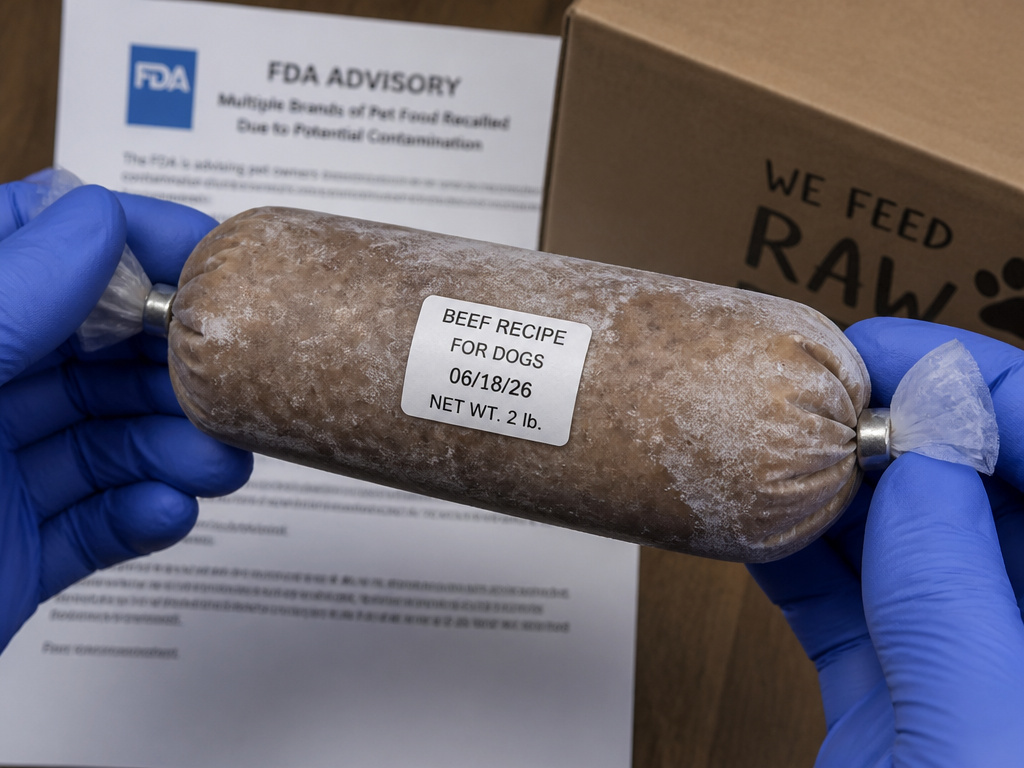
An advisory is not a recall. That distinction has a documented case behind it.
On January 23, 2026, the FDA cautioned that eight samples of Raaw Energy dog food had tested positive for one or more of L. Monocytogenes, Salmonella, and Campylobacter jejuni. The testing followed a consumer complaint to the Connecticut Department of Agriculture about a dog illness. Connecticut and New Jersey agriculture officials collected and tested eight unopened samples. All eight came back positive.
The packaging detail matters for anyone trying to check a package at home. Raaw Energy is sold frozen in 2-pound or 5-pound clear plastic tubes sealed at each end with a metal clip, in brown cardboard boxes holding 10 tubes. The products carry no lot codes at all. Batches are distinguishable only by a date code printed on white stickers on both the tube and the box.
The FDA recommended the firm recall the eight lots. As of that advisory, the firm had not initiated an adequate recall.
Where this goes sideways: A company-generated announcement and an FDA-supervised recall are not the same document. Read the notice for who issued it. If the firm wrote it and the agency only linked to it, the scope and the wording are the company’s, not the regulator’s.
The scope question didn’t settle cleanly either. In January the FDA recommended eight specific lots. The firm’s May 22, 2026 expansion covered all product manufactured from 7/17/25 through 12/23/25 plus one lot dated 3/31/26, roughly five months more production than the original eight.
The hazard basis moved too. The January advisory listed E. Coli among the pathogens of concern. On February 6, 2026, the E. Coli in the Beef Chicken Tripe Medley lot dated 12.23.25 was reclassified as non-pathogenic, and the FDA edited the advisory to drop the pathogenic E. Coli language.
That’s the practical lesson for a buyer: a recall’s scope can widen and its hazard list can narrow, sometimes within the same quarter. If you’re weighing a brand’s recall history against its neighbors, look at how the company responded and how fast, not just whether a notice exists.
What the Plant Records Before Your Bag Is Filled
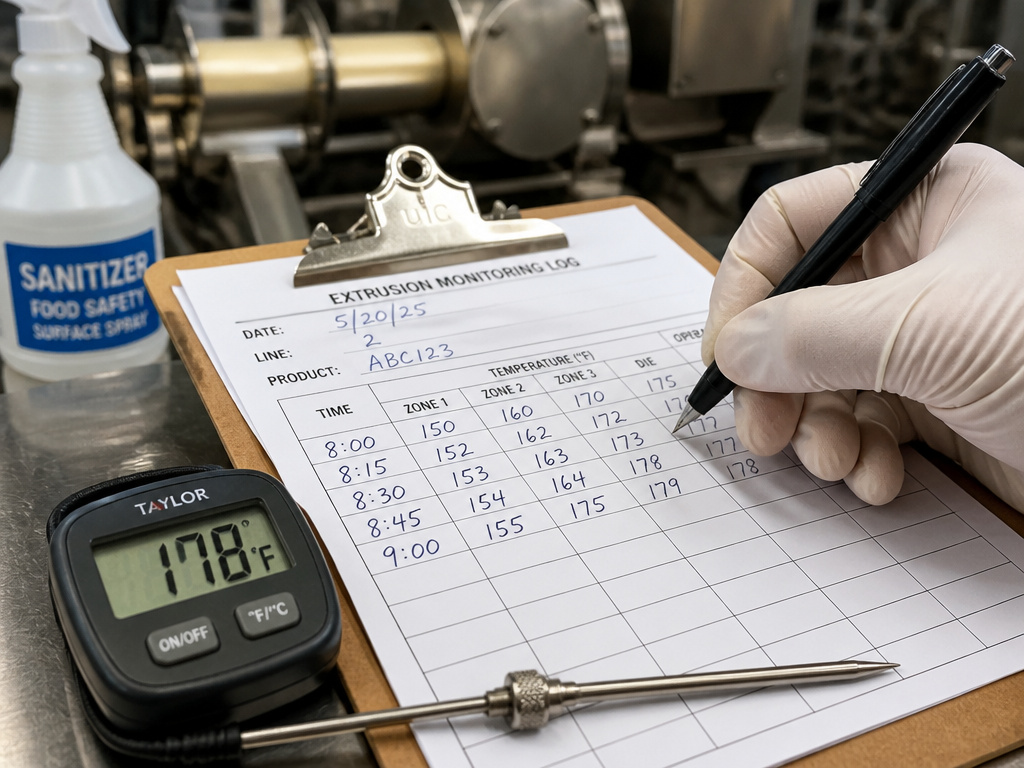
Extruder barrel temperature has to hold above 178°F, which the Nebraska Department of Agriculture’s example food safety plan ties to an instantaneous six-log reduction in Salmonella.
That same plan’s validation section lists an internal minimum required temperature of 175.6°F. Two numbers, one document, and a gap of just over two degrees between the process control and the internal data behind it. That gap is the kind of thing you only see when you read the plan instead of the summary.
Here’s what a plant is supposed to be recording while the food runs:
- Post-extruder surfaces: no residual material or 200 ppm sanitizer, checked before operations begin and again at the end of daily production. A miss here means re-clean and re-sanitize before anything else moves.
- Monitoring and corrective action records reviewed within 7 working days. Going past that requires a written justification.
- Thermometers checked daily for accuracy and calibrated quarterly.
- The whole food safety plan reanalyzed every three years, or sooner after a process change, new information, or a preventive control that stops working.
Canned pet food runs on its own set of rules. It has to be processed in conformance with the low-acid canned food regulations at 21 CFR 113 to ensure the food is free of viable microorganisms, which is a separate regime from the extrusion controls above.
The manual of good practices for recalls adds the piece most people never think about: there has to be a plan for disposing of recalled product and for monitoring its destruction or reprocessing. A recall isn’t finished when the food leaves the shelf. It’s finished when someone documents where it went.
The plan also expects testing. A national recall framework should require operators to have recall plans in place and to test them periodically, which is the difference between a binder on a shelf and a procedure that works at 2 a.m.
Does Freezing or Cooking Kill Bacteria in Recalled Pet Food?
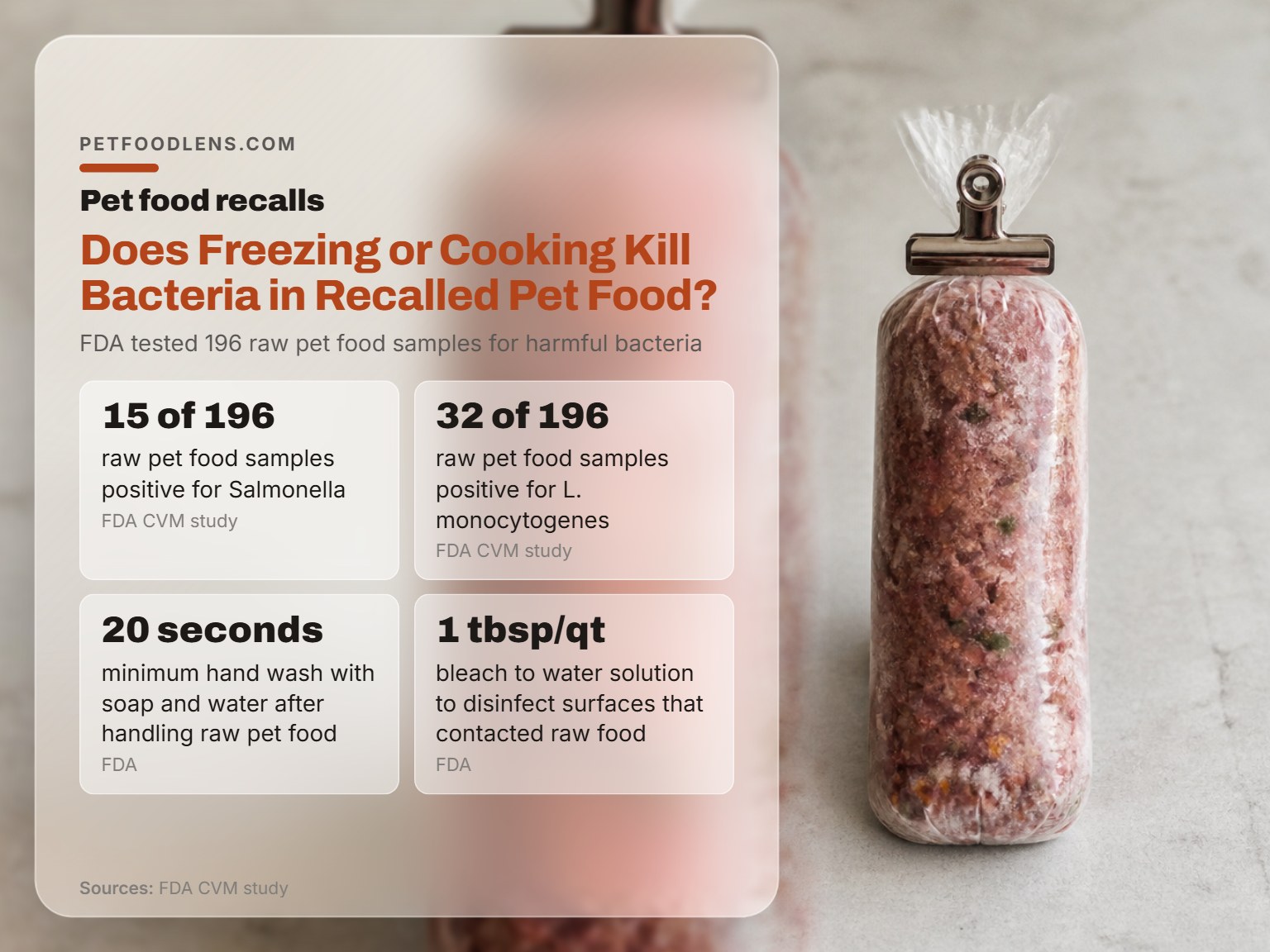
Freezing slows bacteria down and does nothing else. The FDA states plainly that neither refrigeration nor freezing eliminates Salmonella, L. Monocytogenes, or Campylobacter jejuni.
That catches people who portion and freeze.
I freeze portions for convenience, not for safety. If that can is under recall, the cubes go in the trash with it. Cold storage bought me texture and time, nothing else.
The raw side is where the numbers get uncomfortable. In a two-year study running from October 2010 through July 2012, FDA’s Center for Veterinary Medicine screened over 1,000 pet food samples. Of 196 raw pet food samples analyzed, 15 were positive for Salmonella and 32 were positive for L. Monocytogenes. Raw pet food was more likely to be contaminated with disease-causing bacteria than the other types tested.
Cooking is the step that actually works. If you make your own cooked pet food from raw ingredients, cook all of it to an internal temperature measured by a food thermometer.
Handling matters as much as the food. Wash hands with soap and water for at least 20 seconds after handling raw pet food and after touching anything that contacted it. Clean and disinfect surfaces in two stages: hot soapy water first, then a disinfectant. A solution of 1 tablespoon bleach to 1 quart of water does the job.
And the carrier problem is real. Pets don’t need to show symptoms to pass bacteria to their human companions. A dog that looks completely normal can be shedding Salmonella onto the floor and into the water bowl.
If your pet does get sick, the signs are worth knowing before you’re guessing at them. There’s a breakdown of food poisoning signs that covers what vomiting, lethargy, and bloody diarrhea actually look like in a dog or cat, and you can report a pet food illness through the FDA’s Safety Reporting Portal.
For campylobacteriosis specifically, most people recover completely within 2 to 5 days, though the illness can run about a week. That timeline is for humans. Your pet’s course is a question for your vet, not for me.
What to Do the Day a Recall Notice Lands
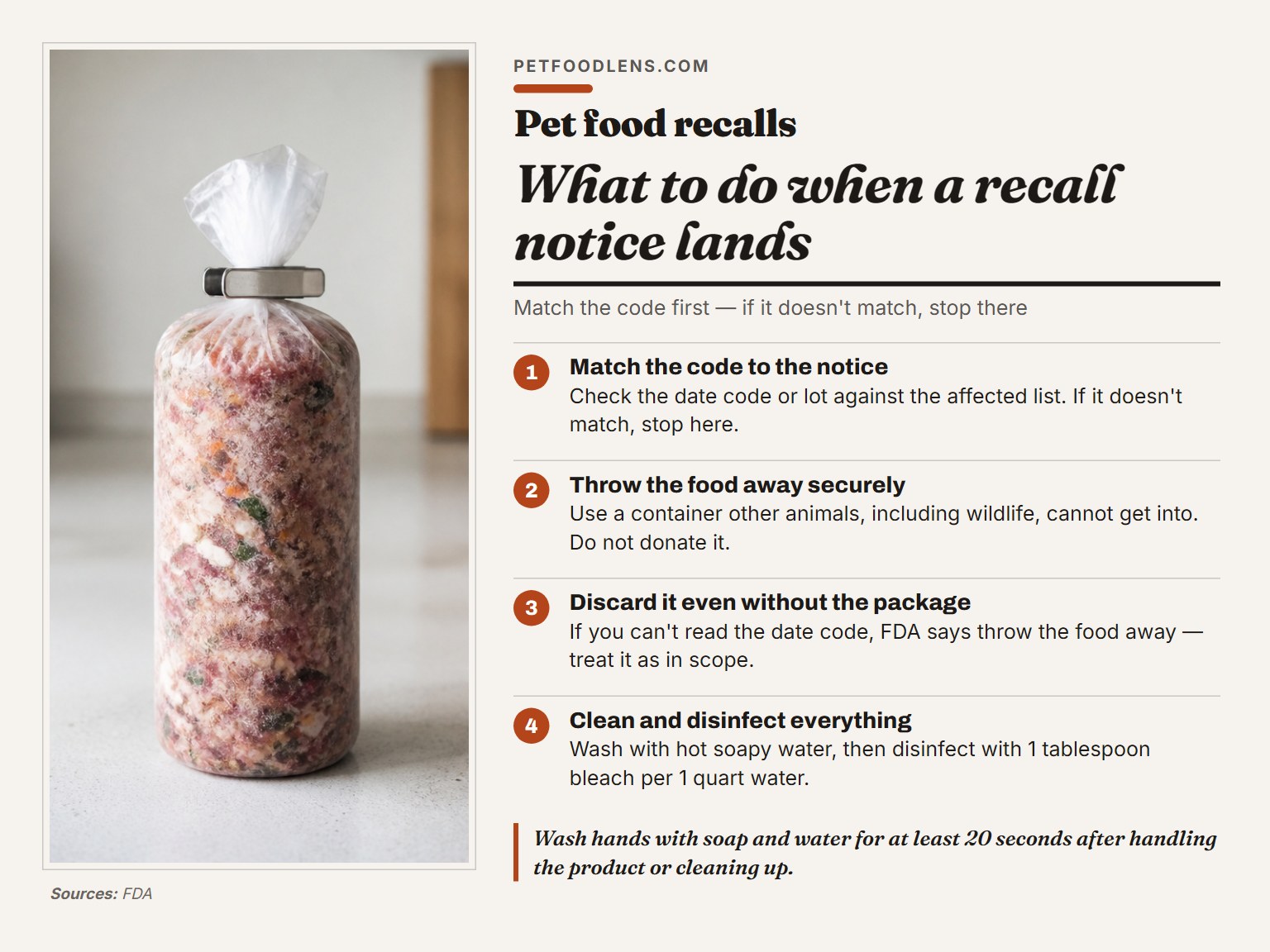
The notice gives you a date code or a lot range. Match it before you do anything else, because a bag that isn’t in scope stays on the shelf and you’ve saved yourself the whole exercise.
Before you start: Bleach at 1 tablespoon per quart is a skin and eye irritant, so mix it in a ventilated space and keep it off your clothes. Raw or recalled pet food cross-contaminates a kitchen sink fast, so wash your hands before you touch your face or your phone. Bag the recalled food in something a raccoon can’t open, because a torn bag at the curb is how wildlife gets exposed.
- Match the code to the notice. Check the date code or lot against the affected list. If it doesn’t match, stop here. Skipping this step is how people throw away a perfectly good bag over a headline.
- Throw the food away in a secure container. Somewhere other animals, including wildlife, cannot get into it. Do not donate it.
- Discard it even if the package is gone. If you no longer have the package or can’t read the date code, the FDA’s instruction is to throw the food away. An unreadable code is treated as an in-scope code.
- Clean and disinfect everything it touched. Storage containers, bowls, utensils, food prep surfaces, bedding, litter boxes, toys, floors, and the refrigerator or freezer.
- Wash your hands for 20 seconds after handling the product or cleaning up after a pet that ate it.
- Report it if your pet got sick.
Matching the Code to Your Bag
The FDA model press release for pet food recalls tells consumers to discontinue use and return the unused portion to the place of purchase for a full refund. That’s the retailer path. If that’s your situation, the secure-container disposal is the whole remedy.
If the notice itself is confusing, there’s a walkthrough on reading a recall notice that separates the affected-code section from the marketing language around it.
A recall notice without a date code or lot range is a press release, not an instruction. If you can’t match your package to a specific batch, call the company and ask which codes are covered.
Cleaning Up After a Recalled Bag
The Raaw Energy advisory lists the full surface inventory: pet supplies, storage containers, bowls, utensils, food prep surfaces, bedding, litter boxes, toys, floors, and any other surface the food or pet may have touched, including the refrigerator or freezer. Clean up the pet’s feces anywhere people or other animals could be exposed.
If you want the notice to reach you before the next one, signing up for alerts is one option. The full sequence, including what to do about a pet that already ate the food, is laid out in these recall steps.
Frequently Asked Questions
Can the FDA force a pet food company to recall a product?
Yes, under Section 423 of the FD&C Act, but only where there’s a reasonable probability the food is adulterated or misbranded and exposure will cause serious adverse health consequences or death. Only the FDA Commissioner can issue that order, and the company gets 2 days to request an informal hearing.
How do I know if my bag is part of a recall?
Match the lot number or date code on your package to the codes listed in the notice. The lot number identifies when the product was made and which plant made it, which is exactly what the notice is scoped to. If you can’t tell which printed code is the lot number, report or compare all of them.
Is a recalled bag safe to finish if my pet seems fine?
No. Pets don’t need to display symptoms to pass bacteria on to their human companions, and freezing or refrigeration doesn’t eliminate Salmonella, L. Monocytogenes, or Campylobacter jejuni. The FDA’s instruction is to discard the food in a secure container and not donate it.
What if the package has no lot number?
Plenty of packages don’t, since lot numbers aren’t required on pet food. Use the date code instead, which is what Raaw Energy relied on because its products carry no lot codes at all. If the code is unreadable or the package is gone, throw the food away.
Do recalls only happen with raw food?
No, but raw food carries more risk. Of 196 raw pet food samples in an FDA CVM study, 15 tested positive for Salmonella and 32 for L. Monocytogenes, and raw was more likely to be contaminated than other pet food types tested. Cooked and canned products get recalled too, for pathogens and for other reasons.
Who handles a recall for a product containing chicken?
Pet food and pet treats fall under FDA. For human food the split is different: meats, poultry, shelled eggs, and catfish sit with USDA’s FSIS, while all other foods are under FDA purview. The species on the label doesn’t move a pet product between agencies.
The Bottom Line
Not the front of the bag, not the flavor name, the printed code on the flap or the sticker.
One concession, and it’s a real one.
The recall system works the way it works. Your job in it is smaller and more specific: know which batch you’re feeding, and know it before someone else has to tell you.
