
What Causes Pet Food Recalls?
This post contains affiliate links. As an Amazon Associate, we earn from qualifying purchases.
Pet food recalls are caused by four things: pathogens like Salmonella, mold toxins such as aflatoxin, foreign material, and nutrient levels that run too low or too high. Federal rules require makers to write those hazards down and control them.
Those four causes don’t fail the same way. A pathogen problem usually traces back to a raw ingredient or a handling step. A nutrient problem traces to a formula or a mixing error. Knowing which one you’re looking at tells you whether the worry is one bag in your kitchen or an entire product line. Understanding what causes pet food recalls helps you see why these failures differ.
What follows walks the four causes in the order the recall data puts them, then the gap the categories miss, and finishes with what to do with a bag you already own.
Key Takeaways
- Pathogen recalls were among the most frequent in the pet food industry over the past decade, according to Diamond Pet Food’s food-safety lead.
- Only 6 of 22 Class I and II pet food recalls from 1996 to 2008 were chemical, so the scariest-sounding category is smaller than it sounds.
- Nutrient hazards count as chemical hazards under 21 CFR 507.33, and a shortage and an excess land in the same bucket.
- Melamine has a 2.5 ppm FDA guideline. Above that, the food is considered adulterated.
- A recall record is a testing record. A brand with no recalls may simply test less.
What Does Federal Rule Actually Require of a Pet Food Maker?
21 CFR Part 507 is the rule that covers every US plant making animal food, and it is unusually specific about paperwork.
Under 21 CFR 507.33, an animal food facility must prepare a written hazard analysis identifying biological, chemical, physical, and radiological hazards, and must evaluate nutrient deficiencies or toxicities. The rule names inadequate thiamine in cat food, excessive vitamin D in dog food, and excessive copper in sheep feed as examples of nutrient hazards.
Four requirements matter for recalls:
- A written hazard analysis covering biological, chemical, physical, and radiological hazards, including nutrient deficiencies or toxicities.
- A recall plan on file before anything goes wrong, required under section 507.38.
- A supply-chain program built on approved suppliers and backed by supplier verification activities for raw materials.
- A full reanalysis of the food safety plan at least once every 3 years.
The hazard analysis is the interesting one. It has to be written even when nothing is found, which means a plant can’t quietly skip the exercise. You can read the whole thing at the 21 CFR Part 507 animal food rules page if you want the source text on what causes pet food recalls.
The Recall Plan Is a Document, Not a Promise
A plan on file is worth what the company puts into rehearsing it. The FAO/IFIF recall manual recommends that legislation require operators to have recall plans and test them periodically, and it warns that a country without a national plan ends up with unjustified recalls, erroneous communications, and panic.
Michele Sayles, executive director of food safety and technology at Diamond Pet Food, makes the same point from the industry side. She recommends mock recalls to sharpen the ability to locate and retrieve finished product, phone trees so the plan is actually usable, and hunting for choke points during audits that would slow a real recall down.
That’s a decent proxy for manufacturer quality control when you’re standing in a store with two bags in your hands.
Pathogens: The Cause Behind Most Recalls of the Past Decade
Pathogen recalls were among the most frequent in the pet food industry over the past decade, per Sayles. Salmonella is the headline name, and it isn’t the only one.
The FDA’s Center for Veterinary Medicine ran a two-year screen from October 2010 through July 2012 and tested more than 1,000 pet food samples for foodborne bacteria. Raw pet food came out more likely to be contaminated than the other types tested. In the second year, CVM added 196 samples of commercially available raw dog and cat food. Of those 196, 15 were positive for Salmonella and 32 were positive for Listeria monocytogenes.
Canned pet food wasn’t tested at all in that study, so don’t read the results as a ranking of every format.
Why raw? Raw product skips the cooking step that would otherwise knock the bacteria down. FDA’s own advice for people making home-cooked pet food is to cook everything to a proper internal temperature measured with a food thermometer, precisely because thorough cooking kills Salmonella, L. Monocytogenes, and other harmful bacteria. Raw diets skip that.
Before you start: Raw pet food handling is a real exposure route, not a hypothetical one. FDA found 15 of 196 raw samples positive for Salmonella and 32 for Listeria monocytogenes. Wash hands with soap and water for at least 20 seconds after handling, clean surfaces with hot soapy water first and a disinfectant second, and don’t let the pet lick your face after it eats.
If you feed raw, it’s worth understanding the salmonella risk in raw pet food before the next tube comes out of the freezer.
Mold Toxins and the Aflatoxin Problem That Won’t Go Away
Aflatoxin is a mycotoxin, which is the plain word for a poison produced by mold growing on an ingredient before it ever reaches the plant, and it is one answer to what causes pet food recalls.
Sayles lists mycotoxins as one of the four common recall types, and notes that ingredients tainted by fungal mycotoxins like aflatoxin have caused pet food recalls. The 1996-2008 review of Class I and II pet food recalls lists aflatoxins among the chemical adulterants behind those recalls, alongside cholecalciferol, methionine, and melamine with cyanuric acid.
Here’s the part that makes aflatoxin hard to control: you can’t see it. A load of grain that looks and smells fine can carry it. The 1996-2008 review puts inadequate testing of raw materials for toxins at the top of its list of adulteration causes, which tells you where the defense has to sit. It sits at receiving, on the incoming ingredient, not on the finished bag.
Aflatoxin is one of the four chemical adulterants named in that recall review, and the veterinary literature has a veterinary aflatoxicosis case review covering the clinical side.
For the owner-facing version of this, aflatoxin poisoning covers what mold toxins do once they’re in the bowl.
Nutrient Toxicity and Deficiency: One Category, Two Opposite Failures
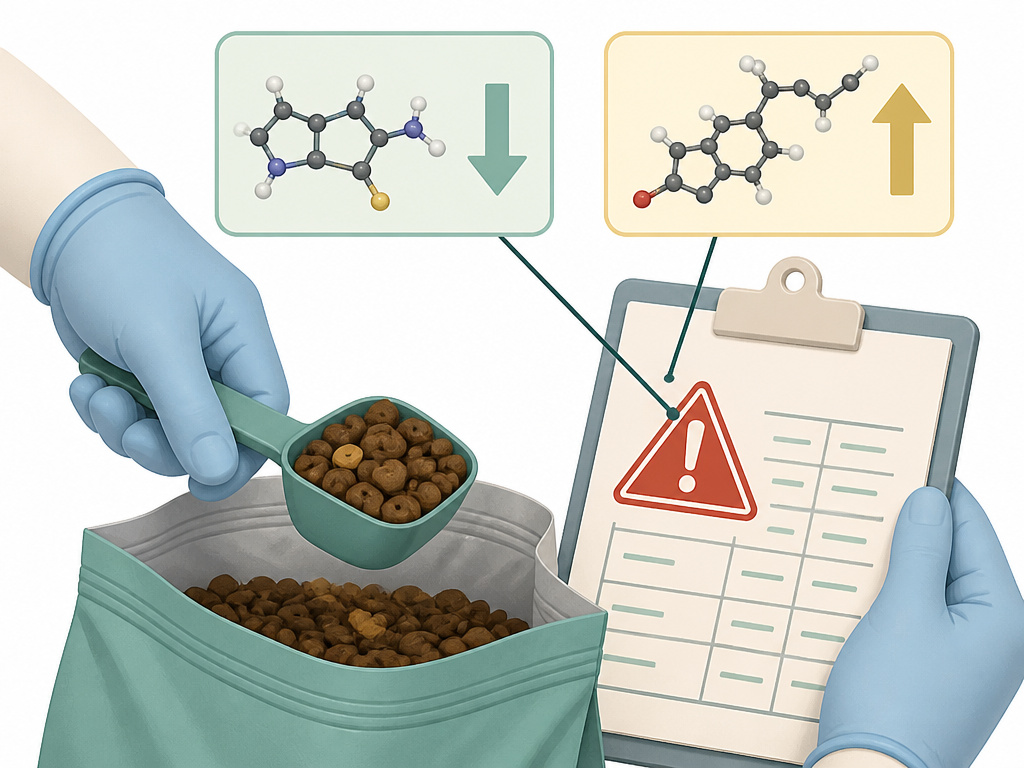
Two of the three nutrient hazards named in federal rule are excesses, and one is a shortage.
21 CFR 507.33 spells them out: inadequate thiamine in cat food, excessive vitamin D in dog food, and excessive copper in food for sheep. Read that list again. A shortage of one vitamin and an overdose of another are the same category of problem on the paperwork.
A nutrient hazard is a chemical hazard. Too little thiamine and too much vitamin D are the same line item on the hazard analysis, which is why a single mixing error can produce either one.
The recall record backs this up. Cholecalciferol, which is vitamin D3, shows up in the 1996-2008 review as one of the chemical adulterants behind Class I and II recalls. Methionine, an amino acid, shows up too. These aren’t industrial poisons smuggled into food. They’re nutrients, dosed wrong.
Why Thiamine and Vitamin D Sit in the Same Bucket
The hazard analysis treats nutrient balance as a chemical hazard because the failure mode is chemical. A cat that runs short on thiamine develops a specific deficiency. A dog that gets a vitamin D overdose is being poisoned by the same molecule it needs in smaller amounts. Same control point, opposite directions.
I spend most of my working hours in cat formulations, and thiamine is the first number I look at on a cat food. Cats have a higher requirement for it than dogs do, and it’s water-soluble, so it’s the one that gets cooked out or under-added when a plant is pushing line speed.
Which Recall Class Does Each Cause Land In?
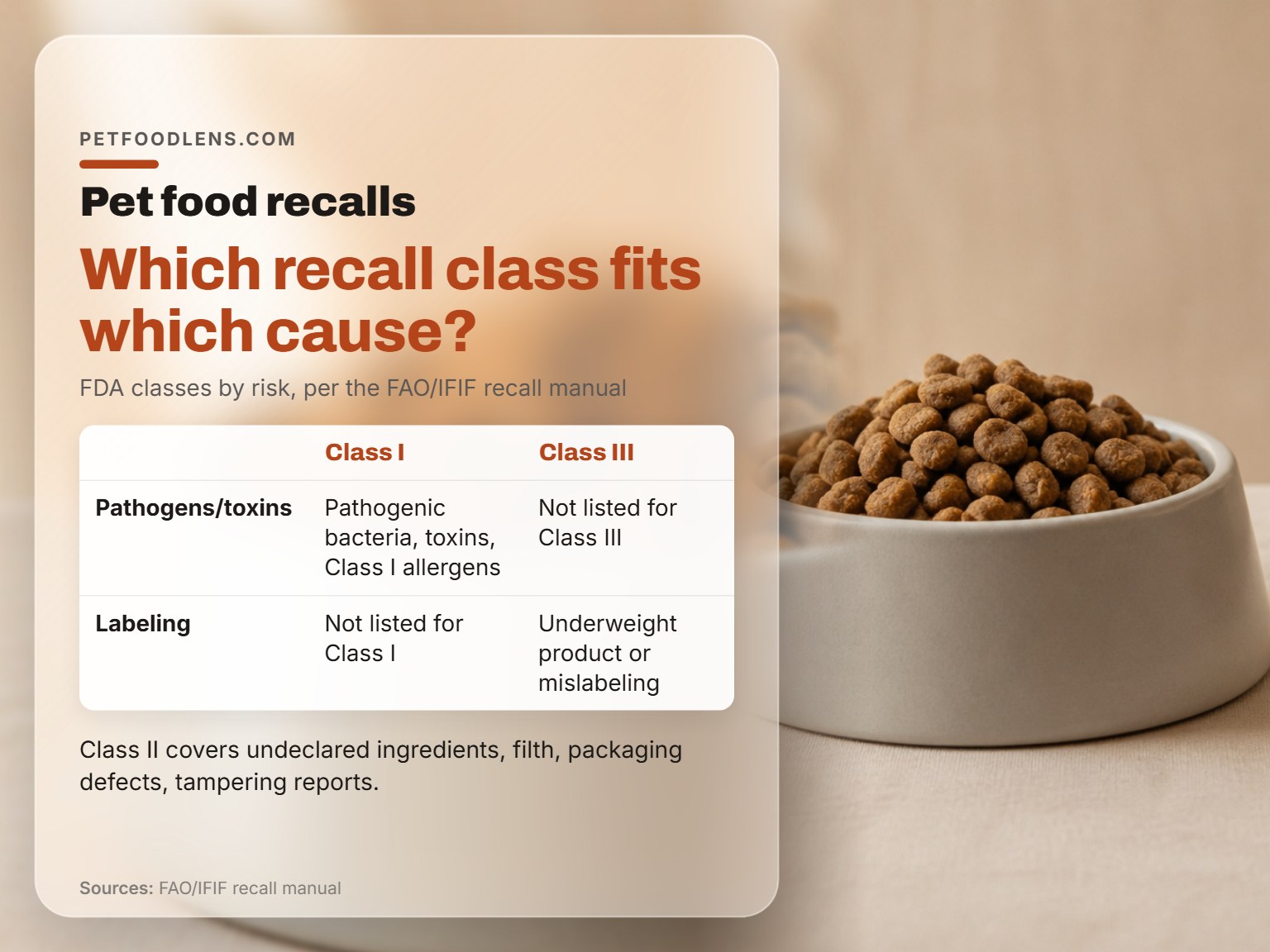
Class I is the one that gets the press release.
The FAO/IFIF recall manual lays out the three FDA classes by risk:
| Recall class | What lands a recall here |
|---|---|
| Class I | Pathogenic bacteria in ready-to-eat food, toxins, Class I allergens |
| Class II | Undeclared ingredients, filth, packaging defects, reports of tampering |
| Class III | Underweight product or mislabeling |
The class drives the urgency, the scope, and how much publicity the recall gets. That matters when you’re reading a notice, because a Class III mislabeling recall and a Class I pathogen recall can produce the same alarming headline on the same news site.
Separately, FDA runs three types of recall by who starts it: a firm’s own initiative, an FDA request, or an FDA order under statutory authority. Those are listed on the FDA pet food recalls and withdrawals page.
The FAO/IFIF manual is blunt about who carries the load. Food and feed business operators are primarily responsible for pulling their own unsafe product off the market, with the competent authority cooperating and monitoring. The company does the work. The regulator watches.
Where this goes sideways: Treating every recall headline as equally urgent. A Class III underweight recall and a Class I Salmonella recall read the same in a news alert, and owners who’ve been burned by one stop opening the next.
Once you know the class, the next step is how pet food recalls get started and what the notice actually says. Reading a recall notice properly means matching the lot code, not the brand name.
How Often Do Chemical Contaminants Actually Cause a Recall?
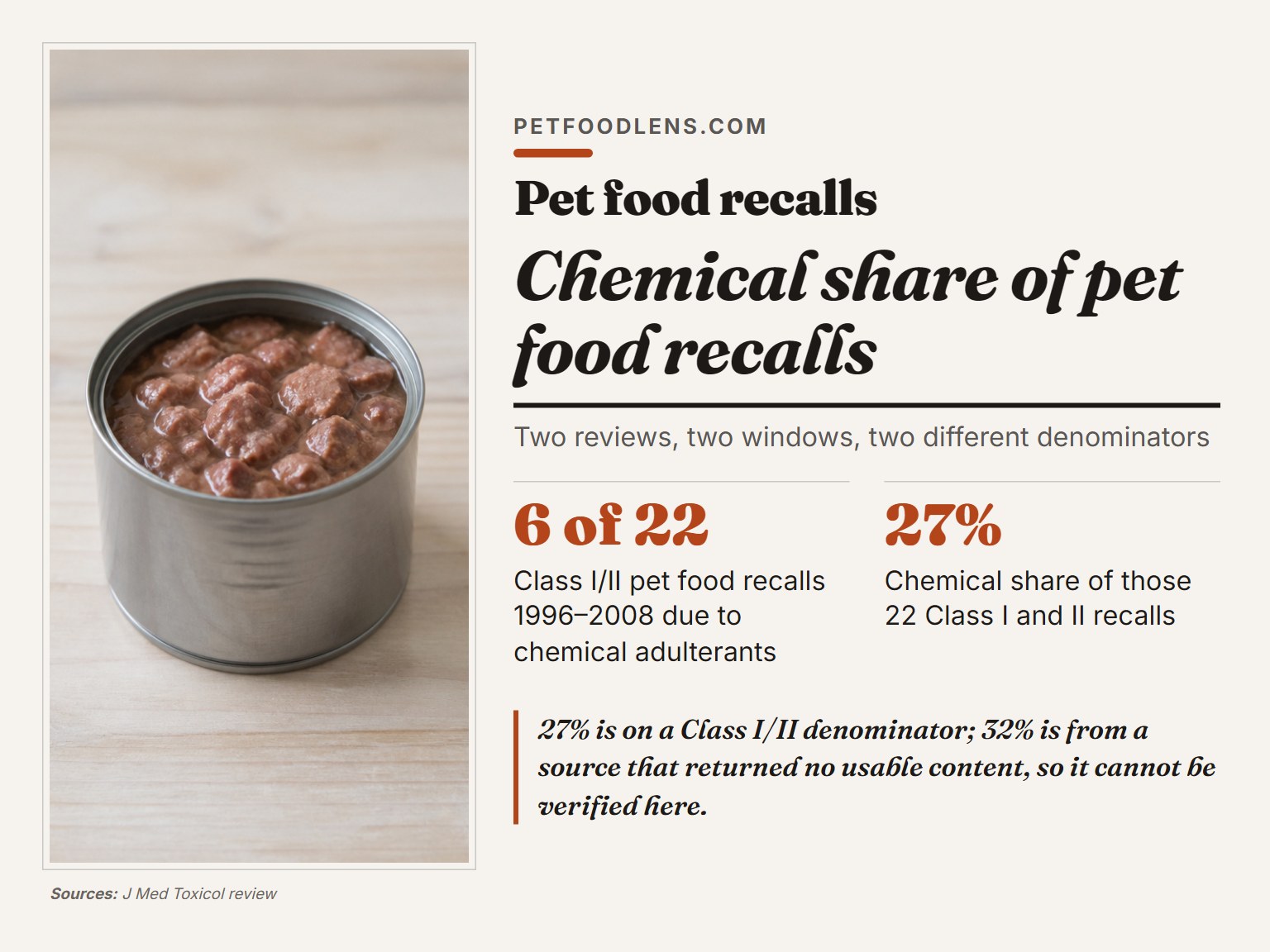
Six of 22. That’s the chemical share of Class I and II pet food recalls between 1996 and 2008, per a FOIA-based 1996-2008 pet food recall review in the Journal of Medical Toxicology.
Twenty-two Class I and II recalls across thirteen years is a small number. Six of them chemical is smaller still. That’s the honest scale of the chemical-contamination problem in that window, and it’s a useful corrective if you’ve been led to believe adulterated food is the norm.
The picture changes depending on which window you use, and the sources don’t agree on the size of the chemical share.
| Question | 1996-2008 review | Later 20-year review |
|---|---|---|
| Recalls counted | 22 Class I and II only | All FDA pet food recalls |
| Chemical share | 6 of 22 (27%) | 32% reported |
| Melamine’s weight | One of four chemical adulterants | Roughly a quarter of the total |
A later two decades of pet food recalls review covering 2003 through 2022 is reported at 32% chemical, and it treats the 2007-08 melamine event as roughly a quarter of the whole 20-year total. The 1996-2008 review treats melamine as one of four chemical adulterants among only six chemical recalls.
Both can be right. They’re counting different things over different windows, and the 27% sits on a Class I and II denominator while the 32% sits on all recalls. Comparing the two directly is a mistake, and plenty of write-ups make it.
The Blind Spot: Adulteration Done on Purpose
Every category above assumes the ingredient is what the supplier says it is.
Melamine broke that assumption. The 1996-2008 review is direct about it: melamine was intentionally added to foods to defraud consumers, and that kind of adulteration is genuinely hard for a pet food firm to avoid 100% of the time. There are tens of thousands of potentially toxic chemicals in the world, and a nutrient panel won’t flag a compound nobody was looking for.
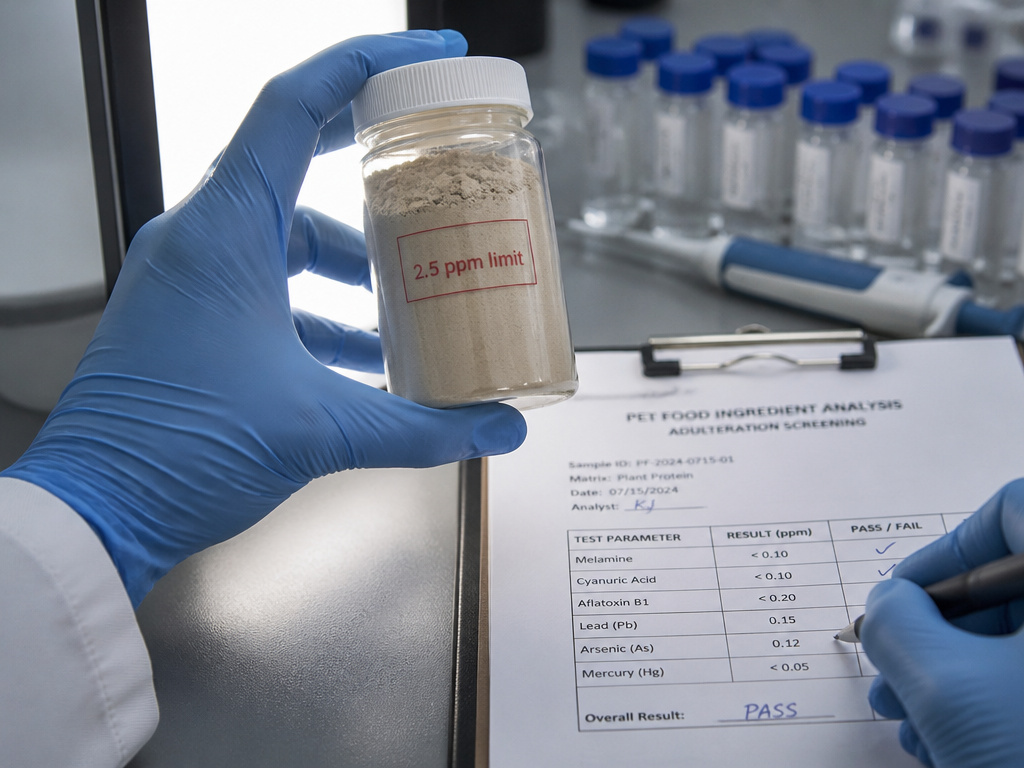
FDA’s response was a guideline. Melamine and melamine-related compounds in food are capped at 2.5 ppm, and anything above that is considered adulterated. That’s a threshold set after the fact, not a test that runs on every load by default.
The other causes in that review are less dramatic and more common: inadequate testing of raw materials for toxins, wrong or faulty mixing equipment, and misformulation of raw materials. All three are process failures. All three are fixable with sampling data, which is exactly what Sayles recommends companies keep, for incoming raw materials and outgoing finished product alike.
The review also notes there was no agency tracking adverse events in pets caused by food adulteration during the period studied. The FDAA Act of 2007 calls for that tracking. The review’s own recommendations go further: make chemical-induced foodborne disease reportable at the state level, and put industry measures in place to prevent economically motivated adulteration.
“I’ve stopped treating a clean recall history as a safety signal. A small brand with no recalls and no in-house lab isn’t safer than a big one that found its own problem and published the lot numbers. It just hasn’t looked yet.”
That’s the honest read on brand safety record claims. A record is a testing record.
What to Do With a Bag That’s Already in Your Kitchen
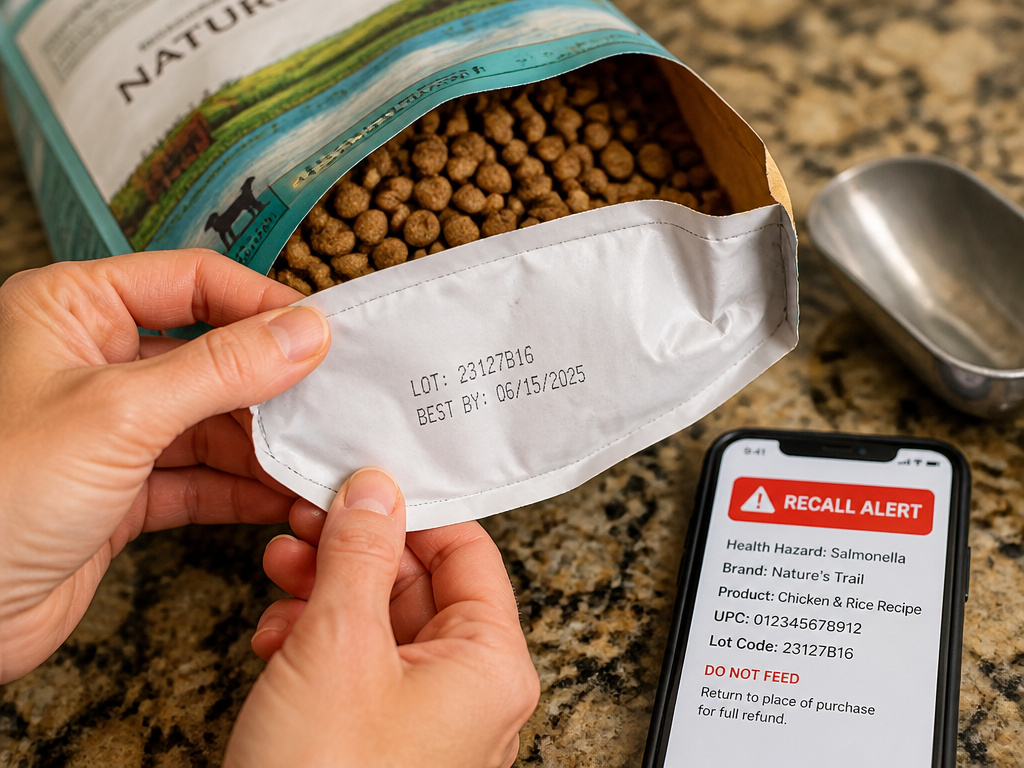
The bag is open on the counter, the scoop is in it, and the recall notice is on your phone.
First, find the lot code. Turn the bag over. The lot code and best-by date are usually printed near the bottom seam or on the back panel, and without them a recall notice tells you nothing you can act on. This is the mistake I see most: the bag goes out with the recycling the day it’s opened, and three weeks later there’s no way to match the notice to what’s in the bowl.
Second, the storage side, which is where most people get it wrong. I used to keep a half-used can in the fridge in the tin with the lid foil pressed back down. By day three it smelled like the inside of a refrigerator rather than like food, and the cat agreed. A glass jar with a tight lid fixed that. I use opened wet food promptly now.
For food in the bowl, I don’t leave it sitting out at room temperature for long. A crusted, dried surface on the food means it’s been sitting too long, whatever the clock says.
Here’s the sequence when a recall actually lands:
- Photograph the lot code and best-by date before you touch anything else. Skipping this means you can’t prove which lot you had if the case widens.
- Check the notice against your exact lot, not the brand. A recall usually covers specific codes, and the rest of the line is fine.
- Stop feeding and bag the food. Don’t finish the bag because the cat seems fine; you’re removing the exposure, not treating a symptom.
- Watch for vomiting, diarrhea, or lethargy and call your vet if any of it shows up. Bring the lot code with you.
- Keep the bag until the case closes. Refunds and reporting both need it.
The part nobody mentions: Freezing an opened bag doesn’t reset the clock on a recall. If the lot is covered, it’s covered whether it’s in the cupboard or the chest freezer.
The lot number is the whole game here, and it’s also what you need when checking recall status on the FDA listing. If you’re mid-recall right now, the steps to handle a pet food recall walk it in order.
One aside on bag size, since it comes up: a large bag for a single cat can take months to finish. Once opened, the last third has had a long time to oxidize, and whatever you saved per pound evaporates if half of it gets tossed. I tell people to buy what they’ll finish before it has time to oxidize.
Frequently Asked Questions
Is raw pet food more likely to be recalled?
The FDA’s two-year screen found raw pet food more likely to be contaminated with disease-causing bacteria than other types tested. Of 196 raw samples collected in the second year, 15 were positive for Salmonella and 32 for Listeria monocytogenes. Canned pet food wasn’t tested in that study, so the comparison doesn’t extend to cans.
What are the three types of FDA recalls?
Recall can be conducted on a firm’s own initiative, by FDA request, or by FDA order under statutory authority. Separately, recalls are classified I, II, or III by risk, which drives the urgency and the publicity rather than who started it.
How often does a pet food maker have to reanalyze its food safety plan?
At least once every 3 years, for the plan as a whole, under 21 CFR Part 507. Individual preventive controls can get reanalyzed sooner when something changes.
Can a vitamin cause a pet food recall?
Yes. 21 CFR 507.33 names inadequate thiamine in cat food and excessive vitamin D in dog food as nutrient hazards, and cholecalciferol (vitamin D3) appears in the 1996-2008 recall review as a chemical adulterant behind Class I and II recalls.
What should I do first if my cat’s food is recalled?
Find and photograph the lot code and best-by date, then check the notice against that exact code rather than the brand name. Stop feeding the food, keep the bag, and call your vet if the cat shows vomiting, diarrhea, or lethargy.
Before You Go
Here’s the trigger I’d actually use. If a food has been recalled repeatedly for the same cause, that’s a pattern and not bad luck, and I’d move off it. One recall, handled well, with lot numbers published and a clear cause, doesn’t move me at all.
The concession I’ll make: none of this is a reason to panic-switch foods. A company that pulls a lot, names the cause, and publishes the codes is doing the job. That’s what the whole regulatory structure is built to produce.
And the part that runs against the grain of every recall-free list on the internet: a brand with no recalls isn’t a safe brand. It’s a brand that hasn’t found anything yet, or hasn’t looked hard enough to. Marketing is not nutrition, and a clean record is not a lab report.
