
How to Check for Pet Food Recalls: Where to Look First
This post contains affiliate links. As an Amazon Associate, we earn from qualifying purchases.
To check for pet food recalls, search the FDA’s veterinary recalls page and the separate Center for Veterinary Medicine advisory list, then match the codes on your package to the notice. Neither list catches everything, so save every code on the bag the day you open it.
The gap between those two channels is where the real work happens. The FDA posts public warnings on its recalls and safety alerts page and says outright that not all recalls appear there, while the Center for Veterinary Medicine runs a dated advisory feed that can flag a product before any company press release exists, which is why how to check for pet food recalls means watching both.
What follows is the lookup order that works, the codes worth photographing the day a bag comes in, and the field on the package that isn’t required and therefore can’t anchor your search.
Key Takeaways
- Watch two FDA channels, not one. The recalls and withdrawals page and the CVM advisory feed are separate, and a product can land on one before the other.
- The lot number is voluntary. The FDA says most companies print one, but no rule requires it and no fixed spot holds it.
- A UPC can’t identify a plant. It names the company and the product, which won’t match a plant-specific recall.
- Photograph every code when you open the bag. The ASPCA says not to throw away the packaging or the food yet, because you will need it for reporting issues.
- One recall doesn’t automatically disqualify a brand. Read the cause and the company’s response first.
Where Do You Actually Check for Pet Food Recalls?
The FDA runs two separate animal-product channels, and they don’t sync with each other.
The FDA Center for Veterinary Medicine publishes public health advisories that are separate from company recall press releases. Advisories can precede a firm’s own announcement or exist without one, so a product can be flagged for consumers before any recall notice appears on a company website. The two channels are not synchronized.
Start with the FDA animal outbreaks and advisories feed. It’s a dated list, and each entry names the product, how many lots are involved, and the reason. Then check the FDA veterinary recalls and withdrawals page, which covers removals the agency describes as firm-initiated, FDA-requested, or FDA-ordered under statutory authority.
Neither page is complete. The FDA’s own consumer guidance concedes that not all recalls are posted on its public warnings page. That admission is why understanding how pet food recalls work beats bookmarking one page and calling it done.
| Where you look | What it lists | What it misses |
|---|---|---|
| FDA CVM advisories | Dated “do not feed” alerts, including ones with no company release | Recalls handled without an advisory |
| FDA recalls and withdrawals | Firm-initiated, FDA-requested, and FDA-ordered removals | Anything the FDA chose not to post publicly |
| USDA FSIS recalls | Products containing meat, poultry, or processed egg | Everything else the FDA regulates |
For context on how often this matters, the FDA notes there are more than 135 million pets in the U.S. And that pet food recalls are relatively rare given the volume of food produced. Rare is not the same as never, and the whole point of learning how to check for pet food recalls is the one time it pays off.
The Advisory Feed Is the One People Miss
The March 13, 2026 advisory for certain lots of Quest Cat Food is the cleanest example of why. It flagged extremely low levels of thiamine, or vitamin B1, which is a formulation failure rather than a bacterial one. A consumer who watches only company press releases can miss that entirely, because an advisory can exist without one.
The same feed shows how repeat events look. Darwin’s product lines appear four times between September 2024 and October 2026, and every one of those entries names a pathogen: Salmonella, Listeria monocytogenes, or E. Coli O157:H7. Raaw Energy Dog Food was flagged twice in 2026 on eight lots, in a January 2026 advisory and again in an updated May 2026 advisory.
If you’d rather not check manually, pet food recall alerts are the set-and-forget version. The FDA runs a subscription service that sends all recalls, commodity-specific recalls, or individual recall events on a daily or weekly basis.
How to Check for Pet Food Recalls in Four Steps
Four steps: find the notice, read the codes it names, match your package, and keep everything.
- Find the notice, not the headline. Pull the actual pet food recall notice and read it. Skipping this is how people throw out food that was never in the affected lots.
- Read the fields it names. Recalling firm notices carry the product name, size and packaging type, UPC, product codes such as lot codes, sell-by or use-by dates, pictures of the packaging, and distribution information.
- Match your package, not your memory. The pet food lot number sits in different places on different packages and may not be labeled “LOT” at all. A brand-name match alone gives you a false alarm or a false all-clear.
- Keep the packaging and the codes. If the bag is already in the bin, you’ve lost your ability to report, to claim a refund, and to tell your vet what the animal actually ate.
Common mistake: Matching on brand and flavor only. A notice naming specific lots doesn’t cover a bag outside those lots, and pulling a safe food costs you a transition onto whatever you buy next.
The Lot Number Is Voluntary, and That Breaks the Standard Advice
A lot code is a voluntary field on pet food packaging.
The FDA is direct about it: the lot number is “not required,” though most companies include it anyway. There’s no set character count, no fixed location on the package, and no requirement that it carry a “LOT” label.
That’s where the FDA and the ASPCA part company. The ASPCA’s guidance treats the lot number as a standard field, a combination of numbers and letters stamped onto the packaging and typically found near the best-by or expiration date. The FDA describes something looser.
| Package | Where FDA says to look | Where ASPCA says to look |
|---|---|---|
| Bag or pouch | Bottom, side, or a few inches from the top | Near the best-by or expiration date |
| Canned | “Most often” the bottom of the can | Near the best-by or expiration date |
| Either, sometimes | A tear-off strip or the can lid | Stamped onto the packaging |
Both descriptions are useful, and neither is wrong. The FDA is describing where manufacturers actually print the code. The ASPCA is describing where a consumer should start looking. The two sources disagree on where to look: the FDA describes where manufacturers actually print the code (bottom, side, or a few inches from the top for bags; most often the bottom for cans), while the ASPCA says to start near the best-by or expiration date.
This matters because a recall notice is written against a lot code. No code on your package means nothing to match. The FDA’s fallback is to report all the codes you find on the packaging, because the agency can work with the company to identify the product even if you don’t get the code completely correct.
One more trap worth naming. The date and time inside a packing code tell you when the product was made, not the product’s best-by date. Those two get conflated constantly, and reading a manufacture date as an expiration date will misjudge freshness in both directions.
I photograph the bottom of every bag and the lid of every can the day it comes into the house, and it’s the only reason I’ve ever been able to answer a recall notice without digging through a bin.
The FDA pet food lot number guide is short and worth reading once, if only to see how many code formats exist on a single package.
When There’s No Lot Code on the Bag, Match What You Have
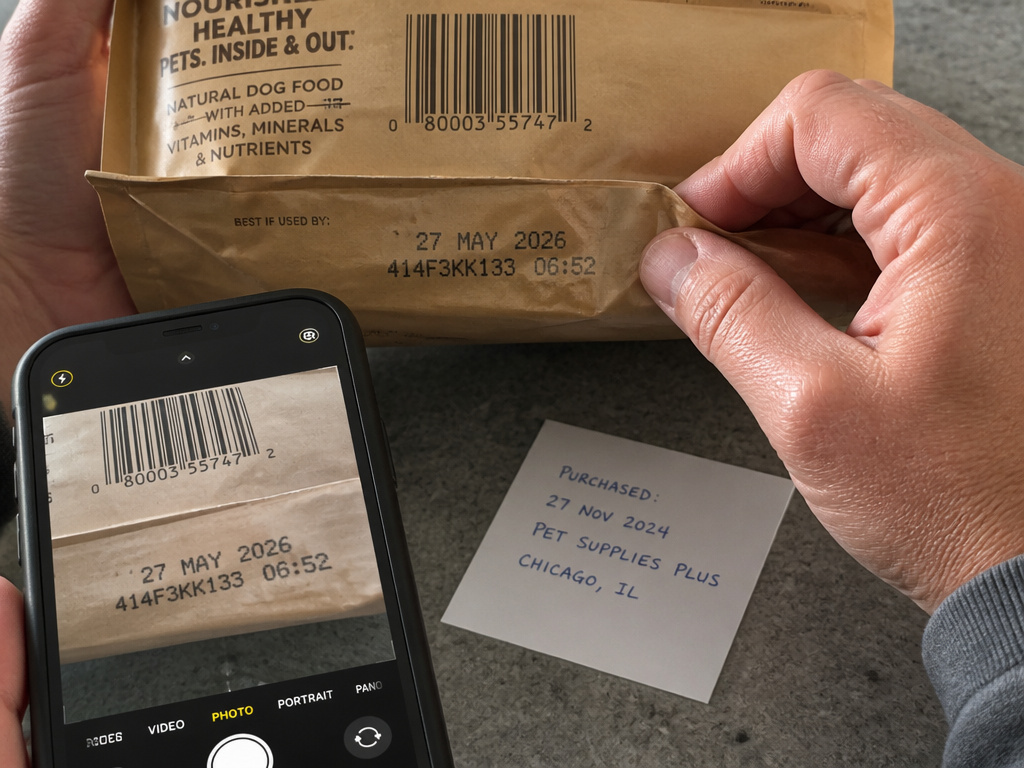
Turn the bag over. The bottom has a smudged date, the side has a barcode, and nothing on the whole package says LOT.
Here are the package problems that defeat a standard lookup:
- No lot number at all. Legal, since the field is voluntary.
- A code with no label. A bare string of letters and numbers with no “LOT” prefix defeats a keyword search of the package.
- The best-by date doing double duty. Some companies use it as the whole lot number or as part of one, which breaks any procedure that treats the two fields as separate.
- Several plants, one product. A company can make the same food in more than one U.S. Plant, and only the lot code narrows which one.
- Meat or poultry in the formula. The FDA regulates all foods except meat, poultry, and processed egg products, which fall to the USDA, so the FDA’s pet food list isn’t always the right lookup.
Easy to miss: The UPC is not a substitute for a lot code. It identifies the company and the product, but it does not show which plant made the product, and companies aren’t required to print one.
Why the UPC Won’t Save You
The UPC can’t tell you which facility ran your batch, so it can’t resolve a plant-specific recall, and it can’t confirm a match on its own.
What you actually need is a photo of every code and date on the packaging, plus the purchase date and location. Those are the fields a company or the FDA will ask for, and they’re the fields you can’t reconstruct after the bag is gone.
Does One Recall Disqualify a Brand?
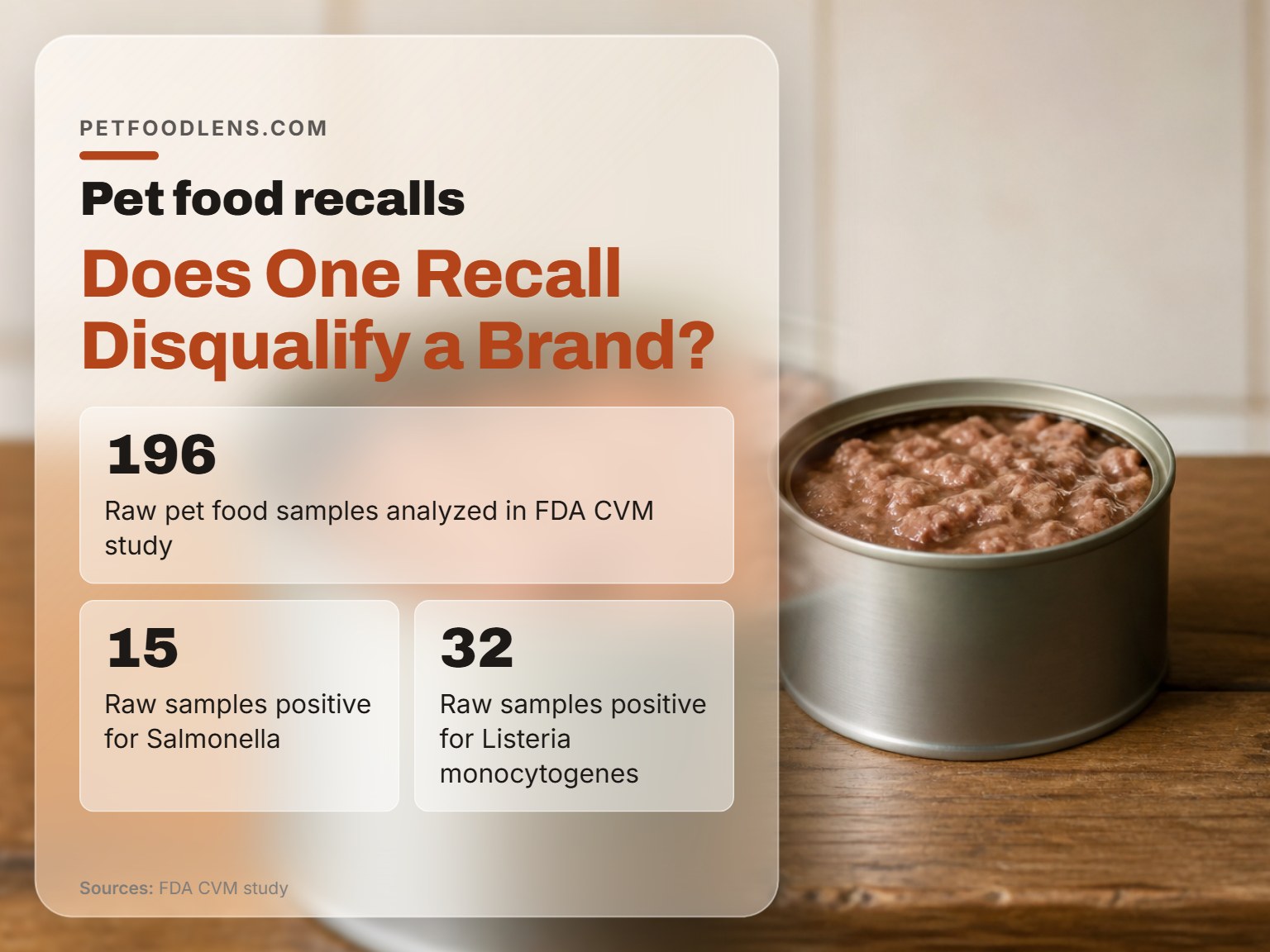
No. And treating it as automatic disqualification punishes the companies doing the most testing.
Neither is a mark against it in isolation. What matters is the cause and the response.
What a Recall Record Actually Tells You
The cause matters more than the count. Quest Cat Food’s thiamine advisory is a formulation failure. Darwin’s four advisories between 2024 and 2026 are all pathogen events.
The FDA’s Center for Veterinary Medicine screened over 1,000 pet food samples between October 2010 and July 2012. Of the 196 raw samples analyzed, 15 tested positive for Salmonella and 32 for Listeria monocytogenes, and raw pet food was more likely to be contaminated than the other types tested. Canned samples weren’t tested at all.
That study is part of why what causes pet food recalls matters more than the raw count.
When you’re looking at a brand’s history, check four things:
- The cause. Pathogen, formulation, allergen, or foreign material.
- The scope. Two lots or an entire production run.
- The response. Whether the company issued its own release, and how fast.
- The pattern. One event, or the same failure twice.
That’s a measurement artifact, not a safety record.
The FDA notes a single food can be made in several U.S. Plants, which cuts both ways.
What to Do the Hour You Find a Match
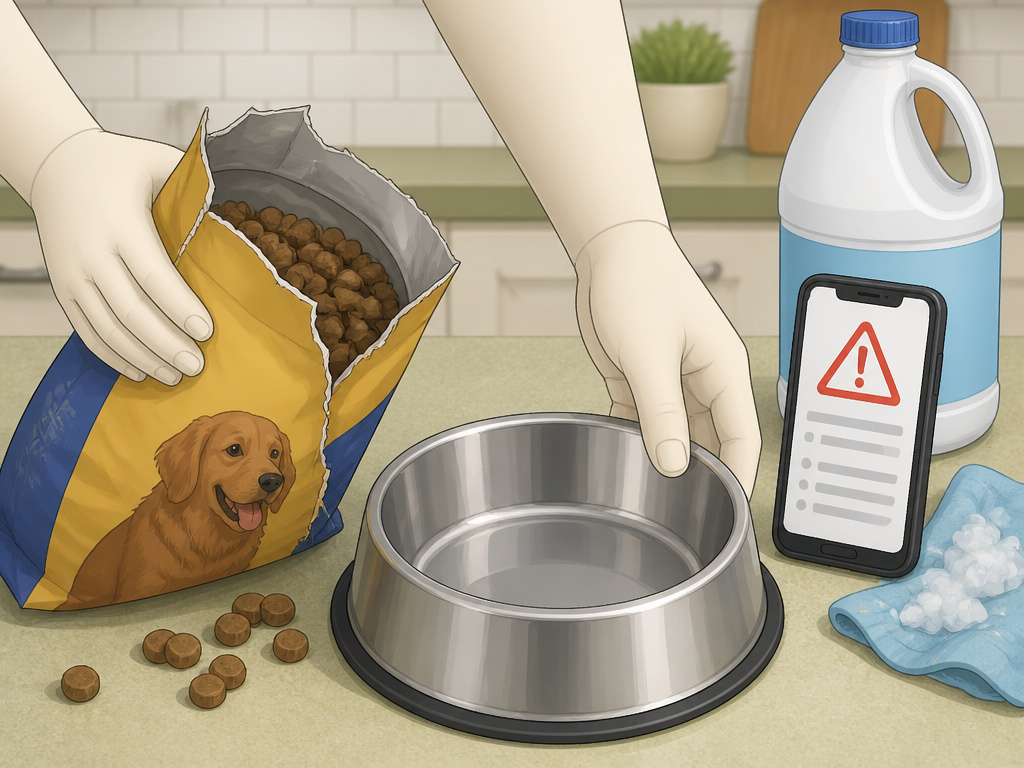
Stop feeding that bag first. Everything else can wait an hour.
Before you start: A contaminated pet food spreads bacteria to bowls, counters, and hands. Wash with soap and water for at least 20 seconds after handling it, and clean anything it touched with hot soapy water followed by a disinfectant. A solution of 1 tablespoon bleach to 1 quart of water works.
Here’s the order, and it matters less than doing all of it:
- Stop feeding it. Set the bag or can aside and put a fresh bowl down.
- Keep the packaging and the food. You’ll need both to report and to claim a refund.
- Don’t pass it on. The FDA says not to give a recalled product to others, including a food bank or a pet.
- Return it or bag it. Recalled products can often go back to the store for a full refund. If not, wrap it securely before it goes in the trash.
- Report it. The FDA’s complaint page and the company both take reports, and how to handle a pet food recall walks the order to do them in.
The FDA food recall basics page covers the return-and-dispose rules in more detail. The ASPCA pet food recall explainer is a reasonable second read, mostly for the symptom checklist.
If Your Pet Is Already Sick
That’s a vet call, not a lookup. The signs of food poisoning in pets run from vomiting and diarrhea to lethargy and refusal to eat, and the ASPCA’s guidance is to watch for a sudden refusal of a food or signs of illness right after starting a new container. The ASPCA Animal Poison Control Center takes calls at (888) 426-4435.
Not every bad meal is a recall. If the food smells off or the packaging is damaged, the ASPCA says don’t feed it regardless of what any list says.
Frequently Asked Questions
Where do I check for pet food recalls?
Two places, and you need both. The FDA’s Center for Veterinary Medicine publishes dated advisories, and the FDA’s veterinary recalls and withdrawals page lists removals. The FDA itself says not all recalls are posted to its public warnings page, so checking one and stopping is how people miss a notice.
Is the lot number required on pet food?
No. The FDA says most companies print one, but it’s voluntary, has no standard format, and isn’t in a fixed spot. If your package carries several codes, report all of them. The FDA can work with the company to identify the product even if you don’t pick the right code.
What if my bag has no lot number at all?
You’re not stuck. Save the packaging, photograph every code and date you can find, and note the purchase date and location. Those are the fields a company or the FDA will ask for.
Does a recall mean I should switch brands?
Not on its own. Look at the cause and the company’s response. A formulation error and a pathogen contamination are different failures, and a company that publishes its own recall release is telling you it found something.
Can I return recalled pet food to the store?
Often, yes. The FDA says recalled products may often be returned to the store where they were purchased for a full refund. If the store won’t take it, wrap it securely before putting it in the trash, and don’t give it to a food bank or another animal.
How do I get notified instead of checking?
The FDA runs a subscription service that can send all recalls, commodity-specific recalls, or individual recall events, on a daily or weekly schedule. It won’t catch an advisory that never became a recall, so keep the CVM feed bookmarked too.
The Bottom Line
The most useful habit here costs nothing: photograph the codes on the package the day it comes into the house. Every step below assumes you have that photo.
Here’s the trigger I’d give a friend.
This all assumes a commercial product with a printed package. I don’t formulate those diets and I won’t pretend to.
And if the answer you’re hoping for is “which brand never gets recalled,” that brand doesn’t exist. The question worth asking is which company tells you first.
