
Salmonella Risk in Raw Pet Food: What the Data Shows
This post contains affiliate links. As an Amazon Associate, we earn from qualifying purchases.
Salmonella risk in raw pet food is measurable: UK retail testing found 20% of raw pet food samples Salmonella-positive in 2023-24, against 2% for retail chicken. Freezing doesn’t kill the bacteria, and the UK Food Standards Agency rates the risk to pets as medium with medium uncertainty.
The gap between those two numbers is a kill step. Retail chicken gets cooked before it reaches your plate, so its 2% is a starting load. Raw pet food skips that step, and the salmonella risk in raw pet food means the product lands on your counter carrying whatever it left the plant with.
What follows is the testing data from both sides of the Atlantic, the conditions under which Salmonella multiplies, what high-pressure processing actually achieves, and the handling sequence that reduces your household’s salmonella risk in raw pet food if you feed raw anyway.
Key Takeaways
- UK retail testing put 20% of raw pet food samples Salmonella-positive; the FDA’s older US sampling found 7.7%. Different countries, different decades, different sampling frames.
- Freezing is not a kill step. Salmonella survives the freezer and multiplies during a counter thaw.
- 70°C for 2 minutes kills Salmonella. That is the number sitting behind Cornell’s cook-before-feeding advice, though raw pet food manufacturers advise serving raw and thawing only, without cooking.
- Outer packaging is a separate route. 10.3% of UK packaging swabs were E. Coli-positive against 0.6% for Salmonella.
- High-pressure processing at 750 MPa for 3.5 minutes produced a 9.33 log reduction in one published study.
What the UK and US Testing Actually Found
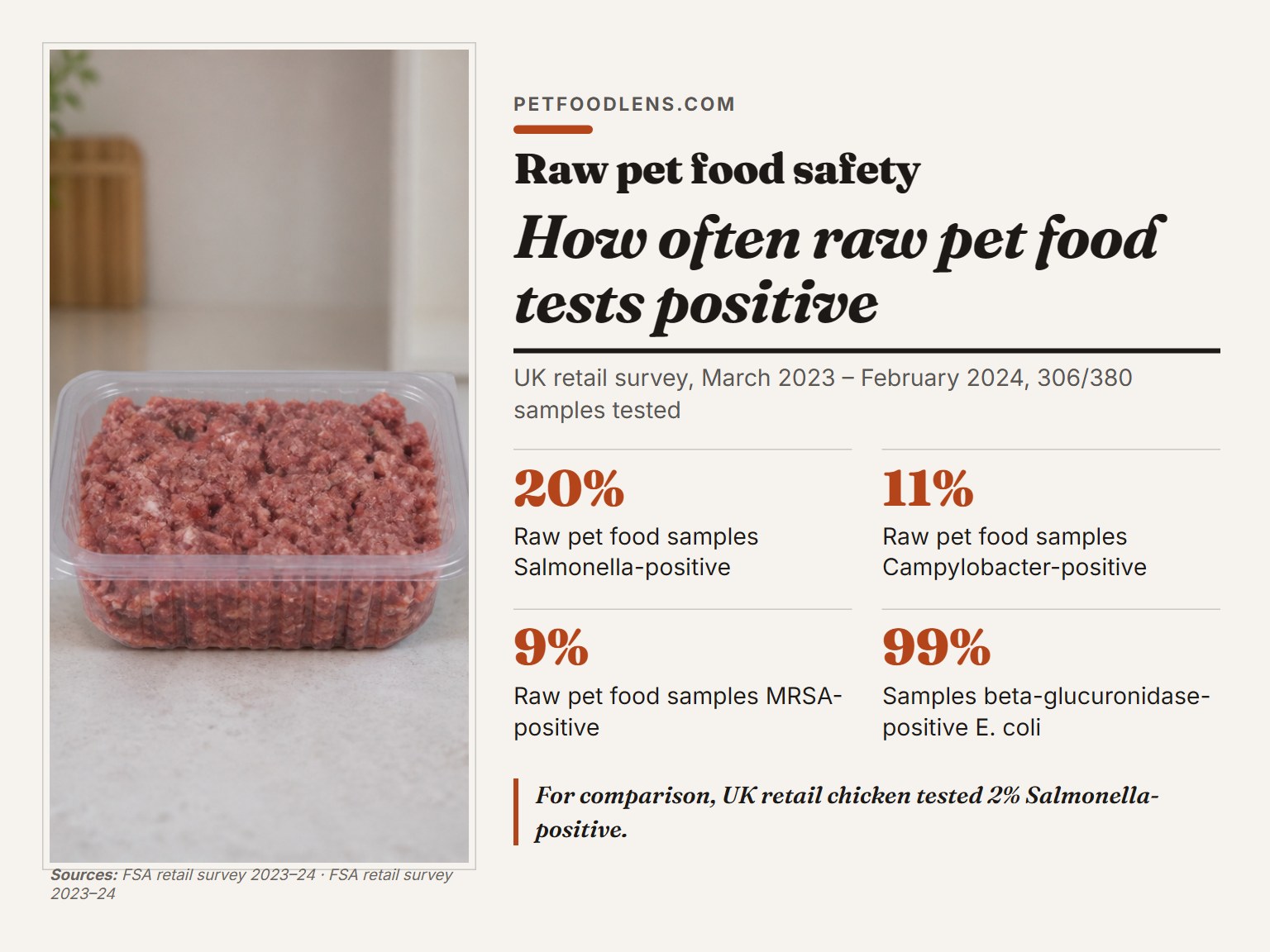
The UK Food Standards Agency collected 380 raw pet food samples between March 2023 and February 2024. Of the 306 that completed testing, 20% carried Salmonella. Campylobacter turned up in 11%, MRSA in 9%, and Shiga toxin-producing E. Coli in 11%.
The survey covered 380 raw pet food products collected at UK retail between March 2023 and February 2024, with 306 samples completing microbiological testing. Salmonella was recovered from 20% of product samples, Campylobacter from 11%, MRSA from 9%, and Shiga toxin-producing E. Coli from 11%. Beta-glucuronidase-positive E. Coli appeared in 99% of samples.
That last figure deserves a pause. Ninety-nine percent of raw pet food samples carried E. Coli at a detectable level. E. Coli is mostly a hygiene indicator, and its presence tells you the contamination profile looks exactly like raw meat, because that is what the product is.
The FSA raw pet food risk assessment also compared raw product against retail meat sold for human consumption. The gap is wide.
| Product tested | Salmonella-positive | Source and window |
|---|---|---|
| Raw pet food, UK retail | 20% | FSA, Mar 2023 to Feb 2024 |
| Raw pet food, US | 7.7% (15 of 196) | FDA CVM, Oct 2010 to Jul 2012 |
| UK retail chicken | 2% | FSA 2023 / Little et al. 2008 |
| UK retail pork | 3.9% | FSA 2023 / Little et al. 2008 |
| UK retail beef | 0.3 to 1.3% | Bishop 2019 |
US testing tells a different story on its face. The FDA’s Center for Veterinary Medicine ran 196 raw pet food samples between October 2010 and July 2012 and found 15 Salmonella-positive, or 7.7%. Listeria monocytogenes came back in 32 samples (16.3%). Dry cat food, at 120 samples, produced one positive. Every other category tested, including jerky and semi-moist, produced none. The FDA raw pet food dangers facts page spells out the sampling frame, including the decision to add raw products only in year two.
Recalls keep arriving. Raw Bistro Pet Fare pulled frozen Grass-Fed Beef Entrée in 3 lb (UPC 858833002247) and 18 lb (UPC 858833002629) sizes in October 2025. Lot 239, best-by 08/27/2026, distributed to California, Colorado, Illinois and Minnesota between September 1 and 17. An FDA-collected distributor sample triggered it, and no illnesses were reported at the time of the notice. That is how a lot of these end, and it is also why the salmonella recalls keep landing without a body count attached.
Why 20% and 7.7% Don’t Contradict Each Other
The two surveys aren’t measuring the same thing, and treating them as one number is where most of the online argument goes sideways.
FSA sampled UK retail product in 2023 and 2024. FDA CVM sampled US product in 2010 to 2012, added raw products only in the second year, and shipped samples direct from online purchases to six labs. Different country, different decade, different sampling frame.
Both figures are real. Neither replaces the other, and any source quoting one as “the” prevalence rate is picking a side without saying so.
What the two surveys do agree on is direction. Raw product carried Salmonella at a multiple of the rate found in retail meat for people, in both countries, fourteen years apart.
FSA also put a number on the risk to the animal rather than to the product: medium risk, medium uncertainty. That is a regulator declining to call it a crisis and declining to call it safe.
Freezing Doesn’t Kill Salmonella, and a Counter Thaw Feeds It
The freezer is a pause button. FSA, citing Dominguez and Schaffner (2009), notes that Salmonella numbers decline slightly on freezing while cells largely remain viable, and that defrosting permits growth.
Growth is the part worth understanding. Salmonella multiplies between 5°C and 47°C, with the optimum sitting at 37°C. That range covers your kitchen counter, your sink, and the warm car ride home from the pet store.
| Condition | Salmonella response | What it means at home |
|---|---|---|
| Temperature range | Grows from 5°C to 47°C | A 4°C fridge slows growth; a counter does not |
| Optimum temperature | 37°C | A room-temperature thaw sits near the peak |
| Kill point | 70°C for 2 minutes | The basis for cook-before-feeding advice |
| Minimum water activity | 0.94 | Moist raw product clears this easily |
| Optimum pH | 6.5 to 7.5 (growth reported to pH 4.0) | Meat sits in the sweet spot |
A counter thaw parks the outer surface of the product inside that range for hours while the centre is still hard. FSA’s own wording is that defrosting can permit growth. The surface gets there first.
Common mistake: Defrosting on the counter because the bag says “thaw overnight.” Overnight at room temperature puts the product in the growth range for the entire thaw, and the outer millimetres are the first to arrive.
The Fridge-Thaw Rule
Move the portion to the fridge the night before and leave it in a lidded container on the bottom shelf. The bottom shelf matters: drips travel down, and nothing below it should be food you eat.
I’ve been freezing leftover pate into silicone cube trays for years. One or two cubes out the night before, thawed in the fridge, never on the counter. It costs a little planning and nothing else, and the thawing frozen pet food routine is the same one.
Do not refreeze what you thawed. Every freeze-thaw cycle hands the surviving cells another window at growth temperature.
What High-Pressure Processing Actually Does
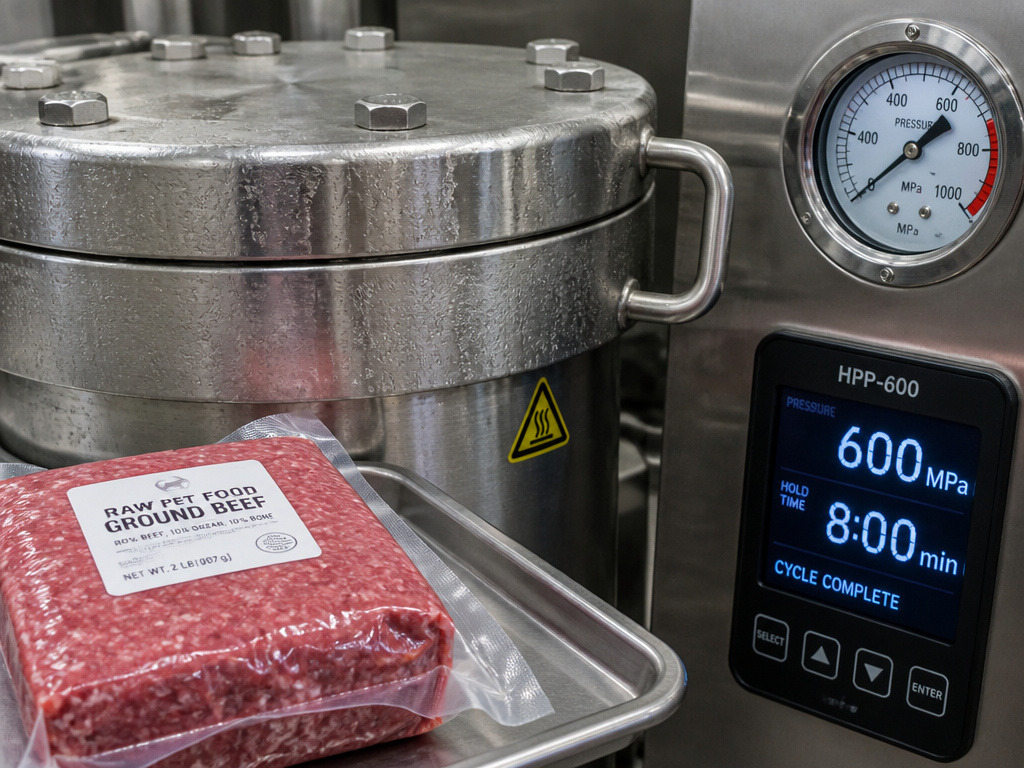
HPP is the one intervention in this category with published kill data behind it. The product goes into a water chamber at very high pressure, and pressure alone inactivates a large share of the bacterial load without cooking the meat.
The numbers are not small. Hasty et al. (2018) treated raw beef pet food at 600 MPa for 8 minutes and measured 4.9 log reductions at 24 hours and 6.2 logs at five days. Serra-Castello et al. (2022b) hit a maximum of 9.33 log at 750 MPa for 3.5 minutes on a vacuum-packed frozen block at pH 6.09. The same team reported a 9.08 log reduction at day 0 and day 14 on samples held at -18°C. Lee et al. (2023) worked at 586 MPa for 1 to 4 minutes and kept beef formulations above 5 logs through the study.
A 5-log reduction means a 100,000-fold drop in the count. The survivors are still in there.
I won’t call HPP raw a guarantee, and nobody selling it should either. Those studies used inoculated samples under lab conditions, and a 5-log reduction on a heavy starting load still leaves cells behind. What HPP buys you is margin. Margin is worth having.
Brands that publish an HPP spec are the ones to look at. Ask any brand for the pressure and the hold time before you buy, and treat a vague answer as the answer. The sourcing raw pet food checklist covers what else to ask for.
Who Actually Gets Sick From This
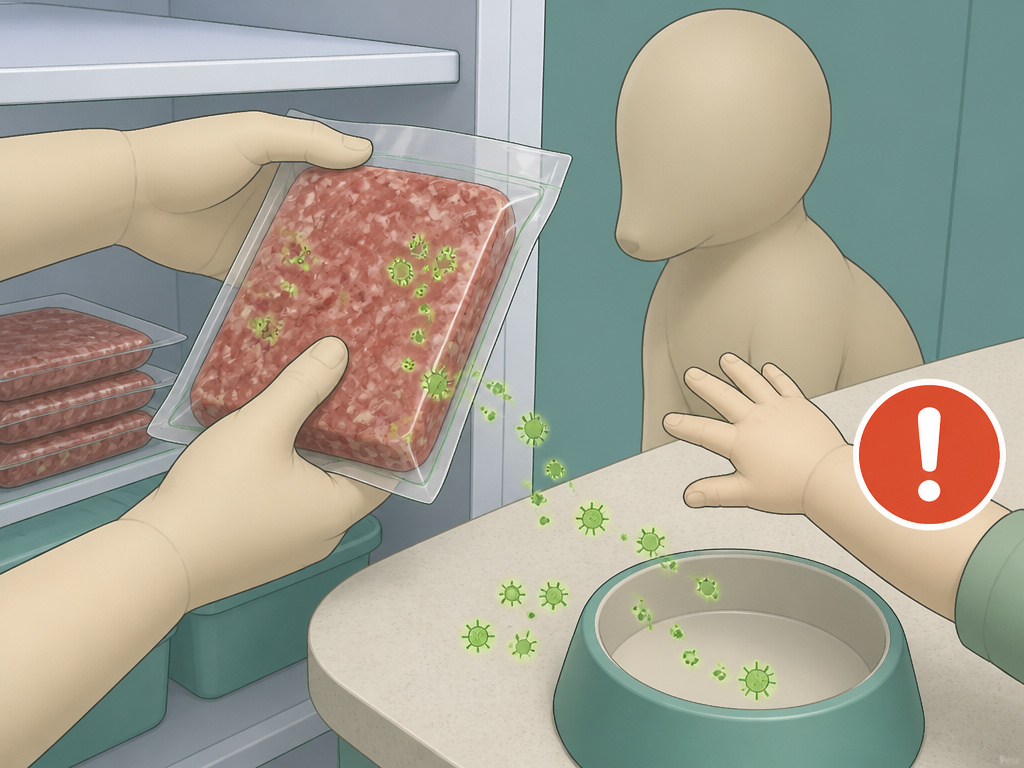
Forty-four people in Canada got sick in the most recent raw pet food-linked outbreak, and thirteen were hospitalized. Ages ran from 1 to 91. 43% of the cases were children five and under. The strain, Salmonella I 4,[5],12:i:-, was extensively drug-resistant, including to antibiotics used in human medicine.
That last detail is the one that changes the argument. A resistant strain narrows what a doctor can do if a child in the household picks it up.
Dry food has its own record. A 2023 outbreak of Salmonella Kiambu tied to dry pet food produced 7 illnesses and 1 hospitalization, with 86% of the infected people aged one year or younger and the remaining 14% aged 65 and over. The Salmonella pet food human health implications review also flags that dry kibble has no standardized post-processing pathogen mitigation step, so “just feed kibble instead” is not automatically the safe answer.
Pets sit in the chain, not just at the end of it. Finley et al. (2008) fed Salmonella-contaminated commercial raw food to 16 dogs, and 7 shed Salmonella in feces after 1 to 7 days. Dogs on Salmonella-free diets shed none. A shedding dog turns a food safety problem into a household hygiene problem.
Packaging is a separate route. In the UK survey, 0.6% of outer packaging swabs were Salmonella-positive against 20% of product samples, but 10.3% of packaging swabs carried E. Coli. The package is not the main source of the bacteria. It is a reliable way to move bacteria from the fridge shelf to the counter to your hands.
If a pet does pick something up, the food poisoning symptoms list is worth knowing before you need it. Cats hide digestive trouble well, and a cat that stops eating for a day is already a phone call.
Where the Veterinary Advice and the Raw Brands Part Ways
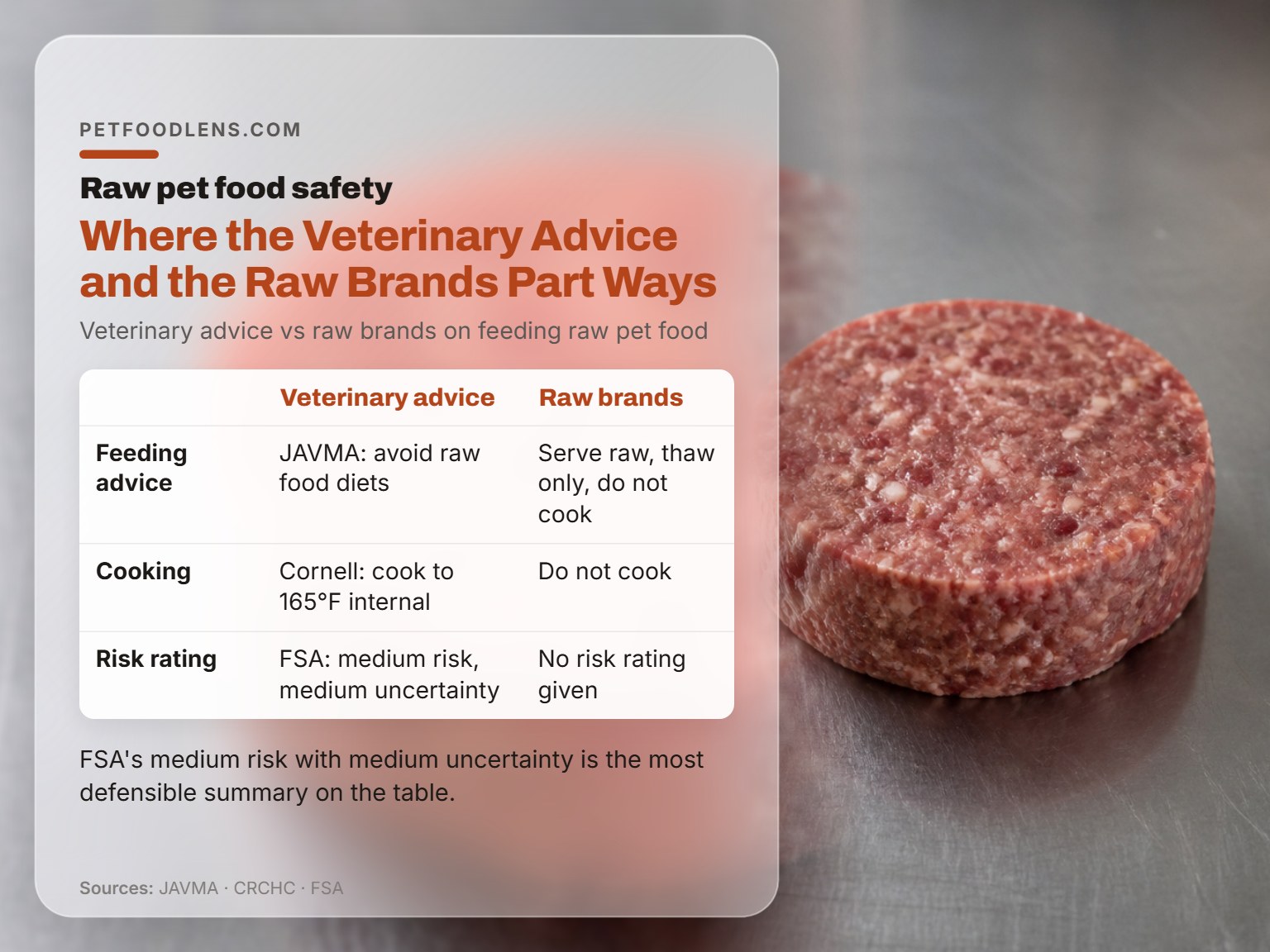
Four credible sources, four different answers, and none of them is being coy about it.
- JAVMA (2011) advises owners to avoid feeding raw food diets to pets. No hedging, no conditions.
- Cornell’s Riney Canine Health Center takes a different line: treat raw pet product like any raw meat you’d buy for the family and cook to 165°F internal temperature before feeding, while raw pet food manufacturers advise serving it raw and thawing only, without cooking.
- FSA rates the risk of pets acquiring Salmonella from raw pet food as medium, with medium uncertainty. Softer than a blanket avoid, and short of an endorsement.
- Raw pet food manufacturers say serve it raw, thaw only, do not cook.
Cornell’s position is the interesting one, because it is a compromise that satisfies nobody. Cooking to 165°F does address the pathogen load. It also turns the product into something the manufacturer did not formulate for, and it undercuts the reason most people bought raw in the first place.
The JAVMA Salmonella pet food update is the bluntest of the four, and a raw diets dogs and cats review in the peer-reviewed literature lays out the same split without resolving it.
I’ll be straight about my own footing. My hands-on formulation work is commercial cat food. Raw is outside that, so on this topic I’m reading the same papers you are, and I’d rather say so than pretend to a confidence I haven’t earned. The raw diet safety for dogs and raw cat food safety material covers the species-specific handling differences.
What I will say: FSA’s medium risk with medium uncertainty is the most defensible summary on the table. That rating is a caution, and it is not a ban.
If You Feed Raw Anyway, Six Steps That Reduce the Load
Before you start: Children five and under made up 43% of the Canadian outbreak cases, so keep the prep board and the bowl out of reach while you work. Use a dedicated plastic board that goes straight into the dishwasher, and never rinse raw product under the kitchen tap, where the spray carries droplets onto nearby surfaces.
- Buy frozen, not fresh-chilled. Frozen product holds at a temperature where growth stops. Chilled product spends its whole shelf life inside the growth range.
- Portion before you thaw. Split the block while it is still solid, bag it, and freeze it flat. Skip this and you thaw more than you need, then refreeze the rest, which hands the survivors a second window. The freezing raw dog food portions method does it in one pass.
- Thaw on the bottom shelf of the fridge, lidded. A counter thaw puts the surface in the 5°C to 47°C range for hours. A fridge thaw keeps the whole product below it.
- Prep on one board, then straight to the dishwasher. A board that sits in the sink until evening has been sitting at room temperature all day.
- Wash hands with soap and water, then dry on paper. A tea towel moves the bacteria onto the towel, and the towel goes back on the rail.
- Disinfect the counter and the bowl rather than rinsing them. Rinsing spreads. The sanitizing raw feeding surfaces sequence is the one that actually clears a surface.
The Sink Spray Problem
The kitchen tap is the step that gets skipped, because rinsing feels like cleaning. Water from a tap hits the board at pressure and throws a fine aerosol onto the surrounding half metre: the dish rack, the drying cups, the fruit bowl.
Use a dedicated bowl of soapy water instead, or wipe with a cloth and disinfect afterwards. The handling raw dog food routine covers the rest of the sequence.
One more thing that has nothing to do with bacteria. A complete raw product carries a nutritional adequacy statement. A grind of muscle meat with no bone, no organ and no added calcium does not, and that problem shows up months later as a cat with the wrong mineral balance. Marketing is not nutrition, and “human-grade” tells you how the material was handled, not whether the diet is balanced. Storing raw pet food properly is the last piece of the routine.
Frequently Asked Questions
Can I get Salmonella from handling my pet’s raw food?
Yes. The UK survey found Salmonella on 20% of product samples and E. Coli on 10.3% of outer packaging swabs, so the handling route is real even when the product stays sealed. The bacteria move from product to hand to mouth, or from product to counter to a utensil you use later.
Does freezing raw pet food kill Salmonella?
No. FSA, citing Dominguez and Schaffner (2009), states that numbers decline slightly on freezing while cells largely remain viable, and that defrosting permits growth. The freezer buys you time, not safety.
Is high-pressure processed raw food safe?
Safer than untreated raw, and not sterile. Published reductions run from roughly 5 logs at 586 to 600 MPa up to 9.33 logs at 750 MPa for 3.5 minutes. Those are large reductions measured on inoculated samples in lab conditions, and a residual population survives a 5-log hit.
Can I cook raw pet food to make it safe?
Cornell’s Riney Canine Health Center advises exactly that, cooking to 165°F internal temperature, while raw pet food manufacturers advise serving raw and thawing only, without cooking. Salmonella is killed at 70°C for 2 minutes, which 165°F clears. The catch is that cooking changes a diet formulated to be fed raw, so you are no longer feeding the product the manufacturer designed.
Is dry kibble safer than raw?
Not automatically. The FDA study found one Salmonella-positive sample in 120 dry cat food samples, which is a low rate. The same review literature notes dry kibble has no standardized post-processing pathogen mitigation step, and a 2023 dry pet food outbreak produced 7 illnesses and 1 hospitalization.
What are the signs a pet has Salmonella?
Digestive upset is the usual presentation, and some animals shed the bacteria with no visible signs at all. Finley et al. (2008) found 7 of 16 exposed dogs shedding within 1 to 7 days of eating contaminated food. A pet that stops eating or develops diarrhea after a food change needs a vet, not a wait-and-see.
The Bottom Line
One threshold decides this for most households. If there is a child under five, anyone over 65, or an immunocompromised person in the house, the arithmetic changes. Those groups accounted for the bulk of the outbreak cases in Canada and in the 2023 dry food outbreak, and a drug-resistant strain narrows the treatment options if it lands.
The first thing to do this week is not a handling change. It is a phone call or an email to your raw brand asking two questions: was this product high-pressure processed, and at what pressure and hold time? A brand that answers has nothing to hide. A brand that deflects has told you something useful.
I’d rather see an owner feed a complete, HPP-treated raw product with an adequacy statement than a DIY grind of muscle meat with a calcium supplement guessed off a forum. If neither is available, a mid-priced food with a clear AAFCO adequacy statement beats a boutique raw product with a wolf on the front of the bag and no pathogen data behind it.
And the honest limit: my formulation background is commercial cat food, not raw. Where the raw question turns on your specific animal’s health, that is a conversation with your vet, and I’m not the one to have it with you.
