
How to Thaw Frozen Pet Food Safely: Step-by-Step
This post contains affiliate links. As an Amazon Associate, we earn from qualifying purchases.
To thaw frozen pet food safely, use the refrigerator at 40°F or below and allow 24 hours for every 5 pounds. Cold water is faster: a 1-pound package thaws in an hour or less, but the water must stay at 70°F or below. Never thaw on the counter; the outer layer crosses 40°F while the center stays frozen.
A frozen block thaws from the outside in. The surface reaches the danger zone long before the middle gives up its ice, and that band, 40 to 140°F, is where bacteria multiply fastest. Ground and chunked pet food makes it worse, because there’s more exposed surface per ounce than a steak carries. This is why how to thaw frozen pet food safely matters.
What follows covers the four methods that hold up, the temperatures each one depends on, and the places where federal guidance and the pet food manufacturers flatly contradict each other.
Key Takeaways
- Refrigerator at 40°F or below, 24 hours per 5 pounds. Even a 1-pound package needs a full day.
- Cold water thaws a 1-pound package in an hour or less under the FSIS static-bath method, while Wisconsin DATCP and the EPA cap running water at 70°F or below and require the package to stay sealed.
- USDA FSIS rules out counter thawing entirely, and Wisconsin DATCP allows no counter time either, while Stella & Chewy’s allows 10-20 minutes for its frozen morsels.
- Microwave thawing is legal only as the first step of cooking. Stella & Chewy’s says never microwave its food at all.
- Refreezing splits the sources. FSIS permits it after a refrigerator thaw; Stella & Chewy’s does not.
The Refrigerator Method: 24 Hours for Every 5 Pounds
Refrigerator thawing is the only method with no clock running against you. Food stays at 40°F or below the whole time, so an extra hour costs nothing but patience.
Refrigerator thawing holds food at 40°F or below for the entire defrost. USDA FSIS figures 24 hours per 5 pounds, with even a 1-pound package of ground meat or boneless chicken requiring a full day. Thaw time lengthens at colder setpoints, so a 35°F refrigerator runs slower than a 40°F one.
The math is easy once you know the weight. A 5-pound chub gets a day. A 15-pound bag gets three days at 24 hours per 5 pounds, the standard answer to how to thaw frozen pet food safely. Write the weight on the bag when you portion it, because nobody remembers in week three.
Wisconsin’s retail guidance adds two details the federal page doesn’t spell out. Set the package on a tray to catch drippings, and put raw animal food on a shelf below anything ready to eat. Both rules exist for one reason: thawing packages leak.
Before you start: A thawing package drips, and the drips carry whatever was on the outside of the food. Use a rimmed tray, keep raw food below ready-to-eat food, and wipe the shelf afterward. FSIS also warns that a leaking bag in a water bath lets bacteria in and lets the meat absorb water, which produces a watery product.
Four steps, in order:
- Set the refrigerator to 40°F or below and check it with a thermometer. A fridge running warm pushes the outside of the package into the danger zone while the middle is still solid.
- Weigh the package before it goes in. At 24 hours per 5 pounds, a 2-pound pack needs about a full day. Guessing is how food ends up sitting in the fridge for three days.
- Use a rimmed tray, on a lower shelf. Skip it and you’ll find the drip pooled on the shelf below by morning.
- Close the door. Poking at it doesn’t speed anything up, and each time you open the door the fridge temperature climbs.
Here’s the full timing picture, drawn from the USDA FSIS Big Thaw guide and EPA figures:
| Method | Package size | Time |
|---|---|---|
| Refrigerator, 40°F or below | Any | 24 hours per 5 lb |
| Refrigerator | About 1 lb | 1 full day |
| Cold water | About 1 lb | 1 hour or less |
| Cold water | 3 to 4 lb | 2 to 3 hours |
| Microwave | Small portions | Cook immediately |
| Cook from frozen | Vegetables, ground meat | Longer than normal |
Freezing doesn’t kill microorganisms; it only slows their growth, per the Wisconsin DATCP fact sheet. That matters when you’re freezing pet food ahead of time. The thaw is the risky half of the cycle, and the freeze is the safe half.
What Temperature Should a Thawing Refrigerator Be?
Forty or forty-one, depending on which document you open, and the gap is narrower than the argument suggests.
| Source | Setpoint | Who it covers |
|---|---|---|
| USDA FSIS | 40°F or below | Home kitchens |
| Wisconsin DATCP | 41°F or below | Retail food establishments |
| North Dakota HHS | 41°F or less | Foodservice |
| Nom | Below 40°F | Its own frozen meals |
The split tracks the audience. FSIS writes for consumers. The Wisconsin DATCP thawing fact sheet and North Dakota HHS write for restaurants and stores operating under the FDA Food Code. One degree apart, two regulatory universes.
What the 40 vs 41 Split Actually Means
Set your home fridge to 40°F and you satisfy both readings. Then leave the thermometer in there, because setpoints drift.
FSIS notes that thaw time at 35°F is longer than at 40°F, so 24-hours-per-5-pounds is a planning number, not a constant. A fridge running cold takes longer. A fridge running warm is a different problem entirely.
The EPA adds one more piece: microbes are inactivated at a 0°F freezer setpoint but reactivate on thaw. Your freezer holds them in a paused state. They pick up where they left off once the food warms.
Anyone planning to store raw pet food in bulk should tape a thermometer to a middle shelf and forget about it. Compare it on the same basis every week: same shelf, same time of day.
Cold Water Thawing: An Hour or Less, With Rules
A package of frozen morsels in a bowl of tap water, a timer on the counter, the water changed twice. That’s the whole method, and the details are where it goes wrong.
The FSIS version is a static bath: submerge the food in cold tap water and change the water every 30 minutes. A 1-pound package thaws in an hour or less that way. A 3- to 4-pound package takes 2 to 3 hours.
The retail version is stricter. Wisconsin DATCP requires the food to be completely submerged under running water at 70°F or below, with enough velocity to float loose particles off in an overflow. The sink has to be a clean, sanitized food sink. A hand-wash or dishwashing sink is out.
Where this goes sideways: A package with a pinhole leak in a water bath pulls bacteria in from the surrounding water and absorbs water into the meat. FSIS calls the result a watery product. Bag it in something sealed before it goes in, and check the seal with your fingers.
The EPA WaterSense food thawing section sets the same 70°F (21°C) ceiling and adds a detail worth stealing: the water should start below 70°F so it has room to warm during the soak without breaking the limit.
North Dakota HHS adds the clock that most home guides skip. Thawed portions of raw animal food can’t sit above 41°F for more than 4 hours total, and that count includes the time under water, the prep time, and the time it takes to chill back down. Run the bath too long and you’ve spent the budget before the food hits the pan.
Running Water vs a Static Bath
The two procedures genuinely differ. FSIS describes a bath you change every half hour. DATCP, North Dakota HHS, and the EPA describe flowing water with an overflow, so how to thaw frozen pet food safely depends on which one you follow.
Both keep the food cold. The running-water version exists for commercial kitchens where a sanitized food sink and an overflow drain are already plumbed in. At home, the static bath with 30-minute changes is the practical version, and it’s the one FSIS publishes.
Whichever you use, sanitize surfaces that the wet package touched before you set anything else down.
Can You Microwave Frozen Pet Food to Thaw It?
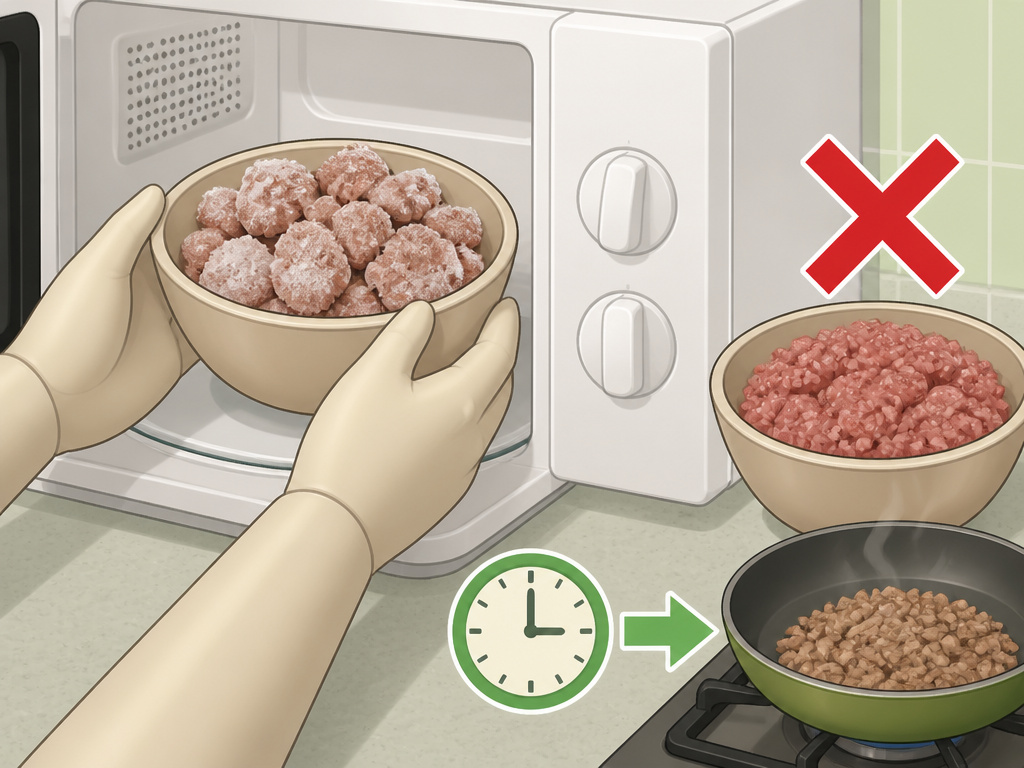
Yes if the food goes straight into a pan, no if it’s served raw.
FSIS lists the microwave as a safe thaw method when the food is cooked immediately afterward. DATCP says the same thing with more detail: microwave thawing begins the cooking process, so it has to be followed by complete cooking, and it isn’t recommended for large items.
North Dakota HHS goes further. The microwave has to be part of the cooking process, with immediate transfer to conventional cooking equipment and no interruption.
The EPA flags the failure mode. If there’s a delay before cooking, microwave-thawed food can carry hot spots that foster bacterial growth. Use the fridge or running water instead if you’re not cooking right away.
Then there’s the manufacturer position. Stella & Chewy’s states plainly that its frozen dog and cat foods should never be cooked, heated, or microwaved. For that brand, the microwave is off the table regardless of what the regulators allow.
If you’re warming dog food after thawing it in the refrigerator, that’s a separate step with its own limits. The microwave isn’t the shortcut for it.
Where the Guidance Actually Conflicts
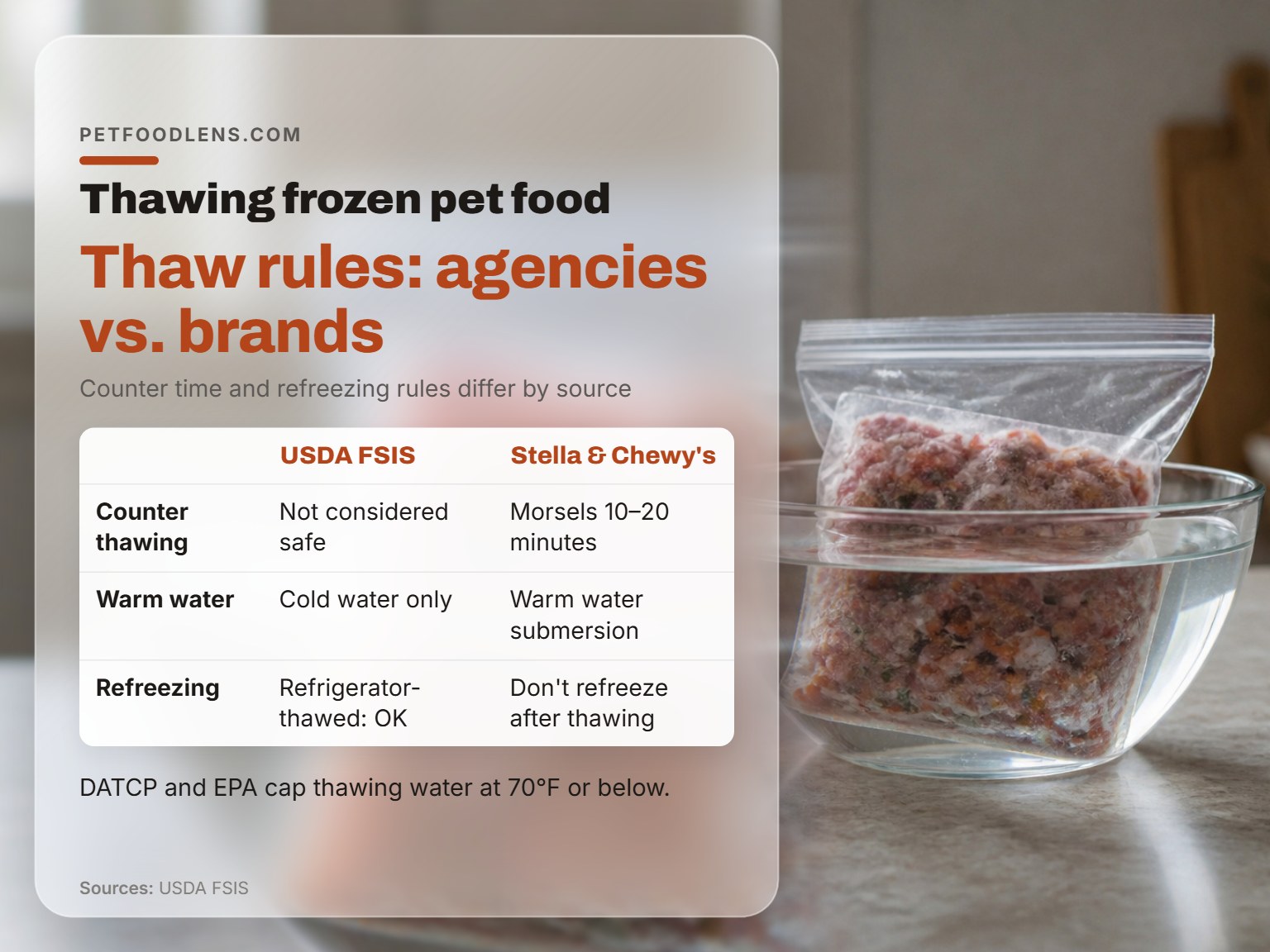
USDA FSIS prohibits hot-water thawing outright, while Stella & Chewy’s tells owners to submerge the product in warm (not hot) water, and Nom warns that hot water can cook the edges while the center stays frozen but says to serve immediately if you use warm water at all.
That one is worth unpacking, because it’s the pattern behind most of the disagreements here.
Counter Thawing: Prohibited, Unless It’s 20 Minutes
FSIS is unambiguous: thawing food on the counter is not considered safe and may lead to foodborne illness. DATCP allows thawing only under refrigeration, running water, microwave, or cooking.
Stella & Chewy’s permits frozen dinner morsels on the countertop for 10 to 20 minutes. The company’s reasoning is piece size and duration. Small morsels, brief window.
FSIS does allow perishable food at room temperature for up to 2 hours as an outer limit, so the 20-minute window sits inside the federal number. It sits outside DATCP’s retail rule, which allows no counter time at all.
Warm Water: An Undefined Ceiling
FSIS prohibits thawing in hot water. DATCP caps running water at 70°F. The EPA sets the same limit.
Stella & Chewy’s says warm, not hot, and gives no number. Nom warns that hot water can cook the edges while the center stays frozen, and says to serve immediately if you use warm water at all.
Wisconsin DATCP and the EPA cap thawing water at 70°F or below, while Stella & Chewy’s says to submerge the product in warm water to defrost quickly, so check the tap with a thermometer and follow the source that applies to your food.
Refreezing: Two Different Answers
FSIS permits refreezing food that thawed in the refrigerator, without cooking, with some loss of quality, and says cold-water-thawed food should be cooked before refreezing; Stella & Chewy’s, by contrast, says don’t refreeze raw dog or cat food after it has thawed, with no cooking exception.
Stella & Chewy’s is stricter and simpler: don’t refreeze raw dog or cat food after it has thawed. No cooking exception.
Easy to miss: The refreezing rule changes with the thaw method, not just the food. Refrigerator-thawed food can go back in the freezer under FSIS guidance. Cold-water-thawed food cannot, unless you cook it first.
For raw feeding specifically, handling raw dog food safely comes down to the same three questions: how it thawed, how long it sat, and whether it’s going back in the freezer.
How Long Does Thawed Pet Food Last in the Fridge?
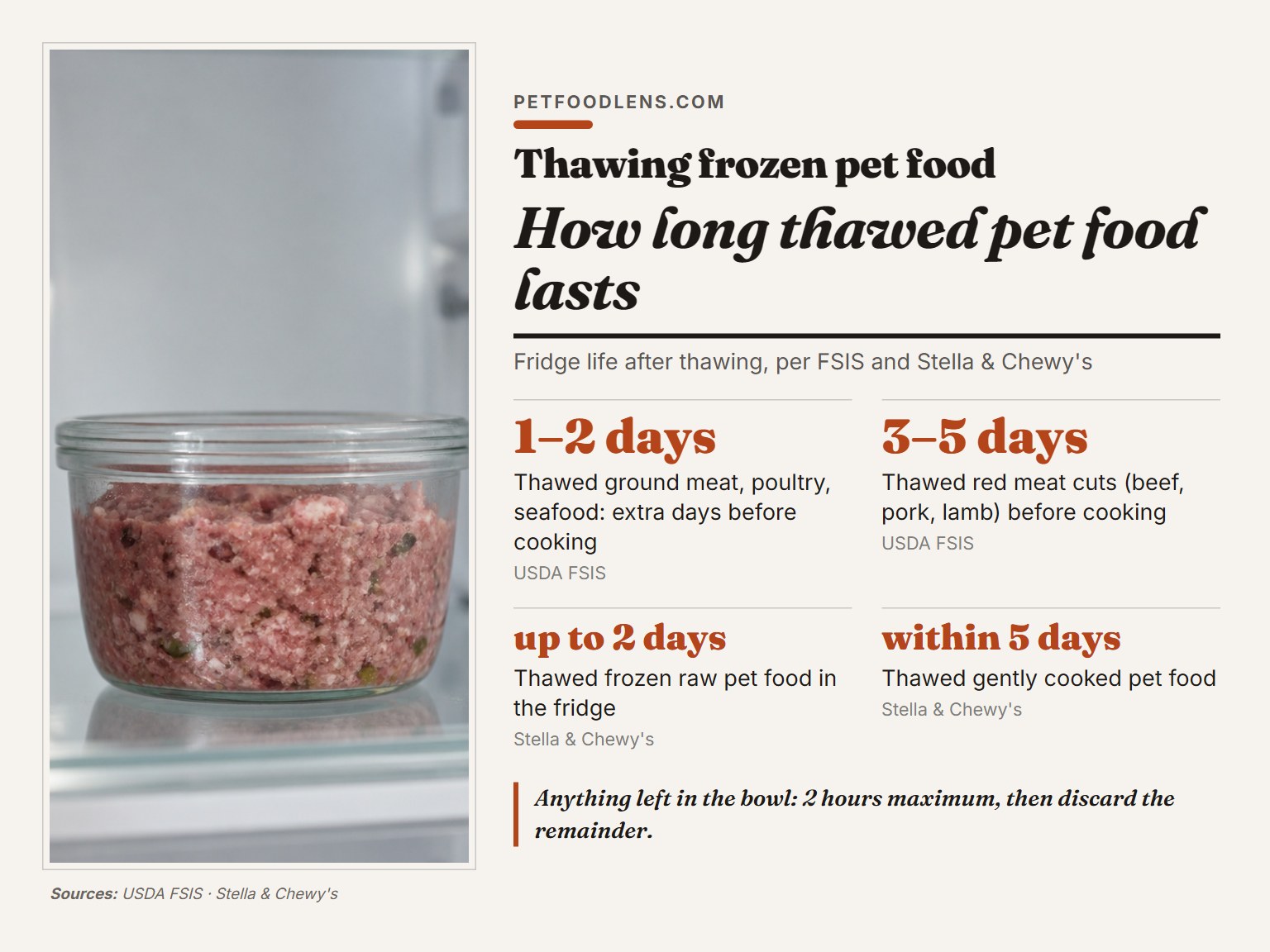
Thawed ground meat, poultry and seafood keep for an extra day or two, per FSIS. Red meat cuts get 3 to 5 days.
The pet food manufacturers publish their own numbers, and they’re shorter.
- Thawed frozen raw pet food: up to 2 days in the fridge (Stella & Chewy’s)
- Thawed gently cooked pet food: within 5 days (Stella & Chewy’s)
- Thawed Nom meals: refrigerated, sealed or covered
- Anything left in the bowl: 2 hours maximum
The 2-hour ceiling shows up in both places. FSIS says perishable food shouldn’t sit at room temperature for more than 2 hours. Stella & Chewy’s says thawed food should sit out no longer than 2 hours, then the remainder gets discarded.
The Two-Hour Rule Outside the Fridge
Two hours is the outer limit, and a warm kitchen shortens it. A crusted, dried surface on the food means it’s been sitting too long, whatever the clock says.
I’ve thrown out more half-cans than I’d like to admit because they sat in the bowl through a long evening. Now I portion first and put the rest away before the bowl goes down.
The short version: If you can’t say when it came out of the fridge, it’s been out too long. Two hours is the ceiling. Aim well under it.
Stella & Chewy’s also gives freezer limits: 12 months in the original unopened package, and up to 4 months frozen after opening. Past that, you’re feeding something the freezer has been slowly oxidizing.
If you’re ever unsure, signs of spoiled pet food are obvious at the bowl before they’re obvious on a label.
Thawing Methods That Aren’t Worth the Risk
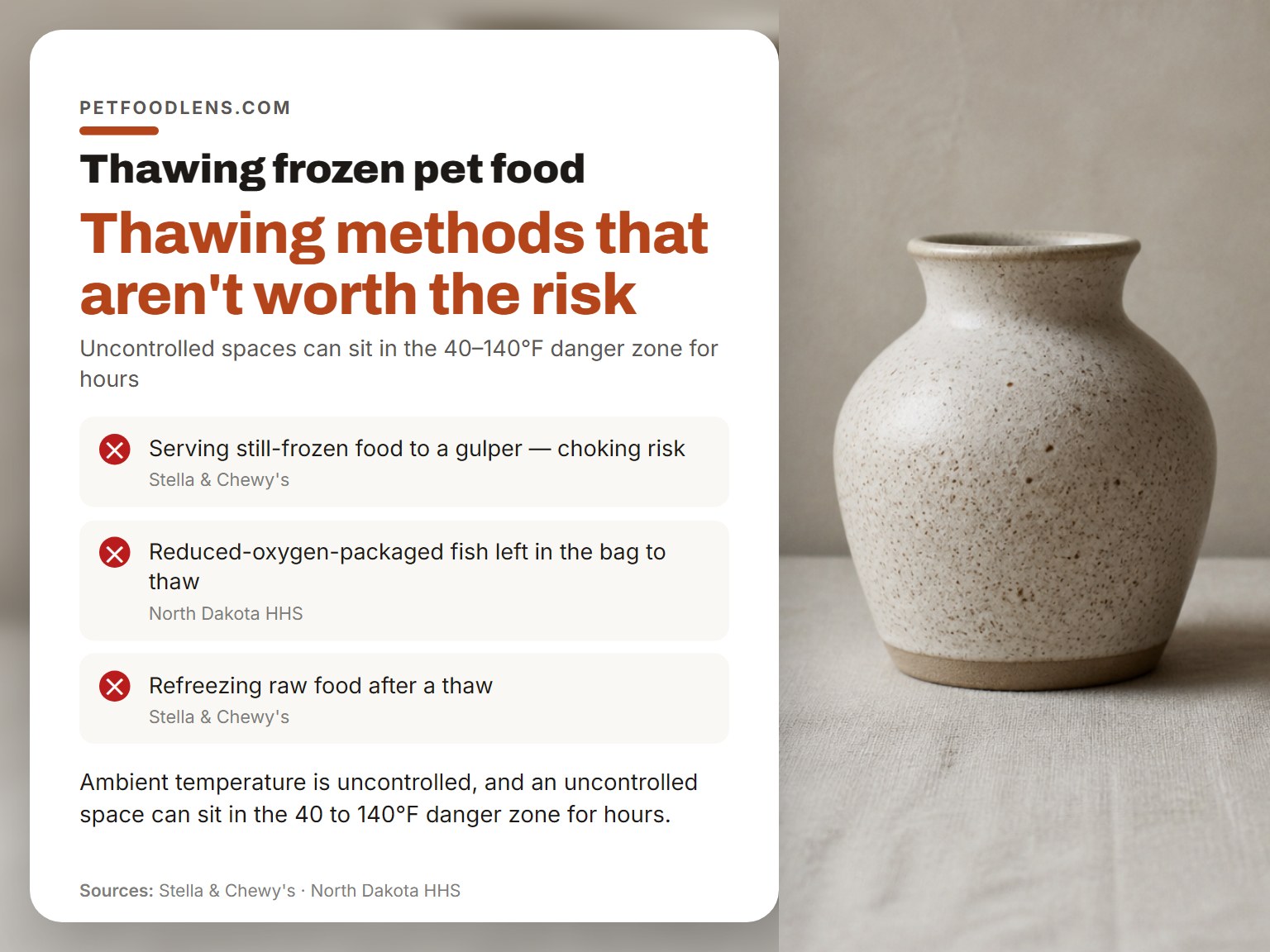
A garage in October feels cold enough. FSIS names that exact mistake in print.
The federal page lists thawing in a garage, basement, car, dishwasher, or plastic garbage bag as unsafe. The reason is the same in every case: ambient temperature is uncontrolled, and an uncontrolled space can sit in the 40 to 140°F danger zone for hours without anyone noticing.
The rest of the list:
- Still-frozen food served to a gulper. Stella & Chewy’s warns that animals which wolf their meals risk choking on frozen food. Thaw it fully.
- Reduced-oxygen-packaged fish left in the bag. North Dakota HHS requires removing it from the package before refrigerator thawing, or immediately on completion of a running-water thaw.
- A leaking bag in a water bath. Covered above, and still the most common way a cold-water thaw goes wrong.
- Refreezing raw food after a thaw. Stella & Chewy’s says no, full stop.
If you’re portioning ahead, freezing raw dog food portions in flat bags solves most of this before it starts. Flat packs thaw faster than a solid block, and a sealed bag doesn’t leak into the water.
The same logic applies to thawing homemade pet food, which tends to go into the freezer in larger, denser containers that take longer to thaw all the way through.
Frequently Asked Questions
Does thawed pet food need to be thrown out if it sat out overnight?
Yes. Stella & Chewy’s says thawed food should sit out no longer than 2 hours, then the remainder gets discarded, and it explicitly says never leave frozen dog or cat food out overnight. FSIS sets the same 2-hour ceiling for perishable food at room temperature. There’s no salvage move here.
Can I refreeze pet food that thawed in the fridge?
FSIS allows it, without cooking, though quality suffers. Stella & Chewy’s does not: it says don’t refreeze raw dog or cat food after thawing, with no cooking exception. If you’re feeding a raw brand, follow the brand.
Is it safe to thaw frozen pet food in hot water?
No. FSIS prohibits hot-water thawing. Wisconsin DATCP caps running water at 70°F or below, and the EPA sets the same limit. Nom adds the practical failure: hot water can cook the edges while the center stays frozen.
How long can thawed raw pet food stay in the refrigerator?
Up to 2 days, per Stella & Chewy’s. Thawed gently cooked food from the same company gets 5 days. FSIS gives thawed ground meat and poultry an extra day or two, and red meat cuts 3 to 5 days, but the manufacturer’s shorter window is the one to use for its own product.
Can I cook frozen pet food straight from frozen?
For raw and gently cooked commercial pet food, no. Stella & Chewy’s says its frozen foods should never be cooked, heated, or microwaved. For ordinary frozen meat and vegetables, Wisconsin DATCP lists cooking from frozen as a valid method: allow more time than normal and stir often.
The Bottom Line
The number to hold onto is 40°F, and the second number is 24 hours per 5 pounds. Everything else here is a variation on those two.
Here’s the concession. My hands-on formulation work has been commercial cat food, and most of the frozen products on the market are raw or gently cooked dog food. For those, I follow the manufacturer’s own thaw sheet before I follow anything else, because Stella & Chewy’s knows its package size and I don’t.
So the first thing to do this week: put a fridge thermometer on the middle shelf and leave it there overnight. If it reads above 41°F in the morning, you’ve been thawing food in the danger zone without knowing it, and every timing rule above is off.
Above 41°F, fix the fridge before you thaw anything else.
