
How to Sanitize Surfaces After Raw Feeding: Step-by-Step
This post contains affiliate links. As an Amazon Associate, we earn from qualifying purchases.
To sanitize surfaces after raw feeding, scrub off all food residue with hot soapy water first, then apply a bleach solution; the CDC specifies leaving items wet for at least 10 minutes. Skipping the scrub is the failure point: a trial found a 10% bleach soak alone still recovered Salmonella from 17 of 24 bowls.
Residue is what deactivates the bleach, and residue is invisible once a bowl looks dry. Illinois Extension states it plainly: food particles and sticky surfaces use up the bleach before it reaches the bacteria. That single fact reshuffles the whole how to sanitize surfaces after raw feeding job. The scrub carries the load, and the disinfectant finishes what the scrub leaves behind.
What follows is the order that holds up under testing, the dilution numbers where the agencies differ, and the surfaces owners skip entirely.
Key Takeaways
- Scrub before you disinfect. Bleach loses potency on food film, so hot soapy water comes first and the solution comes second.
- Leave the solution wet for at least 10 minutes if following CDC guidance. The CDC specifies that dwell time; the FDA publishes a dilution with no contact time at all, and the bowl study tested only a 5-minute immersion.
- Illinois Extension advises mixing with cool water, since hot water deactivates bleach, and dumping a batch older than one day. The FDA gives no water-temperature guidance for the bleach solution itself.
- Treat the bowl as one surface among many. A trial found scrub-then-bleach still recovered Salmonella from 10 of 24 bowls.
- Sources split on microwave-defrosting. The FDA allows thawing raw meat in the microwave, while Welsh food safety guidance forbids it because uneven thawing pushes parts of the meat into the range where bacteria multiply fast.
The Bowl Study That Rewrote the Cleaning Order
Seven stainless steel bowls and seven plastic bowls, six cleaning protocols, one batch of raw meat inoculated with Salmonella.
That trial is the closest thing this topic has to a controlled answer, and it ran in the Canadian Veterinary Journal. The inoculum averaged 5.6 x 10^5 CFU/g, a heavy load, and the design measured how much cleaning actually removes rather than whether cleaning is worth doing.
Salmonella persists in food bowls inoculated with contaminated raw meat. Standard cleaning and disinfection reduce the bacterial load without eliminating it. Recovery rates fall when mechanical scrubbing precedes chemical disinfection, because organic residue deactivates the bleach before it reaches the bowl surface. A 10% bleach soak held for 5 minutes left Salmonella in 17 of 24 bowls.
Here is the full spread of results, which is where the useful information lives.
| Cleaning method tested | Bowls still positive | Share |
|---|---|---|
| No cleaning at all | 24 of 24 | 100% |
| Warm water rinse, about 15 seconds | 23 of 24 | 96% |
| Scrub with dish soap | 19 of 24 | 79% |
| 10% bleach soak only, 5 minutes | 17 of 24 | 71% |
| Dishwasher at 85 C | 16 of 24 | 67% |
| Soap scrub, then 10% bleach soak | 10 of 24 | 42% |
The best result on that table is 42 percent, and the authors say so directly: standard cleaning and disinfection were minimally effective at eliminating Salmonella. They also note that reduction rather than elimination is probably what matters in most households, because high numbers of Salmonella are generally needed to cause illness in healthy people.
Then they name the exception, and it matters. Infants, elderly people, immunocompromised people, and anyone on antimicrobial treatment can develop clinical illness from very low doses. The same paper notes that E. Coli O157 has a reported infective dose of as few as 10 organisms, and that E. Coli O157 has been found in raw pet food.
Ten organisms. That is the number to keep in your head while you decide how much scrubbing is enough.
If you want the wider contamination picture, the salmonella risk in raw pet food breakdown covers what the FDA found across 196 commercial raw samples. The short version: 15 were positive for Salmonella and 32 for Listeria monocytogenes.
How to Sanitize Surfaces After Raw Feeding, Step by Step
Four moves, in this order: scrape, scrub, disinfect, air-dry. Change the order and the chemistry stops working.
Before you start: Never mix bleach with ammonia, because the combination releases toxic gas. Wear rubber gloves, since bleach at working strength irritates skin. Keep children and pets away from treated surfaces until they air-dry.
- Clear the counter first. Move the pet to another room and shift dry items out of splash range. A wet cloth drags bacteria further than the bowl ever did.
- Bin the leftovers before you wash anything. Welsh guidance says discard uneaten raw food promptly and never leave it sitting in the bowl. Room temperature is where the load grows.
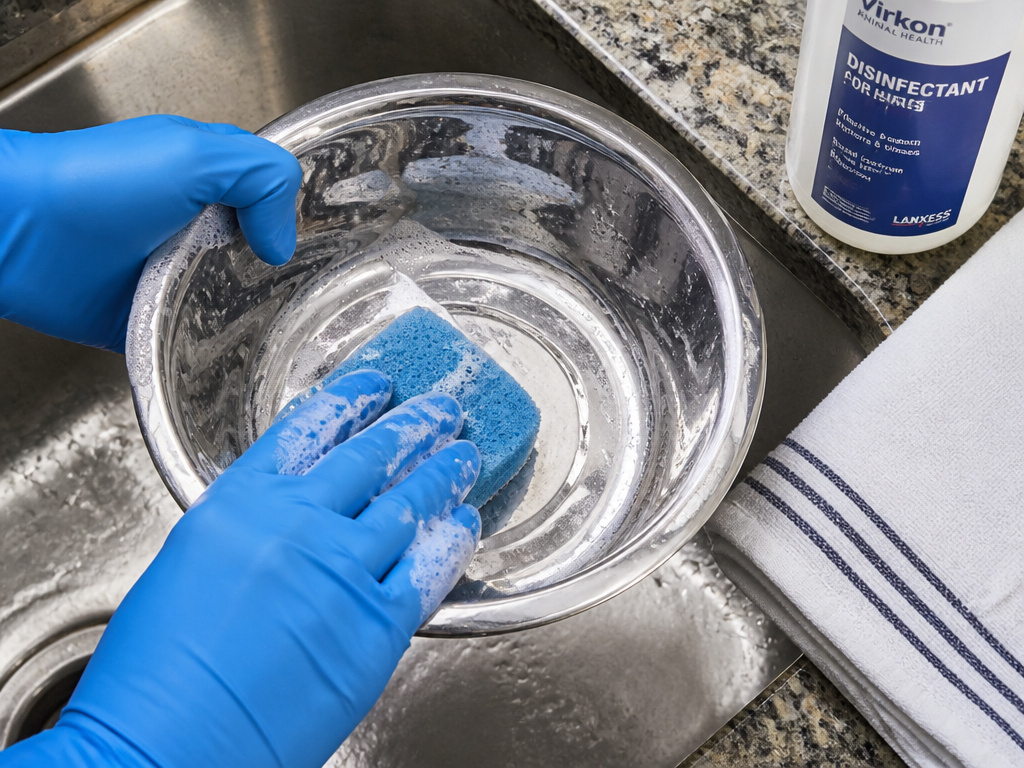
- Scrub with hot soapy water. Dedicated board, dedicated cloth, dedicated sponge. This removes the film, and the film is what kills the bleach.
- Disinfect and leave it wet. The FDA and Georgia Dept. Of Agriculture give 1 tablespoon bleach to 1 quart of water; the CDC gives 2 oz (1/4 cup) per gallon and says to leave it wet for at least 10 minutes. Wipe it dry after 30 seconds and you have cleaned, not disinfected.
- Do the sink last. Welsh guidance says disinfect the sink or washing-up bowl with a bleach-based product once the dishes are done. The sink sits downstream of everything else you just touched.
Step 3 is the how to sanitize surfaces after raw feeding step people rush, and it is the one the trial data supports most clearly. Soap scrubbing alone beat a straight bleach soak. Soap plus bleach beat everything.
What to Do With Items You Cannot Soak
Cutting boards that don’t fit in the sink, feeding stands, fridge shelves, and the scoop all need a different handling. The CDC’s rule for oversized items is to wipe them down and leave them wet for at least 10 minutes, which is the same dwell time as a soak, just applied with a cloth.
The Georgia Department of Agriculture adds one that gets ignored: never use the pet’s feeding bowl as a scoop. Use a clean dedicated scoop or spoon. A bowl rim that has been in contact with raw food is a handle you then carry across the kitchen.
The handling raw dog food routine covers the same sequence for the food itself, including the parts most owners skip.
Which Bleach Dilution Do You Actually Mix?
Four agencies publish a number, and the numbers are not identical.
| Source | Dilution | Contact time |
|---|---|---|
| FDA | 1 tablespoon bleach per 1 quart water | Not stated |
| Georgia Dept. Of Agriculture | 1 tablespoon bleach per 1 quart water | Not stated |
| CDC | 2 oz (1/4 cup) per 1 gallon water | At least 10 minutes |
| Illinois Extension (kitchen sink) | 1 tablespoon per 1 gallon water | Not stated |
| Bowl study (tested solution) | 10% bleach solution | 5 minutes immersion |
Start with the two that look different and are not. The FDA’s 1 tablespoon per quart and the CDC’s 1/4 cup per gallon are the same ratio written two ways, so there is no conflict to resolve there. Pick either.
The genuine disagreements are elsewhere. Illinois Extension gives a weaker mix for the kitchen sink, 1 tablespoon per gallon. Use the stronger ratio on anything that touched raw food.
Contact time is the bigger gap. The CDC says soak for at least 10 minutes, then rinse and air-dry. The FDA gives a dilution and says nothing about dwell time. The bowl study tested a 5-minute immersion in a 10% solution and still recovered Salmonella from 71 percent of bowls when used alone.
Work out what that means in numbers. A stronger solution held for less time underperformed a weaker solution applied after a scrub, which tells you the scrub is doing more work than the concentration.
The dilution matters less than the dwell time and the scrub before it. A perfect mix poured onto a greasy bowl accomplishes very little; a rough mix left wet for 10 minutes on a scrubbed bowl does the job.
Cool Water, Not Hot
Illinois Extension is explicit that hot water deactivates bleach, so the sanitizer gets mixed with cool, clean water. That is not a contradiction of the FDA’s instruction to wash with hot soapy water first. The hot water belongs in the wash step, before the bleach ever enters the picture.
Two more rules from the same source: use unscented liquid household bleach rather than scented or gel versions, and mix a fresh batch if the solution is more than one day old. A jar of bleach water sitting on the counter since Tuesday is water with a story.
The Sponge Is the Surface Nobody Counts
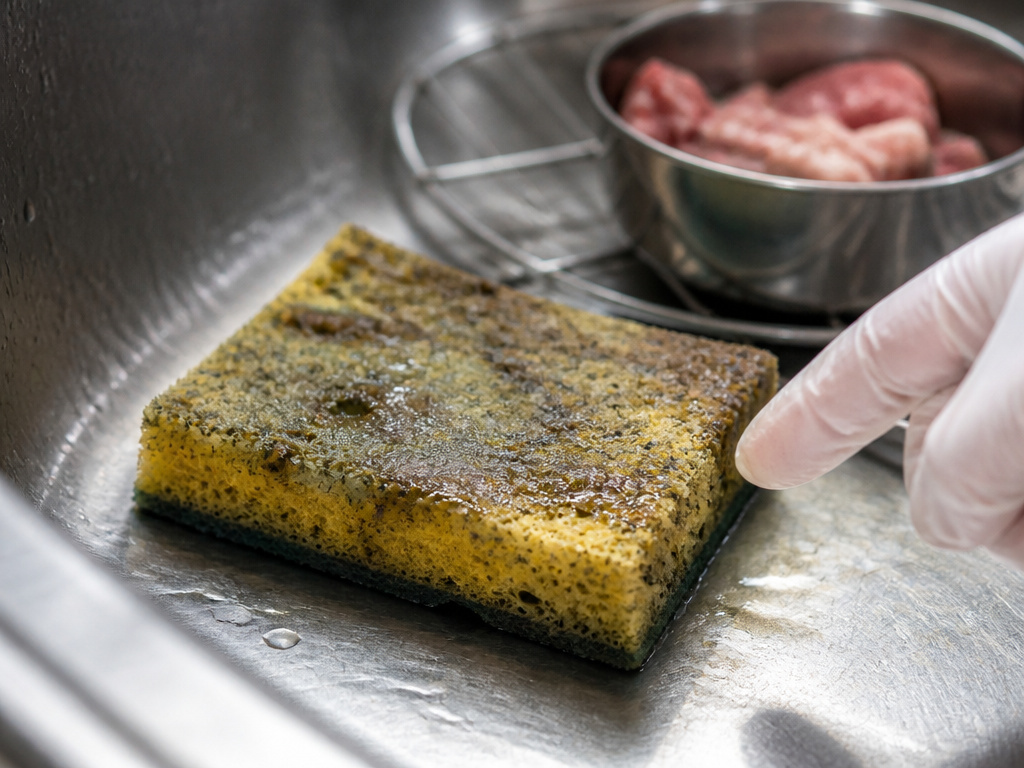
The bowl gets scrubbed, disinfected, and set on the rack. The sponge that did the work goes back in the sink and stays damp until morning.
That is the failure I see most in home kitchens, and it is the one I got wrong myself early on. I treated the bowl as the entire job. The tell was the sponge, which smelled faintly sour a couple of days after a raw meal. That smell means something is growing in it, and whatever is growing arrived from the last thing the sponge touched.
A bowl can look clean and still carry a film you can feel with a dry fingertip. That slickness is the residue the bleach has to fight through, and it is why the scrub step is not optional.
The forgotten surfaces, in rough order of how often I find them still wet with raw residue:
- The fridge door handle, which gets grabbed with the same hand that just set down a bowl.
- The faucet lever, turned off after washing contaminated hands.
- The sponge or cloth itself, which is the usual culprit.
- The scoop, used straight from the tub and then dropped back in.
- The counter edge and the floor directly under the bowl.
- The packaging, which Welsh guidance says should never be rinsed for recycling because it carries the same pathogens as the food.
That last one surprises people. Rinsing a raw food tray under the tap sprays the sink, the splash zone, and the dish rack. Bin it dry.
Does the Dishwasher Count as Disinfecting?
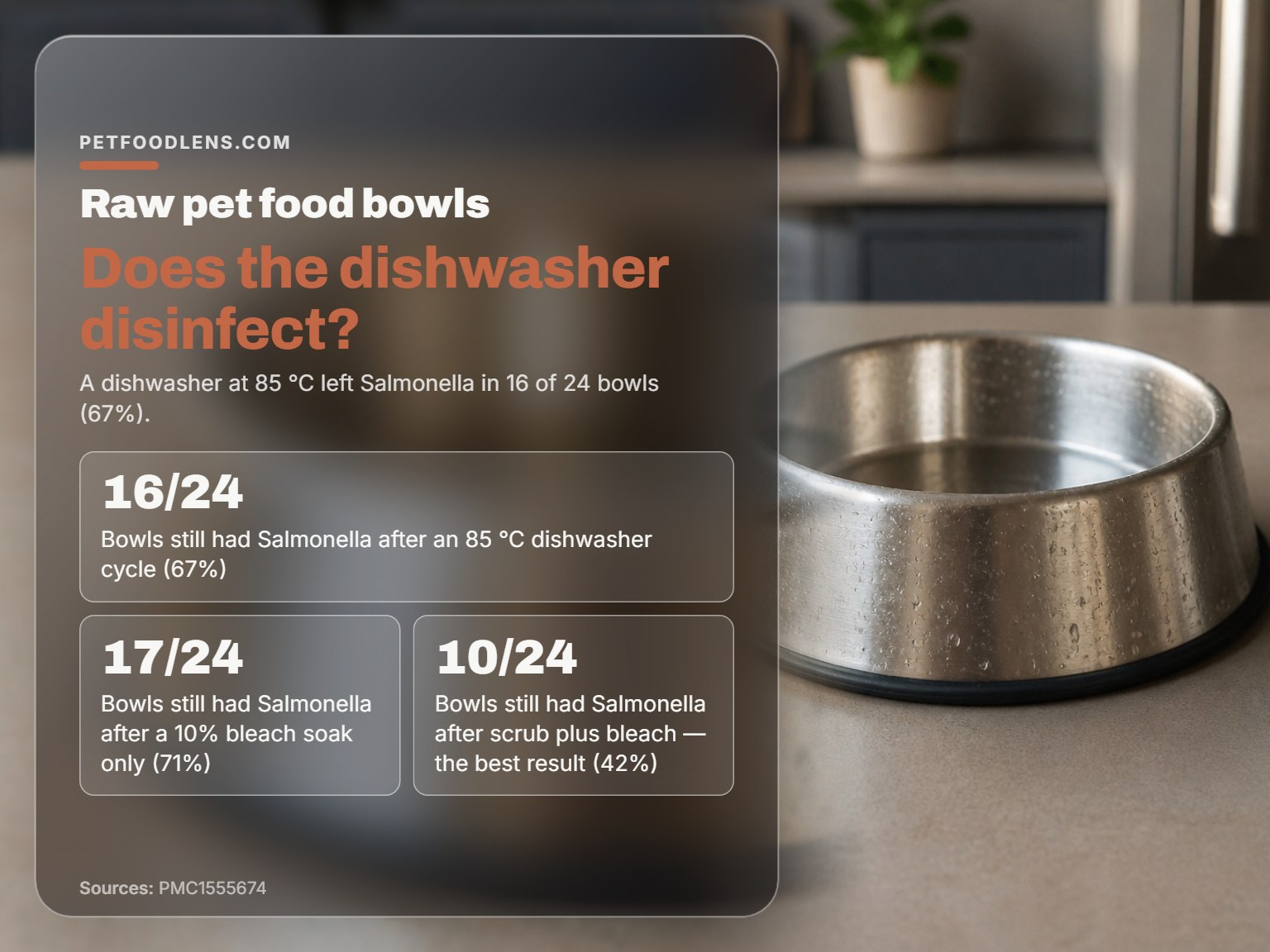
At 85 C, a dishwasher left Salmonella in 16 of 24 bowls. That is 67 percent, and it is the single most useful number in this whole topic for anyone who has been trusting the machine.
The agencies endorse it. The FDA says you can run items through the dishwasher after each use to clean and disinfect them. The Georgia sheet lists the dishwasher as the first wash step, followed by a disinfectant. Neither source offers a temperature threshold or a caveat, though the study found a dishwasher at 85 °C left Salmonella in 16 of 24 bowls.
The trial does. A dishwasher cycle at 85 C still failed to clear two thirds of the bowls.
Sources disagree on whether a dishwasher is sufficient: the FDA says running items through the dishwasher cleans and disinfects them, while the study found a dishwasher at 85 °C left Salmonella in 16 of 24 bowls. Run the bowl through it, then do the bleach soak anyway.
Plastic Versus Stainless
Welsh guidance recommends stainless steel or glass bowls because they are easier to disinfect and warns that plastic harbors bacteria in scratches and cracks, though the study found no significant difference in overall Salmonella persistence between plastic and stainless steel (P = 0.99).
The trial complicates that. There was no significant difference in overall Salmonella persistence between plastic and stainless steel (P = 0.99). But the subgroup analysis is where it gets interesting: for plastic bowls, no cleaning method reached significance (P = 0.051), which means no protocol reliably worked on plastic. Stainless steel responded significantly to scrub plus bleach (P < 0.05).
Both positions can be true at once. Plastic is not worse on average, and plastic is also the material where cleaning stops being predictable. I use stainless for raw feeding and I would not argue with anyone who does the same.
Common mistake: Trusting the dishwasher or a bleach spray on its own. The trial’s bleach-only arm left Salmonella in 71 percent of bowls, and the machine left 67 percent. Within a week of daily raw feeding, that is a lot of exposures.
Thawing and Storage: The One Place the Agencies Split
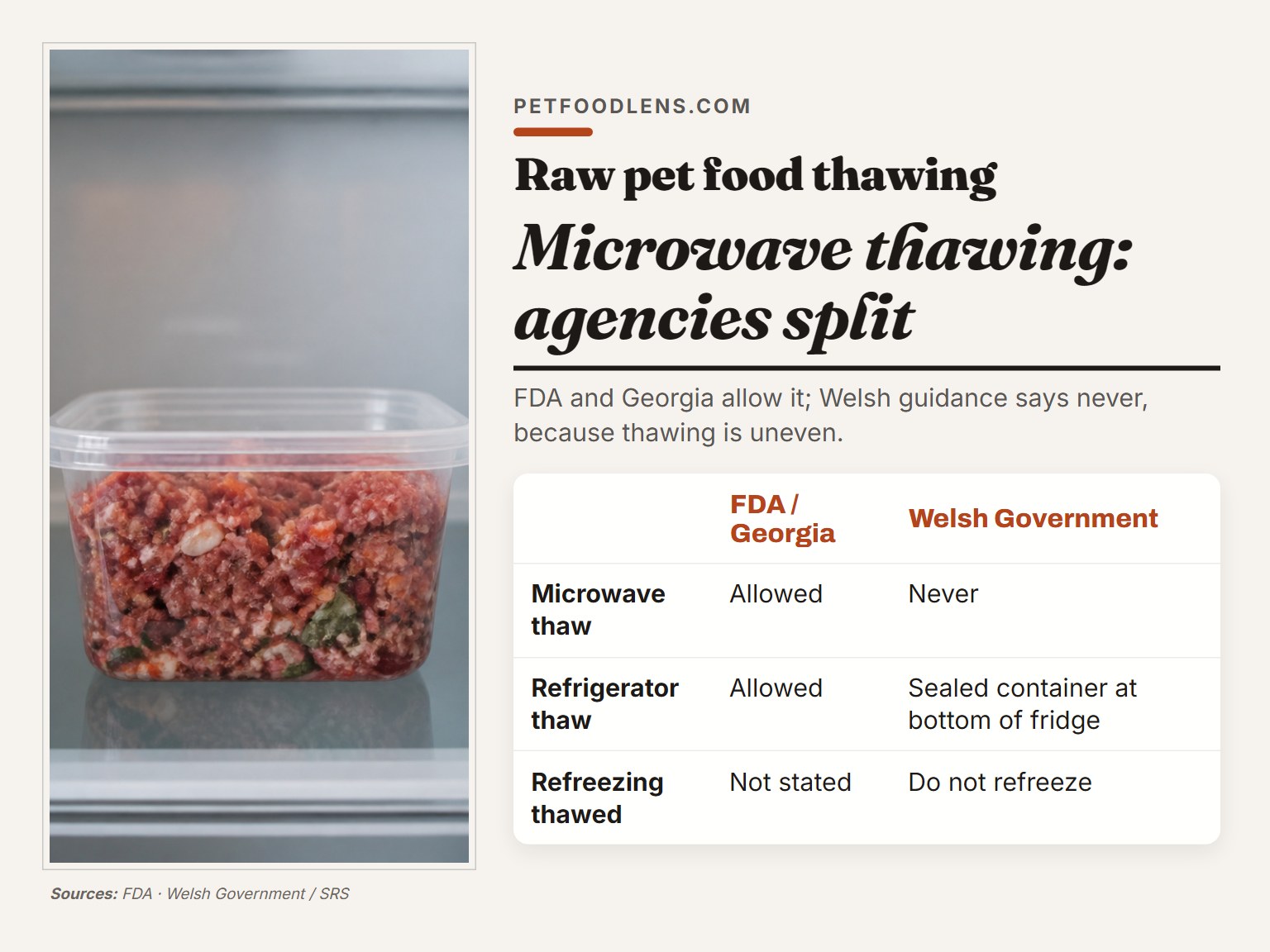
Two federal agencies tell you the microwave is fine for thawing raw pet food. A Welsh government food safety page says never do it, because the food thaws unevenly and parts can reach temperatures where bacteria multiply rapidly.
The FDA says to thaw raw meat and poultry in the refrigerator or microwave, not on the countertop or in the sink. Georgia says the same thing. The Welsh guidance is equally direct: never defrost raw meat in the microwave, because the food thaws unevenly and parts of it can reach temperatures where bacteria multiply rapidly.
Both positions have a mechanism behind them, and they are not describing the same kitchen.
The refrigerator route has no such argument attached to it, and Welsh guidance gives the procedure:
- Defrost in a sealed container at the bottom of the fridge, so nothing drips onto food below.
- Defrost only the amount you need, and do not refreeze what you thawed.
- Freezing raw meat at -18 C for 10 days can remove most parasitic risks.
- Store raw pet food separate from human food.
- Bacteria grow rapidly on raw meat held above 4 to 8 C.
The raw pet food storage setup matters here, because a container that leaks in the fridge turns one contaminated package into a shelf-wide problem. The thawing frozen pet food sequence covers timing and containers in more detail.
Where the Hygiene Stops Being the Whole Answer
I’ll say the unpopular part first. For most households, the pathogen load that comes with raw feeding is a risk I would not take, and the hygiene routine above is a way of managing a risk rather than removing it. The bowl trial’s best result was 42 percent, and that was under laboratory conditions with a measured inoculum.
For owners who feed raw anyway, and plenty do, the practical move is to reduce the load before it reaches your kitchen.
What I would not accept as evidence of anything: a shinier coat and smaller stools. Those two claims get offered as proof that raw is superior, and neither one is a measure of formulation quality or pathogen control.
The raw feeding safety overview covers the broader risk picture, and the raw cat food safety page handles the cat-specific formulation side. If you want the agency position in full, the FDA raw pet food safety facts page is short and worth reading once.
For the cleaning side, the CDC cleaning pet supplies guide is the only federal source that gives an explicit dwell time, the Illinois Extension cleaning and sanitizing page explains why the scrub comes first, and the Georgia Dept of Agriculture safe handling PDF covers the bowl-as-scoop mistake. The Salmonella survival in food bowls study is the source for every recovery figure in this piece.
One more surface people forget: the pet bowl gets disinfected after every meal under Welsh guidance, but the CDC puts dry food and water bowls on a daily schedule and wet food bowls on an after-every-use schedule. Raw feeding belongs in the after-every-use category. The how to clean a pet food bowl walkthrough covers the non-raw cases.
Frequently Asked Questions
How long does bleach need to stay wet on a surface?
The CDC specifies at least 10 minutes of contact, then rinse and air-dry. The FDA publishes a dilution with no contact time at all, which is the gap that trips people up. Ten minutes is the number to use.
Can I use vinegar instead of bleach?
The CDC does not recommend vinegar as a cleaner or disinfectant for pet items, because there is not enough research showing how well it removes dirt or kills germs. Vinegar kills some germs on a surface given enough time, and it does not kill all of them.
Do I need a separate sponge for raw pet food?
Welsh guidance says to wash raw pet food containers and utensils separately, with a separate cloth, sponge, or brush, and then disinfect the sink afterward with a bleach-based product. The CDC makes the same point about using a dedicated wash tub and scrub for pet items.
Is the dishwasher enough for raw pet food bowls?
Two agencies list it as an option and the trial data argues against relying on it alone. A dishwasher at 85 C left Salmonella in 16 of 24 bowls. Treat it as your wash step and follow with a bleach soak.
How often should raw pet bowls be cleaned?
After every meal. Welsh guidance says disinfect the bowl after every meal, and the CDC’s schedule for wet food is after every use. Unconsumed raw meat should not be left sitting in the bowl at all.
What if the kitchen sink is the only place I can clean pet items?
The CDC says using the kitchen sink may spread germs to your food, and if it is the only option, thoroughly clean and disinfect the sink and the surrounding area immediately afterward. Welsh guidance is stricter and says never wash raw pet items alongside other kitchen equipment.
The Bottom Line
The threshold for stepping up the routine is a household member in a high-risk group, and the study’s own note about E. Coli O157 having a reported infective dose of as few as 10 organisms is the reason. In that situation, scrub-then-bleach stops being a suggestion and becomes the floor.
