
Raw Cat Food Safety: What the Evidence Shows
This post contains affiliate links. As an Amazon Associate, we earn from qualifying purchases.
Raw cat food safety rests on three documented hazards: bacteria, avian influenza in raw poultry, and mycotoxins. The FDA found H5N1 genotype B3.13 in two lots of RAWR Raw Cat Food Chicken Eats, and one San Francisco cat that ate lot CCS 25 093 was euthanized.
Those two lots carried Sell By dates of 09/18/26 and 10/03/26, which puts the contamination well inside the window when the product was still moving through normal retail. Whole genome sequencing tied the affected cat and both lots to a single contamination source, and that source matches a virus lineage circulating around November and December 2024.
What follows covers the hazard classes a guaranteed analysis never mentions, the FDA notices that shaped current advice, and the honest split in the published research over how much pathogen load commercial raw food actually carries when you compare a raw cat food safety.
Key Takeaways
- H5N1 genotype B3.13 turned up in two RAWR lots, and a San Francisco cat fed lot CCS 25 093 was euthanized.
- Freeze-drying, dehydrating, and freezing reduce pathogens without eliminating them, per the CDC.
- Three kittens in one household developed diarrhea after eating the implicated Darwin’s lots, and the company declined the FDA’s recommended recall.
- A 2025 Communications Biology study cultured 19 bacterial genera from 112 raw feline diets, and separately isolated carbapenem-resistant Pseudomonas from frozen product.
- A peer-reviewed review found no robust evidence and no identified plausible mechanism for several claimed raw-feeding benefits.
What Does the FDA’s RAWR Raw Cat Food Notice Actually Show?
The FDA notice on RAWR Raw Cat Food Chicken Eats names two lots. Lot CCS 25 077 carries a Sell By date of 09/18/26. Lot CCS 25 093 carries a Sell By date of 10/03/26.
Both tested positive for H5N1. The genotype was B3.13, and whole genome sequencing linked the affected cat and both lots to a common contamination source.
H5N1 genotype B3.13 was detected in two lots of RAWR Raw Cat Food Chicken Eats. Whole genome sequencing matched the virus from an affected cat and from both implicated lots to a single contamination source, indicating one shared point of origin rather than two separate introductions into the supply chain.
A cat in San Francisco ate lot CCS 25 093, became ill, and was euthanized. That is one confirmed feline death tied to a specific printed lot number.
- Lot CCS 25 077, Sell By 09/18/26.
- Lot CCS 25 093, Sell By 10/03/26. This is the lot the San Francisco cat ate.
- Genotype B3.13, matched across the cat and both lots by whole genome sequencing.
Turn the bag over and find those numbers before you read anything else on the package. A lot code is the only identifier that ties a specific bag in your freezer to a specific finding.
Why Avian Influenza Sits Outside the Bacterial Playbook
Many raw feeding warnings are about Salmonella, E. Coli, or Campylobacter. H5N1 is a virus, and the freezing and handling advice built around bacteria does not address it directly.
The FDA states there are no known human HPAI cases from pet food exposure, while noting that uncertainty remains. That is an open question, not a settled all-clear.
Which Bacteria Turn Up in Commercial Raw Cat Food?
Nineteen bacterial genera came out of 112 commercial raw feline diets in a 2025 Communications Biology study. The list includes Salmonella, Clostridium, Escherichia, Klebsiella, Enterobacter, and Cronobacter.
The same study isolated carbapenem-resistant Pseudomonas aeruginosa, Pseudomonas fulva, and Stenotrophomonas lactitubi from frozen raw products. Carbapenem resistance matters because it strips away an antibiotic class that human medicine leans on when other options fail.
It also found that detecting Clostridium sensu stricto I predicted a freeze-dried raw product with 95% sensitivity and 78% specificity. That is a useful screening signal, not a label you’ll ever see printed.
Here is where the published numbers stop agreeing with each other.
| Source | What it reports | Why the figures differ |
|---|---|---|
| UK FSA retail survey, March 2023 to February 2024 | High prevalence of target pathogens | Culture-based survey of UK retail products |
| PMC5644655 | Sporadic detection of Campylobacter, Salmonella, Yersinia | PCR-positive but culture-negative results |
| Communications Biology 2025 | 19 genera across 112 products | Cultivation plus high-throughput sequencing |
The FSA risk assessment of raw pet food and PMC5644655 are not describing the same thing, and merging them into one sentence would be dishonest. Different products, different geographies, different detection methods.
What the Culture-versus-PCR Split Actually Means
PCR picks up genetic material whether or not the organism is still alive. Culture only grows what is viable. A product can be PCR-positive and culture-negative on the same sample.
That single methodological difference explains most of the gap between “high prevalence” and “sporadic detection” in the raw cat food safety question. Neither figure is wrong. They answer different questions.
That level of detail is why it’s the study I keep coming back to.
What it does not tell you is your cat’s risk from one specific bag. Nothing does. The Salmonella risk in a given package depends on the lot, the species source, and the handling after it leaves the plant.
Freeze-Dried and Frozen Are Not Kill Steps
The CDC says freeze-drying only reduces rather than eliminates pathogens, while the 2025 Communications Biology study found pathogens and carbapenemase resistance genes specifically in room-temperature shelf-stable freeze-dried raw products.
CDC pet food safety guidance states plainly that freeze-drying, dehydrating, and freezing only reduce pathogens rather than eliminate them. The 2025 feline diet study reinforces that from the other direction: pathogens and carbapenemase resistance genes turned up in room-temperature shelf-stable raw products, not only in frozen ones.
| Product form | What the step does | What it does not do |
|---|---|---|
| Frozen raw | Slows bacterial growth | Kill pathogens; resistant Pseudomonas was isolated from frozen product |
| Freeze-dried raw | Removes water, makes it shelf-stable | Eliminate pathogens; resistance genes were found in shelf-stable product |
| Dehydrated raw | Lowers moisture content | Guarantee a pathogen-free product, per CDC |
That is the moment it stops behaving like a dry product and starts behaving like meat again.
Freezing buys time, not safety. A pathogen that goes into the freezer comes out of the freezer.
This is the part that gets lost in marketing. The CDC says freeze-drying only reduces pathogens, and the 2025 Communications Biology study found pathogens and resistance genes in shelf-stable raw products, so a shelf-stable bag is not a lower-risk product by default. It is a different product with a different hazard profile, and the cold-chain advice you’d apply to frozen raw simply doesn’t apply to it.
If you feed either form, the raw food storage rules and safe thawing rules are separate conversations. Treat them that way.
The Darwin’s Case: A Recall the Company Declined
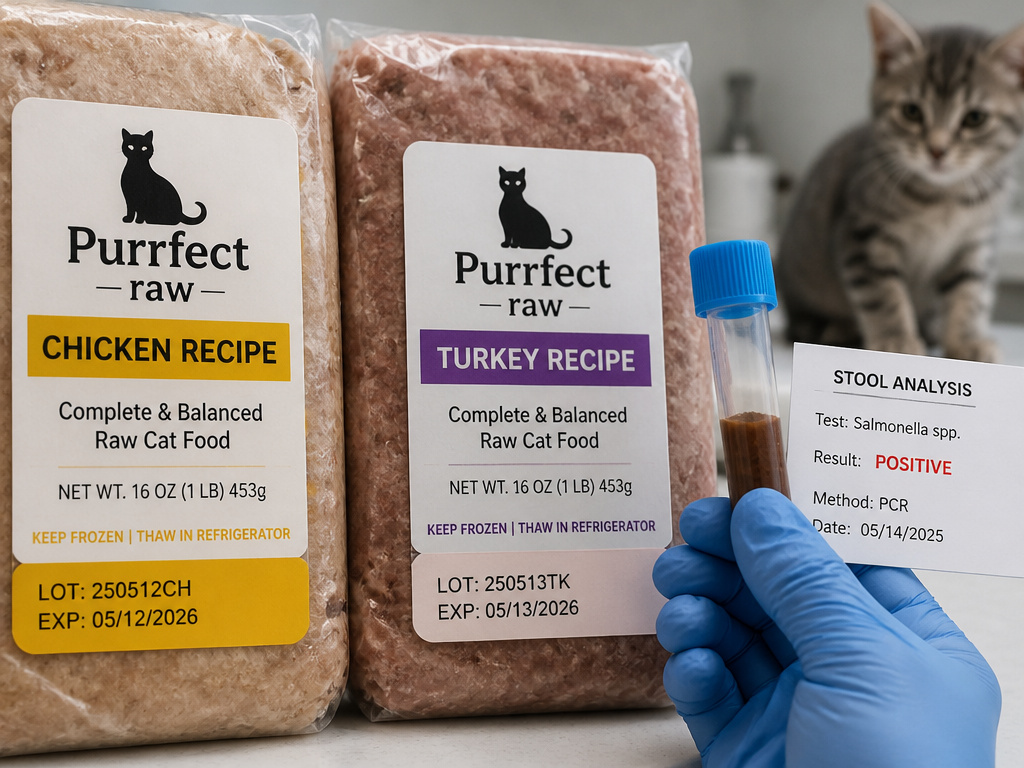
Three kittens in one household developed diarrhea after eating the same raw food. A fourth kitten in that home, never fed the product, stayed well.
The FDA caution notice covers two lots. Natural Selections Antibiotic & Grain Free Chicken Recipe for Cats, lot 9116, was manufactured 2 May 2022. Turkey Recipe for Cats, lot 9121, was manufactured 4 May 2022. Both shipped in 2 lb packs, four units to a pack.
The turkey lot carried Salmonella Typhimurium. The chicken lot carried Typhimurium and Kentucky. Stool from one of the three sick kittens tested Salmonella-positive.
The FDA recommended a voluntary recall of the Salmonella-positive lots. Darwin’s declined.
I can’t put a company on a safe-sourcing list after it declines a recommended recall. That is a judgment about conduct rather than about microbiology, and it is enough for me.
What most people get wrong: Treating a declined recall as a technicality. The product stays in freezers and on shelves, so the printed lot number becomes the only protection a household has.
What the Kittens Tell You About Household Risk
Three kittens in the household developed diarrhea, and stool from one of them tested Salmonella-positive. That is a small sample.
It is also the clearest household-level pattern in the public record: the animal that ate the food got sick, and the animal that didn’t, didn’t.
That pattern is why raw food handling matters as much as the food itself. The bacteria in the bowl do not stay in the bowl.
What the Evidence Says About Shiny Coats and Small Stools
A peer-reviewed review of raw diets found no robust evidence and no identified plausible mechanism for several of the benefits owners report.
Owners report the opposite, and they are not lying about what they see. The disagreement is about what the observation proves.
- A shinier coat. Owners report it. The review found no robust evidence and no plausible mechanism behind the claim.
- Smaller, firmer stools. Stool volume tracks fiber and water content far more than it tracks raw versus cooked.
- A better microbiome. The 2025 study found 19 genera in these products, which reframes what “microbiome support” is actually describing.
The microbiological hazards in raw pet food review is the one to read if you want the full argument rather than the summary. It is not a comfortable read for anyone selling the category.
I’ll say the unpopular part: a coat and a stool are weak evidence. They are visible, they change fast, and they change for a dozen reasons that have nothing to do with pathogens or nutrient balance.
If you want the fuller case on both sides, the raw cat food pros and cons walkthrough lays out what’s supported and what’s anecdote.
How Do You Read a Raw Cat Food Label?
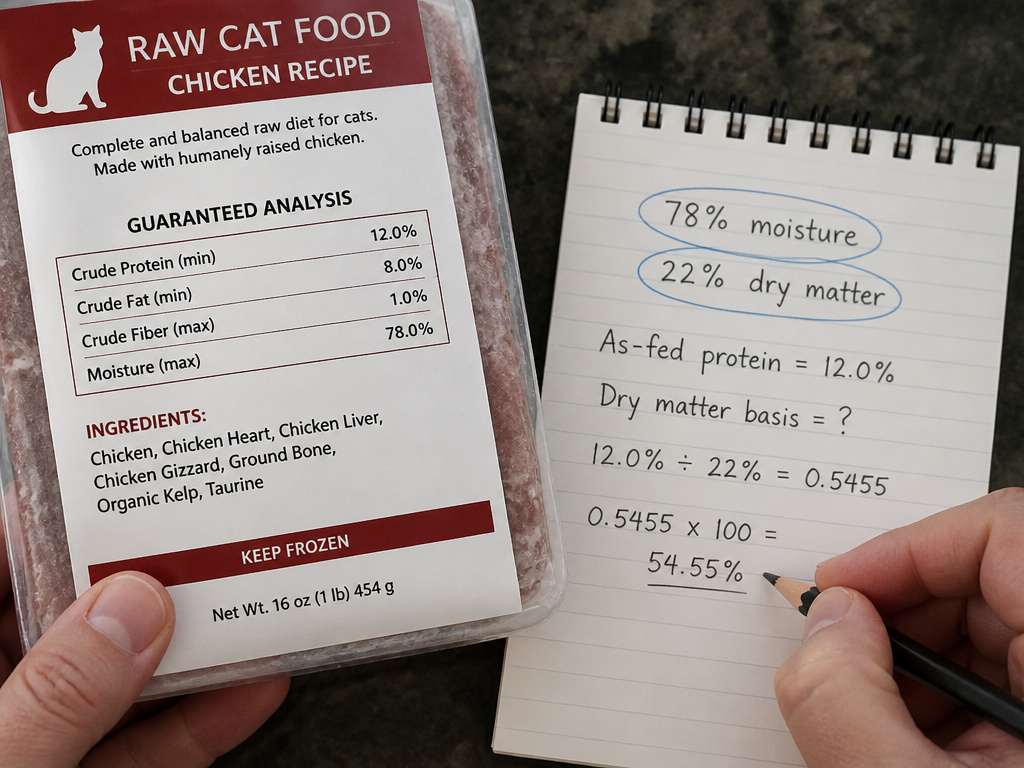
The guaranteed analysis is the least useful panel on a raw cat food package.
“Moisture” on the label is a statement about water. It is not a quality claim, and it is not a comparison you can act on until you convert it to a dry-matter basis.
Early on I compared the protein percentage on a canned label directly against a dry label and concluded the canned food was weak. Converting both to a dry matter basis erased most of the gap, and I’ve done that conversion on the back of a can ever since. Raw food makes the same mistake worse, because raw moisture runs high enough that as-fed protein numbers look almost meaningless.
As-Fed vs Dry Matter in One Worked Example
Do the math. Use a working moisture figure for the calculation.
- Subtract the moisture percentage from 100 to get the dry matter fraction. At 78% moisture, dry matter is 22% of the can.
- Divide the as-fed protein figure by that fraction. Divide the as-fed protein figure by the dry matter fraction to get dry matter protein.
- Do the same for fat before you compare two products. Skipping this step is how a high-carb food outranks a high-protein one on paper.
The part nobody mentions: A brand that won’t publish enough detail for you to run that conversion is telling you something. Compare it on the same basis or don’t compare it at all.
The hygiene quality assessment of raw pet food makes a related point from a different angle: nutritional adequacy and hygiene quality are two separate scores, and a product can pass one while failing the other.
When I check a frozen raw cat food package, the first thing I look for is the AAFCO nutritional adequacy statement. That statement tells me whether the diet is complete. It tells me nothing about the pathogen load, which is exactly why both conversations have to happen.
How Do You Lower the Risk If You Still Feed Raw?
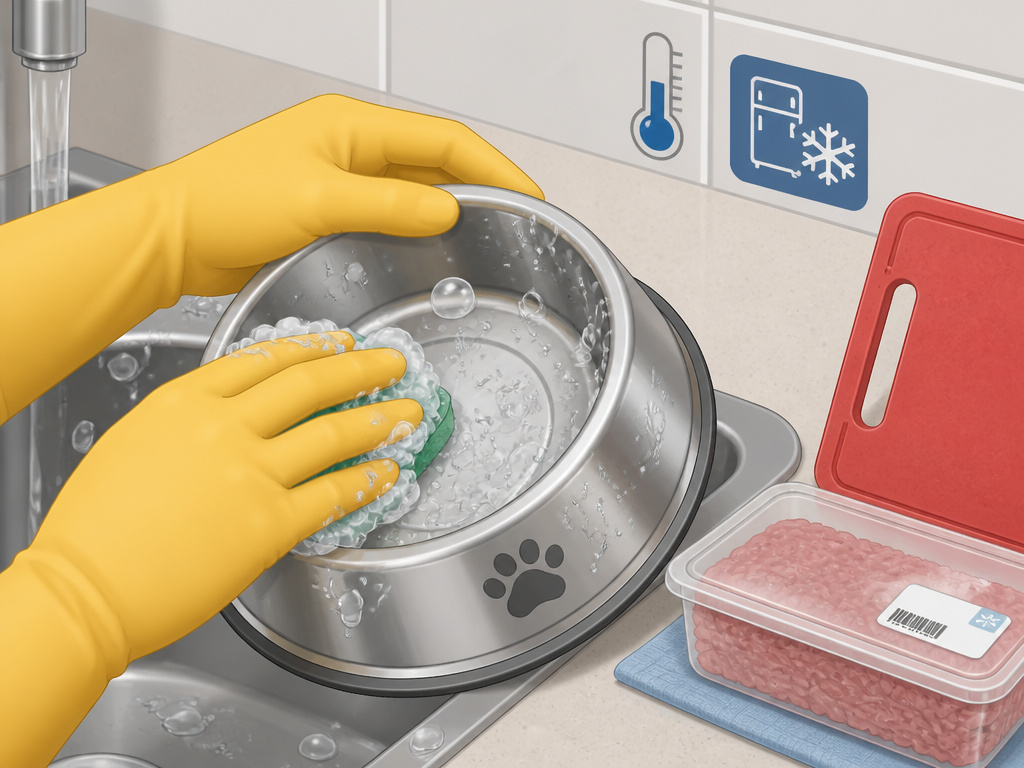
Three things carry most of the risk reduction: sourcing, temperature control, and surface hygiene.
Before you start: Raw meat carries pathogens that infect people as well as cats. Keep a dedicated cutting board that never touches ready-to-eat food, wash your hands with soap after handling, and never thaw raw product on the counter at room temperature.
- Buy from a supplier who prints lot codes and holds them. Without a lot code you cannot act on a recall notice, and a recall you can’t act on is just news.
- Keep frozen product frozen until you’re ready to use it. A pack that has partially thawed and been refrozen in a warm car has spent time in the temperature range where bacteria multiply fastest.
- Thaw in the refrigerator, not on the counter.
- Sanitize bowls and surfaces after every meal. Rinsing is not sanitizing. A bowl that still smells faintly of meat after washing has not been cleaned.
- Wash your hands last, not first. Handling the food, then the bowl, then your phone, then your face is the sequence that moves bacteria out of the kitchen.
The Handling Routine That Matters Most
The single highest-value habit is a dedicated surface. One board, one bowl, one counter section, and nothing else touches them.
Surface sanitation after every meal does more than any product choice on this page. So does raw food sourcing, because a supplier who can trace a lot is a supplier who can warn you.
I’m not a veterinarian and I don’t diagnose or manage medical conditions. If your cat is on a therapeutic diet for kidney disease or diabetes, that conversation belongs with your vet, not with a label.
Frequently Asked Questions
Is raw cat food safe for cats?
It carries documented risk. The FDA tied H5N1 genotype B3.13 to two RAWR lots and one euthanized cat, and the CDC does not recommend raw feeding. The risk is manageable in some households and not worth it in others, and the deciding factors are sourcing, handling, and who else lives in the home.
Does freezing raw cat food kill bacteria?
No. The CDC states that freezing only reduces pathogens rather than eliminating them, and the 2025 Communications Biology study isolated carbapenem-resistant Pseudomonas from frozen raw products. Freezing slows growth. It is not a kill step.
Can I get sick from handling raw cat food?
Yes, that is the documented household risk. The Darwin’s investigation found three kittens ill and one shedding Salmonella in stool, and the FDA’s concern in that case was household exposure as much as feline illness. Handwashing and a dedicated surface are the practical controls.
Is freeze-dried raw cat food safer than frozen?
Not by default. The CDC says freeze-drying only reduces pathogens, and the 2025 study found pathogens and carbapenemase resistance genes specifically in room-temperature shelf-stable raw products. Shelf-stable is a storage category, not a safety guarantee.
What should I do if I already fed a recalled lot?
Stop feeding the product, keep the packaging so you have the lot code, and watch the cat for lethargy, vomiting, diarrhea, or refusal to eat. Contact your veterinarian with the lot number in hand. For the RAWR lots, that means CCS 25 077 or CCS 25 093.
The Bottom Line
If your cat is healthy, eating a complete diet, and living with people who will actually sanitize a bowl every night, the raw decision is a genuine trade-off rather than a clear win in either direction. The evidence for the benefits is thin. The evidence for the hazards is not.
Here is the threshold I’d give a friend. If anyone in the house is immunocompromised, pregnant, or under five, skip raw entirely. The pathogen load in the product is real, the household transmission route is documented, and no coat improvement is worth that.
If you’re going to feed it anyway, the one step that matters this week is this: go find the lot code on every package in your freezer and photograph it. It is the only thing that lets you act on a recall notice the day it publishes instead of the day after your cat gets sick.
And if a company declines a recommended recall, that tells you what their lot codes are worth to them. Believe it.
