
Raw Cat Food Pros and Cons: What the Evidence Says
This post contains affiliate links. As an Amazon Associate, we earn from qualifying purchases.
Raw cat food pros and cons come down to one trade: raw formats skip the cooking step that kills Salmonella and Listeria, and FDA testing found 15 of 196 raw samples positive for Salmonella and 32 for Listeria. Limited evidence points to better stool quality; the safety evidence is stronger than the benefit evidence.
That missing cooking step is the hinge the raw cat food pros and cons debate swings on. Heat is what drops the bacterial load in conventional pet food, and UK regulators classify raw pet food as Category 3 Animal By-Products with no formal kill step in production.
What follows: the four raw formats and what each one actually is, the two studies that reach opposite conclusions about nutritional adequacy, why your freezer isn’t a sterilizer, and the household question that decides more than any label claim.
Key Takeaways
- FDA found Salmonella in 15 of 196 raw samples and Listeria monocytogenes in 32; jerky-type treats tested 0 of 190 for both.
- The benefit evidence is thinner than the risk evidence. A 2025 review calls it limited, and JAVMA rates the risk data higher in quality and quantity.
- Freezing doesn’t reset the clock. Enterobacteriaceae counts ran higher in frozen poultry raw diets than in thawed ones (p = 0.003).
- Households with a child under 5, an adult 65 or older, a pregnant person, or an immunocompromised member sit in a separate risk tier, per CDC and CVMA.
- A high-pressure processing claim isn’t a sterility claim. AAHA states plainly that HPP doesn’t equal sterile food.
What Raw Cat Food Actually Is, Format by Format
Four formats sit under the raw label, and they behave differently in your kitchen. The CDC lists them as raw, raw frozen, freeze-dried, and dehydrated, and the easiest way to spot any of them is the word “raw” printed on the package.
Raw pet food is produced from uncooked animal protein, including muscle meat, organ meat, bone, eggs, and unpasteurized milk, and is not heated to a temperature sufficient to kill pathogens. Production relies on chilling, freezing, drying, or high-pressure processing rather than a thermal kill step, so pathogen control depends on the process and the handling that follows.
The two formats most owners actually buy are frozen raw cat food and freeze-dried raw cat food, and when you compare a raw cat food pros and cons, they aren’t interchangeable. One lives in your freezer and drips. The other lives in a cupboard and crumbles.
| Format | What it is | Handling burden | Pathogen note |
|---|---|---|---|
| Raw (chilled) | Uncooked meat, organ, bone | Highest; fridge space, fast turnover | No kill step at all |
| Raw frozen | Same, frozen at production | Moderate; freezer space, fridge thaw | Freezing halts growth, doesn’t remove |
| Freeze-dried | Frozen then dried in vacuum | Lowest; shelf-stable until opened | Drying isn’t sterilization |
| Dehydrated | Dried using warm air | Low; shelf-stable, needs water | Warm air is below kill temperature |
Home-prepared raw usually follows a prey model raw diet, which sets ratios of muscle meat, bone, and organ. Those ratios are a formulation target, not a nutrition guarantee. The German study of 44 commercial raw diets found at least one nutrient concern in every single one, and those were products built by companies with formulation staff.
The Pros: What the Evidence Actually Supports
A 2025 narrative review found limited evidence that raw meat-based diets may lead to healthy body weight and body condition and improved stool quality. That’s the strongest positive finding in the peer-reviewed literature, and it arrives with the word “limited” attached.
The JAVMA raw meat diet risks review is blunter about the asymmetry. It rates the benefit evidence as weak, built on case series and poor-quality cohort or case-control studies, while calling the infectious-disease risk evidence better in both quality and quantity.
The Canadian Veterinary Medical Association’s position statement, dated October 16, 2023, says there’s limited data supporting clinically relevant beneficial impacts of raw diets over appropriate conventional cooked diets. Set that beside the 2025 review and you have two organizations reading the same thin evidence and disagreeing about whether it’s worth stating.
The CDC’s owner-facing guidance lands in the same place from a different direction: raw pet food is not necessarily healthier, and both raw and cooked food can be nutritionally balanced or inadequate.
I’ll take a stool-quality improvement seriously, because owners notice it and it’s measurable. I won’t take it as proof the diet is complete. Stool quality and nutritional adequacy are two separate questions, and only one of them shows up in the litter box.
One genuine point in raw’s favor: in the kitten feeding trial, all diet groups passed the AAFCO 10-week growth trial with similar growth parameters. A raw diet can be formulated to meet a growth standard. Whether the tub in your freezer does is a separate question, and the adequacy statement is where you find out.
The Cons: What the FDA’s Own Samples Found
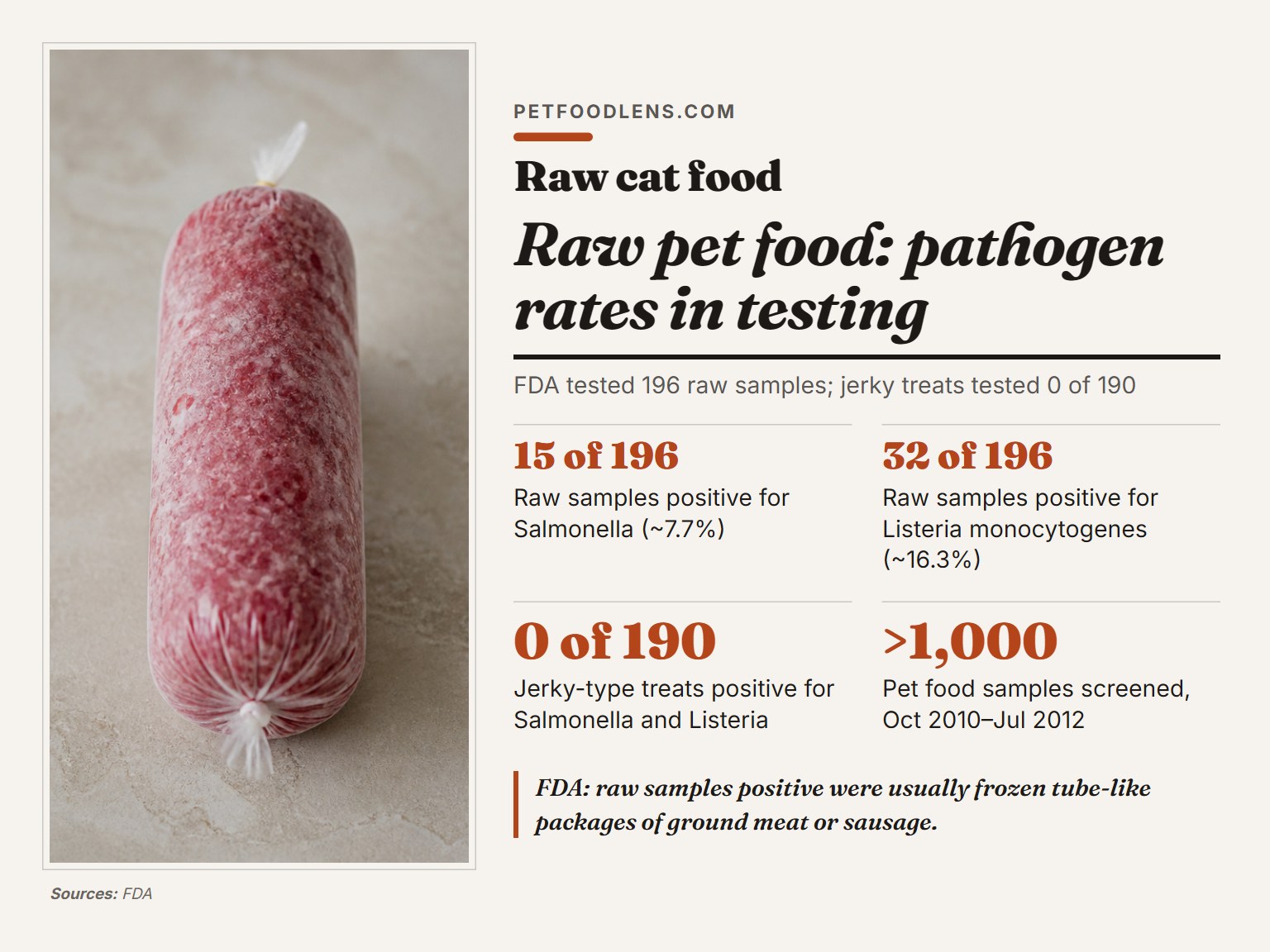
The FDA’s Center for Veterinary Medicine screened more than 1,000 pet food samples between October 2010 and July 2012 and added raw products in the second year. Of 196 raw samples tested, 15 came back positive for Salmonella and 32 for Listeria monocytogenes.
| Finding | Samples positive | Share |
|---|---|---|
| Salmonella in raw samples | 15 of 196 | ~7.7% |
| Listeria monocytogenes in raw samples | 32 of 196 | ~16.3% |
| Salmonella in jerky-type treats | 0 of 190 | 0% |
| Listeria monocytogenes in jerky-type treats | 0 of 190 | 0% |
The FDA raw pet food diet facts page adds a detail worth holding onto: the positive raw samples were usually frozen, in tube-like packages containing ground meat or sausage. Jerky-type treats tested clean in the same window. Format changes the result, which is why treat-format findings don’t transfer to raw formats.
The AAHA raw protein diet guidance is explicit. AAHA does not advocate or endorse feeding pets any raw or dehydrated nonsterilized foods, including treats of animal origin, and the same document notes that raw feeding increases the risk of bacterial and protozoal pathogen transmission to the pets eating the diet and to people and other animals.
Then there’s the part that catches owners off guard. Dogs and cats can shed Salmonella without showing any clinical sign of disease. A pet that looks completely normal is not evidence of a clean diet.
The CDC does not recommend feeding raw pet food or treats to dogs and cats. That’s the agency’s position, stated without hedging.
Why Do the Nutritional Adequacy Studies Disagree?
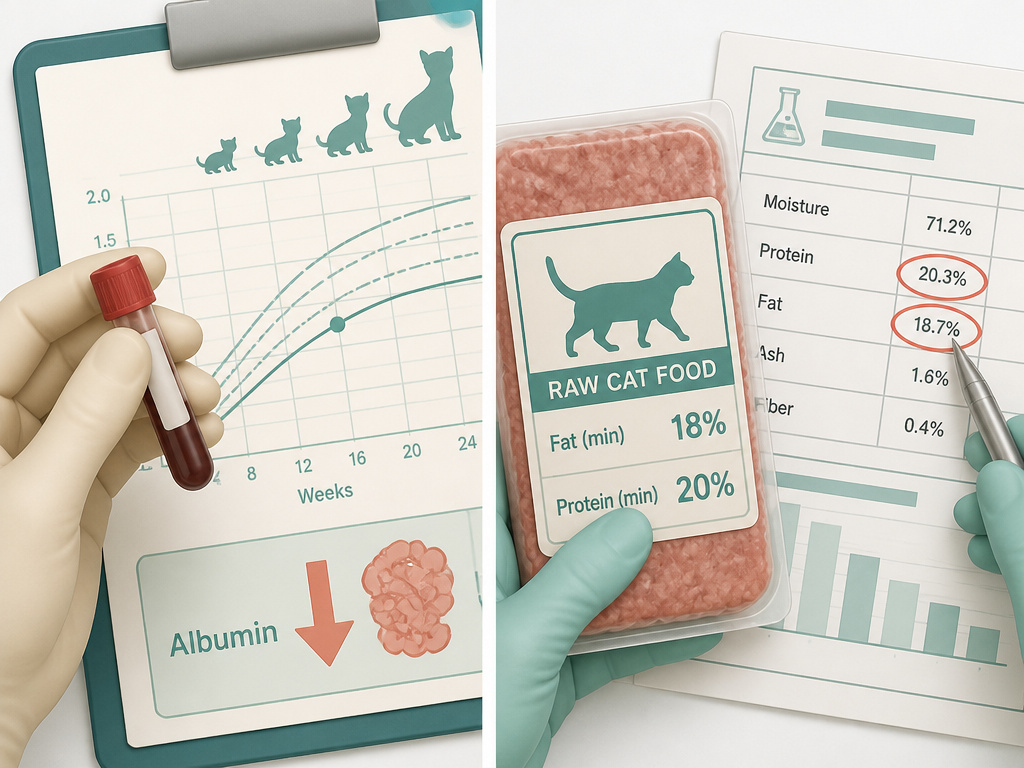
Two peer-reviewed studies can look at raw diets and reach opposite conclusions because they’re answering different questions with different instruments.
What the Kitten Feeding Trial Found
The trial used 24 kittens, nine weeks old, under the AAFCO 10-week protocol. All diet groups passed, and growth parameters came out similar across groups. Then the bloodwork diverged. Raw-fed kittens had lower albumin (P = 0.010) and higher globulin (P = 0.04). The combination-raw group showed red-cell microcytosis (P = 0.001) plus positive fecal Salmonella Heidelberg and C. Difficile toxin.
The study’s own limitation note is the part to keep. Passing a 10-week AAFCO trial doesn’t exclude a long-term deficiency, because liver and fat storage depots can mask a shortfall before it shows in a growing animal.
What the German Lab Analysis Found
Researchers analyzed 44 commercial raw diets against their own labels. Fat exceeded the declared-value tolerance in 33% of them and protein in 45%. Mean fat came out at 69 g/Mcal with a range of 33 to 95. Every diet in the set showed at least one concern about nutrient content.
Why Both Results Can Be True
They measure different things. The kitten trial feeds the diet and watches the animal. The German study compares what’s in the package against what the label promised. A diet can support normal growth through an AAFCO growth trial and still miss its own declared numbers, and a diet can hit its declared numbers and still be short on something the label never listed.
A feeding trial tells you whether the cat grew. A lab analysis tells you whether the label told the truth. You need both answers, and almost nobody publishes both.
I read the nutritional adequacy statement before anything else on a label. It’s one line, usually buried under the guaranteed analysis, and it tells you whether a food is intended for complete daily feeding or only for intermittent use. On raw products it’s often the only place a company commits to anything at all.
What Freezing Does to Bacteria, and What It Doesn’t
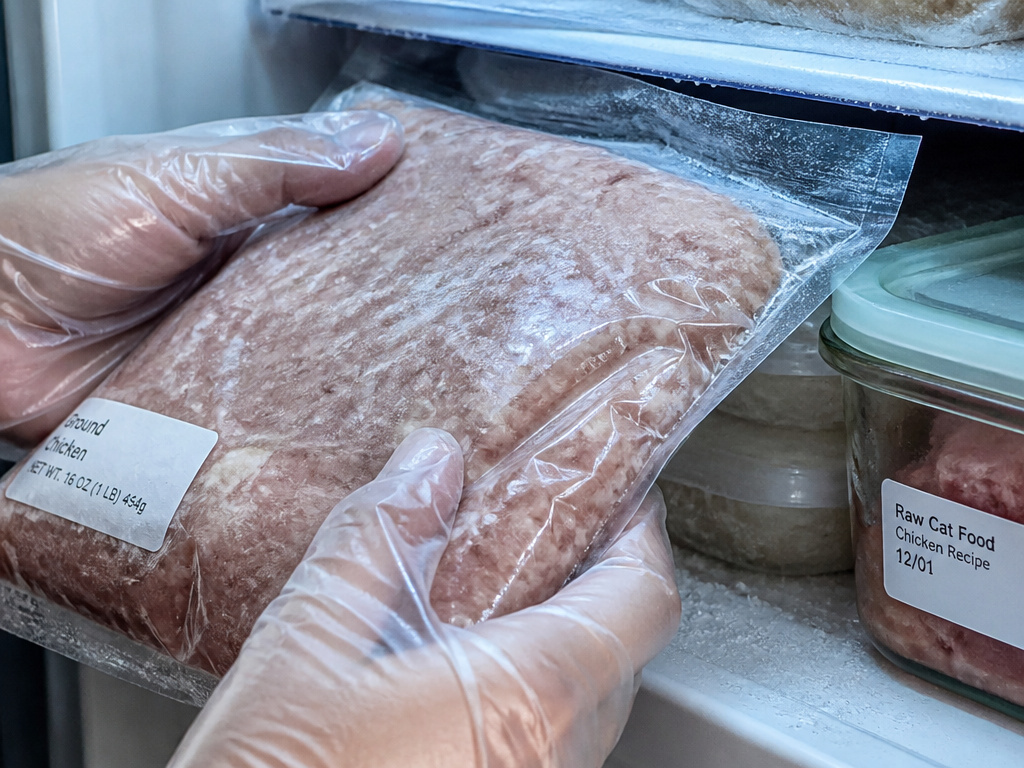
Freezing stops bacteria from multiplying. It leaves them in place.
The CDC’s storage advice is sound as storage advice: freeze raw pet food until you’re ready to thaw and use it, thaw it in the refrigerator, and keep it in a sealed container in the freezer and fridge separate from other foods. None of that claims to sterilize anything.
The German data complicates the picture. Enterobacteriaceae counts were higher in frozen poultry and carcass-mix products than in their thawed counterparts (p = 0.003). In that sample set, the frozen products carried the heavier bacterial load going in.
The two positions aren’t in conflict once you read what each one claims. CDC is telling you how to store a product so it doesn’t get worse. The German study is telling you the frozen product was already carrying a load. Proper raw food storage keeps a contaminated product from contaminating more of your kitchen. It doesn’t make the product clean.
Raw poultry that’s turning has a tacky, slick feel through the plastic and a noticeable smell before you’ve opened anything. That’s the point where storage advice stops helping.
Who Should Not Feed Raw Cat Food?
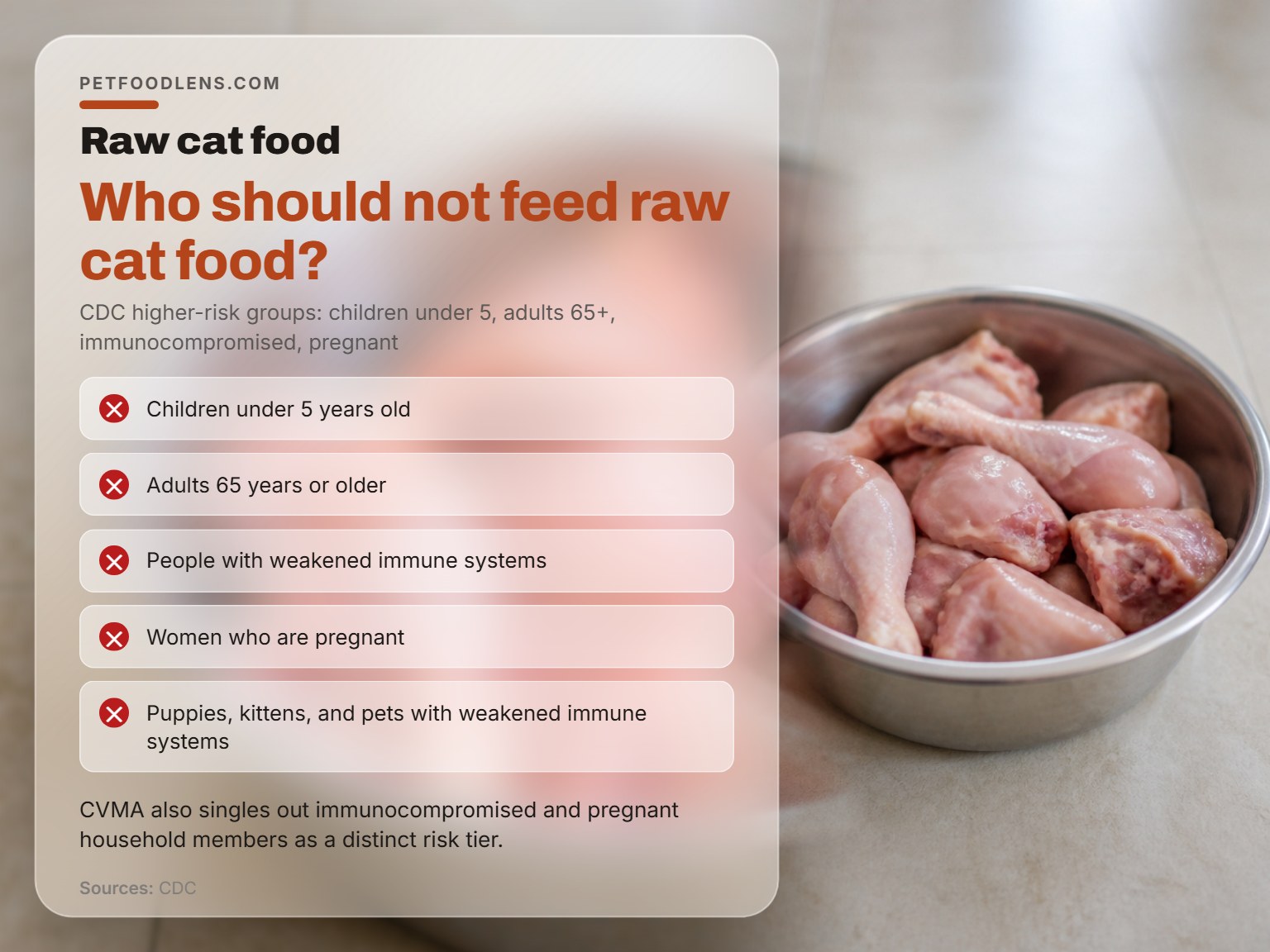
A toddler can cross the kitchen floor at crawling speed while a bowl of raw chicken sits down at cat height. Everything between those two points is one continuous surface as far as Salmonella is concerned.
The CDC names the household groups that face a higher risk from foodborne germs:
- Children under 5 years old
- Adults 65 years or older
- People with weakened immune systems
- Women who are pregnant
The CVMA singles out immunocompromised and pregnant household members as a distinct risk tier in its own right. Two organizations, same carve-out.
Pets get a version of the same list. The CDC flags puppies, kittens, and pets with a weakened immune system or other health conditions as more likely to get sick from foodborne germs. The kitten trial backs that up with specifics: the combination-raw group shed Salmonella Heidelberg and carried C. Difficile toxin while passing its growth trial.
Which Raw Format Beats Which
Three comparisons do most of the work: freeze-dried against frozen, raw against fresh cooked, and raw against a plain canned pate.
Freeze-Dried vs Frozen Raw
Freeze-dried wins on storage and on being a topper. It sits in a cupboard, it doesn’t drip, and a freeze-dried raw pouch rehydrates into something close to wet food. Frozen wins as a base diet. Frozen raw products are built to be the whole bowl, and they keep the moisture that drying takes out.
Freeze-dried morsels crumble to a chalky powder between your fingers and take water back in quickly if you break them up first. That texture is also why they work as a topper and poorly as a sole diet.
If you want the longer version of that trade, freeze-dried cat food pros and cons covers rehydration and palatability in detail.
Raw vs Fresh Cooked
Fresh cooked diets carry a kill step and raw doesn’t. That single difference decides it for most households, and it’s why fresh cat food pros and cons reads as a shorter list of hazards than this one. Raw costs you the kill step.
Raw vs Canned Pate
If you’re not committed to raw, a plain pate is the format I’d point you at. Plain pate cans are single-texture foods with short ingredient panels, and you can mash one with water to raise the moisture. Gravy and shredded formats add thickeners and starches.
That’s the format question in one line: pate for consistency, raw for owner preference, and the safety evidence decides the rest.
The Handling Routine That Actually Reduces Risk
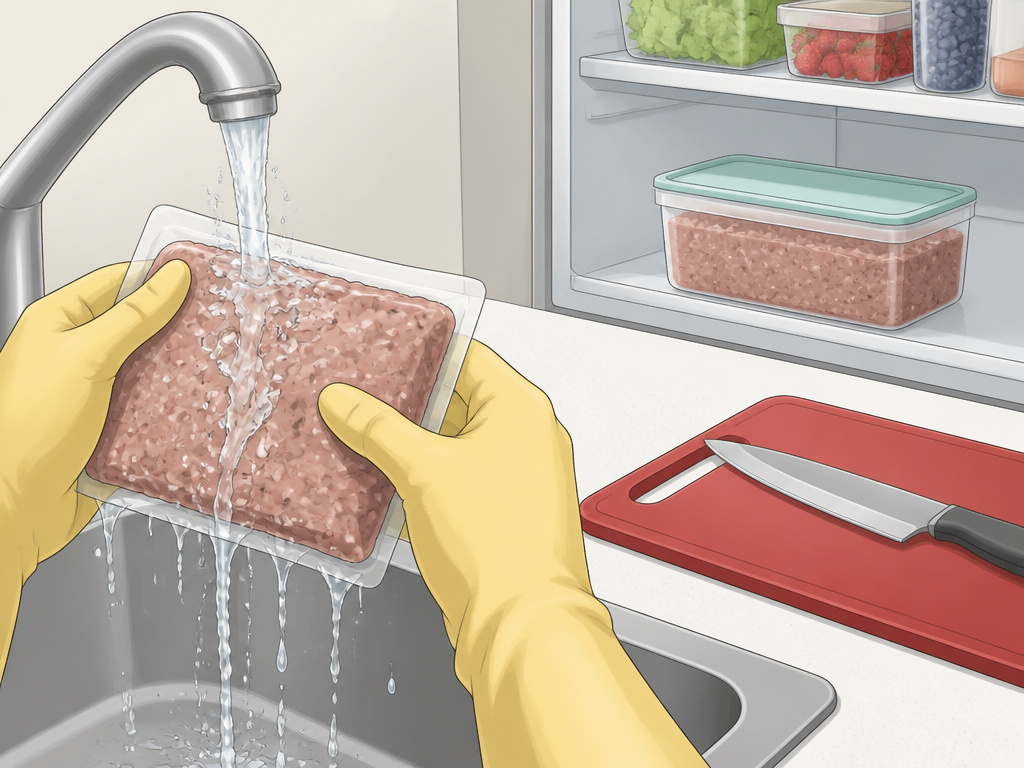
Before you start: Raw pet food can carry Salmonella and Listeria on the packaging surface as well as in the food. Keep a dedicated board and knife for it, and never thaw a package on a counter shelf above ready-to-eat food. A drip that reaches ready-to-eat food is the entire exposure route in one move.
The CDC raw pet food fact sheet lays out the routine. Each step below carries the consequence of skipping it.
- Wash your hands with soap and water before and after handling raw pet food. Skip it and you carry whatever was on the package to every door handle in the house.
- Clean every item and surface that touched the raw food. A sponge that wipes the bowl and then the counter just moves the load somewhere new.
- Freeze it until you’re ready to thaw and use it. Leaving it in the fridge door gives whatever survived the freeze a warm place to multiply.
- Thaw frozen raw food in the refrigerator, never on the counter. A counter thaw holds the outside of the package in the range bacteria grow fastest, long before the center is ready.
- Keep it in a sealed container in the freezer and fridge, separate from other foods. An unsealed package can drip onto the shelf below, where other foods may be stored.
- Throw away leftovers that sat out at room temperature. There’s no salvage step for a bowl that’s been left out at room temperature.
What Should You Ask a Raw Cat Food Company?
Sourcing is the part you can’t verify and the part that doesn’t tell you whether the finished product was tested.
The CDC suggests asking companies directly:
- Does the company test all final products for common foodborne germs like Salmonella, E. Coli, and Listeria?
- What does the company do to kill germs in its raw pet food products?
- Does it employ veterinary nutritionists?
- Is the diet complete and balanced, and what backs that claim?
That second question is where high-pressure processing comes up. AAHA notes that some companies use HPP to reduce bacterial numbers, and that its efficacy depends on the bacterial species, the number of cycles, pH, pressure achieved, processing time, and temperature. A pet food label claim of HPP does not equate to sterile food.
A kill-step statement is worth looking for on a raw package, and a high-pressure processed claim is a different claim than a kill step.
If you do decide to feed raw, raw cat food safety covers the pathogen side in more depth, and how to transition a cat to raw food handles the switch itself.
Frequently Asked Questions
Is raw cat food healthier than cooked cat food?
The CDC says raw pet food is not necessarily healthier, and that both raw and cooked food can be nutritionally balanced or inadequate. A 2025 review found limited evidence pointing to better body weight, body condition, and stool quality on raw diets. The CVMA says there’s limited data supporting clinically relevant benefits over appropriate cooked diets.
Can I feed freeze-dried raw as a complete diet?
It depends on the product, and the answer is printed on the package. Look for a nutritional adequacy statement saying the food is intended for complete daily feeding. Some freeze-dried raw products are complete diets and some are labeled as toppers or intermittent feeding only.
Does freezing raw cat food kill Salmonella?
No. Freezing stops bacteria from multiplying but leaves them in place. A German assessment found Enterobacteriaceae counts were actually higher in frozen poultry and carcass-mix raw diets than in thawed counterparts (p = 0.003), so freezing isn’t a hygiene reset.
What does HPP mean on a raw cat food label?
High-pressure processing. It uses pressure rather than heat to reduce bacterial numbers. AAHA notes that its efficacy depends on the bacterial species, number of cycles, pH, pressure achieved, processing time, and temperature, and states that an HPP claim does not equate to sterile food.
Is raw cat food safe for kittens?
The CDC lists kittens among the pets more likely to get sick from foodborne germs. In a feeding trial of 24 kittens, the combination-raw group showed positive fecal Salmonella Heidelberg and C. Difficile toxin, lower albumin, higher globulin, and red-cell microcytosis, even though all groups passed the AAFCO growth trial.
The Bottom Line
Here’s the threshold I’d use. If your household includes a child under 5, an adult 65 or older, a pregnant person, or anyone immunocompromised, skip raw. That isn’t a soft caution. The CDC and the CVMA both carve out those groups by name, and the kitten trial’s combination-raw group shed Salmonella Heidelberg while passing its growth trial.
If none of those apply and you’ve decided the limited stool-quality evidence is worth the handling burden, then buy frozen or freeze-dried, read the adequacy statement before you read anything else on the package, and ask the company the testing question in writing.
A clean panel can still sit on top of a plant having a bad week. That’s a gap in what a label can tell anyone, and it’s a reason to favor a company that answers the Salmonella question over an elaborate origin story.
