
Freeze-Dried Cat Food Pros and Cons: What the Panel Shows
This post contains affiliate links. As an Amazon Associate, we earn from qualifying purchases.
Freeze-dried cat food pros and cons start with the water: the trial diet measured 4% moisture, so the food stays shelf-stable at room temperature and remains raw. Freeze-drying lowers pathogen numbers without eliminating them, and many products are toppers rather than complete diets.
That 4% figure is central to the format. Catit claims that removing moisture prevents bacteria, mold and yeast from growing, while ProudPet warns that freeze-dried food is highly prone to moisture absorption and spoilage after opening. It’s also the number that makes the pieces brittle and puts rehydration at the center of how the food should be fed.
What follows is the panel-by-panel version: what the feeding trials measured, where the veterinary guidance and the marketing split, and the checks that decide whether a bag belongs in your cart.
Key Takeaways
- 4% moisture buys the shelf life, and it’s also why many freeze-dried products require rehydration with water or a pet-safe broth.
- Freeze-drying lowers pathogen numbers without sterilizing; viable bacteria have been cultured from raw freeze-dried products.
- A canned diet raised total water intake and urine volume in the trial. Freeze-dried only competes on hydration if you rehydrate it.
- Freezing doesn’t slow thiamine loss in stored extruded diets, so a freezer is not a nutrient lock.
- Look for a “complete and balanced” statement on the panel. Without one, you’re buying a topper with a dinner-sized price.
The 4% Moisture Number That Explains the Whole Format
Freeze-drying uses cold and vacuum to remove moisture from the food.
Freeze-drying uses cold and vacuum to remove moisture from the raw mixture. In the trial, the freeze-dried diet carried 4% moisture against 82% in the canned diet. That gap leaves the pieces brittle enough to shatter rather than tear.
Freeze-dried products are flagged as a concern for viable pathogens affecting companion animals and owners. Freeze-drying decreases but does not eliminate pathogens, so no raw diet is truly safe.
Dehydration gets confused with freeze-drying constantly. Dehydration uses low heat, which is not enough to count as cooking. The heat isn’t high enough to count as cooking. Freeze-drying sidesteps that particular loss.
ProudPet notes that freeze-dried food is highly prone to moisture absorption and spoilage after opening.
Because freeze-dried products are flagged as a concern for viable pathogens, the whole raw feeding argument applies here. If you want the long version of that debate, the raw cat food question is worth reading before you commit to any raw format, freeze-dried included.
Does Freeze-Drying Kill Bacteria in Raw Cat Food?
A 2025 Communications Biology study analyzed 112 raw commercial feline products and flagged freeze-dried products specifically as a concern for the health of cats and their owners. The microbiota analysis of raw cat diets found viable pathogens in raw foods, including freeze-dried products. It found viable pathogens, including in freeze-dried products.
This is where the sources stop agreeing, and the disagreement matters more than any single verdict.
| Source | Position on pathogen survival | Basis |
|---|---|---|
| Cats.com | Process “destroys pathogenic bacteria” | Commercial review, no trial cited |
| PetMD (Ellen Malmanger, DVM) | Numbers drop, many pathogens survive | Veterinary review |
| ProudPet | Not sterile; Salmonella and E. Coli risk | Commercial blog |
| Communications Biology (2025) | Viable pathogens cultured from raw products, freeze-dried included | 112-product study |
Cats.com claims freeze-drying destroys pathogenic bacteria, making the food extraordinarily safe. PetMD’s position is the narrower one: freeze-drying does reduce the pathogen load, and many pathogens survive it anyway, so no raw diet is truly safe. The 2025 study flags freeze-dried products as a concern for viable pathogens affecting companion animals and owners.
The scale of the difference is worth seeing. Conventional dry and semimoist foods came in under 0.05% on the same test.
There’s also a documented harm case. A cluster of thirteen cats in the UK developed Mycobacterium bovis infection, and the investigation tied the index cases to a commercial raw food diet. That’s not a statistical abstraction.
Where this goes sideways: A bag that tested clean at the plant can pick up contamination after testing, and the household most likely to pay for it is the one with a kitten, a senior cat, or an immunosuppressed adult.
The study authors singled out products sold on shelves at room temperature as the category of concern. That’s the exact convenience the format is sold on.
Freeze-Dried Cat Food Pros and Cons: What the Moisture Trials Show
Ever watched a cat drink from a fountain for two minutes and assumed the hydration job was done?
Eight healthy male neutered domestic shorthairs, four diets, four 21-day periods in a Latin square design. That’s the entire evidence base behind most claims that dietary moisture changes how active a cat is. The diet moisture effect on cat activity trial is small, and it’s the best controlled comparison available.
| Format | Moisture | Drinking water (ml/kg BW per day) |
|---|---|---|
| Canned, as fed | 82% | Lowest of the four |
| Dry, rehydrated | 70% | Low |
| Freeze-dried | 4% | 38.57 |
| Dry, as fed | 3% | 21.1 |
Average 24-hour activity didn’t differ between the four treatments (P > 0.05). The one activity signal that did reach significance was the day-to-night ratio, which was higher on the dry diet (P = 0.030). Total water intake and urine volume both rose on the canned diet (P < 0.001).
The interesting number is the drinking water split. Cats on the freeze-dried diet drank 38.57 ml/kg BW per day against 21.1 on the dry diet, despite the two diets sitting at 4% and 3% moisture. The authors put it down to food structure. The brittle pieces are harder to eat, and the cats compensated at the bowl.
What the trial did and didn’t find
It didn’t find that moisture level changes how much a cat moves. It did find that water has to come from somewhere.
Which brings me to fountains. I’ve watched them get sold as a urinary fix for years. A cat on dry kibble takes in a fraction of the water a canned-fed cat gets, and a pump in the corner doesn’t close that gap. Where fountains earn their place is with cats who genuinely prefer moving water. Where they fail is maintenance: filters and pump housings that don’t get cleaned weekly turn into a biofilm display. Roughly half the ones I’ve seen in homes were overdue.
So here’s the head-to-head. On water intake, canned cat food wins outright and freeze-dried only draws level once you add water yourself. On shelf stability and portioning, freeze-dried wins. On cost per calorie, dry cat food wins and it isn’t close.
The Freezer Does Not Protect Thiamine, and That Changes Storage Advice
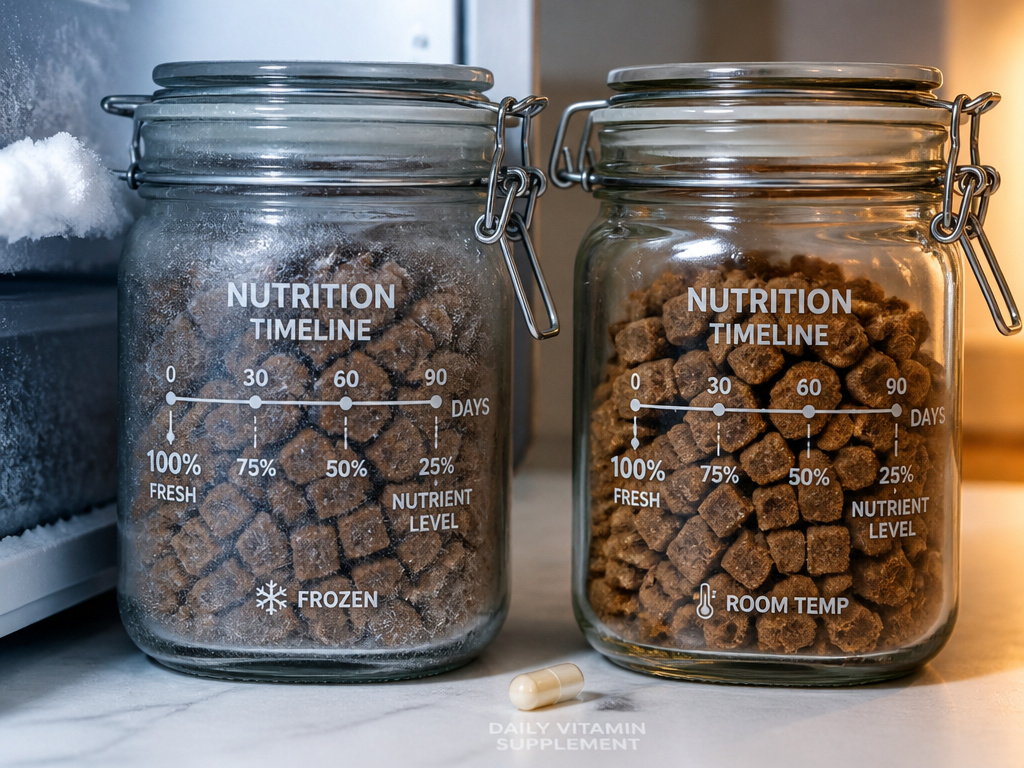
Twelve commercial extruded feline diets, split in half, one half stored at 24 degrees Celsius and the other at minus 20 degrees Celsius, sampled every six months for a year. That’s the design behind the thiamine degradation in extruded feline diets study.
Thiamine concentrations fell over storage time (P = 0.001). There was no treatment-by-time interaction (P = 0.9534), which is the statistical way of saying freezing didn’t slow the decline at all. Retention from baseline to twelve months came in around 95% across both treatments.
Why the freezer changes nothing
Thiamine is a labile vitamin. The paper lists pH, oxidation, UV light, ambient temperature, heat, and freezing as degradation factors, and the data here point at time doing the work rather than storage temperature. Bagging a year’s supply and freezing it doesn’t buy you anything the shelf didn’t already offer.
Two honest caveats. This study used extruded kibble, not freeze-dried pieces, so the rates don’t transfer directly. And a 95% retention figure means the loss was small enough that the authors called the clinical relevance possibly inconsequential, since no diet that started above the AAFCO recommendation dropped below it.
The bigger thiamine story is upstream. Pelleting and extrusion cost 50 to 85% of thiamine, and household cooking costs 50 to 60%. Clinical signs of deficiency can show up within two weeks on a deficient diet. That’s the number that should shape how you read a “gently processed” claim on the front of a bag.
Should You Refrigerate Freeze-Dried Cat Food After Opening?
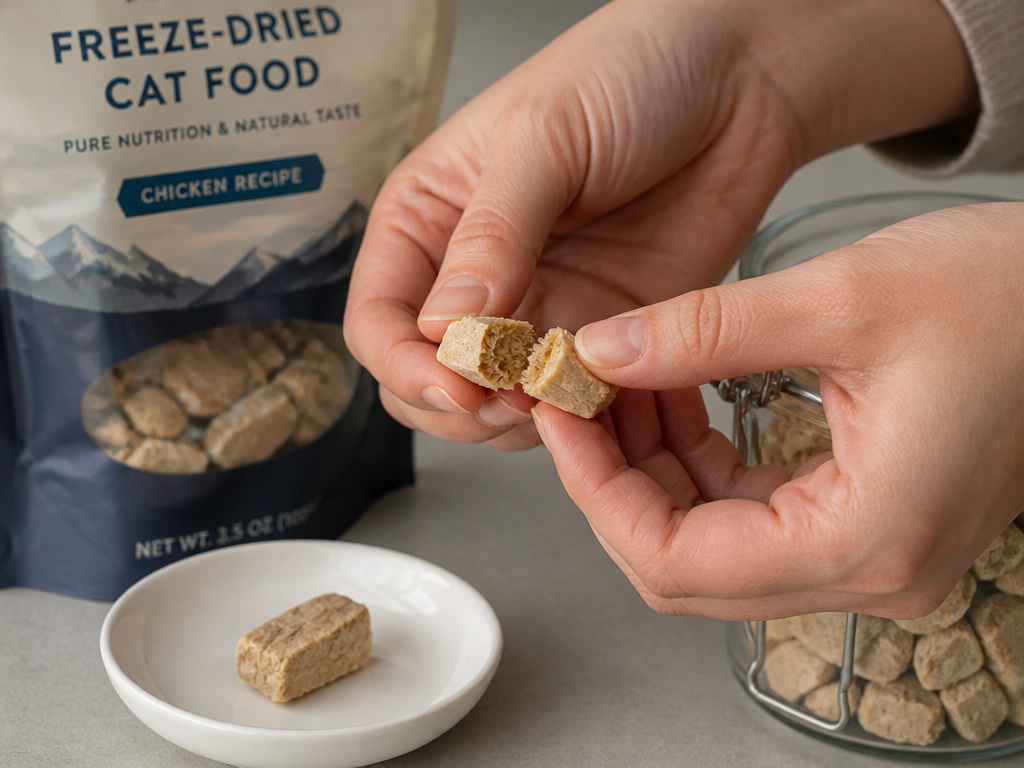
Two credible sources give opposite answers here, and neither one is obviously wrong.
PetMD’s veterinary guidance says most freeze-dried cat food should be refrigerated once opened, and shouldn’t sit out more than an hour because of food poisoning risk. Catit’s brand guidance says the food can and should be stored unrefrigerated. ProudPet lands closer to PetMD, noting that the product absorbs moisture readily and spoils after opening.
If two sources you trust disagree about storage, follow the stricter one until the package says otherwise. An hour out of the bag costs you nothing. A spoiled portion costs you a vet visit.
The physical tell is easy to learn. Opened pieces that have been sitting in humid air go leathery and chewy instead of snapping. Once they hit that stage, the texture that made the food useful as a training reward is gone, and the moisture that got in is exactly what the drying process was meant to remove.
Practical version: read the storage line on the bag, use an airtight container either way, and if the label is silent, refrigerate. PetMD also points out that any freeze-dried product should carry a clearly labeled expiration date and storage instructions. A bag without them is a bag I’d leave on the shelf.
Complete and Balanced: The Line That Decides Whether It’s Dinner
I once worked with a household whose old cat was down to skin and bone on a senior formula. The senior recipe was built for a cat that was slowing down, and this cat needed more calories per bite, not fewer. We moved to a standard adult recipe with more fat and the weight came back over a few months. I’ve matched the food to the cat rather than the age on the label ever since.
That same logic applies to freeze-dried. The format tells you nothing about whether the food is a meal. PetMD’s guidance is blunt about it: many freeze-dried products are formulated as toppers, treats, or kibble coatings, and are not meant to be the only source of nutrition. ProudPet adds the nutritional failure mode, warning that feeding a single-meat freeze-dried product as a staple risks deficiency in calcium, essential fatty acids, and trace elements.
What “complete and balanced” actually certifies
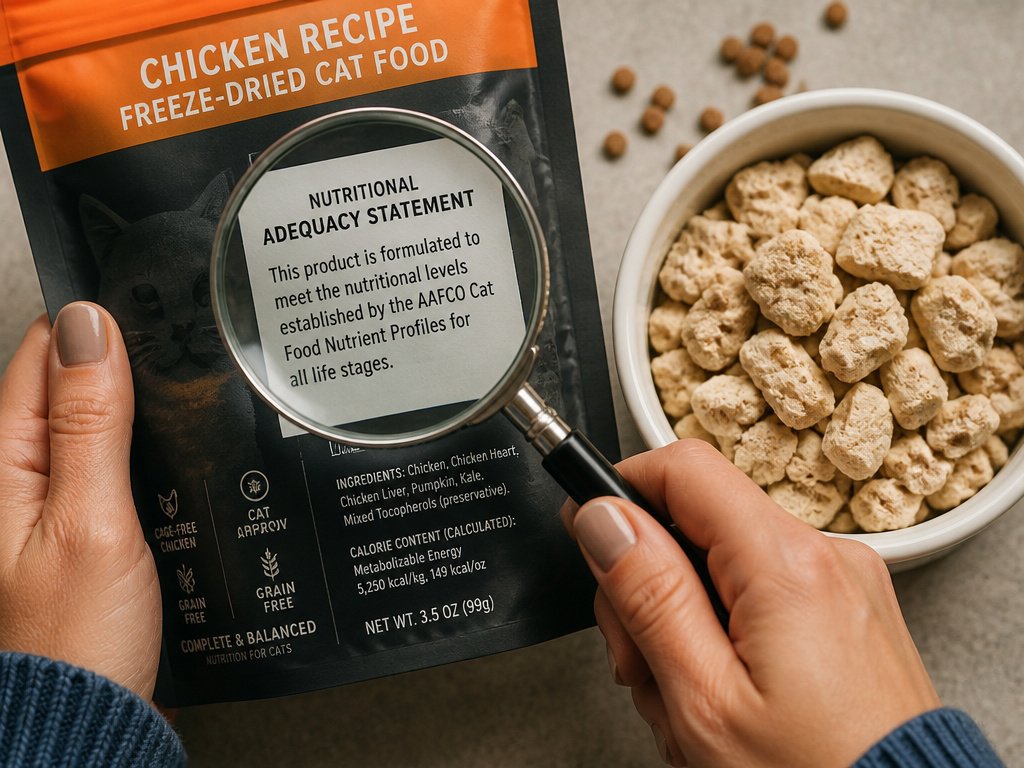
The phrase on the panel refers to a nutritional adequacy statement, meaning the food meets a recognized nutrient profile for a stated life stage. That statement is the difference between dinner and a garnish. Everything else on the bag is decoration.
Run these four checks before you buy:
- Nutritional adequacy statement present, and matched to your cat’s life stage rather than to the picture on the front.
- Ingredient panel with a named muscle meat or named meat meal in the first few slots, not three split pea fractions (the wolf on the bag is not a stakeholder).
- A stated species and cut you can actually identify, since “poultry” covers a lot of ground.
- Storage and expiration instructions printed on the package, not implied.
If you want a starting shortlist rather than a lecture, the best freeze-dried cat food picks are filtered on that adequacy statement. If you’re feeding toppers rather than meals, freeze-dried chicken treats for cats is the more honest comparison, because a treat doesn’t have to carry a full nutrient profile.
How to Rehydrate Freeze-Dried Food Without Wrecking It
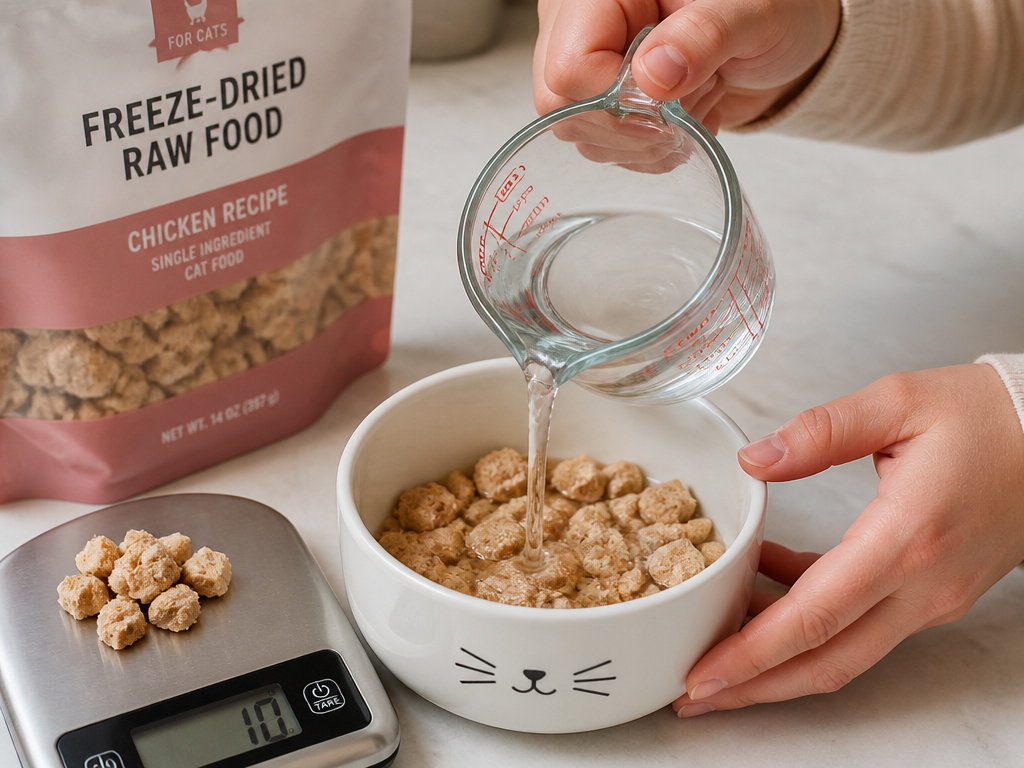
Rehydration takes about two minutes, and it’s where most of the practical risk in this format sits.
Before you start: The meat is raw, so treat the bowl like raw chicken. Wash hands, bowl, and counter with hot soapy water after every feed, and don’t leave a rehydrated portion sitting out more than an hour. Keep the bag sealed between servings so the pieces don’t pull moisture from the room.
- Measure the portion first. Weigh or scoop dry, then add water. Guessing at the dry amount and topping up later throws off the calorie count, which is the whole reason you’re feeding a measured diet.
- Add warm, not hot, water. Hot water drives off the volatile compounds that make the food palatable, and you’ll end up with a cat that walks away from a bowl it used to finish.
- Use roughly equal parts by volume as a starting point, then adjust. Some pieces absorb far more than others, and the right consistency is a soft mash rather than soup.
- Wait five to ten minutes. The center of a chunk takes longer than the surface. Feeding too early leaves a hard core that cats pick around, and you’ll find it dried onto the bowl later.
- Serve, then bin the leftovers. A rehydrated portion is a wet food portion now, and the clock starts immediately.
The full ratios and troubleshooting live in the how to rehydrate freeze-dried cat food walkthrough if you want numbers rather than ranges.
The broth and the milk question
Broth is fine as a rehydration liquid, with one check. PetMD advises confirming with your vet first, because some broths carry an unhealthy amount of sodium.
Raw goat or cow milk is a different matter. Some freeze-dried products recommend it right on the label. PetMD advises against it anyway: dairy causes significant gastrointestinal upset in cats, and raw milk carries its own pathogen risk. That’s a case where the label instruction and the veterinary guidance directly conflict, and I’d follow the vet.
When Freeze-Dried Is the Wrong Buy
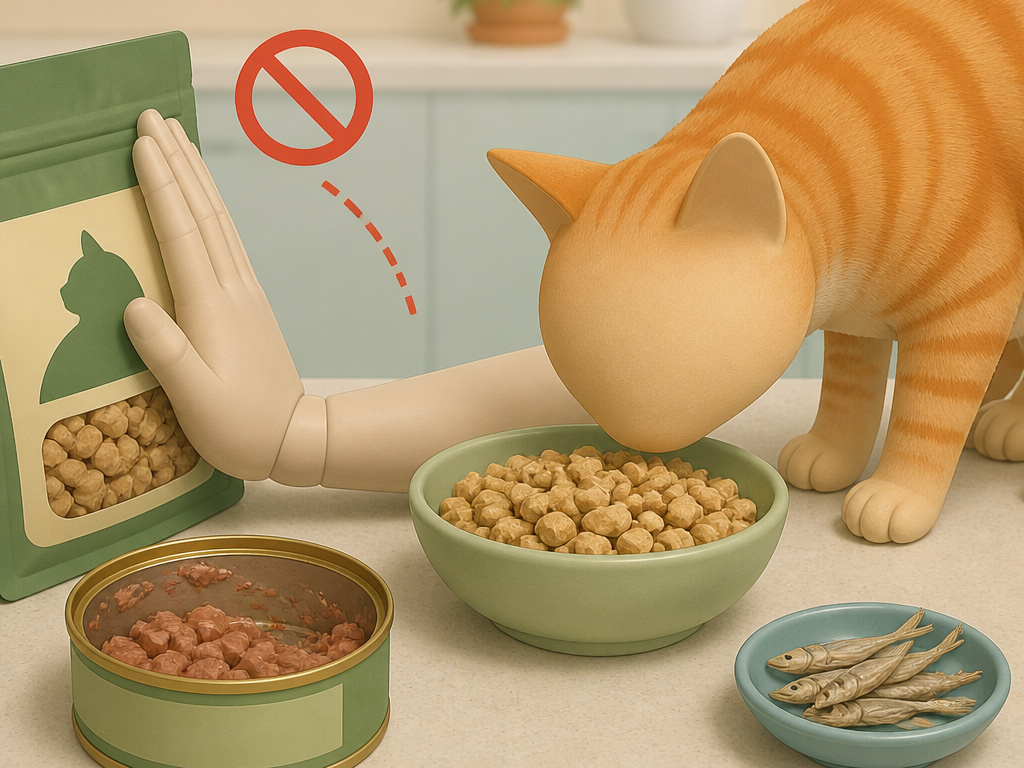
Skip it if anyone in the house is immunosuppressed, very young, or elderly. PetMD flags those groups as especially prone to the risks of raw pet food in the home, and that includes the humans handling the bowl.
Skip it as a sole diet if the bag doesn’t carry an adequacy statement for your cat’s life stage. You’d be running a deficiency experiment with a pet as the subject.
Skip it if cost is the deciding factor. Freeze-dried products run higher than ordinary dry or canned food, and no amount of convenience changes that arithmetic. A canned diet delivers more water per bowl and a lower bill.
Skip it if your cat won’t eat it. This one sounds obvious and gets ignored constantly. A food with a perfect panel that sits in the bowl is worth less than a mid-tier food the cat actually finishes.
One more thing worth saying plainly: freeze-dried fish treats and single-protein rewards are a fine use of the format. Freeze-dried minnows for cats are a fine use of the format, doing exactly what they should, which is being a treat and not pretending to be a diet.
Frequently Asked Questions
Is freeze-dried cat food safe for cats?
It’s raw food with the water removed, so the safety profile is the raw safety profile. Freeze-drying reduces pathogen numbers without eliminating them, and viable bacteria have been cultured from raw freeze-dried products. Households with kittens, senior cats, or immunosuppressed people carry more risk.
Is freeze-dried cat food better than canned?
Not on hydration. In the Cambridge trial, the canned diet raised total water intake and urine volume significantly, and freeze-dried only matches that if you add water yourself. Freeze-dried wins on shelf stability and portion control. Canned wins on water per bowl.
Can I feed freeze-dried cat food as a complete meal?
Only if the panel carries a complete and balanced statement for your cat’s life stage. Many freeze-dried products are formulated as toppers or treats. Feeding a single-meat product as a staple risks deficiencies in calcium, essential fatty acids, and trace elements.
Does freeze-dried cat food need water added?
Most products do, per PetMD’s guidance, using water or a pet-safe broth. Cats on the freeze-dried diet in the Cambridge trial drank 38.57 ml/kg BW per day on their own, well above the dry-fed group, but that’s compensation rather than a substitute for rehydrating.
Does freezing freeze-dried food keep it fresher?
Not in the way people expect. A year-long storage study found thiamine degraded at the same rate at minus 20 degrees Celsius as at 24 degrees Celsius, with roughly 95% retention either way. Freezing doesn’t slow the loss.
The Bottom Line
Flip the bag over tonight and find the nutritional adequacy statement. If it isn’t there, or it’s written for a life stage your cat isn’t in, you’re holding a bag of treats with a dinner-sized price tag, and no amount of freeze-dried cat food pros and cons weighing changes that.
The format has a real use. It’s shelf-stable raw protein that portions cleanly, travels well, and works as a high-value reward or a topper on a food that already carries its own adequacy statement. What it doesn’t do is sterilize raw meat, and it doesn’t hydrate a cat unless you add the water back.
One concession, because it matters. If your cat has kidney disease, diabetes, or any condition that comes with a therapeutic diet, none of this comparison work substitutes for the prescription. I can read a panel. I can’t read your cat’s bloodwork, and the person who can should be making that call.
Fair warning: the bag that markets hardest is usually the one with the least on the panel.
