
Wet Cat Food Pros and Cons: What the Label Hides
This post contains affiliate links. As an Amazon Associate, we earn from qualifying purchases.
The wet cat food pros and cons start with water: wet food is roughly 70-80% moisture, which helps hydration and urinary health but costs more per calorie and spoils quickly once opened. Only 2 of 22 products in a Consumer Council test met all three international nutrient standards.
That moisture figure is also where most label reading goes wrong. A guaranteed analysis reports every number on an as-fed basis, so a can that reads 78% moisture is only about a fifth food by weight. Strip the water out and the protein and fat numbers move a long way. Two cans that look identical on the shelf land in different places once you convert them.
What follows walks the actual wet cat food pros and cons: what moisture does for a cat’s bladder, the calorie argument the sources genuinely disagree on, the mineral gaps a lab test found in 20 of 22 products, and how to run a mixed feeding schedule without leaving a bowl of wet food out all afternoon.
Key Takeaways
- Wet food is 70-80% water, so treat it as a hydration tool first and a nutrient package second.
- Convert to dry matter before you compare anything. As-fed protein on a 78%-moisture can tells you almost nothing on its own.
- “Complete and balanced” is a claim, not a test result. In a Consumer Council test of 22 wet products, only 2 fully met AAFCO, FEDIAF and NRC recommendations.
- Opened wet food is short-lived. PetMD says 24 hours refrigerated, VCA allows up to three days, so 24 hours is the safer default.
- Mixed feeding covers most households. Wet for the moisture, dry for the convenience and the cost.
What Does 78% Moisture on the Label Actually Tell You?
The guaranteed analysis on the back of a can reports moisture on an as-fed basis, which means the figure includes the water that makes the food wet in the first place.
Canned cat food contains 68% to 78% water and 22% to 32% dry matter, according to the Merck Veterinary Manual. Semi-moist products run 25% to 40% water. Dry kibble sits near 10% water and roughly 90% dry matter. The three formats are therefore measured on different scales, and only a dry-matter conversion puts them on the same one.
Different bodies publish slightly different bands. AAHA puts wet food at approximately 70-80% moisture. Royal Canin Academy gives 60-80% for wet, 25-35% for semi-moist, and about 10% for kibble. PetMD lands at roughly 70% for canned and 10% for dry. The spread matters less than the principle: wet food is mostly water, and the label says so right on the panel.
Reading the Guaranteed Analysis on a Dry Matter Basis
Take the moisture percentage, subtract it from 100, and that remainder is your dry matter. A can listing 10% crude protein and 78% moisture works out to about 45% protein on a dry matter basis (10 divided by 0.22). Same can, same food, a very different-looking number.
That arithmetic is the whole trick, and it takes only a moment on the back of the can. I do it out of habit, mostly because the as-fed panel flatters low-protein products and punishes high-moisture ones.
Most pates I check land in the high-moisture range typical of wet food. When a “chunks in gravy” product reads lower than expected, I start reading the thickener list, because something other than meat is holding that texture together. You can feel it before you read it. A pate built on muscle meat breaks into shreds under a fork; one built on starch slides out of the can in a single glossy block and sits there.
Where this goes sideways: Treating “moisture 78% max” as a quality claim. It’s a water content figure. It says nothing about protein, fat, or whether the minerals are anywhere near the recommended range.
If you want the wider map of how these formats differ before drilling into one, the types of cat food breakdown covers the full set.
The Hydration Case, With the Numbers Attached
The moisture gap between wet and dry food is the comparison that matters.
That’s the mechanism behind every hydration claim you’ve read.
AAHA frames the payoff in practical terms. A high-moisture diet dilutes urine and increases urination, which makes the bladder less hospitable to crystal formation. VCA Animal Hospitals points the same fact at sick cats, noting that canned food’s water content helps increase intake for cats with urinary disease or chronic kidney disease.
Here’s where the evidence gets thinner than the marketing suggests. Hydrating the food did not make the cats move more.
What most people get wrong: Buying a water fountain as urinary insurance. A cat on kibble is eating food that’s about 10% water; a canned-fed cat is eating food that’s 70-80% water. No pump closes that gap. Buy a fountain because your cat drinks from moving water, not because it solves a moisture problem.
Where fountains do earn their place is with cats that genuinely prefer running water. Where they fail is maintenance. Many of the ones I’ve seen in homes were overdue for a filter change, and a neglected fountain is a biofilm display. The pump housing feels slick to the touch and the water takes on a faint wet-cardboard smell that owners stop noticing after a week.
If your cat already has a diagnosed urinary issue, that’s a different conversation with different food, and the urinary cat food options are worth reading before you buy anything off a shelf.
Do Wet Food Calories Really Come Out Lower? The Sources Don’t Agree
Three credible sources look at the same can and reach different conclusions about calories, and the disagreement is worth understanding because it changes how you portion.
| Source | Position on wet food calories | Stated basis |
|---|---|---|
| AAHA | Fewer calories per volume than dry food | Per volume, as fed |
| VCA Animal Hospitals | Lower energy density, so a larger portion for the same calories | Calories per 100 g |
| Royal Canin Academy | Higher fat content and higher calories than dry food | Dry matter basis |
Read the third column and the conflict mostly dissolves. AAHA and VCA are talking about calories per scoop or per 100 grams of the food as it comes out of the container. Royal Canin is talking about calories per unit of dry matter, which strips the water out first. Both are correct about what they measured.
The practical consequence of the wet cat food pros and cons is that a wet meal looks bigger and weighs more for the same energy, which is exactly why it can help with intake control. Royal Canin also notes that cost per calorie and the perishable nature of wet food may reduce overfeeding simply because owners serve it more deliberately.
Protein is a messier question. AAHA states that wet foods generally run higher in protein than dry diets, which helps cats hold lean body mass during weight loss. Royal Canin’s own material points the other way, describing wet food as higher in fat with a correspondingly higher calorie density on a dry matter basis. I’d call that genuinely unsettled rather than pick a winner, and it’s a reason to read the panel on the specific product instead of trusting a format-level rule.
Compare two foods on the same basis or don’t compare them at all. A calorie figure per can and a calorie figure per 100 g of dry matter are not the same measurement, and the one printed largest on the packaging is usually the one that flatters the product.
The broader wet vs dry cat food comparison is worth a look if you’re still deciding which format deserves the bigger share of the bowl.
The Mineral Gap: Only 2 of 22 Wet Foods Cleared All Three Standards
Twenty-two products went to a lab in Hong Kong. Two came back fully compliant.
The Consumer Council tested 22 models of canned and pouched wet cat food, covering 12 complete foods and 10 complementary foods. Twenty of the 22, or 90%, failed to fully comply with recommended mineral or amino acid amounts set by AAFCO, FEDIAF and the National Research Council. Sixteen models missed the recommended concentrations of all three organisations for between 3 and 9 different minerals. Another 4 had a single mineral short of the mark.
The iron numbers make it concrete. Among the 12 complete foods, 4 had iron content between 43.9 mg/kg and 66.8 mg/kg, below the 80 mg/kg minimum recommended by both AAFCO and FEDIAF.
That is a label-versus-reality problem, not a wet-food problem. The same test would likely find similar gaps in dry products. But it does undercut the assumption that a can with a tidy nutrient panel on the back is delivering what the panel promises.
Complete vs Complementary: The Two Words That Change the Feeding Plan
Merck Veterinary Manual lays out the labelling rules clearly. A “complete and balanced” statement means the product contains all nutrients known to be required for a species and life stage, properly balanced to the food’s energy density. A product that doesn’t meet that bar must carry the statement “This product is intended for intermittent or supplemental feeding only.”
| Label wording | What it means | What to do |
|---|---|---|
| “Complete and balanced” | Formulated to meet nutrient profiles for a named life stage | Check which life stage is named |
| “Intermittent or supplemental feeding only” | Not a complete diet on its own | Use as a topper, never as the base |
| “Adult maintenance” or “all life stages” | Formulated for that stage | Match it to your cat’s age |
| No adequacy statement at all | Snack, treat, or supplement | Don’t build a diet on it |
The Consumer Council’s warning is blunt: complementary food must be fed alongside a complete food, and misfeeding it causes long-term imbalanced nutrition. Three of the complementary models in the test carried no feeding guide at all.
Two more caveats sit underneath all of this. Royal Canin notes that thiamine is heat-labile and has been reported deficient in some pate-style wet foods and in wet food from some smaller manufacturers. The same source flags that selenium, sodium and potassium appear less bioavailable in wet food, possibly because of gelling agents. And Merck points out that laboratory analysis doesn’t address bioavailability in the first place, so a panel can be accurate and still not tell you what the cat absorbs.
Semi-moist sits in its own awkward category here. Royal Canin puts semi-moist moisture at 25-35%; Merck gives 25%-40% water and 60%-75% dry matter. The two sources don’t agree on the band. VCA adds a bigger concern: semi-moist food can carry more sugar and more sodium than dry or canned, which matters for cats with diabetes, urinary, kidney, or heart disease. The semi-moist cat food trade-offs are worth reading before you use it as anything more than an occasional topper.
The part nobody mentions: A “complete” claim on the label isn’t proof of compliance. In the Consumer Council test, 4 of the 12 complete foods fell short on iron alone.
If you’d rather start from a shortlist than from a chemistry lesson, a roundup of best wet cat food brands is a reasonable entry point, provided you check the adequacy statement on each can before committing to a case.
How Long Does Opened Wet Food Actually Last?
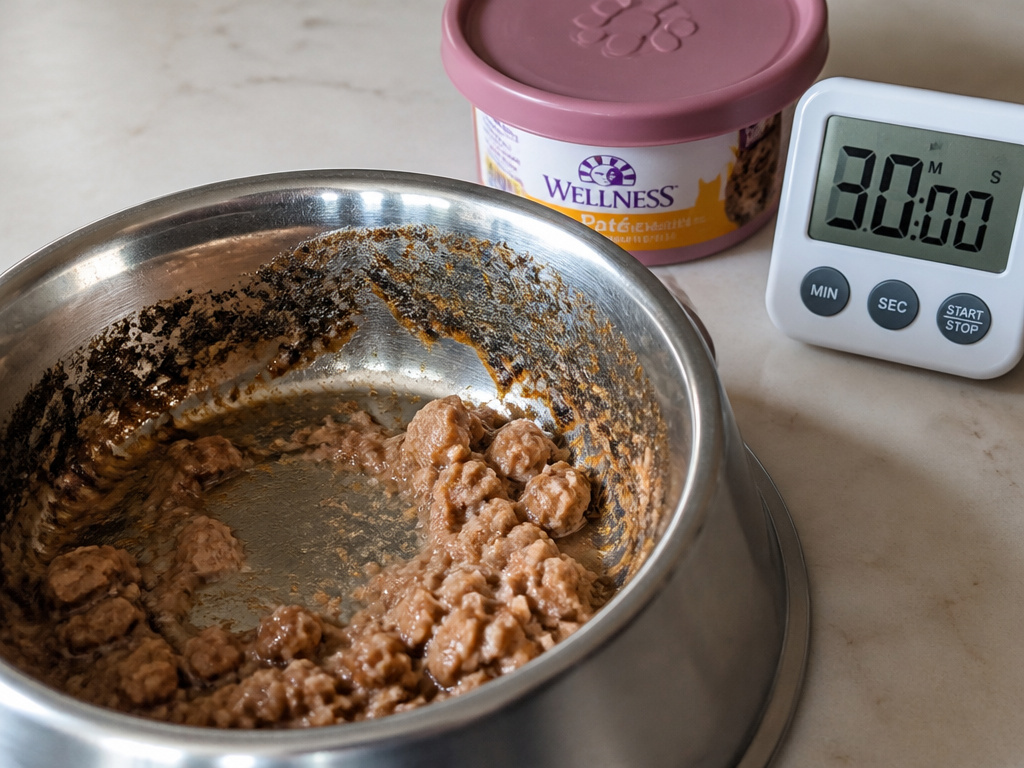
Assume one day, not three.
This is one of the few places where two veterinary sources flatly contradict each other. PetMD states that once opened, canned food has a shelf life of 24 hours and must be refrigerated, and warns that leaving it out longer than a few hours risks contamination and gastrointestinal upset. VCA allows up to three days refrigerated for the unused portion, but says to discard what’s left in the dish after about 30 minutes.
The 30-minute rule is the one both sources effectively agree on, and it’s the one that gets ignored. A cat that walks away from a half-finished bowl and comes back hours later is eating food that’s been sitting at room temperature.
Spoiled wet food doesn’t announce itself. It goes sharp and sour at the edges first, a bit like milk left on the counter, and by the time it smells obviously wrong the cat has usually already refused it. Refrigeration slows that curve but doesn’t stop it, which is why I default to the 24-hour figure and treat day three as an outside limit rather than a target.
Easy to miss: Refrigerated wet food loses palatability fast, and a cat that refuses a cold portion often gets labelled picky. VCA notes that gentle warming increases aroma and palatability. Gentle warming, stirred and tested for hot spots, does more for acceptance than switching brands.
The container matters too. Canned food is retorted after sealing, a heat-and-pressure process that sterilizes the contents and destroys foodborne pathogens, which is why an unopened can keeps for so long in the cupboard. That protection ends the moment the seal breaks.
How Do You Switch a Cat From Dry to Wet Without a Hunger Strike?
You put the bowl down. The cat looks at it, looks at you, and walks away.
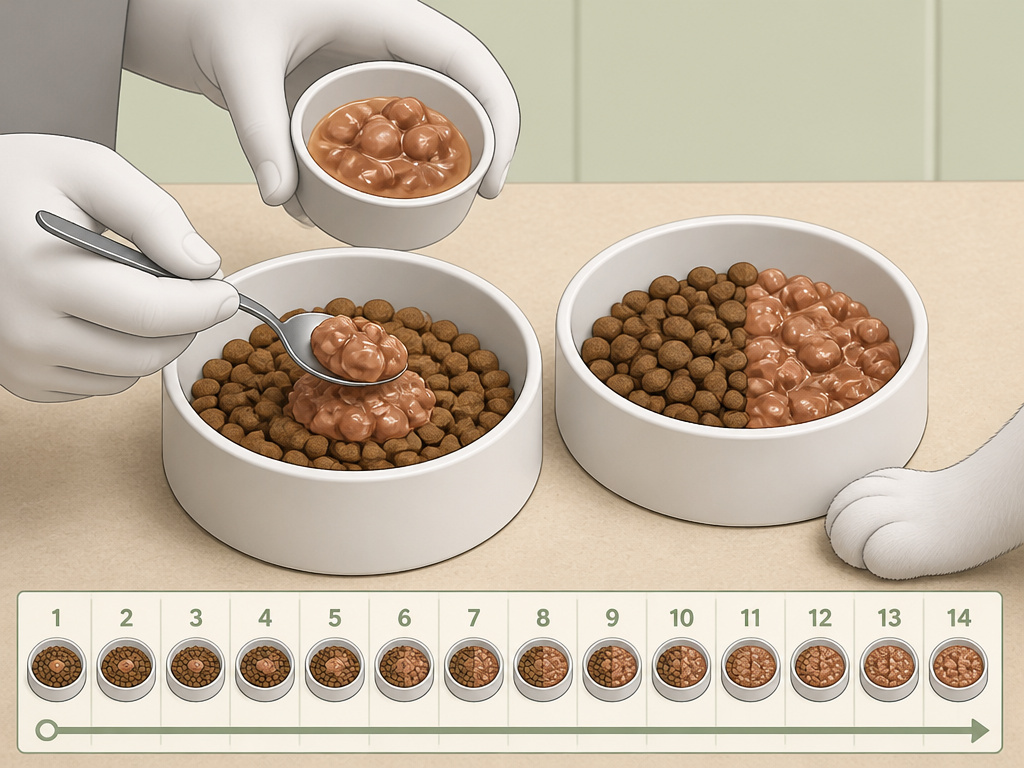
Fast switches fail more often than slow ones, and the failure is usually blamed on the cat. A gradual shift, starting with a small amount of wet stirred into the kibble, works far better than swapping the bowl overnight and then negotiating with an animal that has already decided the kitchen is untrustworthy.
One client was certain her picky adult cat would never accept a new food. We moved it in small increments and the cat ended up eating it outright, which was a useful reminder that refusal is often a pace problem rather than a preference.
Before you start: Wet food mixed into kibble spoils on a different clock than dry food does, so pick the bowl up after about 30 minutes rather than leaving it down all morning. And if a cat stops eating entirely during a transition, that’s a vet call, not a stubbornness contest. Overweight cats are at real risk of hepatic lipidosis, a dangerous fat accumulation in the liver that develops quickly in cats that stop eating.
The 2-Week Transition Schedule
- Days 1-3: a small amount of wet stirred through the kibble. Skip this and go straight to a half-and-half bowl, and you’ll likely get a refusal on day one that sets the whole attempt back a week.
- Days 4-7: a slightly larger amount, mixed in the same way. Keep the total calories the same by trimming a little kibble; adding wet on top of a full dry ration is how cats gain weight during a transition.
- Week 2: a larger share of the bowl as wet. This is where most cats either accept the format or stall. A stall here usually means the pace was too fast, not that the food is wrong.
- Week 3: increase the wet share, or hold wherever the cat is comfortable. There’s no prize for reaching an all-wet diet. A stable mix is an outcome worth keeping.
- Watch the litter box, not just the bowl. Urine volume rises on higher-moisture food, which is the point, but a cat straining to urinate needs a vet the same day regardless of diet.
Mixed Feeding: The Setup Most Owners Should Actually Run
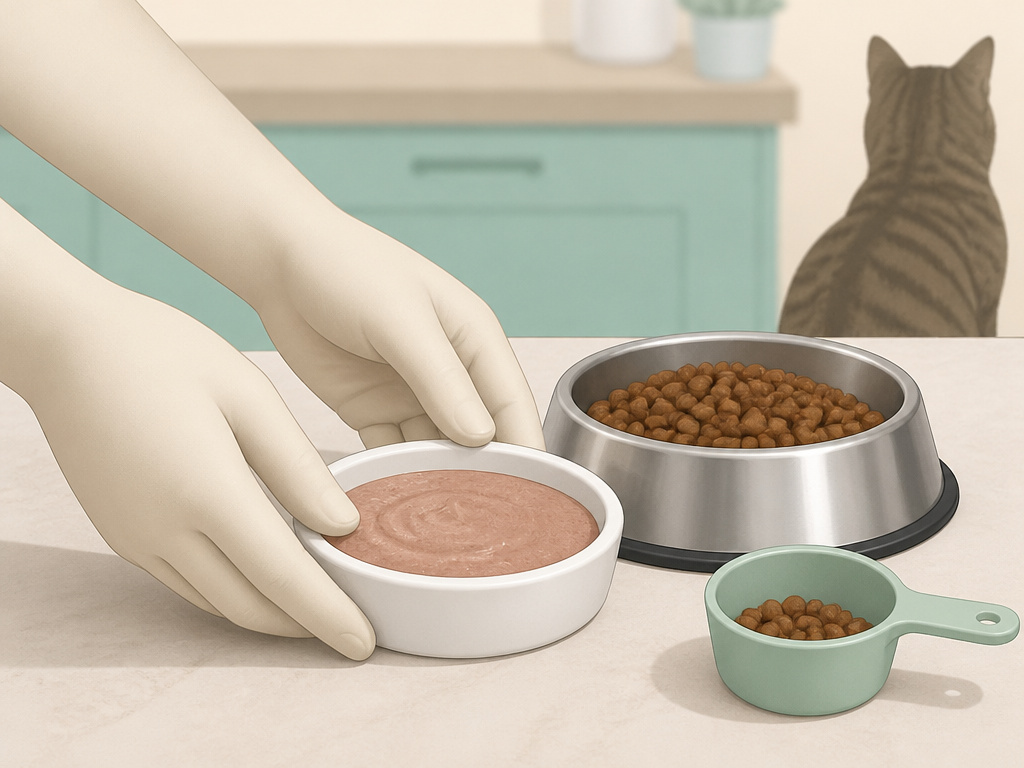
Half-and-half is the answer for most households, and it isn’t a compromise position.
Mixed feeding gets you the moisture of wet food and the convenience and shelf stability of dry, without the waste of opening a can the cat won’t finish. It also keeps costs closer to a dry-only budget, which matters because canned food is more expensive than dry food per Merck Veterinary Manual.
If you want one concrete starting point: a complete-and-balanced pate carrying a named AAFCO life-stage statement, fed as the main meal, with a measured dry ration left down for grazing. A complete-and-balanced canned pate with a named AAFCO life-stage statement does that job without a story attached, and a smoother pate option is reasonable if your cat prefers that texture. Compare any of them on a dry matter basis before you decide which one wins.
A few rules that keep mixed feeding from turning into a mess:
- Measure the dry portion for the day, not for the week. Free-feeding kibble alongside wet meals is the most reliable way to overshoot calories.
- Serve wet first, dry second. Hungry cats eat what’s in front of them, and the wet portion is the one with a clock on it.
- Pick one wet texture and stay there for a month. Constant rotation makes it impossible to tell what caused a digestive upset.
- Don’t stack a topper on a complete food and call it balanced. Toppers dilute the nutrient profile of the base diet.
On the dental question, VCA is direct: there are no canned food options that carry dental health benefits. Royal Canin agrees, attributing it to the lack of gingival stimulation from wet textures. Some kibble diets do carry oral health claims, but that’s a claim about a specific tested product, not a property of dry food in general. Most kibble shatters on contact long before it scrapes anything meaningful.
Whether you go with canned cat food vs pouches, the nutrient panel is what decides it, not the packaging. And if you’re weighing how much dry to keep in the mix, the dry cat food pros and cons cover the portion-control side properly.
Frequently Asked Questions
Is wet food better than dry food for cats?
Not automatically. Wet food has a clear edge on moisture, which helps with hydration and urinary health, and it’s lower in calories per volume. But format matters less than formulation. A well-made complete dry food beats a poorly formulated wet one, and the 2021 Consumer Council test found nutrient gaps in 20 of 22 wet products.
How much wet food should a 4 kg cat eat per day?
In the Consumer Council test, the recommended daily serving of complete wet food for a 4 kg cat ranged from 160 g to 352 g, which is a huge spread driven by calorie density. Use the feeding guide on the specific can and adjust from there based on body condition, not on a generic number.
Can I leave wet food out all day?
No. VCA advises discarding what’s left in the dish after about 30 minutes, and PetMD puts refrigerated shelf life at 24 hours once a can is opened. Leaving it down longer risks contamination and gastrointestinal upset.
Does wet food clean a cat’s teeth?
No. VCA states plainly that no canned food carries dental health benefits, and Royal Canin attributes that to the lack of gingival stimulation from wet textures. Dental benefits come from specifically formulated dry diets or from brushing, not from moisture.
Is semi-moist cat food a good middle ground?
Usually not. VCA warns that semi-moist food can contain more sugar and sodium than dry or canned, which is a problem for cats with diabetes, urinary, kidney, or heart disease. Sources also disagree on its moisture band, with Royal Canin at 25-35% and Merck at 25%-40%.
Can I mix wet and dry food in the same meal?
Yes, and it’s how most households actually feed. Measure the dry portion for the whole day, serve the wet first, and pick the bowl up after about 30 minutes. Just make sure the base diet is complete and balanced, because a topper won’t fix an incomplete food.
The Bottom Line
Before you compare moisture percentages, find the AAFCO nutritional adequacy statement on the can. That single line tells you whether the product is a complete diet or a supplement wearing a food label, and it matters more than the water content, the protein number, or the picture on the front.
Here’s the trigger that changes the advice. If your cat is a poor drinker, has had a urinary blockage, or is already managing kidney disease, wet food stops being a preference and becomes a clinical decision. That’s where my advice ends, because therapeutic diets are a vet’s call and a label reader shouldn’t be prescribing them.
Start smaller than you think you should. Buy two cans, not a case. Convert both to dry matter, check the adequacy statement, and see whether the cat will eat either one before you commit to a diet change that takes three weeks to unwind.
And if cost is the real constraint, a mid-priced complete dry food with a wet topper beats an all-wet diet you can’t sustain past the second month. Sustainability wins. A feeding plan that survives contact with your actual budget is the only one that helps the cat.
