
Types of Cat Food Formats: What Each One Delivers
This post contains affiliate links. As an Amazon Associate, we earn from qualifying purchases.
Types of cat food formats are separated by water content and processing method. Dry food is roughly 90% dry matter and 10% water. Canned food runs 68% to 78% water. Semi-moist sits at 25% to 40% water, and Merck Veterinary Manual sorts all three by processing and moisture rather than by what the front of the bag says.
That moisture line is the number owners misread most often, and on its own it tells you almost nothing. Flip the bag over. The guaranteed analysis lists moisture as a maximum, so until you subtract it and put protein and fat on a dry matter basis, you’re comparing a bowl of water against a bowl of kibble.
What follows walks the types of cat food formats Merck recognizes, the fourth band Japan’s environment ministry adds, and the numbers each one actually delivers once you strip the water out. There’s a table for the places the sources contradict each other, because they do.
Key Takeaways
- Water content sorts the formats. Dry runs about 10% water, canned 68% to 78%, and semi-moist 25% to 40% in Merck’s ranges, and that spread explains most of the price gap.
- Format drives preference more than protein source. A two-bowl study with 20 cats held the protein constant and still produced 1.67:1 to 2.07:1 preference ratios.
- The retort costs thiamin. Canned processing cut thiamin by 30.4% and riboflavin by 18.3%, while niacin, biotin and cobalamin came through untouched.
- Semi-moist carries extra sugar and sodium, so it belongs as a topper rather than a staple, especially for cats with diabetes or urinary, kidney or heart disease.
- The published moisture bands disagree. Merck’s semi-moist ceiling is 40%, and both Animals (2023) and Japan’s environment ministry stop at 35%.
Dry Food: 90% Dry Matter and a 130 °C Spore-Kill Floor
Extrusion pushes a mixed batter through a die at 80 °C to 200 °C (176 °F to 392 °F), and about 95% of dry cat food is made that way. The die and the knife set the kibble’s shape and size.
Dry food contains approximately 90% dry matter and 10% water, and extrusion is used for about 95% of commercial dry dog and cat foods. Manufacturer extrusion temperatures range from 80 °C to 200 °C (176 °F to 392 °F), and a minimum of 130 °C (266 °F) is required to destroy both microbes and bacterial spores.
That 130 °C floor is why dry food sits on a shelf instead of in a fridge. Below it, spores survive the cook and the bag becomes a culture dish with a nice photo on it.
Merck puts dry food at roughly 90% dry matter and 10% water. A 2023 review in Animals puts moisture at 10% to 12%. Either way you’re looking at a food that is almost entirely solids, which is why a cup of kibble and a can of wet food are nowhere near the same amount of food.
VCA’s guidance is to buy a bag that lasts about four to six weeks. Once the package is open, the food starts to oxidize, and oxidation hits both nutrient concentration and palatability.
Open a bag past that window and the fat on the kibble smells like old cooking oil rather than roasted chicken. Cats notice before you do.
Where dry food actually wins:
- Automatic feeders and food toys. Kibble is the format that works in both, and VCA names it as the best fit for each.
- Grazers. Measure the day’s portion into the bowl in the morning and check what’s left at night.
- Cost. Merck lists lower cost than canned or semi-moist as a dry food advantage, plus room-temperature storage for unused portions.
- Dental claims, sometimes. Some kibble carries an oral health claim. Check the label for an oral health claim before you pay extra for one.
Not all dry food is extruded, either. Baked and extruded kibble differ in how the starch sets and how dense the finished piece comes out.
Common mistake: Buying the big bag to save money. Oxidation starts the day you open it, and by week six the food is flatter on the nose and less appealing, which is exactly when a cat starts leaving it in the bowl.
Canned Food: 68% to 78% Water and What the Retort Takes Out
Canned food is sealed and pressure-cooked in a retort, and that process is what makes it shelf-stable without refrigeration.
Merck gives canned cat food at 68% to 78% water and 22% to 32% dry matter. The Animals review narrows it to 74% to 78% moisture. Both describe a food that is mostly water by weight.
“Canned” is a regulatory term, not a container shape. The 2023 Frontiers paper notes it covers hermetically sealed containers processed under 21 CFR part 113, including cans, pouches, tubs and trays. A pouch is legally canned food.
That’s why canned cat food vs pouches is a container question more than a process question. Same retort logic, different package.
What the Retort Does to B Vitamins
Frontiers ran a canned cat food formula through retorts targeting a lethality of 8 minutes. Total accumulated lethality came out at an average of 14.99 minutes for flexible and semi-rigid containers against 12.86 minutes for rigid cans.
The vitamin losses are the part worth knowing. Thiamin dropped 30.4% and riboflavin dropped 18.3% across processing. Niacin, biotin and cobalamin were not affected at all.
Three vitamins actually measured higher after processing: pantothenic acid up 9.1%, pyridoxine up 22.6%, folic acid up 22.6%. The authors attribute that to sampling or analytical variation rather than a real gain.
Container size and type changed the cook. Medium containers needed 41.6 minutes to hit target lethality against 33.7 minutes for small ones, a 23.4% difference. Flexible containers got there in 31.2 minutes; rigid and semi-rigid took 40.9.
A separate retorting conditions canned cat food study found that retort time and temperature change palatability and physical characteristics directly. Same recipe, different retort, different product.
Thiamin is heat-labile, so the retort destroys some of it by design. That’s why the Frontiers authors note thiamin-deficient canned cat foods are still found on store shelves even when manufacturers do their best to prevent it.
Pate, Chunks in Gravy, and Stews
VCA lists three canned forms: pate, chunks in gravy, and stews. The form changes texture, water, and how much thickener is holding the whole thing together.
A pate carrying too much starch comes out holding the can’s ridges, glossy and stiff, and it won’t break apart under a fork the way cooked meat does.
Pate vs chunks in gravy is worth reading before you commit to a case, because the two behave differently in a bowl and in a cat.
Canned food’s real advantage is water. VCA notes the high moisture helps increase a cat’s water intake, which matters for cats with urinary disease or chronic kidney disease. It also lowers energy density, so a cat gets a bigger portion for the same calories.
Semi-Moist: 25% to 40% Water, More Sugar, and a Real Disagreement
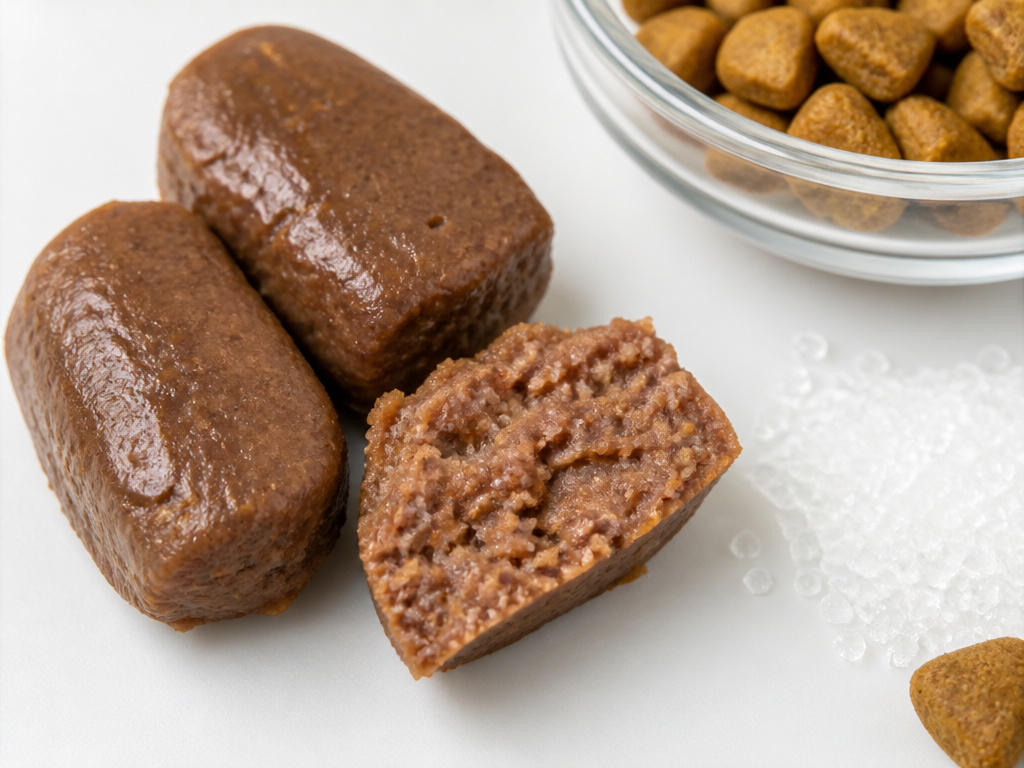
Three sources publish a semi-moist moisture band and they don’t agree. Merck says 25% to 40% water. Animals (2023) and Japan’s environment ministry both say 25% to 35%.
Merck describes the preservation method: humectants bind water so bacteria and mold can’t use it. Those humectants are usually sucrose, sorbitol and salts. Many semi-moist foods are also acidified with phosphoric, malic or hydrochloric acid to further inhibit spoilage.
The Animals review adds potassium sorbate to the list, used against yeasts and molds. It also puts the dry-to-wet ingredient ratio in semi-moist formulas somewhere between 4:1 and 1:1.
Japan’s environment ministry goes further than either Western source and defines a separate “soft-dry” band at 10% to 30% moisture. Merck and Animals don’t recognize that category at all.
| Format | Merck Veterinary Manual | Animals (2023) | Japan MoE |
|---|---|---|---|
| Dry | ~10% water | 10%–12% moisture | Not defined |
| Canned | 68%–78% water | 74%–78% moisture | Not defined |
| Semi-moist | 25%–40% water | 25%–35% moisture | 25%–35% moisture |
| Soft-dry | Not recognized | Not recognized | 10%–30% moisture |
The practical read: nobody disputes that semi-moist sits in the twenties and thirties. The argument is about where the ceiling lands, and Merck’s 40% is the outlier.
VCA is blunter about the trade-off. Semi-moist food can contain more sugar and more sodium than dry or canned, and VCA recommends reserving it as a topper or occasional treat. That advice sharpens for cats with diabetes or urinary, kidney or heart disease.
Merck does list one genuine advantage: semi-moist food needs no refrigeration.
I don’t stock semi-moist as a diet. I keep a pouch in the cupboard for a cat that needs a smell strong enough to get it eating again, and that’s the whole job.
Types of Cat Food Formats: Which One Wins for Which Cat
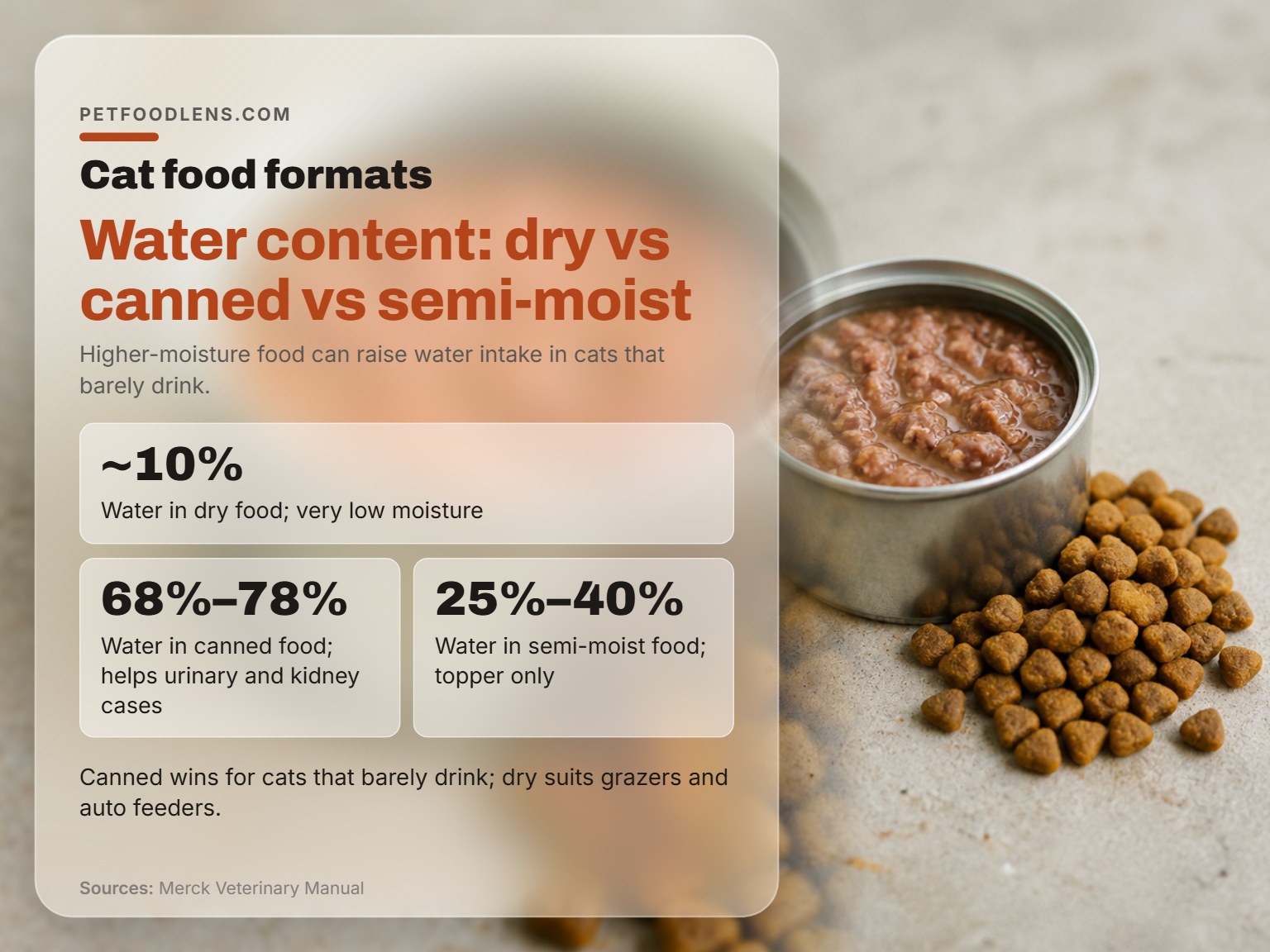
If your cat barely drinks, canned wins and it isn’t close.
VCA is direct about this: dry food has very low moisture, and for cats that aren’t good drinkers, choosing a higher-moisture food can increase water intake. Canned food’s very high water content is especially useful for urinary disease or chronic kidney disease.
| Format | Water Content | Open-Package Life | Pick It When |
|---|---|---|---|
| Dry | ~10% | 4–6 weeks, sealed | Your cat grazes or you run an auto feeder |
| Canned | 68%–78% | Refrigerate after opening | Your cat barely drinks, or has urinary or kidney issues |
| Semi-moist | 25%–40% | No refrigeration needed | You want a topper, not a full diet |
Working through it by case:
- Poor drinker, or a urinary or kidney history: canned, and the brand matters less than the water.
- Grazer or auto-feeder household: dry, because kibble is the format those feeders are built for.
- Cat that needs to eat more volume: canned, since lower energy density per 100 grams means a bigger portion for the same calories.
- Budget-first: dry, on Merck’s lower-cost note.
- Semi-moist: topper only, per VCA.
Format Says Nothing About Completeness
A can, a bag and a pouch can all hold an incomplete food. AAFCO recognizes four nutritional adequacy categories: growth, maintenance, gestation/lactation, and all life stages.
If a product doesn’t meet complete and balanced requirements, the label must carry the statement “This product is intended for intermittent or supplemental feeding only.” The Animals review limits complementary foods, meaning treats and mixers, to 10% of daily intake.
So the format decision comes first and the adequacy statement comes second. Read both.
Does Format Matter More Than Ingredient for Palatability?
Ever watched a cat lick the gravy off a shred and leave the meat behind?
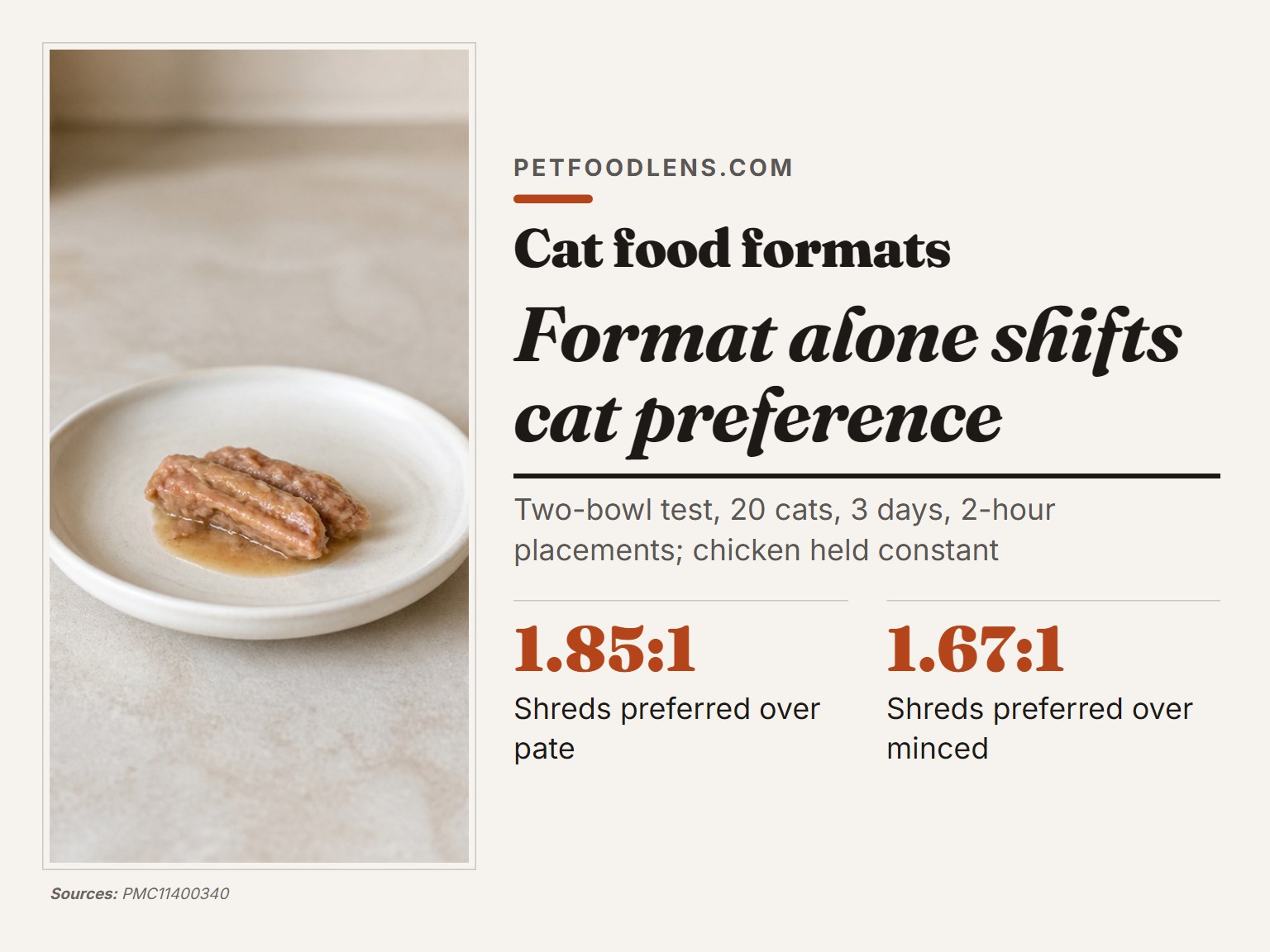
A controlled two-bowl test with 20 cats, three days and two-hour bowl placements put numbers on that. Shreds beat pate at 1.85:1. Shreds beat minced at 1.67:1. Minced beat standard cuts in gravy at 2.07:1. Pate came out at parity with minced, standard cuts and flaked formats.
The important part is the control. The researchers held protein source and ingredients constant, using chicken throughout, and still got preference ratios between 1.67:1 and 2.07:1. Format is a variable in its own right.
That finding sits in the broader drivers of pet food palatability literature, which is where the two-bowl methodology gets discussed in detail.
It also cuts against my own preference. I think a plain pate is easier to portion, easier to mash with water, and easier to check for thickeners. Cats disagree with me on preference, and the data backs the cats.
Cat food textures are the lever here. If a cat refuses a pate, the same protein in a different shape often gets eaten.
A cat that turns its nose up at a pate will often eat the same protein as a shred. Change the shape before you change the food.
Shredded vs pate is the specific comparison if you’re stuck between those two, and it’s the pair with the widest measured gap.
What About Raw, Freeze-Dried, and Air-Dried Formats?
Raw is the one format where the veterinary bodies line up on the same side.
Merck lists the risks plainly: nutrient imbalances, dental injury, gastrointestinal obstruction or perforation, and exposure to pathogens. Freezing and freeze-drying don’t destroy all the potential pathogens and spores, so a frozen raw product isn’t a sterilized one.
The organizations discouraging raw or undercooked animal protein include AAHA, NASPHC, AAFP, AVMA, the CDC, FDA’s Center for Veterinary Medicine, and the CVMA. It is illegal in the US to sell commercial pet food contaminated with Salmonella.
The risk list, in Merck’s own terms:
- Nutrient imbalances, which are common in home-formulated raw diets
- Dental injury from bone
- Gastrointestinal obstruction or perforation
- Pathogen exposure to the cat, and to the people handling the food
If you want to feed home-cooked instead of raw, Merck’s position is specific: use a recipe formulated by a boarded veterinary nutritionist, not one from the internet or a book.
Freeze-Dried and Air-Dried
Freeze-dried cat food is raw product with the water pulled out under vacuum. It’s lighter and shelf-stable, and it is still raw at the pathogen level.
Freeze-dried cat food pros and cons covers the handling rules, which matter more than the marketing does.
Air-dried is a different process with a different texture, closer to a soft jerky than a powder.
If you want to compare specific products rather than processes, best freeze-dried cat food narrows the field.
Both formats sit inside a wider question about how processing affects pet health, which a recent pet food processing techniques review takes on directly. For the home-prepared side, there’s a commercial versus homemade cat diets review worth reading before you start cooking.
How Do You Compare Two Cans When One Is Mostly Water?
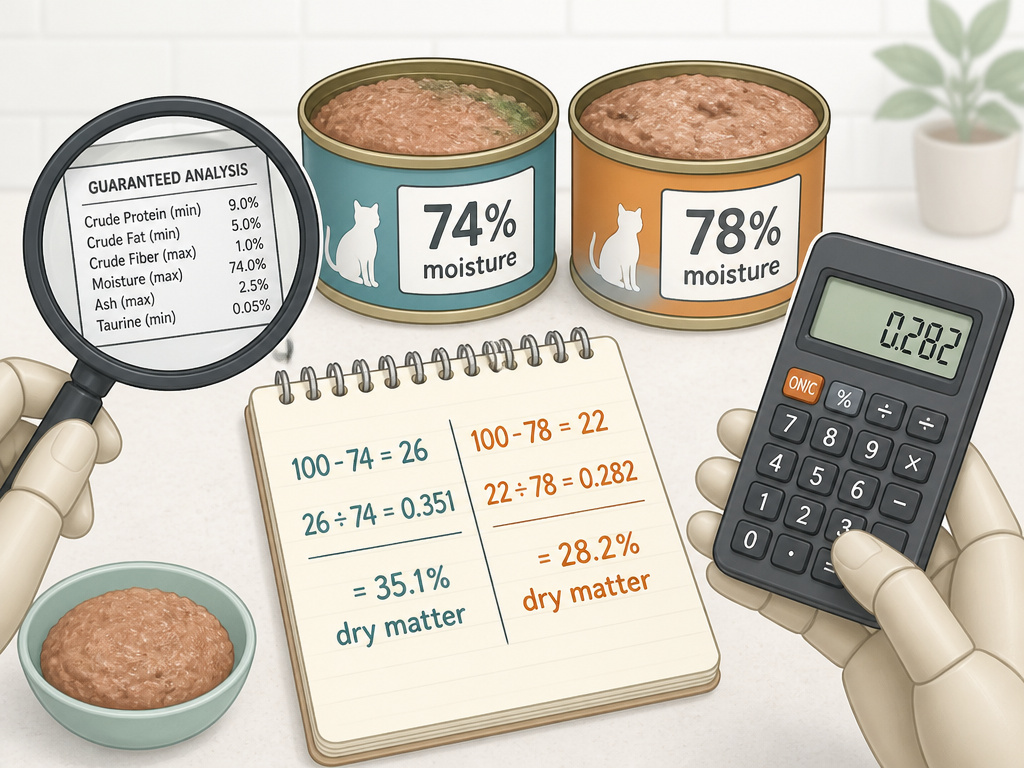
Two cans, one at 74% moisture and one at 78%. Which one delivers more protein?
You can’t answer that from the front of either can. You need the guaranteed analysis and about thirty seconds of arithmetic.
I spent my first couple of years assuming the higher protein number meant the better food. Then I lined up several formulas and found the extra protein was arriving from plant concentrates rather than animal sources. The number moved. The food didn’t.
Here’s the conversion, and it’s the same math whether you’re looking at protein, fat or phosphorus:
- Subtract the moisture percentage from 100 to get dry matter. A 78% moisture food is 22% dry matter.
- Divide the as-fed nutrient percentage by that dry matter figure. An 11% protein food becomes 11 divided by 22.
- Multiply by 100. You get 50% protein on a dry matter basis.
For reference, the Frontiers test formula was built to 78.0% moisture, 35.0% crude protein on a dry matter basis, 44.3% crude fat, and 8.0% ash, at pH 6.5. Formulas get specified on a dry matter basis because that’s the only basis that compares.
The “moisture 78% max” line gets read as a quality signal, but it is water. It’s water.
Most pates I check land within the 74% to 78% moisture range the Animals review gives for canned food. A stew or chunks-in-gravy product with unusually low moisture usually means thickener is carrying the texture the meat should be carrying.
Where this goes sideways: Comparing a canned food’s protein number against a dry food’s protein number straight off the label. The dry food is 10% water and the can is 78% water, so the two percentages describe different amounts of actual food.
Switching Formats Without a Hunger Strike
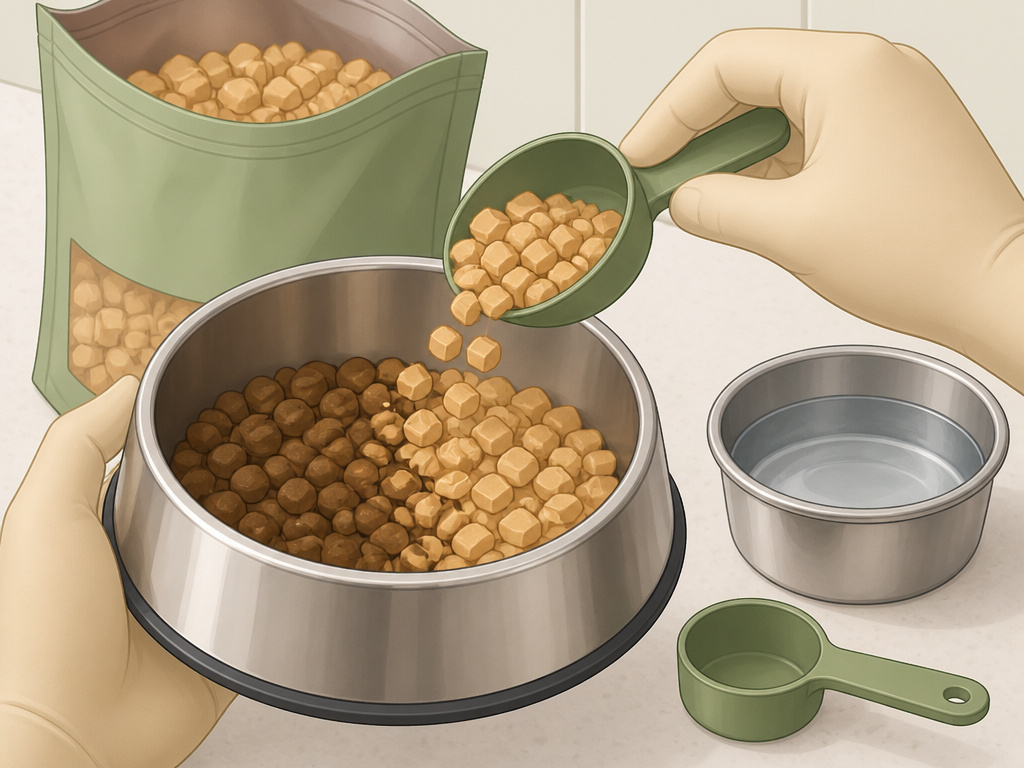
The bowl goes down, the cat sniffs it once, and walks away.
Fast switches fail more often than slow ones. A gradual shift, starting with a small amount of wet mixed into the kibble, works better than swapping the bowl overnight and then negotiating with a cat who has decided the kitchen is now a hostile environment.
Warm water helps more than most people expect. Stirring a little warm, not hot, water into a can of pate costs nothing and can help, since warming releases aroma. Warming releases aroma, and aroma is probably half the reason it works.
If you want to add broth, plain poached chicken broth is fine only if there’s no onion, garlic or salt in it. The ingredient list matters on your kitchen pot too.
The part nobody mentions: A cat that stops eating during a transition needs a vet, not patience. A cat that stops eating during a transition needs a vet, not patience.
How to rotate cat food textures covers the pacing in more detail, including how to sequence textures so a picky cat doesn’t lock onto one and refuse the rest.
VCA makes one more point worth keeping. Exposing cats to a variety of textures and forms when they’re young makes later transitions easier. A cat that has only ever seen one shape of food is a cat that will fight you when a medical condition forces a change.
Frequently Asked Questions
Is canned cat food better than dry?
For most cats, canned is the better default because of the water. Merck puts canned food at 68% to 78% water against roughly 10% for dry, and VCA notes that higher moisture can increase water intake, which matters for urinary and kidney health. Dry wins on cost and convenience, and Merck lists both as dry food advantages.
How much water is in dry cat food?
Merck puts dry food at about 90% dry matter and 10% water. The Animals review gives a range of 10% to 12% moisture. That near-total absence of water is why dry food stores at room temperature and why it does so little for a cat that doesn’t drink much.
Can I feed my cat only semi-moist food?
VCA advises against it as a staple. Semi-moist food can carry more sugar and more sodium than dry or canned, and VCA recommends reserving it as a topper or occasional treat, particularly for cats with diabetes or urinary, kidney or heart disease. Merck does note it needs no refrigeration, which is its one clear practical edge.
Does the format affect how much my cat eats?
Yes, measurably. In a two-bowl test with 20 cats, shreds were preferred over pate at 1.85:1 and minced beat standard cuts in gravy at 2.07:1. The researchers held the protein source constant, so the preference tracked the format rather than the ingredient.
Is freeze-dried cat food raw?
It’s raw product with the water removed, and Merck is clear that freeze-drying doesn’t destroy all potential pathogens and spores. Treat it with the same handling care as any raw product, and wash your hands after portioning.
The Bottom Line
Here’s the threshold I’d actually use. Flip the can over. If the moisture line reads below the canned range and the front says stew or chunks in gravy, thickener is doing work the meat should be doing, and I’d leave it on the shelf.
The other trigger is simpler. If your cat won’t drink, the format decision is already made for you. Canned, every time, and the brand matters less than the water content.
I’ll be straight about where I stop. I’m not a clinical specialist, and a cat with kidney disease or diabetes needs a veterinarian’s diet plan rather than my comparison chart. What I can give you is what the panel says and how to put two foods on the same basis.
Start with one can tonight. Do the division. Run the numbers on your own cat’s food before you buy the next case.
