
Pate vs Chunks in Gravy Cat Food: Which Wins?
This post contains affiliate links. As an Amazon Associate, we earn from qualifying purchases.
Pate vs chunks in gravy cat food is a texture choice. Neither format is healthier by default; what decides quality is a named animal protein first on the panel plus an AAFCO complete and balanced statement for your cat’s life stage. Pick the texture your cat actually finishes.
That statement is the one line on the can a regulator actually enforces, and it says nothing about the pate vs chunks in gravy cat food question. A pate and a gravy can both carry it. So the argument in the bowl and the argument on the panel run on separate tracks, and mixing them up is how a shopper pays a premium for a format that delivers less.
What follows is the split that matters: how the two formats differ on the production line, where the premium story and the bowl disagree, which cats do better on which, and how to move a cat across without a hunger strike.
Key Takeaways
- Neither texture is a nutrition tier. The AAFCO statement and the first ingredient decide quality.
- Moisture on the panel is not a quality claim. A wet food is mostly water regardless of format.
- Chunks get left behind. A gravy-licker takes the sauce and skips the meat, so the can’s stated protein never reaches the cat.
- Switch gradually, not overnight. A cat that refuses food for an extended period needs a vet.
- Gums and starches are the first thing to read on a gravy label, before the protein number.
What Actually Separates Pate From Chunks in Gravy
Gambol Pet Group builds both formats for other brands, and its process write-up is the cleanest manufacturer-side description available: pate gets milled into a smooth, uniform mixture, while chunks in gravy keeps visible pieces suspended in sauce.
Pate begins as a finely processed blend, milled until the mixture is smooth and uniform, so every component sits evenly through the can and filling stays predictable. Chunks in gravy suspends visible pieces in sauce, and holding chunk size, moisture balance, and appearance steady across a full run takes tighter control on the line.
A pate can turns out in one piece and holds the shape of the tin. A chunks can sloshes before you’ve opened it, and the sauce separates from the pieces if it sits in the cupboard long enough.
None of that changes what’s in the can. It’s a difference in how the food is built, and it shows up in three places: how evenly the ingredients land, how hard the line has to work, and how the can behaves in storage. Pate is easier to standardize because the structure is uniform, which supports stable filling and portion control. Chunks in gravy needs extra control because solid pieces and liquid have to stay evenly distributed right through the fill.
Texture also drives processing and packaging decisions in the pate vs chunks in gravy cat food comparison, and those feed into shelf life. That’s the manufacturer’s problem rather than yours, but it explains why the two formats age differently on the shelf.
| Question | Pate | Chunks in gravy |
|---|---|---|
| Structure | Smooth, uniform blend | Visible pieces in free sauce |
| Production consistency | Easier to standardize | Needs tighter line control |
| Moisture on the panel | Mostly water | Mostly water |
| Best-fit cat | Kittens, seniors, sameness-lovers | Bored eaters, sauce obsessives |
| Main risk | Refused by a texture-seeker | Gravy-licking leaves meat behind |
The wider cat food textures picture works the same way: format first, panel second.
Is Pate or Chunks in Gravy Healthier for a Cat?
For a while I ranked wet foods by the crude protein number and thought I was being rigorous. Then two cans with the same protein figure behaved like completely different foods in the bowl, and I had to admit the number was telling me less than the ingredient list behind it.
Neither format is healthier by default. Texture is the shape of the food, not its quality, and that holds whether the can says pate or gravy. Gambol lands in the same place from the manufacturing side: nutrition depends on ingredients and formulation rather than texture alone. Two sources with different incentives, same conclusion.
So what actually decides? Three things, and none of them is the format.
- A named animal protein leading the ingredient list, not “meat by-products” and not a split pea trio.
- An AAFCO complete and balanced statement printed on the can, matched to your cat’s life stage.
- A short filler list. If peas, pea protein, and pea fiber appear as three separate lines, that’s ingredient splitting dressed up as variety.
AAFCO is the body that publishes the nutrient profiles behind that statement, and its model regulations are the reference point US pet food labels work from. In the EU, FEDIAF draws a separate legal line between “complete” and “complementary” food, and that distinction matters more than texture ever will.
Moisture on the guaranteed analysis is not a quality claim. A can that reads “moisture 78% max” is telling you it’s mostly water, which every wet food is. The useful move is converting protein and fat to a dry matter basis so two cans sit on the same footing.
Here’s the arithmetic. A can listed at 78% moisture is 22% dry matter, so 0.22 is your divisor. Take the protein percentage off the panel, divide it by 0.22, and you have the dry matter protein figure. I do that conversion about once a week out of habit, on the back of whatever can is on the counter. It takes ten seconds and it kills most of the marketing.
Here’s my honest position: I’d rather see a plain pate with a named protein and a life-stage statement than a chunky “premium” can with three gums and no clear protein source. Show me what is actually in it.
Where the Premium Story and the Bowl Disagree
Gambol says chunks in gravy can support premium positioning because a buyer can see the meat pieces and the gravy structure, while the consumer-side view holds that texture is neutral and either format can be excellent or poor. Owners who have scraped out a bowl have a different read.
Both positions are on the record, and they don’t reconcile. Gambol’s is a positioning argument: visible structure supports a higher price. The consumer-side argument is nutritional: texture is neutral, and either format can be excellent or poor. One claim is about what a shopper perceives. The other is about what the cat absorbs. A format can win the first and lose the second in the same meal.
There’s a third claim floating around owner communities, that visible chunks are often rebuilt from meat plus a binder and extruded into shape, so the visible “meat” is a processing artefact rather than a cut of anything. No manufacturer in this source set confirms or denies it, and I can’t verify it from a label. Treat it as an open question.
The part nobody mentions: The premium signal and the actual meat intake point in opposite directions. A cat that licks the gravy clean has taken the sauce and left the protein sitting in the bowl.
Then there’s the thickener question. Gravy needs body, and body comes from gums and starches. Read for these on the panel:
- Guar gum, cheap and common, and the one you’ll see most.
- Xanthan gum, which shows up in pouches more than cans.
- Carrageenan. The FDA permits it as GRAS. A chunk of the owner community avoids it anyway.
- Starch, listed generically without saying which one.
Carrageenan is the one worth naming precisely. The FDA permits it, and no regulator has moved against it. The avoidance campaign is owner-led rather than agency-led, and I’d present it that way instead of as settled science.
The moisture claim is the other soft spot. The consumer-side case for gravy is that cats are bad at drinking water, so extra liquid in the food is a genuine perk, while Gambol lists moisture content as one of several palatability factors and stops short of claiming a gravy-specific moisture advantage. Gambol lists moisture content as one of several palatability factors and stops short of claiming gravy delivers a moisture advantage. Both positions are defensible. Neither has a head-to-head water-intake study behind it in this source set.
Read the gravy cat food shelf with that in mind: the sauce is real, the advantage is unquantified.
Which Cats Do Better on Pate, and Which Do Better on Gravy?
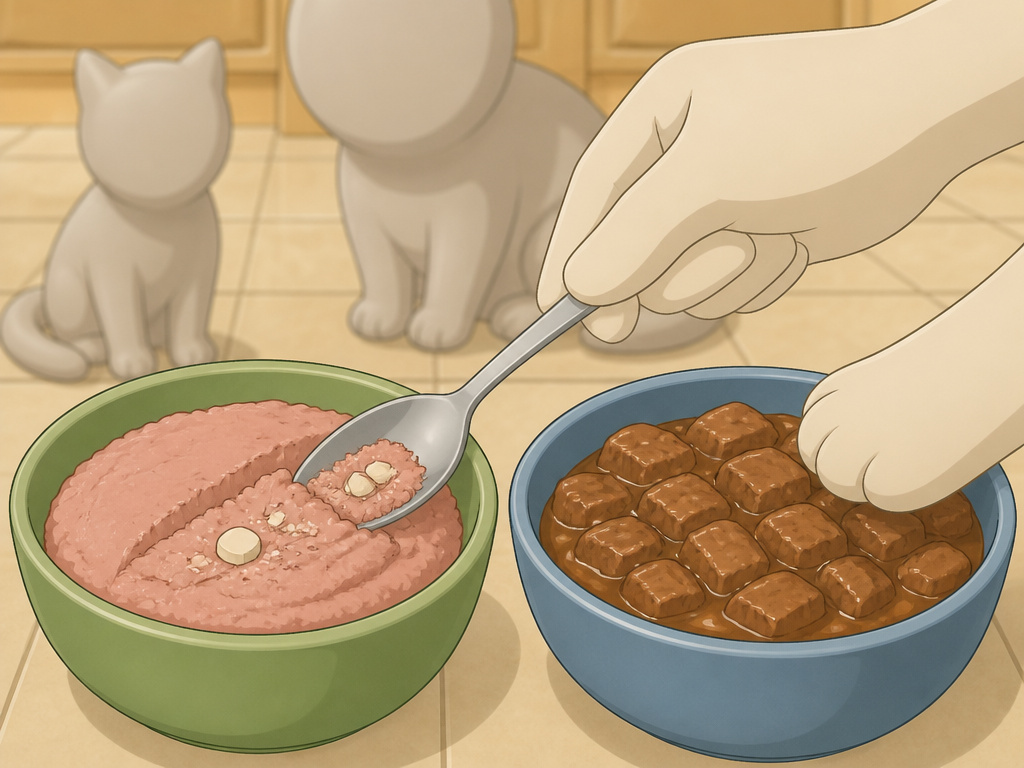
Three things decide this: the cat’s age, its dental condition, and how bored it is with the current bowl.
Kittens, Seniors, and Cats With Dental Trouble
Pate wins this group, and it isn’t close. A smooth can is easier for a kitten still learning to eat and for a senior working around missing teeth or oral pain. Chunk pieces are a genuine challenge for a kitten or a senior who struggles to manage them, and the smaller the cat, the bigger the problem.
Medication is the other reason. A clever cat eats around a pill sitting in a chunk. Mashed into pate, it doesn’t get the option.
Bored Eaters and Sauce Obsessives
Pets Perfect holds that chunks in gravy often wins with bored eaters and sauce-lovers, while Gambol notes palatability is influenced by aroma, ingredient quality, moisture content, and nutritional balance, with texture only one important part. Warm gravy smells stronger than cold pate, and appetite in cats runs heavily on smell. Some gravy-loving cats will take the sauce and leave everything else, which is the whole problem sitting in one bowl.
Preference forms early and runs deep. A kitten weaned onto one mouthfeel carries it for years, and cats are neophobic about food, so a new texture reads as a threat before it reads as dinner. For picky cats, a side-by-side test beats a guess every time. Two small bowls, same moment, no coaxing.
The logic that settles shredded vs pate applies here too: mouthfeel decides acceptance, the panel decides quality.
If you want one answer and no further reading: pate for kittens, seniors, and any cat on medication. Chunks in gravy for a healthy adult cat that has gone bored on everything else in the cupboard. Sorting the best pate cat food brands starts with those same two label checks, not the price.
The Gravy-Licker Problem, and How to Read the Bowl
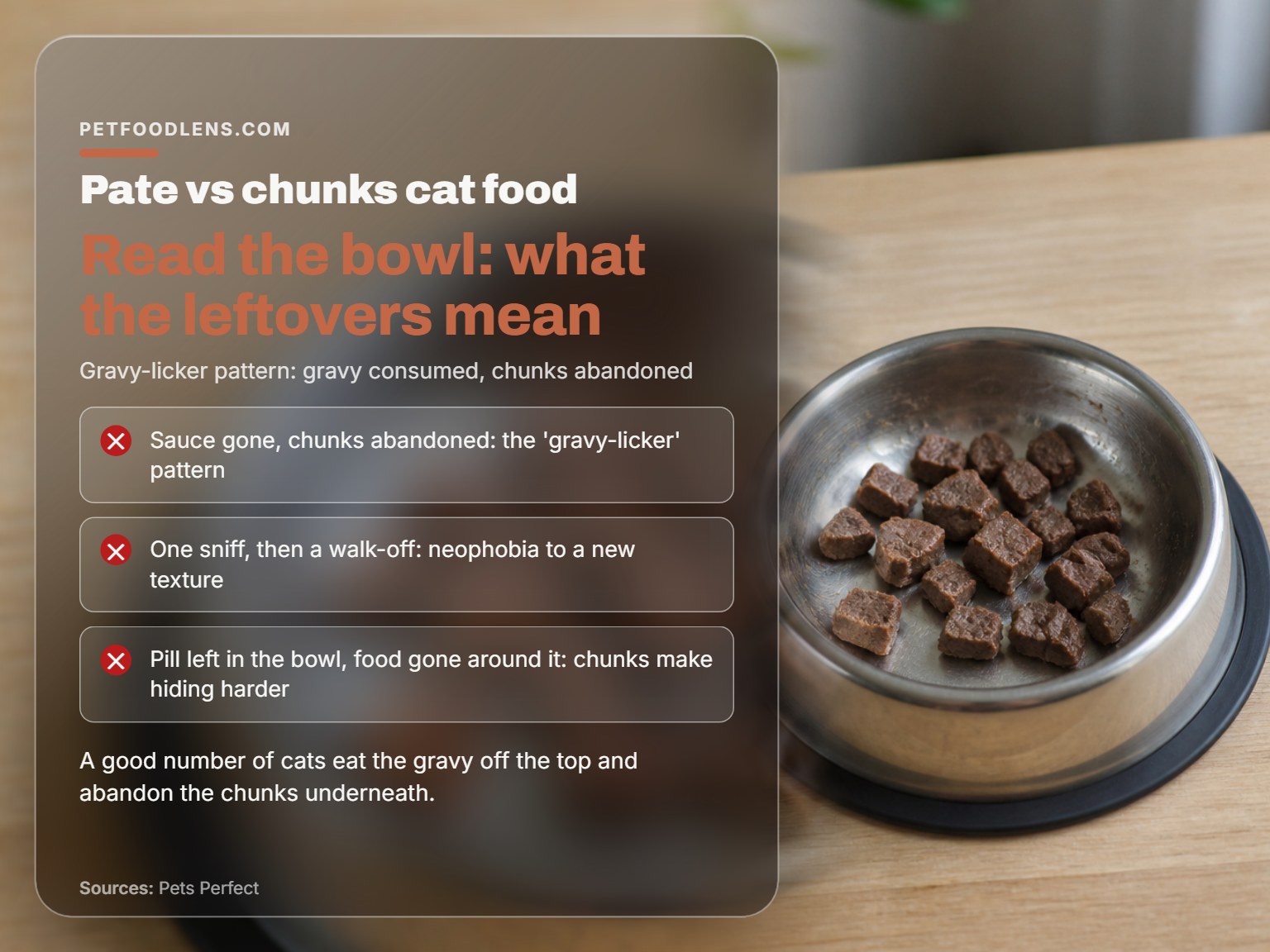
A bowl that comes back clean is not the same as a cat that ate.
The gravy-licker pattern is the most common failure I see with the chunks format. The cat takes the sauce, leaves the meat, and walks away having eaten the flavour and the water but not the protein the can promised. You get an empty bowl and a cat that’s still hungry, and the can’s guaranteed analysis never applies to what actually went down.
| What you see | What it points to | What to do next |
|---|---|---|
| Sauce gone, chunks dry and intact | Gravy-licker; meat intake below the can’s claim | Switch to pate, or mash the chunks into the sauce |
| One sniff, then a walk-off | Neophobia to a new texture | Warm it slightly and offer it beside the familiar food |
| Pill left in the bowl, food gone around it | Chunks make hiding harder | Use pate and mash the dose in |
| Cat eats, then begs within the hour | Sauce-only intake, calories short | Weigh the portion in grams |
That last row is why I portion in grams rather than scoops. A scoop of chunks and a scoop of pate are not the same weight, and a gravy-heavy can puts a lot of water in the bowl before any meat arrives. Chunks are also harder to portion precisely, which matters more than it sounds over the course of a week.
Weigh the portion, then watch the bowl. If the meat comes back and the sauce doesn’t, the format is wrong for that cat, no matter what the front of the can says.
There’s a pate version of the same problem: a cat that licks pate and leaves it spread thin around the dish. That’s a portion or temperature issue rather than a texture one, and warming it usually fixes it.
How to Switch Textures Without a Hunger Strike
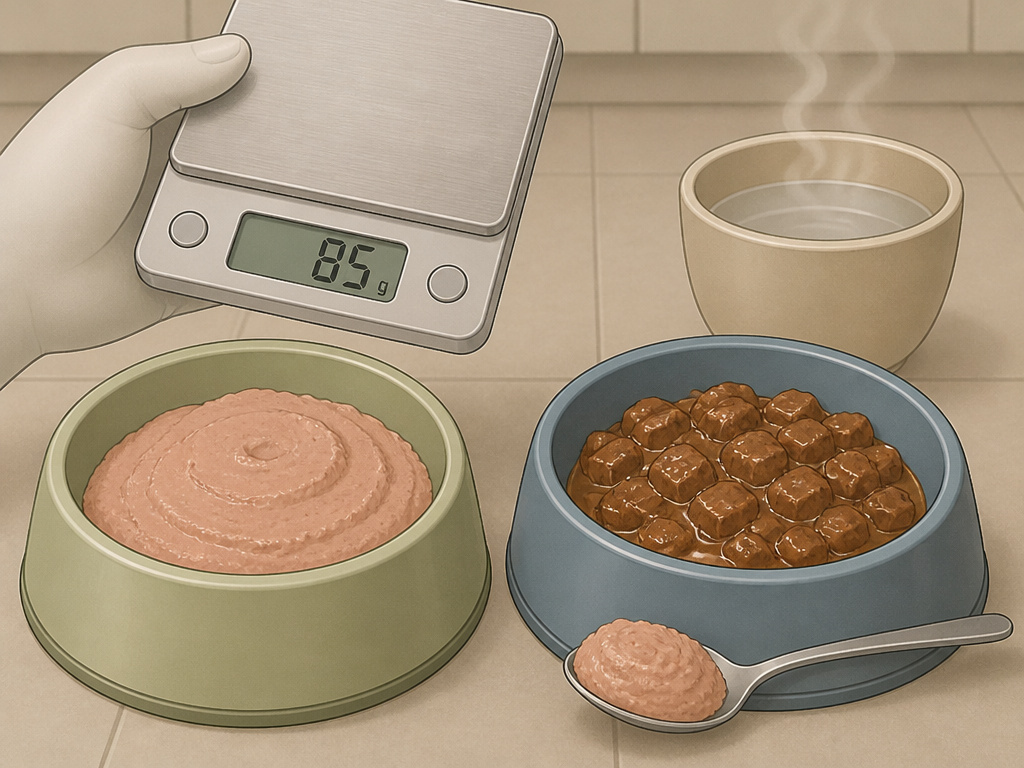
Slow beats fast here, and the honest timeline is longer than most guides suggest.
Before you start: A cat that stops eating for more than a day or two is a vet call, not a stubbornness contest. Overweight cats carry the real risk, because hepatic lipidosis can develop fast when a fat cat goes off food. And if you’re using homemade broth to loosen the food, check it for onion, garlic, or salt first.
Here’s the sequence I use.
- Weigh the current portion in grams. Skip this and you have no baseline, so you can’t tell whether intake dropped or just moved.
- Put a teaspoon of the new texture beside the old, not mixed into it. Mixed in, a cat that dislikes the new food rejects the whole bowl and you learn nothing.
- Hold that ratio for several days. Move faster and a neophobic cat reads the change as a threat rather than as dinner.
- Warm the new food slightly. A little warm, not hot, water stirred into the pate releases aroma, and aroma is what sells the switch.
- Stretch the whole change over a gradual period. A fast swap is where most transitions fall apart.
If Your Cat Refuses the New Texture
Refusal is information. Cats are neophobic about food, and a new mouthfeel reads as a threat before it reads as dinner. Back up one step in the sequence and hold there for a while, then try again with the new food warmed.
A side-by-side test is the only reliable way to know which texture a cat prefers. Two bowls, same time, no coaxing, and watch which one gets finished.
The published timelines don’t agree, and it’s worth saying so plainly. The published timelines don’t agree, and it’s worth saying so plainly. My own experience with texture switches is longer, and slower still for a cat that has eaten one format its whole life.
If you already rotate cat food textures on a regular basis, the switch goes easier because the cat has seen change before and survived it. For a cat that has only ever eaten one format, plan on a longer transition.
Frequently Asked Questions
Is pate better than chunks in gravy for cats?
Not by default. Texture is the shape of the food, not its quality, and either format can be excellent or poor. What decides it is a named animal protein first on the panel and an AAFCO complete and balanced statement for your cat’s life stage.
Why does my cat only lick the gravy?
Because the sauce is the part that smells strongest and moves easiest. Many cats eat the gravy off the top and abandon the chunks, which means they take in the flavour and the water but not the protein. Switch to pate, or mash the chunks into the sauce so the two can’t be separated.
Can I mix pate and chunks in gravy in the same bowl?
You can, and some cats accept it without complaint. Mixing hides which texture the cat actually rejected, so run a side-by-side test first. Once you know the answer, mixing is a fine way to use up the rest of a case.
Do chunks in gravy have more protein than pate?
Not as a category. Protein comes from the formulation rather than the format, and Gambol states plainly that nutrition depends on ingredients rather than texture. Compare the two cans on a dry matter basis before you assume anything.
Is carrageenan in cat food safe?
The FDA permits it as GRAS, and no regulator has moved against it. A section of the owner community avoids it anyway, particularly for cats with sensitive digestion. That’s an owner-led position rather than an agency one, and I’d present it that way.
Is chunks in gravy harder for a senior cat to eat?
For a senior with missing teeth or oral pain, yes. Chunk pieces are a genuine challenge for a kitten or a senior who struggles to manage them, and pate is the easier format for both. If your cat has dental disease, that’s a vet conversation before it’s a shopping one.
The Bottom Line
If your cat leaves chunks behind regularly, stop buying that format. That’s the trigger. A cat eating the sauce and skipping the meat is running a calorie shortfall the can doesn’t advertise, and no amount of premium positioning fixes it.
Reach for a plain pate first. Both mash cleanly, both portion by weight without a fight, and both let you hide a pill.
One concession, and it’s a real one. I’m not a clinical specialist. If your cat has kidney disease, diabetes, or a history of urinary blockages, the moisture and texture question belongs to your vet rather than to a label comparison. The dry matter math here tells you what’s in the can. It doesn’t tell you what your cat’s kidneys need.
The format your cat accepts today may not be the one it accepts in two years. Cats change, and a refused bowl isn’t a verdict on you. It’s data.
