
Shredded vs Pate Cat Food: Which Should You Buy?
This post contains affiliate links. As an Amazon Associate, we earn from qualifying purchases.
Shredded vs pate cat food describes texture, and texture alone tells you nothing about completeness. Some shredded cans are complete meals and some are toppers, so the guaranteed analysis on the back carries more weight than the word on the front.
Completeness is the part that gets buried. Stella & Chewy’s Savory Shreds is positioned as a topper or a standalone treat, while DogCatStar sells its shredded cans as complete staples. Same texture family, opposite jobs.
What follows is how to read the panel on both formats: the moisture number nobody explains, the organ-content argument that splits two premium brands, and the protein figure that makes shredded look better than it is.
Key Takeaways
- Texture is not a nutrition claim. A shredded can and a pate can both be complete, or both be toppers. The panel decides.
- Compare protein on a dry matter basis, not as fed. Stella & Chewy’s 10.0% protein at 84.0% moisture works out to roughly 62.5% dry matter protein.
- Organ content is a genuine split. DogCatStar markets “no added offal” and warns about Vitamin A and copper. Leonardo runs roughly 50% organ and calls it quality protein.
- Moisture is water, not quality. A “moisture 84.0% max” line tells you how much water is in the can, not how good the food is.
- Switch textures gradually, starting with a teaspoon of wet mixed into the current food.
Shredded vs Pate Cat Food: The Texture Label Tells You Less Than You Think
The word “shredded” on a can is doing less work than you think.
Shredded and pate describe physical form. Neither word says anything about nutritional adequacy. A shredded product can be formulated as a complete diet meeting AAFCO nutrient profiles, or as a supplemental topper. The guaranteed analysis, the AAFCO nutritional adequacy statement, and the feeding directions determine which one actually sits in the can.
DogCatStar’s own product page for its Beef 80g can calls the food “shredded meat” in one line and “meat pate” in another. That’s about as clear a proof as you’ll get that the texture word is shorthand, not a specification.
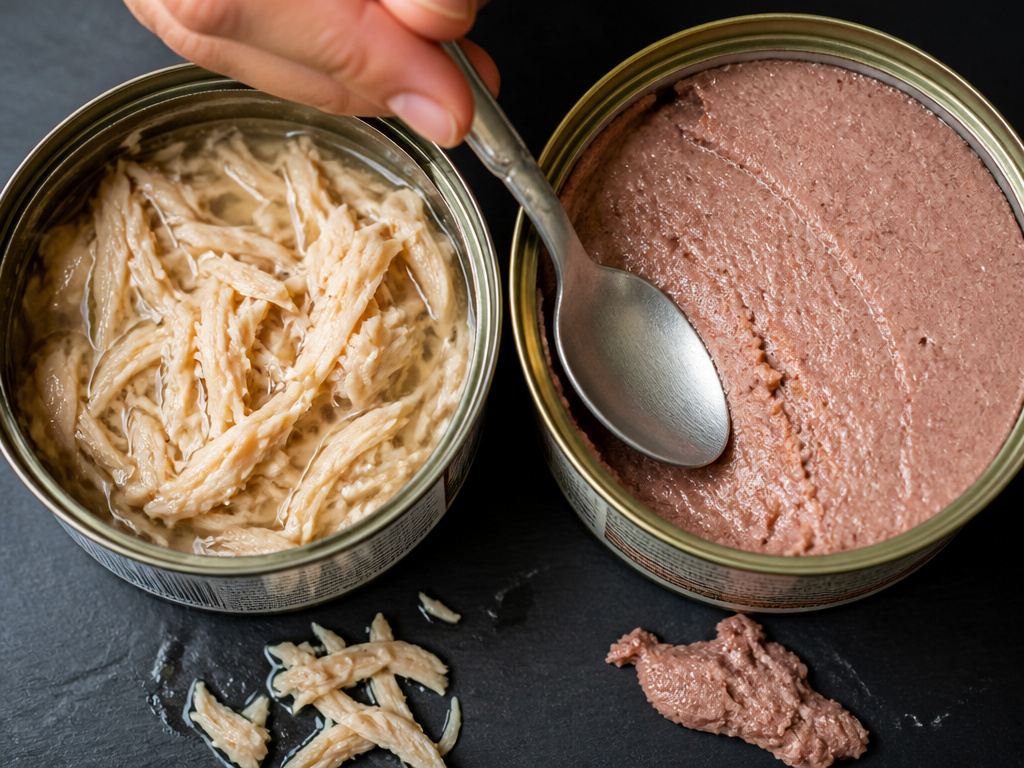
Shreds slump off the spoon and leave a clear pool at the rim of the bowl. Both are wet food. Only one of them is easy to portion consistently.
Most owners cycle through cat food textures by trial and error, which gets expensive fast. Reading the panel first cuts the guessing.
Easy to miss: The same brand can use “shredded” and “pate” on the same product page. Treat the texture word as a description of what the food looks like, and check the nutritional adequacy statement for what it actually is.
What Does the Guaranteed Analysis Actually Tell You?
Two numbers on a Stella & Chewy’s Carnivore Cravings Savory Shreds pouch do most of the work: 84.0% maximum moisture and 10.0% minimum protein.
Those figures are read on an as-fed basis, which means they include the water. To compare two foods fairly, you strip the water out first. Subtract moisture from 100 to get dry matter, then divide the protein by that dry matter figure.
Work it through:
- 100 minus 84.0 leaves 16.0% dry matter.
- 10.0 divided by 0.16 gives about 62.5% protein on a dry matter basis.
Now run the same math on DogCatStar Beef 165g (FM214), which lists 15.5% protein and 76.6% moisture:
- 100 minus 76.6 leaves 23.4% dry matter.
- 15.5 divided by 0.234 gives about 66.2% protein on a dry matter basis.
The as-fed gap looks like 5.5 points. On dry matter it’s closer to 3.7. Do the division.
| Product | Moisture (label) | Protein (as fed) | Protein (dry matter) |
|---|---|---|---|
| Stella & Chewy’s Savory Shreds, 79g | 84.0% max | 10.0% min | about 62.5% |
| DogCatStar Beef 165g (FM214) | 76.6% | 15.5% | about 66.2% |
| DogCatStar Beef 80g (FM184) | not published | 15.5% (wet basis) | cannot be calculated |
That third row is the point. A panel that lists protein but not moisture can’t be converted, so you can’t compare it to anything else on the shelf.
I do this conversion on the back of a can about once a week out of habit.
Water is the cheapest ingredient in the can and the one that moves the other numbers most. A wetter food reads lower on protein, fat, and ash without being a worse food.
Common mistake: Reading “moisture 84.0% max” as a quality claim. It’s water content, and it makes every other number on the panel look smaller by shrinking the dry matter you divide into.
Pate tends to publish a fuller panel than shreds do, so a pate cat food comparison is usually easier to run than a shredded one.
Is Shredded Cat Food a Complete Meal or a Topper?
It depends entirely on the can.
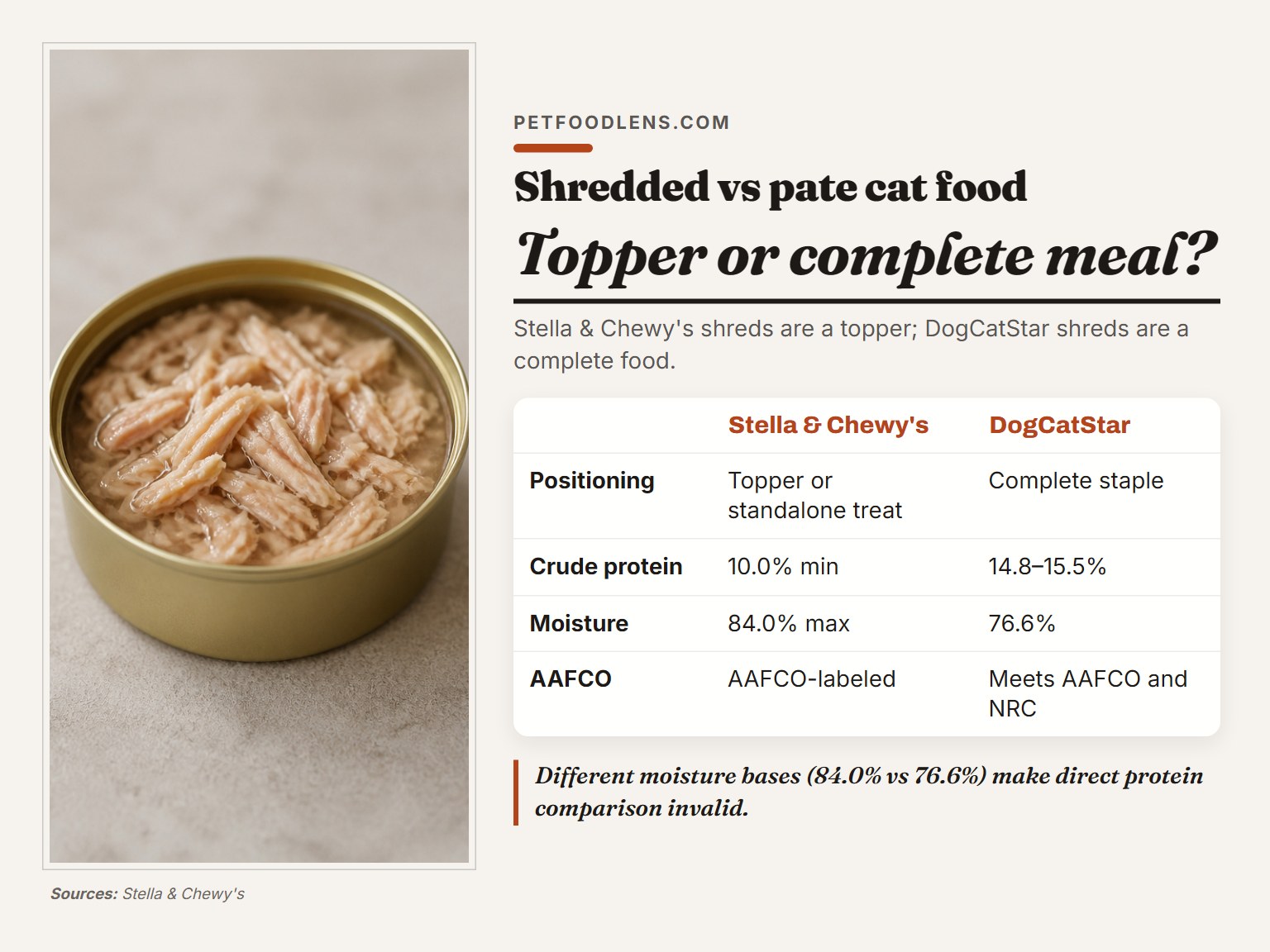
Stella & Chewy’s positions its Savory Shreds as a topper or a standalone treat. DogCatStar markets its shredded cans as complete staples meeting AAFCO and NRC standards. Those are two different jobs inside one texture category, and the sources do not agree on which one is the norm.
| Product | Positioned as | Protein (as fed) | Moisture |
|---|---|---|---|
| Stella & Chewy’s Savory Shreds, 79g | Topper or standalone treat | 10.0% min | 84.0% max |
| DogCatStar Beef 80g (FM184) | Complete staple, AAFCO and NRC | 15.5% | not published |
| DogCatStar Salmon 80g (FM179) | Complete staple, AAFCO and NRC | 14.8% | not published |
How to Tell a Complete Shred from a Topper
Three checks, in this order:
- Look for an AAFCO nutritional adequacy statement that names a life stage. A topper usually carries none.
- Read the feeding directions. A complete food tells you how much to feed as a sole diet, and a topper tells you to use it alongside something else.
- Check protein and moisture together. A 10.0% protein line at 84.0% moisture is a light food, and the maker’s own positioning usually admits it.
The shredded cat food category is where this split shows up most often, because shreds are cheap to build as a broth-heavy topper and expensive to balance as a sole diet.
Where this goes sideways: Feeding a topper as the only food. The can wasn’t built to carry the full nutrient load, so the cat eats something that looks like dinner and falls short of it.
Why “No Offal” and “50% Organ” Both Get Sold as Premium
Two premium brands can look at the same ingredient and call it opposite things.
DogCatStar markets its shredded cans as having no added offal, and its own copy warns that overreliance on organ meat can lead to high levels of Vitamin A or copper. Leonardo’s Duck + Pulled Beef 70g runs the other way: duck meat, heart, liver, and gizzard at 34.5%, chicken liver at 8.5%, and beef lung at 7.5%, which works out to roughly half the can as organ.
Both are sold as quality. Neither is lying about what’s in the can.
That’s the mechanism behind DogCatStar’s warning, and it’s a real one. Heart and gizzard sit closer to muscle meat in composition, which is why “organ” as a category covers both the nutrient-dense parts and the everyday ones.
I stopped treating “organ meat” as one ingredient years ago. Heart, liver, and lung behave differently in a formula, and a brand that lumps them into a single marketing line is hiding the part that matters.
I’d want the organ percentage disclosed either way. A label that says “no added offal” and a label that says 50% organ are both telling you something useful. A label that says neither is telling you nothing.
If organ load worries you, a chicken pate with a short ingredient list is easier to audit than a shred with eight components.
Does Higher Protein Make a Wet Food Better?
I used to rank wet foods by crude protein percentage. I stopped after two cans with identical protein numbers turned out to be built from very different ingredients. The number was identical, and the ingredient lists told a different story.
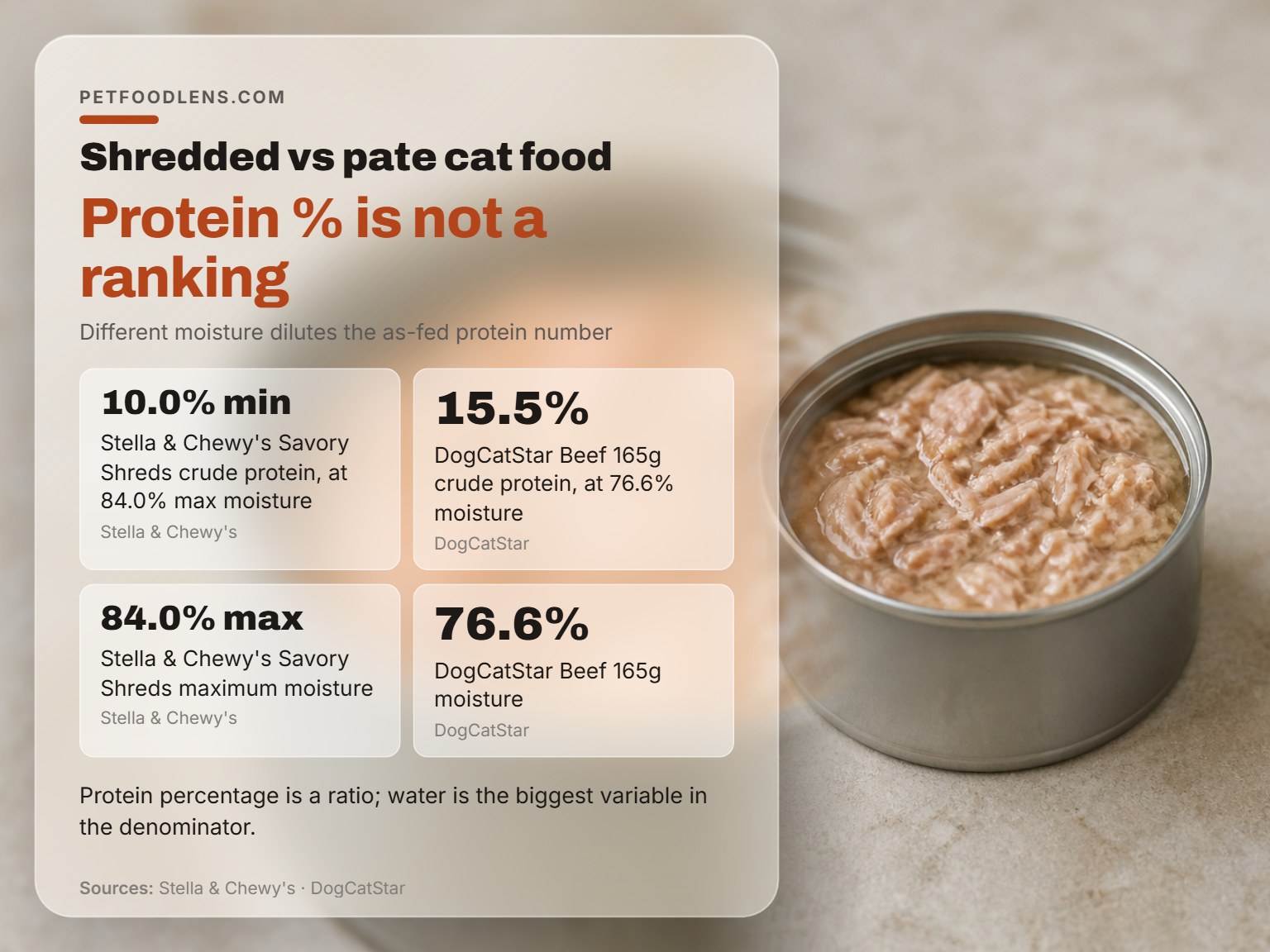
That’s the trap with shredded versus pate. DogCatStar cites 14.8% to 15.5% crude protein as a premium marker. Stella & Chewy’s Savory Shreds sits at 10.0% minimum. Put those side by side and the shreds look weaker.
They aren’t comparable yet. Stella’s panel lists 84.0% maximum moisture. DogCatStar’s 165g beef can lists 76.6%. Different water content means different dilution, and the dry matter math above already showed the gap shrinking from 5.5 points to about 3.7.
The pate vs chunks in gravy comparison runs the same math on a third format, and the pattern holds: the wetter the food, the lower the as-fed number, regardless of what’s in it.
Protein percentage is a ratio, and water is the biggest variable in the denominator. Change the moisture and you change the number without touching the formula.
Protein is one line in a bigger comparison. It is not a ranking.
When Pate Wins and When Shredded Wins
Three things decide this: the cat’s mouth, the cat’s health, and how much time you have.
Pate wins in most of the cases I see:
Shredded wins in a narrower set:
- Cats that refuse pate outright. Texture refusal is real, and no amount of label reading fixes it.
For the cats that turn their nose up at everything, wet food for picky cats is where texture choice matters most.
Pate vs Shredded: The Head-to-Head
Stella & Chewy’s Savory Shreds is positioned as a topper, so it works as an appetite trigger on top of a complete food and does not work as the whole bowl.
Shreds separate the moment the broth hits them, and the edges of the bowl dry out quickly.
The shredded vs pate cat food decision usually comes down to whether you need a sole diet or an appetite trigger. Get that wrong and the rest of the comparison doesn’t matter.
How Do You Switch Textures Without a Hunger Strike?
A cat that refuses a new texture for a long stretch is a bigger problem than a cat that refuses it briefly.
Before you start: A cat that stops eating needs a vet, not a new brand. Homemade broth is only safe if it has no onion, garlic, or salt in it. Fast switches fail more often than slow ones.
The Five-Step Texture Switch
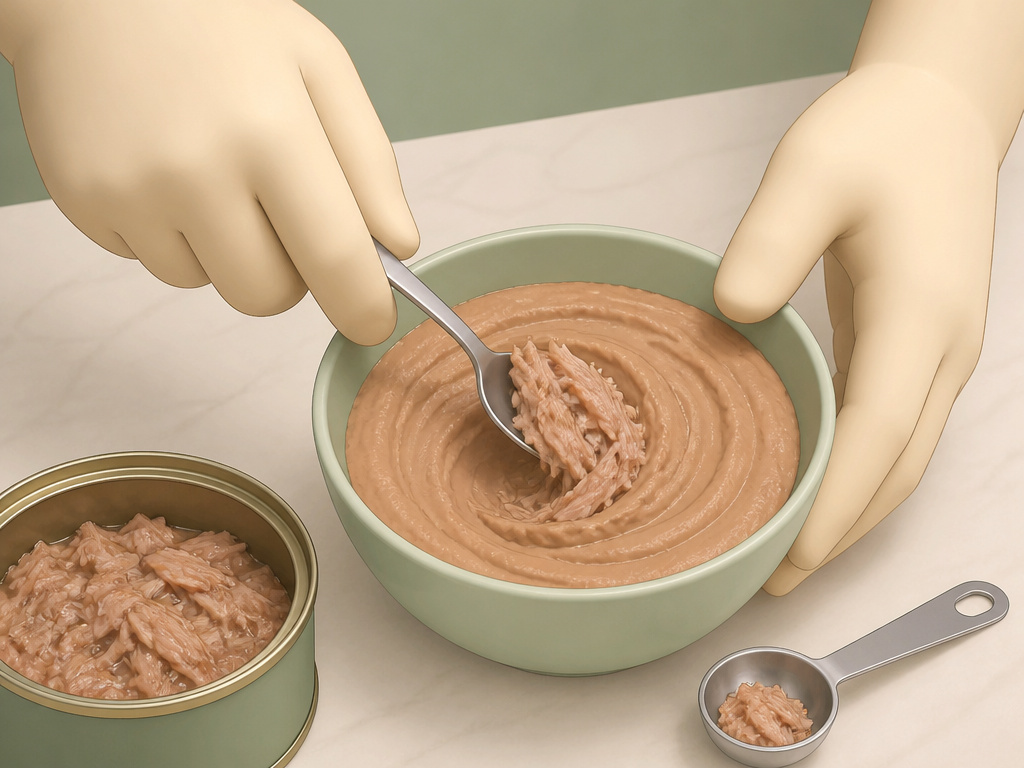
- Start with a teaspoon of the new texture mixed into the current food. Swapping the bowl overnight is how most switches fail.
- Hold that ratio for several days. Moving faster tells you nothing about whether the cat refused the texture or the change.
- Raise the new food to a quarter of the bowl, then half, holding each step for several days.
- Warm the pate slightly if the cat is unsure. A little warm, not hot, water stirred into a can releases aroma and gets most cats eating.
- Stop and call the vet if the cat stops eating.
The mechanics of switching cat food textures matter more than which texture you pick. Slow works in both directions.
A cat that stops eating is a veterinary question. A cat that refuses a new texture briefly is a patience question. Don’t confuse the two.
Stirring a spoonful of warm water into a pate is a simple step. It costs nothing but a minute.
Frequently Asked Questions
Is shredded cat food better than pate?
No. Texture doesn’t determine quality. Stella & Chewy’s sells its Savory Shreds as a topper, and DogCatStar sells its shredded cans as complete staples. Those are two different products wearing the same word, and the guaranteed analysis is what separates them.
Why does shredded cat food have less protein than pate?
Often because it has more water. Stella & Chewy’s lists 10.0% minimum protein at 84.0% maximum moisture, which converts to about 62.5% on a dry matter basis. DogCatStar’s 165g beef can lists 15.5% protein at 76.6% moisture, about 66.2% dry matter. The gap is smaller than the front of the can suggests.
Is pate higher in calories than shredded?
Not automatically. Stella & Chewy’s lists 915 kcal/kg, which is about 91.5 kcal per 100g. DogCatStar Beef 80g lists roughly 100 kcal per 100g. Those numbers sit close enough that portion size matters more than format.
Can I feed shredded food every day?
Only if the can is a complete diet. A topper fed as the sole food leaves gaps the can wasn’t formulated to fill, and the label will usually tell you which one you’re holding.
What does “no added offal” mean on a cat food label?
It means the maker didn’t add organ meat beyond what’s declared. DogCatStar uses it as a selling point and warns that heavy organ inclusion can push Vitamin A or copper high. Leonardo takes the opposite approach, with roughly half its Duck + Pulled Beef can as organ.
Should I switch my cat from pate to shredded?
Only for a reason: refusal, boredom, or a texture the cat actually eats. A cat doing well on pate has no nutritional reason to change.
The Bottom Line
Here’s the threshold I’d give a friend. If your cat stops eating during a texture switch, call the vet before you open another can. Hepatic lipidosis is why that rule exists, and it moves faster than most owners expect.
The rest is simpler. Flip the bag over, find the moisture line, and do the division. A 10.0% protein food at 84.0% moisture and a 15.5% protein food at 76.6% moisture are closer than the front of the can suggests.
Everything above assumes a healthy adult cat. If your cat has kidney disease or diabetes, the format question belongs to your vet, and a label comparison is not a treatment plan.
Marketing is not nutrition. The shredded vs pate cat food question has an answer, and it’s printed on the back of the can in type small enough that most people skip it.
