
Canned Cat Food vs Pouches: Which Should You Buy?
This post contains affiliate links. As an Amazon Associate, we earn from qualifying purchases.
In the canned cat food vs pouches decision, the two formats deliver near-identical protein and fat, so the real differences sit in water, packaging, and cost per meal. Pouches are single-serve portions of about 85 to 100 grams; cans run larger, keep up to 24 months unopened, and carry a lower cost per meal.
Water is where the canned cat food vs pouches debate gets argued about most, and it is the least interesting number on either label. A pouch and a can both land around 78 percent moisture, which means the printed protein percentage on the front tells you almost nothing until you strip the water out.
What follows walks the decision in the order that matters: what the panel actually says, how long an opened portion keeps, where each format wins, and how to move a cat across without a hunger strike.
Key Takeaways
- Both formats sit around 78 percent moisture, so printed protein percentages mean little until you convert to dry matter.
- Pouches are single-serve at 85 to 100 grams; cans run larger and keep up to 24 months unopened.
- Storage advice conflicts between sources: one says 24 to 48 hours after opening, another says 3 to 5 days.
- Cans cost less per meal, while pouches cost more per ounce but cut waste in a one-cat house.
- Switch formats over 10 to 14 days, not overnight, or you get a cat that refuses the bowl.
Canned Cat Food vs Pouches: What Actually Differs
Both formats are cooked inside the package and sealed before they reach a shelf. Canned product falls under FDA rules for low-acid canned foods, which set the retort schedule and the container closure checks.
Canned cat food and pouches are retorted, sealed products governed by the same FDA and AAFCO framework. Canned product falls under the low-acid canned food regulation covering retort schedules and container closure evaluation. Pouches use flexible packaging. Protein and fat content stay close between formats, and water content is nearly identical.
Beyond that, the cat food formats on the shelf split along three lines: portion size, packaging material, and what the panel says about water. None of those three is a nutrition argument.
Here is the shape of it:
- Pouch portions run 85 to 100 grams, which is roughly one meal for an average adult cat.
- Cans run larger than pouches, so a single cat eats half and the rest goes in the fridge.
- Pouches stack and stand on a shelf; cans need depth and weigh more.
- Both carry a Best By date, and both must follow FDA and AAFCO rules.
That last point matters more than the packaging material. The FDA publishes its animal food guidance publicly, and AAFCO’s nutrient profiles are what sit behind the words “complete and balanced” on either format.
| Factor | Cans | Pouches |
|---|---|---|
| Typical portion | Larger than pouches | 85 to 100 grams |
| Unopened shelf life | Up to 24 months | Best By date on pack |
| Water content | About 78% | Over 78% |
| Cost per meal | Lower per meal | Higher per ounce |
| Storage footprint | Heavy, needs shelf depth | Light, stackable |
Read that table and you can see the whole argument. The nutrition row is missing because there isn’t one worth writing.
The Moisture Number on the Label Is Not a Quality Score
Seventy-eight percent of a typical can is water. That figure sits in the guaranteed analysis, and people read it as a quality claim when it is just a description of the contents.
I learned that the hard way. Early on I lined up a can and a bag of dry food and compared the printed protein. The can showed a low printed protein, the dry food a much higher one, and I concluded the dry food was the richer product. The moisture gap made the whole comparison meaningless. A can that is 78 percent water has only 22 percent dry matter, so the printed protein works out much higher on a dry matter basis. The dry food, at low moisture, lands at a comparable dry-matter figure. I had it backwards.
Converting to dry matter in three lines
- Subtract the moisture percentage from 100 to get the dry matter figure. Skip this and every comparison you make is water talking.
- Divide the printed protein by the dry matter figure. Skip this and a 10 percent can looks weaker than a 35 percent kibble.
- Multiply by 100 to get the percentage. Skip this and you’ll argue about the wrong number for years, which is what I did.
Do the same with fat and you have a comparison that survives contact with reality. The moisture content line is the input, not the verdict.
Most pates I check land around the typical wet-food moisture level. That is normal for the format.
The part nobody mentions: A stew or chunks-in-gravy product reading unusually low moisture is usually leaning on thickener. The meat is not doing the work the label implies.
That is also why I lean toward pate over chunks in gravy for consistency. Gravy formats add gums and starches, and the amount varies by batch and brand. Pate has less to vary. Your cat may still prefer the chunks, and preference settles ties.
How Long Does Opened Wet Cat Food Last in the Fridge?
The two sources don’t agree, and neither one cites a regulator.
Joybuy says to cover the food and refrigerate it, then use it within 24 to 48 hours. YLTPACK says 3 to 5 days for an opened can, or up to 7 days if it stays airtight. That is a wide gap for the same product.
| Source | Stated refrigerator life for opened wet food |
|---|---|
| Joybuy | 24 to 48 hours |
| YLTPACK | 3 to 5 days |
| YLTPACK, airtight container | Up to 7 days |
Neither page points to an FDA or USDA home-storage figure, so I can’t hand you a regulator’s ruling. What I can tell you is how I handle it: I treat the shorter window as the ceiling. A can that has been open since Tuesday is not worth the argument on Thursday.
Both sources do agree on temperature at the bowl. Joybuy is explicit that food should be served at room temperature, taken out of the fridge before mealtime, because most cats won’t eat it cold.
That part is real and physical. Chilled pate goes stiff and the aroma drops off sharply. Warm it slightly and the smell carries across the kitchen, which is the entire reason a cat walks over.
Which Format Wins for Your Household?
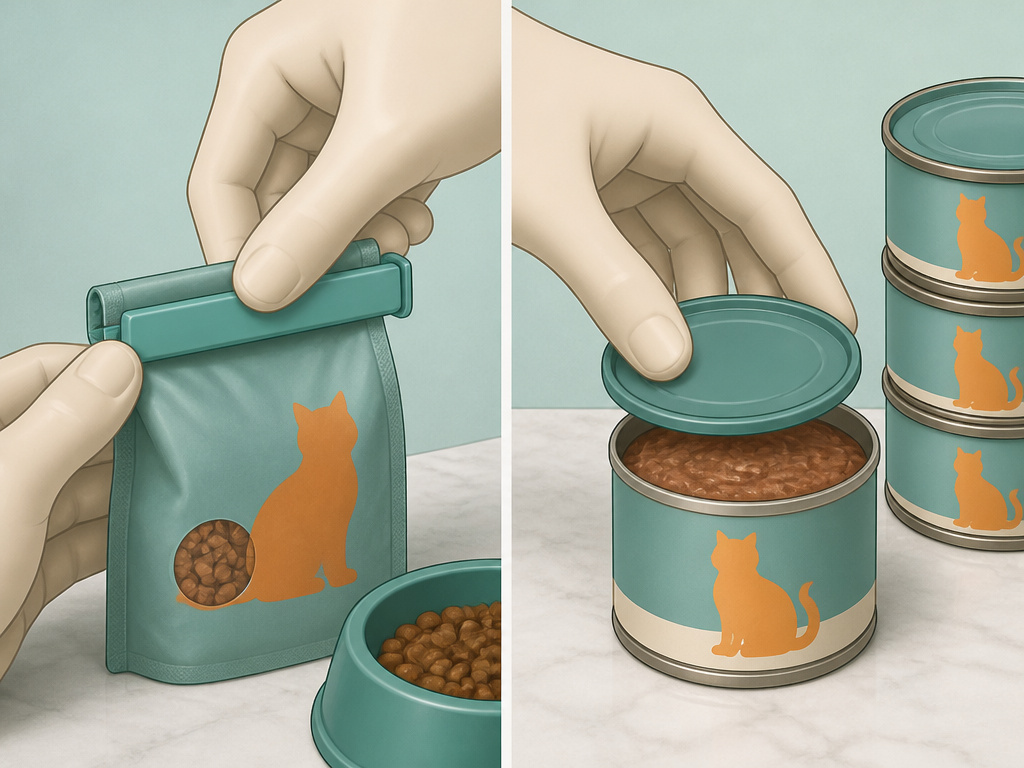
Three things decide this: portion size, storage, and what your cat will actually eat.
Pouches win on portion control. If you have one cat and a 400 gram can means half of it hits the bin every meal, the pouch is doing you a favor. YLTPACK notes that pouches help serve the right amount and reduce waste, and that is the honest case for them.
Cans win on storage and shelf life. Up to 24 months unopened, stackable in a pantry, and cheaper per meal. YLTPACK also points out that cans take a lid or plastic wrap for leftovers and that opening one can be sharp. Both true.
The verdict by household
One cat, small appetite: pouches. Reach for a kitten wet food if you’re feeding a kitten in the 2 to 12 month growth phase, since that format is built for it and the protein sits at 13.5 percent. For an adult single cat, a pate in a small can gives you the same portion control with less packaging.
Two or more cats, or one big eater: cans. A larger can gets split across bowls in one sitting and nothing goes in the fridge.
If you genuinely don’t know your cat’s texture preference, buy a few single pouches before committing to a case. A large multipack of a texture your cat hates is a expensive lesson.
The pate vs chunks question sits underneath all of this. Format within the can matters as much as can versus pouch.
Cost, Space, and the Convenience Tax
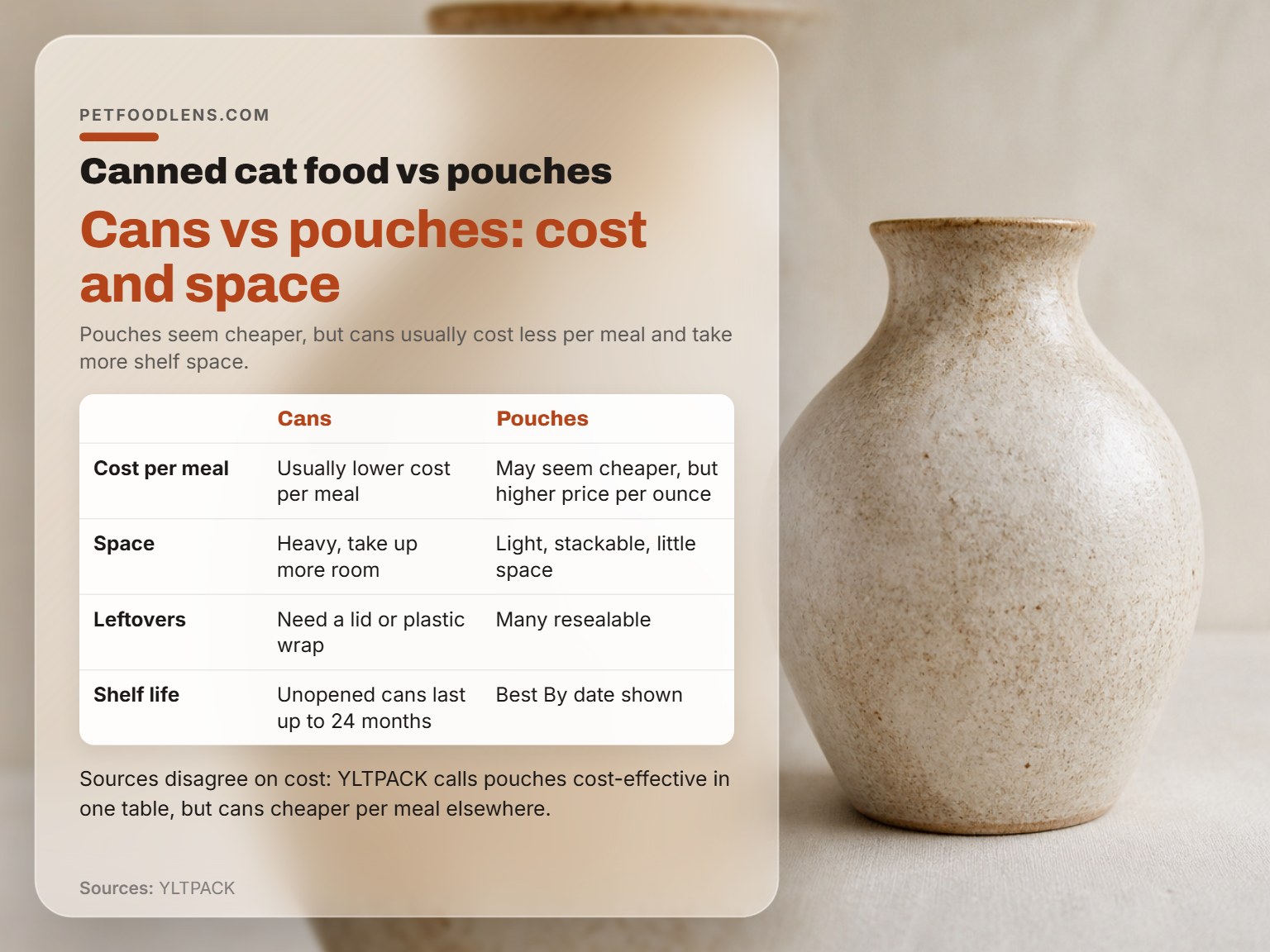
You’re standing in the aisle with a pack of 85 gram pouches in one hand and a large can in the other. The pouch pack looks cheaper. It usually isn’t.
YLTPACK puts it plainly: pouches may seem cheaper at first, but the price per ounce can be higher, and you pay more per calorie. Cans usually offer a lower cost per meal. Joybuy agrees from the retail side, noting that larger cans are often more cost-effective per gram and that a multipack is the most economical way to stock up.
Where the two pages part company is consistency. YLTPACK calls cans cheaper per meal in one section, then describes pouches as cost-effective in its materials table. That is a packaging supplier talking about packaging, so weight it accordingly.
On space, pouches are not close:
- Pouches are light and stack or stand on a flat bottom, so they take up little space.
- Cans are heavier and need shelf depth, which matters in a small kitchen.
- Pouches reseal on many designs, so a half-eaten portion can go back in the fridge without a separate lid.
That resealable edge is the one convenience claim I’d actually pay for. Cans need a lid or wrap, and most people don’t own a can cover that fits properly.
If you want the wider picture on what wet food does and doesn’t do for a cat, the wet cat food case is worth reading before you commit to a format. And if you’re weighing a healthier formulation in either shape, the healthy wet cat food shortlist covers both cans and pouches.
How to Switch Formats Without a Hunger Strike
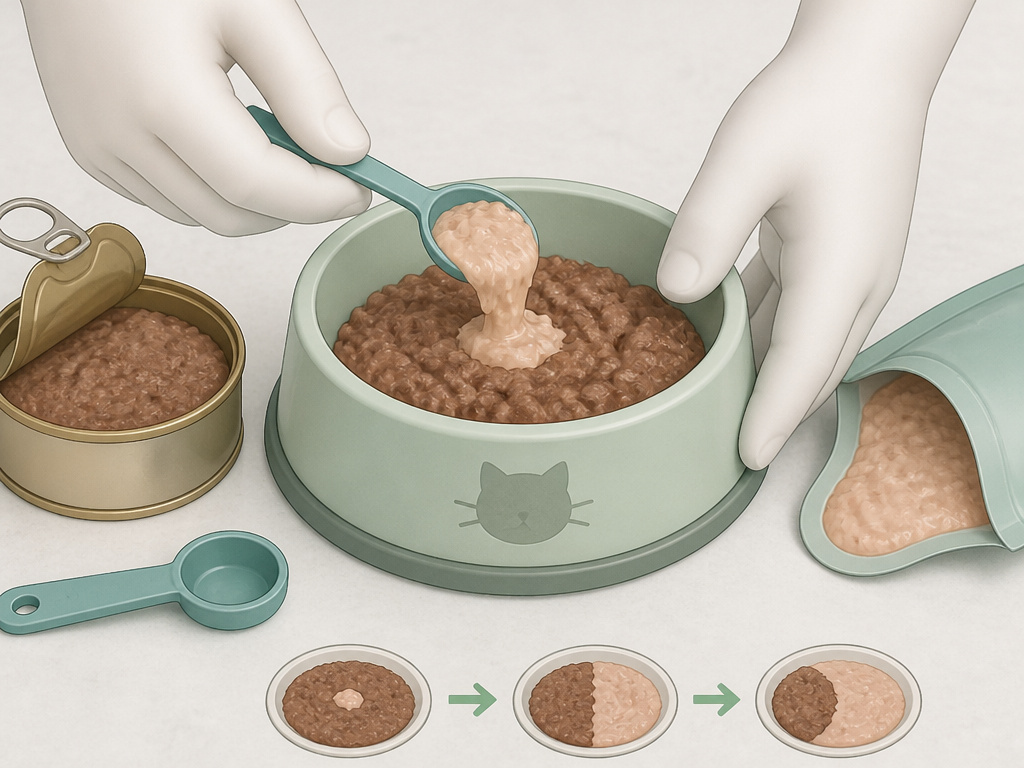
Ever tried to swap a cat’s food overnight? It goes badly more often than it goes well.
Before you start: A can lid edge can be sharp, so lever the whole lid up and drop it straight in the bin instead of leaving it standing. Opened wet food sitting on the counter gives bacteria a head start, so cover and refrigerate it as soon as the cat walks away. And a bowl straight from the fridge gets refused by most cats, so let it sit on the counter until the chill comes off before you put it down.
Here is the sequence that works:
- Start with a teaspoon of the new format mixed into the old food. Skip this and you get a cat that eats around the new food and leaves it to crust.
- Hold that ratio for three or four days before increasing it. Rush it and the cat associates the bowl with something unfamiliar and stops trusting it.
- Raise the proportion every few days across 2 to 3 weeks. YLTPACK recommends 10 to 14 days for a food change; my experience says the longer end of that range is safer for a texture switch.
- Watch intake, not attitude. A cat that eats a reduced portion for a short time is fine. A cat that eats nothing is not.
When to call the vet instead
A cat that stops eating during a transition is a vet call, not a stubbornness contest. That goes double for an overweight cat.
Two things help in the meantime. Stirring a little warm, not hot, water into a can of pate costs nothing and raises intake noticeably in most cats, because warming releases the aroma. And if you’re tempted to use broth, check the ingredient list first. Check the ingredient list first before using broth.
If you’re feeding a cat that turns its nose up at everything, the picky eaters problem is usually texture, not brand. Fix the texture first.
One more note on mixed feeding. Combining wet and dry can give you the moisture of wet food alongside the texture of dry, and Joybuy suggests consulting a veterinarian on the right balance. I’d take that advice. I’m not a clinical specialist, and a cat with kidney disease or diabetes needs a vet more than a comparison chart.
Frequently Asked Questions
Is canned cat food better than pouches?
Nutritionally they are close. YLTPACK states both formats carry about the same protein and fat, and the container doesn’t change that. The real differences are portion size, packaging, storage life, and cost per meal. Pick the format that fits your household and your cat’s acceptance.
How long can I keep opened wet cat food in the fridge?
The sources disagree. Joybuy says 24 to 48 hours after opening. YLTPACK says 3 to 5 days, or up to 7 in an airtight container. Neither cites a regulator, so treat the shorter window as the safe ceiling.
Do pouches hydrate a cat better than cans?
The claim doesn’t hold up on its own numbers. YLTPACK says pouches have over 78 percent water and cans about 78 percent, then argues the extra water in pouches helps hydration. A fraction of a percent is not a hydration strategy. Both formats are moisture-rich, and that is the useful part.
Is it cheaper to feed cans or pouches?
Cans, on a per-meal basis. YLTPACK notes pouches can cost more per ounce and more per calorie, and Joybuy points to larger cans as more cost-effective per gram. Pouches earn their price back through portion control and less waste in a one-cat house.
Can I feed both cans and pouches?
Yes. YLTPACK suggests trying both formats and watching how the cat responds to each. Change any food slowly over 10 to 14 days, and ask your veterinarian if you’re unsure about the balance.
Should I warm refrigerated wet food before serving?
Yes. Joybuy advises serving at room temperature and taking the food out of the fridge before mealtime, since most cats won’t eat it cold. A few minutes on the counter does the job.
The Bottom Line
Here is the trigger that settles it for most people. If you feed one cat and you’re scraping half a can into the bin at every meal, the pouch’s higher price per ounce is already paid for by the food you’re not throwing away. Do that math on your own bin before you do it on the shelf tag.
The reverse also holds. Two cats, or one cat that cleans a large can in a sitting, and pouches become an expensive way to buy water and foil.
Fair warning on one thing I can’t help with. Everything above comes from labels, published formulations, and the sources cited here. I can’t verify manufacturing quality, ingredient sourcing, or batch consistency from a can. A clean panel can still sit on top of a problem I have no way to detect, and that applies to both formats equally. Read the label, not the front of the package, and if your cat is unwell, the vet outranks this article.
