
Freeze-Dried Chicken Treats for Cats Pros and Cons
This post contains affiliate links. As an Amazon Associate, we earn from qualifying purchases.
Freeze-dried chicken treats for cats come with real pros and cons: high protein, 2 calories per piece on the brands that publish a figure, and a long shelf life, against a thin nutritional profile and documented recall history. Nearly all are complementary treats, not complete diets, so thiamine (vitamin B1) has to come from the rest of the bowl.
That thiamine line is the one worth pulling on. Cats carry a higher dietary requirement for thiamine than dogs and a limited capacity to compensate when intake falls short, which is the FDA’s own stated reason cats sit at the front of this particular risk rather than behind dogs. Weighing freeze-dried chicken treats for cats pros and cons means considering thiamine as well.
What follows is a label-first walk through the category: what the guaranteed analyses actually say, where the recall record sits, how the named brands compare side by side, and whether the boiling-water advice circulating online is worth following.
Key Takeaways
- Freeze-dried chicken is often a complementary treat, not a diet. PureBites and Applaws both sell single-ingredient chicken with no added vitamins, so it cannot carry a cat’s nutrition alone, though Fresh Is Best says using its freeze-dried foods as an exclusive daily ration is an excellent option.
- Calories are not the constraint. At 2 calories per piece, a handful barely moves the daily total; displacement of complete food is the real issue.
- Cats handle thiamine shortfalls worse than dogs do. The FDA names the higher requirement and limited compensation as the reason.
- Two lots were pulled in 2026 for low thiamine. Steve’s Real Food lot C26022 and Quest lot C25288, both from Go Raw LLC.
- A Salmonella recall hit freeze-dried chicken hearts. Freeze-drying is not a kill step, and the recall notice makes that point.
What Is Actually in a Freeze-Dried Chicken Treat?
Applaws prints 82% minimum crude protein, 5% minimum fat, 2% maximum fiber, and 6% maximum moisture on its Chicken Breast Freeze Dried bag, with under 2 kcal per treat. That is close to the entire story for a single-ingredient product.
Freeze-drying freezes the raw meat first, then dries it under vacuum to pull out most of the moisture, which is why the finished piece weighs a fraction of the raw input. PureBites states that a 1.09 oz bag holds 0.25 lb of raw chicken breast and 85 treats, with 2 calories in an average piece.
A freeze-dried chicken piece feels like a dense foam packing peanut between your fingers and shatters into powder under a cat’s teeth. There is no chew to it. That texture is exactly why cats who refuse everything else will often take one.
What the Guaranteed Analysis Actually Tells You
The guaranteed analysis is a minimum-and-maximum panel, not a measured result. Crude protein minimum 82% means the lab found at least that much, and the number says nothing about amino acid balance, thiamine content, or whether the batch was tested at all.
Early in my career I graded a bag on its first ingredient and called it good because the word was chicken. Ingredients are listed by weight before cooking, and fresh chicken is mostly water, so that first slot flatters the product. I read the first five as a group now.
Flip the bag over. If there is no guaranteed analysis on a product sold as food rather than a treat, that absence is the finding.
The Pros Hold Up Better Than the Marketing Does
Two things genuinely earn their place here: protein density and shelf stability.
- Protein per gram is high. Applaws lists 82% minimum crude protein, close to the ceiling for anything in the treat aisle.
- 2 calories per piece, so a training session barely registers against the day’s intake.
- No refrigeration and a long shelf life, which matters when rewards live in a pocket, a car, or a training pouch.
- Single-ingredient options exist, and a one-line ingredient list is easy to check against the bag.
When you compare a freeze-dried chicken treats for cats pros and cons, short ingredient lists are easy to verify, which is the only real advantage they carry. Plenty of long lists are perfectly good formulations, and a two-word list on a product with no nutritional adequacy statement tells you almost nothing useful.
For cats that turn their nose up at everything, the strong flavor and dry crunch do real work, which is why treats for picky cats so often land on freeze-dried chicken first.
Completeness and Thiamine Are Where the Cons Live
The completeness problem is the one that actually bites.
A cat on a hydrolyzed diet that still gets two or three chicken-based freeze-dried nibbles a day is not on an elimination trial. It’s on a very expensive chicken diet. Flavored medications are the second offender; chewable or liver-flavored pills and fish-oil capsules can carry enough protein to keep the itching going. Ask the vet for unflavored or compounded versions before day one.
Complementary Treat vs Complete Diet
Applaws labels its chicken breast freeze-dried product as a 100% natural complementary treat for adult cats. That word, complementary, is doing legal work. It means the product is not formulated to meet a cat’s full nutritional needs, and feeding it as the bowl is a formulation error rather than a flavor choice.
The freeze-dried cat food pros and cons picture changes completely once a product is a complete diet with added vitamins rather than a single-ingredient treat. Those are two different categories sitting on the same shelf.
Where this goes sideways: Treating a single-ingredient chicken product as the whole bowl. It carries no added thiamine, and the FDA notes that cats have a higher requirement and limited capacity to compensate, so a deficiency builds over an extended period before anyone notices.
The early signs the FDA lists are easy to miss, and as it progresses the neurological signs arrive. As it progresses, the neurological signs arrive, including ventroflexion of the neck (the head bending toward the floor), mental dullness, vision changes, wobbly walking, circling, falling, and seizures. Recognized early and treated appropriately, the FDA says thiamine deficiency is generally reversible, and most animals respond well to supplementation and supportive care.
How Do PureBites, Applaws, and Fureeze Compare?
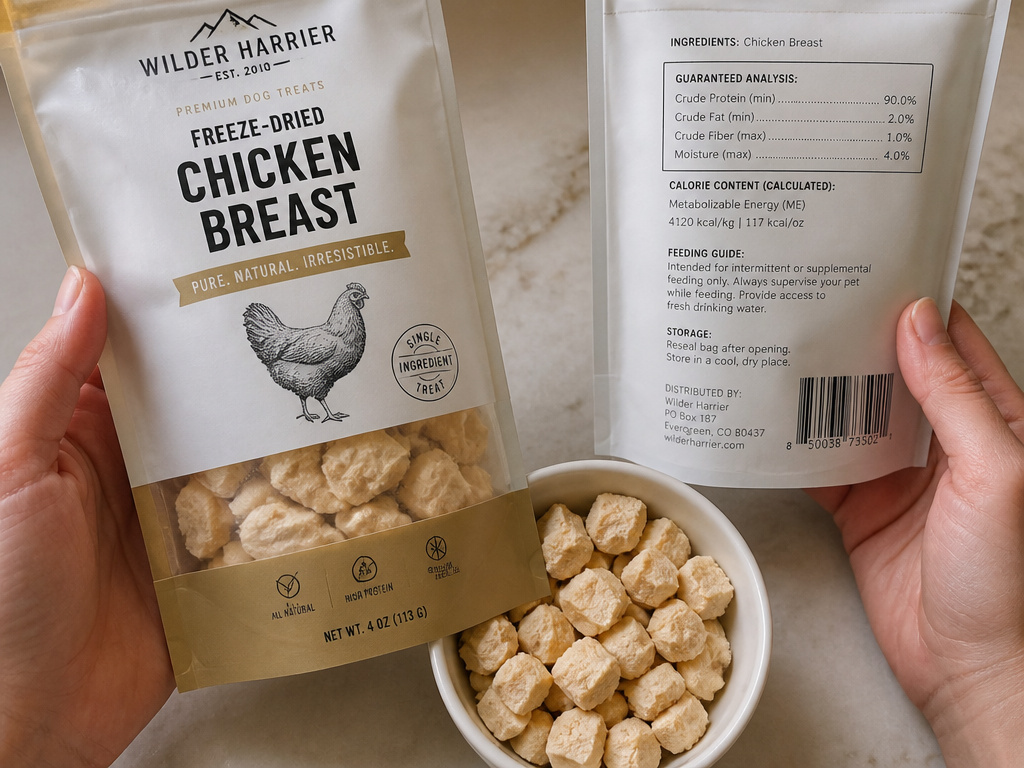
Ever flipped a treat bag over and found no guaranteed analysis at all?
| Product | What the label states | Calories per treat | Complete diet? |
|---|---|---|---|
| PureBites Chicken Freeze Dried Cat Treats | 1 ingredient, 100% chicken breast | 2 calories | No |
| Applaws Chicken Breast Freeze Dried Cat Treats | 82% min protein, 5% min fat | Under 2 kcal | No, complementary |
| Fureeze Freeze Dried Chicken Breast | 82g protein per 100g | Not stated per treat | No, nutritionally incomplete |
| Steve’s Real Food Chicken Recipe Freeze Dried | Complete diet, lot C26022 recalled | Not stated | Yes |
The Fureeze numbers come from a nutritional information panel rather than a guaranteed analysis, which is a different document with different rules. Per 100g it lists 1809 kJ, 82g protein, 11g fat, 0g carbohydrate, and 130mg sodium.
Reading these four bags in order takes about four minutes, and it is the single most useful thing you can do before buying:
- Find the guaranteed analysis, not the front-of-bag claim. If there isn’t one, that absence is your answer.
- Check for the word complementary, which Applaws uses openly. Complementary means treat, no matter what the front panel implies.
- Look for an AAFCO nutritional adequacy statement on anything sold as a diet rather than a treat. Fresh Is Best states its freeze-dried foods tested for taurine exceed the AAFCO profiles.
- Write down the lot code and best-by date before the bag goes in the cupboard, so a recall notice becomes a two-second check instead of a panic.
If you want the wider spread of single-ingredient chicken treats across brands, the same four checks apply to every bag on the shelf.
The 25-Year Shelf Life Claim
Fureeze claims a 25-year shelf life on its freeze-dried chicken breast. A reviewer who examined the product called that claim excessive and doubted it would hold under real-world storage conditions, and I’d treat it the same way.
The practical guidance from that same review is to use the product within the best-before date and finish the package within a few weeks of opening it. Fresh Is Best, a competing brand, recommends a 2 week guide for how long its products last once opened, notes that storage conditions differ by household, and says to let your nose be the guide.
The Recall Record Nobody Prints on the Front of the Bag
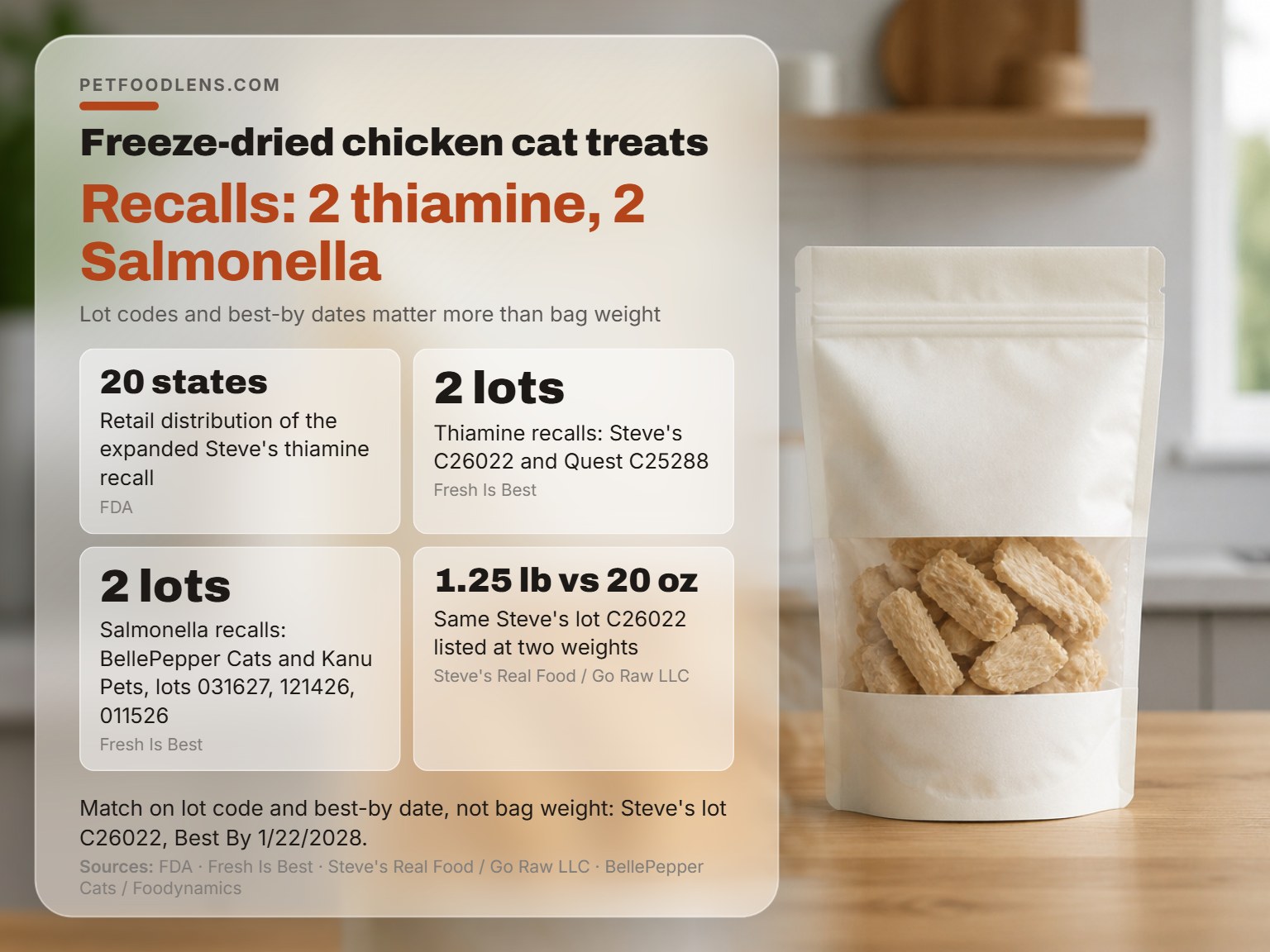
Go Raw LLC expanded a February recall to cover one more lot of Steve’s Real Food Chicken Recipe Freeze Dried, citing potentially low levels of thiamine.
| Product | Lot | Size | Reason |
|---|---|---|---|
| Steve’s Real Food Chicken Recipe Freeze Dried | C26022 | 1.25 lb (FDA) / 20 oz (retailer letter) | Low thiamine |
| Quest Cat Food Chicken Recipe Freeze Dried Nuggets | C25288 | 10 oz | Low thiamine |
| BellePepper Cats Freeze Dried Chicken Heart Slices | 031627 | 3 oz | Salmonella |
| Kanu Pets Freeze Dried Chicken Heart Raw Treats | 031627 | 3 oz | Salmonella |
Two details in that table are worth sitting with. The first is the size mismatch: the FDA notice lists the Steve’s product as a 1.25 lb bag, while the company’s own retailer letter lists the same lot C26022 as a 20 oz bag. If you are matching a bag in your cupboard against the notice, match on the lot code and the best-by date of 1/22/2028, not the weight.
The second is that the FDA freeze-dried chicken recall notice states the expanded product went through retail stores in 20 states: CO, UT, WA, OR, PA, RI, MI, CA, TX, IL, GA, NC, SC, FL, MN, NY, OH, WI, PA, ID, and MT. Go Raw says the affected lot was manufactured before February 2026 and is no longer in distribution, and that all current product uses an updated formulation with a new vitamin premix.
The Salmonella side is separate and older. Foodynamics recalled specific lots of Raw Dog Barkery, BellePepper Cats, Kanu Pets, and What’s In the Bowl freeze-dried treats for potential Salmonella contamination. The Oregon VMA freeze-dried treat recall notice makes the point that matters: freeze-dried chicken hearts carried live Salmonella, so freeze-drying is not a kill step.
I’d rather an owner check a lot code once at the counter than read a recall notice three weeks later. The lot and the best-by date are printed on the front of the bag, and checking them takes less time than reading the feeding guide.
What to Do If You Have a Recalled Bag
For the thiamine lots, the FDA’s instruction is to stop feeding the product and return it to the place of purchase for a full refund or a replacement. Go Raw’s consumer line is listed on the notice.
For the Salmonella lots, the instructions are stricter. Do not feed the product to pets or any other animals. Dispose of it so children, pets, and wildlife cannot reach it. Do not sell it or donate it. Wash and sanitize bowls, cups, storage containers, hands, utensils, and any surface the product touched.
Should You Add Boiling Water Before Serving?
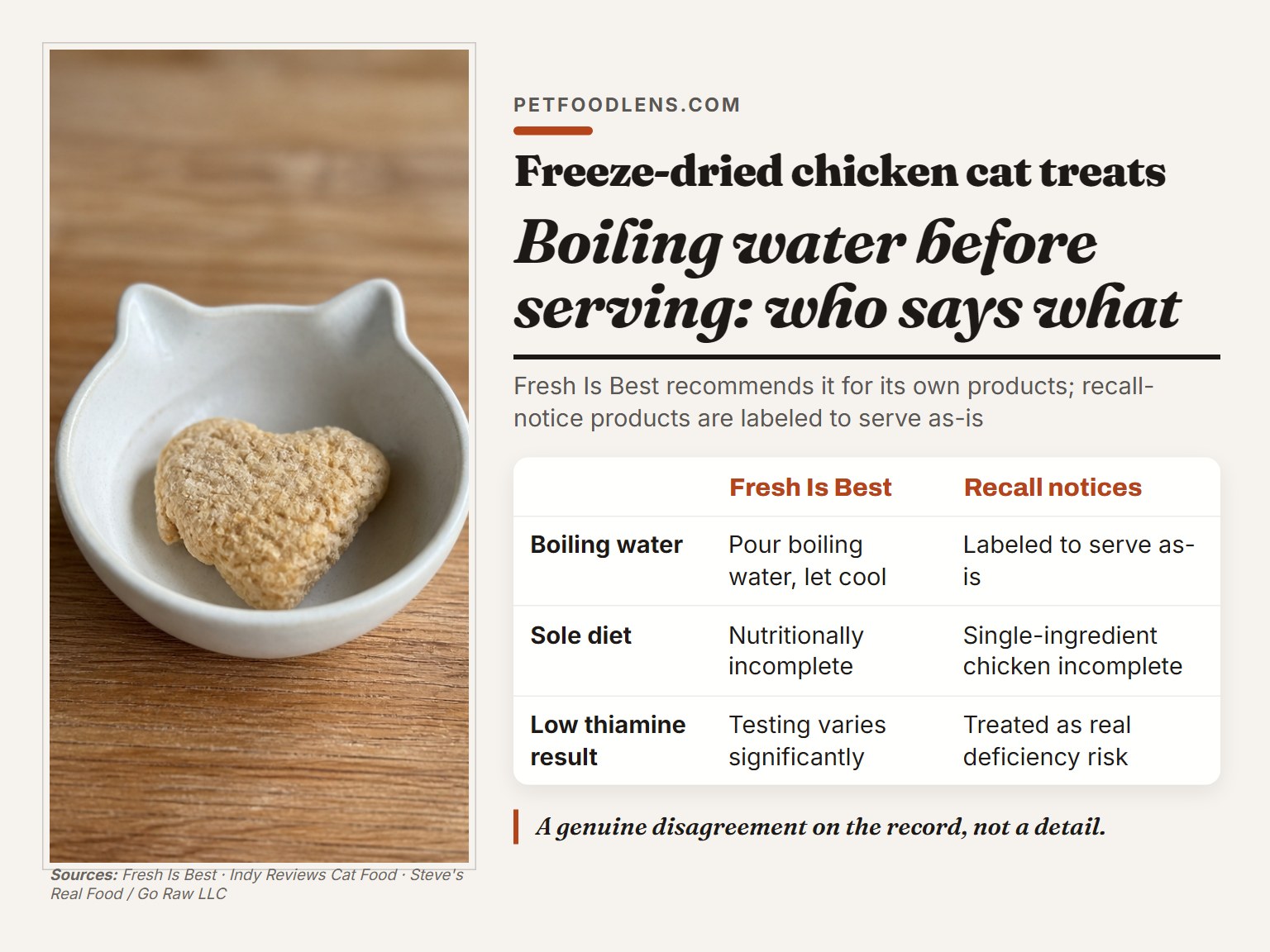
The bag comes out of the cupboard, a few nuggets hit the bowl, and the cat eats them dry before you’ve put the bag away. That is how nearly everyone feeds these.
Fresh Is Best recommends an extra step for its own products: pour boiling water onto the freeze-dried food, let it cool, then serve. Drain any excess water or leave it in for added hydration. No manufacturer named in the recall notices recommends that step, and those products are labeled to serve as-is. That is a genuine disagreement, not a detail.
| Question | One position | The other |
|---|---|---|
| Boiling water before serving | Fresh Is Best: pour boiling water, let cool | Recall notices: labeled to serve as-is |
| Freeze-dried chicken as sole diet | Fresh Is Best: an exclusive ration is “excellent” | Indy Reviews Cat Food: single-ingredient chicken is incomplete |
| A low thiamine test result | Go Raw LLC: thiamine testing varies significantly | FDA: treats the low result as a real deficiency risk |
The third row is the one that decides how much faith to place in any single lab result. Go Raw’s position is that thiamine is a sensitive nutrient and that testing results can vary significantly even in products formulated with elevated levels. The FDA’s action treats the same low result as a real deficiency risk worth a recall. Both positions are on the record. An owner reading them should know that the science here is contested by the company that made the food.
I’ve been asked whether pouring boiling water over a nugget makes it safer, and the honest answer is that Fresh Is Best recommends that step for its own products while no manufacturer in the recall notices does.
Rehydrating is a separate question from pathogen risk, and it does change the texture and the moisture your cat takes in. If you want the mechanics, this walkthrough on how to rehydrate freeze-dried cat food covers water temperature and ratios.
An opened bag left in the cupboard goes from smelling faintly of roasted chicken to smelling like old cooking oil, and that shift is the signal. Fresh Is Best says storing the opened bag in the freezer may slow the oxidation process, which is the cheapest fix available.
How Many Pieces a Day Before Treats Stop Being Treats
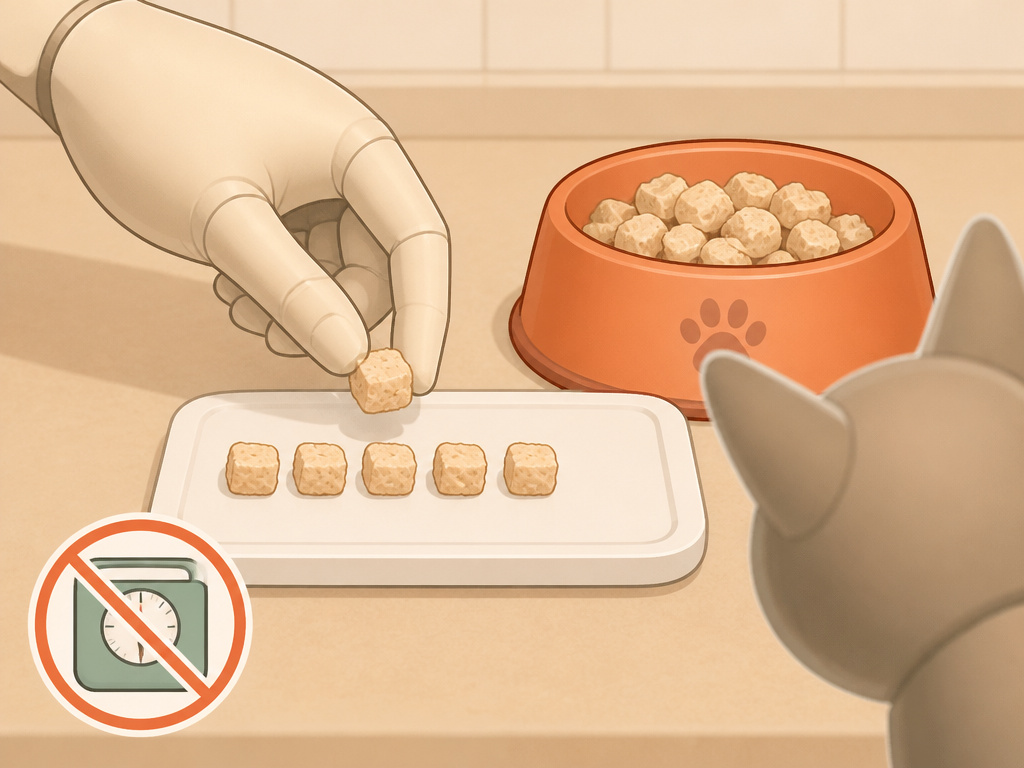
The freeze-dried chicken treats for cats pros and cons discussion shows calorie math is the wrong place to start with this category.
At 2 calories per piece, ten pieces is 20 calories, which is noise against a cat’s daily intake. Counting calories here is a distraction from the three things that actually matter: whether the complete food is still doing the nutritional work, whether an elimination trial is being contaminated, and whether the bag is still good.
The raw cat food pros and cons discussion runs into the same wall. Freeze-dried raw is convenient and shelf-stable, and it inherits the same pathogen questions as the raw product it came from.
Count treats in pieces, not handfuls, and count them against the complete food they’re replacing. At 2 calories a piece the calories are almost irrelevant; the displacement is not.
If you want a wider rotation across proteins, the same math holds for freeze-dried fish treats for cats, and a mixed rotation makes it easier to keep any single bag from becoming a staple. For a broader survey of freeze-dried cat treats across brands, check the guaranteed analysis on each one before you commit to a bag.
Frequently Asked Questions
Are freeze-dried chicken treats good for cats?
As a reward, yes. They are high in protein, low in calories, and most cats accept them readily. As nutrition, no. Applaws labels its chicken breast freeze-dried product a complementary treat, which means it is not formulated to meet a cat’s full needs.
Can freeze-dried chicken be a cat’s main food?
Not the single-ingredient kind. A product made of chicken breast and nothing else carries no added vitamins or minerals, and a reviewer examining one such product described it as nutritionally incomplete and unsuitable as a primary food, while Fresh Is Best says using its freeze-dried foods as an exclusive daily ration is an excellent option. Complete freeze-dried diets are a different product category with added vitamins and an AAFCO statement.
How many freeze-dried chicken treats can a cat have a day?
Calories are not the limiting factor at 2 kcal per piece, so the ceiling is about displacement. Keep the complete food doing the nutritional work and treat the nuggets as a reward. Cats on an elimination trial should get none unless the vet approves the specific product.
Do freeze-dried chicken treats need refrigeration?
Unopened, no. Once opened, Fresh Is Best recommends a 2 week guide and says storing the opened bag in the freezer may slow oxidation. The company also says to let your nose be the guide, since storage conditions differ by household.
Is freeze-dried chicken safe after a recall?
Only if your bag is not one of the recalled lots. Check the lot code and best-by date against the notice. The Steve’s Real Food lot was C26022 with a best-by of 1/22/2028, and the Quest lot was C25288 with a best-by of 10/15/2027. If either matches, stop feeding and return it.
The Bottom Line
Here is the trigger to act on: if the bag has no guaranteed analysis and no AAFCO nutritional adequacy statement, put it back on the shelf. That combination tells you the product was never intended to be more than a reward, and you should price your expectations accordingly.
The concession worth stating plainly is that none of this makes freeze-dried chicken a bad treat. It makes it a treat. The category’s real failure mode is owners who read “100% chicken breast” as a nutritional claim rather than an ingredient list, then wonder why a cat on an all-chicken reward schedule is still itchy, still thin, or still not quite right.
Start this week with one bag. Find the lot code, write it on the calendar next to the best-by date, and read the guaranteed analysis before the first nugget comes out. That is four minutes of work, and it is the difference between knowing what you’re feeding and hoping.
