
Fresh Cat Food Pros and Cons: What Holds Up
This post contains affiliate links. As an Amazon Associate, we earn from qualifying purchases.
The fresh cat food pros and cons are measurable: a 2026 meta-analysis of 121 studies found processing shifts digestibility (SMD 1.971, p=0.005) and nutrient content (SMD 1.405, p<0.001), with no pooled additive or preservative risk difference, while the CDC advises against raw. Fresh delivers moisture and acceptance, and costs you freezer space and pathogen risk.
Those pooled figures come from a review that screened 4,888 studies and kept 121, so the effect sizes are about as solid as this literature gets. What they describe is a category where the processing method and the ingredient list do most of the work, and the story on the front of the tub does almost none.
What follows walks the label, the trials, the freezer, and the four formats that compete with fresh, so you can decide with the panel in front of you instead of the photograph.
Key Takeaways
- Additives and preservatives were not the problem. Pooled risk differences landed at 0.0006 for additives (n=60) and 0.0003 for preservatives (n=39), and the Bayes factors supported the null.
- The CDC does not recommend raw pet food or treats for dogs or cats, and its position page was updated on Jan 30, 2025.
- Freezer logistics are the hidden cost. Delivery windows, power loss, and a second freezer for large shipments all show up after you subscribe.
- Passing an AAFCO growth trial is not the same as safe or optimal. Two raw diets passed a 10-week AAFCO growth trial while producing lab abnormalities and pathogen shedding.
- Judge the finished formula, not the first ingredient, because fresh chicken is mostly water and water cooks off.
Fresh Cat Food: What’s Actually in the Package
Darwin’s Natural Selections Chicken Recipe for Cats ships frozen in 2-lb packages split into four sub-units, and the label carries no expiration date. That single detail tells you more about the category than any front-of-tub claim, because it tells you what you’re handling: a perishable product on a short clock with no printed deadline.
Fresh commercial cat food is formulated to a complete-and-balanced standard, typically via AAFCO nutrient profiles or a feeding trial, then frozen or refrigerated rather than retorted. The manufacturing step that changes most is the cook, because heat alters protein structure, moisture content, and the surviving microbial load in the finished product.
Flip the package over and you get a guaranteed analysis, an ingredient list, and a feeding guide. What you don’t get is any indication of whether the food was tested in cats or formulated on paper. That distinction separates most fresh cat food brands from each other, and it’s the first thing I look for.
A thawed brick of fresh food smells like raw chicken thigh and cold metal. Set it down wet and it leaves a slick, faintly pink film on the counter that you’ll wipe twice.
Does Fresh Cat Food Beat Kibble? What the Trials Actually Show
The 2026 meta-analysis published in Animals screened 4,888 studies and included 121. Its pooled processing effects were large: SMD 1.971 for digestibility (p=0.005, n=102 comparisons) and SMD 1.405 for nutrient content (p<0.001, n=137).
Read that carefully. Processing changes outcomes. It doesn’t automatically improve them. The authors concluded that results were highly dependent on ingredient type and processing method, with both beneficial and detrimental outcomes showing up in the same dataset.
Where this goes sideways: Treating “less processed” as a synonym for “better.” The meta-analysis found outcomes swinging both directions depending on the ingredient and the process, so a fresh food built on a poor formula is still a poor formula.
The additive and preservative question, which is where most of the marketing energy goes, came out flat. Pooled risk differences were 0.0006 for additives and 0.0003 for preservatives, and the Bayes factors supported the null. If you’re paying more to avoid preservatives, the evidence for that spend is thin.
| Claim | What Marketing Says | What the Evidence Shows |
|---|---|---|
| Less processing is better | Fresh beats kibble by default | Outcomes depend on ingredient and method, both directions |
| Preservatives are harmful | Fresh avoids a real risk | Pooled risk difference 0.0003 (n=39) |
| Human-grade is superior | A higher tier of food | Only n=6 studies, high bias, no conclusion |
| Fresh is more digestible | A clear win | Higher digestibility is plausible, but can overshoot |
The human-grade comparison is the weakest link in the whole argument. It rested on six studies with high risk of bias, and the authors declined to reach a definitive conclusion. Anyone telling you human-grade is proven superior is ahead of the literature.
For the raw side of the aisle, the PMC review of raw meat diets frames it as a nutritional controversy rather than a settled upgrade, and the review of microbiological hazards in raw diets covers the pathogen problem in detail. If you’re comparing formats, dry cat food is the baseline you should measure against, because it’s what most cats actually eat.
The Fresh Cat Food Pros and Cons That Actually Matter
In my first year ranking foods, I sorted foods by first ingredient and put the one with fresh chicken on top. Then I worked out that fresh chicken is mostly water, and it weighs far less once cooked. The finished food was nowhere near as meat-heavy as the label implied. I’ve read whole formulas ever since, not headlines.
Here’s what genuinely holds up on the pro side.
- Moisture content. Canned and fresh formats put water in the bowl. A cat eating dry kibble is taking in a fraction of the water a canned-fed cat gets, and that gap is the single most defensible argument for wet or fresh.
- Acceptance. Fresh food is palatable, and for a cat that turns its nose up at everything, that’s not a small thing. It’s often the whole reason the switch happens.
- Digestibility may run higher, which Clinician’s Brief concedes for fresh and less-processed diets. The same source warns it can run too high, causing constipation or diarrhea from insufficient fiber.
- Portion control. You can see and portion what you’re feeding, which makes adjusting intake far easier than guessing at a scoop of kibble.
- Format flexibility. You can mash it with water, warm it, or split a package across two meals.
A named meat meal usually delivers more protein per pound than fresh chicken does, because the water is already gone. Fresh chicken listed first is often a pricing decision dressed up as a nutrition one.
If you want the canned version of this argument laid out the same way, wet cat food covers the moisture math in full. And here’s the part I can’t answer from a label: I have no way to verify manufacturing quality, sourcing, or batch consistency. A clean panel can still hide a plant problem.
The Cons That Show Up in Your Kitchen, Not the Brochure
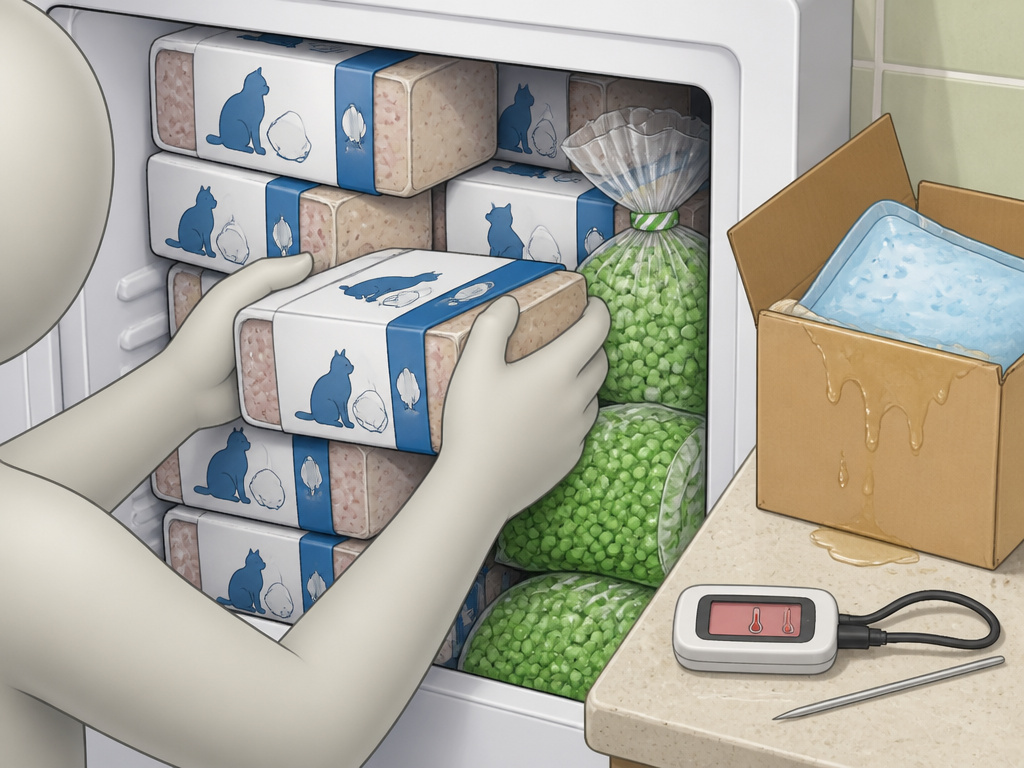
Every con below is a logistics problem before it’s a nutrition problem. That’s what the sales pages leave out.
- Freezer space. Large shipments may need a second fridge or freezer. If you don’t have one, you’ll be stacking 2-lb bricks around the frozen peas and resenting it.
- Delivery windows. Owners must be present at delivery, especially in summer or warm climates. Miss the window and you’ve paid for food that sat on a porch.
- Power or refrigeration failure. A single outage creates both a safety risk and a financial loss, because you throw the whole shipment out.
- Pathogen handling. Raw and fresh raw products carry a microbial load, and the CDC explicitly does not recommend raw pet food or treats for dogs or cats.
- Label blind spots. When no expiration date is printed, the standard “check the date” safety step doesn’t exist. The FDA’s advice on the Darwin’s product was to check the freezer instead of the label.
That Darwin’s advisory is worth reading in full. Two lots tested positive for Salmonella: Lot 12731 (MFG Jul 08, 2026) and Lot 12493 (MFG Apr 02, 2026). The advisory was triggered by a consumer complaint involving two cats with GI illness, one of them hospitalized. As of the advisory, the firm had not initiated an adequate recall.
The part nobody mentions: A fresh food subscription is a cold-chain commitment, not a purchase. If your routine can’t absorb a missed delivery or a power outage, the format will fail you before the nutrition ever gets a chance.
How Do You Store Fresh Cat Food Without Wrecking It?
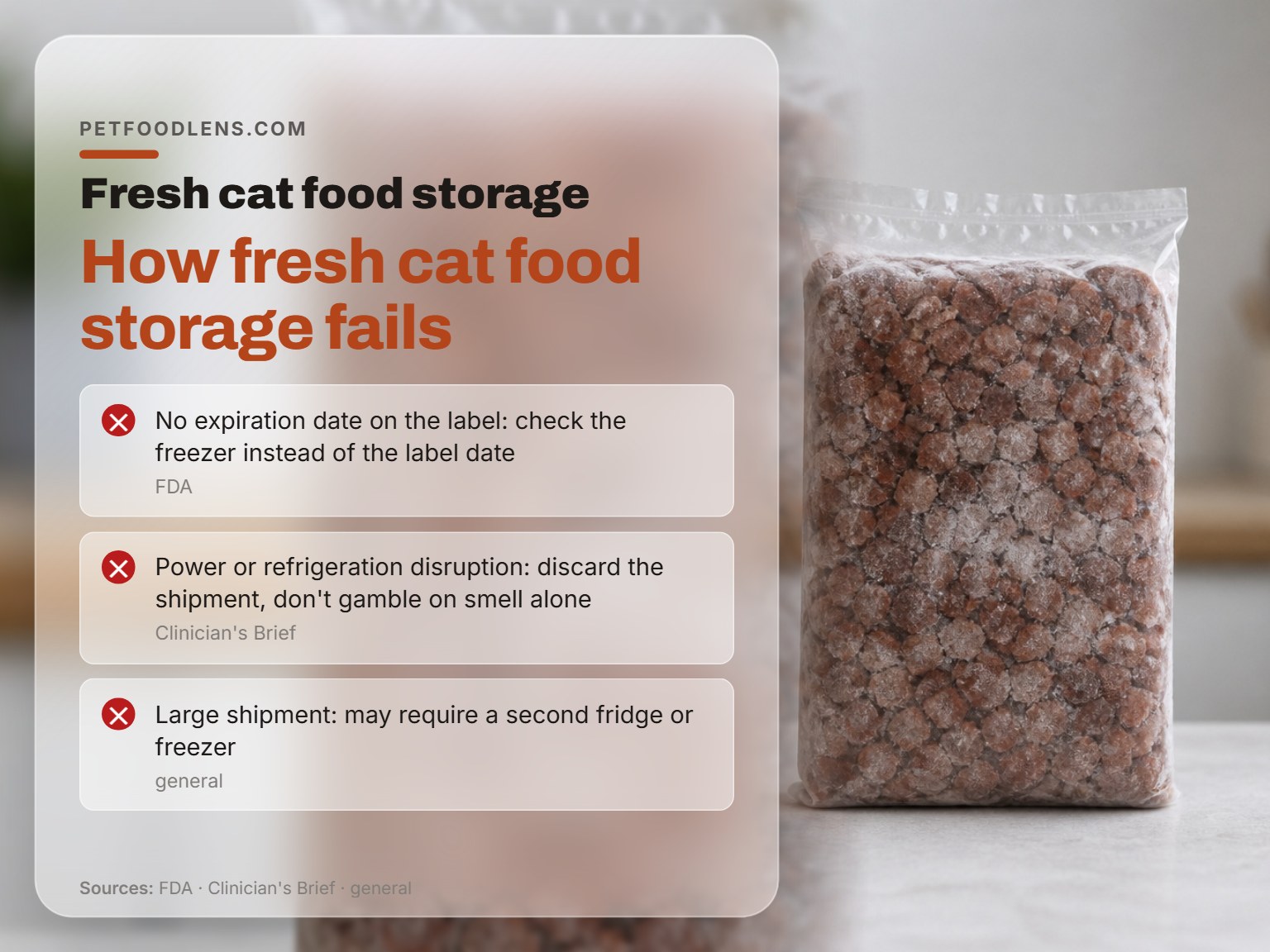
Storage is where most of the real-world failures happen, and almost none of them are about the recipe.
| Situation | What Fails | What to Do |
|---|---|---|
| Delivery arrives warm | Outer layer thaws, middle stays frozen | Refuse the shipment, don’t refreeze |
| Package has no date | You can’t judge age from the label | Track the freeze date yourself |
| Power outage | Whole shipment becomes unsafe | Discard, don’t gamble on smell alone |
| Large shipment | Fridge or freezer overloaded | Confirm capacity before subscribing |
| Travel or evacuation | Cooler-and-ice becomes impractical | Have a shelf-stable backup format |
A package that thawed and refroze shows ice crystals inside the plastic and a dull grey-brown edge on the meat. The smell turns sour-sweet before it turns outright rotten, which is why smell alone is a bad test.
Thaw in the fridge, never on the counter. A package left out warms on the outside while the middle is still solid, and that outer layer sits in the danger zone for hours before anyone notices.
If you’d rather not manage a freezer at all, refrigerated cat food sits in a shorter, simpler supply chain. Here’s the part the front label skips: the smaller and more frequent your shipments, the higher the cost and the environmental impact per pound of food.
Fresh, Raw, Home-Cooked, or Canned: Which Format Fits?
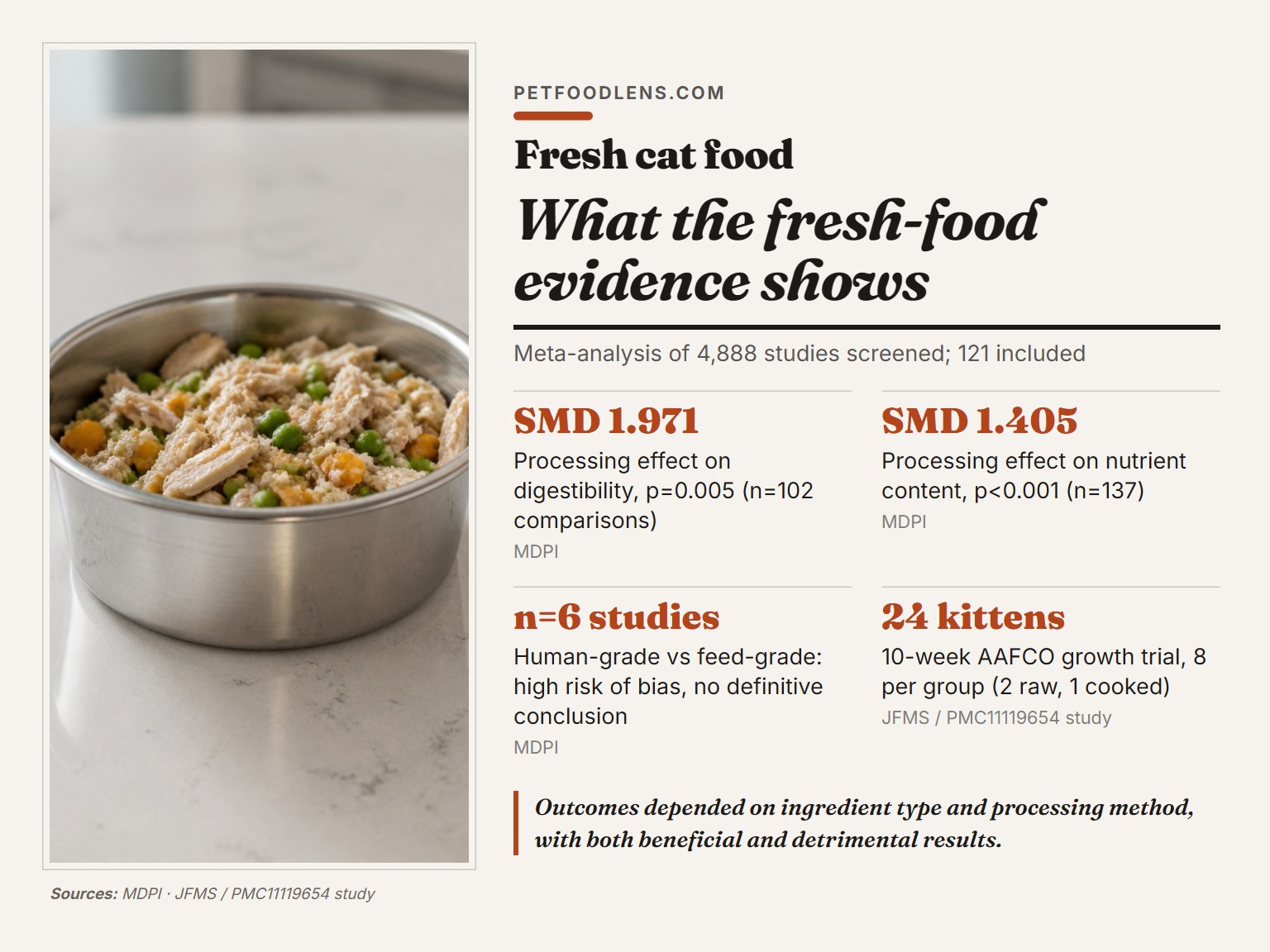
Four formats compete with fresh, and each wins in a specific situation. Pick by what your week can actually support.
Fresh vs Raw
The CDC does not recommend raw pet food or treats, while sources differ on whether fresh cooked is safer for most households. The raw cat food pros and cons are real, but the CDC position is unambiguous, and the pathogen handling burden lands on you. Raw wins only if you’re prepared to treat your kitchen like a food-safety zone.
Fresh vs Home-Cooked
Home-cooked gives you total control and total responsibility. The commercial and homemade cat diets comparison is the honest starting point, because recipe formulation errors are common and quiet. If you want the workload trade-off spelled out, home-cooked cat food covers it. Some sources favor a commercial fresh food with a feeding trial behind it, while others note that passing an AAFCO growth trial does not exclude long-term deficiencies.
Fresh vs Canned and Freeze-Dried
Canned is the pragmatic middle. Pate and chunks-in-gravy differ in consistency, because gravy adds thickeners and variable fill. Freeze-dried cat food wins on shelf stability and travel, and loses on water content.
What to Check Before You Switch
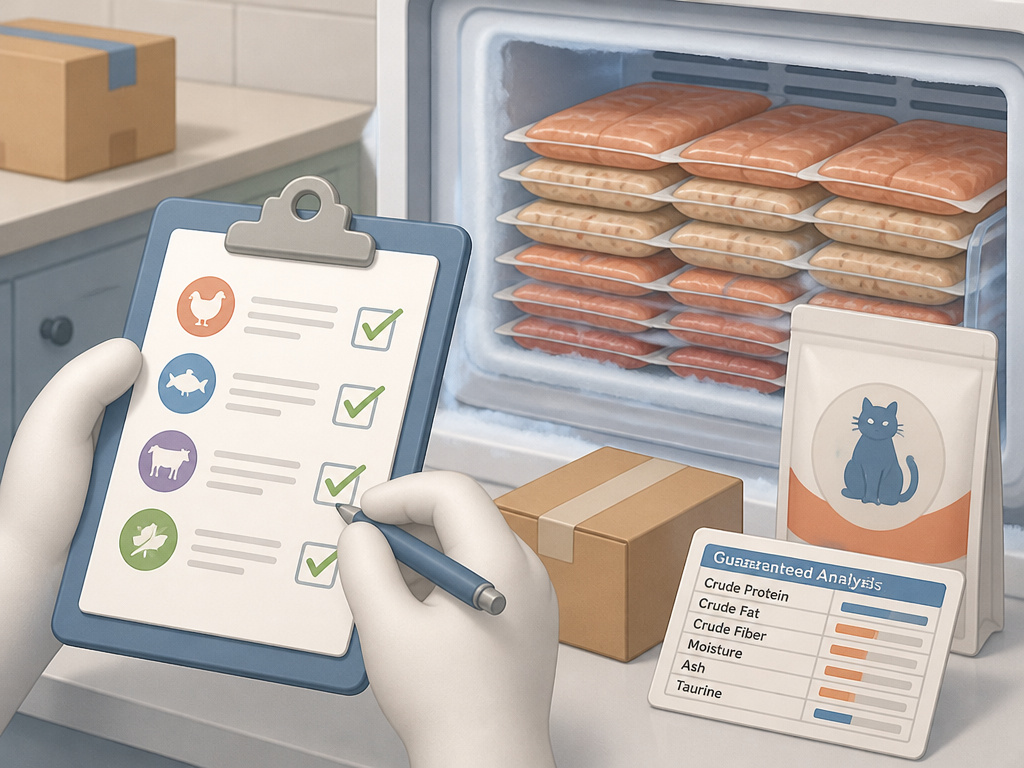
Three things decide whether fresh food works in your house: freezer capacity, delivery reliability, and whether the food was tested in cats or only formulated on paper.
On that last point, the raw versus cooked feline growth study is the most useful piece of evidence in this whole category. It ran 24 kittens starting at 9 weeks old, 8 per group across two raw diets and one cooked diet, for a 10-week AAFCO growth trial. Two raw diets passed, with growth parameters similar to the cooked diet.
They also produced lower albumin (P=0.010), higher globulin (P=0.04), red cell microcytosis (P=0.001) in the combination raw group, and positive fecal Salmonella Heidelberg and C. Difficile toxin. Passing the trial didn’t exclude long-term deficiencies either, because liver and fat storage depots can mask a problem for a long time.
Easy to miss: “Complete and balanced” describes the formula on paper. It says nothing about the plant that made it, the batch you bought, or how it was handled in transit.
Before you commit, run this list:
- Confirm freezer capacity against the shipment size, not the daily portion.
- Check whether the food passed a feeding trial or was formulated to a nutrient profile only.
- Ask what happens on a missed delivery, in writing.
- Read the guaranteed analysis on a dry-matter basis so you’re comparing protein and fat on equal footing across formats.
- Skip it if your cat has a diagnosed condition and you haven’t talked to your vet first.
For kittens, the calculus shifts, and fresh food for kittens covers the growth-stage specifics. The CDC pet food safety guidance is the page to keep bookmarked for handling, and it’s blunt: raw isn’t necessarily healthier, and both raw and other diets can be nutritionally balanced or inadequate.
Frequently Asked Questions
Is fresh cat food healthier than dry or canned?
The evidence doesn’t support a blanket yes. A 2026 meta-analysis of 121 studies found processing changes digestibility and nutrient content, but outcomes depended on ingredient type and method, with both beneficial and detrimental results. The CDC states plainly that raw isn’t necessarily healthier and that both raw and other diets can be balanced or inadequate.
Is fresh cat food the same as raw cat food?
No. Fresh food is often cooked and then frozen or refrigerated, while raw food is sold uncooked. The distinction matters because the CDC does not recommend raw pet food or treats, and the pathogen handling burden is different for a cooked product than for a raw one.
Can I feed fresh food and kibble together?
Yes, and plenty of owners do. Mixing formats is mostly a moisture and calorie math problem, so weigh the total daily intake rather than eyeballing two bowls. If you’re feeding dry as the base, check the guaranteed analysis so you know what the fresh portion is actually adding.
What if the package has no expiration date?
Then the label can’t help you, and you need another system. The FDA’s advice on the Darwin’s Natural Selections product, which carries no expiration date, was to check the freezer rather than a label date. Write the freeze date on the package yourself the day it arrives.
Is fresh food worth it for a picky cat?
Often yes, because acceptance is where fresh food earns its keep. Palatability is an advantage that is widely cited, though sources disagree on whether fresh is healthier overall. Just don’t confuse a cat eating enthusiastically with a cat eating a better-formulated diet, because those are two different questions.
The Bottom Line
Here’s the threshold I’d give a friend: if you can’t reliably be home for delivery and you don’t have freezer space to spare, the fresh cat food pros and cons tip against you regardless of what the trials say. Fix the logistics first or pick a canned format and stop there.
One thing I’d change about how most people shop this category. Stop ranking by the first ingredient. Fresh chicken is mostly water, so a food that leads with it isn’t automatically the meatiest option in the freezer, and a named meat meal often delivers more protein per pound because the water is already gone.
The honest limit on all of this is that I read labels and published formulations. I can’t audit a plant, verify sourcing, or test a batch. That means a clean panel and a passing trial are the ceiling of what I can tell you, and a food can still fail somewhere I can’t see.
So read the label, not the front of the package. Then decide whether your freezer, your schedule, and your cat actually agree with the marketing.
