
How to Freeze Pet Food: What Actually Survives the Freezer
This post contains affiliate links. As an Amazon Associate, we earn from qualifying purchases.
Here’s how to freeze pet food without wrecking it: wet food and raw portions freeze fine, but kibble should stay out of the freezer because moisture collects on the surface as it thaws and quality drops fast.
That condensation problem only bites on a dry surface. A thawing piece of kibble can collect moisture from the air on its surface. Wet food and raw portions already carry that moisture, so freezing is not a problem for them.
What follows covers how to freeze pet food by format, the ice cube tray method for leftover pate, where the FDA, CDC and university extension guides actually disagree on thawing, and how to keep the last third of a bag worth eating.
Key Takeaways
- Wet food and pate freeze without a problem, according to Edgard & Cooper‘s own product guidance; kibble is the exception and belongs in the cupboard.
- Thaw in the refrigerator. The FDA and Virginia Tech also allow the microwave; none of these sources allows the countertop or the sink.
- Raw portions are a separate decision. The CDC does not recommend feeding raw pet food at all, and FDA testing found pathogens in raw samples far more often than in dry food.
- Finish an opened bag while it is still fresh. The last third oxidizes long before it reaches the bowl.
- Keep the original bag inside the bin. Fewer than half of the pet food complaints the FDA receives include a lot number.
How to Freeze Pet Food: Which Formats Survive and Which Don’t
Wet food freezes cleanly. Kibble comes back out of the freezer worse than it went in.
Manufacturer guidance splits by product format. High-moisture wet food and pate freeze without a problem, while dry kibble is not recommended for freezing because moisture accumulates on the outside during thaw and quality falls rapidly. Raw frozen product is kept frozen until it is thawed for use.
Edgard & Cooper published that position by product line on January 23, 2024, which makes it the most specific manufacturer statement in this whole area. The kibble entry gives a mechanism rather than a blanket rule, and the mechanism is worth reading twice: moisture gathers on the outside of the kibble as it thaws, and quality drops quickly afterward.
| Format | Freeze it? | What the source says |
|---|---|---|
| Wet food / pate | Yes | No problem, per Edgard & Cooper |
| Dry kibble | No | Surface moisture on thaw, quality drops fast |
| Raw frozen tubes | Yes, keep frozen | FDA and CDC: freeze until ready to use |
| Opened canned food | No guidance given | FDA: refrigerate at 40 F or below |
Unopened canned food is a different case again. The FDA puts it in the same category as dry food for storage: a cool, dry place below 80 F. Once a can is open, the instruction changes to refrigeration at 40 F or below. No source here says to freeze an opened can, so I don’t.
That gap matters. Plenty of storage charts online lump every format together and call it done. The manufacturer’s own split is narrower and more useful, and it’s the one I’d follow.
Why Does Kibble Go Bad in the Freezer but Wet Food Doesn’t?
Condensation is the whole mechanism, and it only matters on a dry surface.
Kibble is dry. That dryness is part of what makes it keep. Pull a piece out of a freezer and moisture from the kitchen can condense onto the kibble. It stays on the kibble.
Wet food arrives already loaded with water, so a film of surface moisture is not a problem. What changes is texture. Some gravy styles separate on thaw, which is a cosmetic problem you can fix with a spoon.
Freeze what’s wet and refrigerate what’s open. The freezer is for portions, the fridge is for leftovers.
Here’s the honest gap. The manufacturer says quality decreases “rapidly” and stops there. Nobody in these sources puts a number on how many days or how much of a percentage, so I won’t invent one. Treat “rapidly” as the whole warning and don’t freeze kibble in the first place.
The Ice Cube Tray Method for Leftover Wet Food
Spoon the leftover pate into an ice cube tray or a small silicone mold, freeze it, then bag the cubes.
This is the method I’ve settled on for a cat who eats a third of a can at a time. It solves the portion problem rather than the storage problem, which is the one that actually costs you food.
Before you start: Anything raw that goes into the freezer needs a sealed container, because packages leak as they freeze and thaw, and drips land on whatever sits below. Wash hands with soap and water for at least 20 seconds after handling raw product, and thaw raw portions in the refrigerator or microwave, never on the counter or in the sink.
- Spoon the pate into the wells of an ice cube tray or silicone mold. Leave a little headroom, because pate expands as it freezes and a full well pushes the lid off.
- Freeze the tray flat overnight. A level tray gives you even cubes; a tilted one gives you thin slabs that crumble when you bag them.
- Pop the frozen cubes into a labelled freezer bag and press the air out. Skip the label and you’ll be guessing at contents in three weeks.
- Move one or two cubes to the refrigerator the night before you need them. Fridge thawing takes hours, and skipping the overnight step is how people end up thawing on the counter.
What to do about separated gravy
Some gravy styles separate on thaw. A quick stir pulls it back together, and most cats don’t care either way. If yours does, mash the cube with a fork while it’s still cold and stir the liquid back through before it reaches room temperature.
The opened can in the fridge
A half-used can left in its own tin with the lid pressed back on can pick up other flavors from the fridge. I decant into a small glass jar with a tight lid and use it promptly. That’s my practice, not a published figure.
How Long Can Wet Food Sit in the Bowl?
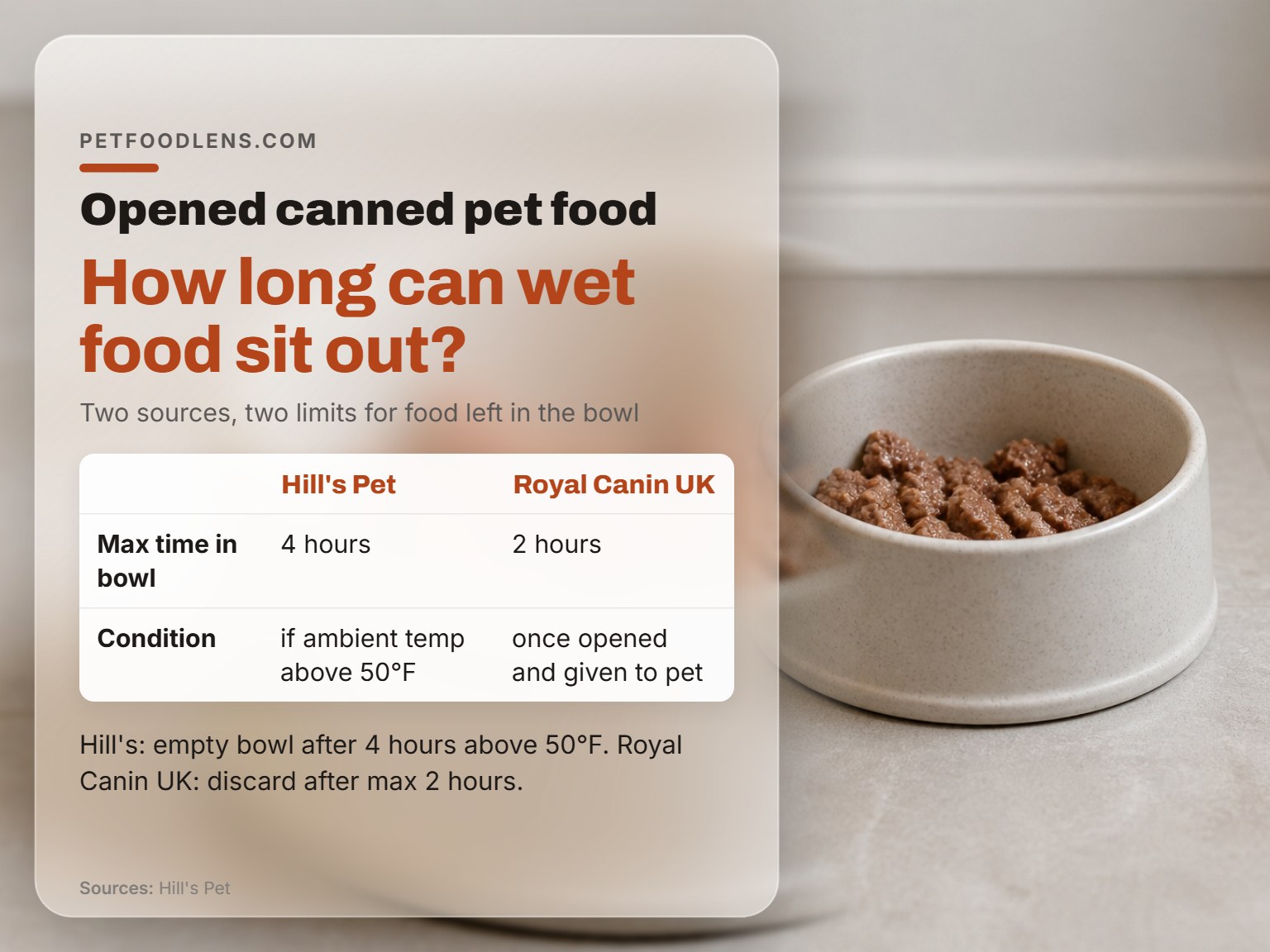
I don’t leave wet food in a bowl for long, and less in a warm kitchen.
The clock is a rough guide. A crusted, dried edge on the food tells you more than the clock does, and a faint sour smell tells you the rest. Once the surface has skinned over, the cat has usually walked away from it anyway.
The CDC is blunt about the endpoint: throw away leftovers that have been out at room temperature. There’s no salvage step and no “just put it back in the fridge” allowance.
If you want to know what spoilage looks like before it reaches the bowl, the signs of pet food gone bad may help. A swollen can, a leaking pouch, or a smell that doesn’t match the food are all stop signals.
Two hours, then it goes. That’s the whole rule.
Thawing Frozen Pet Food: Where the Sources Disagree
Ask three agencies where to thaw frozen pet food and you get three different answers.
| Thaw method | Who allows it | Note |
|---|---|---|
| Refrigerator | CDC, FDA, Virginia Tech | Slowest, plan overnight |
| Microwave | FDA, Virginia Tech | Virginia Tech adds a secondary container |
| Countertop or sink | None of them | FDA rules it out explicitly |
The CDC allows refrigerator thawing only. The FDA permits the refrigerator or the microwave, and specifically bars the countertop and the sink. The Virginia Tech pet food safety guide matches the FDA but adds a detail the FDA leaves out: thaw in a secondary container so leaks don’t spread across a shelf.
That’s three tolerances for one step. If you want the version that satisfies all three, use the refrigerator and put the package in a container. It costs you nothing but planning.
The rule all three sources share
Wash your hands with soap and water, and clean anything the raw product touched. The FDA gives a working disinfectant ratio: 1 tablespoon of bleach to 1 quart of water, or 1/4 cup to a gallon for a bigger batch. Virginia Tech extends the list to countertops, refrigerator and microwave interiors, utensils, spoons, bowls and cutting boards.
The same logic applies to any meat you handle at home, and the MU Extension freezing meat guide may help if you want the wider picture beyond pet food.
If you’re working through the thaw step in detail, the thaw frozen pet food rundown may help. Thawing is also a key part of the handling raw dog food safely picture, because a leaking package on a fridge shelf contaminates everything under it.
Raw Portions: Freeze It, but Read This First
The freezer is the easy part of a raw diet. The hard part is deciding whether to feed one.
The sources do not agree here, and I’m not going to smooth it over. The CDC states plainly that it does not recommend feeding raw pet food or treats to dogs and cats. The FDA takes a different starting position: it gives freeze, thaw and disinfection instructions that presuppose raw feeding, framed as risk management for owners who choose it. Virginia Tech reproduces the same precautions under an “if you choose to feed” heading.
So the FDA manages the risk. The CDC discourages the practice. Both give you freeze-and-thaw steps, and the steps are nearly identical.
What the FDA testing actually found
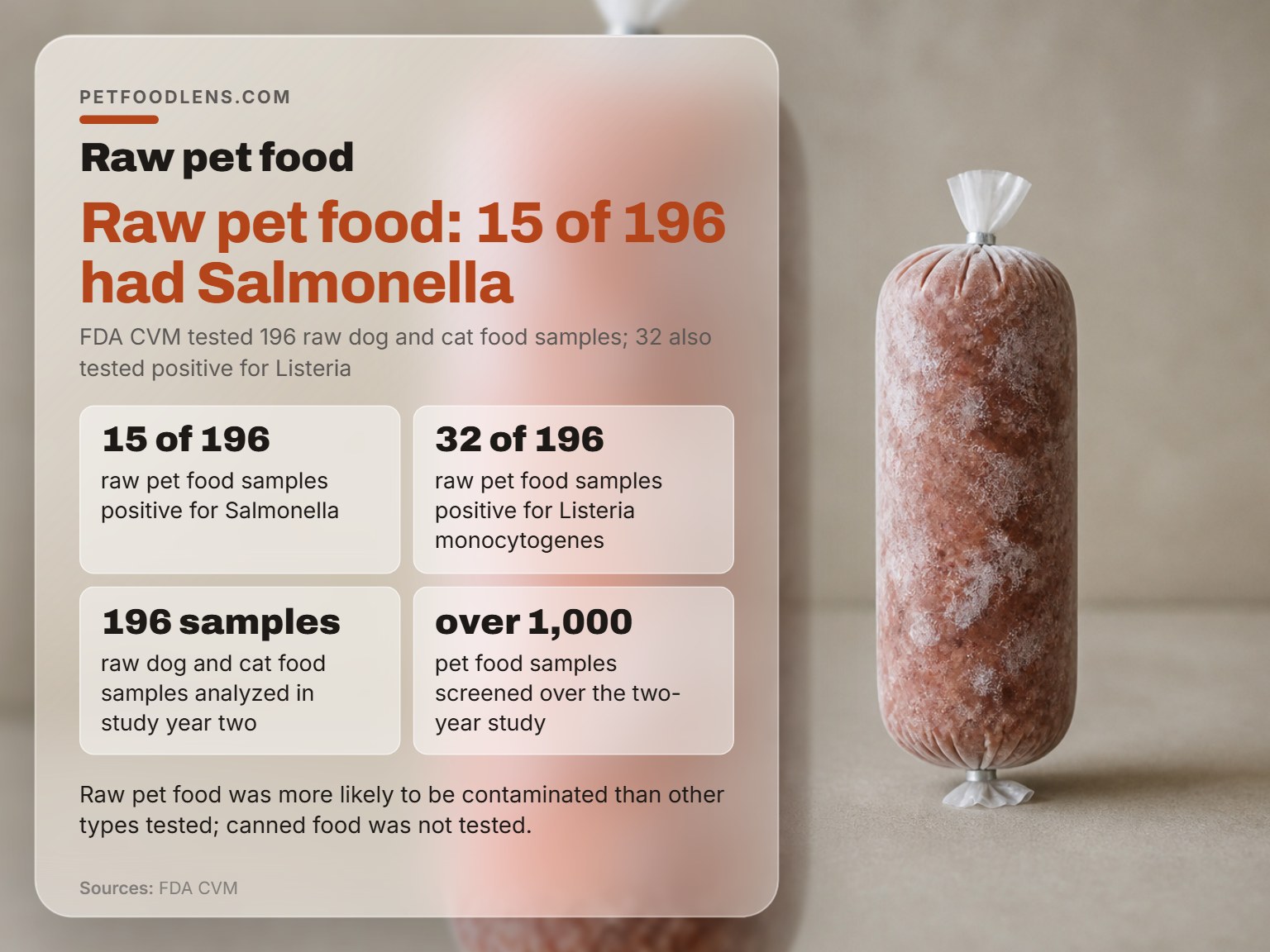
The FDA’s Center for Veterinary Medicine ran a two-year screening covering over 1,000 pet food samples. Raw food was added only in the second year: 196 raw dog and cat samples were analyzed. Of those 196, 15 tested positive for Salmonella and 32 for Listeria monocytogenes.
Raw pet food was more likely to be contaminated with disease-causing bacteria than other types tested. Canned pet food was not tested at all, so the raw numbers have no canned comparison in that study.
The raw products were usually frozen in tube-like packages made from ground meat or sausage. In other words, the frozen format was the article being tested, not a workaround.
If you’re portioning raw, the freeze raw dog food method and the store raw pet food basics may help.
The handling rules that all three sources converge on:
- Wash hands for at least 20 seconds with soap and water, before and after handling raw product.
- Keep it sealed and separate in both the freezer and the refrigerator, away from your own food.
- Disinfect contact surfaces with 1 tablespoon of bleach per 1 quart of water, or run items through the dishwasher.
- Thaw in the refrigerator or microwave, in a secondary container, never on the counter or in the sink.
- Bin anything left out at room temperature. There’s no rescue.
- No face-licking after a raw meal, and wash up after playing with the pet.
Where this goes sideways: Thawing a raw tube on the counter because it’s still frozen at dinnertime. The outside reaches room temperature while the core stays solid, and the outside is where the bacteria are. Move it to the fridge the night before instead.
One more thing worth saying plainly: children under 5, adults 65 and older, people with weakened immune systems, and pregnant women are at higher risk from foodborne germs. The CDC lists all four groups. If someone in that list shares your kitchen, the risk calculation changes.
Storing the Bag So the Last Third Is Still Worth Eating
A large bag can last one cat for months of feeding.
That’s the number that should stop you. Once a bag is opened, the clock starts, and the last third has had months to oxidize. The bulk discount stops mattering if half the bag gets tossed or the cat quits eating it.
I tell people to buy what they’ll finish while it’s still fresh. If the bag is cheaper per pound but you’re scooping from it in month four, it isn’t cheaper. Kibble that’s been open too long loses its snap and smells faintly of old cooking oil, which is the point where I’d stop feeding it.
Common mistake: Topping up a half-empty container with fresh kibble. The stale fat residue on the old kibble coats the new, and the whole bin goes off on the old bag’s schedule.
The FDA pet food storage guidance is specific about the container question, and it’s the opposite of what most people do:
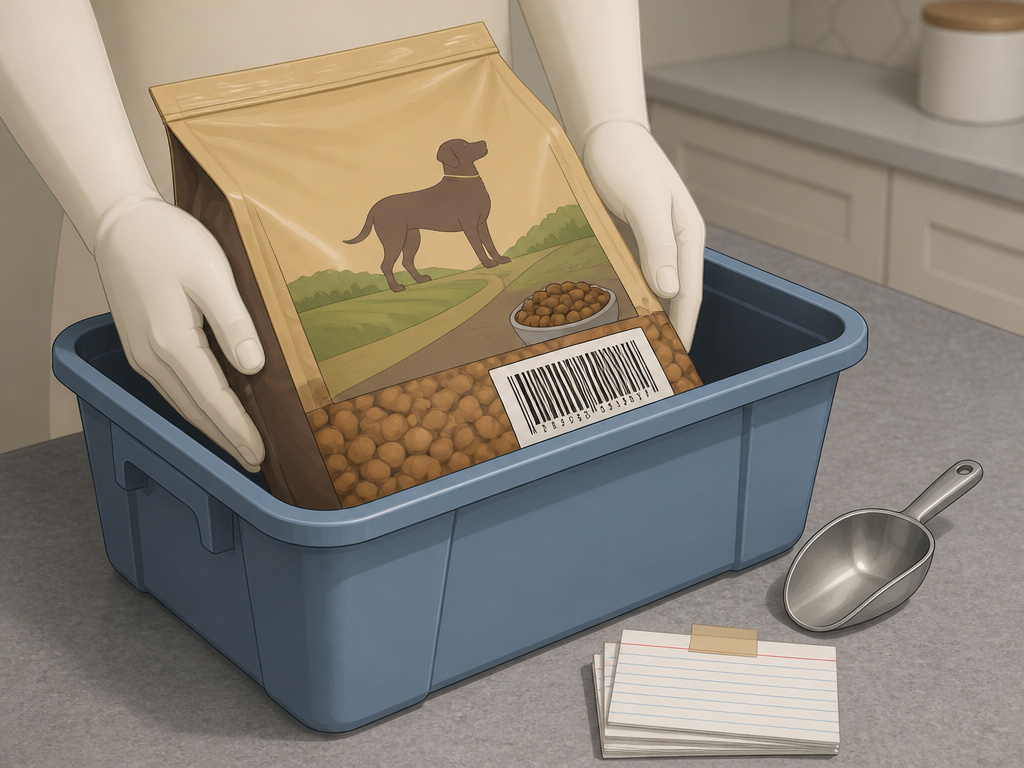
- Keep the original bag. The UPC code, lot number, product name, manufacturer and best-by date all live on it, and you need them for a recall.
- If you use a bin, put the whole bag inside rather than pouring kibble in loose.
- If you do pour, tape that label information to the outside and replace it every time you open a new bag. Virginia Tech offers an alternative: photograph the UPC, label and lot number.
- Keep it cool and dry, below 80 F. Heat and moisture break down nutrients.
- Wash bowls, scoops and measuring utensils after each use, and wash water bowls daily.
That lot number point isn’t housekeeping trivia. Fewer than half of the pet food complaints the FDA receives include one, and without it the agency can’t quickly trace when and where the product was made.
For the bin itself, choose one that holds a full bag with the bag still inside it, which is exactly the use case the FDA describes. A sturdier bin is worth considering if it lives in a garage or a shed where rodents are a real concern. Neither one is worth buying if you’re going to pour loose kibble into it.
If you want to push the freshness window further, the pet food storage containers comparison and the keep pet food fresh guide may help.
Frequently Asked Questions
Can you freeze dry kibble?
Manufacturer guidance says no. Edgard & Cooper’s stated reason is that moisture accumulates on the outside of the kibble as it thaws, and quality drops rapidly as a result. The freezer doesn’t make kibble unsafe in any documented way; it makes it stale fast.
How long can frozen pet food stay in the freezer?
None of the sources here sets a maximum freezer time for pet food. The CDC and FDA both say to freeze raw product until you’re ready to thaw and use it. In practice, use the product’s own best-by date as your ceiling and label the container with the date you froze it.
Can you freeze canned wet dog or cat food?
Wet food and pate freeze without a problem according to the manufacturer’s own guidance. For an opened can you haven’t frozen, the FDA says refrigerate at 40 F or below and use it promptly. I decant into a glass jar rather than leaving it in the tin.
Do you have to thaw frozen pet food in the refrigerator?
The CDC says refrigerator only. The FDA and Virginia Tech both allow the refrigerator or the microwave, and Virginia Tech adds that the microwave step should happen in a secondary container. All three rule out the countertop and the sink.
Does freezing kill bacteria in raw pet food?
The CDC treats freezing as a handling step that reduces risk, and it still does not recommend feeding raw pet food at all. Freezing is not a substitute for cooking, and the FDA’s own testing found Salmonella and Listeria in raw samples that had been commercially frozen.
The Bottom Line
Here’s the trigger I’d give anyone: if you can’t finish an opened bag in about six weeks, buy the smaller bag. Not the fancier bin, not the vacuum canister. The smaller bag. Freshness you actually eat beats freshness you store.
The rest sorts itself by format. Wet food and pate go in the freezer without drama, portioned into cubes and thawed in the fridge overnight. Kibble stays in the cupboard, in its original bag, inside a bin that keeps the pests out. Raw is a decision you make before you get to the freezer, and the FDA and CDC genuinely disagree about whether you should make it at all.
One concession, because it’s honest: none of this fixes a food that was the wrong choice to begin with. A stale bag of a well-formulated food beats a fresh bag of a bad one, and no container changes that. Turn the bag over and read the panel before you worry about where to put it.
