
How to Keep Pet Food Fresh: What the Bag Does Not Tell You
This post contains affiliate links. As an Amazon Associate, we earn from qualifying purchases.
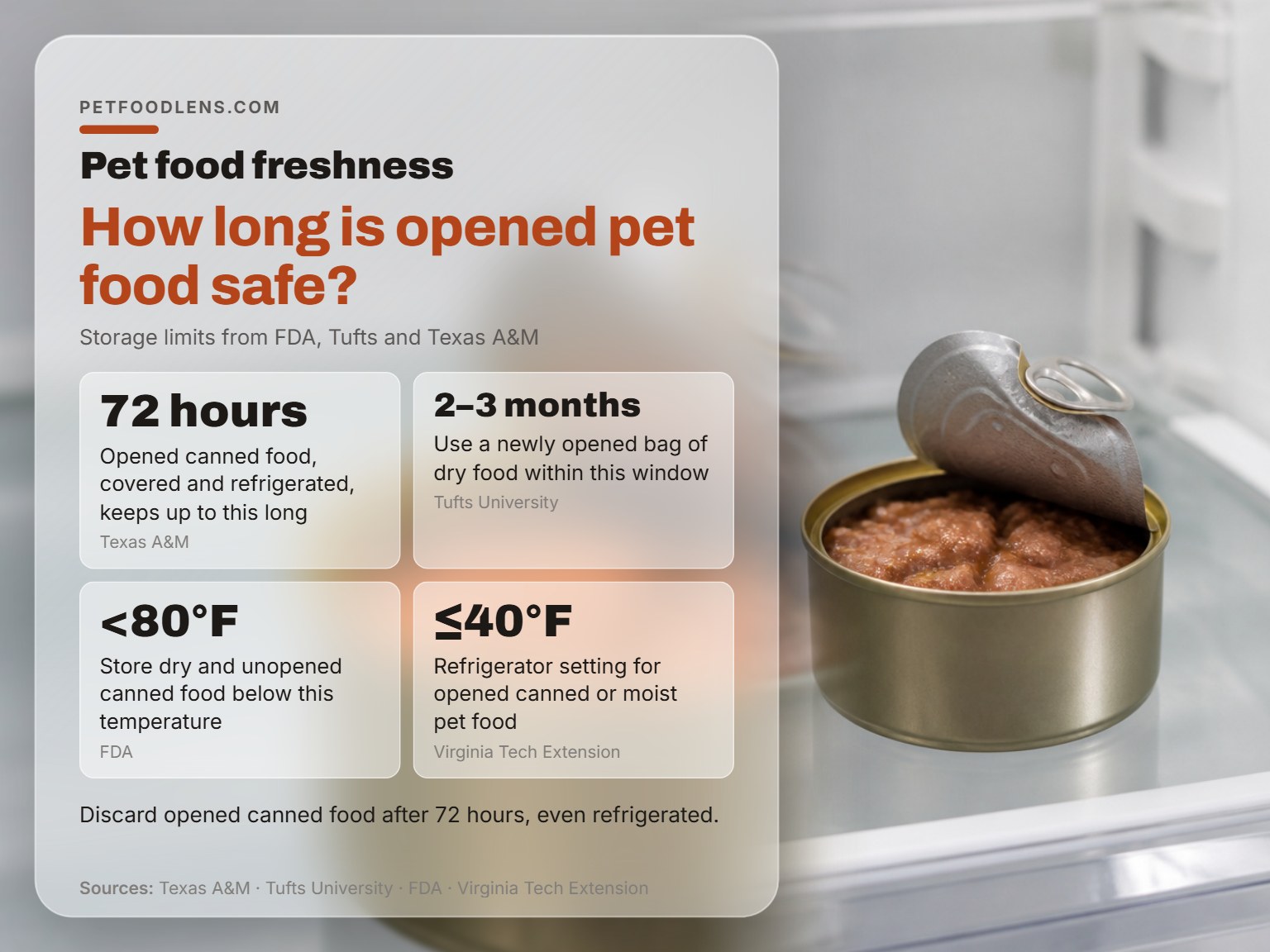
To keep pet food fresh, store dry food and unopened cans below 80F, refrigerate opened cans at 40F or below, and use an opened bag within 2 to 3 months. Keep kibble in its original bag inside the container, never poured loose.
The poured-loose habit is a costly one, because a bin is where kibble goes to oxidize, and it is the opposite of how to keep pet food fresh. Fat residue on the container walls turns rancid, and every fresh scoop lands on top of it.
What follows covers the temperature numbers, the container question, the 72-hour canned-food clock, and the spoilage signs that show up well before mold does.
Key Takeaways
- Below 80F for dry food and unopened cans; heat and humidity break down the nutrients inside.
- 40F or below for the refrigerator, though Hong Kong’s AFCD sets 0-4C, which lands colder than the US figure.
- 2 to 3 months is the real post-opening window for kibble, and that number comes from Tufts, not from FDA.
- 72 hours is the limit for opened canned food, even refrigerated.
- Keep the original bag inside the container; the lot number on it is your only lifeline in a recall.
The Bag Beats the Bin Every Time
Everyone tells you to buy an airtight container. The bag inside that container does more work than the container does.
FDA is explicit about this. Put the entire bag into the storage container rather than pouring the kibble in. Tufts reaches the same conclusion from the other direction: manufacturers formulate and shelf-life test a food in its original packaging, so decanting throws away protection that was measured in a lab.
Dry pet food is formulated and shelf-life tested inside its original packaging. Decanting kibble into a bin removes that tested barrier, exposes the fat coating to ambient oxygen, and strips the lot number and best-by date off the product at the exact moment a recall would make them useful.
The lot number point deserves its own paragraph, because it is not a hypothetical. FDA veterinarian Lauren Carey has said the lot number, best-by date and full product name are what the agency needs when you file a complaint. Less than half of the pet food complaints FDA receives include the lot number at all.
So the bag does two jobs. It slows oxidation, and it carries the paper trail.
| Move | What it does | What it costs you |
|---|---|---|
| Pour kibble loose into a bin | Exposes fat to air and to old residue | Rancidity can start early |
| Bag inside the bin | Keeps the tested barrier and the label | Ten seconds of your time |
| Top up an old bin with new kibble | Layers fresh food onto stale fat | The whole batch tastes off early |
| Wash and dry between bags | Removes fat film and storage mites | Real drying time |
If you want to compare specific bins, the practical difference between them comes down to lid seal and how easy the interior is to dry. Our breakdown of storage containers covers which shapes actually seal. The FDA pet food storage guidance is worth reading in full for the container language alone.
Three things to do with the bag itself:
- Squeeze the air out before you seal it, then close it with the bag’s own seal, a clip, or tape.
- Tape the label information to the outside of the bin if you ever do pour, and change it when you open a new bag.
- Store the whole setup off the floor, which is the cheapest pest control you will ever buy.
That third one matters. Rodents find a floor-level bin. They rarely find a shelf.
What Temperature Actually Keeps Kibble Fresh?
80F is the ceiling for how to keep pet food fresh, and it is a ceiling plenty of kitchens cross in July.
FDA sets a single number: dry pet food and unopened canned food should be stored below 80F. Virginia Tech Extension repeats it. Tufts adds low humidity to the same figure and warns that pet food shouldn’t get too cold either, so an outdoor shed in February is the wrong answer.
Then there’s the refrigerator, where the sources genuinely split.
| Source | Dry and unopened cans | Refrigerated | Frozen |
|---|---|---|---|
| FDA | Below 80F | 40F or below | Not specified |
| Virginia Tech Extension | Below 80F | 40F or below | Not specified |
| Tufts (Freeman) | Below 80F, low humidity | No separate figure given | Avoid freezing |
| AFCD (Hong Kong) | Cool and dry, no number given | 0-4C | -18C or below |
Read the refrigerated column twice. FDA and Virginia Tech both say 40F or below. The Hong Kong pet food safety guidelines say 0-4C, which converts to roughly 32-39F. That is colder than the US ceiling, not a contradiction of it.
Both positions are defensible. FDA writes a single safe maximum. AFCD writes a cold-chain range for a jurisdiction that handles imported product. If your fridge sits within the AFCD range, you satisfy both.
The Virginia Tech pet food safety guide is the more useful document for a household, because it also covers keeping food away from small children and out of a pet’s reach. A dog that eats an entire supply in one sitting is a veterinary visit, not a storage problem.
Where the freezer advice splits
Tufts warns against storing pet food where freezing temperatures are possible, because freezing alters quality. AFCD treats -18C as the correct target for frozen product.
Both are right, and the variable is what you bought. A frozen raw diet is formulated to be frozen. A can of pate is not. Freeze the first, don’t freeze the second.
How Long Does Opened Pet Food Actually Last?
Tufts puts opened dry food at 2 to 3 months. FDA puts no interval on it at all, only an instruction to use it before the best-by date.
That gap is worth naming, because it tells you something about how the numbers get made. FDA writes a floor that applies to every product on the shelf. Tufts, through nutritionist Lisa M. Freeman, writes a working recommendation for a real household. The 2 to 3 months figure is the more useful one, and it is a university recommendation rather than a regulatory limit.
Canned food is tighter. Tufts says discard opened canned food after 72 hours even if it has been refrigerated. Texas A&M’s Dr. Katie Tolbert gives the same window, describing it as up to 72 hours covered in the fridge. FDA declines to name a number and simply says to refrigerate or discard leftovers promptly.
So 72 hours is the consensus, and it comes from two universities rather than from a regulator. Treat it as a ceiling.
If one bag of kibble lasts your cat longer than three months, buy the next size down. Food you finish beats food you abandon, and the math favors the smaller bag once you count what gets thrown out.
Two product types run shorter than the general window. Texas A&M notes that foods with more fat, especially polyunsaturated fat, have a shorter shelf life. Tufts singles out fish-oil-heavy diets for the same reason. If your cat eats a fish-oil-heavy formula, expect a shorter shelf life than the 2 to 3 month figure.
Dry food: the 2 to 3 month window
Once a bag is opened, the clock starts. Tufts recommends using it within 2 to 3 months and buying smaller bags if your current bag runs longer than that.
Unopened bags are a different question. Those should be used before the best-by date on the label, and that date is printed for a reason.
Canned food: the 72 hour clock
Opened cans get 72 hours refrigerated, per Tufts and Texas A&M. FDA gives no number but does say to refrigerate or discard promptly, which is not permission to leave a can on the counter overnight.
For the full procedure on portioning and covering, our guide to opened canned food walks through it. If you’re storing a dry formula specifically, the same rules apply with a longer clock, and our notes on dry dog food cover the bag handling in detail. Reading the date codes correctly is its own skill, and expiration dates explains what the printed formats actually mean.
How to Keep Pet Food Fresh When You Buy in Bulk
A large bag, one cat, and a pantry shelf. That combination can run for months of feeding, which means much of the bag spends a long time oxidizing before the cat ever sees it.
I’ve told people to buy what they’ll finish well within the 2 to 3 month window. That’s stricter than the 2 to 3 months Tufts allows, and it’s deliberate. The per-pound savings on a bigger bag evaporate the moment half of it gets tossed or the cat quits eating it.
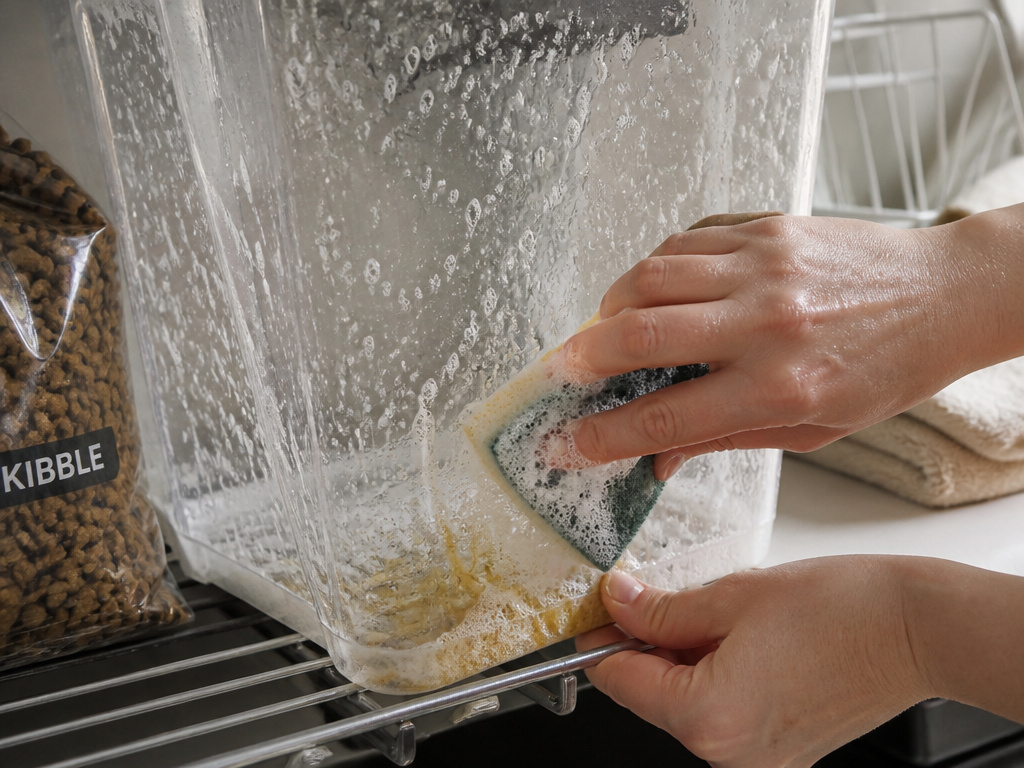
The failure mode I keep running into is layering. I emptied out a bin at the bottom of a pantry once and found a yellowish, tacky film on the walls and a sharp crayon-and-paint smell coming off it. Months of fresh kibble had been poured over that residue. Every new batch met old oxidized fat on day one, and the owner couldn’t understand why her cat had gone off a food she hadn’t changed.
That smell is the tell. Rancid fat doesn’t announce itself as rot. It smells like a pencil box or a cheap crayon, and it clings to the plastic.
Common mistake: Topping up a half-empty bin with a new bag. Fresh kibble lands on stale fat residue, the whole batch picks up the off note within days, and you blame the manufacturer for a problem sitting in your pantry.
If you do use a bin, empty it completely and wash it with hot soapy water between bags. Dry it fully. Damp plastic plus fat residue is a genuinely bad pairing.
Texas A&M’s Tolbert makes the same point about plastic containers and adds the part most owners miss: residual crumbs and fat harbor dust mites and other parasites. Tufts notes that storage-mite contamination can trigger allergies in dogs and cats, which is one reason a food allergy diagnosis sometimes turns out to be a storage problem.
Keeping the bin clean also keeps pests out, and the two problems tend to arrive together. Treat bags are their own case, and pet treats covers the shorter timelines that apply to an open bag of soft chews.
Freezing Leftovers Works, With Two Hard Rules
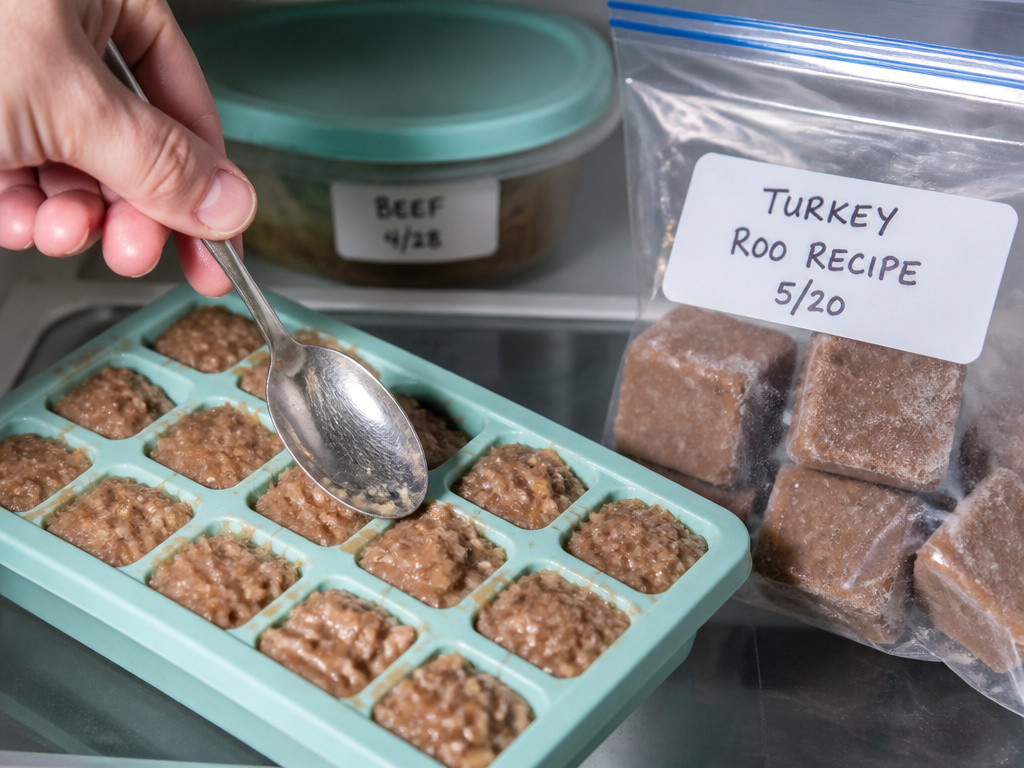
Freezing leftover wet food is fine. Refreezing it is not.
AFCD is blunt on this: never refreeze pet food once thawed. CDC adds the thawing method, which is in the refrigerator, in a sealed container, kept separate from other foods. Virginia Tech allows the refrigerator or the microwave, provided the food sits in a secondary container so it doesn’t leak onto anything else.
For a cat eating a third of a can at a time, spooning the remainder into an ice cube tray or small silicone molds, freezing it, then bagging the cubes works well. Pop out one or two the night before and thaw in the fridge.
Here’s the sequence that keeps it safe:
- Portion the leftover into molds or tray wells while the food is still cold from the fridge.
- Freeze solid, then transfer the cubes to a labeled bag so they don’t pick up freezer odors.
- Move one or two cubes to the refrigerator the night before you need them.
- Stir before serving, and discard anything that has already been thawed and refrozen.
Some gravy styles separate on thawing. A quick stir usually fixes it, and cats can be picky about texture regardless.
Where this goes sideways: Thawing a cube on the counter because you forgot to move it the night before. The outside warms into the danger zone while the middle stays hard, and you’ve built a bacterial gradient in a portion you were trying to be careful with.
The Tufts caution about freezing applies here too, and it’s about quality rather than safety. Freezing changes texture and can degrade nutrients. That’s an argument for freezing promptly, not for leaving the can in the fridge for four days first.
Our guide to freezing covers portion sizes and container choices in more depth.
Does Your Kibble Smell Like a Pencil Box?
That question is a quick spoilage test, and Texas A&M recommends exactly this approach.
Tolbert describes the color and smell test as an accessible tool a pet owner has for spotting rancidity, which is the chemical change that turns fats and produces off flavors. If the color of the food looks different from previous batches, or the smell has changed, don’t feed it. Contact the company, because a single bad bag is sometimes the front edge of a wider problem.
AFCD lists the stop signs plainly: unusual odor, mold growth, discoloration, or damaged packaging. Any one of those is a stop, not a judgment call.
Watch for these before you scoop:
- A sour or crayon-like smell that wasn’t there when you opened the bag.
- Kibble that has gone matte and dusty instead of holding a slight sheen from its fat coating.
- A can that is swollen, leaking, or hisses when opened.
- Any foreign object in the food, which FDA lists as a reportable problem.
- A pet that got sick after eating a specific product.
The reporting side matters. FDA encourages complaints to both the agency and the manufacturer, and the lot number is what lets either one trace the problem back to a production run. That number is usually printed near the expiration date, and it’s a very useful thing on the bag.
Our guide to spoiled food goes deeper on the smell and texture changes worth watching for.
I keep the empty bag until the new one is open. Not for sentiment. If the cat turns her nose up at a fresh bag, the old label is the only place the previous lot number still exists, and that comparison is what a manufacturer needs.
Raw and Fresh Diets Follow Different Rules
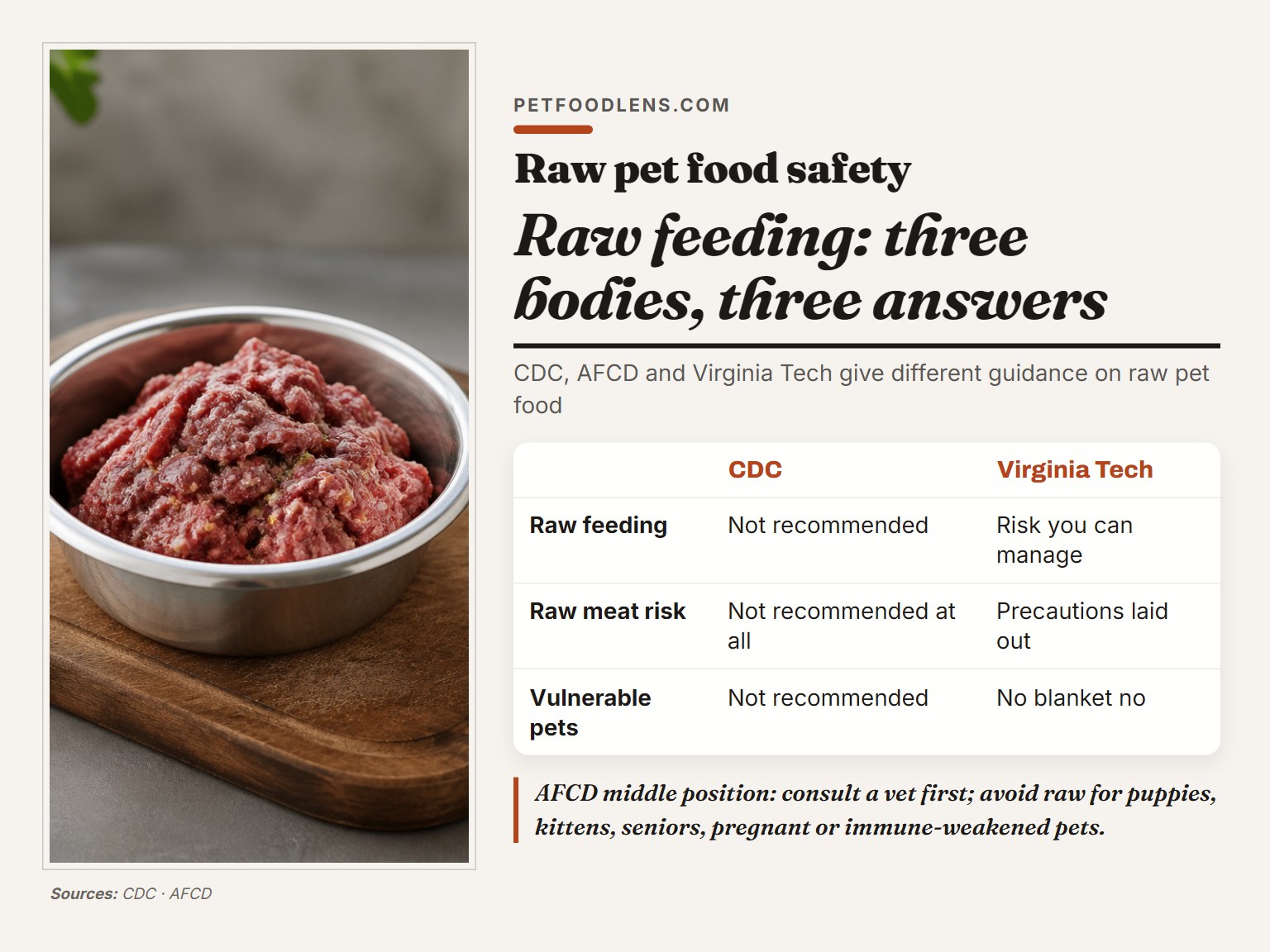
Three credible bodies looked at raw feeding and did not all land in the same place, and the article would be lying if it pretended otherwise.
CDC does not recommend feeding raw pet food or treats to dogs and cats at all. AFCD takes a middle position: raw meat often carries Salmonella and E. Coli, so consult a veterinarian first, and avoid raw entirely for puppies, kittens, senior pets, pregnant pets, and any animal with a weakened immune system unless a vet has specifically instructed it. Virginia Tech doesn’t issue a blanket no. It lays out precautions and treats raw feeding as a risk you can manage.
Before you start: Raw meat carries Salmonella and E. Coli, so don’t rinse it, because rinsing splashes bacteria across the sink and counter. Use a dedicated cutting board and disinfect every surface it touches. Don’t let the pet lick your face afterward, and wash your hands before and after handling.
The practical rules converge even where the recommendations don’t. Freeze raw product until you’re ready to use it. Thaw it in the refrigerator, sealed, away from other food. Never refreeze once thawed. Clean and disinfect countertops, utensils, bowls, the inside of the fridge and microwave, and cutting boards.
Fresh refrigerated diets are a separate case again. CDC notes these are cooked food with fewer or no preservatives, which means they need refrigeration and don’t keep as long as kibble or canned food. The 80F pantry rule is not the relevant guidance for them.
If you’re preparing food at home, homemade food has its own handling requirements, including cooking ingredients to proper internal temperatures measured with a food thermometer.
Frequently Asked Questions
Should I put the whole bag in the container or pour the kibble in?
Put the whole bag in. FDA and Tufts both recommend it, and the reason is that the original packaging is what the manufacturer shelf-life tested. Pouring loose kibble into a bin also separates the food from its lot number and best-by date, which is exactly the information you need if there’s a recall.
How long does opened canned pet food last in the refrigerator?
72 hours, covered and refrigerated. Tufts and Texas A&M both give that figure. FDA doesn’t name a specific time limit and simply says to refrigerate or discard leftovers promptly, so treat 72 hours as the working ceiling rather than a regulatory standard.
Can I freeze leftover wet food?
Yes, and it works well for cats eating a partial can at a time. Portion into molds, freeze, then bag the cubes. Thaw in the refrigerator overnight. AFCD is clear that you should never refreeze pet food once it has been thawed.
Does a cold garage count as cool storage for dry food?
Not reliably. Tufts warns that pet food shouldn’t get too cold and specifically advises against storage where freezing temperatures are possible, because freezing alters quality. A garage that swings from hot summer temperatures to below freezing in winter fails on both ends.
How do I know if the food has gone bad without opening it?
You often can’t, and that’s the honest answer. Texas A&M’s guidance is a color and smell test once the bag is open. For cans, watch for swelling, leaking, or a damaged seal, which FDA lists as reportable problems. A foul odor or a foreign object is a stop either way.
Is grain-free food more stable in storage?
Grain-free is a marketing category, not a storage category. What actually shortens shelf life is fat content. Texas A&M notes that foods with more fat, especially polyunsaturated fat, spoil faster, and Tufts singles out fish-oil-heavy diets for the same reason. A grain-free formula with a high fat load goes off sooner than a grain-inclusive one with less.
The Bottom Line
The 2 to 3 month window is an outer limit, not a target. Tufts gives it as an outer limit for opened dry food, and the sources cited here agree that fat, heat, air and humidity all push you toward the short end of it. If your cat is eating from a bag that’s been open a long time, the food may still be technically within the window and still not what you think it is.
Here’s the step to take this week. Go pull the bag out of your pantry and read the lot number off it out loud. If you can’t find it because the kibble is sitting loose in a bin, you’ve just found your first fix, and it costs you one empty container and a little time.
One concession worth stating plainly: none of this matters much if your cat is on a therapeutic diet. Your vet’s instructions override everything above. I’m not a veterinarian, and storage advice is where my input stops.
For everything else, the rule is boring and it holds. Keep the bag, keep it cool, keep it dry, and finish it before the fat turns.
