
How to Store Dry Dog Food: Step-by-Step
This post contains affiliate links. As an Amazon Associate, we earn from qualifying purchases.
The short answer to how to store dry dog food: keep it in the original bag, squeeze the air out, and hold it below 80 degrees F in a dry spot. FDA, Virginia Tech, and Tufts all set that same ceiling, though a Park & Lee study found dry food safe up to 95 degrees F for 120 days, and the original bag carries the lot number you need if the food is ever recalled.
That lot number is the first thing to go when you look into how to store dry dog food. Fewer than half of the pet food complaints FDA receives include one, and without it the agency has a harder time tracing a problem back to a specific production run. The bag is the record.
What follows is the temperature argument, because the sources genuinely disagree, then the container setup, the realistic life of an opened bag, and the four ways storage goes wrong.
Key Takeaways
- Below 80 degrees F, dry, and indoors is the ceiling FDA, Virginia Tech, and Tufts all publish, though a Park & Lee study found dry food safe up to 95 degrees F for 120 days.
- Keep the kibble in its original bag and put the whole bag inside the bin instead of pouring.
- Opened dry food runs 2 to 3 months by Tufts’ guidance; buy smaller bags if yours lasts longer.
- Never top off an old bin with a new bag, and wash the container between bags.
- Freezing is not a storage fix. Tufts warns against letting dry or canned food freeze.
The 80 F Ceiling, and the Study That Says 95 F
Three separate sources land on the same number for dry dog food storage: below 80 degrees F, while a Park & Lee study found dry food safe up to 95 degrees F for 120 days.
Dry dog food keeps best below 80 degrees F in a cool, dry location. Heat and moisture break down nutrients and turn fats rancid, while humidity creates conditions for mold and bacterial growth. The original packaging is tested for shelf life by the manufacturer, so food left in the original bag holds quality longer than food decanted into an unsealed bin.
FDA states it plainly for dry food and unopened canned food. Virginia Cooperative Extension’s FST-433 repeats the same ceiling. Tufts adds the word “ideally,” which is the same number wearing a hedge.
Then there’s the lab work, and it goes higher. Park & Lee stored dry pet food at 25 C and 35 C (95 F) for 120 days in unsealed plastic film bags at 40% relative humidity, sampling on days 0, 30, 90, and 120.
| Source | Upper limit | Basis |
|---|---|---|
| FDA | Below 80 F | Federal storage guidance |
| Virginia Tech Extension (FST-433) | Below 80 F | Consumer food-safety publication |
| Tufts (Cummings School) | Ideally under 80 F | Veterinary nutrition review |
| Park & Lee (PMC study) | 95 F for 120 days | Controlled lab trial, 40% humidity |
The results were flat. No microorganisms were detected at either temperature across the full 120 days. Water content on day 120 came in at 17.1% at 35 C versus 17.5% at 25 C, a spread of 0.4%. PH drifted from 6.26 to 6.20 at the higher temperature, which the authors call practically insignificant.
Volatile basic nitrogen, the marker that tracks protein breakdown, started at 7.9 mg/100 g and rose by 1.2 mg/100 g from day 90. The decay standard is 20 mg/100 g. It never came close.
I still run 80 degrees F in my own kitchen. The study pinned humidity at a fixed 40% and used unsealed film bags, which is a lab condition rather than a July kitchen. Humidity is the variable FDA and Tufts both flag for mold and rancidity, and the trial never tested it high.
A bag that’s gone over usually announces itself before you scoop it. Signs of spoilage covers the visual and smell cues.
What the Original Bag Does That a Decorative Bin Doesn’t
I emptied a pantry bin once and found a yellowish, tacky film on the walls and a smell like crayons and house paint. Months of fresh kibble had been poured in on top of that residue, so every new bag met oxidized fat on day one.
That film is what fat does when it sits exposed on plastic. Tufts notes that air exposure breaks nutrients down faster and can introduce environmental bacteria. The bin isn’t the problem. The refilling is.
The bag is doing real work. Manufacturers test shelf life in the original packaging, and the bag is a barrier against oxygen, pests, and storage mites. Tufts points out that mites can invade through defective seals, so a pinhole near the seam matters as much as an open lid.
Squeeze the air out after every feeding and close the bag with its own seal, a clip, or tape.
Before you start: Pet food carries the same bacteria as any raw food ingredient, so wash your hands for at least 20 seconds before and after handling it. Don’t use the dog’s bowl as a scoop, because that’s the fastest route to cross-contamination in a kitchen. Store the bag where a child or a determined dog can’t reach it, since eating a full supply at once can cause vomiting, diarrhea, or worse.
The Label Information You Lose by Pouring
Pour the kibble out and you throw away the four pieces of information that matter in a recall.
- The UPC code, so the product can be identified at the shelf level.
- The lot number, which is the one that actually gets used.
- The brand and exact product name, because “chicken and rice” describes forty different bags.
- The best-by date, which tells you how much of the window you’ve already burned.
FDA’s workaround is blunt: tape that information to the outside of the container and change it when you open a new bag. Virginia Tech offers the modern version, which is to photograph the label and keep it on your phone.
Most of the dog food storage advice you’ll read starts with the container. That’s backwards. The container is the last decision, not the first.
How Long Does Opened Dry Dog Food Actually Stay Good?
Tufts puts the window at 2 to 3 months after the bag is opened.
That figure assumes the bag is sealed and stored cool. If a bag lasts longer than that in your house, the fix is a smaller bag, not a better container. Tufts says the same thing directly: buy smaller bags if your food outlasts the window.
I aim closer to the shorter end of that window in my own kitchen. That’s a preference, not a finding, and I’d rather tell you that than dress it up as research. The Tufts number is the one with a veterinary nutritionist’s name on it.
| Situation | Use within | Why |
|---|---|---|
| Unopened dry food | Before the best-by date | The label date is the manufacturer’s tested limit |
| Opened dry food, sealed and cool | 2 to 3 months | Tufts’ post-opening guidance |
| Leftover canned food | 40 degrees F or below, used promptly | FDA refrigeration guidance |
One more thing that doesn’t get said often enough: the clock starts at opening, not at purchase. A bag that sat unopened in a cupboard is still fresh on the day you open it, and stale three months later.
The pet food freshness question is mostly a question about air and temperature, and both are things you control.
The Container Setup That Survives a Determined Dog
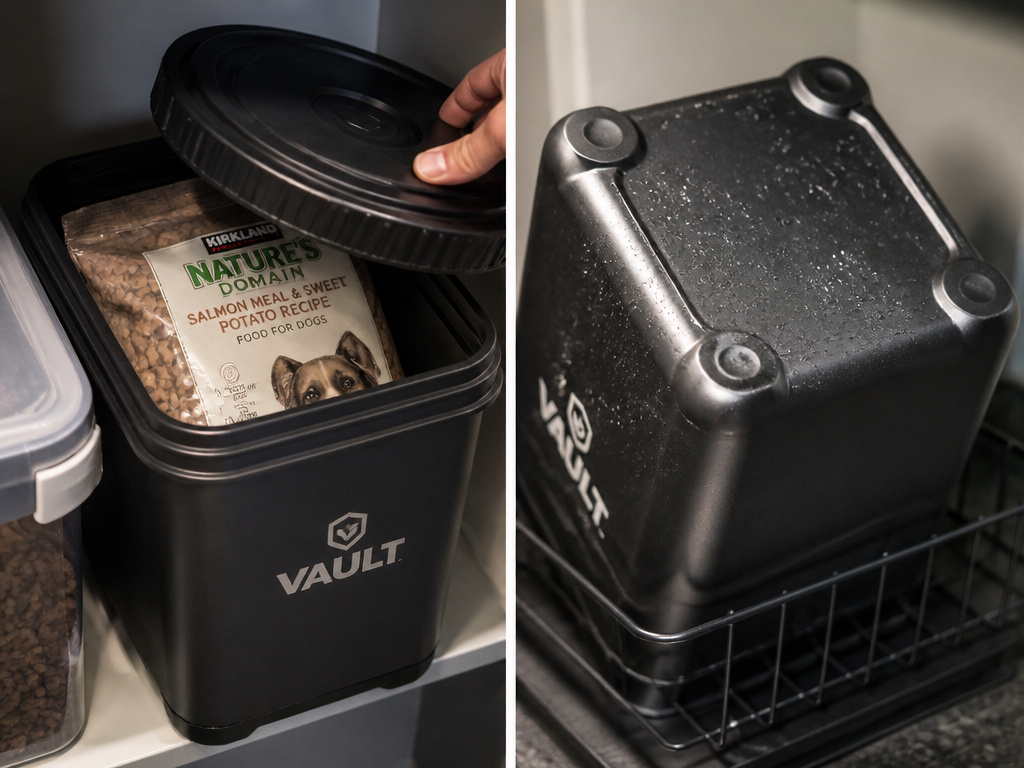
Buy the bin for pests and dogs. Freshness comes from the bag.
Tufts recommends the whole bag inside an airtight container, and if that isn’t practical, a tightly sealed bag out of reach. Either way, the bag stays in the chain.
A molded vault-style bin with a threaded lid is the one I’d buy for a large bag. The lid threads on, the body is a single molded piece, and there’s no gasket to lose or dry out. A budget airtight pet food container stacks in a closet without wasting much space. If you already own a bucket, a threaded, gasketed lid turns it into a sealed bin.
Some dogs defeat bins outright. Tufts notes that resourceful pets can open storage containers, which is when you move the food to a room the dog can’t enter.
I won’t store kibble in a bin without the bag inside it. The bag is the barrier and the bin is armor. Skip the bag and you’ve traded a sealed, labeled package for a plastic box that holds air and crumbs.
Bag-In-Bin vs Pour-In
Bag-in-bin wins on every measure that matters. You keep the manufacturer’s barrier, you keep the label intact, and you never have to reconstruct a lot number from memory.
Pour-in is workable, and FDA treats it as a fallback rather than a failure. It costs you the label unless you tape or photograph it, and it costs you the packaging barrier permanently. For a food you’ll finish within Tufts’ 2 to 3 month window, that’s a fair trade. For a bag that takes longer than Tufts’ 2 to 3 month window, it isn’t.
Where this goes sideways: A bin that never fully dries. Damp plastic plus fat residue is a bad pairing, and moisture wicks into the next bag within days. Drying takes longer than people expect, so leave it upside down to air-dry rather than toweling it and calling it done.
The dog food containers worth owning are the ones you can empty, wash, and dry completely. If you can’t get your hand to the bottom corner, it’s the wrong shape.
Does Dry Dog Food Go Bad Faster in the Garage?
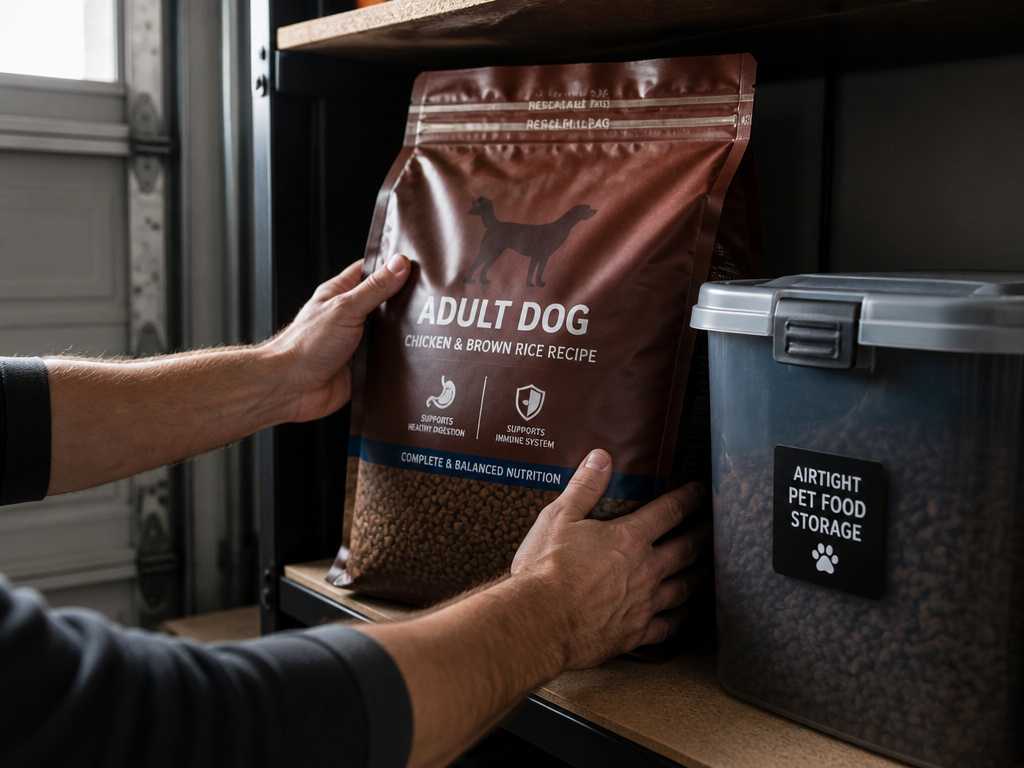
The garage is the worst place in the house for a bag of kibble.
The Pet Food Institute says it outright: don’t leave the bag on the floor in the garage or outside. Tufts adds that food should be stored off the floor to minimize pests. FDA and Virginia Tech point at a snug lid instead, which is a different mechanism aimed at the same risk.
Cold Is a Failure Mode Too
Most guidance gives you a ceiling and forgets the floor. Tufts warns against storing pet food outdoors where freezing temperatures are possible, because pet food shouldn’t get too cold. Canned food is the same story: Tufts says canned food should not be allowed to freeze.
Pests: Lid, Height, or Both?
Both, and the sources split on which one carries the load. Tufts favors height. FDA and Virginia Tech favor the snug lid. A sealed bin on a shelf satisfies all three positions at once, which is why I don’t argue the point.
Here’s what actually goes wrong, in rough order of how often I see it:
- Topping off. New kibble poured over old residue starts oxidizing immediately, and the whole batch tastes stale.
- The garage or shed. Heat in summer, freezing in winter, and rodents year-round.
- A bag left open. Air breaks down nutrients and invites storage mites through any weak seal.
- A damp bin. Residual moisture plus fat is the setup for mold, and it doesn’t take long.
Rancid fat has a smell. It’s flat and slightly painty. If you catch that on opening, the food is past useful.
The part nobody mentions: The Park & Lee trial fixed humidity at 40%. A humid kitchen runs well above that, and high humidity is exactly what FDA and Tufts flag for mold and rancidity. The 35 C finding doesn’t automatically transfer to a humid house.
Pests get in through seams, not just open lids, which is why keeping pet food away from pests starts with inspecting the bag before it goes in the bin.
How to Store Dry Dog Food in a Bin Without Losing the Lot Number
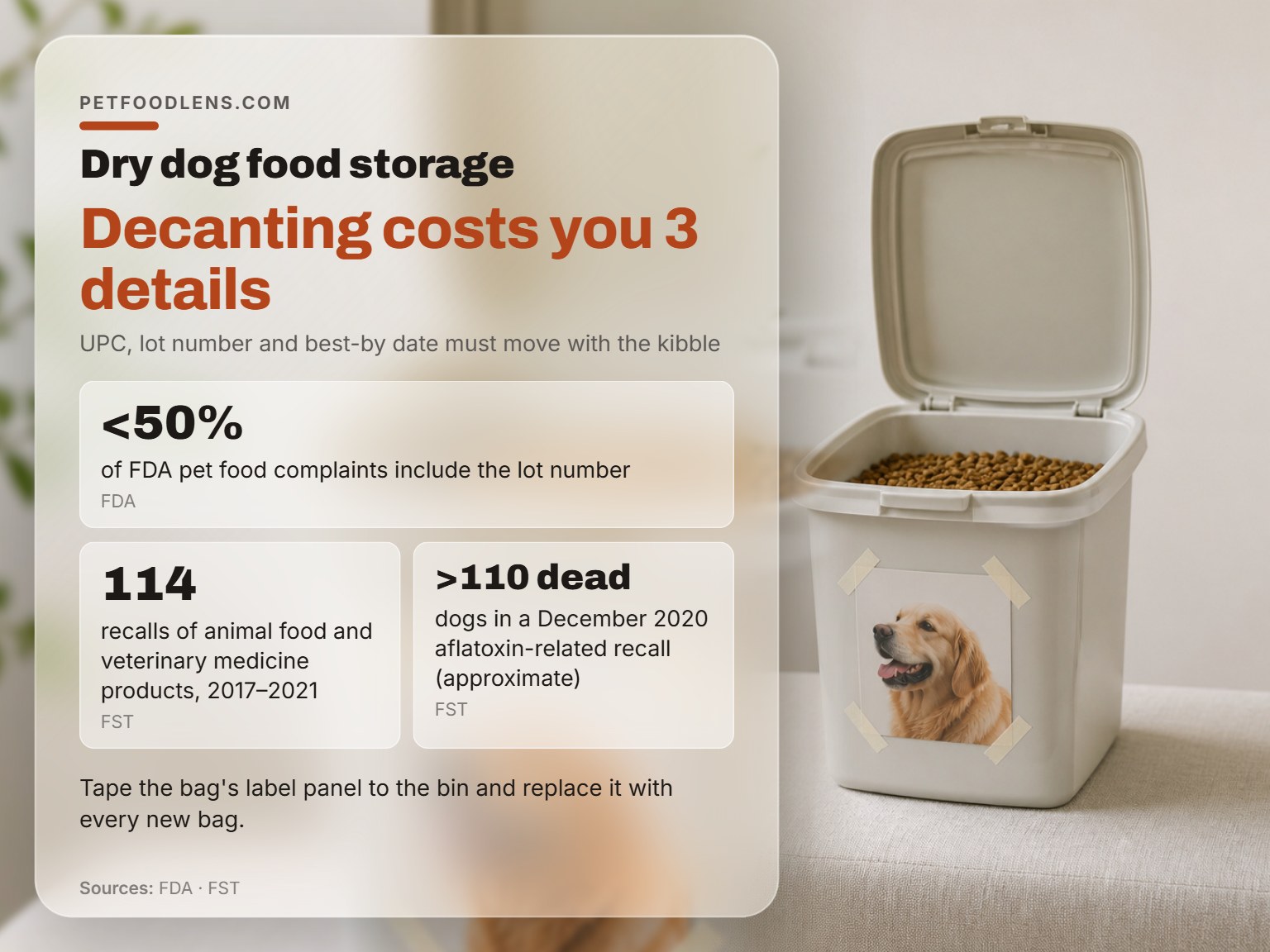
Decanting costs you three pieces of information unless you plan for it.
- Finish the old bag completely before adding new food. Mixing old and new means the fresh kibble sits against stale fat from day one, and you’ll blame the new bag for a staleness it didn’t cause.
- Wash the container with hot soapy water and dry it fully. Residual fat and crumbs come off the walls, which is the whole point. Drying fully matters as much as washing.
- Cut the label panel off the bag and tape it to the container. UPC, lot number, brand, best-by date, all in one piece.
- Replace that panel every time you open a new bag. A label from three bags ago is worse than no label, because it points a recall investigation at the wrong lot.
- Keep the lid snug between feedings. A lid that fits properly keeps freshness in and rodents out, and it’s the one piece of hardware FDA, Virginia Tech, and the Pet Food Institute all name.
A container without the lot number on it is a decorative box. The food inside might be perfectly fine, and you’ve still given up your ability to trace it.
The Virginia Tech pet food safety guide is worth reading in full if you want the handling side, not just the storage side. It also carries the number that should get your attention: 114 recalls of animal food and veterinary medicine products between 2017 and 2021.
One of those, in December 2020, involved dog and cat food made with an aflatoxin-contaminated ingredient. More than 110 dogs died and more than 210 got sick, by Virginia Cooperative Extension’s approximate figures. That’s the scenario the lot number exists for.
If you want a container that closes properly and comes apart for cleaning, the airtight dog food containers worth shortlisting are the ones with a removable gasket. And if you’re still deciding between a molded vault and a bucket setup, storage bins covers the trade-offs.
Frequently Asked Questions
Should I keep dry dog food in the refrigerator?
No. Refrigeration adds moisture and condensation every time you pull the bag out, and dry food is formulated to sit at room temperature. FDA’s 40 degrees F refrigeration rule applies to leftover canned and pouched food, not kibble.
How can I tell if dry dog food has gone bad?
Smell it first. Rancid fat reads as flat and slightly painty, and the kibble may feel soft or clump together instead of falling apart. Visible mold or a swollen, leaking can means discard it and report the problem to FDA and the manufacturer.
Can I freeze dry dog food to extend its life?
Tufts advises against it. Pet food shouldn’t get too cold, and freezing temperatures are one of the reasons outdoor storage is a bad idea. Use the 2 to 3 month opened-bag window and buy smaller bags instead.
Is a plastic storage bin better than the original bag?
For pests and for keeping a determined dog out, yes. For freshness, no. Tufts recommends the entire original bag inside the airtight container, because the packaging is what the manufacturer tested shelf life against.
Does the 80 degree rule apply to canned food too?
For unopened cans, yes. FDA and Virginia Tech both put unopened canned food under the same below-80 ceiling. Tufts gives canned food a 40 to 80 degrees F range and warns against letting it freeze, consistent with the below-80 ceiling for unopened cans. Once a can is open, cover it and refrigerate at 40 degrees F or below.
The Bottom Line
If your kitchen sits above 80 degrees F, buy smaller bags so the food is used within Tufts’ 2 to 3 month window. Buy smaller bags and the temperature question mostly stops mattering.
The 35 C study result is real and I’m not waving it away. Dry food is more stable than the 80 degree guidance implies, though the study did not test high humidity. What the trial can’t tell you is how your bag behaves at high humidity, because it never tested that.
The one change I’d make in most kitchens this week is to stop pouring. Put the bag in the bin, tape the label to the lid, and wash the bin out between bags. That single habit protects the food and the record at the same time.
