
High-Protein Cat Food Pros and Cons: What Studies Show
This post contains affiliate links. As an Amazon Associate, we earn from qualifying purchases.
High-protein cat food pros and cons split by diagnosis: in 23 healthy cats, a 46% metabolizable-energy diet raised urea nitrogen and urine specific gravity while every value stayed inside the reference range. In cats with kidney disease, that same direction is the problem.
The 46% figure is metabolizable energy, and it doesn’t match the crude protein number on the bag. That gap is where most label comparisons fall apart before anyone reaches the kidney question. Converting the guaranteed analysis to a dry-matter basis is the only way to put a canned food and a kibble on the same footing.
What follows: the ten-week trial data, the two studies that reach opposite conclusions about oxalate risk, the phosphorus confound sitting in the same bag, and the four numbers you need to compare two foods yourself.
Key Takeaways
- Healthy cats kept every renal value inside the reference range on a 46% ME diet across ten weeks, even though urea nitrogen and urine specific gravity rose.
- Cats with kidney disease are a separate case. A CKD study held phosphorus constant on purpose, which tells you the field regards protein and phosphorus as tangled in real products.
- Protein quality moves the urine as much as protein percentage. Hydroxyproline ran 3.76 to 9.44 g/kg dry matter in low-quality canned diets against 2.56 to 4.45 in high-quality ones.
- 52% of high-protein commercial foods cleared 3.6 g phosphorus per 1000 kcal versus 0% of low-protein foods (P=.01), so the badge and the mineral panel pull in the same direction.
- The oxalate verdict is genuinely split. Two studies reached opposite conclusions, and the difference tracks how much urine the cat was passing.
What “High-Protein” Actually Means on a Cat Food Label
The 45% line comes from research, not from a regulator. In the feline literature, a diet counts as high-protein when protein supplies more than 45% of metabolizable energy.
Metabolizable energy is the share of a diet’s calories remaining after digestion and urinary losses are subtracted. A diet described as high-protein in the feline literature typically supplies more than 45% of those calories from protein, which is a different measurement than the crude protein percentage printed on a guaranteed analysis.
Metabolizable energy (ME) is what’s left of a food’s calories once the body has taken what it can use and dumped the rest. Crude protein on a guaranteed analysis is a different measurement entirely: a percentage of the food’s total weight, water included.
That distinction matters most with canned food. A wet food listing a modest protein percentage is mostly water, and the dry-matter conversion is what makes it comparable to kibble. Divide the protein percentage by the dry-matter percentage and multiply by 100. That’s the whole calculation.
Three terms do most of the work on a cat food label, and only one of them helps you compare:
- Crude protein is a lab estimate of nitrogen content multiplied by a standard factor. It says nothing about where the protein came from.
- Metabolizable energy (ME) is the calorie basis the research uses, so a 46% ME diet and a 46% protein diet are not the same claim.
- Dry matter basis strips the water out so a can and a bag can sit in the same column.
Get those three straight and the rest of the panel starts making sense.
Where the 45% Line Comes From
The threshold shows up in the research because therapeutic high-protein diets for obesity and diabetes pushed it into common use. Feeding obese diabetic cats a high-protein, low-carbohydrate diet improves glycemic control and enhances insulin sensitivity, which is one of the better-supported uses of the category. If you want the full picture on that application, the high-protein low-carb cat food breakdown covers the numbers.
Protein itself is not optional at any life stage. Protein requirements for cats run higher than for dogs, and deficiencies of arginine, taurine, methionine and cysteine have documented harms. Kitten food has the least room for error, because growth is where a shortfall shows up fastest.
Marketing sits on top of all of it. Grain-free cat food is a category built on an ingredient exclusion, not a protein claim, and the two get blended together on the shelf. The front number and the dry-matter number can tell different stories, and the front number is usually the flattering one.
High-Protein Cat Food Pros and Cons in 23 Healthy Cats
Twenty-three spayed female cats, ten weeks, blood and urine drawn every two weeks.
The crossover design meant every cat ate both diets. One supplied 46% of metabolizable energy from protein, the other 26%. On the high-protein diet, serum urea nitrogen, albumin, alanine aminotransferase and urine specific gravity were significantly higher. Creatinine and phosphorus were significantly lower (P<0.05).
Here’s the part that gets skipped: none of the mean values left the reference interval. Every one of those shifts was diet-induced and still normal.
| Measurement | On the 46% ME diet | On the 26% ME diet |
|---|---|---|
| Serum urea nitrogen | Significantly higher | Lower |
| Creatinine | Significantly lower | Higher |
| Phosphorus | Significantly lower | Higher |
| Urine specific gravity | Significantly higher | Lower |
| Values outside reference range | None | None |
The authors put the creatinine drop down to a higher glomerular filtration rate, which increased dietary protein has been shown to produce. They labeled that as a possible explanation rather than a finding, and the distinction is worth keeping.
Easy to miss: A single creatinine reading can push a well-muscled cat into IRIS stage II on paper. The study authors flagged that risk in their own colony and recommended multiple readings before anyone stages a cat.
Muscle mass is the confounder underneath all of this. These cats were lean and active, and the authors speculated their creatinine reflected muscle rather than kidney function. No DEXA scans were run, so that stays a hypothesis and the paper says so.
One more figure worth carrying: a cited study fed a high-protein diet for 180 days and found no apparent change in lean muscle mass. The same paper speculates that a longer feeding period could raise muscle mass and therefore creatinine. Both readings live in the same source, and both are honest about the uncertainty.
The full dietary protein and renal parameter study is worth reading in the original if you want the analyte table.
Why Does High-Protein Cat Food Split the Oxalate Research?
Because two well-designed studies reached opposite conclusions, and the difference tracks urine volume.
Start with the study that found a problem. Three high-quality diets at 35, 44 and 57% crude protein on a dry-matter basis, plus a 55% crude protein diet built with 34% greaves meal, went to eight cats per group. After 21 days of adaptation and 7 days of sampling, urinary pH sat between 6.34 and 6.66. Higher protein increased urinary calcium, renal calcium and oxalate excretion, and raised the relative supersaturation for calcium oxalate. The authors wrote that this “may be critical for the development of CaOx uroliths.”
Now the study that didn’t. Six canned diets, six weeks per diet in a randomized crossover, with urine and feces collected in the last two weeks of each period. Urine volume ran 24.2 to 34.2 mL/kg body weight per day across all six diets. The authors of one study concluded that a high-protein canned diet “might not be” a specific risk factor for calcium oxalate formation, crediting the urine volume, while another study found high protein increased urinary calcium, renal calcium and oxalate excretion and RSS CaOx, potentially critical for CaOx urolith development.
Same mineral, opposite verdicts. Here’s what separates them:
- The dietary protein and calcium oxalate stones work measured supersaturation on controlled diets without a stated urine-volume target.
- The protein concentration in canned cat diets work measured it on canned diets that pushed urine volume to 24 to 34 mL/kg per day.
- Dry-food equivalents were not tested in either, so nobody knows whether kibble reproduces those volumes.
A fountain doesn’t close the water gap. A cat eating kibble still takes in a fraction of the water a canned-fed cat gets, and moving water around a bowl doesn’t change the arithmetic. Where fountains earn their place is with cats who prefer moving water. Where they fail is maintenance. Run a finger inside an overdue fountain and it comes back with a slick, faintly sour film. Many of the ones I’ve seen in homes were past due.
Read the front of over-the-counter urinary bags and you’ll find the same two verbs: supports and promotes. None of them say dissolves. That verb is the line between a marketing claim and a diet that has been through feeding trials in cats with the condition. The wet cat food format is part of why canned urinary diets work.
Protein Quality Moves the Urine as Much as Protein Percentage
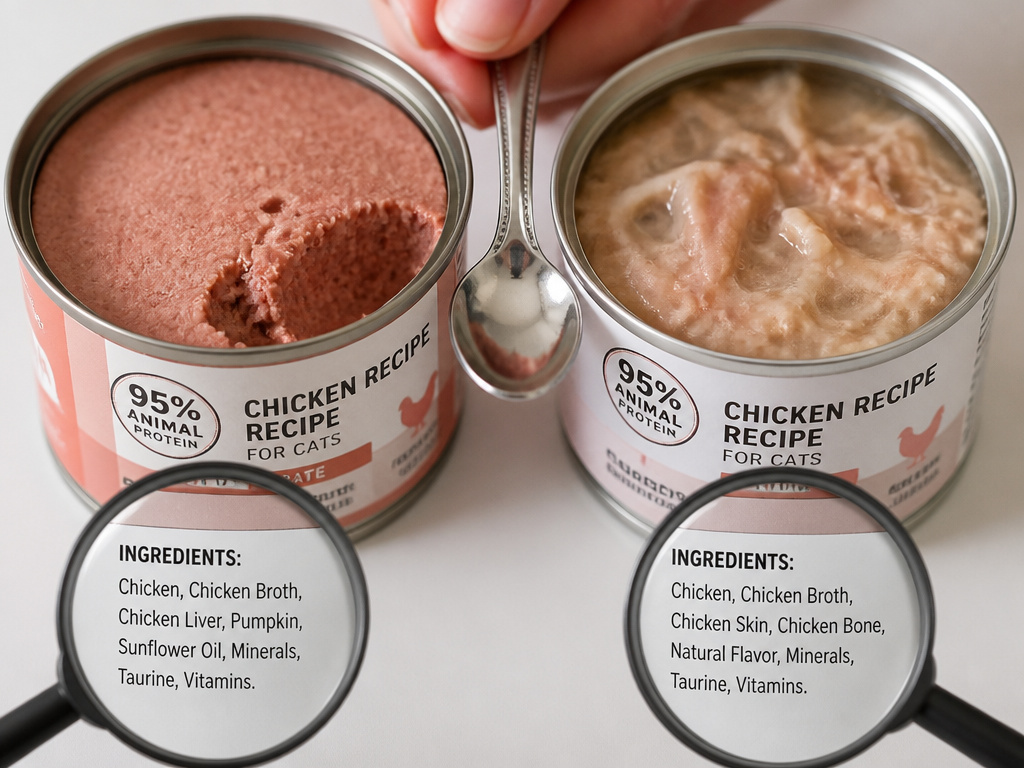
Change the collagen load in a canned food and the urine shifts without the protein percentage moving at all.
I used to treat the protein percentage as the whole story. Then I lined up several formulas side by side and found the extra protein was coming from sources that weren’t doing the same work as the rest of the can. The number went up. The food didn’t get better. That comparison changed how I read a panel.
The canned-diet research makes the same point with numbers. Six diets, six weeks each. Protein levels ran 36.2, 43.3 and 54.9% in the high-quality group and 36.7, 45.0 and 56.1% in the low-quality group. Quality here means collagen load, and hydroxyproline is the marker for it: 2.56 to 4.45 g/kg dry matter in the high-quality diets against 3.76 to 9.44 g/kg dry matter in the low-quality ones.
Body weight rose with protein concentration regardless of quality (P=0.003). Feed intake was higher on the low-quality diets (P=0.026). Fecal volume rose with protein concentration (P<0.05).
Hydroxyproline Is the Quality Marker You Can’t See on a Label
You won’t find hydroxyproline on a guaranteed analysis. It’s an amino acid that shows up in collagen, and collagen-rich ingredients like trachea and greaves meal are cheap protein. A can built on them can hit a high percentage while delivering a different amino acid profile than a can built on muscle meat.
I stopped trusting a protein percentage after comparing cans at the same number and seeing how differently they behaved. Texture is a crude proxy for what’s in the can, and it’s a better first question than the front panel.
Separate research found protein quality driving fecal microbiota outcomes more than concentration. The dietary protein and gut microbiota in cats work used a fixed 1:1 animal-to-plant protein ratio over 90 days in 30 cats, which means its results may not hold for all-plant or all-animal formulations.
Plant protein deserves its own note. Cats increase protein digestibility as dietary protein shifts from animal to plant sources, rising 5.5% at 50% plant protein. That’s the opposite of what happens in dogs. The high-protein dog food comparison runs differently for exactly that reason, and it’s a useful reminder that a plant-heavy formula isn’t automatically a worse one for a cat.
Is High-Protein Cat Food Safe for a Cat With Kidney Disease?
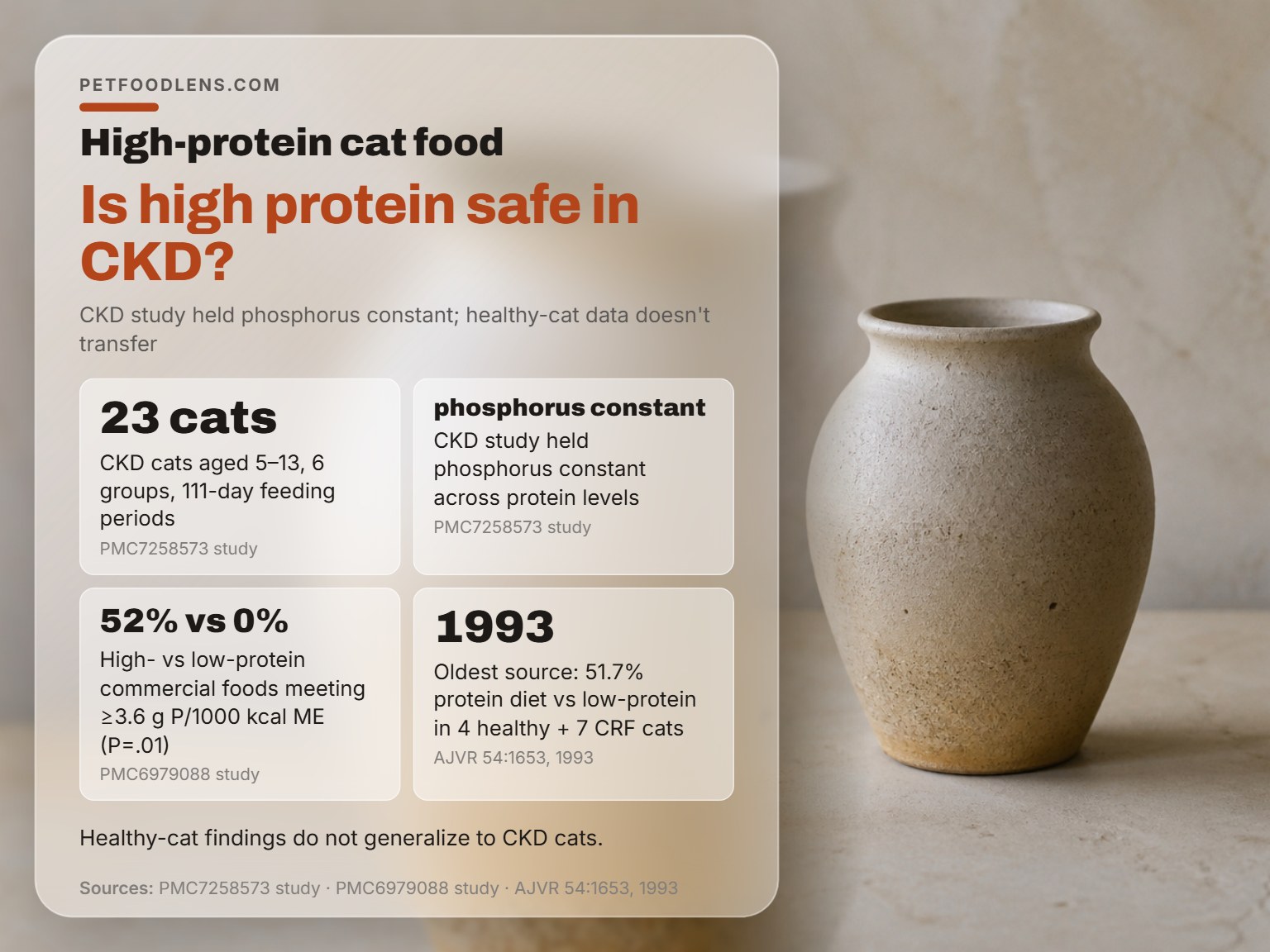
The honest answer is that the healthy-cat data doesn’t transfer, and the CKD-specific study was built differently on purpose.
Twenty-three cats aged 5 to 13 with chronic kidney disease, six groups, 111-day feeding periods, Williams Latin Square design. The critical design choice: phosphorus was held constant across protein levels. That’s the researchers admitting that in real commercial products, protein and phosphorus move together and can’t be separated by reading a bag.
Compare that to the healthy-cat trial, where every analyte stayed inside the reference interval. Those cats had working kidneys. A cat with CKD starts from a different baseline, and the same shift in urea nitrogen means something else entirely.
The oldest source in this body of work dates to 1993, when a 51.7% protein diet was compared against a low-protein diet in four healthy cats and seven cats with surgically induced chronic renal failure. Anyone telling you protein restriction in feline CKD is settled should be dated against that paper.
Skip this if: Your cat has a CKD diagnosis. A high-protein food is the wrong direction for that cat, and the badge on the front of the bag should be read against the diagnosis rather than the marketing.
This is the one place where a therapeutic diet earns its cost, and the protein restriction in them is the point. These are foods formulated for cats with the condition, and swapping them for an over-the-counter lookalike is a decision to run past the vet.
If your cat is older and otherwise healthy, the senior cat food question is about monitoring rather than restriction.
The Phosphorus Number Nobody Prints on the Front of the Bag
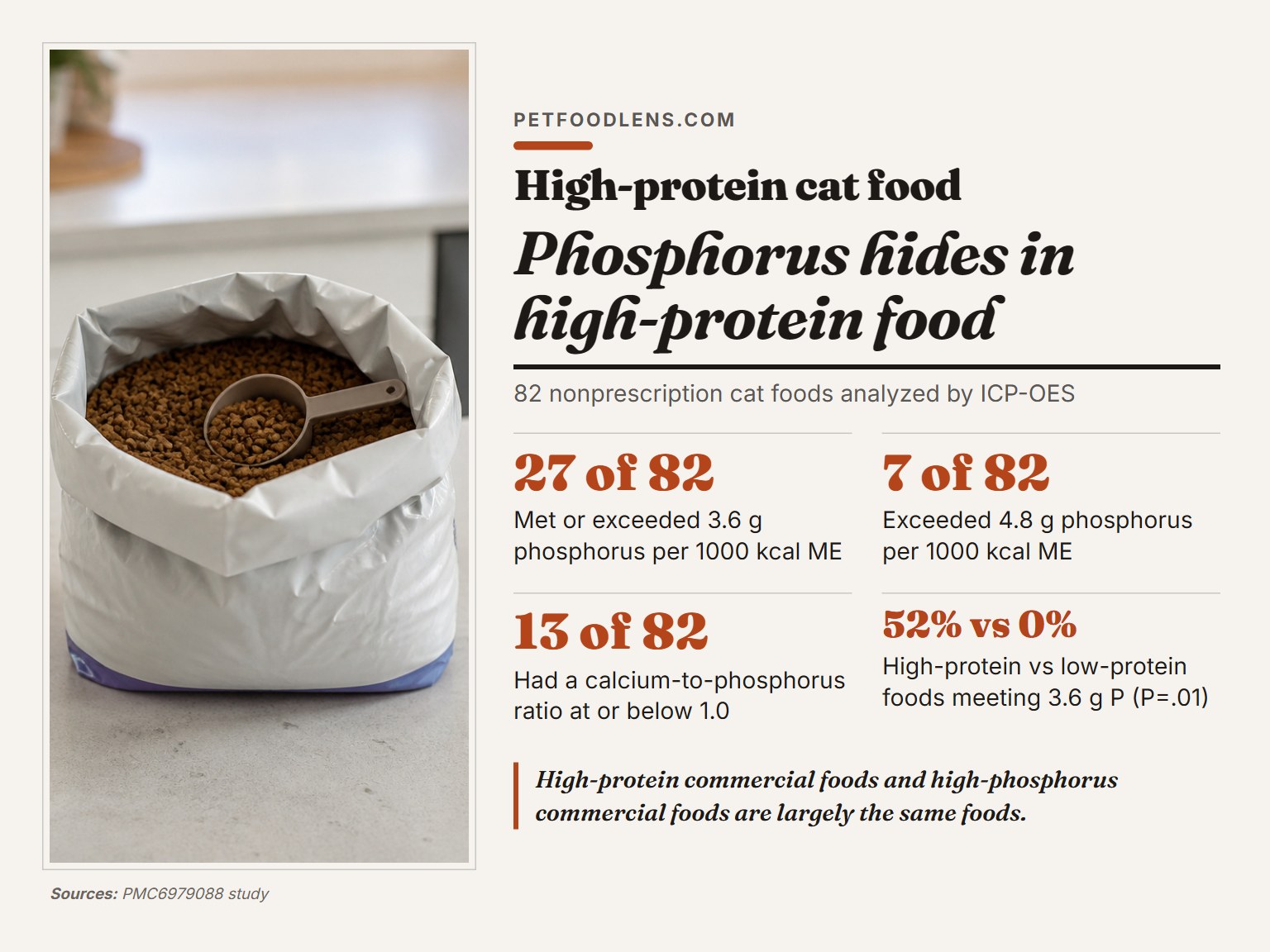
Phosphorus is the number that separates the bags, and it isn’t on the front panel.
A commercial cat food mineral analysis of 82 nonprescription foods, run by ICP-OES, found that 27 met or exceeded 3.6 g phosphorus per 1000 kcal metabolizable energy. Seven went past 4.8. Thirteen had a calcium-to-phosphorus ratio at or below 1.0.
| Threshold | Foods (of 82) | What it means |
|---|---|---|
| 3.6 g P / 1000 kcal ME or higher | 27 | The cutoff the study used to flag high-phosphorus foods |
| Above 4.8 g P / 1000 kcal ME | 7 | Well past that cutoff |
| Calcium:phosphorus at or below 1.0 | 13 | Ratio outside the usual target |
| High-protein foods meeting 3.6 g | 52% | Versus 0% of low-protein foods (P=.01) |
The 52% versus 0% figure is the one that matters here. High-protein commercial foods and high-phosphorus commercial foods are largely the same foods. When a study finds an outcome in cats on high-protein diets, phosphorus is riding along unless the design holds it constant.
Why the Two Variables Can’t Be Pulled Apart
The ingredients that carry protein in a canned food also carry phosphorus, which is why the two numbers track each other in the survey. Holding one constant while varying the other takes a purpose-built diet, and that’s what the CKD study did.
If a bag advertises protein and doesn’t print phosphorus per 1000 kcal, you’re reading half the panel.
Mineral panels are worth keeping for exactly this reason. The front of the bag tells you the marketing position. The panel tells you whether the food clears a threshold.
The CaOx-protective urine volumes of 24 to 34 mL/kg per day were achieved on canned diets, and dry equivalents weren’t tested in this body of work. That’s one more reason the dry cat food versus canned comparison matters more than the protein number on either bag.
How to Compare Two Bags Without a Nutrition Degree
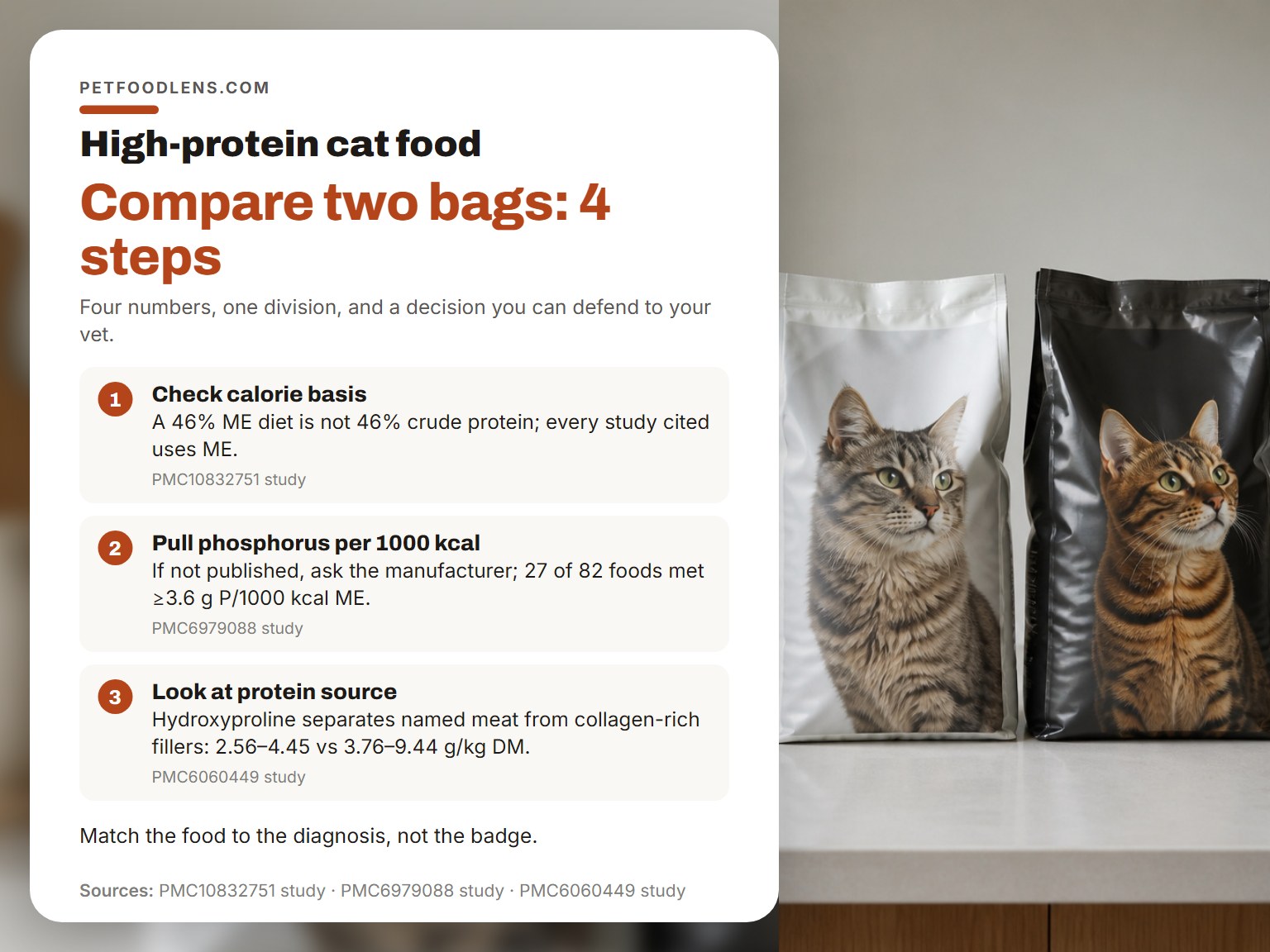
Four numbers, one division, and a decision you can defend to your vet.
Before you start: Any diet change in a cat with a diagnosed condition should run past the vet who has the bloodwork. A cat with a history of oxalate stones, a struvite blockage, or CKD is not a candidate for a self-directed switch, and a cat that stops eating after a change needs a call rather than a wait.
- Convert to dry matter first. Divide the protein percentage by the dry-matter percentage and multiply by 100. Skipping this is how a canned food gets compared against a kibble and loses when it shouldn’t.
- Check the calorie basis against the research. A 46% ME diet is not a 46% crude protein diet, and every study cited above uses ME.
- Pull the phosphorus figure per 1000 kcal ME. If it isn’t published, ask the manufacturer. A food company that won’t give you the number is telling you something.
- Look at where the protein comes from. Named muscle meat and named meals sit differently on the panel than collagen-rich fillers, and hydroxyproline is the marker that separates them.
- Match the food to the diagnosis, not the badge. A high-protein food is a reasonable default for a healthy adult cat and the wrong default for a cat with CKD.
The Three Numbers to Convert First
Protein, fat, and phosphorus. Protein and fat convert to dry matter the same way. Phosphorus converts to a calorie basis, which is a different division. Get all three onto a common footing and the comparison stops being about packaging.
Once the numbers line up, a short list usually falls out on its own. The best high-protein cat food options for a healthy adult cat are not the same list as the ones for a cat with a urinary history, and no single bag covers both.
Sorting cats rather than bags:
- Healthy adult cat, no history: a high-protein canned food is a reasonable default, and the moisture is a bonus.
- CKD diagnosis: protein-restricted therapeutic diet, chosen with the vet who has the labs.
- Oxalate stone history: the research is split, so the urine volume question outranks the protein percentage.
Frequently Asked Questions
Is high-protein cat food bad for a cat’s kidneys?
In healthy cats, a ten-week trial at 46% metabolizable energy shifted several renal analytes without pushing any mean value outside the reference interval. That’s a diet effect, not kidney damage. In cats with existing chronic kidney disease, the calculus changes, and a CKD-specific study was designed with phosphorus held constant precisely because the two variables are tangled in real foods.
How much protein does a cat actually need?
More than a dog at every life stage, and the amino acid profile matters as much as the total. Arginine, taurine, methionine and cysteine deficiencies have documented harms, which is why protein is treated as essential rather than optional. Kittens in growth have the least tolerance for a shortfall.
Does high-protein cat food cause crystals?
The published answer is split. One study found higher protein increased urinary calcium, renal calcium and oxalate excretion and raised the supersaturation for calcium oxalate, while another found a high-protein canned diet might not be a specific risk factor, crediting urine volumes of 24 to 34 mL/kg per day. The difference appears to hinge on how much water the cat is passing.
Should I switch my cat off high-protein food as it gets older?
Age alone isn’t the trigger. A lab value is. Multiple creatinine readings should be assessed before anyone applies IRIS staging, because muscle mass can inflate a single result. Get the bloodwork and the urine specific gravity first, then decide.
What counts as high-protein on a cat food label?
In the research literature, more than 45% of metabolizable energy. That is not the same as 45% crude protein on a guaranteed analysis, and it is not the same as 45% on a dry-matter basis. Convert before you compare.
The Bottom Line
The high-protein cat food pros and cons split cleanly at the diagnosis line, and everything above that line is about measurement rather than ideology.
Two things I’d ask you to take away. First, the phosphorus number and the protein number are the same number on most bags, so a study that finds an effect from one is usually carrying the other along. Second, the oxalate research genuinely disagrees with itself, and anyone who tells you it’s settled is picking a side and calling it a consensus.
Here’s the trigger for changing course: a creatinine, a urine specific gravity, and a phosphorus reading on the same draw. If those come back clean in a healthy adult cat, a high-protein canned food is a defensible default. If any of them are off, the bag stops being the decision-maker and the diagnosis takes over.
One concession worth stating plainly. A reader can’t verify manufacturing quality, sourcing, or batch consistency from a panel. A good-looking label can still hide a problem I have no way to detect. That’s why the cats with conditions belong with a vet who has the labs.
