
Grain-Free Cat Food Pros and Cons: What Labels Hide
This post contains affiliate links. As an Amazon Associate, we earn from qualifying purchases.
Grain-free cat food pros and cons are narrower than the packaging suggests: across 77 dry cat diets, grain-free foods averaged 64 g of carbohydrate per 1000 kcal against 86 g for grain-containing diets, yet every diet tested still contained measurable carbohydrate and the individual ranges overlapped heavily.
Those overlapping ranges explain why the grain-free cat food pros and cons question matters: two bags that both say grain-free on the front can deliver very different carbohydrate loads once a lab runs the analysis. The number on the label is a calculation from the guaranteed analysis, not a measurement, and the 2017 comparison found reported carbohydrate running about 6 g/1000 kcal above the analyzed nitrogen-free extract.
What follows is the honest version: what the claim actually covers, where the peer-reviewed work and the European trade body split, and how to compare two bags without trusting either front panel.
Key Takeaways
- Grain-free describes ingredients left out. FEDIAF states plainly that grain-free does not mean carbohydrate-free.
- The 2017 comparison of 77 dry cat diets found lower mean carbohydrate in grain-free foods, with wide overlap between individual products.
- Reported carbohydrate ran about 6 g/1000 kcal above analyzed values in that same study, so the label figure is an estimate.
- In a 2020 analysis of 82 commercial cat foods, 27 sat at or above 3.6 g phosphorus per 1000 kcal, and high-protein products drove that figure.
- Every brand caught in the 2021 UK mycotoxin recall was marketed as grain-free, which is exactly when the label stops being a safety signal.
What Grain-Free Actually Means on a Cat Food Label
Everything else about the formula stays wide open.
Grain-free describes the absence of a named cereal grain in the ingredient list. Carbohydrate content is set by the whole recipe, not by the presence or absence of a grain.
Flip the bag over.
The starch swaps that keep the carbohydrate number flat
- Peas and pea protein.
- Potato and tapioca. Nearly pure starch, with almost no protein to contribute.
- Chickpea and lentil.
- Corn, in a grain-inclusive formula.
Each swap moves the ingredient list. Only some of them move the number that matters.
What the claim does not cover
Nothing about protein source, protein quality, mineral balance, or manufacturing.
Wheat takes most of the blame in this category, and wheat in cat food is worth reading before you write off the whole shelf. FEDIAF states that wheat gluten intolerance is very rare in dogs and has not been reported in cats.
Where grain earns its bad reputation is narrower than the category suggests, and the grains in cat food comparison is the place to start before you decide the grain was ever the problem.
Do Grain-Free Diets Actually Cut Carbohydrates?
I used to assume grain-free meant lower starch. Then I started pulling guaranteed analyses side by side, and many of those recipes had simply traded corn for peas, potato, or tapioca at roughly the same inclusion level. The carbohydrate load barely moved.
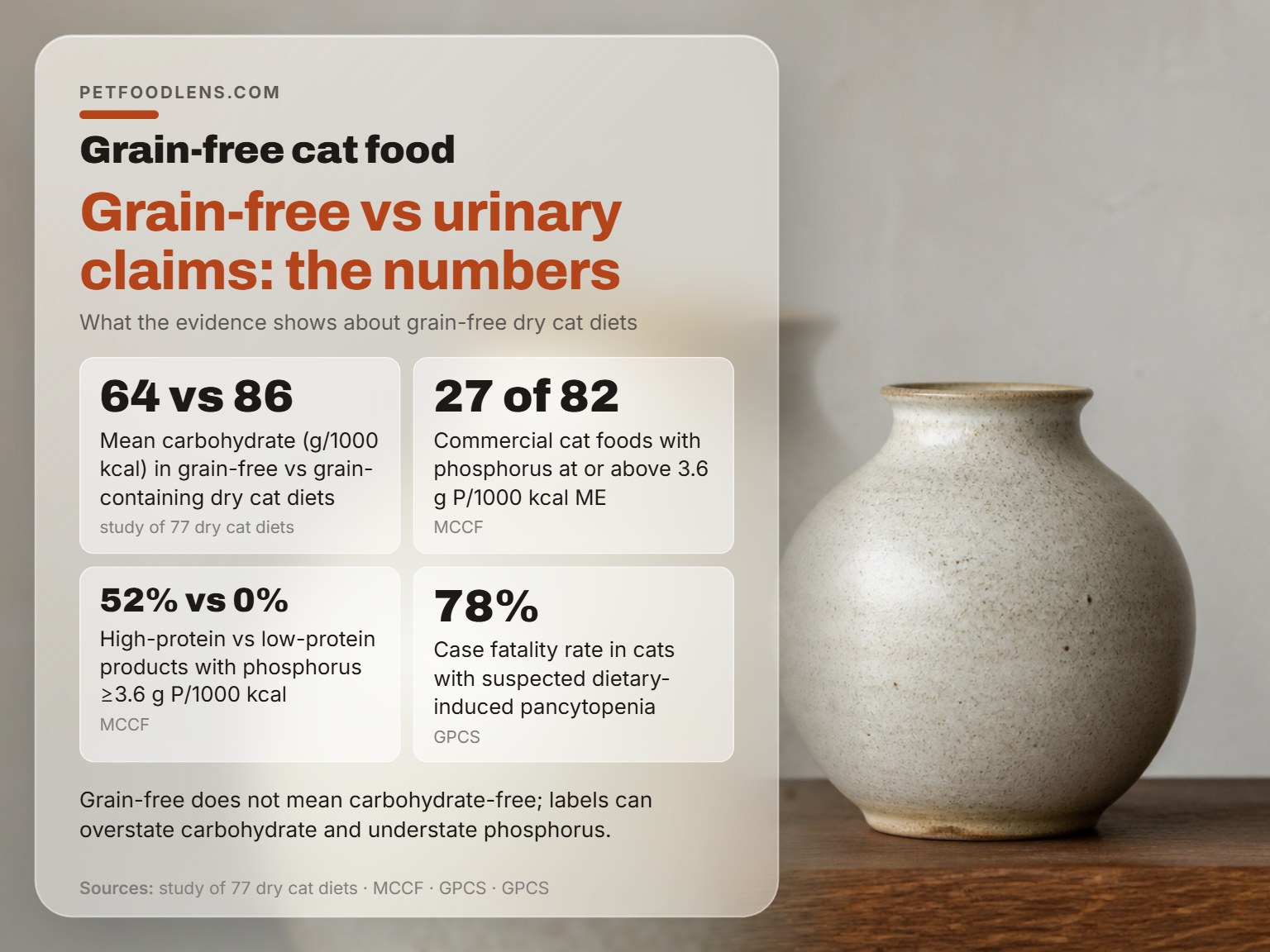
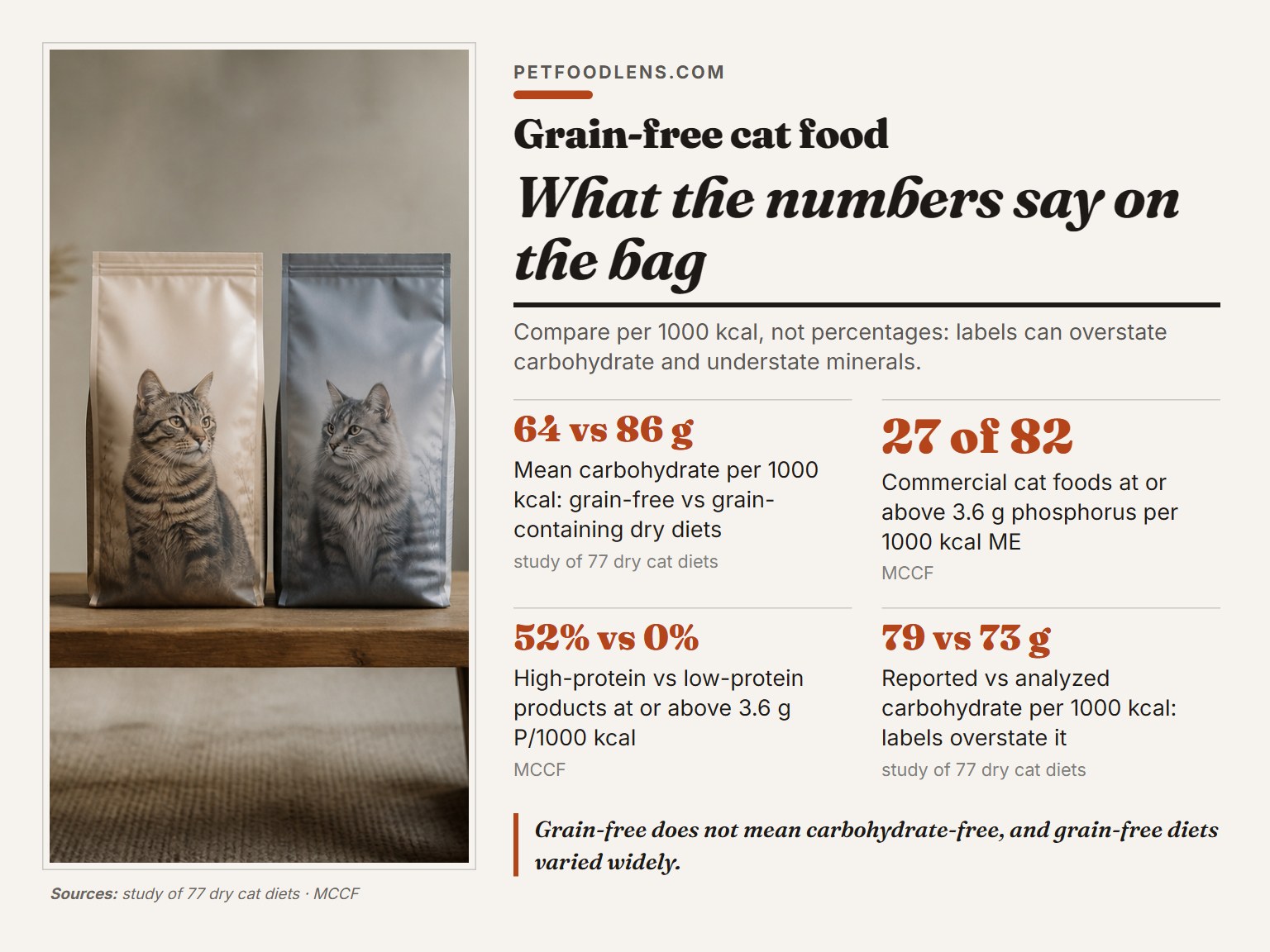
The 2017 comparison in the Journal of Feline Medicine and Surgery put numbers on it. Mean carbohydrate came out at 64 g/1000 kcal for grain-free dry cat diets and 86 g/1000 kcal for grain-containing diets, a genuine gap at the population level.
That paper is the carbohydrate content in grain-free cat diets study, and the detail that matters sits in the spread rather than the mean.
Individual products overlapped heavily, and the authors reported wide variation between diets. Some grain-free bags landed inside the range of grain-containing bags. The claim tells you nothing reliable about the specific bag in your hand.
A mean is a population number. Your cat eats one bag.
The same study found reported carbohydrate averaging about 6 g/1000 kcal above the analyzed nitrogen-free extract, 79 against 73. Nitrogen-free extract is the calculated remainder after protein, fat, ash, and moisture get subtracted, so it carries every rounding error in the guaranteed analysis.
Format matters alongside all of this. Dry cat food is where carbohydrate content swings widest, and there’s a separate body of work on dry foods and feline disease risk that has nothing to do with grain at all.
Grain-Free Cat Food Pros and Cons: Where the Sources Split
Four claims get repeated constantly about this category. On two of them, the peer-reviewed work and the industry position don’t line up, and on one they agree in a way nobody enjoys hearing.
| Claim | Position A, and who holds it | Position B, and who holds it |
|---|---|---|
| Grain-free lowers carbohydrate | Prantil et al., 2017: mean 64 vs 86 g/1000 kcal | FEDIAF: grain-free does not mean carbohydrate-free |
| Grain-free helps weight control | Owner and brand rationale for the switch | Veterinary Evidence PICO review: no evidence it reduces obesity risk |
| Grain is the main allergen | Common assumption behind the purchase | FEDIAF and the 2017 survey: poultry and soy just as frequent |
| The label carbohydrate figure is accurate | Calculated from the guaranteed analysis | 2017 analysis: reported ran about 6 g/1000 kcal high |
The carbohydrate row is the one people misread. A statistically lower mean across 77 diets is a real finding, and it does not translate into a per-product guarantee. FEDIAF, the European trade body that speaks for the manufacturers, says the same thing in plainer language.
The weight row is less ambiguous. The does grain predispose cats to weight gain review is an evidence review, and it found no evidence that grain-free reduces obesity risk.
Weight gain in a cat shows up gradually, which is why a food switch that looked successful over a short period proves nothing.
The allergen row is where the marketing premise takes the hardest hit. Common allergens such as poultry and soy appeared just as frequently in grain-free diets as in grain-containing ones in the 2017 survey. FEDIAF adds that most proven allergens are protein sources: beef, chicken, fish, and dairy.
A 2021 review in Veterinary Clinics of North America covered the pros and cons of commercial pet foods, grain and grain-free included, and an updated review of grain-free feeding covers the nutrition side. Marketing is not nutrition, and both pieces say it with citations.
Is High Protein Always Better for Cats?
Twenty-seven of 82 commercial cat foods in a 2020 mineral analysis sat at or above 3.6 g of phosphorus per 1000 kcal of metabolizable energy. Metabolizable energy is the calories the cat actually absorbs, which is why per-1000-kcal figures compare across formats and percentages on the bag don’t.
| Finding | Foods affected, of 82 | What it means |
|---|---|---|
| At or above 3.6 g P/1000 kcal ME | 27 | The level a vet watches in renal cases |
| Above 4.8 g P/1000 kcal ME | 7 | The top of the range, not the middle |
| Calcium-to-phosphorus ratio at or below 1.0 | 13 | Ratio matters alongside the absolute number |
| High-protein group at or above 3.6 g P | 52% vs 0% in the low-protein group | Protein level tracked phosphorus level |
The pattern behind that table is protein. In the high-protein group, 52 percent of products hit 3.6 g P/1000 kcal or above, against zero percent in the low-protein group. Grain status never entered the calculation.
Common mistake: Reading the guaranteed analysis as a measurement. Declared phosphorus ran significantly below analyzed values in the 2020 study, so the number on the bag is a floor.
That’s the piece the front of the bag skips. A high-protein cat food badge sells, and for a cat with kidney disease it points the wrong way.
The 2020 analysis also found declared minimum phosphorus and calcium significantly lower than the analyzed values, at P=.0005 and P=.003. If you’re calculating from the guaranteed analysis, you’re calculating from a floor.
For a diagnosed cat, the therapeutic renal formulas are where the evidence sits, built around those targets rather than around a protein badge.
The 2021 Recall That Made Grain-Free a Bad Signal
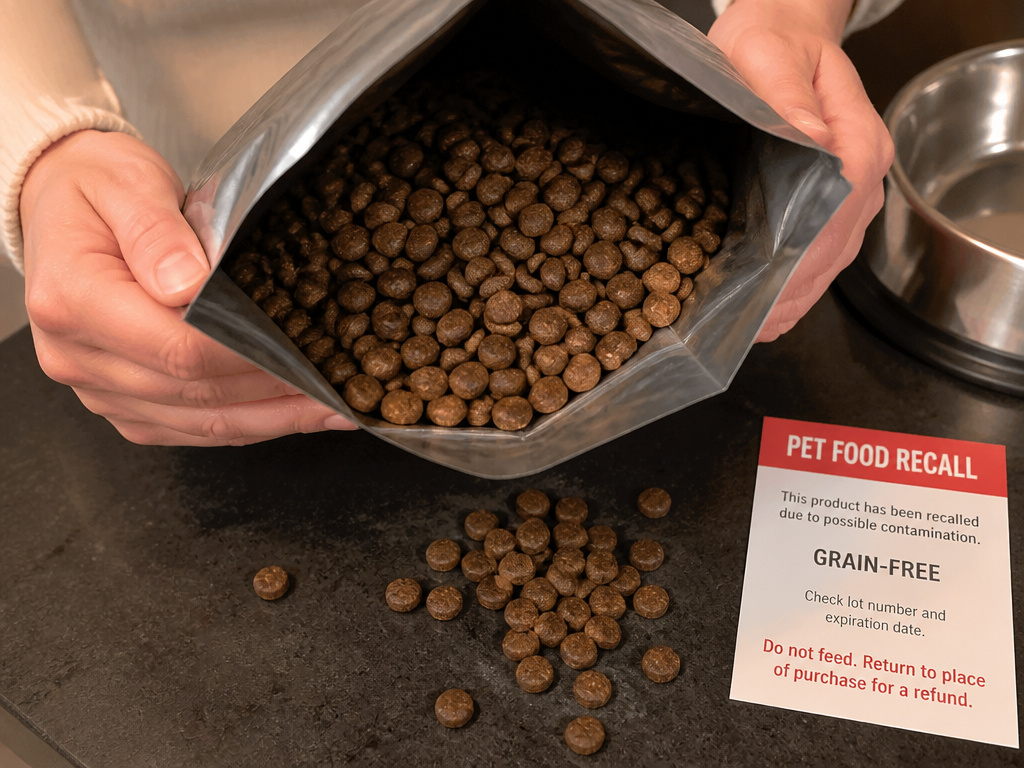
A recall is the one moment when the front of the bag actively works against you.
In 2021, Fold Hill Foods recalled dry cat diets in the UK after they were found to contain T-2, HT-2, and diacetoxyscirpenol above European Commission guidance for dry cat food. Every affected brand was marketed as grain-free.
Worth knowing before you start: The Glasgow case series that followed covered 50 cats with suspected dietary-induced pancytopenia and recorded a 78 percent case fatality rate. Bone marrow hypo/aplasia appeared in all 31 core specimens available for review.
Pancytopenia means all three blood cell lines drop at once. It is not a subtle finding, and it is not something an owner spots early.
The Glasgow authors were careful about causation. They noted that no NOAEL or LOAEL has been established for trichothecenes in cats, and that a causative mycotoxin link remains speculative. A NOAEL is the highest dose with no observed adverse effect; a LOAEL is the lowest dose that produces one. Neither exists here, so there’s no safe-harbor number to design a formula against.
The detail that should change how you read a bag is this one. The same paper notes that grain-free marketing could potentially lessen the likelihood of mycotoxin contamination on initial consideration. A contaminated grain-free bag looked safer than a contaminated bag with grain in it.
An open bag of dry food that’s been sitting a while smells flat and faintly rancid, like oil that’s gone over. That smell is a fat-freshness signal, and nothing about a grain-free label protects against it.
Owners ask the same question about grain-free dog food, and the recall lesson carries over unchanged.
When a Grain-Free Bag Is the Wrong Tool
Why “supports urinary health” and “dissolves stones” are different claims
That verb carries the whole difference. A therapeutic urinary diet makes a dissolution claim that comes from feeding trials in cats with the condition. A bag with a pH-balanced sticker has not been through that exam.
Therapeutic veterinary diets sit in the same category for urinary and renal formulas. These are among the best-evidenced products in the aisle, and dismissing them as marketing because the packaging looks similar to an OTC bag is a category error.
Grain-free has no role in that decision. A cat with a diagnosed urinary or kidney condition needs the diet the diagnosis points to.
Fountains get sold as the urinary fix. Where a fountain helps is a cat who prefers moving water.
If the problem is a suspected sensitivity rather than a diagnosis, limited ingredient cat food is the more useful category, because it constrains the protein source rather than the grain.
I’ve had one case where the owner had been through several grain-free bags for an itchy cat and the trigger turned out to be a single protein. Removing grains changed nothing. Swapping the protein fixed it.
If moisture is the goal rather than a grain claim, grain-free canned cat food is where the format does the work.
How to Compare Two Bags Side by Side
Three numbers decide most of this: carbohydrate per 1000 kcal, phosphorus per 1000 kcal, and the ingredient split.
- Put both foods on the same energy basis. Per-1000-kcal figures compare directly. Percentages on the bag don’t, because moisture differs. Skip this and you’ll compare a wet food against a dry food and conclude the wrong one is higher in carbohydrate.
- Read the guaranteed analysis as a floor. Declared phosphorus and calcium both ran significantly below analyzed values in the 2020 study, so the label understates minerals rather than overstating them.
- Check the ingredient split before you trust the first ingredient.
- Look at the phosphorus number if your cat is older or has any renal history. Twenty-seven of 82 foods sat at or above 3.6 g P/1000 kcal ME, and high-protein products drove that figure.
- Ignore the front panel on the first pass.
If two bags carry the same carbohydrate figure per 1000 kcal, the grain-free one has bought you nothing. Buy the one with the named protein and the lower phosphorus.
If you want a starting point on the other side of the aisle, grain-inclusive cat food is a fair comparison to hold against whatever grain-free bag you’re buying now.
Two bags, one comparison.
Frequently Asked Questions
Is grain-free cat food better for cats with allergies?
Not by default. In the 2017 survey of 77 dry cat diets, common allergens such as poultry and soy appeared just as frequently in grain-free foods as in grain-containing ones. FEDIAF states that wheat gluten intolerance is very rare in dogs and has not been reported in cats, and that most proven allergens are protein sources like beef, chicken, and fish. Change the protein first.
Does grain-free cat food have fewer carbohydrates?
On average, yes, and the difference is smaller than the marketing implies. Grain-free dry diets averaged 64 g/1000 kcal against 86 g/1000 kcal for grain-containing diets across 77 products. Individual products overlapped heavily, so the claim tells you nothing reliable about one specific bag.
Is grain-free cat food safe?
The category itself isn’t the risk. The 2021 Fold Hill Foods recall involved dry cat diets with T-2, HT-2, and diacetoxyscirpenol above European Commission guidance, and every affected brand was marketed as grain-free. The Glasgow authors note that a causative mycotoxin link remains speculative and that no NOAEL or LOAEL exists for trichothecenes in cats. A grain-free label doesn’t function as a safety signal during a recall.
Should I switch my cat off grain-free food?
Only if there’s a reason. If the food is complete, your cat is at a healthy weight, and the phosphorus level suits their age and kidney status, the grain claim isn’t doing any work either way. If your cat has a diagnosed condition, the diet should follow the diagnosis rather than the front of the bag.
What about grain-free wet cat food?
Wet food changes the calculation because moisture dilutes everything on a percentage basis. Compare on a per-1000-kcal basis rather than the label percentages. The carbohydrate gap between grain-free and grain-inclusive then narrows or widens depending on the specific recipe.
The Bottom Line
Here’s the threshold I’d actually use. If your cat is older, or has ever had a phosphorus or creatinine value flagged, stop shopping on the grain claim and start shopping on phosphorus per 1000 kcal. That single switch does more for the cat than any ingredient panel.
None of this makes grain-containing food automatically better.
The uncomfortable version: if a bag’s main selling point is what it left out, you still don’t know what it put in.
