
Grain-Free Dog Food Pros and Cons: What the Trials Show
This post contains affiliate links. As an Amazon Associate, we earn from qualifying purchases.
Grain-free dog food pros and cons split along one unresolved question: the FDA opened a 2018 investigation into a possible DCM link, but an 18-month randomized trial published in 2025 found no clinically significant cardiac changes across four grain-free and grain-inclusive diets. WSAVA 2019 states there is no proven benefit to avoiding grains absent a diagnosed allergy.
The FDA’s Center for Veterinary Medicine opened that investigation after receiving reports of DCM in breeds not genetically predisposed to the disease. That detail is the reason the grain-free dog food pros and cons question stays open: if diet can trigger heart disease in a dog with no family history, the mechanism matters more than the label on the bag.
What follows is the evidence as it actually stands: the FDA’s position, the trial data on both sides of the argument, the mycotoxin finding that almost nobody mentions, and a label-reading method you can run on the bag in your kitchen right now.
Key Takeaways
- No controlled trial has reproduced the DCM signal. The 18-month JAS 2025 RCT found no clinically significant cardiac changes across four diets.
- The FDA still does not recommend changing a dog’s diet without veterinary consultation (Q&A updated June 27, 2019).
- Wrinkled pea and lentil are not interchangeable. The 28-day trial saw cardiac changes on pea, none on lentil.
- Grain-free dry food tested cleaner for mycotoxins (zero detectable) than grain-containing dry food (9 of 12 with at least one Fusarium mycotoxin), though no sample exceeded regulatory limits.
- Grain-free is a marketing category, not a nutritional one. Many formulas swap corn for peas, potato, or tapioca.
What the FDA Investigation Actually Found (and What It Didn’t)
The FDA’s Center for Veterinary Medicine opened its investigation in 2018 after receiving reports of dilated cardiomyopathy in breeds not genetically predisposed to the disease. The agency has not closed it.
The FDA’s Center for Veterinary Medicine opened its investigation in 2018 after receiving reports of dilated cardiomyopathy in dog breeds not genetically predisposed to the disease. The agency’s June 27, 2019 Q&A update still states that it is not advising dietary changes based solely on the information gathered so far.
What the investigation did not do is issue a recall, a warning, or a recommendation to change diets. The June 27, 2019 Q&A update is explicit: the FDA is not advising dietary changes based solely on the information gathered so far. That is a regulator declining to act on a signal it cannot yet explain.
The agency’s caution is worth reading against the FDA canine heart disease investigation page directly. I have read it more times than I would like to admit, and the language has not moved.
Grain-free marketing usually starts by removing corn, which is why corn in dog food gets framed as the villain in the first place. The FDA’s investigation never singled out corn. It flagged legume and potato-heavy formulas, and it flagged them as a possible association, not a cause.
The broader grain-free dog food pros and cons question, alongside grains in dog food, is separate from the DCM signal and worth reading on its own terms. A grain-free formula is not automatically lower in carbohydrate, and a grain-inclusive formula is not automatically higher.
Do the Clinical Trials Back the DCM Link?
Short answer: the largest controlled trial published so far does not, and the smaller feeding trial that did find a signal points at one specific pulse ingredient rather than the grain-free category as a whole.
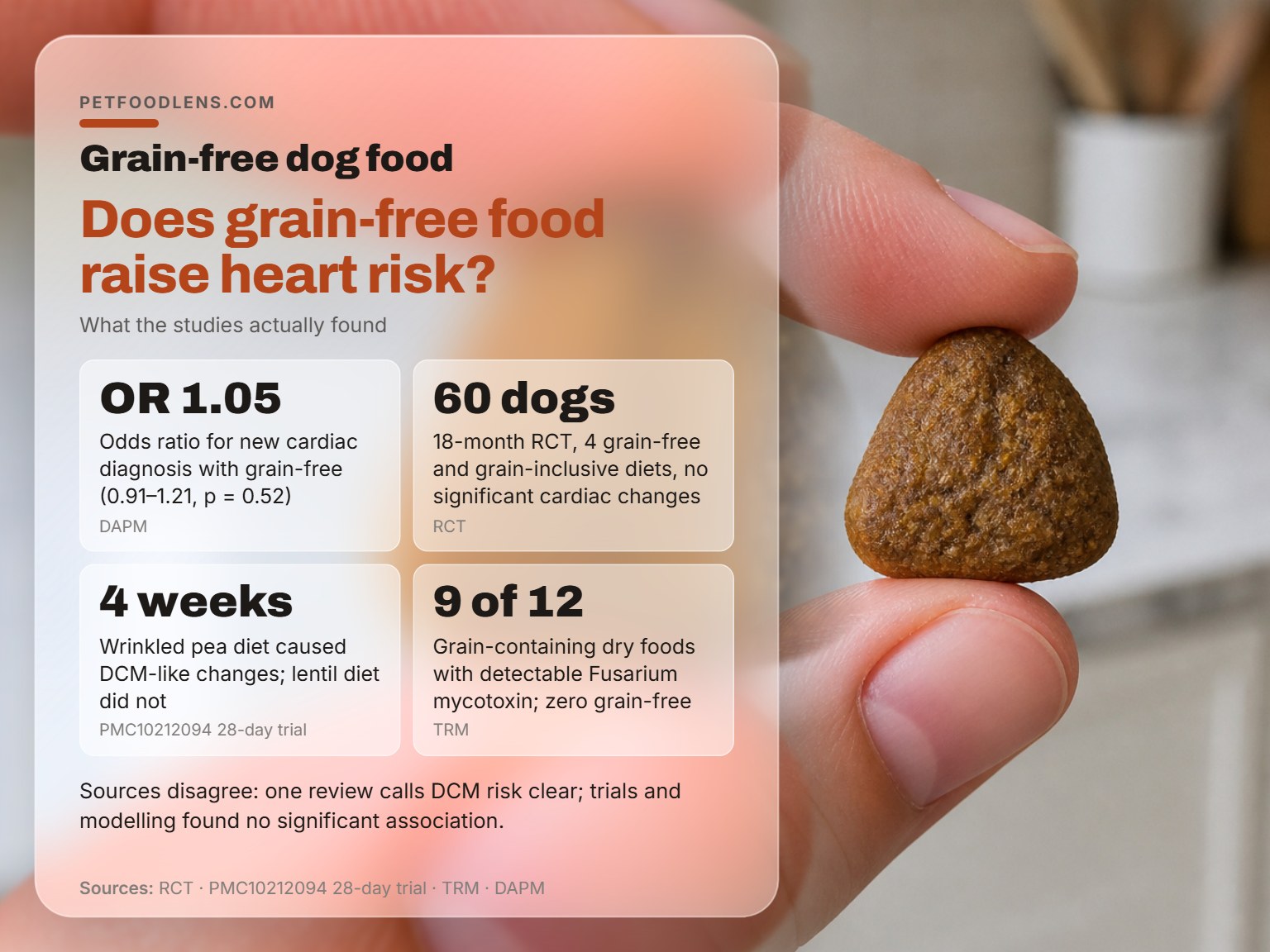
The 18-month randomized double-blind trial published in the Journal of Animal Science in 2025 fed 60 dogs one of four diets: grain-free with potato and pea, grain-inclusive with pea and pea fiber, grain-inclusive with no pea or potato, and grain-free with potato only.
What the 18-Month Trial Actually Measured
Endpoints at 6, 12, and 18 months included whole-blood and plasma taurine, cTn-I, NT-BNP, and echocardiographic measurements. The trial found no clinically significant cardiac changes across all four diets. That is the strongest single piece of evidence against a blanket grain-free warning.
The authors did flag one confounder: 24 dogs developed mild endocarditis by the end of the trial, which they note could explain some of the echocardiographic changes independent of diet. That is the kind of detail that gets stripped out of the headline.
The diet-associated cardiac disease in dogs resource from the University of Wisconsin School of Veterinary Medicine takes a more cautionary posture. It flags legumes and potatoes, exotic proteins, and unknown sourcing as risk factors. That is a softer claim than “grain-free causes DCM,” and it is also a more defensible one.
The smaller 28-day grain versus pulse feeding trial is where the picture gets more interesting. Three test diets: white rice flour, whole lentil, and wrinkled pea. The wrinkled pea diet impaired stroke volume and cardiac output, raised end-systolic ventricular diameter, and increased NT-ProBNP within four weeks. The lentil diet did not.
That result undercuts the “only predisposed breeds” framing, because the 28-day trial used a breed not known to be DCM-prone and still saw changes. It also undercuts “grain-free is the problem,” because lentil is grain-free and produced no cardiac changes.
Plasma taurine was unchanged across the 28-day trial. Plasma methionine was significantly lower on all three test diets versus the commercial baseline.
The updated review of grain-free diets published in 2025 asserts a potential association with DCM as a clear risk, while the 18-month JAS 2025 RCT found no clinically significant cardiac changes and the Dog Aging Project found no significant association (OR 1.05). It is a narrative review, not a controlled trial, and it sides with the FDA’s caution over the null trial results. That is a legitimate position. It stops short of a demonstrated causal link.
Why “Grain-Free” Is Not One Ingredient
Grain-free is not a single exposure. It is a category label that covers formulas built on peas, lentils, chickpeas, potatoes, tapioca, or some combination of all four, and those ingredients do not behave the same way in a feeding trial.
The 28-day data makes that concrete. Wrinkled pea produced sub-clinical DCM-like changes in four weeks. Lentil did not. If “grain-free” were a single mechanism, that split would not exist.
Pea, Lentil, Rice: What the 28-Day Data Shows
| Test diet | Grain status | Cardiac finding |
|---|---|---|
| White rice flour | Grain | No changes |
| Whole lentil | Grain-free | No changes |
| Wrinkled pea | Grain-free | Impaired stroke volume, raised NT-ProBNP |
The 28-day trial is small and short, and I would not hang a diet decision on it alone. But it is the cleanest evidence anyone has that the pulse identity matters.
This is also where the grain-free vs grain-inclusive framing gets slippery. A grain-inclusive formula with pea and pea fiber is still a pea formula. A grain-free formula built on potato only is not a pea formula at all. The category label tells you what was removed. It does not tell you what replaced it.
I spent a week a few years ago comparing guaranteed analyses on about a dozen grain-free dog foods, expecting to see carbohydrate numbers drop. They didn’t. Several landed within a point or two of the grain-inclusive bags on the same shelf, because the corn had been swapped for peas, potato, or tapioca. Now I check the numbers before I read the marketing.
The same logic applies across species. Grain-free cat food runs into the same substitution problem, often with the same ingredients, and the label-reading method is identical.
If you are specifically trying to avoid the pulse ingredients that showed up in the 28-day trial, pea-free dog food is a narrower and more useful search than “grain-free.”
Is Grain-Free Dry Food Actually Cleaner for Mycotoxins?
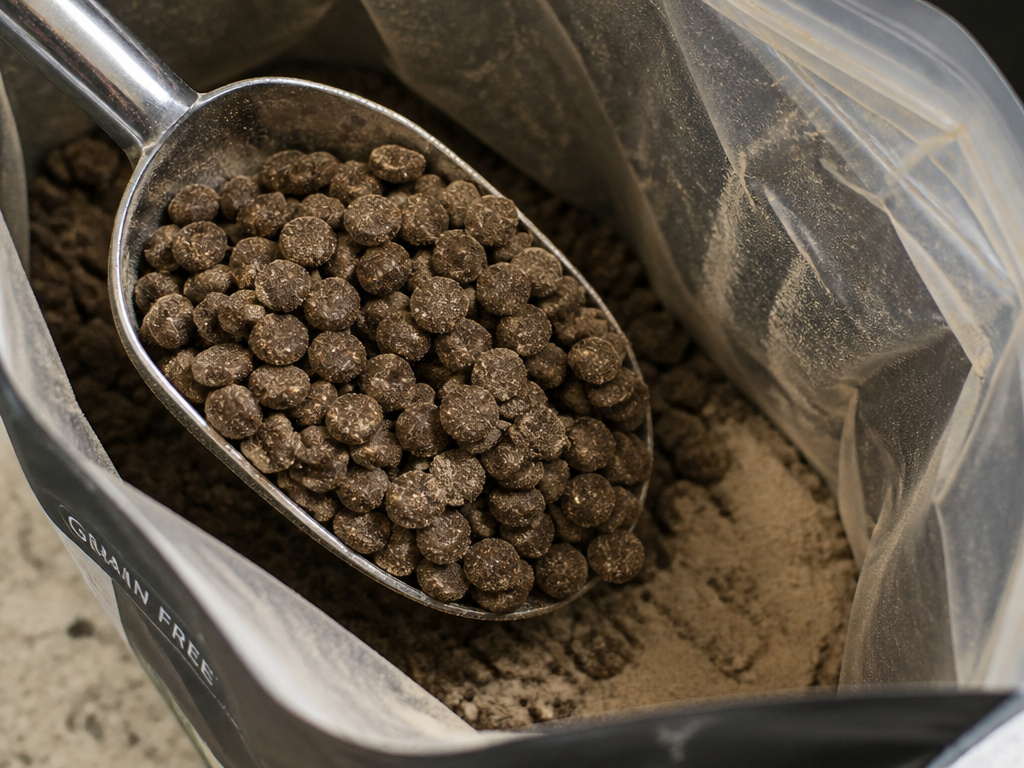
Nine of 12 grain-containing dry foods in a 2019 Toxin Reviews study carried at least one detectable Fusarium mycotoxin. Zero grain-free dry foods did. Zero wet foods of either type did.
That is the finding that gets skipped in most grain-free debates, and it is the one that cuts in grain-free’s favor.
The study analyzed 60 samples of dry and wet food from five major US manufacturers. No sample in the study exceeded regulatory limits. So the practical takeaway is not “grain-containing food is dangerous.” It is that detectable mycotoxin exposure was concentrated in the grain-containing dry category.
The 2025 narrative review frames reduced mycotoxin exposure as a benefit of grain-free formulas, while the Toxin Reviews 2019 study found zero detectable mycotoxins in grain-free dry and wet foods versus 9 of 12 grain-containing dry foods, though no sample exceeded regulatory limits.
The catch is format. Wet foods showed zero detectable mycotoxins regardless of grain status, so the grain-free advantage in this study is a dry-food advantage. If your dog eats wet food, the mycotoxin argument is not doing any work for you.
A bag of grain-free kibble that has been open for a month smells faintly of old cooking oil, and shaking it leaves a pale, chalky dust at the bottom of the bag. That dust is the ground pea or potato flour settling out.
The wheat in dog food question is adjacent here: Fusarium mycotoxins are associated with cereal grains, but the study did not break down which grain was responsible in each positive sample. So “wheat is the problem” is a step past what the data supports.
How to Read a Grain-Free Label Without Getting Fooled
You’re standing in the pet aisle with two bags in your hands, and the front of one says “grain-free” in letters twice the size of anything on the ingredient panel. Flip both bags over and the first five ingredients tell you more than either front label ever will.
Before you start: Do not switch a dog off a food it is doing well on based on a label claim alone. An abrupt diet change can trigger vomiting or diarrhea, and a dog with a diagnosed cardiac condition needs a veterinary cardiologist’s input before any switch. If a true grain allergy is suspected, a veterinary elimination trial is the only way to confirm it.
The Dry Matter Conversion
A wet food at 10% protein and a dry food at 25% protein are not comparable on the label. Divide protein by (100 minus moisture) to get a fair number. I keep a calculator in my phone for this. It is the single most useful tool in the whole process.
Here is the method I use:
- Read the first five ingredients in order. If the first three are peas, potato, and tapioca, you are looking at a starch-heavy formula regardless of what the front says.
- Look for a named meat meal in the top three. “Chicken meal” is a concentrated protein source; “fresh chicken” is mostly water before cooking, so it weighs more on the label than it contributes after extrusion.
- Convert the guaranteed analysis to dry matter basis. Skipping this is how people end up comparing a 10% protein wet food to a 25% protein dry food and concluding the wet food is inferior. It isn’t; the numbers are on different scales.
- Find the AAFCO adequacy statement. “Complete and balanced” for a life stage is the sentence that matters. Skipping this is how a dog ends up on a food that is not actually complete for its life stage.
- Check whether the formula is actually grain-free or just grain-swapped. Skipping this is how grain-free bags end up in carts at a premium for a formula that is functionally the same carbohydrate load as the grain-inclusive bag next to it.
Common mistake: Assuming grain-free means low-carb. Several grain-free formulas land within a point or two of grain-inclusive formulas on carbohydrate percentage, because peas, potato, and tapioca are starch sources too.
Run your thumb across a piece of grain-free kibble and it feels harder and slicker than a grain-inclusive piece, because the starch binder behaves differently during extrusion.
For the grain-free dog food category, the label-reading method is the same. The category name is doing less work than the ingredient list.
For owners who want a grain-inclusive option with a clear adequacy statement, look for a bag that publishes an AAFCO statement and uses named meat meals in the top three ingredients. Both publish an AAFCO statement on the bag and both use named meat meals in the top three ingredients.
When Grain-Free Is the Wrong Choice
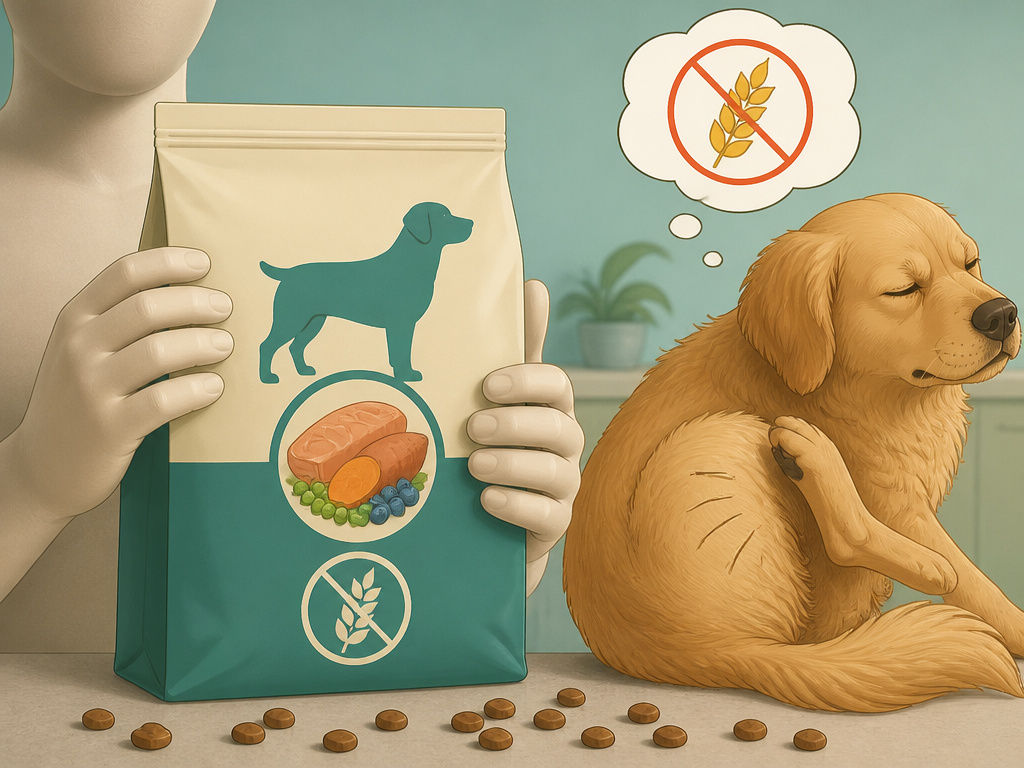
Grain-free is the wrong call when the reason for choosing it is a label claim rather than a diagnosis. That is the wrong reason.
The most common version of this: an owner suspects a grain allergy because the dog has itchy skin, switches to grain-free, and the itching continues. True grain allergy in dogs is uncommon, and WSAVA 2019 states there is no proven benefit to avoiding grains unless the individual animal has a diagnosed allergy.
- Suspected grain allergy without a veterinary elimination trial. Grain-free is not the same as hypoallergenic, and most grain-free formulas still contain the proteins that trigger reactions.
- A dog already doing well on a grain-inclusive formula. The FDA’s position is that diet changes absent veterinary consultation are not advised, and “doing well” is the outcome that matters.
- A dog with a diagnosed cardiac condition. This is a veterinary cardiologist conversation, not a label-reading one.
- A puppy or a pregnant dog. Life-stage adequacy matters more than the grain status on the front of the bag.
Where this goes sideways: Switching to grain-free for itchy skin without an elimination trial. If the dog is reacting to chicken or beef, the new formula probably still contains it, and you have spent three months and a premium for the same itch.
The best grain-inclusive dog food shortlist is a better starting point for most owners than the grain-free aisle, because the formulas are more likely to be built around named meat meals and a clear adequacy statement.
What the Dog Aging Project Found About Owner Labels
The Dog Aging Project modelling study is the one that reframes the whole debate, because it found the odds ratio for grain-free status on any new cardiac diagnosis was 1.05, with a 95% confidence interval of 0.91 to 1.21 and a p-value of 0.52. Read that again. That is statistical language for no significant association in this dataset.
The Dog Aging Project grain-free modelling also found large owner misclassification error when comparing owner-reported grain-free labels to actual ingredient lists. In plain terms: a meaningful share of owners who said their dog was on a grain-free diet were wrong about what was in the bag.
That finding has two implications. The first is that owner-reported diet studies, including some of the ones cited on both sides of this debate, are shakier than they look. The second is that “grain-free” as a category is not stable enough for owners to self-report accurately, which is a problem for any study that relies on the label.
No trial can prove safety outright. The 18-month study is the largest controlled test anyone has run, and it found no signal.
Frequently Asked Questions
Is grain-free dog food bad for dogs?
The evidence is mixed. The FDA opened an investigation in 2018 into a possible DCM link, but an 18-month randomized trial published in 2025 found no clinically significant cardiac changes across four grain-free and grain-inclusive diets. The FDA still does not recommend changing a dog’s diet absent veterinary consultation.
What does the FDA say about grain-free dog food?
The FDA’s Center for Veterinary Medicine opened its investigation in 2018 and updated its Q&A on June 27, 2019. The agency states it is not advising dietary changes based solely on the information gathered so far. It has not closed the investigation.
Is grain-free the same as hypoallergenic?
No. Grain-free means no grains. Hypoallergenic means the formula has been designed or tested to avoid the proteins a specific dog reacts to. WSAVA 2019 states there is no proven benefit to avoiding grains unless the dog has a diagnosed allergy.
Why did the 28-day trial find cardiac changes on pea but not lentil?
The 28-day trial fed three diets: white rice flour, whole lentil, and wrinkled pea. The wrinkled pea diet impaired stroke volume and cardiac output and raised NT-ProBNP within four weeks. The lentil diet did not. Plasma taurine was unchanged across all three, but plasma methionine was lower on all test diets versus the commercial baseline.
Do grain-free foods have fewer mycotoxins?
In a 2019 study of 60 samples, zero grain-free dry foods and zero wet foods had detectable mycotoxins, while 9 of 12 grain-containing dry foods had at least one detectable Fusarium mycotoxin. No sample exceeded regulatory limits. The advantage is specific to dry food.
Should I switch my dog off grain-free?
That is a veterinary conversation, not a label-reading one. The FDA does not advise dietary changes based solely on the investigation. If your dog is doing well on a grain-free formula, the case for switching is weaker than the headlines suggest.
The Bottom Line
Here is the threshold I would give a friend: if your dog is on a grain-free formula and doing well, do not switch based on the FDA investigation alone. The agency has not closed the investigation and has not issued a diet-change recommendation. The 18-month trial published in 2025 found no clinically significant cardiac changes across four diets. That is not proof of safety, but it is the absence of a demonstrated signal in the largest controlled test anyone has run.
The case for switching is stronger if the formula is built on peas, potato, and tapioca rather than a single pulse, if the dog has a diagnosed cardiac condition, or if the reason for the grain-free choice was a suspected allergy that was never confirmed by an elimination trial. Those are specific triggers, not category-level ones.
The one thing I would change this week: flip the bag over and read the first five ingredients. If the top three are peas, potato, and tapioca, you are paying a grain-free premium for a starch-heavy formula. If the top three include a named meat meal and the bag carries an AAFCO adequacy statement, the grain status is doing less work than the marketing suggests.
I am not a veterinarian, and nothing here replaces a cardiologist’s read on an individual dog. What I can tell you is that the label on the front of the bag is the least informative part of the package. Read the back first.
