
Grains in Pet Food Pros and Cons: What Labels Hide
This post contains affiliate links. As an Amazon Associate, we earn from qualifying purchases.
Grains in pet food pros and cons rest on three questions: what the grain supplies, what it replaced, and whether the food is dry or wet. Grains supply digestible carbohydrate, plant protein and fiber that most pets handle well. The FDA has not established that grain-free diets are safer.
That third question, dry versus wet, is where the grains in pet food pros and cons contamination data gets interesting. Detectable mycotoxins in one 2019 survey turned up only in dry foods that contained grain, and in none of the wet samples. Format changes the risk profile before ingredient choice enters the picture.
What follows walks the FDA investigation, the two cardiac trials that disagree with each other, the allergy question, and the label math that tells you what you are actually buying.
Key Takeaways
- The FDA investigated and stopped short of a verdict. Its Center for Veterinary Medicine said in a June 27, 2019 update that it is not yet known how legumes, pulses or potatoes might link to canine heart disease.
- Two credible trials point in opposite directions. A 28-day wrinkled-pea study found sub-clinical cardiac changes; an 18-month trial of 60 dogs found no clinically significant differences.
- Mycotoxins showed up in dry grain-containing food only. Nine of 12 such samples carried at least one Fusarium mycotoxin in a 2019 survey of 60 products. Wet foods showed none.
- Grain allergy is rare, and going grain-free rarely fixes the real one. Beef, dairy and chicken outrank wheat and corn as likely culprits.
- Compare on dry matter, not on the front of the bag. Moisture content distorts every percentage printed on the panel.
What Grains Actually Do in a Pet Food Formula
Corn, wheat, rice, barley and oats supply three things a formula has to have: digestible energy, plant protein and fiber. Starch is the cheapest way to deliver calories in an extruded kibble, and dogs digest cooked starch well.
Extrusion cooks a starch-and-protein mix under heat, moisture and pressure, then forces it through a die. The process gelatinises starch and expands the kibble. Research on corn in pet foods notes that resistant starch can form under certain extrusion conditions, which alters colonic fermentation. Ingredient lists do not capture that variation.
That last point matters more than it sounds. A 2021 review of corn in pet foods found that resistant starch formation depends on extrusion conditions, so the same ingredient can behave differently in two plants. Reading “corn” on a panel tells you what went in, not what came out.
A properly cooked kibble snaps with a dull click when you break it and shows a slightly porous, uniform interior. An under-cooked one looks pale and glassy at the break.
Here is what grains are actually contributing:
- Digestible carbohydrate for energy, which matters most in high-activity and growing animals
- Plant protein, lower in quality than meat but not zero, and it counts toward the crude protein figure
- Fiber, including the resistant starch fraction that feeds colonic bacteria
- A consistent pellet, because starch is what holds a kibble together through the die
For a deeper look at one grain in isolation, the argument over wheat in pet food is a useful case study in how a single ingredient gets blamed for a whole formula.
Why Did the FDA Open an Investigation into Grain-Free Diets?
Because the agency received a number of reports of dilated cardiomyopathy, or DCM, in dogs eating diets that listed legumes, pulses or potatoes as main ingredients. DCM is a heart muscle disease that reduces the heart’s pumping ability.
The FDA’s Center for Veterinary Medicine opened its inquiry on that basis. Its FDA CVM diet and heart disease investigation page is careful about what it claims. It states plainly that it is not yet known how these ingredients may be linked to canine heart disease.
The agency also declined to recommend a diet change while the grains in pet food pros and cons work was ongoing, and its FAQ page carried a June 27, 2019 update date. Its own notes record that most taurine-deficient DCM cases responded to taurine supplementation, which points at a nutritional mechanism rather than an inherent hazard in the bag.
Then there is the framing problem. A 28-day feeding study published in PMC notes that the FDA publicly reported a link between canine DCM and grain-free diets in 2018. A public report of a link and an established causal link are two different things, and the coverage blurred them.
If you want the ingredient-level version of that argument, grain-free dog food covers the trade-offs bag by bag.
The Two Cardiac Trials That Do Not Agree
One trial found cardiac changes in four weeks. Another found none in eighteen months. Both were peer-reviewed, and neither has been retracted.
The short trial is a 28-day canine cardiac function trial that fed a wrinkled-pea diet against grain-containing controls. After four weeks, stroke volume and cardiac output were impaired and NT-ProBNP was raised sub-clinically. NT-ProBNP is a blood marker released when the heart muscle is stretched.
Two details in that study get skipped constantly. Plasma taurine was unchanged, so the effect was not simply taurine depletion. And plasma methionine was lower on all the test diets compared with the commercial baseline.
The long trial ran 18 months on 60 dogs across four diet formulations, with assessments at 6, 12 and 18 months. It found no clinically significant cardiac biomarker or taurine differences between grain-free and grain-inclusive diets. Twenty-four dogs developed mild endocarditis by the end of the study.
| Evidence source | What was measured | Result |
|---|---|---|
| FDA CVM investigation | Owner and vet reports of DCM on legume, pulse or potato diets | Link not established as of June 27, 2019 |
| 28-day pulse trial | Stroke volume, NT-ProBNP, plasma taurine | Sub-clinical changes; taurine unchanged |
| 18-month trial, 60 dogs | Cardiac biomarkers, taurine, 4 diet types | No clinically significant differences |
Where this goes sideways: Treating “grain-free” as one risk category. The 28-day trial produced cardiac changes on a wrinkled-pea diet, and the lentil diet in the same work did not. Grouping every legume together buries the one distinction the data actually supports.
Notice also that the 28-day trial used a breed not known to be susceptible to DCM, and still showed changes. Susceptibility assumptions are doing less work here than owners assume.
The grain-free vs grain-inclusive comparison is where most people start, and it is the right place to start as long as you read both trials.
Do Grains Cause Allergies in Dogs and Cats?
Rarely, and almost never the grain the marketing blames. Purina’s nutrition education material states that gluten allergy is extremely rare in dogs and has not been identified in cats at all. The same source puts beef, dairy and chicken ahead of wheat and corn as likely allergens.
That position is contested, and the disagreement is worth stating plainly. A 2025 updated review of grain-free diets lists allergen elimination as an advantage of grain-free formulas. A separate veterinary review argues that grain concerns are based on marketing rather than nutrition, while a 2025 review of grain-free diets lists allergen elimination as an advantage of grain-free formulas. Both are peer-reviewed; they are answering different questions.
Here is how I read that standoff. A true food allergy is an immune response to a specific protein, and the way you find it is a controlled elimination trial, not a bag redesign. Swapping rice for peas changes the protein set, so it can help by accident. It is not a diagnosis.
What an Elimination Diet Can and Cannot Tell You
An elimination trial uses a single novel protein source for a set period and then reintroduces the old diet to see if signs return. It can identify a trigger. It cannot tell you whether grain in general is a problem, because it never tests “grain” as a category.
What it also cannot do is rule out environmental allergy, which is far more common in itchy dogs than food. If your cat is scratching, start with the vet, not the pet store.
For the cat-specific version of this argument, grain-free cat food walks through what actually changes on the panel.
I have watched owners spend months on grain-free food for an itchy cat without ever trialling a single-protein diet. If the allergy is real, the trial is what finds it. The bag cannot.
The Mycotoxin Numbers Nobody Puts on the Front of the Bag
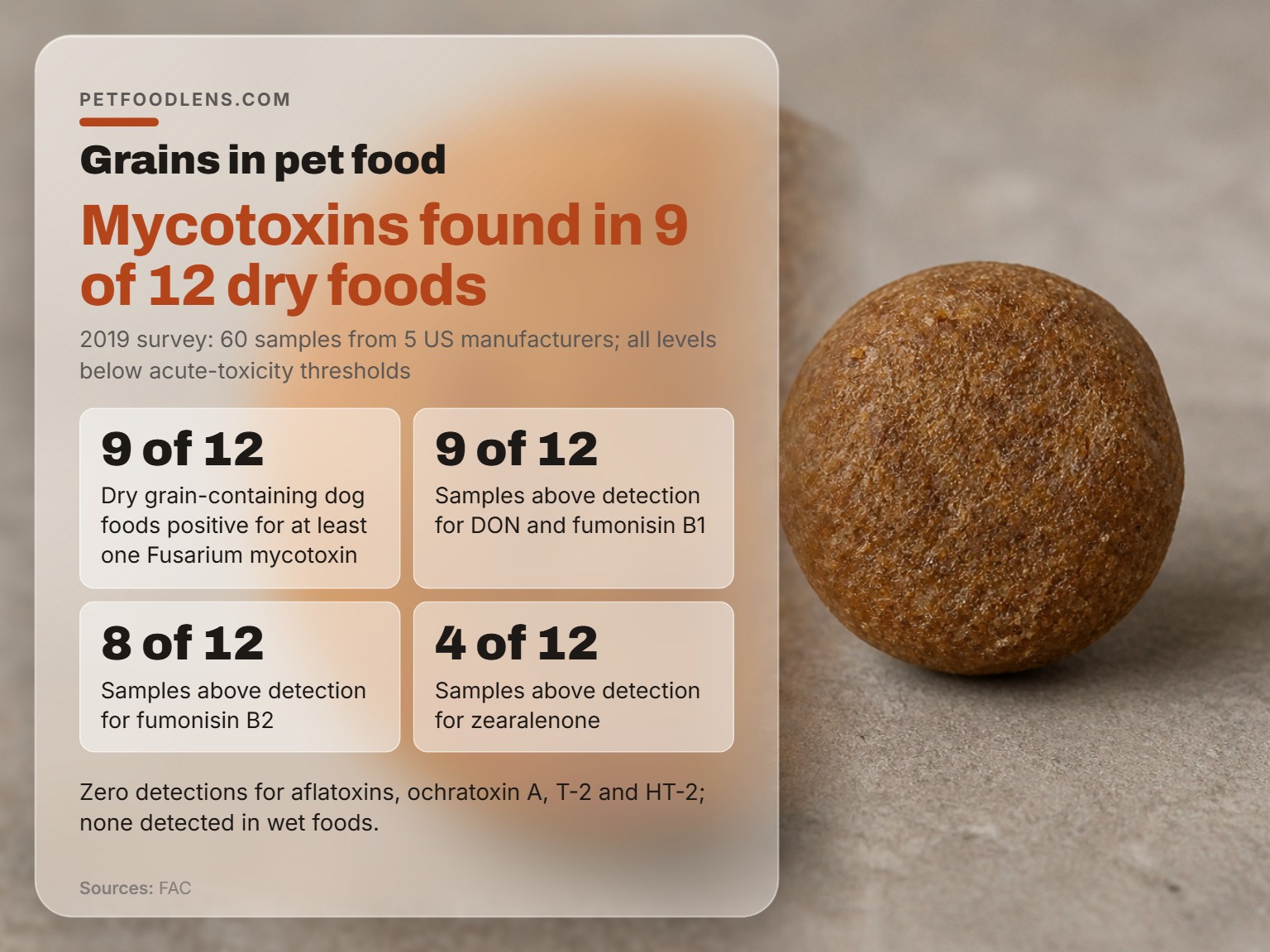
Nine of twelve dry, grain-containing dog foods in one 2019 survey carried at least one Fusarium mycotoxin. The survey analysed 60 samples from five US manufacturers.
The breakdown is specific. Deoxynivalenol and fumonisin B1 were above detection in 9 of 12 samples, fumonisin B2 in 8 of 12, and zearalenone in 4 of 12. Aflatoxin B1, B2, G1 and G2 came back at zero, as did HT-2, ochratoxin A and T-2.
| Mycotoxin | Positive samples | Note |
|---|---|---|
| Deoxynivalenol (DON) | 9 of 12 | Dry grain-containing foods only |
| Fumonisin B1 | 9 of 12 | Same sample set |
| Fumonisin B2 | 8 of 12 | Same sample set |
| Zearalenone | 4 of 12 | Same sample set |
| Aflatoxin B1, B2, G1, G2 | 0 of 12 | Below detection |
| Ochratoxin A, T-2, HT-2 | 0 of 12 | Below detection |
Every detected level sat below acute-toxicity thresholds, which is the part headlines leave out. A musty, faintly sour smell on opening a bag is the practical warning sign, along with a dull rather than slightly glossy kibble surface.
Why Wet Food Sits Outside This Problem
No mycotoxin contamination was detected in the wet foods tested, grain-containing or grain-free. That is a format effect, not a grain effect.
The survey’s own mitigation advice was grains graded USDA US No. 1, which is a sourcing and grading standard. It is not an argument for dropping grain from the formula. If you want the ingredient-level version, corn in dog food and soy in pet food both get the same treatment.
Mycotoxins are a raw-ingredient and storage problem, not a grain problem. The mitigation the researchers recommended was a grading standard for grain, which tells you the fix sits upstream of the ingredient list.
Grain-Free Is Not One Category, and Legumes Are Not Interchangeable
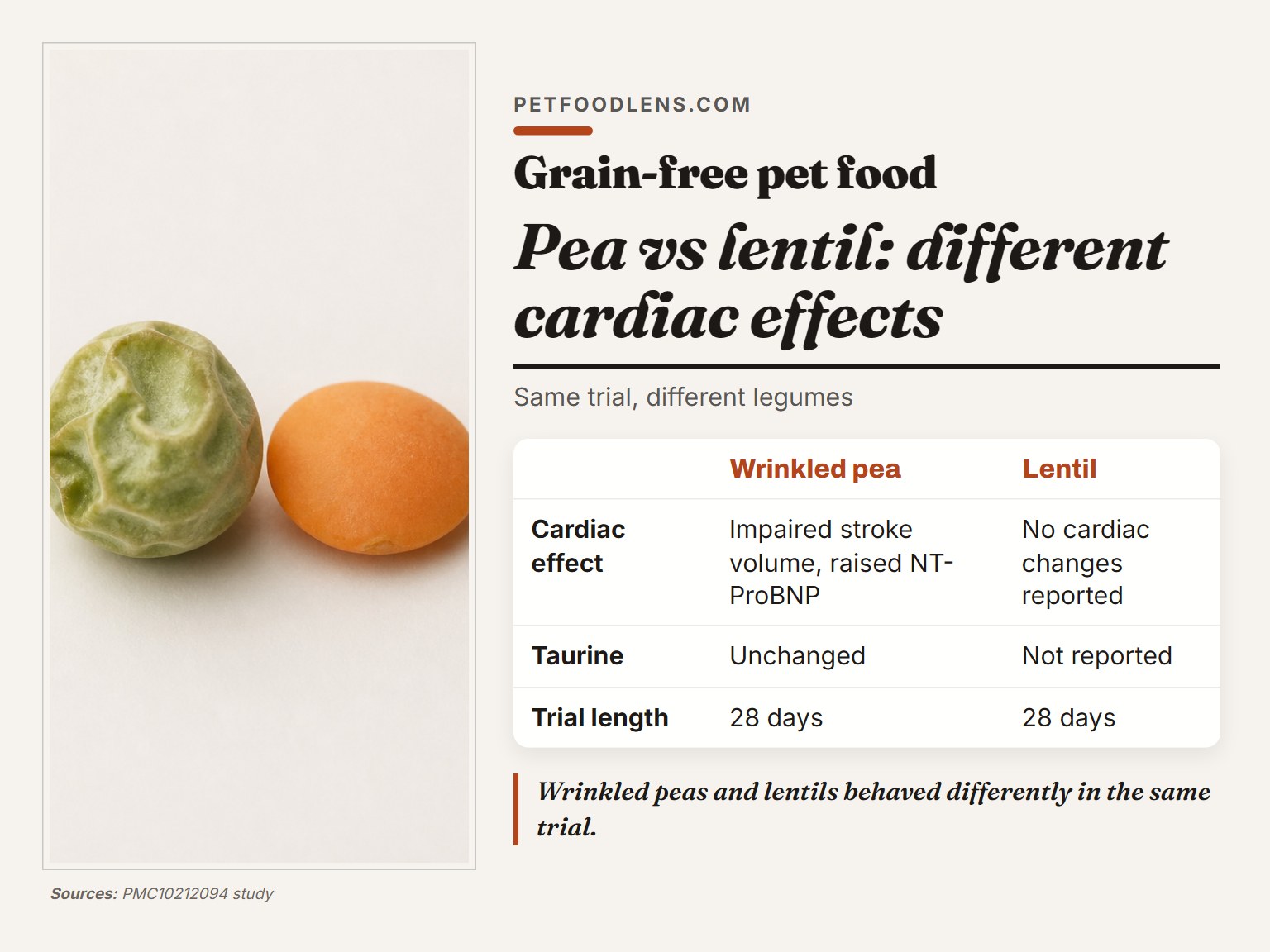
Wrinkled peas and lentils behaved differently in the same trial. That single fact should end most of the loose talk about “grain-free legumes.”
A 180-day grain inclusion digestibility in dogs study used 32 Beagles and 33 hounds across four diets varying animal protein and grain inclusion. All four diets were well-digested. Whatever the cardiac argument turns out to be, basic digestibility was not the problem.
I have compared grain-free bags where corn came out and peas, pea protein and pea fiber went in, and the carbohydrate load barely moved. The front of the bag changed. The back panel did not.
That is the trick worth naming. Split one plant source into three entries and no single one lands near the top of the list, even when together they outweigh the named meat. The fillers in pet food breakdown covers how that regrouping works.
- Peas, pea protein and pea fiber are one ingredient wearing three hats
- Potato starch and potato protein are the same manoeuvre
- Tapioca is starch with a friendlier name
How to Compare a Grain-Inclusive and a Grain-Free Bag at the Shelf
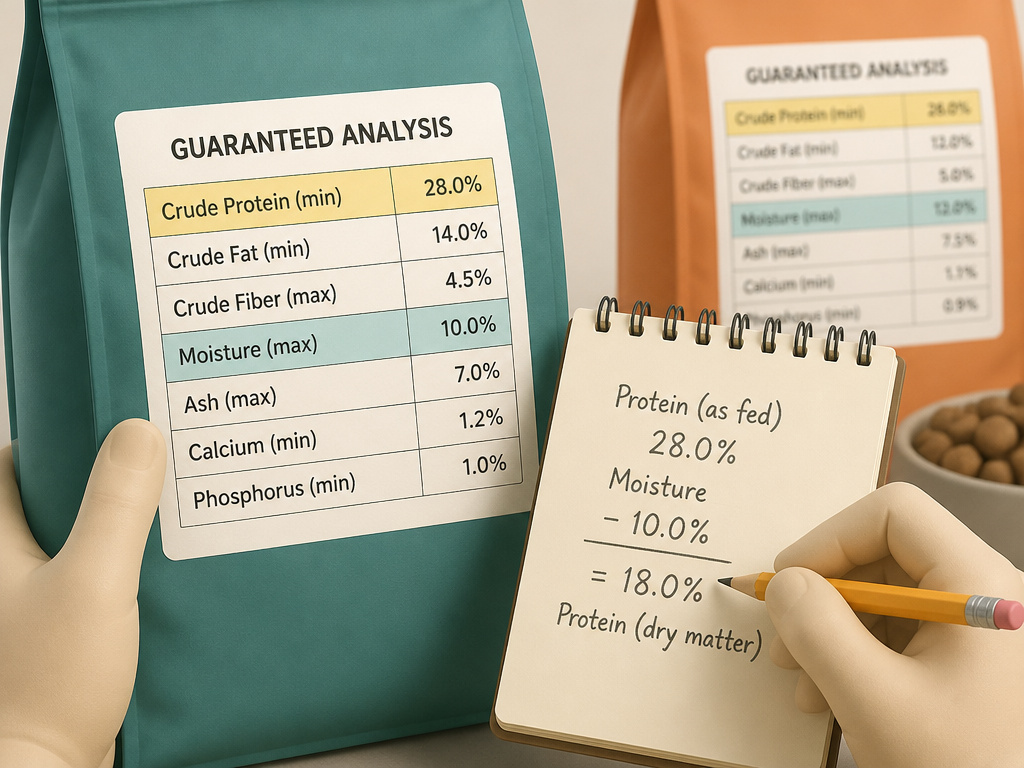
The guaranteed analysis is the only part of the panel that lets you compare two bags fairly, and moisture is what throws it off. A canned food at high moisture and a kibble at low moisture cannot be compared on the printed percentages.
Here is the method, in order:
- Find the moisture percentage on the guaranteed analysis. Skip this and every other number on the panel is measuring water.
- Subtract moisture from 100 to get the dry matter fraction. This is the part of the food that is actually food.
- Divide each nutrient percentage by the dry matter fraction. That converts protein, fat and fiber onto a common footing.
- Compare the converted figures, not the printed ones. Skipping this step is how a “high protein” kibble loses to a canned food with a lower number on the label.
Converting Guaranteed Analysis to Dry Matter
The arithmetic is one division per nutrient, and it takes about a minute per bag. Do it once for two foods and the marketing language stops working on you.
When I want a grain-inclusive cat food I can defend, I start with the guaranteed analysis on the bag and work backward to the ingredient list. If the numbers do not support the front of the bag, the front of the bag is decoration.
The same discipline applies to therapeutic claims. Some therapeutic diets carry dissolution claims that came from feeding trials in cats with the condition. An over-the-counter bag with a pH-balanced sticker has not been through that exam. “Supports” and “dissolves” are not the same verb.
If you want a starting shortlist rather than a method, best cat food with grain applies the same dry-matter logic.
Frequently Asked Questions
Are grains bad for dogs and cats?
Not universally: grains supply digestible carbohydrate, plant protein and fiber, and the 180-day digestibility trial found grain-inclusive and grain-free diets alike were well-digested, though a 2025 review of grain-free diets lists allergen elimination as an advantage of grain-free formulas. The legitimate concerns are narrower: mycotoxin risk in dry grain-containing food, and specific legume species in specific formulas.
Do grains cause heart disease in dogs?
That has not been established. The FDA’s Center for Veterinary Medicine investigated reports of DCM in dogs eating legume, pulse or potato-based diets and stated it is not yet known how those ingredients may be linked. An 18-month trial of 60 dogs found no clinically significant cardiac differences between grain-free and grain-inclusive diets.
Is grain-free food better for allergies?
It depends on the source: Purina Institute states gluten allergy is extremely rare in dogs and has not been identified in cats, with beef, dairy and chicken more likely culprits than wheat or corn, while a 2025 review of grain-free diets lists allergen elimination as an advantage of grain-free formulas. A genuine food allergy is found with a controlled elimination trial, not by changing the grain source.
Are mycotoxins in pet food dangerous?
At the levels detected in the 2019 survey, no. All detected mycotoxins sat below acute-toxicity thresholds, and contamination appeared only in dry grain-containing foods. The researchers’ recommended mitigation was grain graded USDA US No. 1, which is a sourcing standard.
Should I switch my pet off grains?
Only with a reason. If your pet is doing well on a grain-inclusive diet, the evidence does not support a switch. If you are managing a diagnosed condition, that decision belongs to your vet, not to a bag.
Before You Go
If your cat is healthy and eating a grain-inclusive wet food, the least useful thing you can do this month is move it to a grain-free dry one. You would be trading a format with no detected mycotoxin contamination for one that carries the risk, in exchange for a marketing claim.
None of this settles the DCM question, and I want to be clear about that. The 28-day trial and the 18-month trial disagree, the FDA never closed its investigation, and anyone telling you the science is settled is selling something. What the evidence does support is narrower: watch the format, watch the storage, and do the dry matter math before you trust a front panel.
One threshold worth carrying: if a bag lists three forms of the same plant ingredient in its first five entries, treat them as one ingredient and re-read the list. That single habit will tell you more about a formula than any claim printed above it.
I am not a veterinarian, and nothing here substitutes for an exam on a cat that is already sick. Bring the dry matter numbers to that appointment. They make the conversation shorter.
