
Senior Cat Food Pros and Cons: What Labels Skip
This post contains affiliate links. As an Amazon Associate, we earn from qualifying purchases.
Senior cat food pros and cons rest on one measured finding: across 31 senior cat foods, protein, fat, and mineral levels did not differ significantly from adult maintenance foods, while crude fiber ran higher. The pros are fiber and, in canned products, water. The con is paying for a life stage with no legal nutrient standard.
That gap matters because AAFCO writes nutrient profiles for growth, adult maintenance, and reproduction, which is the core of the senior cat food pros and cons. There is no senior profile. A senior food gets measured against the adult maintenance standard and passes without changing anything meaningful.
What follows is the pros column and the cons column, each tied to a number you can check yourself: fiber, calories per 100 grams of dry matter, protein as a percentage of dry matter, and the age printed on the label.
Key Takeaways
- Senior food is largely adult food plus fiber. Across 31 senior cat foods, protein, fat, and minerals matched adult maintenance products and only crude fiber ran significantly higher, though AAHA notes prescription therapeutic diets may be indicated more often for mature adult or senior cats.
- Calorie density swings from 337 to 505 kcal per 100 g of dry matter, so the word senior tells you nothing about whether the food is light or heavy.
- Healthy senior cats should not be protein restricted. AAHA puts moderate protein at 30 to 45 percent dry matter.
- Canned senior food runs denser than dry, at 459 versus 392 kcal per 100 g dry matter, which matters for a thin cat.
- Underweight is common in senior cats, so defaulting to a lower-calorie senior bag can work against you.
What the Word Senior Actually Certifies
Nothing on a senior cat food bag certifies a senior nutrient profile, because no such profile exists.
AAFCO publishes nutrient profiles for growth, adult maintenance, and reproduction only. Foods marketed for cats over seven or eleven years are formulated to the adult maintenance profile. In one evaluation, all 31 senior cat foods tested met that adult maintenance standard. No separate senior or geriatric requirement exists to test against.
Summers and colleagues measured 31 senior cat foods against 59 adult foods. Crude fiber was the one real gap, and it ran higher in the senior products.
The age on the label is just as loose. Summers and colleagues note that some consider cats mature at 7 and senior at 11, while AAHA’s guidance provides senior energy multipliers for cats over 10. Two credible sources, two different birthdays.
Settle that question before you shop.
The wider nutrition and aging in cats literature keeps circling the same question: what exactly should change at 11 that did not change at 7? Nobody has published a requirement that answers it.
The Pros: Fiber, Water, and Calories on Demand
Three things genuinely do improve in senior formulations: fiber, water, and calorie density.
Here is what you actually get for the premium:
- More crude fiber, and significantly so. The senior products in the Summers evaluation carried higher fiber than adult maintenance foods at P < .0001. For a cat that struggles with hairballs or slow transit, that is a real functional difference.
- Canned senior food carries more water, and AAHA notes that higher-moisture diets may improve overall water intake. A cat eating only dry is taking in a small fraction of the water a canned-fed cat gets.
- Calorie density goes up in foods labeled 11+, at 429 versus 399 kcal per 100 g dry matter for the 7+ products. That is the opposite of what most owners expect from a senior bag.
- Prescription options exist for the conditions that cluster after age ten.
One more point in the senior column. A 2021 crossover trial in 40 cats aged 8.3 to 13.5 years, with 30-day washouts between diets, looked at how diet affects feline metabolic markers as cats age. The short version: diet composition moves the markers, and age changes how much.
The Cons: Paying for a Category With No Standard
The premium on a senior bag buys you a word.
Start with the calorie spread. That is a wide spread inside a single marketing category, and the bag does not tell you where on that range your food sits.
Label reliability is the second problem. A compliance study of 27 Canadian-only dry foods found that only 9 of 27 met every guaranteed-analysis claim printed on the package. Twenty-five of the 27 met AAFCO nutrient recommendations, so the food was generally sound. The numbers on the panel were the part that drifted.
Here is the part the front label skips. I have pulled grain-free senior bags apart on paper more times than I can count, and the swap is usually corn out, peas and tapioca in. The carbohydrate load barely moves. Turn the bag over and read the order.
The part nobody mentions: A senior food labeled 11+ can carry higher calories and lower magnesium than one labeled 7+. Two bags, both “senior,” pulling in opposite directions on the two numbers that matter most for an older cat.
How Much Protein Does a Senior Cat Really Need?
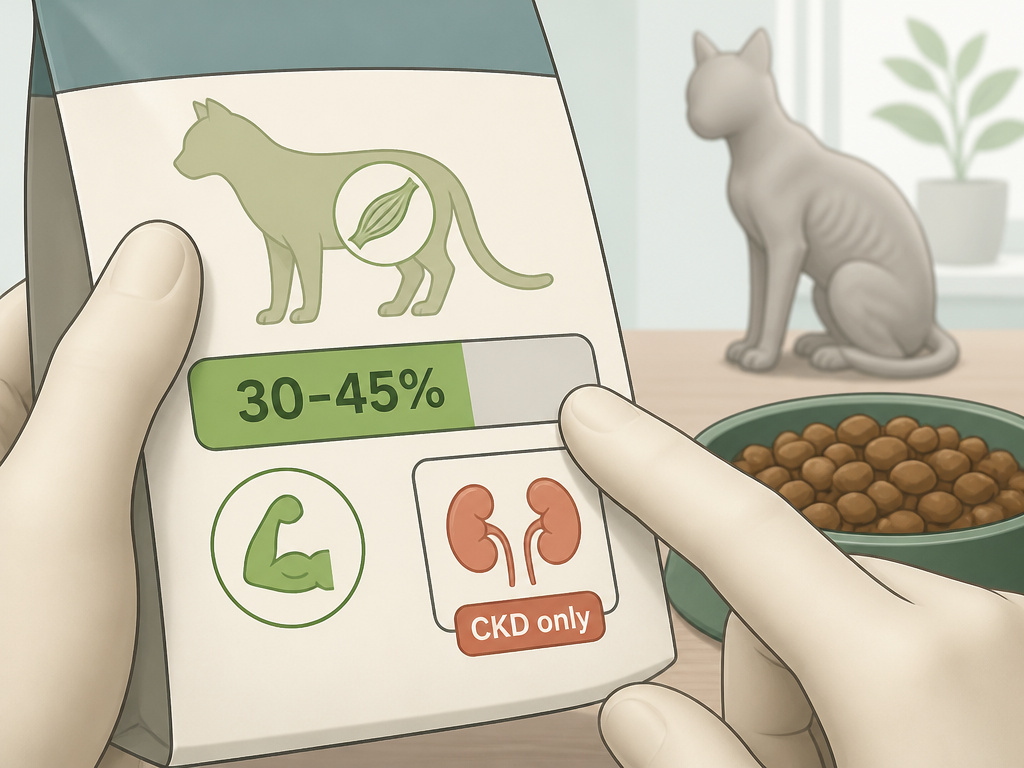
AAHA’s number for healthy mature and senior cats is 30 to 45 percent protein on a dry matter basis, and the guideline says plainly that these cats should not be protein restricted.
That runs against a habit I still see in clinics and kitchen conversations: cut the protein because the cat is old and the kidneys are probably next. AAHA’s own wording is that a lack of consensus exists on optimal protein levels, and Summers and colleagues note that aging cats may require higher dietary protein to maintain lean body mass.
The Kidney Exception
The rule flips the moment chronic kidney disease is diagnosed. AAHA endorses prescription renal diets with restricted, high-quality protein and restricted phosphorus for CKD cats.
Same guideline body, opposite advice, and the dividing line is the diagnosis rather than the birthday. It is not a default for every cat over ten.
This is where I stop being useful and your vet starts. I read labels. I do not diagnose renal disease, and neither does a bag.
Where this goes sideways: Restricting protein on a healthy 12-year-old because the cat is “getting up there.” AAHA’s guidance for healthy seniors is 30 to 45 percent dry matter, and muscle loss in an otherwise healthy cat is the cost of getting this wrong.
Why Does My Senior Cat Lose Weight on Senior Food?
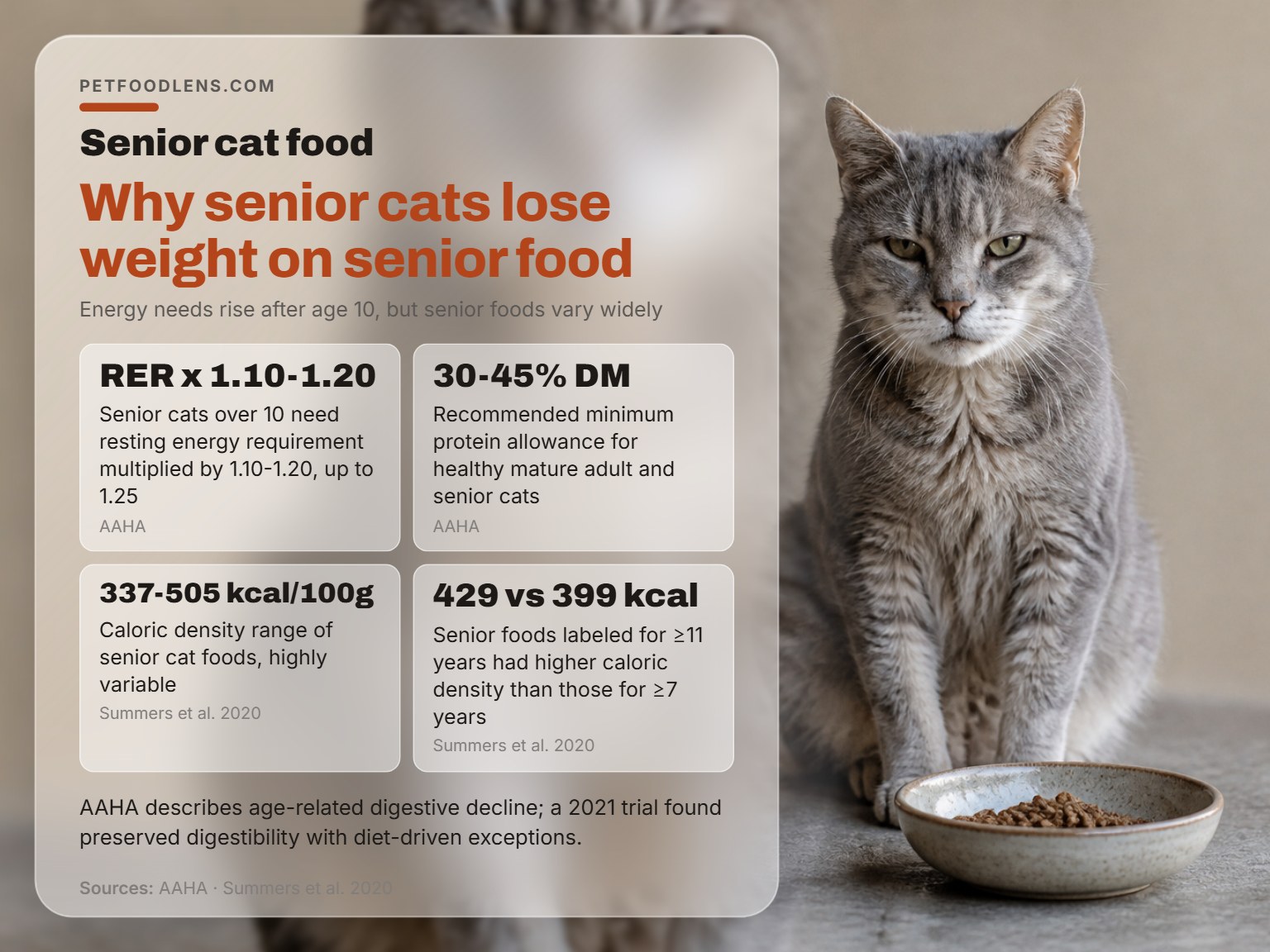
You weigh the cat in March and again in June. Weight gone, and the bowl still empties every night.
Underweight is a common problem in senior cats, and AAHA says so directly. AAHA notes that seniors may experience reduced digestive capability, which lowers body condition and pushes caloric needs up, while a 2021 digestibility study found healthy ageing preserved or enhanced nutrient digestibility, with lower digestibility tied to a specific diet formulation rather than age. The energy math reflects it: mature adults aged 7 to 10 sit at roughly resting energy requirement, while cats over 10 need RER multiplied by 1.10 to 1.20, and up to 1.25 in some cases.
Run a hand down the spine. A cat losing muscle feels like a row of knuckles under the skin long before the ribs ever show.
Now the disagreement. A 2021 study on healthy ageing and nutrient digestibility found that older cats actually digested total dietary fiber and calcium better than young adults. The lower fat and protein digestibility in that trial tracked to one specific formulation, a 17 percent fat, 9 percent fiber diet, not to age itself.
So two credible positions exist. AAHA describes age-related digestive decline; the trial data describes preserved digestibility with diet-driven exceptions. Both can be true at once if the food matters more than the birthday.
| What you see | Likely cause | First move |
|---|---|---|
| Weight dropping, coat dull | Calories below RER x 1.10-1.20 | Weigh weekly, raise intake |
| Eats less, then refuses | Stress-related aversion from a rushed swap | Offer new food in a separate container |
| Spine feels bony, ribs hidden | Protein under 30% dry matter | Ask the vet about a 30-45% DM food |
| Drinking and urinating more | Possible CKD or hyperthyroidism | Bloodwork before any diet change |
The case I run into most often is an all-life-stages food sitting in front of a 12-year-old cat that has slowed down. Those calories are built for growth, and the cat stopped growing a decade ago. I ask age and weight now before I say a word about the food.
If weight is the problem, senior cat food for weight gain is the more useful search than anything with senior on the front.
Canned vs Dry Senior Cat Food: Which One Wins?
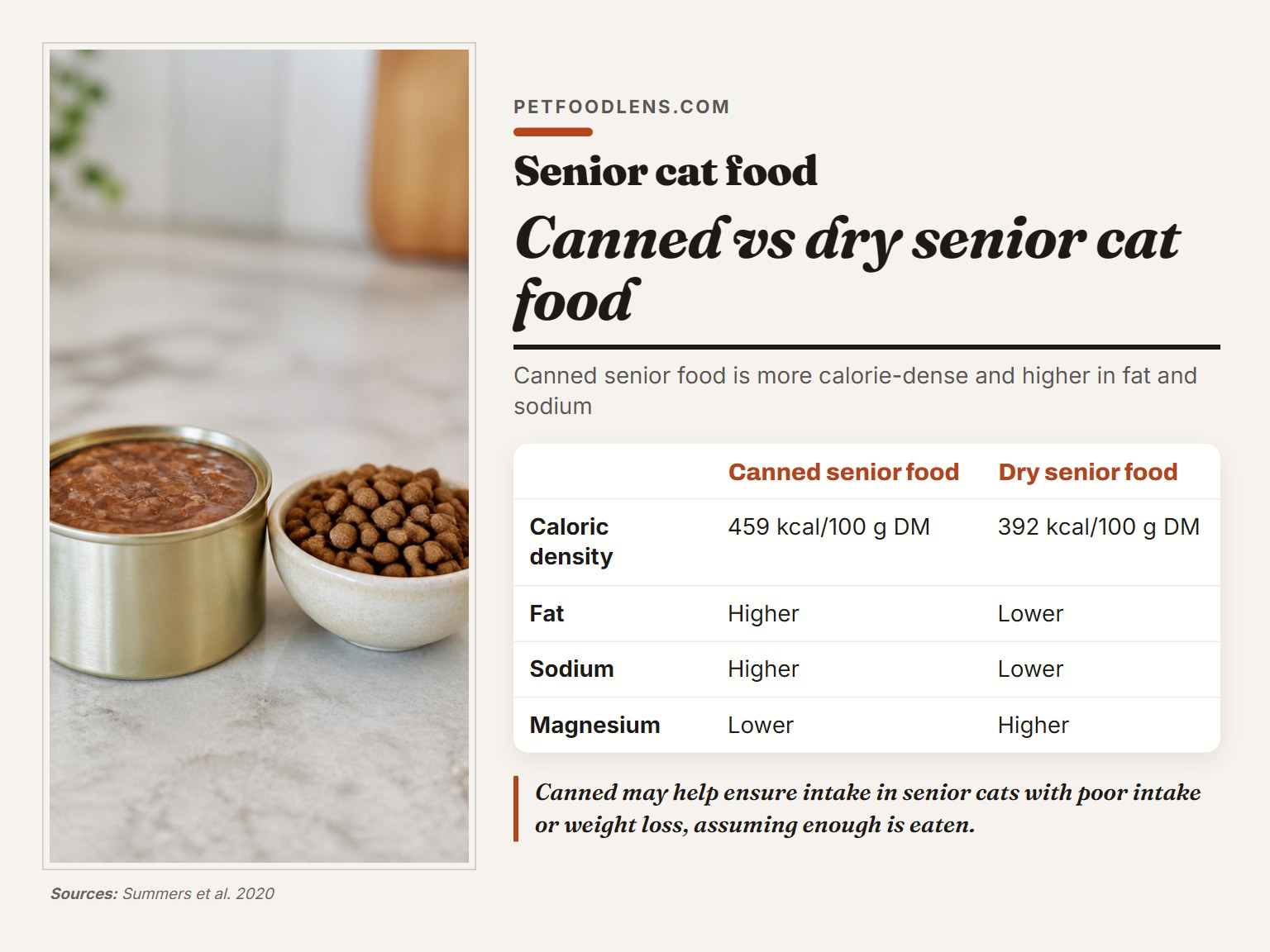
For a thin senior cat, canned wins.
The measured case is straightforward. Canned senior foods carried 459 kcal per 100 g dry matter against 392 for dry, plus higher fat and sodium and lower magnesium. For a cat with poor intake or unintentional weight loss, Summers notes canned food may help ensure adequate intake assuming enough gets eaten.
A bowl of canned food left down goes tacky at the rim and smells faintly sour in a warm kitchen. That is your feeding window. Dry food sits out all day without that problem, which is exactly why it gets free-fed.
| Measure | Canned senior food | Dry senior food |
|---|---|---|
| Caloric density | 459 kcal/100 g DM | 392 kcal/100 g DM |
| Fat | Higher | Lower |
| Sodium | Higher | Lower |
| Magnesium | Lower | Higher |
| Water content | High | Lower |
Where dry wins: convenience, cost per calorie, and cats that graze. Where canned wins: water intake, palatability, and any cat carrying too little weight.
The wet food pros and cons break that trade-off down further, and the wet food for seniors shortlist covers the palatability end. If you are staying with kibble, the dry food for seniors options are worth comparing on calorie density rather than brand.
One thing a fountain will not do: close the water gap. A cat on dry kibble is still taking in a fraction of the water a canned-fed cat gets, and moving water does not change the math.
How to Switch Foods Without Triggering a Strike
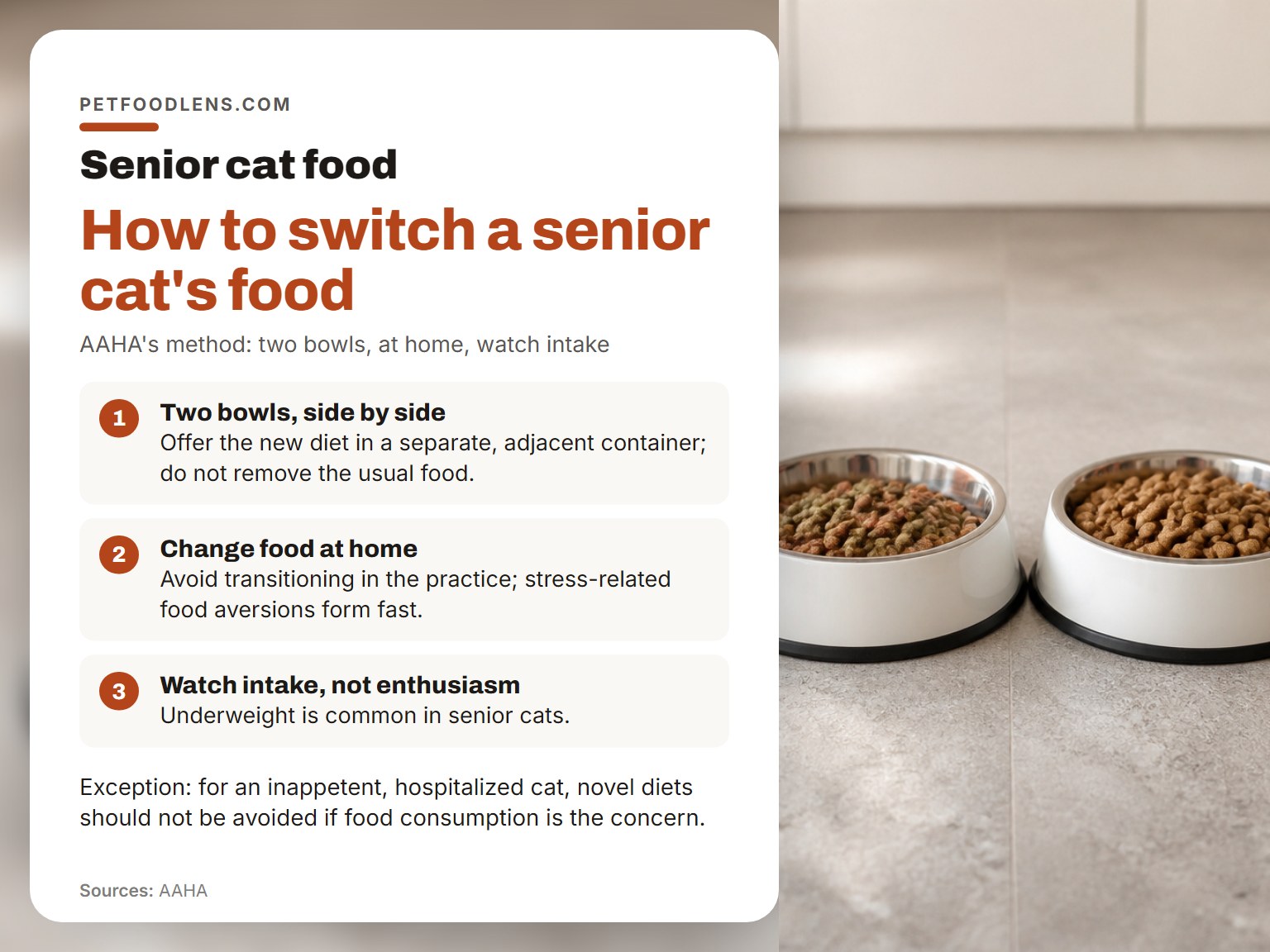
AAHA’s method is specific, and it is not the seven-day blend most guides describe.
- Put the new food in a separate, adjacent container. Do not remove the usual food and replace it. Two bowls, side by side, lets the cat express a preference instead of forcing a decision.
- Make the change at home. AAHA recommends against transitioning in the practice, because stress-related food aversions form fast and follow the cat home. Skipping this is how a cat learns to refuse a food it would otherwise eat.
- Watch intake, not enthusiasm. A senior cat that sniffs and walks away is telling you something. Reduced intake in an older cat costs weight quickly, and weight is already the thing you are trying to protect.
- Keep the old food available until the new one is reliably eaten. Pulling it early gets you a hungry cat and a wasted bag.
- Recheck weight regularly. Frequent checks give you enough signal to adjust before body condition moves.
Easy to miss: AAHA carves out one exception to the at-home rule. For an inappetent, hospitalized cat, novel diets should not be avoided if food consumption is the concern. Different setting, different rule.
If your cat has a history of reacting to new foods, start with the food for sensitive stomachs list rather than working through the shelf at random.
Frequently Asked Questions
Is senior cat food better than adult cat food?
For most healthy cats, the measured difference is fiber. Senior foods in the Summers evaluation matched adult maintenance foods on protein, fat, and minerals, and all 31 met the AAFCO adult maintenance profile. Higher fiber helps some cats and does nothing for others.
At what age should a cat switch to senior food?
There is no agreed answer. One review notes mature at 7 and senior at 11 as common definitions, while AAHA’s guidance provides senior energy multipliers for cats over 10. Body condition and bloodwork are better triggers than a birthday.
Do senior cats need less protein?
No. AAHA states that healthy mature and senior cats should not be protein restricted, with 30 to 45 percent dry matter considered moderate and recommended. The exception is a diagnosed condition like chronic kidney disease, where restricted protein and phosphorus are the therapeutic approach.
Is wet or dry food better for an older cat?
Canned wins for a cat that is thin or not drinking enough, since it carries more water and more calories per 100 g of dry matter. Dry is fine for a cat holding weight well that grazes through the day. Match the format to the cat, not to the category.
How do I know if my senior cat is underweight?
Run your hands along the spine and ribs. Underweight is common in senior cats, and AAHA flags it directly. A spine that feels like knuckles under the skin is the early signal, well before the ribs become visible.
The Bottom Line
One rule I would put above everything else: if your cat is over 10 and losing weight, stop buying senior food on autopilot and get bloodwork first. Thyroid and kidney disease both look like “just getting old” from across the room, and no bag on the shelf fixes either one.
The senior dog food side of the shelf has the same structural problem, by the way. Different animal, identical absence of a legal senior standard.
Here is the concession. Everything above assumes a healthy cat with no diagnosis. Add chronic kidney disease and the protein advice inverts completely, which is why the renal diets exist and why your vet owns that decision.
For the cat with clean bloodwork and a body condition score in range, the honest answer is that a mid-priced adult maintenance food with a clear AAFCO adequacy statement does the same job as the senior bag next to it. Compare them on dry matter. If the numbers match, buy the cheaper one and spend the difference on a follow-up weight check.
