
Senior Dog Food Pros and Cons: What Labels Hide
This post contains affiliate links. As an Amazon Associate, we earn from qualifying purchases.
Senior dog food pros and cons come down to this: a dedicated senior formula can help a dog with a specific problem like lean muscle loss, arthritis, or obesity, but the label itself promises nothing regulated. Cornell veterinarians say there is no true reason to feed a senior diet unless a real problem exists.
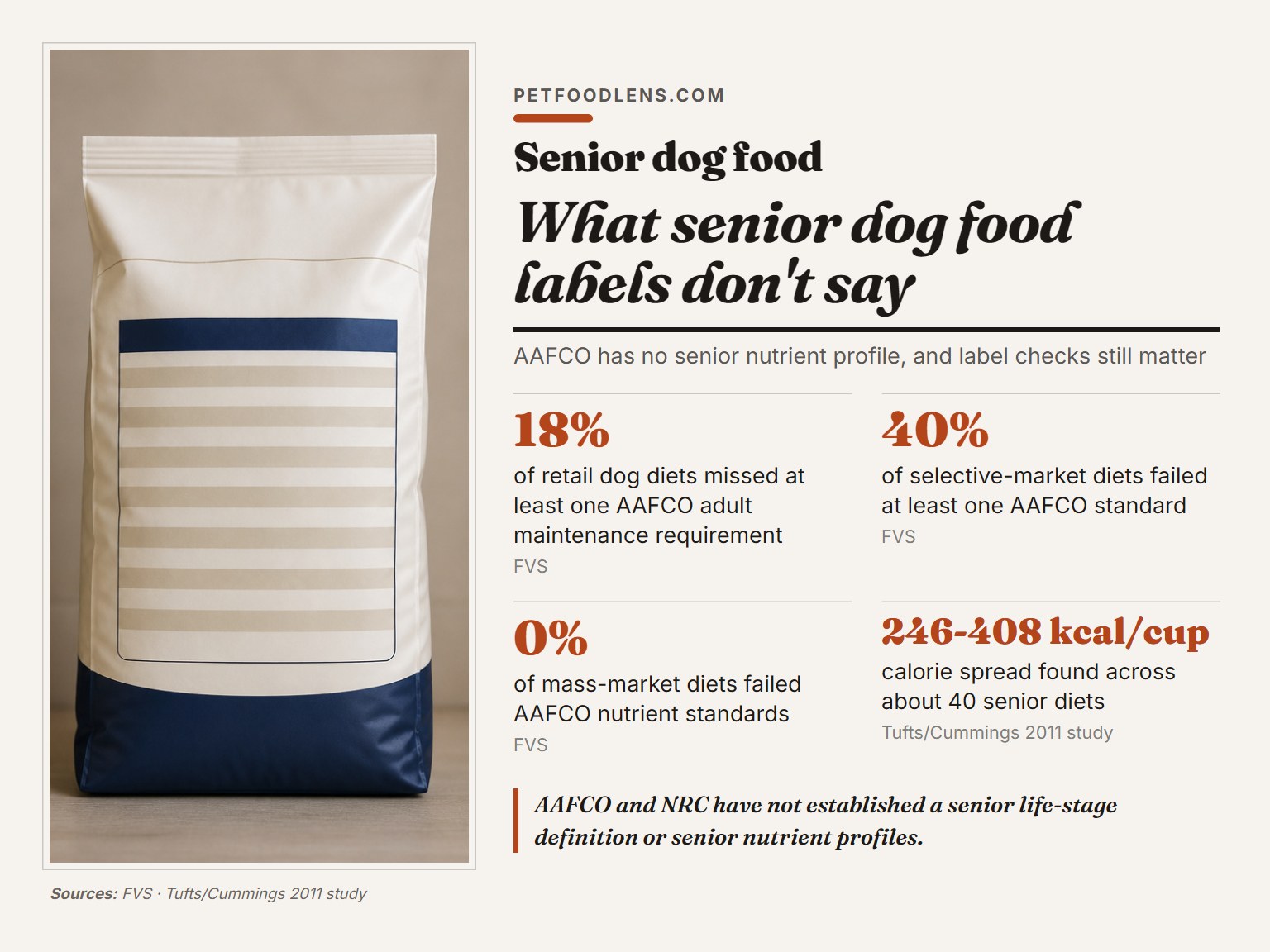
The gap between the label and the regulation is where the senior dog food pros and cons question goes wrong. AAFCO sets nutrient floors for adult maintenance, and a senior diet has to clear those floors, but no separate senior standard exists. So the word “senior” on the front of the bag is a marketing category with no fixed nutrient meaning.
The research disagrees on some fundamentals. Cornell’s veterinary nutritionists, a peer-reviewed analysis of 61 retail diets, and a Tufts survey of 1,300 owners do not line up on protein, calories, or whether a senior diet helps at all. What follows walks through each disagreement, then the specific problems a senior diet does solve.
Key Takeaways
- No AAFCO senior standard exists. A senior diet is formulated to adult maintenance or all-life-stages, and the manufacturer defines “senior.”
- Cornell sees no reason to feed a senior diet unless a dog has lean muscle wasting, arthritis, or obesity.
- Protein matters more than the label suggests. Cornell wants slightly higher protein; FEDIAF recommends more, not less.
- 18% of 61 retail diets failed at least one AAFCO requirement, with all 17 individual failures involving calcium, phosphorus, potassium, or the Ca:P ratio.
- Check the guaranteed analysis, not the front of the bag. Five of seven companies raised sodium in their senior formulas.
What the “Senior” Label Actually Means
AAHA’s 2019 Canine Life Stage Guidelines call a dog senior in the last 25% of its estimated lifespan. The Dog Aging Project uses 11 years and older for its statistics. Neither AAFCO nor the National Research Council has set a senior nutrient profile at all.
Neither AAFCO nor the National Research Council has established a senior life-stage definition or a senior nutrient profile. A diet marketed for seniors is formulated to meet adult maintenance requirements or all-life-stages requirements. The manufacturer decides what “senior” means, and that decision varies by company.
That definitional mess matters. A bag labeled “senior” at year seven is making a marketing choice, not a nutritional one. The manufacturer picks the cutoff, the nutrient targets, and the explanation, and is under no obligation to share the reasoning.
A peer-reviewed senior dog food study published in Frontiers in Veterinary Science tested 61 retail diets from 25 brands against AAFCO adult maintenance. Eleven of the 61 (18%) missed at least one requirement. Every one of the 17 individual failures involved calcium, phosphorus, potassium, or the calcium-to-phosphorus ratio.
The market-segment split is the part I’d frame on the wall. All 23 mass-market diets met AAFCO. Three of 18 mid-market diets (17%) and 8 of 20 selective-market diets (40%) failed at least one standard.
| Nutrient | AAFCO limit | Diets outside | Observed range |
|---|---|---|---|
| Potassium (low) | min 1.5 g/1,000 kcal | 5 | 1.0-1.3 g/1,000 kcal |
| Calcium (high) | max 6.25 g/1,000 kcal | 6 | 6.4-8.9 g/1,000 kcal |
| Phosphorus (high) | max 4.0 g/1,000 kcal | 4 | 4.1-4.4 g/1,000 kcal |
| Ca:P ratio (high) | max 2:1 | 2 | 2.2:1 and 2.3:1 |
None of those failures are exotic. They’re mineral-level misses on calcium, phosphorus, potassium, and the ratio between calcium and phosphorus, which are the four numbers most relevant to kidney and bone health in an older dog.
Where this goes sideways: A senior diet with phosphorus above the AAFCO maximum of 4.0 g/1,000 kcal is a hazard for a dog with early kidney disease. Three senior diets in the 2025 sample exceeded that ceiling, and a Tufts analysis found one senior diet at three times the AAFCO minimum.
What “Senior” Means by Breed and Size
A large breed like a Great Dane reaches senior status earlier in life than a small breed like a Chihuahua. AAHA’s lifespan-percentage definition handles that, but a bag that says “7+” does not. If you have a large breed, the age on the bag is a rough guess at best.
The Protein Question: More, Not Less
Cornell’s clinical nutrition team wants slightly higher protein for senior dogs. The median protein in 31 senior diets from a 2025 analysis was 76 g/1,000 kcal, identical to the adult median.
Joseph Wakshlag, a professor of clinical nutrition at Cornell, puts it plainly in the Cornell senior dog food guide: the goal is slightly higher protein, and many senior diets on the market are lower protein. The reason is lean body mass. As dogs age, they stop synthesizing protein as efficiently, and decreasing lean mass is tied to higher risk of illness and death.
FEDIAF’s scientific advisory board lands in the same place. Its 2017 statement recommends increasing dietary protein, when not medically contraindicated, to support lean body mass. For older dogs with reduced intake, FEDIAF recommends a higher protein concentration, not a lower one.
The 2025 retail data complicates the picture. Across the 61 diets tested, crude protein did not differ significantly between adult and senior formulas, with a median of 76 g/1,000 kcal for both. Company-level changes were mixed: five of seven companies raised protein in their senior line, one lowered it, and one left it unchanged.
| Measure | Adult diets | Senior diets | Significant? |
|---|---|---|---|
| Crude protein | 76 g/1,000 kcal | 76 g/1,000 kcal | No (p = 0.88) |
| Crude fat | 46.8 g/1,000 kcal | 42.2 g/1,000 kcal | Yes (p = 0.019) |
| Energy density | 4,117 kcal/kg DM | 3,965 kcal/kg DM | Yes (p = 0.01) |
| Crude fiber | 7.2 g/1,000 kcal | 8.5 g/1,000 kcal | No (p = 0.08) |
So the label says “senior” and the protein number barely moves in the 2025 retail data, though Cornell and FEDIAF recommend slightly higher protein for senior dogs. What does move is fat and calories, and both drop, which is consistent with the FEDIAF recommendation to lower energy density, though the 2025 study found senior diets had significantly higher energy density than adult diets (mean 4,117 vs 3,965 kcal/kg DM).
Fat and energy density drop for a mechanical reason. Fat is energy-dense, roughly twice the energy of protein or carbohydrate, so trimming fat is the fastest way a formulator lowers calories without shrinking the bag. The trade-off is that fat is also the most palatable fraction, which is why some senior formulas lean harder on canned textures to keep the dog eating.
Pour a senior kibble and an adult kibble from the same brand side by side and they often look the same: same color, same size, same crunch. The difference, when there is one, is in the fat line on the guaranteed analysis.
If you’re weighing a high-protein dog food for a senior, the number to watch is grams per 1,000 kcal, not the crude protein percentage on the front. I read cat labels for a living, and the pattern is identical on the dog side: the front of the bag sells a life stage, the guaranteed analysis sells the actual formula.
Senior Dog Food Pros and Cons: The Label Problem
The bag says “senior.” The numbers say “adult with a different label and a higher sodium level.”
A Tufts senior dog food discrepancy study surveyed 1,300 owners and found that 84.5% believed senior dogs have different nutritional needs. When researchers analyzed roughly 40 senior diets, the differences from adult formulas were inconsistent. Sodium ranged from 33 to 412 mg/100 kcal, a 12.5-fold spread. Phosphorus varied threefold, and one diet carried three times the AAFCO minimum.
The owner assumption and the lab result don’t line up. Owners assumed senior foods are lower in sodium, lower in fat, and lower in calories. The data show wide spread in both directions, and in the 2025 sample, five of seven companies actually raised sodium in their senior formulas, by 14.4% to 43.7%.
I’ve stopped trusting the word “senior” on a bag the same way I stopped trusting “urinary” on a cat bag. The front panel is a marketing decision. The guaranteed analysis is where the formulation actually lives, and the two often disagree.
The phosphorus number is the one I’d flag hardest. Only two of seven companies reduced phosphorus in their senior line. The rest raised it, by 2.4% to 19.7%, and three senior diets in the 2025 sample exceeded the AAFCO maximum of 4.0 g/1,000 kcal. For a dog with early kidney disease, that’s the wrong direction.
The same label-skepticism applies to wet food pros and cons: moisture and fat matter more than the life-stage claim on the front.
When a Senior Diet Actually Makes Sense
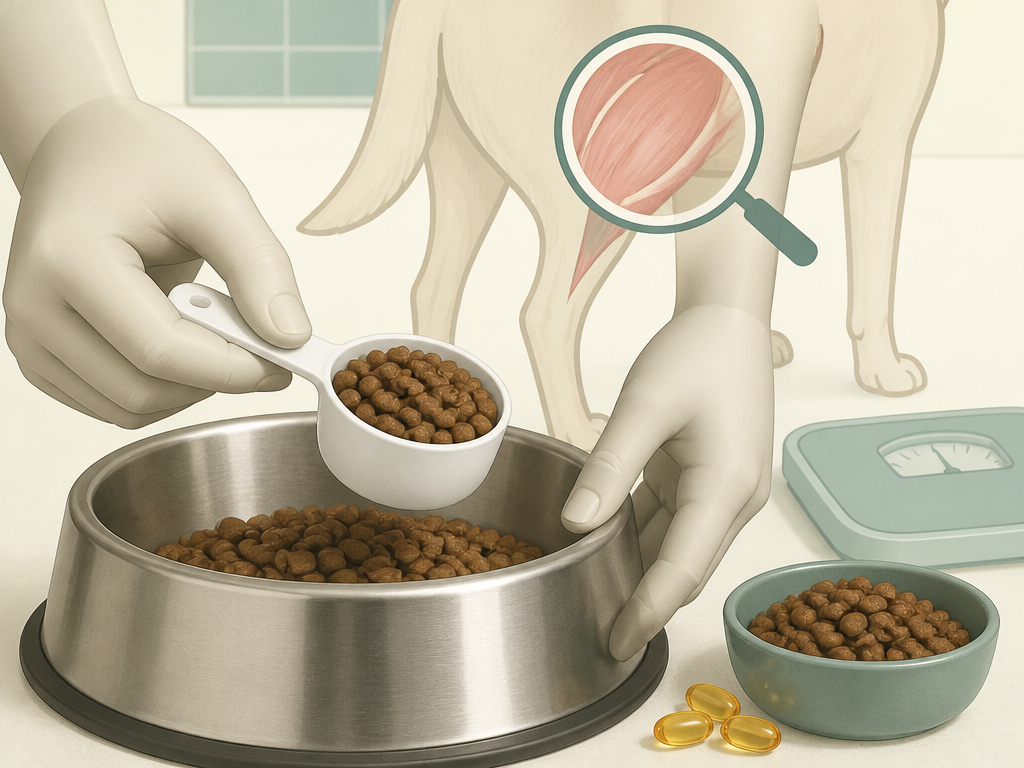
So when does the senior label earn its place on the shelf?
Cornell names three specific conditions: lean body wasting, arthritis, and obesity. Each one changes what the dog needs, and each one calls for a different formula. That’s why Wakshlag says there’s no one-size-fits-all senior diet, and why the choice is worth a conversation with a veterinarian.
The Three Problems a Senior Diet Actually Addresses
- Lean body wasting. Muscle loss that weight alone hides. Cornell recommends evaluating the thighs and shoulders, and a higher-protein diet may be necessary.
- Arthritis. Cornell points to long-chain omega-3s from marine oils (EPA and DHA), with a caution about the added fat.
- Obesity. Cornell recommends weighing regularly, decreasing portions, or switching to a lower-calorie food if the dog is gaining.
For arthritis specifically, Cornell names two prescription diets: Purina JM and Royal Canin Mobility. For canine cognitive disorder, Purina NeuroCare. For brain support without a prescription, Purina Bright Mind.
The fish-oil math is worth knowing. A 1,000 mg capsule usually contains about 300 mg of EPA and DHA, and Cornell’s dosage is 1-2 capsules per 10 pounds of body weight. A 50-pound dog with arthritis-related lameness could receive 5-10 capsules a day.
FEDIAF’s senior dog nutrition statement adds a fiber recommendation: higher crude fiber to support gastrointestinal motility and lower energy density.
Skip this if: Your dog is still hiking daily and holding weight. Cornell’s guidance is explicit that an active dog doesn’t need a portion cut, so a lower-calorie senior formula can work against you.
If arthritis is the driver, the arthritis diets category is where the omega-3 levels actually get compared. If weight is the driver, weight management formulas are a separate decision from a generic senior bag.
Canned vs Dry for Older Dogs
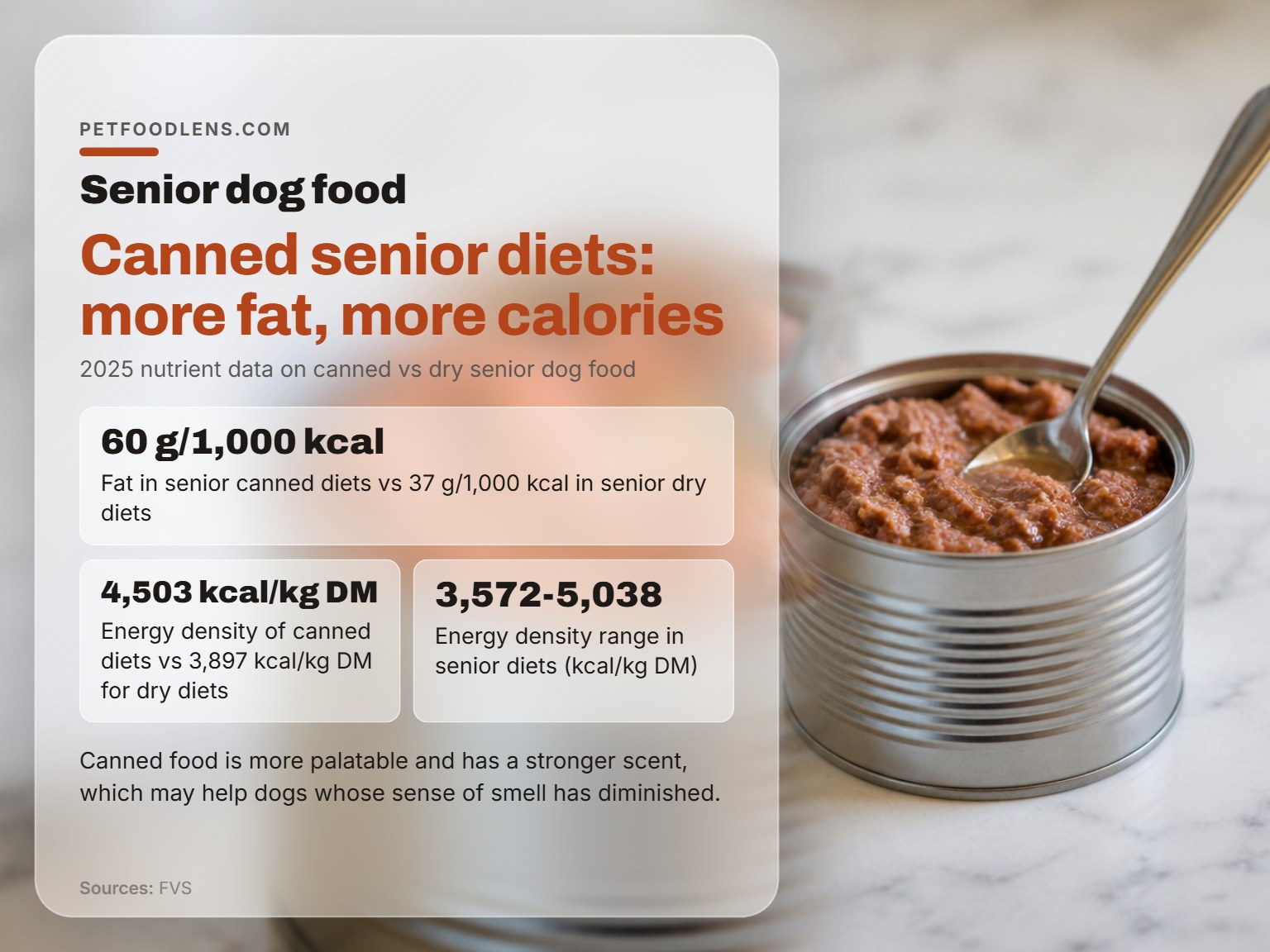
An older dog turns his nose up at kibble, then eats a bowl of canned food in one go. That’s a scent problem, not a preference problem.
Cornell’s guidance is that scent drives canine appetite, and a dog whose sense of smell has diminished may refuse standard kibble but accept canned food, which is more palatable and has a stronger scent. Canned food has a stronger scent, and for a dog whose nose has dulled, that scent is often the difference between eating and walking away.
The 2025 nutrient data adds a wrinkle. Canned senior diets had significantly more fat than senior dry diets, 60 vs 37 g/1,000 kcal. Canned diets across all life stages had higher energy density than dry, 4,503 vs 3,897 kcal/kg DM. If you’re switching a dog to canned to get him eating again, watch the calorie line, because the switch can add fat and calories at the same time.
A Korean digestibility study complicates the picture further. Nitrogen-free extract digestibility was significantly higher in senior dogs fed dry food, and crude fat digestibility showed an age-by-food-type effect in small breeds only. That’s a small study, and it doesn’t settle the canned-versus-dry question, but it’s a reminder that “easier to digest” depends on the nutrient and the dog.
A nutrition and aging in dogs review makes the same point: the evidence for one texture over the other is thinner than the marketing suggests.
- Start with the dog’s teeth and appetite. If kibble is being refused, try canned or a softened kibble before switching formulas.
- Check the fat and calorie line on the can. Canned senior diets run higher in fat than dry, so a canned switch can add calories even when the bag says “senior.”
- Watch the stool after the switch. A sudden texture change can loosen stool before it settles, so monitor whether the new food is working.
- Don’t switch proteins and texture at the same time. Change one variable, then the other, or you won’t know which one caused the problem.
If you’re leaning canned, the wet dog food category is where to compare formulas. If you’re staying dry, the dry dog food picks are organized by life stage and protein level.
For a dog with a sensitive stomach, the texture change matters more than the life-stage label, and a slow transition is the safer path.
What to Check on the Bag Before You Buy
The back of the bag is where the useful information lives.
Start with the AAFCO nutritional adequacy statement. It tells you whether the food is formulated for adult maintenance, all life stages, or growth, and whether the claim is based on a formulation or a feeding trial. A senior diet with an adult-maintenance statement is telling you it meets adult floors, not that it’s been tested on senior dogs.
The Guaranteed Analysis, Read in Order
- The AAFCO statement. Adult maintenance or all life stages, formulation or feeding trial.
- The guaranteed analysis. Protein, fat, fiber, and moisture, in that order.
- The calorie line. kcal/kg or kcal/cup, so you can compare across bag sizes and textures.
- The ingredient list. Named meats and named meals, not vague “meat” or “poultry.”
- The NASC seal on supplements. Cornell recommends buying through a veterinarian or a source carrying the National Animal Supplement Council seal, which means the product has been through quality control.
The ingredient-list rule is the one I use most. Reading the ingredient list is like checking a recipe’s opening lines. If the list leads with starches and vague proteins, the formula is doing something other than what the front of the bag implies.
The supplement side deserves its own caution. Cornell notes that animal supplements are not always well-regulated, and counterfeit products are more common online. Buying through a veterinarian or a source you trust is the safer path. Cornell recommends choosing supplements carefully and buying through a veterinarian or reputable source to avoid counterfeits.
If a senior bag’s leading ingredients are starches and vague proteins, the word “senior” on the front is doing more work than the formula is. Read the back first.
If you want a starting point, the senior dog food picks are organized by problem, not by age. For the timing question, when to switch to senior dog food is a separate decision from which food to switch to. And for a large breeds dog, the calorie and joint-support numbers matter more than the life-stage label.
Frequently Asked Questions
Is senior dog food necessary?
Not automatically. Cornell’s position is that there is no true reason to feed a senior diet unless a dog has a specific problem such as lean body wasting, arthritis, or obesity. For a healthy, active older dog, an adult maintenance formula that already works is a reasonable place to stay.
At what age is a dog considered senior?
It depends on who you ask. AAHA defines senior as the last 25% of estimated lifespan, which varies by breed and size. The Dog Aging Project uses 11 years and older for its statistics. Neither AAFCO nor the National Research Council has set a definition at all.
Is senior dog food lower in protein?
Often it is, and that runs against the research. Cornell wants slightly higher protein for senior dogs, and FEDIAF recommends increasing protein unless medically contraindicated. The 2025 retail data found median protein identical between adult and senior diets, but five of seven companies raised protein in their senior line, so the category is moving in the right direction.
Should I feed my senior dog canned or dry food?
Canned food is more palatable and has a stronger scent, which helps a dog whose sense of smell has diminished. But canned senior diets run higher in fat, 60 vs 37 g/1,000 kcal, and higher in energy density. If your dog is eating well on dry food, there’s no nutritional reason to switch textures.
How much fish oil should I give my senior dog?
Cornell’s dosage is 1-2 capsules per 10 pounds of body weight, with a 1,000 mg capsule providing about 300 mg of EPA and DHA. A 50-pound dog could receive 5-10 capsules a day for arthritis-related lameness. Ask your vet before starting, because the added fat matters for some dogs.
The Bottom Line
The one number I’d check before anything else is phosphorus. If your dog has any sign of kidney disease, a senior diet above the AAFCO maximum of 4.0 g/1,000 kcal is the wrong food, and three senior diets in the 2025 sample cleared that ceiling. Ask your vet for the phosphorus number on the formula you’re considering, then compare it to the AAFCO limit. If the number isn’t available, that’s your answer.
This all assumes a dog with a real problem. For a healthy, active older dog, Cornell’s position is that the senior label doesn’t buy you anything, and the adult formula you already trust is a reasonable place to stay.
I’m not a veterinarian, so I can’t tell you what your dog’s phosphorus target should be. I can tell you that the bag won’t tell you either, and the guaranteed analysis is the closest thing to an answer you’ll get without a blood test.
Read the back first.
