
Wet Dog Food Pros and Cons: What the Label Won’t Tell You
This post contains affiliate links. As an Amazon Associate, we earn from qualifying purchases.
Wet dog food pros and cons come down to water and what rides along with it: canned food runs 60-80% moisture, which supports hydration and urinary health, but it costs more per calorie, carries no dental benefit, and can overshoot phosphorus and sodium limits. Dry food wins on cost and convenience.
The moisture band is the whole mechanism. Royal Canin Academy puts wet food at 60-80% water, kibble at roughly 10%, and semi-moist at 25-35%. A cost comparison in PMC found some wet products exceed 80% moisture while dry food stays at or below 14%. That gap explains the price per calorie, the bigger bowl, and the reason a dog on canned food drinks less from the water bowl.
What follows walks the real trade-offs: the mineral load that doesn’t make the front of the can, the dental claim that doesn’t hold up, the fat numbers two peer-reviewed studies can’t agree on, and the storage clock that starts the moment you pop the lid.
Key Takeaways
- Wet food is 60-80% water, which is why it helps hydration and why it costs more per calorie than kibble at roughly 10% moisture.
- No canned food carries a dental benefit; VCA and Royal Canin both say so, and kibble’s chewing action scrapes more plaque.
- Mineral overshoot is real: in one assay of 25 wet foods, 3 dog foods exceeded the FEDIAF phosphorus ceiling and 7 total exceeded the sodium ceiling.
- Refrigerate after opening and discard after 3 days; discard bowl leftovers after about 30 minutes.
- Wet and dry can both meet a dog’s nutritional needs; the choice is about the dog, not the format.
Wet Dog Food Pros and Cons: The Real Trade-Offs
A can of wet food is mostly water, and that is the point.
Wet pet food carries a moisture content of 60-80%, compared with roughly 10% in extruded kibble and 25-35% in semi-moist products. The water dilutes energy density per gram, so a dog eats a larger portion for the same calorie load, and total water intake rises with the food.
VCA Animal Hospitals notes that the high water content can help increase a dog’s water intake, especially for dogs with urinary disease or chronic kidney disease. A Royal Canin Academy review adds a specific finding: feeding a 73%-moisture diet versus a 7%-moisture diet reduced urine specific gravity and calcium oxalate relative supersaturation in cats and at-risk dog breeds. Lower specific gravity means more dilute urine, which is the mechanism behind the urinary benefit.
Open a can of pate and the smell hits before the scoop does: iron, liver, a faint mineral tang. That aroma is also why picky dogs take to it faster than kibble.
Why Does Wet Food Cost More Per Calorie Than Kibble?
Because you’re paying to ship and package water.
A cost comparison in PMC found that commercial wet diets were more expensive than dry maintenance diets, dry therapeutic diets, and homemade diets in every scenario tested. VCA puts the same point plainly: canned food costs more per calorie than kibble because of the water content and the packaging. McGill’s Office for Science and Society adds the packaging angle: bags of kibble require less packaging than cans, which means less garbage.
The cost gap comes from three places:
- Water weight: you’re buying 60-80% water by mass, and water has no calories.
- Packaging: cans and pouches cost more to make and ship than a single bag.
- Volume: a dog needs more grams of wet food per calorie, so the can empties faster.
Cost per calorie beats cost per can every time. A bigger can at a lower shelf price can still be the more expensive food.
| Factor | Wet | Dry |
|---|---|---|
| Moisture | 60-80% | ~10% |
| Cost per calorie | Highest of formats tested | Lowest |
| Dental benefit | None | Some kibble |
| Storage after opening | 3 days refrigerated | Weeks in a sealed bag |
| Water intake | Higher | Lower |
If you want the dry-side numbers for comparison, the dry dog food breakdown covers cost, storage, and dental claims in the same format.
Three of Thirteen Wet Dog Foods Blew Past the Phosphorus Limit
Three of thirteen wet dog foods in one assay exceeded the FEDIAF safe upper limit for phosphorus of 4 g per 1,000 kcal.
That finding comes from PMC6868456, which tested 25 commercial wet foods (13 for dogs, 12 for cats) against FEDIAF 2018 recommendations. Every food tested cleared the minimum for phosphorus and sodium. The problem was the ceiling, not the floor. Ten dog foods and seven cat foods carried phosphorus at more than twice the recommendation. Four dog foods and three cat foods exceeded 3.75 g of sodium per 1,000 kcal, the level FEDIAF considers safe.
| Mineral | Reference ceiling | Wet foods above it |
|---|---|---|
| Phosphorus (dog) | 4 g/1,000 kcal | 3 of 13 dog foods |
| Sodium (dog and cat) | 3.75 g/1,000 kcal | 4 dog, 3 cat |
| Phosphorus, 2x minimum | 2x FEDIAF minimum | 10 dog, 7 cat |
High phosphorus intake is associated with struvite uroliths and may make them harder to dissolve, according to the same paper. High phosphorus diets have also been linked to adverse effects on renal function parameters. That matters because wet food is the first thing recommended for a dog with urinary or kidney disease.
Royal Canin Academy adds a separate wrinkle: selenium, sodium, and potassium appear less bioavailable in wet food, possibly due to gelling agents, though the same source says gelling agents don’t appear to impact macronutrient digestibility. That’s a different issue from the mineral excess PMC6868456 measured, and the two findings don’t reconcile neatly. One says the minerals are there but harder to absorb; the other says they’re simply over-supplied.
Common mistake: Treating “complete and balanced” as a mineral guarantee. AAFCO adequacy confirms the food meets minimums; it doesn’t cap phosphorus or sodium, and the assay above found several products that cleared the minimum and blew past the ceiling.
The paper’s authors put it bluntly: several wet foods evaluated were not recommended for use despite being available on the market, because of mineral excesses. That’s a formulation problem. A better-made can doesn’t have it.
Does Wet Food Help or Hurt Your Dog’s Teeth?
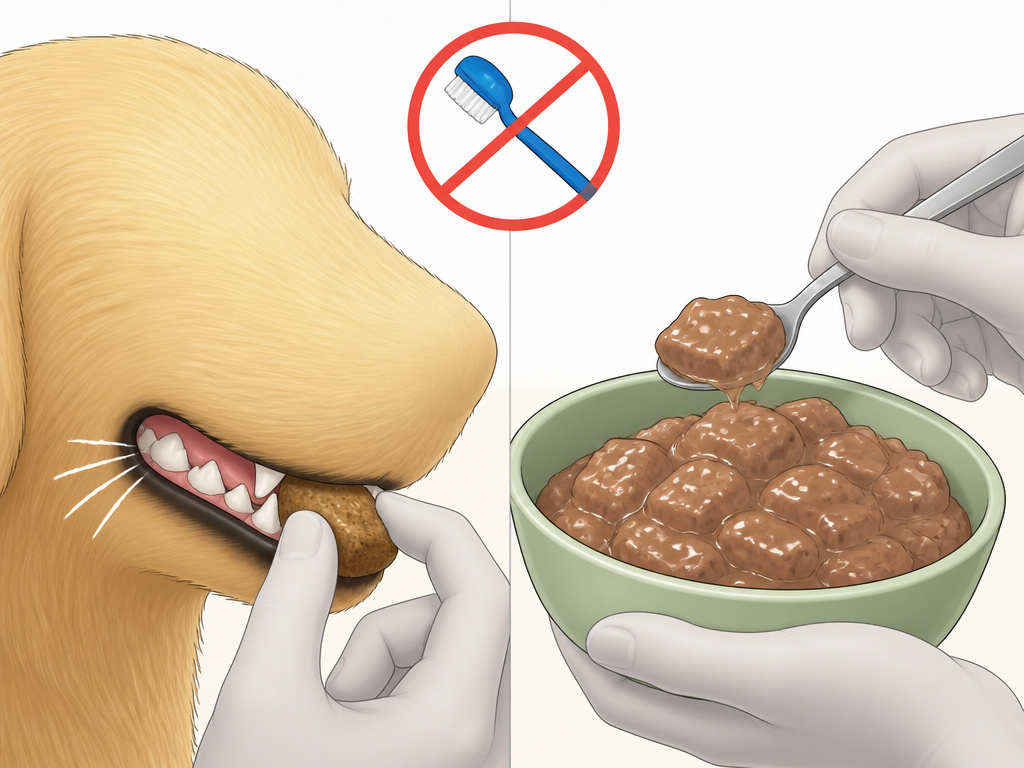
No. VCA Animal Hospitals states plainly that no canned food carries a dental health benefit, and Royal Canin Academy says wet food plays no role in preventing dental disease because it provides no gingival stimulation.
McGill explains the mechanism on the other side: the more chewing a pet does, the more plaque gets scraped off the teeth, and eating kibble involves more chewing than eating wet food.
Kibble scrapes plaque. It doesn’t clean teeth. Those are different jobs, and only one of them happens without a toothbrush.
So VCA and Royal Canin see no dental argument for wet food, though McGill notes kibble’s extra chewing scrapes more plaque. McGill holds that kibble’s extra chewing scrapes more plaque, while VCA and Royal Canin say wet food offers no dental benefit. Neither format replaces brushing.
Wet vs Dry: Where the Fat Numbers Disagree
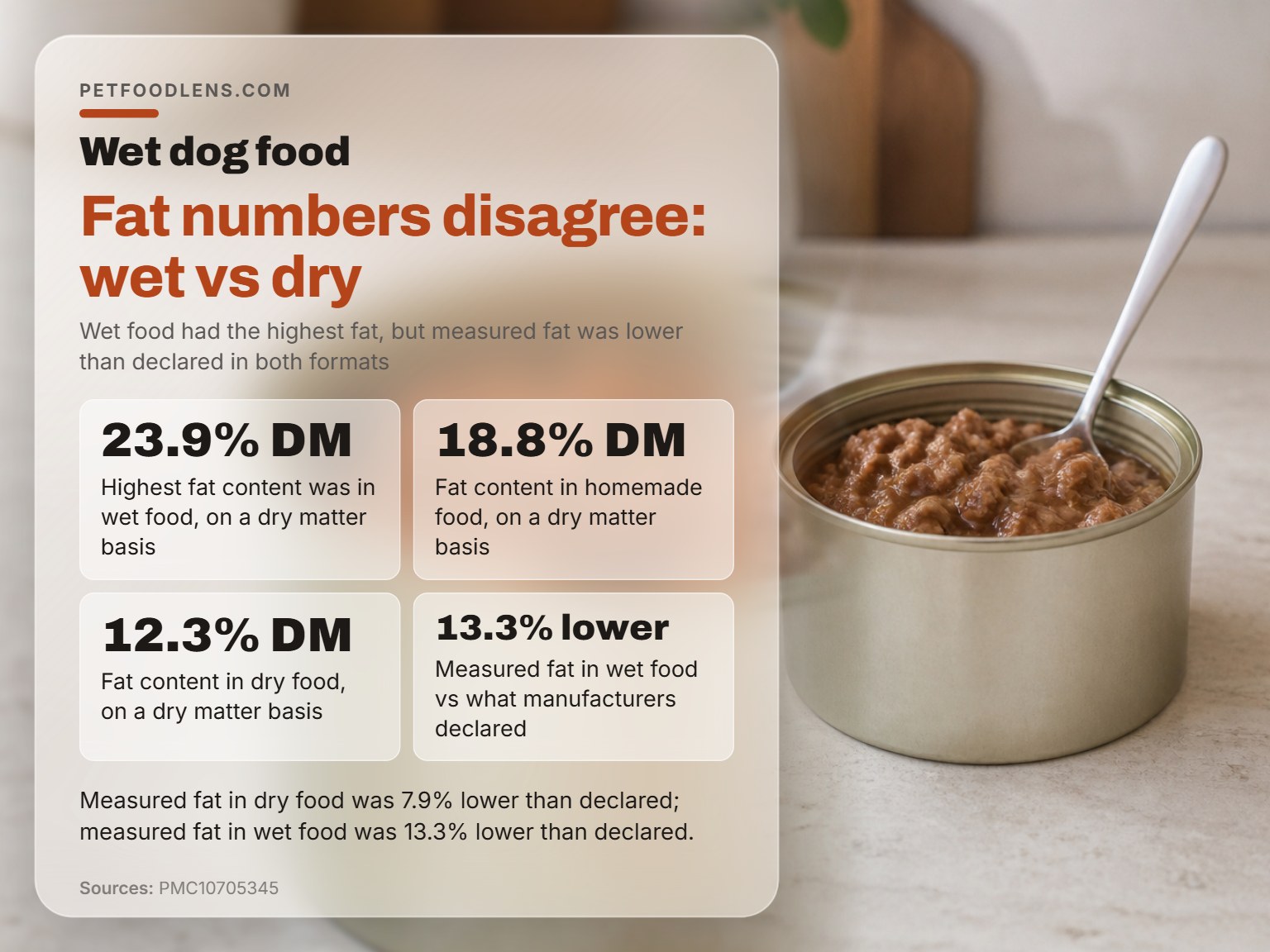
Two peer-reviewed studies and two institutional sources give you opposite answers about what happens to fat and calories when you switch to wet.
Royal Canin Academy says wet food is higher in fat than dry food and therefore higher in calories on a dry matter basis. McGill says wet and dry foods have similar protein and fat levels, with dry foods carrying significantly more carbohydrates. VCA frames wet food as lower energy density per 100 grams, which allows a dog to eat a larger portion for the same calories. All three are describing the same can from different angles, and the disagreement is real.
What the Fat Numbers Actually Show
PMC10705345 found the highest fat content in wet food, with a mean of 23.9% dry matter, followed by homemade food at 18.8% and dry food at 12.3%. The same study found measured fat in wet food averaged 13.3% lower than what manufacturers declared, and dry food averaged 7.9% lower. Labels run high on fat in both formats.
The part nobody mentions: The fat number on the guaranteed analysis is a minimum, not a measurement. The PMC10705345 assay found actual fat running below the declared figure in both wet and dry foods, so the label is a floor, not a promise.
What the Digestibility Trials Found
One feeding trial found that an abrupt switch from dry to canned increased the digestibility of dry matter, organic matter, crude protein, and gross energy, while nitrogen-free extract digestibility and metabolizable energy decreased. A separate trial in PMC8672265 found no difference in protein, fat, fiber, ash, or energy digestibility by moisture content, with nitrogen-free extract digestibility differing only in senior dogs.
If you want the primary literature, the abrupt dry-to-canned diet study and the age-related nutrient digestibility research are both indexed and open. The short version: the fat and calorie question doesn’t have a single answer. Anyone who tells you it does is overselling.
How Long Does Opened Wet Food Actually Keep?
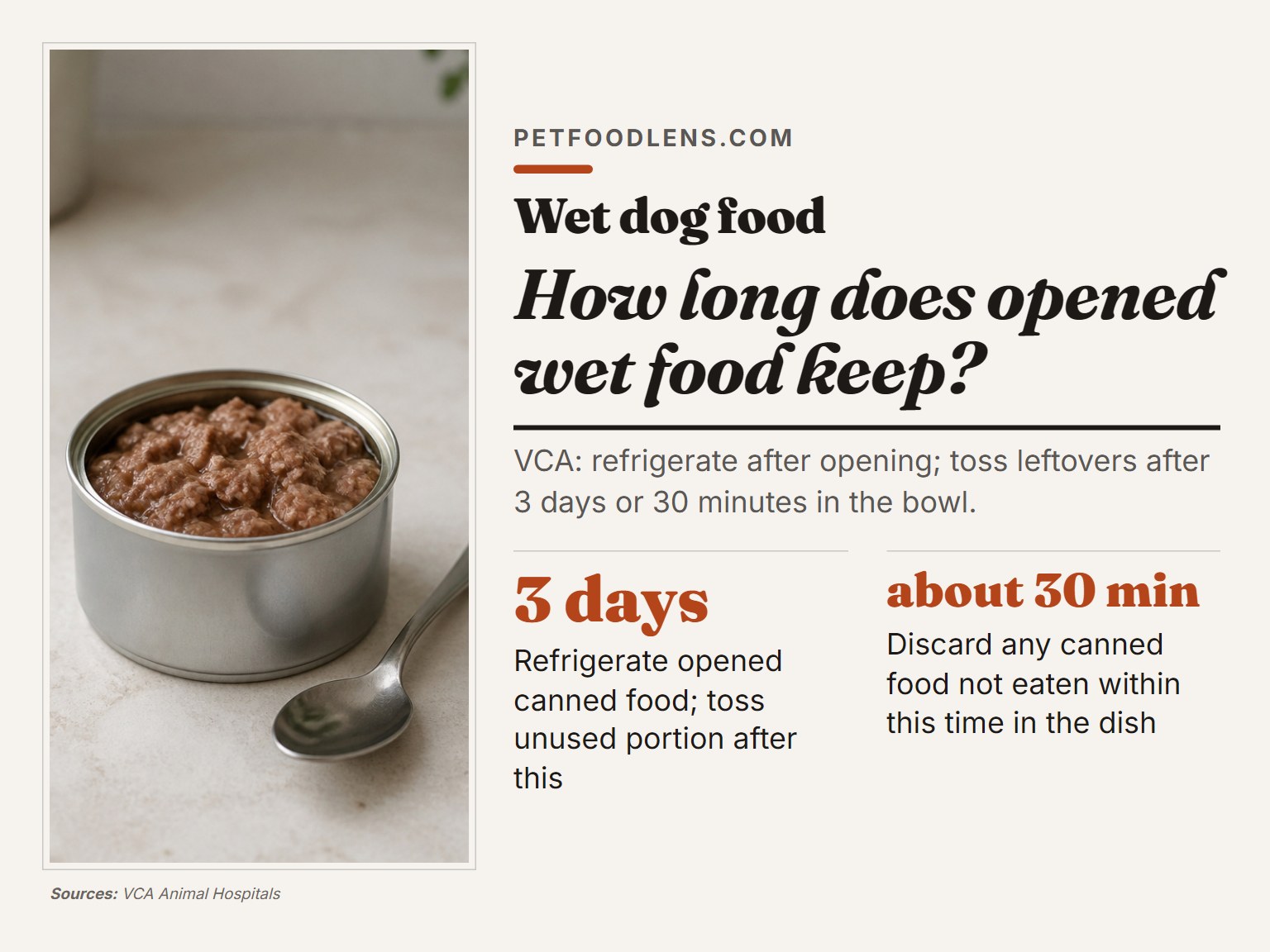
Three days in the refrigerator, and about 30 minutes in the bowl.
VCA gives both numbers. Canned food must be kept in the refrigerator after opening, and any unused portion should be tossed after three days. Any amount not eaten within about 30 minutes of being put in the dish should be discarded.
The storage rules that matter:
- Refrigerate after opening, and discard bowl leftovers after about 30 minutes.
- Discard after 3 days, even if it still smells fine.
- Toss bowl leftovers after 30 minutes, especially in warm weather.
- Wash the bowl between meals, not just rinse it.
Before you start: Opened wet food is a bacterial growth medium, and the clock starts at room temperature. Scoop what you need, seal and refrigerate the rest immediately, and wash the bowl after every meal.
That 30-minute rule is the one owners break. Wet food doesn’t support grazing the way kibble does.
For the storage side, the pet food storage question matters more for kibble than cans, but the same principle applies: seal it, cool it, and don’t stretch the clock.
What to Read on the Can Before You Buy
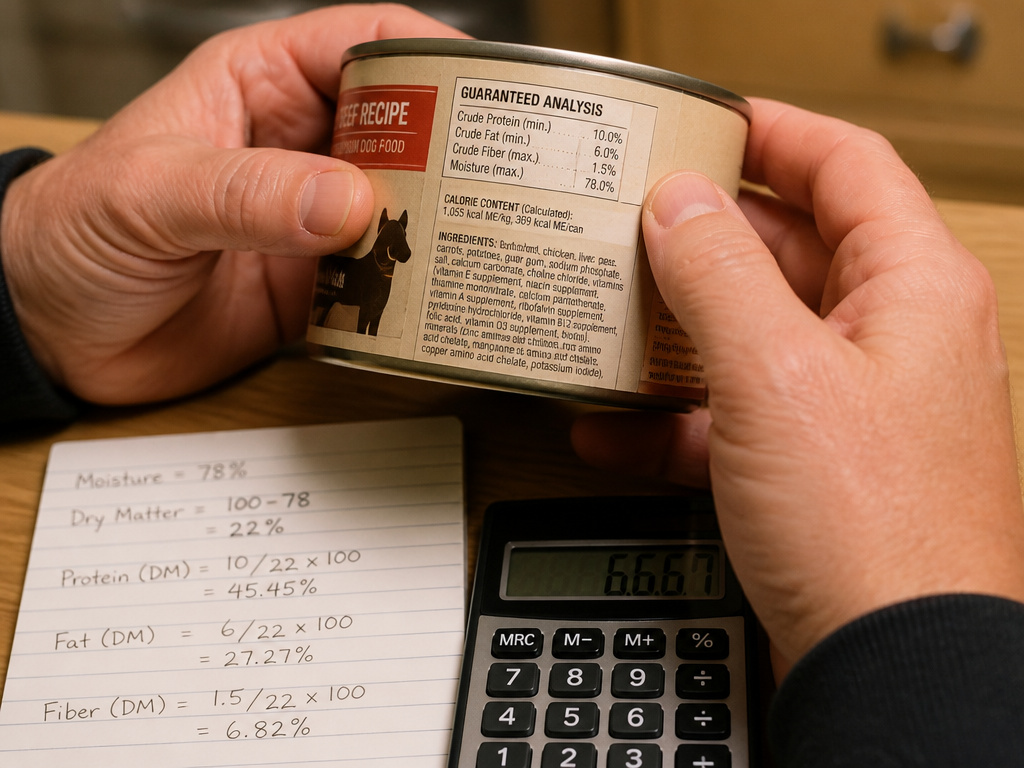
Read the guaranteed analysis on the back. The slogan on the front won’t help you.
“Moisture 78% max” is not a quality claim. It’s water. The useful comparison is protein and fat on a dry matter basis, which means dividing the listed percentage by the dry matter fraction.
The Dry Matter Conversion, Step by Step
- Find the guaranteed analysis panel and note protein, fat, fiber, and moisture as fed.
- Subtract moisture from 100 to get dry matter.
- Divide protein and fat by the dry matter figure to get the dry matter percentages.
- Compare those numbers across cans, not the as-fed numbers on the front.
- Check whether phosphorus is listed. If it isn’t, that’s a gap, not a green light.
See the best wet dog food picks for specific formulas, and the picky eaters list if your dog turns its nose up at pate.
Pate is the easier format to portion and measure. Chunks in gravy are more about appearance than nutrition, and the gravy is often thickened starch doing work the meat should be doing.
Two formulation issues don’t show up on the label at all. Royal Canin Academy reports thiamine deficiency in some pate-style wet foods and in wet food from some small manufacturers, attributed to heat-labile nutrient loss during retort processing. The same source notes wet food requires higher taurine inclusion than dry to offset enhanced bile-acid excretion and microbial degradation. Those are reasons to buy from a manufacturer with the testing budget to catch them.
If you’re weighing formats more broadly, the wet vs dry dog food comparison covers the full trade-off, and the semi-moist dog food page covers the middle format that VCA flags for higher sugar and sodium. The fresh dog food question is a separate decision with its own cost and handling rules.
Frequently Asked Questions
Is wet dog food better than dry?
Neither format is better by default. McGill’s Office for Science and Society states that either wet food, dry food, or a combination of both can meet the nutritional needs of a dog or cat. The choice comes down to the individual dog’s health, the owner’s budget, and how consistently the food can be stored and served.
Can I mix wet and dry dog food?
Yes. McGill notes that a combination of both can meet a dog’s nutritional needs, and many owners use wet food as a topper to boost palatability and water intake. The main thing to watch is total calories: VCA frames wet food as less energy-dense per gram, while Royal Canin Academy says it is higher in fat and calories on a dry matter basis.
How much wet food should I feed my dog?
Match calories, not volume. McGill notes that a pet needs to eat a greater volume of wet food than dry food to consume the same number of calories, so the bowl will look fuller for the same energy intake. Use the calorie statement on the can and adjust for your dog’s weight and activity level.
Does wet food clean a dog’s teeth?
No. VCA Animal Hospitals states that no canned food carries a dental health benefit, and Royal Canin Academy says wet food plays no role in preventing dental disease because it provides no gingival stimulation. Kibble involves more chewing, which scrapes more plaque, but neither format replaces brushing.
How long can opened wet dog food stay in the fridge?
Three days. VCA recommends refrigerating canned food after opening and discarding any unused portion after three days. Food left in the bowl should be discarded after about 30 minutes.
The Bottom Line
The wet dog food pros and cons come down to two questions: does your dog need the water, and can you afford the calories? If your dog has a urinary or kidney diagnosis, wet food is the stronger default. The moisture data supports it, and the water intake benefit is the clearest advantage the format has.
If your dog is healthy and you’re feeding on a budget, dry food plus a clean water bowl does most of the same work for less money per calorie. VCA and Royal Canin see no dental benefit from wet food, while McGill notes kibble’s extra chewing scrapes more plaque; neither format fixes a formulation problem.
One concrete step this week: turn over the next can you buy and read the guaranteed analysis before you open it. If phosphorus isn’t listed, that’s a gap, not a green light. If it is listed, compare it against the 4 g per 1,000 kcal ceiling and see where the food actually lands.
The format debate gets less interesting once you read the back of the can. Water is water, minerals are minerals, and the label tells you which is which.
