
Kitten Food Pros and Cons: Wet vs Dry and Raw
This post contains affiliate links. As an Amazon Associate, we earn from qualifying purchases.
Kitten food pros and cons split along three lines: moisture, protein density, and how the label was verified. Wet food runs 75 to 78 percent moisture. Dry food runs 10 to 12 percent. Both types are legally allowed to print complete and balanced.
Moisture is the number that reshapes every other figure on the label, including protein. A can at 78 percent water reports its nutrients on a different basis than a bag at 10 percent, so the two labels can’t be laid side by side without a conversion first.
What follows walks the real trade-offs: what complete and balanced actually certifies, where wet and dry split, what the raw trials found, and how to read a kitten food label in five steps without trusting the front of the bag.
Key Takeaways
- Wet food is 75 to 78 percent moisture; dry is 10 to 12 percent. That gap is why the two labels can’t be compared without converting to dry matter.
- Complete and balanced has two legal routes — an AAFCO nutrient profile or an AAFCO feeding trial — and the label should tell you which one was used.
- A 10-week-old kitten needs 200 kcal per kilogram per day, dropping to 80 kcal/kg/day by 10 months.
- Passing an AAFCO growth trial doesn’t guarantee long-term adequacy. Vitamins A, D, B12, copper and iron sit in body stores a 10-week trial won’t deplete.
- Skip third-party seals as proof. The FDA states that endorsements from other organizations aren’t assurances of nutritional adequacy.
What “Complete and Balanced” Actually Certifies
The phrase on the bag is a legal claim with two allowed routes behind it, and the label is supposed to tell you which one was used.
A pet food may carry the complete and balanced claim by meeting an AAFCO Dog or Cat Food Nutrient Profile, or by passing a feeding trial run under AAFCO procedures. The profiles were last updated in 2016. Every listed nutrient carries a minimum, and some carry a maximum.
Route one is formulation: the maker hits the numbers in the FDA complete and balanced pet food profiles. Route two is a feeding trial, where real animals eat the food and gain weight on it.
Both routes sit inside a system with two profiles per species. One covers growth and reproduction, which includes pregnant and nursing queens. The other covers adult maintenance.
That split matters more than any front-of-bag word. The FDA’s framing is that adult food avoids unnecessary excesses.
For a kitten, growth food is the appropriate profile, though the FDA notes adult food avoids unnecessary excesses.
The 10-Week Trial and the Vitamins It Can’t Catch
A growth feeding trial runs 10 weeks under AAFCO protocols. That’s the whole test.
Ten weeks catches a food that won’t support weight gain. It won’t catch a marginal shortage of anything the body stores. The published research names them: vitamins A, D and B12, plus potentially copper and iron, sit in depots a 10-week trial can’t drain.
So a food can pass and still come up short over a year. That’s the honest limit of the label, and it’s why I read the ingredient panel alongside the adequacy statement.
Worth knowing before you start: A seal from a breed club, a retailer, or a nutrition council is not a nutritional test. The FDA states plainly that endorsements and seals of approval from other organizations are not assurances of nutritional adequacy and may be misleading.
Kitten Food Pros and Cons: Wet vs Dry, Head to Head
For a kitten under four months, wet food has practical advantages that can decide whether the animal eats at all: it’s easier to lap, it carries water, and it smells strong enough to pull a hesitant kitten to the plate, though VCA notes either canned or kibble can be a great option for healthy cats so long as the diet is balanced and nutritionally complete.
Here’s the head-to-head.
| Factor | Canned kitten food | Dry kitten food |
|---|---|---|
| Moisture | 75 to 78 percent | 10 to 12 percent |
| Left out safely | 1 to 2 hours | All day, free-choice |
| Puzzle toys and feeders | Doesn’t work | Works |
| Dental effect | None claimed | VOHC-sealed kibble can help scrub plaque |
| Water burden on the cat | Low | High; the cat must drink more |
Warm a spoonful and the smell carries across the kitchen. Straight from the fridge it barely registers, and a kitten that was interested a minute ago walks away. That’s not fussiness. Cold food releases almost no aroma, and a cat decides whether to eat with its nose first.
Texas A&M advises no kibble before 6 weeks and never as the sole food, while VCA says either canned or kibble can be a great option for healthy cats so long as the diet is balanced and nutritionally complete. The convenience is real, but a 10-week-old eating kibble has to make up a lot of water at the bowl, and most of them don’t bother.
Where Kibble Actually Wins
Kibble’s real advantages are handling and cost, not nutrition. It stays out, it loads into a puzzle feeder, and it works in an automatic feeder for a household that isn’t home at noon.
The dental claim needs a qualifier. Some kibble diets carry a seal from the Veterinary Oral Health Council, and those can help scrub plaque off teeth. That’s a texture effect tied to specific products, not a property of kibble as a category.
The dry food drawbacks are mostly about water and about how easy it is to overfill a bowl that never spoils.
The Two-Hour Window on Canned Food
VCA puts the ceiling at 1 to 2 hours for canned food left out, while the kitten digestibility trial removed food not eaten within 4 hours, so wet food and free-feeding don’t mix.
The research setting used a different number. In the kitten digestibility trial, food not eaten within 4 hours was pulled to prevent microbial growth. That’s a lab protocol with bowls sanitized between feedings, not a kitchen floor with a toddler in it.
VCA’s 1 to 2 hours is the more cautious home figure, while the digestibility trial’s 4-hour cutoff was a lab protocol with bowls sanitized between feedings. The wet food pros and cons come down to that trade: better hydration and palatability, against a bowl you have to pick up.
Why You Can’t Compare a Can and a Bag Without the Math
I ranked kitten foods by crude protein percentage for my first couple of years, until two foods with the same number on the label turned out to have completely different protein sources behind them. The number matched. The food didn’t. Now protein percentage is one line in a longer comparison, and the first move is always converting to dry matter.
The AAFCO Cat Food Nutrient Profile for adult maintenance sets crude protein at a minimum of 26 percent on a dry matter basis. Dry matter means moisture-free protein.
The guaranteed analysis on the can or bag is as-fed, meaning the water is still inside the number. A 78 percent moisture can and a 10 percent moisture bag are reporting on two different scales.
To compare, subtract the moisture and divide. A can at 78 percent moisture is 22 percent dry matter, so a listed 10 percent protein works out near 45 percent on a dry matter basis. That same 10 percent on a 10 percent moisture bag stays around 11 percent.
The rule: Compare protein, fat and carbs only after both foods are on a dry matter basis. A label number without its moisture figure is half a number.
This is the single most useful piece of arithmetic in cat food, and it’s the one the front of the bag is counting on you not doing. If you want the short version, the kitten protein needs piece walks the same conversion with a worked example.
One more wrinkle: carbohydrate source matters as much as carbohydrate amount. A study in the peer-reviewed literature found the maximum rise in blood glucose above baseline was significantly higher (P = 0.01) in cats fed a rice-flour-based diet than in cats fed a ground sorghum and corn diet. Same category, different response. That’s covered in the dry foods and cat disease research.
How Much Should a Kitten Eat at 10 Weeks?
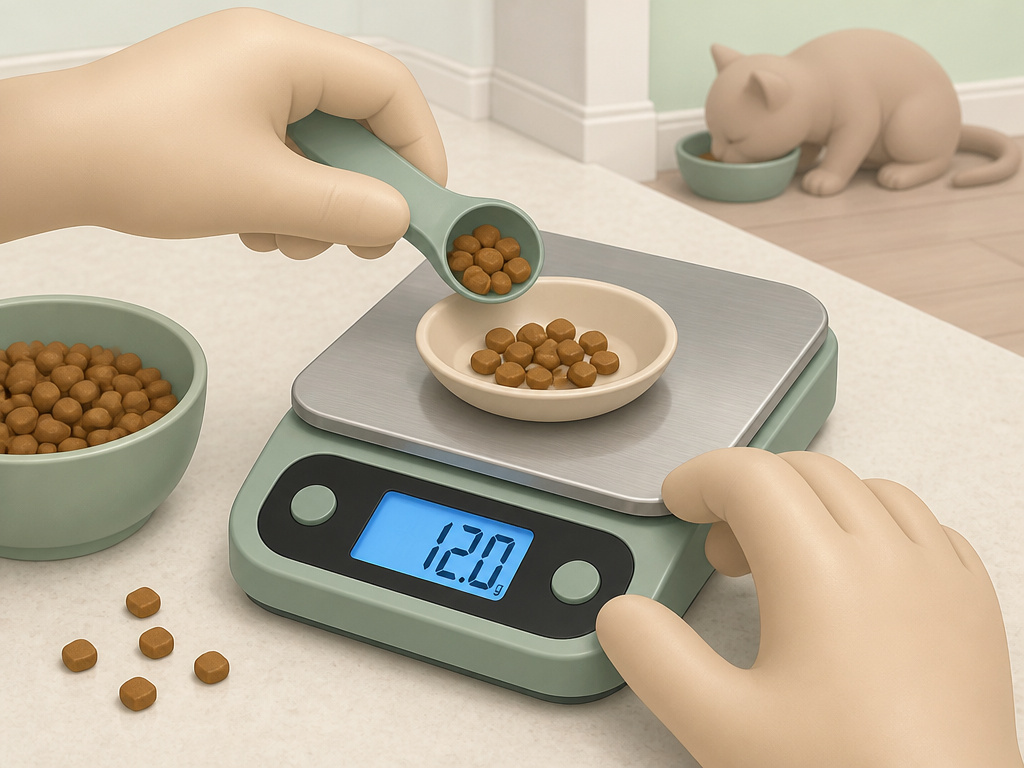
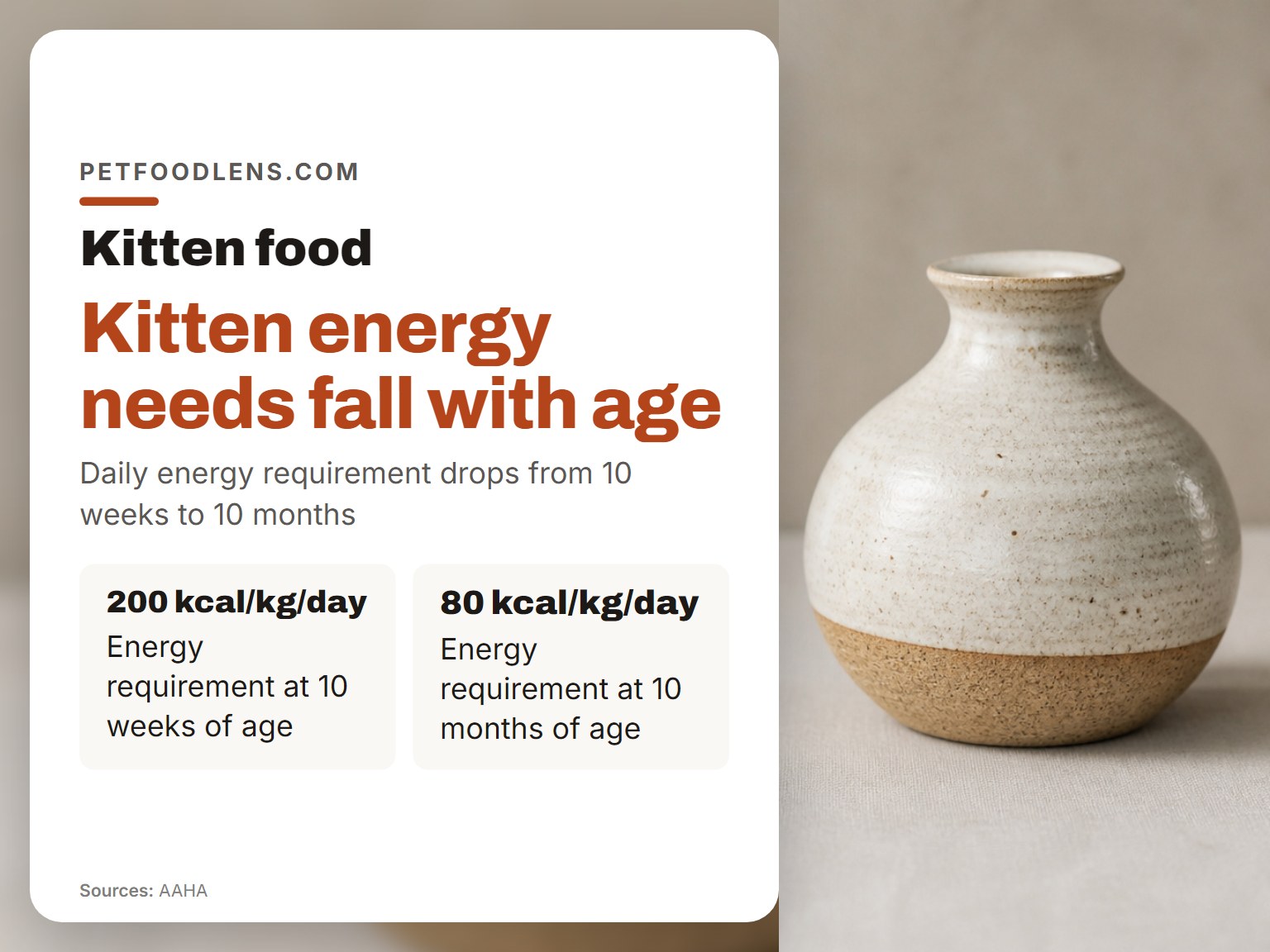
Two hundred kilocalories per kilogram of body weight per day. That’s the energy requirement for a growing kitten at 10 weeks, per the AAHA-AAFP kitten nutrition guidelines, against 80 kcal/kg/day at 10 months.
The drop is steep because the growth rate is steep. At 10 weeks a kitten is laying down body mass fast, and every gram of it costs energy. By 10 months the frame is nearly finished, and the requirement falls by more than half.
How that gets delivered matters too:
- Feed several small meals, not one big one. Cats naturally take many small meals across the day, and meal size limits how much carbohydrate lands in the system at once.
- Put the bowl somewhere quiet. Cats prefer to eat alone, away from sudden movement and other animals.
- Hide part of the ration. Scattering a few pieces or using a food puzzle mimics stalking and pouncing, and the AAHA/AAFP guidelines recommend it during the kitten stage.
- Weigh the portion.
That last one sounds fussy until you test it. I gave up on scoops after weighing the same scoop on a kitchen scale across several fills and watching the weight swing noticeably. Grams, not scoops.
If you’re bringing a kitten through the transition from milk, the weaning kittens material covers the texture progression.
Raw and Homemade Kitten Diets: What the Trials Actually Show
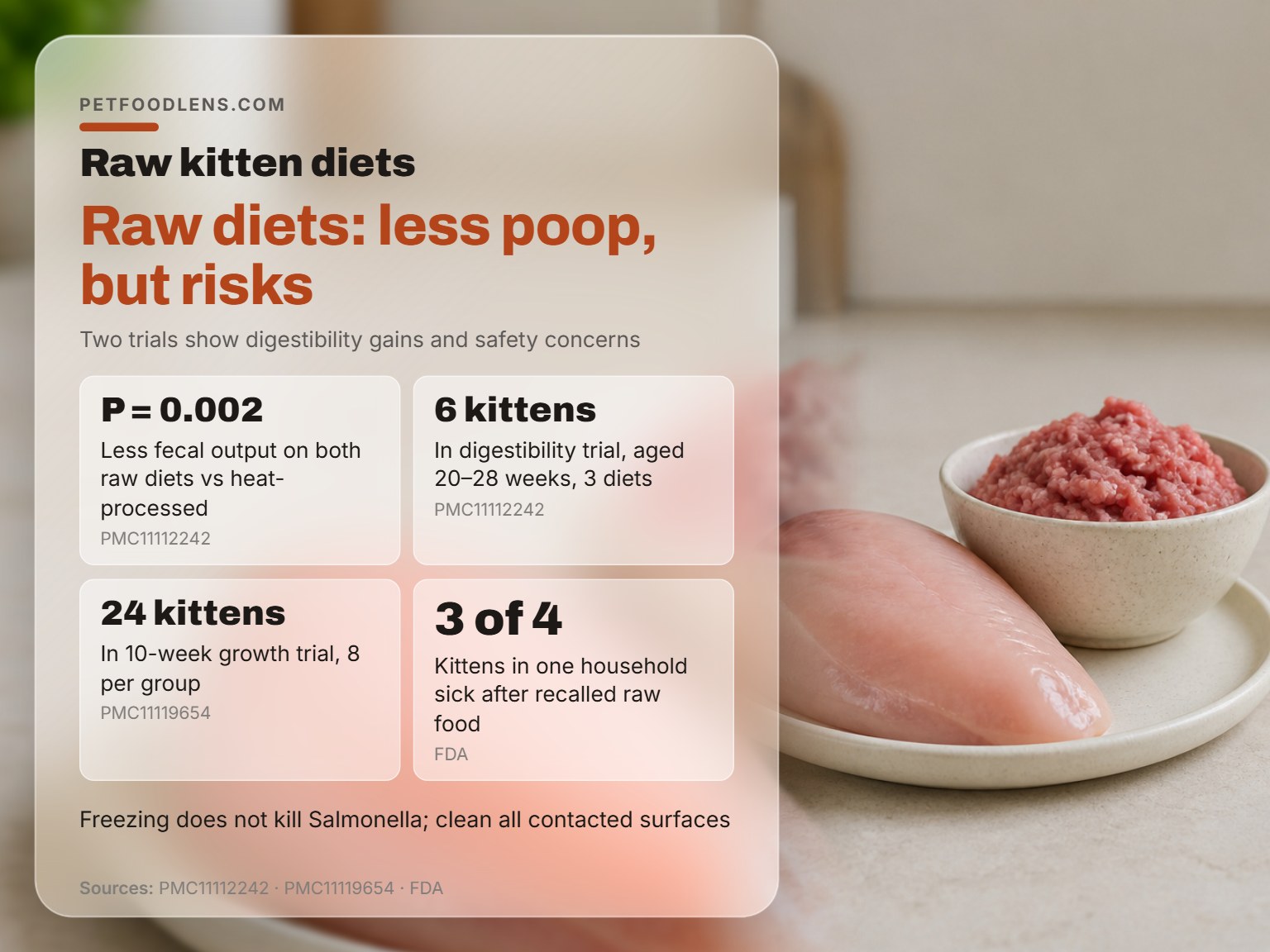
The raw feeding research is the most interesting material on this page, and it points in two directions at once.
Before you start: Raw pet food carries Salmonella risk to the kitten and to the people handling it, and freezing does not kill the bacteria. The FDA’s guidance after a raw food recall was to clean and disinfect every surface the food touched, including the freezer shelf, bowls, utensils, bedding, litter boxes and floors.
Start with the recall. The FDA cautioned owners off two lots of Darwin’s Natural Selections raw cat food: Chicken Recipe Lot 9116, made May 2, 2022, and Turkey Recipe Lot 9121, made May 4, 2022. Three kittens in one household developed diarrhea, and a stool sample from one tested positive for Salmonella. A fourth kitten in the same house didn’t eat the food and didn’t get sick.
Now the digestibility side. The raw diet kitten digestibility study fed six kittens, aged 20 to 28 weeks, three diets in a crossover design. Both raw diets produced significantly less fecal output than the heat-processed canned diet (P = 0.002), with no significant difference in fecal score. Higher digestibility means less undigested residue reaching the box.
The growth side tells a different story. A separate 10-week trial ran 24 kittens, eight per group. The raw-fed groups showed lower albumin (P = 0.010), higher globulin (P = 0.04), red-cell microcytosis (P = 0.001), and positive fecal tests for Salmonella Heidelberg and C. Difficile toxin.
Both raw diets in that growth trial had no AAFCO statement of nutritional adequacy. Neither did the homemade raw diet in the digestibility study.
| Question | One position | The other |
|---|---|---|
| Is raw more digestible? | Yes; less fecal output, higher protein digestibility (PMC11112242) | Growth held, but bloodwork and pathogen shedding moved the wrong way (PMC11119654) |
| Is dry food a problem? | Not shown nutritionally unsatisfactory; the recall was toxicological (PMC2387258) | No kibble before 6 weeks and never as the sole food (Texas A&M) |
| Do carbs matter? | Keep under 10 percent, no carb source in the first five ingredients (Texas A&M) | Cats process carbs; the obesity link is far from clear (PMC2387258) |
On homemade diets, the guidance is blunt. Generic recipes pulled from the internet carry added risk of deficiency and imbalance and aren’t recommended. A homemade diet should be built by a veterinary nutrition specialist who accounts for the individual cat.
If you want a middle path, fresh food for kittens sits between kibble and raw on the processing scale, and it comes with an adequacy statement attached.
Reading a Kitten Food Label in Five Steps
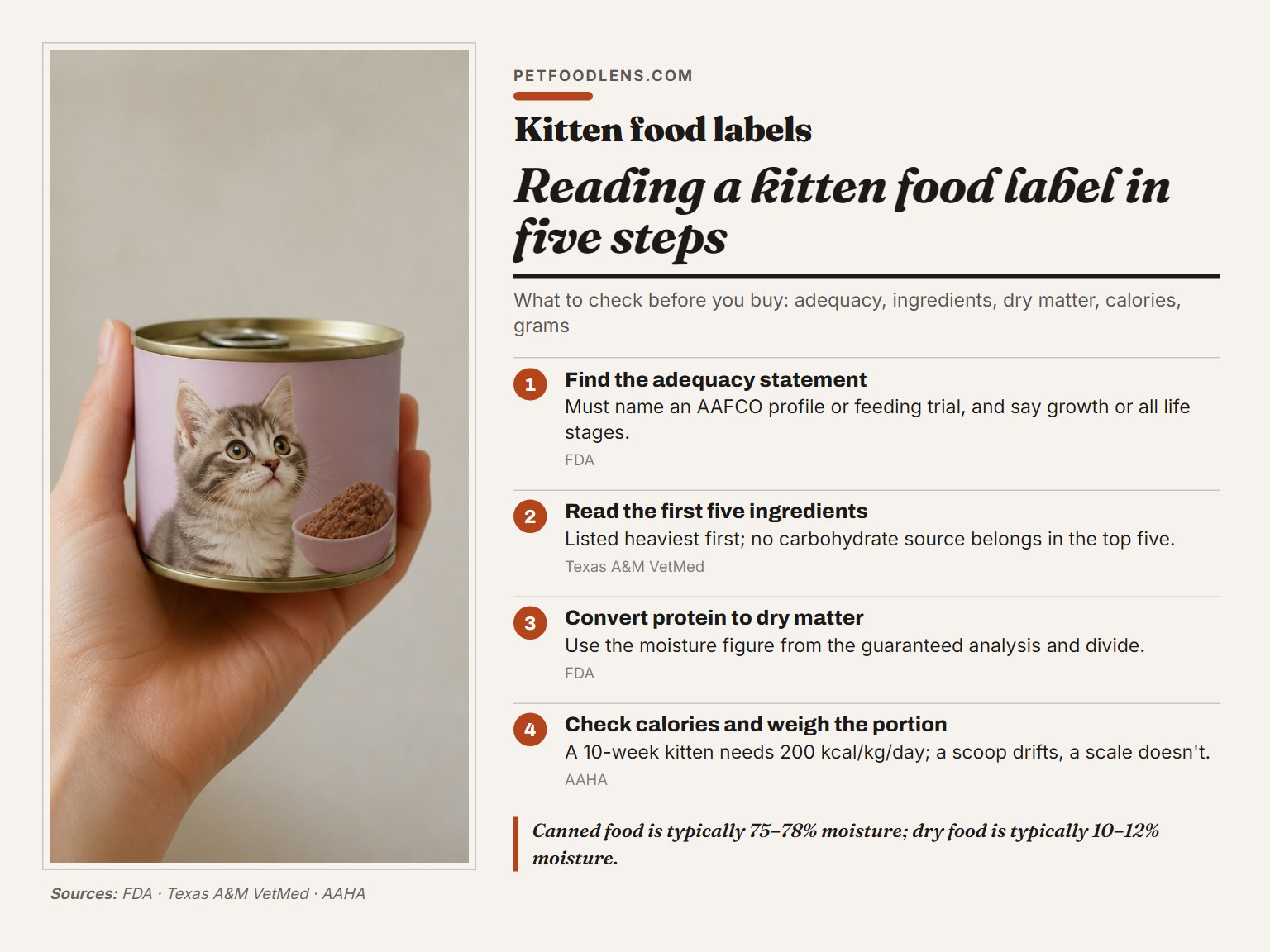
Five things decide whether a kitten food is worth buying: the life-stage statement, the first five ingredients, the dry-matter protein, the moisture, and the calorie density.
- Find the nutritional adequacy statement. It should name an AAFCO profile or an AAFCO feeding trial, and it should say growth or all life stages. Miss that line and you’re guessing which profile the food was built to.
- Read the first five ingredients by weight. Ingredients are listed heaviest first, so a starch in the top five tells you where the bulk of the food comes from. Texas A&M’s guidance is that no carbohydrate source belongs there, while PMC2387258 notes cats can process carbohydrates and the obesity link is far from clear.
- Convert protein to dry matter. Use the moisture figure from the guaranteed analysis and divide. Without it, a canned food looks weaker than it is and a bag looks stronger.
- Check the calorie density against the kitten’s stage. A kitten at 10 weeks eating 200 kcal/kg/day needs a food dense enough that the meal fits in a small stomach.
- Weigh the portion in grams. A scoop drifts. A scale doesn’t.
Once a kitten is fully weaned, the choosing the best kitten diet guidance sets the target at more than 50 percent protein and less than 10 percent carbohydrate, though PMC2387258 notes cats can process carbohydrates and the obesity link is far from clear. Texas A&M warns that too many carbs, or a poor-quality food, can cause diarrhea, while PMC2387258 notes cats can process carbohydrates and the obesity link is far from clear.
Grain-free is where I see the most label theater. Swapping corn for peas, potato or tapioca moves the carbohydrate load barely at all. A bag with a wolf on the front and a starch-heavy ingredient list is still a starch-heavy bag.
Common mistake: Feeding a recipe pulled from a forum because it reads like real food. Generic internet recipes carry added risk of deficiency and imbalance, and a kitten on an unbalanced diet shows it in weeks, not years.
For a kitten that reacts badly to a food, sensitive stomach food is the category to search, and the dry food for kittens list covers the kibble side of it.
When Should a Kitten Switch to Adult Food?
There’s no calendar date for the switch.
The AAFCO system gives you two profiles, not a birthday. Growth and reproduction covers the growing animal. Adult maintenance covers the settled one, with lower levels of some nutrients.
The energy figures show the shape of it: 200 kcal/kg/day at 10 weeks, 80 kcal/kg/day at 10 months. The requirement falls as the frame finishes.
I judge the switch on body condition and the growth curve, not the age printed on the bag. A kitten still gaining steadily stays on growth food. That’s a judgment call, and it’s one a veterinarian can make with hands on the animal in a way a chart can’t.
Frequently Asked Questions
Is wet or dry food better for kittens?
Wet food has advantages in water content and in how easy it is for a small kitten to eat, though VCA says either canned or kibble can be a great option for healthy cats so long as the diet is balanced and nutritionally complete. Dry wins on handling, cost and puzzle feeders. VCA’s position is that either works for a healthy cat as long as the diet is balanced and nutritionally complete.
What should the first five ingredients on kitten food look like?
Protein and water sources, not starch. Ingredients are listed by weight with the heaviest first, so a carbohydrate in the top five means the food is built around it. Texas A&M’s guidance is that no carb source should appear there at all, while PMC2387258 notes cats can process carbohydrates and the obesity link is far from clear.
Can a kitten eat dry food at 6 weeks?
Texas A&M says no kibble before 6 weeks and never as the sole food, while the AAHA/AAFP guidelines put weaning onto commercially balanced kitten food at 3 to 5 weeks and VCA says either canned or kibble can be a great option for healthy cats. The AAHA/AAFP guidelines put weaning onto commercially balanced kitten food at 3 to 5 weeks, which covers the transition rather than kibble specifically. Those two statements aren’t in conflict, but they answer different questions.
How long can kitten food sit out?
VCA puts canned food at 1 to 2 hours maximum, while the kitten digestibility trial used a 4-hour cutoff with bowls sanitized between feedings. The kitten digestibility trial used a 4-hour cutoff, but with bowls sanitized between feedings.
Is grain-free kitten food better?
There’s no AAFCO nutrient profile for grain-free, because grain-free is a marketing category rather than a nutritional standard. Swapping corn for peas, potato or tapioca barely changes the carbohydrate load. Judge the food on its adequacy statement and its first five ingredients instead.
Does a kitten still need milk after weaning?
Until about 4 weeks of age and roughly a pound of body weight, yes. An orphaned kitten’s best option is a foster queen, and commercial kitten milk replacer is the next best. Cow’s, goat’s or dog’s milk can cause diarrhea and lacks the amino acids a kitten needs.
The Bottom Line
If you do one thing this week, flip the bag and find the nutritional adequacy statement. If it names an AAFCO profile or an AAFCO feeding trial and says growth or all life stages, the food is in the running. If it doesn’t, put it back on the shelf.
That single line does more work than every other word on the package combined. The front panel is written by a marketing team. The adequacy statement is written to a legal standard.
Here’s the concession. None of this tells you about manufacturing quality. I work from labels and published formulations, so a clean panel can still sit on top of a batch problem I have no way to detect. That’s the gap a veterinarian fills and a comparison chart can’t.
So the kitten food pros and cons come down to a short list you can actually check: moisture, dry-matter protein, the life-stage statement, and whether the food was verified by profile or by trial. Run those four and you’ll know more than the bag is telling you.
