
Protein Requirements for Cats: What the Numbers Say
This post contains affiliate links. As an Amazon Associate, we earn from qualifying purchases.
Protein requirements for cats sit in two tiers. NRC sets the adult minimum at 2.5 g/kg body weight (RDA 3.13 g/kg), but a Purina DEXA study (Laflamme et al.) found 5.2 g/kg needed to maintain lean body mass. AAFCO’s 26% dry-matter floor sits between them.
That gap between 2.5 and 5.2 g/kg is roughly double, and it decides whether your cat holds muscle through middle age or quietly loses it. The Laflamme study found weight loss increased linearly as protein intake dropped, even with identical calories.
What follows: the two-tier requirement, why nitrogen balance and lean body mass give different answers, how NRC, AAFCO, and FEDIAF stack up, and how to read a bag without getting fooled by the crude protein number.
Key Takeaways
- NRC minimum is 2.5 g/kg BW (RDA 3.13 g/kg); a Purina DEXA study found 5.2 g/kg needed to preserve lean body mass.
- AAFCO’s 26% dry-matter floor sits between the two; FEDIAF’s 33.30 g/100 g DM is stricter.
- Crude protein is a test method. The NRC says so directly.
- Nitrogen balance and lean body mass disagree; DEXA is the newer endpoint.
- Per-100-kcal numbers shift when calorie density changes, so 34% DM at low kcal can still under-deliver.
Protein Requirements for Cats: The Two-Tier Rule
The NRC and the Purina group are answering two different questions. The NRC asks how much protein keeps an adult cat in nitrogen balance. That’s the point where nitrogen in equals nitrogen out. The Laflamme study asks how much protein keeps lean body mass intact on a DEXA scan.
Adult cats reach nitrogen balance at roughly 1.5 g protein per kg body weight, but DEXA measurements in a 24-cat Purina trial showed 5.2 g/kg was required to maintain lean body mass over a 2-month feeding period. The 20% and 26% protein diets both lost lean mass; only the 34% diet held it.
Those are two different endpoints. Nitrogen balance can look fine while muscle is quietly leaving the building. That’s the whole argument in the lean body mass protein requirement study.
The Laflamme trial tested three diets: 20% protein (5.6 g/100 kcal ME), 26% (7.3 g/100 kcal), and 34% (9.5 g/100 kcal); only the 34% diet held lean body mass, though Burger & Smith 1984 reported that 17/13/10% diets maintained bodyweight for 32 weeks.
Here’s the part that gets skipped: those cats ate the same calories. The loss wasn’t from underfeeding. It was from protein dilution.
Why Nitrogen Balance and Lean Body Mass Give Different Answers
Four protein levels, four different oxidation ratios. Green et al. (J. Nutr., 2008) fed 7.5%, 14.2%, 27.1%, and 49.6% ME protein to adult cats and measured what came back out.
At 7.5% ME (9% CP), the ratio of protein oxidation to intake was 1.39, which is net protein loss. At 14.2% ME (17% CP), it was 1.00. At 27.1% ME (33% CP), 0.93. At 49.6% ME (60% CP), 1.07.
Their conclusion: cats adapt protein oxidation to intake, provided the minimum requirement is met. That’s why the cats adapt protein oxidation to intake paper keeps showing up in these debates.
But “adapt” and “thrive” are different claims. Laflamme’s group argues that nitrogen balance is an inadequate endpoint. The requirement looks lower than it is because the body compensates. DEXA shows the muscle loss that nitrogen balance hides.
The disagreement isn’t settled. Burger & Smith (1984) fed diets at 17%, 13%, and 10% protein for 32 weeks and reported bodyweight maintained with no health problems, while Laflamme et al. Found 20% and 26% diets lost lean body mass despite equal calories.
What most people get wrong: Treating the NRC minimum as a target. It’s a floor for short-term nitrogen balance. Lean mass needs more. Cats fed at the floor lose muscle over months, not days.
Which Standard Should You Actually Follow: NRC, AAFCO, or FEDIAF?
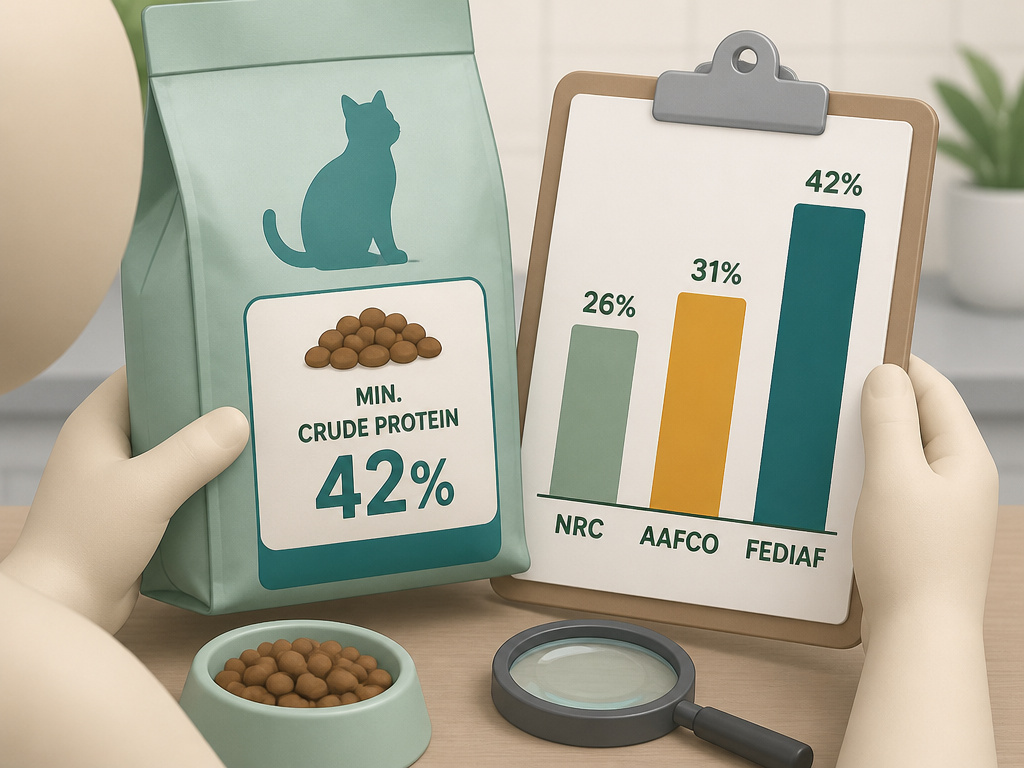
Three bodies publish adult cat protein minimums, and the numbers don’t line up. They’re measuring different things on different bases, so “meets AAFCO” is a weaker claim than most owners assume.
| Standard | Adult minimum | Basis | What it’s really saying |
|---|---|---|---|
| NRC | 2.5 g/kg BW (RDA 3.13 g/kg) | Metabolic body weight | Nitrogen balance floor |
| AAFCO | 26% DM / 6.5 g/100 kcal | Dry matter | US label benchmark |
| FEDIAF (July 2024) | 33.30 g/100 g DM / 83.30 g/1000 kcal | Dry matter + energy | EU industry floor |
Here is what the numbers actually say. The National Academies cat nutrition report sets the NRC figures. AAFCO’s 26% dry-matter number is what most US bags are formulated against. FEDIAF’s 33.30 g/100 g DM is materially higher, nearly a third higher on a dry-matter basis.
So a food that just clears AAFCO is not automatically clearing FEDIAF. Laflamme et al. Question whether AAFCO’s 26% DM is enough to hold lean mass, while AAFCO sets 26% DM as the adult minimum.
Does Protein Source Quality Matter More Than the Percentage?
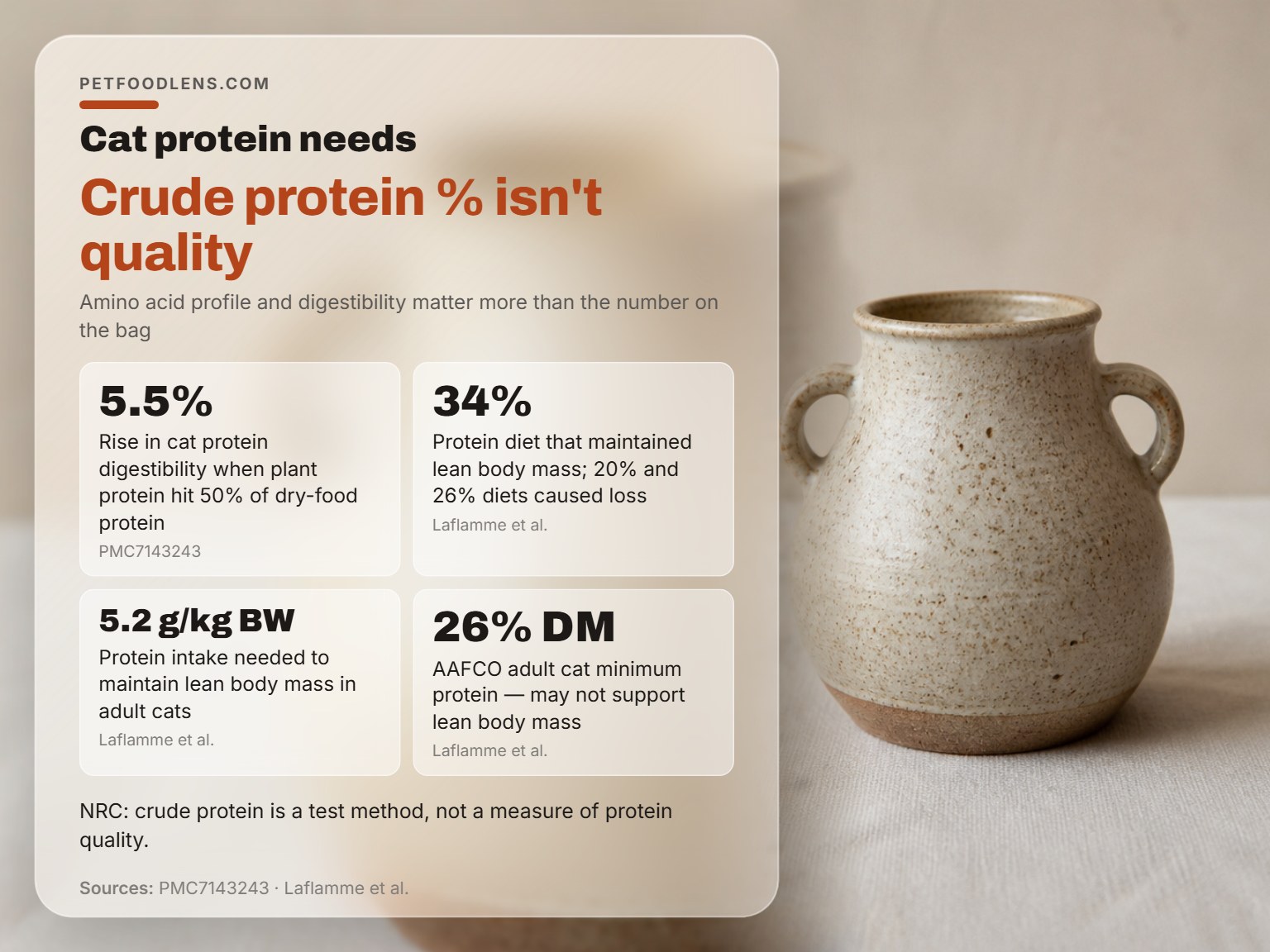
Yes, and the percentage is the least useful number on the bag. Two foods at 34% crude protein can deliver very different amounts of usable amino acids depending on source, processing, and digestibility.
A PMC study on cat versus dog protein digestibility found that when plant protein was pushed to 50% of dry-food protein, cats actually improved protein digestibility by 5.5%. No equivalent effect in dogs. Cats are better than dogs at extracting protein from plant-shifted diets, which undercuts the “cats can’t use plant protein” line.
Plant protein still isn’t equivalent. The digestibility story is more nuanced than the marketing suggests.
The amino acid profile is where the real quality lives. Cats can’t make taurine or arginine in sufficient amounts, so both have to come from the diet. A 34% protein food built on feather meal and corn gluten can hit the percentage while missing the amino acid nutrition targets for cats and dogs that matter.
Worth knowing before you start: Arginine and taurine must come from the diet, and deficiencies in either can cause serious health problems; both are preventable with a complete diet. Both are preventable with a complete diet. Neither is fixed by a higher crude protein number.
If you want the amino acid deep dive, the taurine for cats and arginine for cats explainers cover the two that fail first.
How to Read a Cat Food Label for Protein (Without Getting Fooled)
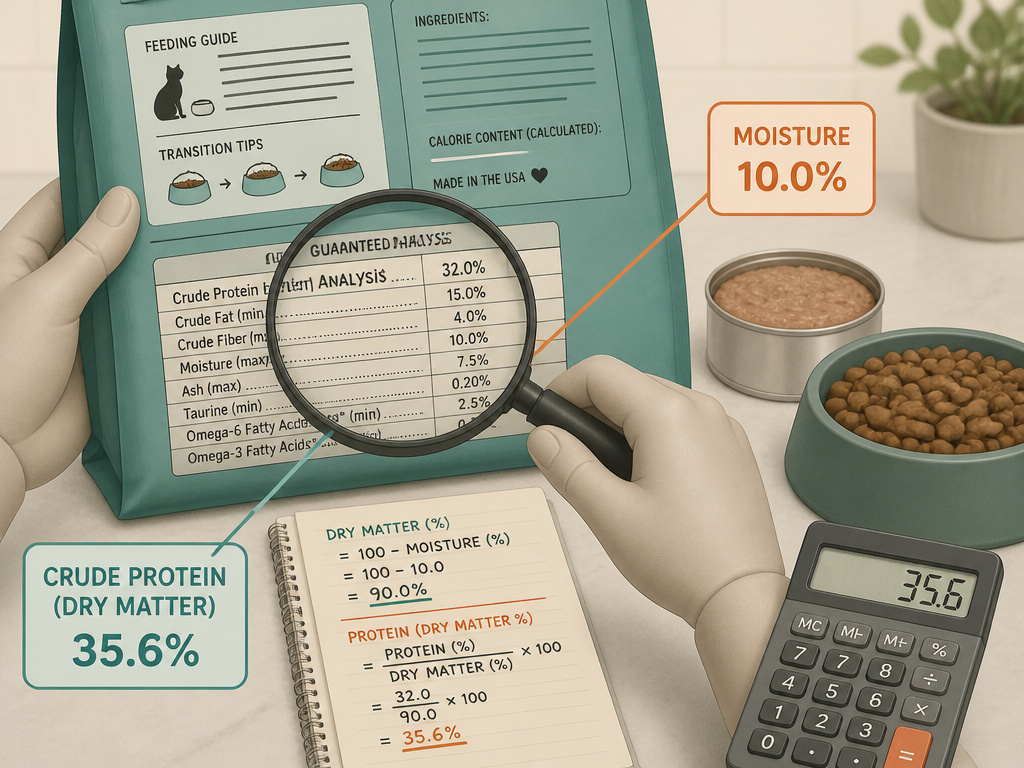
Flip the bag over. The guaranteed analysis sits in a small grid near the bottom, usually in 6-point type, and it’s the only part of the label that’s actually regulated. The bag smells like kibble and the grid looks like a tax form. That grid is the whole story.
The guaranteed analysis gives you crude protein as a percentage of the food as fed, which includes water. Wet food at 10% protein and dry food at 34% protein are not 3.4x apart on a dry-matter basis. They’re much closer.
Here’s the conversion, in order:
- Find the moisture percentage on the guaranteed analysis.
- Subtract moisture from 100 to get dry matter.
- Divide the crude protein percentage by dry matter, then multiply by 100.
- Compare only the dry-matter numbers, never the as-fed numbers.
A low-protein wet food can be higher on a dry-matter basis than a higher-protein dry food once moisture is subtracted. The wet food wins on protein density, which is not what the front of either package implies.
Three numbers matter on the label, and the front-of-bag protein claim isn’t one of them:
- Dry-matter protein percentage after the conversion
- The named protein source and where it falls in the ingredient list
- Calories per can or cup, because per-100-kcal numbers shift with calorie density
Common mistake: Comparing crude fiber or crude protein across wet and dry food without converting to dry matter. The numbers look wildly different and the comparison is meaningless.
Comparing cat foods using only the first five ingredients can mislead; converting to a dry-matter basis often shows the protein gap is far smaller than ingredient order suggests. Ingredient order alone says very little.
The high-protein dry food and high-protein wet food comparisons show the same pattern across brands. The front-of-bag protein number is the least predictive thing on the label.
The crude-protein trap
“Crude protein” is a lab test. It measures nitrogen content, and that’s all it measures. It counts nitrogen from any source, including non-protein nitrogen that the cat can’t use. The NRC report says this directly: crude protein is a test method, not a measure of protein quality.
That’s why a 40% crude protein food built on plant isolates and added amino acids can underperform a 34% food built on named animal meals. The number is real. The inference you want to draw from it is a stretch.
The part nobody mentions: A named meat meal like chicken meal is often a more concentrated protein source than fresh chicken listed first, because fresh chicken contains a lot of water. “Chicken first” is a marketing position, not a protein guarantee.
A quick reference for common label claims
| Label claim | What it actually means | What to check instead |
|---|---|---|
| “High protein” | No legal definition | Dry-matter protein % |
| “Chicken first” | Fresh chicken is mostly water | Named meal further down the list |
| “Complete and balanced” | Meets AAFCO profile for life stage | Which AAFCO profile, and whether FEDIAF too |
| “Grain-free” | Carbohydrate swap, not protein upgrade | Total carbohydrate on a DM basis |
That table is the whole game. Every claim on the front maps to a number on the back, and most of them map to numbers that don’t help you.
When the Adult Numbers Don’t Apply
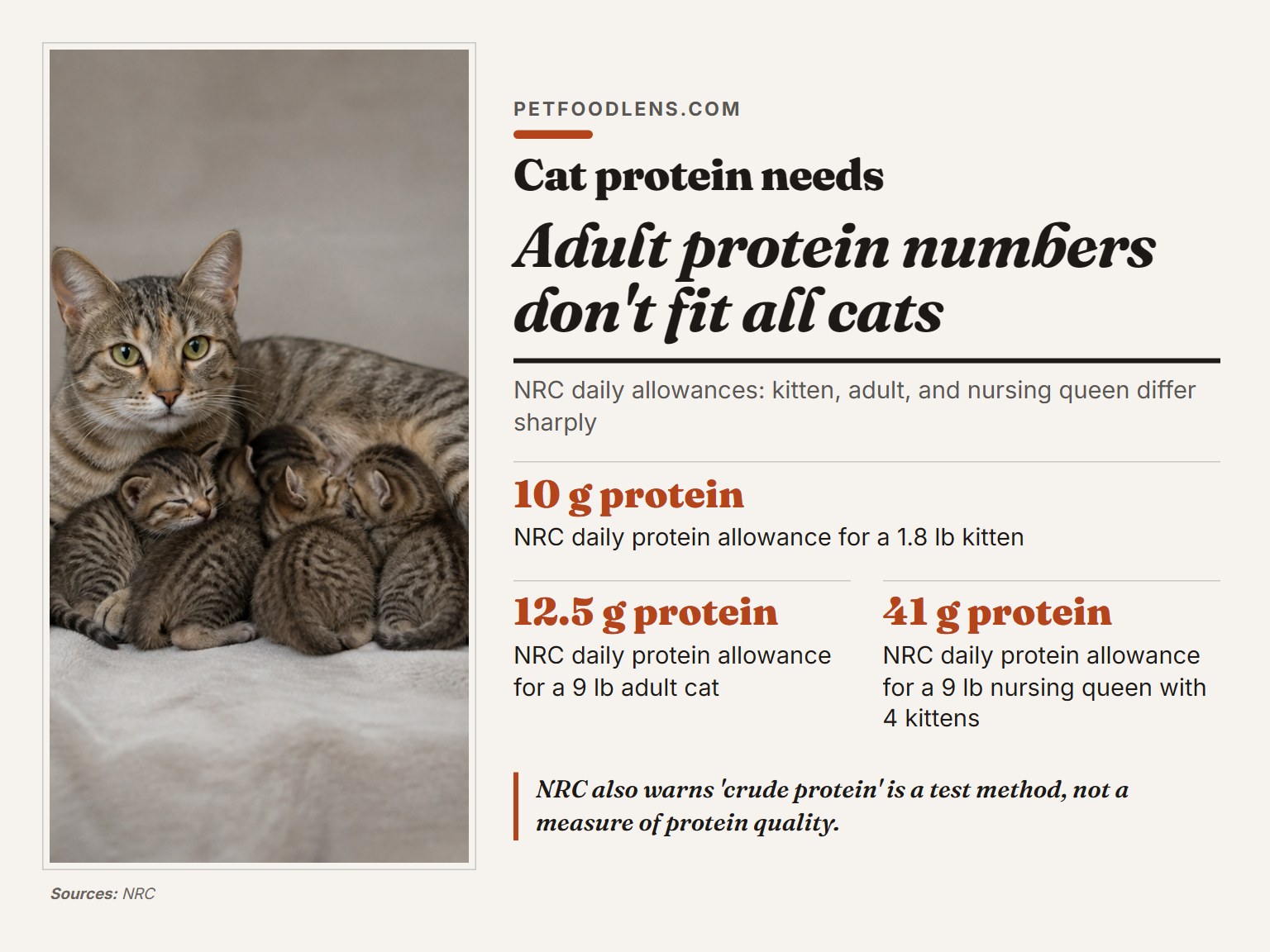
The 2.5 and 5.2 g/kg figures are for healthy adult cats. They don’t transfer cleanly to kittens, nursing queens, or cats with kidney disease, and treating them as universal is how people get into trouble.
Kittens and nursing queens need far more. The NRC daily allowance for a 1.8 lb kitten is 10 g protein and 4 g fat. For a 9 lb nursing queen with four kittens, it’s 41 g protein and 12 g fat. That’s far above the adult maintenance figure, and it’s why kitten food is formulated differently from adult food.
A cat losing lean mass still eats normally. The hollowing happens behind the shoulder blades first, and the scale doesn’t move until later. That’s why body condition scoring matters more than the number on the scale.
For cats with kidney disease, the calculus changes again, and it’s outside what I can responsibly advise on. The renal cat food guide covers the veterinary side. A board-certified veterinary nutritionist should set the actual target.
Skip this if: Your cat is a healthy adult at ideal body condition. The two-tier requirement is the whole story. Once CKD, diabetes, or weight loss enters the picture, the numbers above are a starting reference. Your vet sets the actual target.
What the mainstream brands actually deliver
A few commercial foods may land at or above the Laflamme threshold without going to a prescription formula, but you should verify the dry-matter protein yourself on the label.
If you want to actually hit the 5.2 g/kg LBM figure from the Laflamme study, you’re looking at either a purpose-built high-protein formula or a wet food with high protein density. The high-protein cat food pros and cons breakdown explains why most mainstream adult dry foods don’t get there, and that’s a real gap between the research and the shelf.
Both clear AAFCO, both name their primary protein sources, and neither relies on exotic proteins to hit the number. The best high-protein cat food picks for adult maintenance don’t apply to a growing kitten, so match the formula to the life stage.
Phosphorus is the other number that matters here, especially for aging cats, and it’s rarely on the front of the bag. It’s outside the scope of this article, but it belongs on your radar.
Frequently Asked Questions
How much protein does an adult cat need per day?
The NRC sets the minimum at 2.5 g/kg body weight (RDA 3.13 g/kg). A Purina DEXA study found 5.2 g/kg needed to maintain lean body mass. For a 9 lb cat, the NRC minimum and the Laflamme lean-body-mass figure translate to different daily gram targets.
Is 26% protein enough for a cat?
AAFCO’s 26% dry-matter minimum is the US benchmark. Laflamme et al. Found that a 26% protein diet lost lean body mass over a 2-month feeding period. It’s a legal floor, and the DEXA data suggests it doesn’t hold muscle over months.
What’s the difference between crude protein and digestible protein?
Crude protein is a nitrogen-based lab test that counts all nitrogen, including non-protein nitrogen the cat can’t use. Digestible protein accounts for what the cat actually absorbs. The NRC explicitly warns that crude protein is a test method, not a measure of protein quality.
Do wet and dry foods have the same protein requirement?
The requirement is the same; the labels aren’t comparable as-fed. Always convert to dry matter before comparing.
Can cats get too much protein?
Healthy adult cats tolerate high protein well. Green et al. Fed 49.6% ME (60% CP) with no adverse effect on protein oxidation. The concern is in cats with kidney disease, where protein level has to be managed with veterinary input, not by applying adult maintenance numbers.
The Bottom Line
Protein requirements for cats come down to two numbers and one conversion. Aim for a food that meets the Laflamme lean-body-mass figure, verify the dry-matter calculation yourself, and treat the NRC minimum as a floor rather than a target.
Above 5.2 g/kg body weight, you’re in the range where the Laflamme data shows lean mass holding. Below 3.13 g/kg (the NRC RDA), you’re relying on nitrogen balance as your endpoint. That endpoint can look fine while muscle is disappearing.
One concession: this all assumes a healthy adult cat. If your cat has CKD, diabetes, or unexplained weight loss, the numbers above are a starting reference. That’s the point where the vet sets the number and the bag follows.
