
Gel Food for Fish Pros and Cons: What the Evidence Says
This post contains affiliate links. As an Amazon Associate, we earn from qualifying purchases.
Gel food for fish holds its shape in water and lets you control every ingredient, but the evidence splits: a 5% calcium lactate gel scored highest for acceptance in rosy barb, while a 12-week zebrafish trial found gel-fed fish grew slower than micro-pellet controls.
Water stability comes from the binder, and the binder is where a gel diet either holds or falls apart. Agar, gelatin, and calcium lactate all set a gel, but they set it differently, and the two studies that tested them didn’t test the same binders against each other. Gel food for fish pros and cons often come down to the binder.
What follows covers the binder chemistry, the two studies pointing opposite ways, the water ratio FAO publishes, the storage clock that decides whether a moist diet is safe, and the feeding schedule that changes with water temperature.
Key Takeaways
- Gel is a moisture delivery system. It lets you control the recipe and skip the heat and drying that can cost nutrients, per FAO.
- The growth evidence is split. One gel beat its control on acceptance; a 12-week zebrafish trial found gel-fed fish smaller than pellet-fed controls.
- Moist diet is a same-day food unless you freeze it. FAO measured thiamine at 65% after 12 hours and 8.2% after 7 days.
- Water temperature sets feeding frequency. Channel catfish get fed twice daily above 26°C, once daily at 22-26°C, and every other day below 20°C.
- Binder choice decides whether the tank goes cloudy. Too much water makes the mix stick in the grinder; too little binder and the gel dissolves.
What Actually Holds a Gel Diet Together in Water?
A gel diet is a protein-and-moisture matrix held together by a binder, and the binder decides whether it survives the tank. Three binders show up in the published work: agar, gelatin, and calcium lactate.
A gel diet binds ground protein and water into a solid matrix using a gelling agent. Agar sets a firm, heat-stable block. Gelatin sets a softer gel that degrades in solution. Calcium lactate at 5 percent ranked top for physical and acceptance characteristics.
Gelatin is the binder in most kitchen-counter homemade fish food, because it’s cheap and already in the pantry. It also has a documented degradation problem: cold-water fish gelatin breaks down in solution, though a set gel slows that down.
Agar, Gelatin, and Calcium Lactate Compared
Agar holds a firmer block. The 2015 wrasse work found agar significantly stronger than gelatin from cold-water fish skin and beef. Calcium lactate 5% came out on top in a separate rosy barb trial for physical and acceptance characteristics.
| Binder | What the published work shows | Main risk |
|---|---|---|
| Agar | Significantly stronger than gelatin in the 2015 wrasse work | Brittle block that needs heat to set |
| Calcium lactate 5% | Top physical and acceptance characteristics in the rosy barb trial | Ranked only against its own control |
| Gelatin | Softer set; degrades in solution unless chilled | Breaks down fastest once wet |
The two studies didn’t test the same binders, so there’s no reconciled ranking. MDPI Gels put calcium lactate 5% on top for physical and acceptance characteristics. The 2015 Animal Feed Science and Technology paper found agar significantly stronger. Neither one tested the other’s full set.
That’s the honest state of the gel food for fish pros and cons question. Pick one binder and test it on your own fish, because the published ranking doesn’t transfer cleanly.
If you’d rather buy a mix than build one, You add hot water, stir, and let it set, which removes the binder guesswork but not the storage clock.
The Two Studies That Point in Opposite Directions
The Laboratory Animals trial put adult zebrafish on either a gel diet or a micro-pellet control for 12 weeks. Body length and mass were measured every two weeks.
The Laboratory Animals zebrafish feeding trial ran adult zebrafish for 12 weeks. Half got a gel diet, half got a micro-pellet control, and the gel group came out shorter, lighter, and less successful at breeding.
The authors didn’t hedge. They wrote that the formulation was not a satisfactory alternative to the micro-pellet diet in a research zebrafish colony.
The rosy barb work went the other way. A 5% calcium lactate gel scored highest for physical and acceptance characteristics against its control.
Different species, different formulations, different endpoints when you compare a gel food for fish pros and cons. The two experiments answered different questions, and neither one settles the other.
Anyone who tells you gel food is proven better or proven worse is overreading a single trial. The evidence is thin and species-specific.
Three things separate those results, and it’s worth naming them:
- Species. Rosy barb accepted a calcium lactate gel; zebrafish did worse on gel than on pellets.
- Formulation. A 5% calcium lactate gel and an agar block are not the same diet, even when both are called gel.
- Endpoint. Acceptance, growth, and breeding success are three different measurements, and a diet can win one and lose another.
Gel is one of several types of aquarium fish food, and it’s the only one where you control the binder. That control is the whole appeal, and it’s also the whole risk.
How Much Water Goes Into a Moist Diet?
FAO’s practical fish diets chapter puts the water at 350 milliliters per kilogram of dry mixture. That’s the working number, and it’s a starting point rather than a law.
The FAO practical fish diets chapter gives the ratio and the target texture. Stir the water in with a dough mixer until the mass reaches a stiff plastic consistency. Squeeze a handful and it should hold. If it crumbles, add water.
Too much water is the more common failure. FAO notes that excess water causes the mix to stick as it comes out of the food grinder, which turns a clean extrusion into a smear.
You’ll feel it before you see it. The mix goes from a stiff putty to a wet paste that coats your fingers and won’t release from the die.
The Mixing Sequence
- Weigh the dry mix, then add 350 ml of water per kilogram. Eyeballing the water is how you end up with a sticky batch.
- Stir with a dough mixer until the mass turns stiff and plastic. Hand stirring works, but it takes longer and you’ll under-mix.
- Squeeze a sample. If it doesn’t hold together, add water a spoonful at a time.
- Run it through a food grinder. A pelleting machine isn’t needed, per FAO.
- Stop adding water the moment the extruded strands start sticking to the die. That’s the sign you’ve crossed the line.
Easy to miss: The water ratio is per kilogram of dry mix, not per kilogram of finished gel. Doubling the dry mix without doubling the water gives you a crumbly batch that won’t extrude.
Excess water in the mix is one of the fastest routes to cloudy water once the gel hits the tank. The binder can’t hold what the recipe overloaded.
The Storage Clock: Why a Moist Diet Is a Same-Day Food
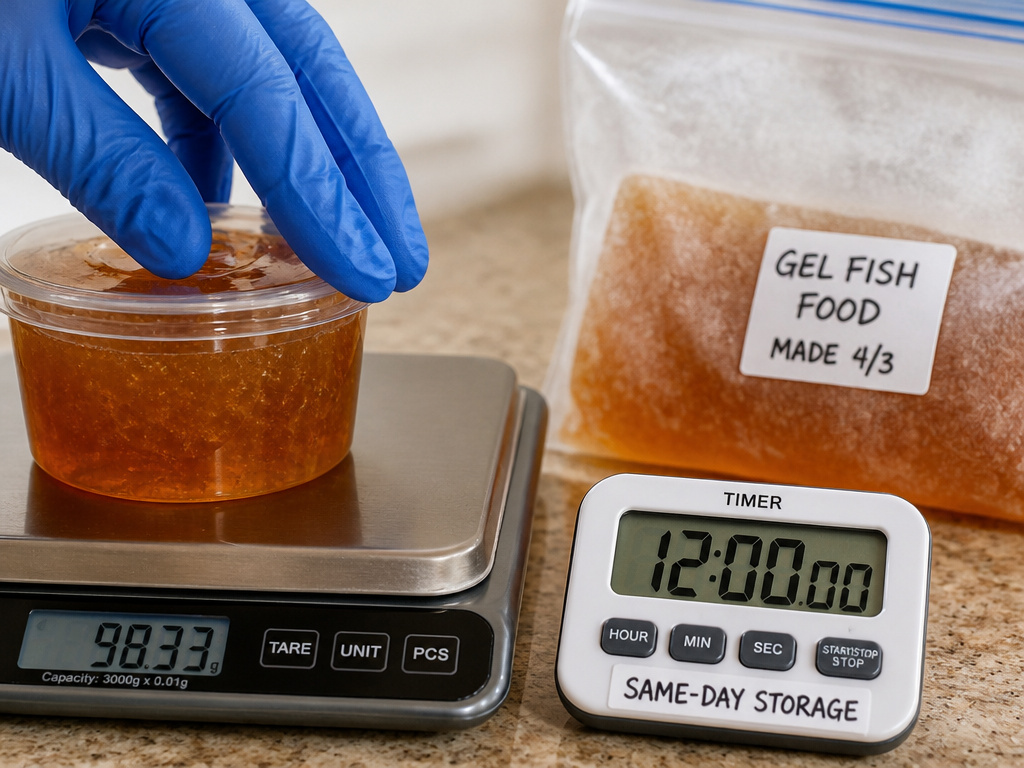
FAO advises feeding a moist diet made with raw fish waste within several hours of mixing, while an Animal Feed Science and Technology study found an agar-based diet remained water-stable 7 days fresh or after a week at -20°C.
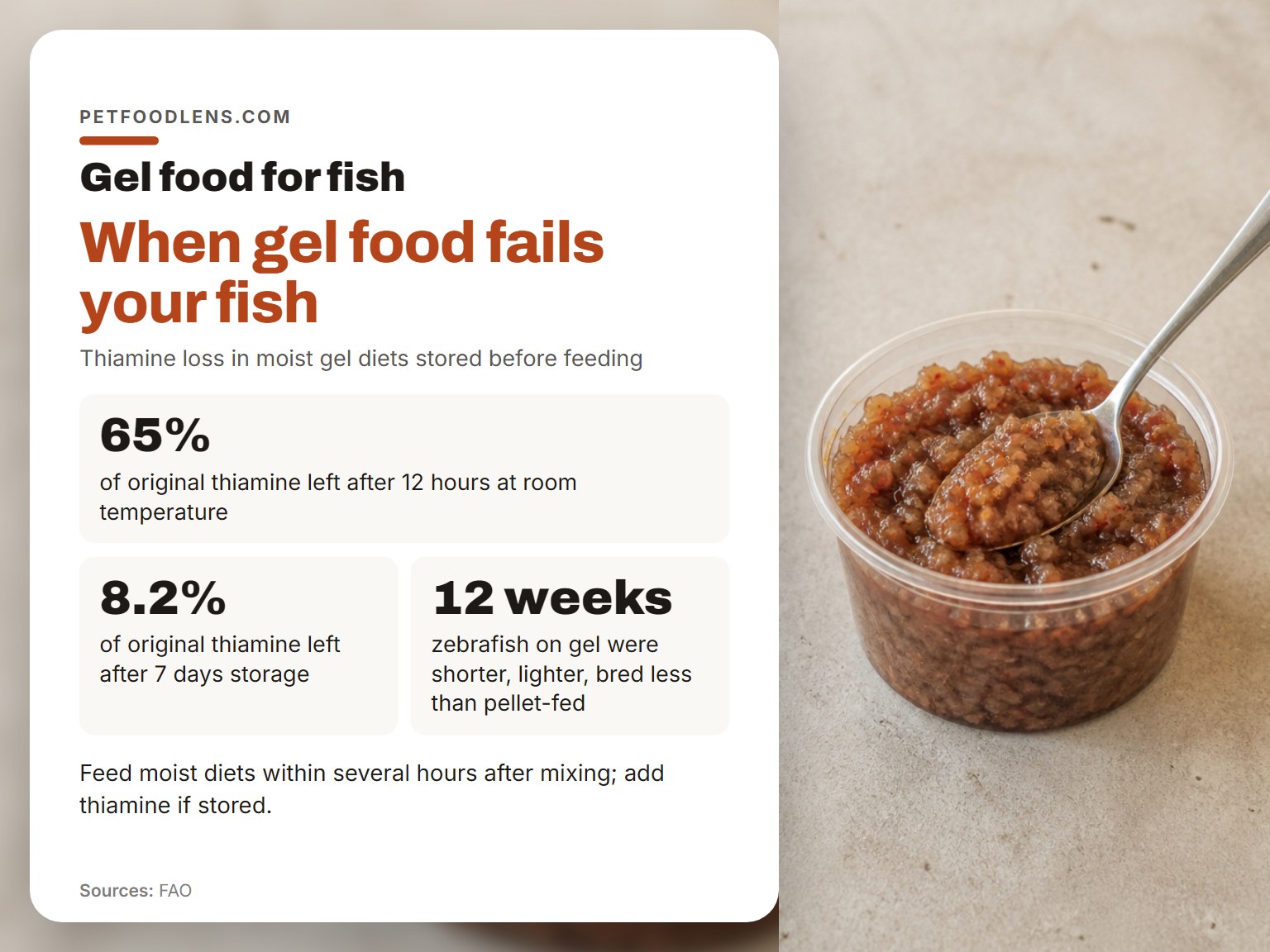
FAO measured thiamine in moist food containing non-heated fish waste. After 12 hours at room temperature it held 65 percent of its original thiamine. After 7 days it held 8.2 percent.
That’s an anti-thiamine enzyme at work. Raw animal tissue can carry it, and heat destroys it, which is why extruded dry feed doesn’t have the same problem.
Before you start: Moist food made with non-heated fish waste loses thiamine fast, down to 65 percent at 12 hours and 8.2 percent at 7 days. Feed it within several hours of mixing, or freeze it and add a separate thiamine source if it’s been stored.
FAO’s guidance is direct. Moist diets with non-heated fish waste feed well if they go in within several hours of mixing. If the diet has been stored, supply another source of thiamine.
Water stability and nutritional stability are different clocks. The agar-based water-stable diet study for ballan wrasse kept its diet water-stable for 7 days fresh, or after a week at -20°C. Water stability says nothing about whether the thiamine is still there.
The same fish food storage discipline that applies to flakes applies here, only harder. A flake goes stale. A moist diet goes stale and loses a vitamin at the same time.
How Often Should You Feed, by Water Temperature?
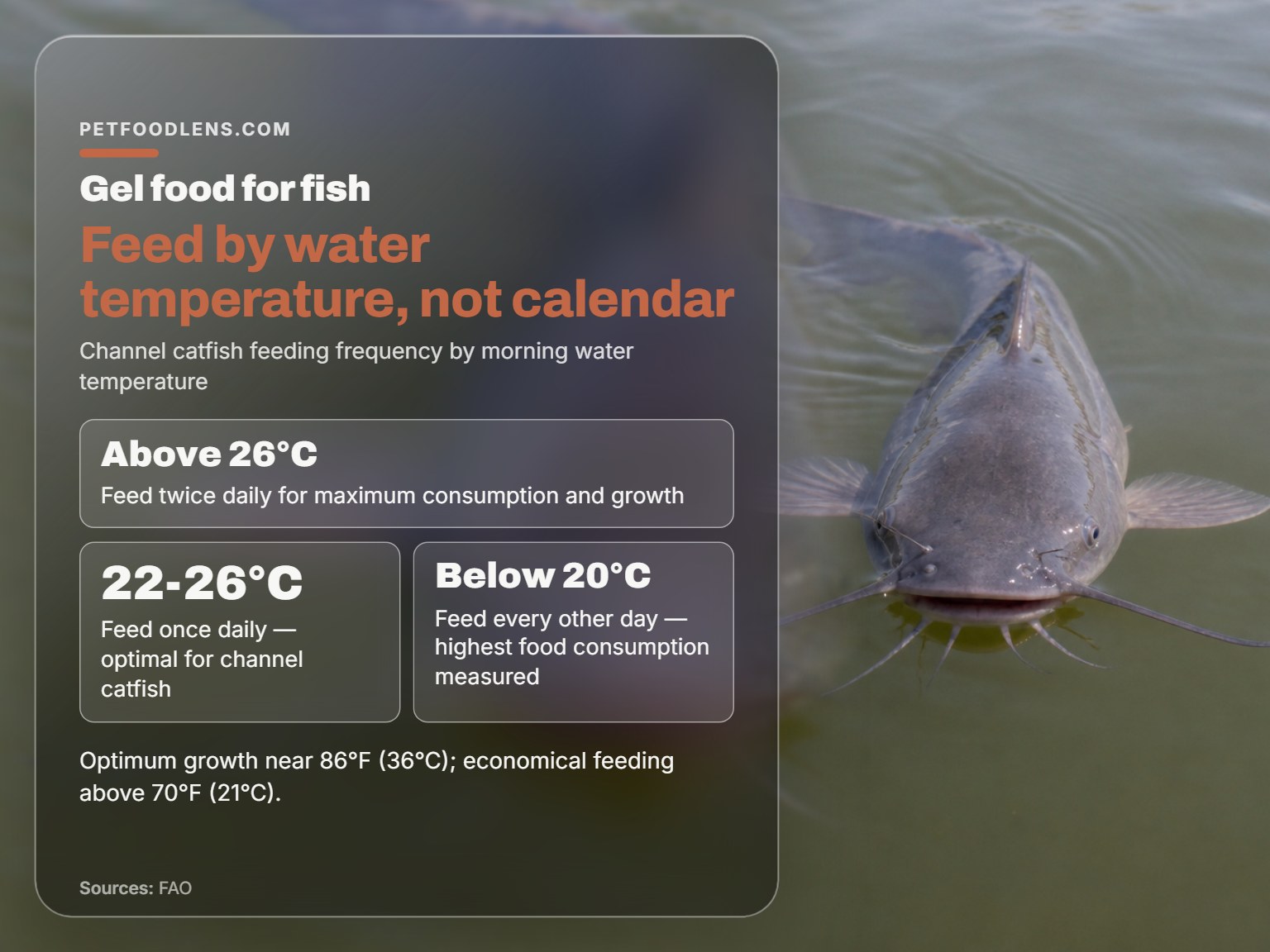
Channel catfish get fed twice a day when morning water temperature is above 26°C, once a day at 22-26°C, and every other day below 20°C.
Those numbers come from FAO’s catfish feeding work, and they’re a better guide than a fixed schedule on the calendar.
| Morning water temp | Feeding frequency | Result |
|---|---|---|
| Above 26°C | Twice daily | Maximum consumption and growth |
| 22-26°C | Once daily | Optimal for channel catfish |
| Below 20°C | Every other day | Highest food consumption measured |
The optimum for growth sits near 86°F (36°C). Economical feeding still works above 70°F (21°C). Below that, you’re feeding the water more than the fish.
Temperature drives appetite, and appetite drives how much of your gel gets eaten versus how much dissolves. A gel that sits uneaten is a gel that’s leaching.
Whatever you feed, a varied diet is worth less than getting the frequency right for the water temperature. Variety is a nice-to-have. Frequency is the load-bearing variable.
How Much to Feed: Body Weight and Satiation
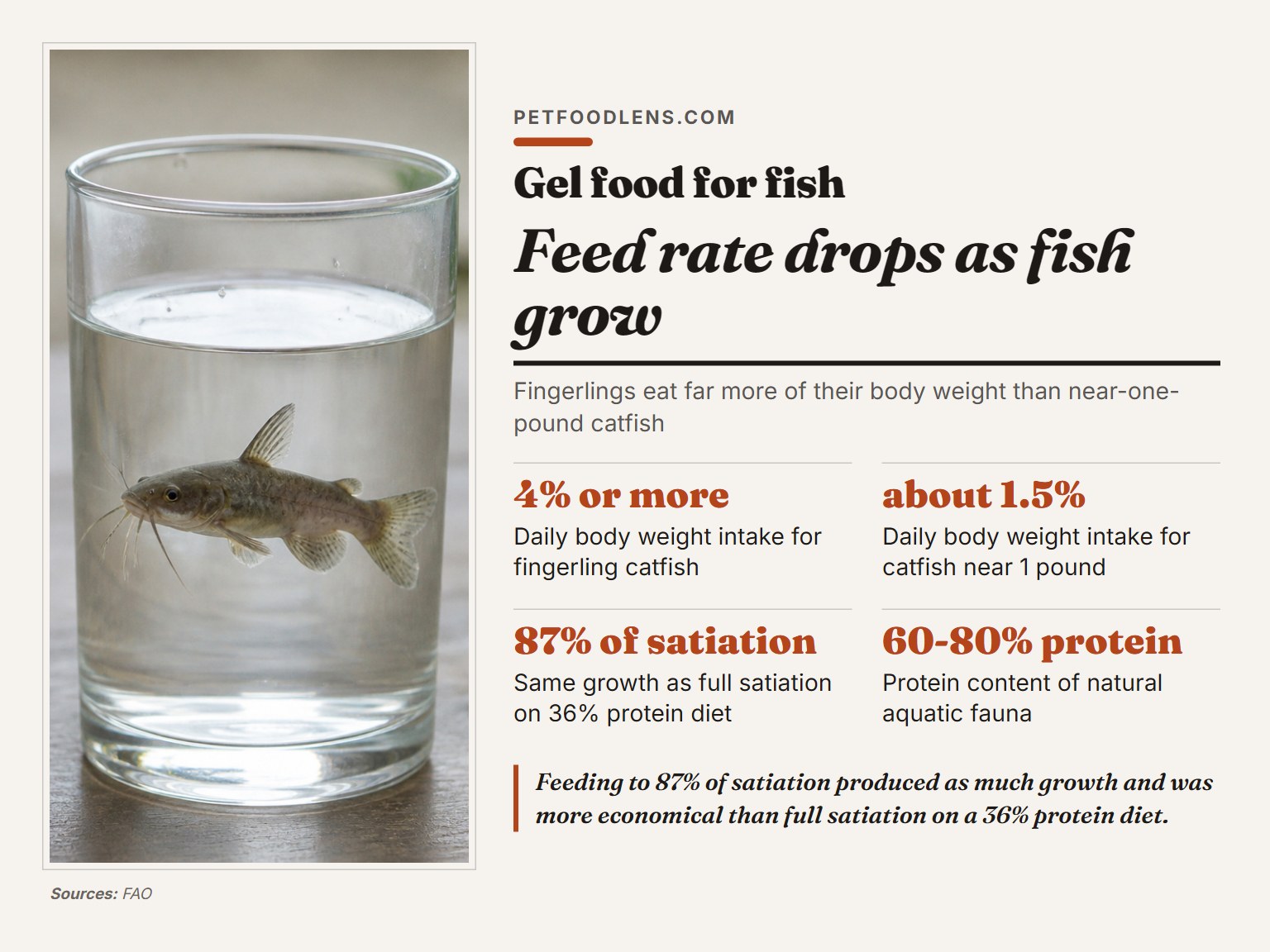
Fingerling catfish eat 4 percent or more of their body weight a day. A fish near one pound eats about 1.5 percent.
That spread is the whole reason a single feeding chart doesn’t work across sizes. Same food, same tank, and a tenfold difference in intake per unit of body weight.
FAO also reports an Auburn University result worth knowing. Feeding catfish to 87 percent of satiation on a 36 percent protein diet produced as much growth as feeding to full satiation, and it was more economical. The same didn’t hold on a 30 percent protein diet.
Reading the Feeding Numbers
- Fingerlings: 4% or more of body weight daily. Growth-stage fish need the most.
- Near one pound: about 1.5% of body weight daily. The rate drops as the fish grows.
- 87% of satiation on 36% protein. Same growth, less feed.
- Natural food changes the math. Aquatic fauna runs 60-80% protein, so a supplementary diet can carry very little protein when natural food is abundant.
The practical read: feed to just under full, and use a higher-protein diet if you’re pushing growth. Slight restriction plus a dense diet is the more efficient combination. Feeding to full satiation doesn’t buy you more growth on a 36 percent protein diet.
Feed conversion in catfish practice runs near 1.7. That figure comes from ponds, so treat it as a rough ceiling for tank systems rather than a target.
The same logic applies when you’re choosing food for a different species: the label tells you the protein percentage, not the feeding rate. Those are two different decisions, and the panel is the one that answers the first.
When Gel Food for Fish Is the Wrong Choice
Skip gel as the sole diet for a research colony. That’s the clearest case the published work gives you.
The 12-week zebrafish trial found gel-fed fish shorter, lighter, and less successful at breeding than pellet-fed controls. The authors said the formulation wasn’t a satisfactory alternative. If your goal is reproducible growth data, gel is a variable you don’t need.
The second case is anyone who won’t commit to the storage clock. A gel diet that sits at room temperature for a day is losing thiamine the whole time. FAO’s numbers make that plain.
The third case is a fish that won’t take it. Wild-caught ballan wrasse naive to manufactured feed may take time to accept an agar diet. Hatchery fish may accept it more readily. If your fish are wild-caught, budget the transition time.
If a batch of gel is stored before feeding, you’re feeding texture and water. Thiamine is the part that leaves first.
Read the panel, not the front of the bag. A gel mix that lists a named protein near the top of the ingredient list is doing more for your fish than one whose first ingredient is a starch.
For everything else, the alternatives are cheaper and simpler. Fish flakes float and get eaten fast, and they don’t need a binder; Frozen fish food gives you moisture without the mixing, and Freeze-dried fish food keeps on the shelf and reconstitutes in water.
None of those give you control over the recipe. That’s the trade.
Frequently Asked Questions
Is gel food better than flakes for fish?
For most display tanks, flakes are easier and just as good. Gel earns its place when you need a custom recipe or a moist diet for a fish that won’t take dry food. The published growth data doesn’t favor gel over pellets, so “better” depends on what you’re measuring.
Does gel food cloud the water?
It can, and the usual cause is too much water in the mix or too little binder. FAO notes that excess water makes the mix stick during extrusion, which is the same overload showing up earlier. A gel that holds a stiff shape when you squeeze it holds in the tank.
How long can you keep gel food in the fridge?
Not long if it’s made with raw fish waste. FAO measured thiamine down to 65 percent at 12 hours and 8.2 percent at 7 days. Feed it within several hours, or freeze it and add a separate thiamine source.
Can you feed gel food to goldfish?
Yes, but match the recipe to the fish. Goldfish graze all day, and a gel that dissolves in an hour just fouls the water. A firm binder and a batch sized to what the fish eat in a few minutes beats a soft set.
Why did my fish ignore the gel food?
Acceptance varies by species and by how the fish was raised. Wild-caught ballan wrasse may take time to accept an agar diet, while hatchery fish may accept it more readily. If your fish are wild-caught, give it time and don’t switch recipes every day.
The Bottom Line
Here’s the threshold I’d use. If you’re feeding a research colony or measuring growth, stay on pellets. The zebrafish trial is the closest thing to a controlled answer, and it didn’t favor gel.
If you’re feeding a display tank and you want control over the recipe, gel is worth the hassle, but only if you commit to feeding it within hours of mixing or freezing it immediately. A gel diet with a casual storage habit is a thiamine deficiency with extra steps.
This all changes if your fish won’t take gel at all. Wild-caught wrasse may take time to accept gel. Yours might never.
Start small: one binder, one batch, and a scale. Weigh the water instead of eyeballing it, and write down what you used. The next batch is where you learn something.
