
Frozen Fish Food Pros and Cons: What to Weigh
This post contains affiliate links. As an Amazon Associate, we earn from qualifying purchases.
Frozen fish food pros and cons split along one line: raw tissue and moisture versus freezer space and thawing work. Frozen food beats flakes and freeze-dried on palatability and water content, but it needs storage at -18 C or colder and a thawing routine. Most community fish thrive on it. Most owners waste part of every pack.
A cube of bloodworms softens fast, and most tanks hold more fish than one cube feeds. That mismatch is where the waste starts, and it is also where the freezer-burn and refreezing questions come from. Handle the thaw and the storage, and frozen food earns its reputation.
What follows covers what freezing actually preserves, where frozen beats the alternatives, how long each type keeps at -18 C, and the thawing habits that turn a cube into cloudy mush.
Key Takeaways
-
Frozen tissue holds its water, which is why finicky predators take a cube when they ignore a flake.
-
Never refreeze a thawed cube. Refreezing costs texture and gives bacteria a second run at the tissue.
- Rinse before feeding to strip the cloudy runoff that carries oxidized protein and leached vitamins.
What Frozen Fish Food Actually Is
Frozen fish food is raw aquatic tissue held below freezing: bloodworms, brine shrimp, mysis, daphnia, krill, silversides, and beef heart, sold in cubes, flats, or blister packs. Freezing stops bacterial growth. It does not stop the chemistry inside the tissue.
Bacterial growth stops below -10 C, but chemical and physical deterioration continues. Protein denaturation accelerates exponentially as storage temperature rises, and temperature swings during frozen storage accelerate denaturation further. A product can pass a microbial test while losing texture, moisture, and palatability, which is why frozen food quality depends on the cold chain rather than the date on the pack.
That distinction matters more for fish food than for a bag of kibble. A frozen cube can test clean and still be pale, mushy, and low in the free amino acids that trigger a feeding response.
What “Frozen” Actually Preserves
Freezing locks water in place and slows the enzymes that break tissue down. It does not stop lipid oxidation, and it does not stop protein denaturation. Both keep running at a rate that climbs with temperature.
The colder and steadier the freezer, the slower that chemistry runs.
Water-soluble vitamins leave first. They leach into the thaw liquid, which is the cloudy runoff you see when a cube hits tank water.
Frozen Fish Food Pros and Cons: What It Does Well
Three things frozen food does better than anything else on the shelf: moisture, raw texture, and picky-eater appeal.
- Moisture. Frozen tissue still holds the water the animal had in life. A flake has given most of it up in the dryer.
- Palatability. Raw tissue releases free amino acids and lipids as it thaws, and that is the signal a predator reads.
- A short ingredient panel. Whole organisms, not meals bound with starch and rendered fat.
- Portion control. Cubes and blisters break into small units, which suits one tank better than a bulk tub.
Moisture is the one I would argue hardest for. A fish that evolved in a river is built to take water in with its food, and a cube is closer to that than an extruded pellet will ever be.
The palatability point has a mechanism behind it. Those free amino acids and lipids are volatile, and a flake or a pellet loses a large share of them to heat during extrusion. What is left still feeds the fish. It just does not smell like prey.
For most community tanks, frozen bloodworms are a common default cube. The pieces are small enough for tetras, the panel is short, and the pack is consistent from one batch to the next. For fry and small rasboras, frozen brine shrimp are the better call, because the nauplii are small enough to swallow whole.
Frozen food gives you that component without a live culture on the counter.
Where Frozen Food Falls Short
A freezer is not a pause button.
Freezer burn is the first failure most keepers meet. A freezer-burned cube comes out pale and furred with frost, and the water it thaws in turns cloudy instead of clear. The tissue underneath has dried out, and no amount of soaking brings the texture back.
Every swing pulls moisture off the surface and redeposits it as ice on the packaging.
Common mistake: Dropping a frozen cube straight into the tank. The outer layer thaws first and dumps a concentrated cloud into the water, while the core stays hard and the fish tear at it. Feed the runoff and you feed the filter, not the fish.
The rest of the list is practical:
- Partial-cube waste. Most tanks do not need a whole cube, and the leftover rarely gets handled well.
- Freezer space. A dedicated shelf is the honest requirement, and a crowded freezer swings in temperature every time the door opens.
- Thaw time. Dinner takes planning, and hungry fish do not wait.
- Feed cost per meal. Frozen runs higher than a tub of flake, and the gap widens once you throw away the burned portion.
- Overfeeding risk. A cube is easy to dump. A cube is also a lot of protein for a small tank.
Where this goes sideways: Thawing a cube in hot tap water. The outside cooks before the center softens, and the runoff carries dissolved protein and vitamins straight down the drain. Warm water also speeds up the bacterial growth you were trying to avoid.
Frozen vs Live vs Freeze-Dried vs Flakes
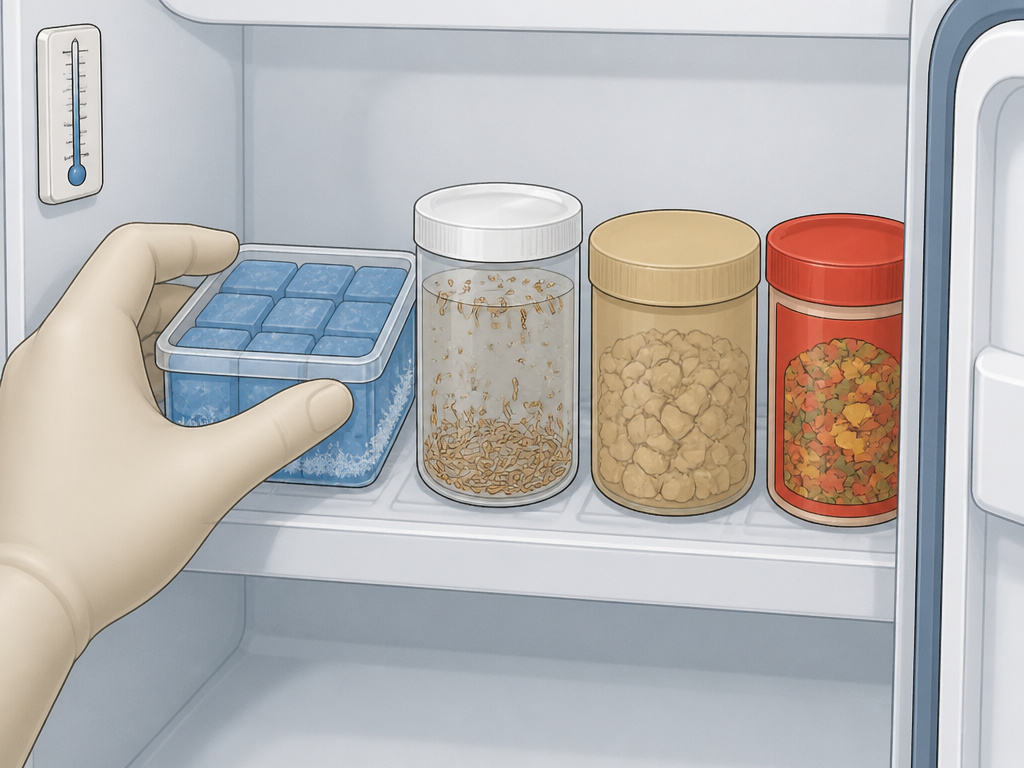
Four formats sit on the shelf, and they fail in different ways.
| Format | Best for | Main drawback |
|---|---|---|
| Frozen | Community tanks, finicky eaters | Needs freezer space and a thaw routine |
| Live | Breeders, predatory fish | Short shelf life, culture work, disease risk |
| Freeze-dried | Quarantine and nano tanks | Floats, absorbs water slowly, poor moisture |
| Flakes | Everyday maintenance feeding | Lowest moisture, fastest nutrient loss |
For most community fish, frozen wins. The moisture and the raw tissue are worth the freezer shelf.
It sits in a cupboard for months and does not care about the door swing.
For a breeder chasing growth rates, live wins, and the culture work is the price of admission.
Two specific comparisons are worth naming. On the shelf, frozen bloodworms win on palatability and freeze-dried wins on storage.
How Long Does Frozen Fish Food Last?
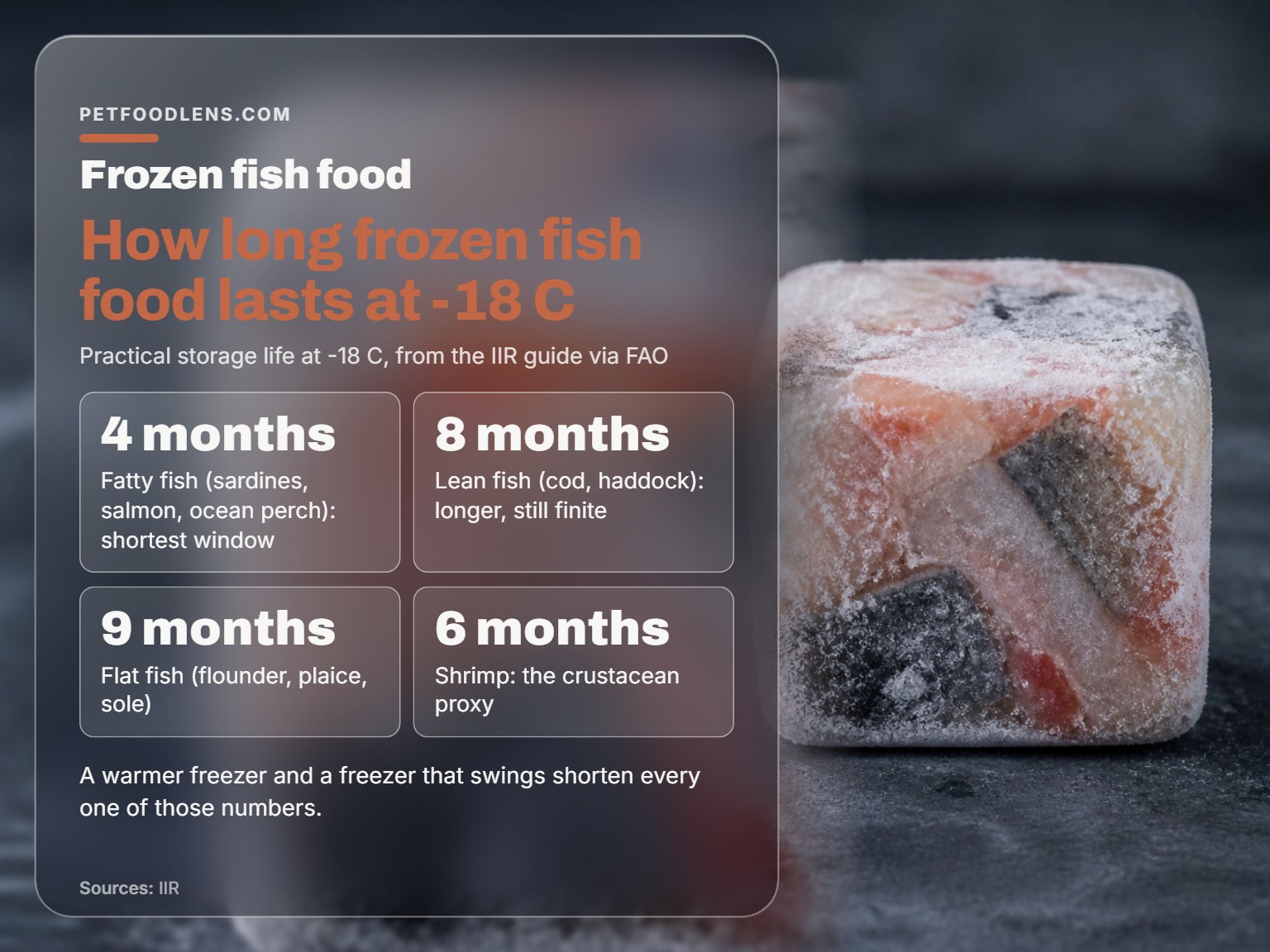
Those figures come from the International Institute of Refrigeration and were built for seafood, not aquarium packs. The tissue is the same tissue.
| Food type | Practical storage life at -18 C | What it means for a cube |
|---|---|---|
| Fatty fish (silversides, salmon) | 4 months | Shortest window; buy small packs |
| Lean fish (cod, haddock) | 8 months | Longer, still finite |
| Flat fish (flounder, sole) | 9 months | Rarely sold as fish food |
| Shrimp, brine shrimp, mysis | 6 months | The crustacean proxy |
| Lobster, crab | 6 months | Not a typical aquarium food |
Two things shorten every one of those numbers. The first is a warmer freezer. The second is a freezer that swings.
A cube is a portion, not a serving. Feed what the tank clears and put the rest back before it softens.
Where the Temperature Advice Disagrees
The standard is not the whole story, and the sources do not agree.
| Source | Recommended storage temperature | Position |
|---|---|---|
| Codex Alimentarius / IIR (1989) | -18 C or lower | The regulatory floor |
| Fukuda, Fisheries Science (2020) | -20 to -25 C still insufficient | Deterioration cannot be fully suppressed |
| PMC freeze-chilling review | -24 to -30 C for lean fish | Colder than the standard |
The chilled and frozen fish quality review goes further and recommends -24 to -30 C for lean fish.
There is a second disagreement about going colder still. The same review notes that storage below -40 C may not deliver a substantial overall benefit, while the Fisheries Science work finds denaturation slows around -40 C. Both positions are on the record. Neither has been settled.
For a home keeper, the practical read is contested: Codex/IIR set -18 C as the floor, while the freeze-chilling review recommends -24 to -30 C for lean fish and Fukuda argues -20 to -25 C is still insufficient.
The Freezer-Burn Problem
Ice crystal size gets blamed for more than it deserves. The Fisheries Science review counters that crystal size does not necessarily determine quality, because tissue reabsorbs water during thawing unless protein denaturation has already damaged it.
The FAO takes a third position. Fish muscle cell walls are elastic enough to absorb larger crystals without excessive damage, and the real difference between slow and quick freezing is time spent in the zone of maximum activity.
Where does that leave you? For kamaboko gels, crystal size does determine quality because denatured gel cannot reabsorb thaw water, while for intact muscle the Fisheries Science review holds that crystal size does not necessarily determine quality. For whole muscle, the time in the warm zone matters more. Freeze fast, store cold, and do not let the door swing.
How to Thaw Frozen Fish Food Without Wrecking It
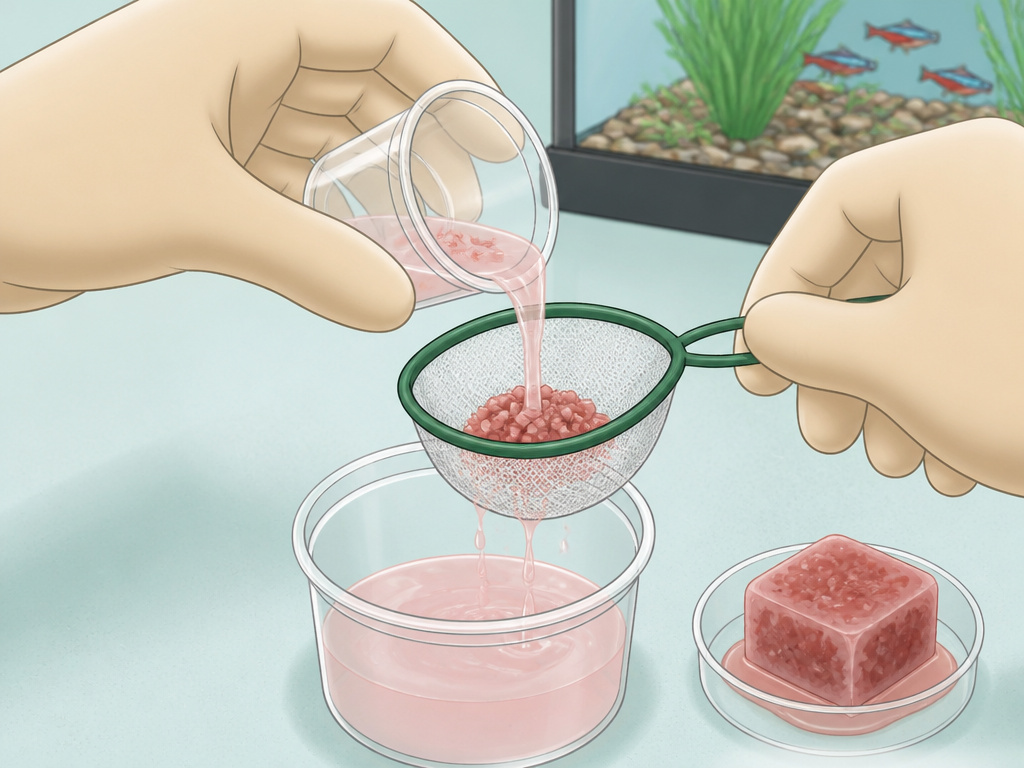
You drop a cube into the tank. It sinks, then releases a pinkish cloud that drifts through the water column and settles into the substrate. Half of that cloud is dinner. The other half is waste.
A cube thawed in tank water releases its color quickly.
Before you start: Thawed frozen food is raw animal tissue, so treat it the way you would raw chicken. Wash your hands and the net after handling, keep the thaw cup off the fridge door where it can drip onto other food, and never refreeze what the fish did not eat.
- Break off what the tank will clear. A partial cube is normal. Snap it off while frozen, and put the rest back immediately.
- Thaw in a small cup of tank water. Room-temperature tank water is fast enough, and it avoids the cook-and-leach problem that hot tap water creates.
- Pour through a fine net. This is the step most keepers skip. The cloudy runoff carries oxidized protein and leached vitamins, and it does nothing for the tank.
- Rinse the net under the tap, then feed. What lands in the tank is clean tissue, not a cloud.
- Remove what the fish ignore. Uneaten frozen food breaks down fast, and an ammonia spike can follow.
If you keep more than one tank, thaw in a cup per tank rather than one shared cup. Cross-contamination between tanks is a real route for pathogens, and a shared cup is the easiest way to move something you did not mean to move.
Who Should Skip Frozen Fish Food
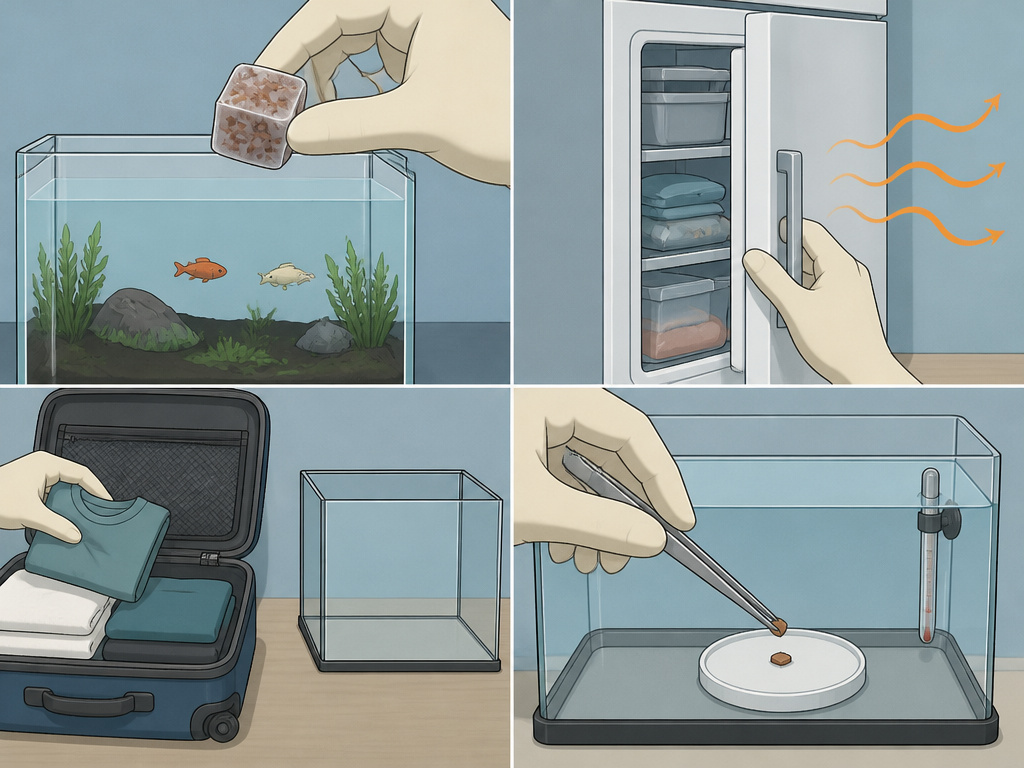
Some tanks do better without it.
Skip frozen if your freezer runs warm or the door gets opened constantly. A freezer that swings will burn a pack before you finish it, and you will pay boutique prices for dried-out tissue.
Skip it if you keep two small fish in a nano tank. A cube is too much food, and the partial-cube waste adds up faster than the convenience does.
Skip it if you travel. Frozen food needs someone home to thaw it, and a pet sitter will reach for the flake tub every time.
Skip it in a hospital or quarantine tank where you are watching every gram. A measured pellet gives you a cleaner record of intake than a cube does.
I would rather see a keeper feed half a rinsed cube than a whole cube dumped straight in. The uneaten fraction is what spikes ammonia, and it is almost always the fraction nobody measures.
If you want one answer and you keep a normal community tank: frozen bloodworms or frozen brine shrimp, stored at -18 C or colder, thawed in tank water and rinsed through a net. That covers the large majority of setups.
Frequently Asked Questions
Does frozen fish food need to be rinsed?
Yes, and the rinse is the step most keepers skip. The cloudy liquid that runs off a thawed cube carries dissolved protein and leached water-soluble vitamins. Pouring it into the tank feeds the filter bacteria rather than the fish, and it adds to the organic load.
Can I refreeze thawed fish food?
Do not. Once a cube thaws, the tissue has lost water and the bacteria on it have had a warm window to multiply. Refreezing slows them down again but does not undo the growth, and the texture will be worse on the second thaw. Break off what you need while the cube is still frozen.
Is frozen fish food better than flakes?
On moisture and palatability, yes. Frozen tissue still holds its water, and it releases the free amino acids that trigger a feeding response. Flakes win on shelf life, cost per meal, and convenience. Most keepers end up using both, with frozen as the regular feed and flakes as the backup.
How do I stop frozen food from clouding the tank?
Thaw in a cup of tank water, pour through a fine net, and rinse the net before feeding. That removes the runoff that causes the cloud. Feeding a smaller portion also helps, because uneaten tissue breaks down into the same cloudy suspension within hours.
Can I feed frozen food to fry?
Yes, if the particle size fits. Frozen brine shrimp nauplii work for most fry once they are large enough to take them. Frozen bloodworms are too large for newly free-swimming fry, and a whole cube is far more food than a fry tank can clear.
The Bottom Line
Weigh the frozen fish food pros and cons against your actual routine, not the ideal one. If you have freezer space, a steady -18 C, and a habit of rinsing, frozen food is the best regular feed most community tanks can get.
Here is the threshold that decides it. If your freezer sits warmer than -18 C, or the door is opened often, frozen food will burn before you finish the pack. Fix the storage first or buy freeze-dried.
The first step this week is small. Take a thermometer reading of your freezer, write the date on the pack when you open it, and start rinsing through a net. Those three habits do more for food quality than any upgrade on the shelf.
One concession worth stating plainly. None of this tells you how digestible a specific pack actually is. Labels and published tables describe the tissue, not the batch, and a brand with a clean panel can still ship a pack that sat too long in a distribution chain you never see. Buy from a store with turnover, and trust the smell when you open it.
