
Fish Flakes Pros and Cons: A Label Reader’s Verdict
This post contains affiliate links. As an Amazon Associate, we earn from qualifying purchases.
Fish flakes pros and cons come down to convenience, cost, and what the guaranteed analysis actually shows. Flakes are an easy food for a community tank, but they’re built on fish meal and flour, the standard feeding rule is three minutes, and the front of the tin tells you almost nothing.
That panel is where the real comparison happens. A flake label lists minimum crude protein, minimum fat, maximum fiber, and maximum moisture. Those four numbers tell you more about the food than the word “premium” ever will.
What follows is a straight read of the flake format: how it’s made, what the panel means, where flakes beat pellets and frozen food, and the two numbers that decide whether a tin is worth buying.
Key Takeaways
- Flakes are an economical format per feeding and the only one you can scatter across a mixed community tank without sorting fish by size.
- The 34% protein on a flake tin is a guaranteed minimum, not a lab result for the tin in your hand.
- Three minutes is the whole feeding instruction. Feed only what the fish clear in that window.
- Flakes are the wrong format for a single betta, because you can’t count them the way you count pellets.
- The speckled color on a flake is a manufacturing choice, not a nutrition signal.
What Fish Flakes Actually Are
The Hartz Mountain patent for fish food flakes lays out the process in plain language, and it’s less romantic than the tin suggests.
Commercial fish flakes are made by pulverizing fish meal and wheat flour to a particle size no greater than 150 microns. That powder is mixed into a slurry running 70 to 80 percent water. The slurry cooks on a steam-heated drum at 300 to 350 degrees Fahrenheit until moisture drops to between 2 and 10 percent.
That’s the whole trick. Dry ingredients get ground fine enough to pass through 100 mesh, then mixed with water.
The slurry is mostly water by design, because a drum needs a pumpable liquid, not a paste. Steam inside the drum runs at least 300°F, preferably 300°F to 350°F, and that heat does two jobs at once. It gelatinizes the starch so the sheet holds together, and it drives the moisture down.
Then the vitamins go on.
Here’s the part the front of the tin won’t tell you. Vitamins mixed into the slurry degrade badly under that heat and moisture, so the patent sprays them on instead. The spray hits the sheet one to four seconds before it comes off the drum.
That’s a real engineering decision, and it’s why the flake looks the way it does. The patent aims for a speckled pattern so a buyer can see the spray against the tan or blonde base flake. The speckle is proof of application, not proof of quality.
A drum-dried sheet comes off thin and slightly brittle, then gets broken by a rotating screw and screened to knock out fines and clumps.
Food scientists working on ready-to-eat fish cake processing run into the same trade-off: heat makes the product stable, and heat also costs you some of the vitamins.
One more thing worth flagging. Finished moisture targets differ by source. The patent dries the sheet to between 2% and 10% moisture. The Aquascape Premium Fish Food Flakes label allows a maximum of 12%. Two different processes, two different guarantees.
The Four Numbers on the Back of the Tin
Four numbers on a flake label do most of the work: minimum protein, minimum fat, maximum fiber, maximum moisture.
The Aquascape Premium Fish Food Flakes label is a clean example because it publishes the full panel, not just the headline protein number.
| Nutrient | Guaranteed Level | What It Tells You |
|---|---|---|
| Crude protein | 34% min | A floor the batch has to clear |
| Crude fat | 5% min | Energy density |
| Crude fiber | 3% max | Digestibility ceiling |
| Moisture | 12% max | Shelf-life clock |
| Ash | 12% max | Mineral load |
Read the panel, not the front of the tin. That’s the whole method.
Why “Minimum” and “Maximum” Matter
A minimum is a floor. A maximum is a ceiling. Neither is a measurement of the specific tin in your hand.
I’ve spent most of my working life reading guaranteed analyses, and the pattern holds across species. A 34% minimum crude protein means the batch tested at or above 34%. It can run higher.
Here’s where moisture changes the math. The label’s 34% protein is measured on the whole product, moisture included.
That conversion is the only fair way to compare a flake to a frozen food, which carries far more water. Do the conversion before you compare formats.
A few best flake foods hold up under that panel test, and most of them are not the ones with the biggest fish on the tin.
Do Fish Flakes Work for Bettas?
Bettas will eat flakes. Portion control is the harder question.
A betta takes food at the surface. A pinch of flake starts breaking apart the moment it hits water, and some of it sinks before the fish gets to it. Four pellets is four pellets. A pinch is whatever your fingers did that morning.
I won’t feed flakes to a single betta. Not because flakes are bad food, but because you can’t count them. In a small tank, the difference between a good feed and a fouled filter is a few extra flakes.
Pellets solve the counting problem. A pellet gives you a fixed unit, and a fixed unit is easier to adjust when the fish starts looking thin or fat.
The betta pellets vs flakes comparison lands on the same point every time. In a tank that small, portion control beats the ingredient list.
The Real Fish Flakes Pros and Cons, Sorted by Tank Type
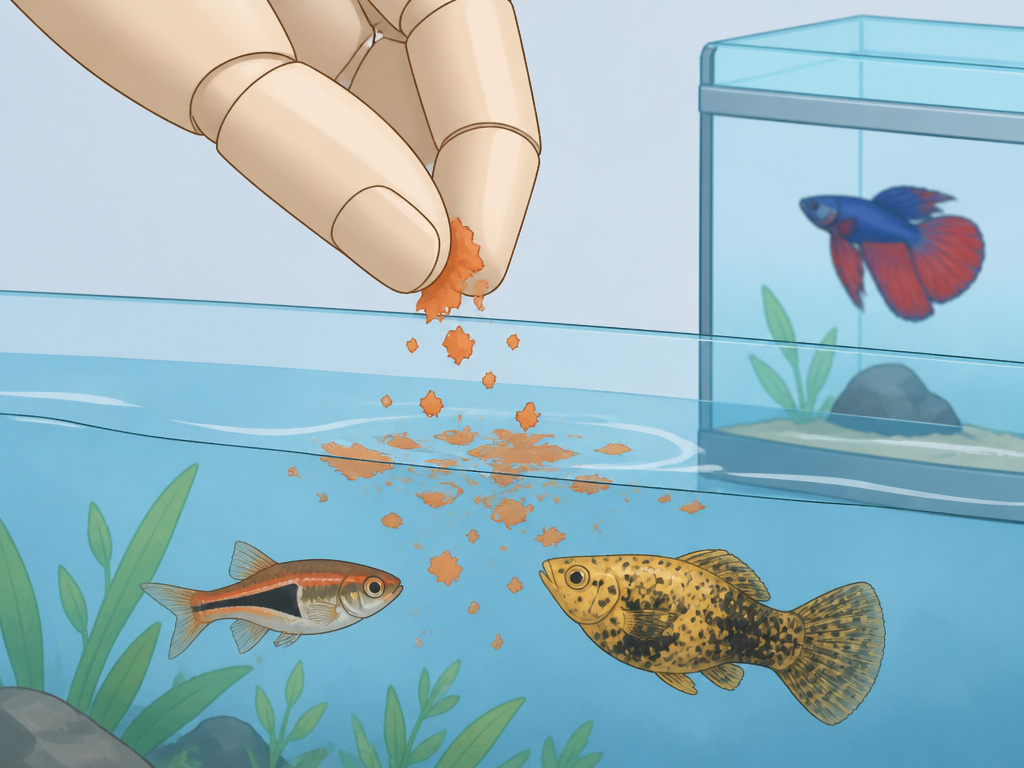
Three setups, three answers: a mixed community tank, a fry grow-out, and a single betta in a small tank.
- Mixed community tanks. A flake crumbles into different sizes as it hits water, so a rasbora and a molly can both get a piece from the same pinch.
- Fry and small fish. The Aquascape flake is milled small on purpose, which is the one case where a tiny particle is the point.
- Cost per feeding. A tin lasts a long time, and the format is an economical way to feed a large group.
- Automatic feeders. Flake drops cleanly from most drum-style feeders, which is more than you can say for frozen food.
- Single-fish tanks. This is where flakes lose. You can’t count them, and a betta in a small tank pays for the error.
Where flakes win
The community tank is the flake’s home turf. You get surface feeding, mixed particle sizes, and a format that disperses instead of sinking into one corner.
If you’re choosing community tank food, the flake is the default for a reason. It’s the only format that feeds a group of different-sized fish from one pinch.
A staple flake is where most people start, and it’s a reasonable place to start. It disperses, it floats long enough to be eaten, and the tin is small enough to finish before it goes stale.
Where they lose
A single betta, a goldfish in a bare tank, or any setup where you need to count what goes in. Flakes also lose on water clarity when the portion is wrong.
| Format | Best For | Main Risk |
|---|---|---|
| Flakes | Community tanks, fry, mixed sizes | Overfeeding and cloudy water |
| Pellets | Single fish, bettas, bottom feeders | Uneaten pellets in the substrate |
| Frozen | Picky eaters, conditioning | Thaw handling and mess |
The table is a starting point, not a rule. A tank with several species at different sizes is a flake tank. A tank with one betta is a pellet tank.
The types of aquarium fish food available in most stores break into several families, and flakes are the only one built for dispersal.
For vacations, an automatic flake feeder handles short trips better than a block feeder, mostly because the portion is adjustable.
The fish flakes vs pellets question usually resolves on tank size, not on nutrition.
Why Do Fish Flakes Cloud the Water?
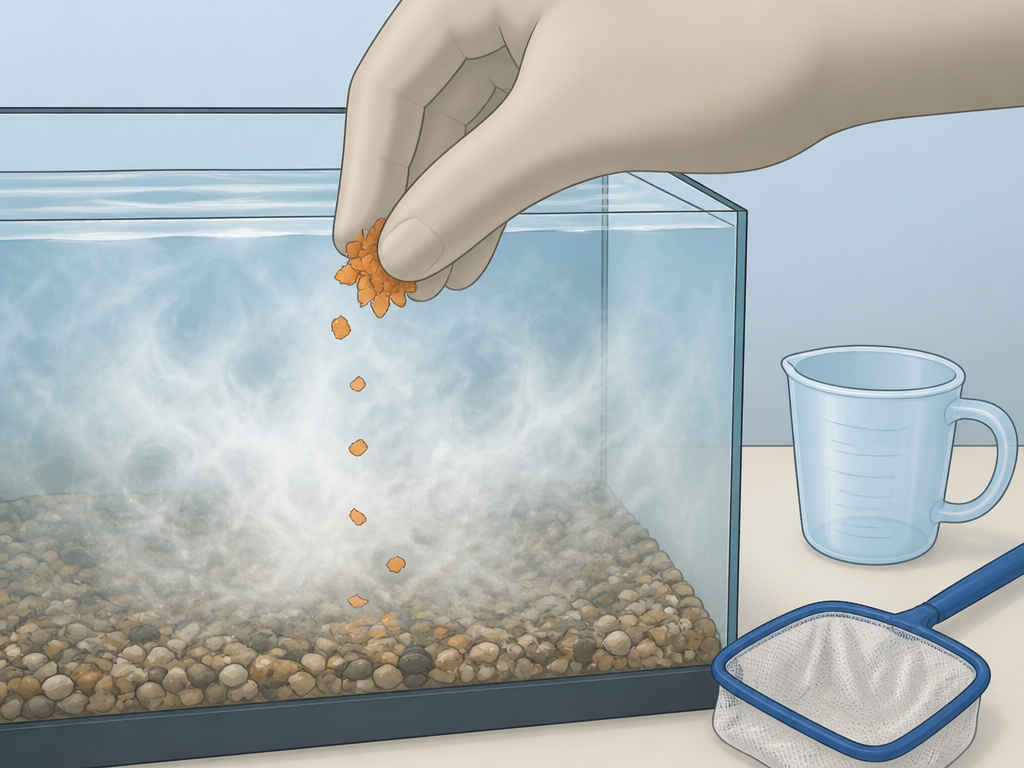
Cloudy water after a feed is almost always a portion problem, not a product problem.
Uneaten flake sinks, softens, and breaks down. The starch binder that holds the flake together is also food for bacteria, and a bacterial bloom looks exactly like milk stirred into the tank.
The fix is a routine, not a different brand.
- Net out what’s left. If flake is still floating or sitting on the substrate after three minutes, you fed too much.
- Cut the next portion by half. Then work back up until the fish clear the surface in under three minutes.
- Feed small portions, not one big dump.
If the fish don’t clear the surface in three minutes, you fed too much. Net out what’s left, and cut the next pinch in half. The tank will tell you.
Common mistake: Tapping the tin over the tank instead of measuring into a cup. The tap always drops more than you think, and the extra flake is in the water before you can stop it.
A frozen fish food rotation cuts the dry flake load without cutting nutrition.
What “Color Enhancing” Actually Means
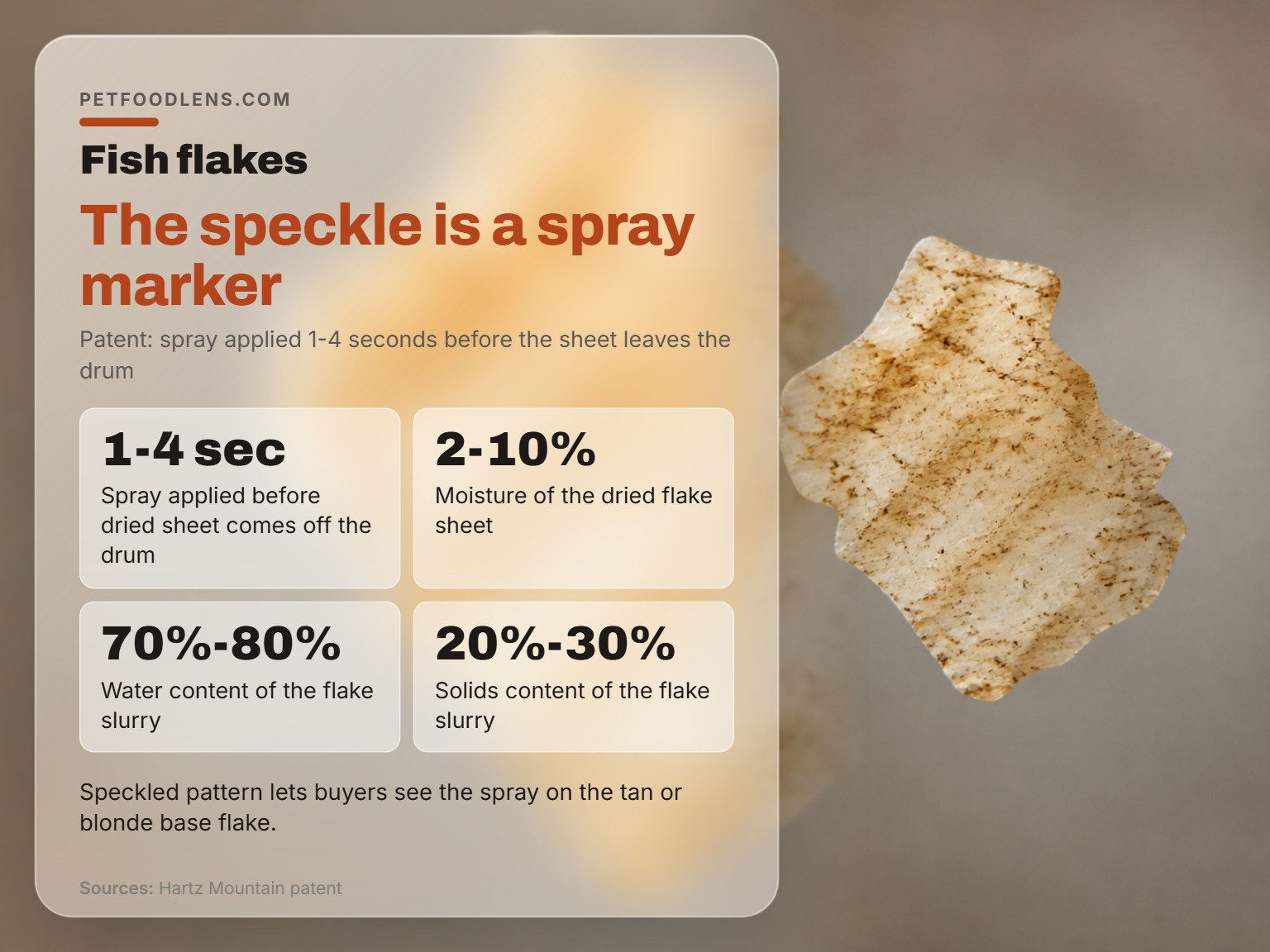
The front of the tin is the least informative part of the package, and the patent is more honest about what’s inside.
“Color enhancing” is a marketing phrase with no fixed definition. The patent shows why the flake looks the way it does. The speckled pattern exists so a buyer can see the spray against the base color. The patent says it plainly: if the buyer can see the specks, they’re more likely to believe the vitamins and carotenoids went on.
Worth knowing: the speckle is a delivery marker, not a nutrition label.
- “Premium” with no panel. If the tin doesn’t list a guaranteed analysis, put it back.
- A protein number with no moisture number. Protein means little without the moisture ceiling next to it.
- Color claims with no ingredient named. “Enhances color” tells you nothing. A named carotenoid source tells you something.
- A fish on the front and starch in the first ingredients. The front of the bag is the paint and the chrome. The panel is the engine specs.
Not one used it. Fish food runs the same play with “supports” and “promotes.”
Some spirulina flakes do name their pigment source, which is the exception rather than the rule.
A varied fish diet does more for color than any single enhanced flake, because the pigment has to come from somewhere.
Freeze-dried fish food sidesteps the starch binder entirely, which is why some keepers rotate it in.
How Long Do Fish Flakes Last?
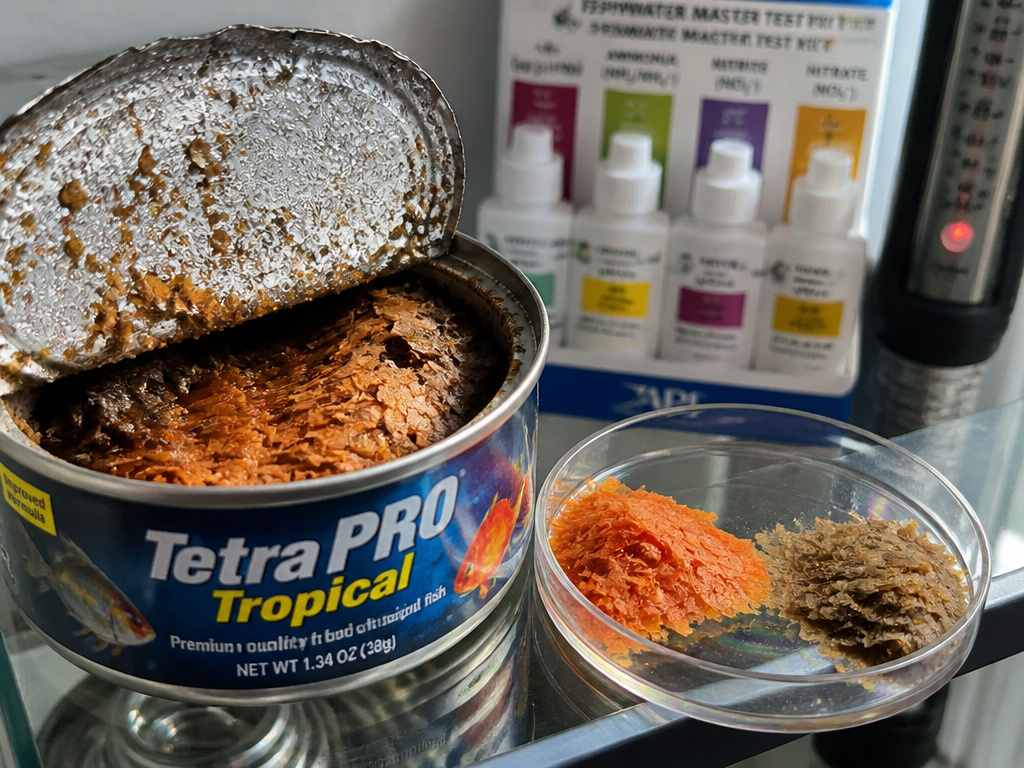
You open the tin in March, feed half of it, and find it in September behind the test kit.
Flake is a dry product, but it isn’t sealed against humidity.
That’s the minimum.
The moisture problem
Flake absorbs water from the air every time you open the tin. Once the flake picks up moisture, the vitamins that were sprayed on the surface have a shorter window, and the flake starts to smell like old cooking oil.
That smell is the tell. Fresh flake smells faintly of fish meal. Stale flake smells flat and slightly rancid.
That’s a food-science result rather than an aquarium one, but the mechanism carries over: keep moisture out and the clock runs slower. You can read the fish flake shelf-life research directly.
Easy to miss: A tin stored next to a window or a heater cycles through warm and cool air every day. Condensation forms inside the lid, and the flake picks it up.
Frequently Asked Questions
Are fish flakes bad for fish?
No. Flakes are a legitimate staple for community tanks. The problems come from overfeeding and from buying a tin with no guaranteed analysis, not from the format itself.
Can I feed only flakes?
For a mixed community tank, yes, with a caveat. A single flake is a complete diet on paper, but rotating in a frozen or freeze-dried food covers the gaps a single manufacturer’s formula leaves.
How much should I feed?
Feed only what the fish completely consume within three minutes. That’s the manufacturer’s rule, and it’s the most useful sentence on the label.
Do bettas eat flakes?
They will, but portion control is harder. A single betta does better on a pellet you can count, with flake as an occasional substitute rather than the base diet.
Why do my flakes sink immediately?
Some flake sinks because it’s denser, and some sinks because it’s been sitting open and picked up moisture. If a fresh tin sinks fast, the fish at the surface may not get to it before it’s gone.
How long do flakes last after opening?
There’s no fixed answer, but moisture is the enemy. Keep the lid tight, store the tin at room temperature, and replace it when it smells flat rather than faintly of fish.
The Bottom Line
The fish flakes pros and cons come down to a simple split. Flakes are the right format for a mixed community tank, a fry grow-out, or any setup where you’re feeding a group from one pinch. They’re the wrong format for a single betta in a small tank, where portion control decides water quality.
Here’s the threshold I’d use. If the fish can’t clear the surface in three minutes, the portion is wrong, and no brand change fixes that. Cut the pinch in half and work back up.
One concession: this whole read assumes a tin with a full guaranteed analysis on the back. A tin without one isn’t worth the comparison, because you have nothing to compare.
And if you keep one fish in one small tank, skip the flake entirely. Buy a pellet you can count. The fish will eat it, the filter will thank you, and you’ll stop guessing.
