
Spirulina Fish Food Pros and Cons: What the Numbers Say
This post contains affiliate links. As an Amazon Associate, we earn from qualifying purchases.
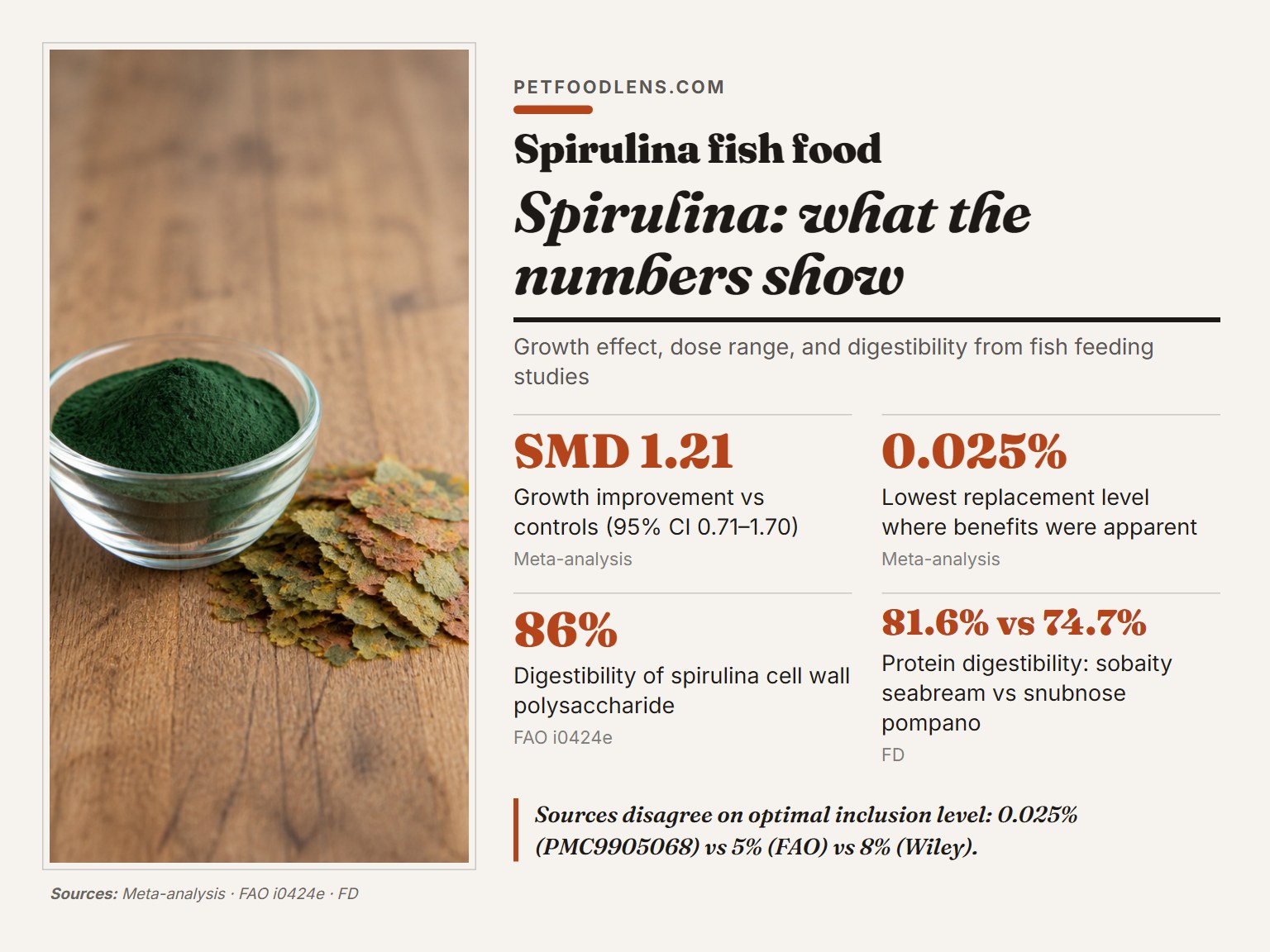
The spirulina fish food pros and cons split on dose and species. A 50-study meta-analysis found Spirulina improved fish growth (SMD 1.21, 95% CI 0.71-1.70), with benefits from as little as 0.025% inclusion. It does not replace fish oil, and full replacement cut EPA in one catfish trial.
Those two numbers sit at opposite ends of the same question. The 0.025% figure is a replacement level at which the pooled analysis detected a growth effect. The catfish result came from a trial where the fatty acid profile shifted.
Between those poles, the spirulina fish food pros and cons question comes down to the inclusion rate, which decides whether you get a growth bump, a colour change, a fatty acid loss, or nothing you can measure.
What follows walks the evidence in order: what the pooled data actually supports, which species respond, the three conflicting inclusion numbers and who published each, and the safety flag the FAO review raises that almost no consumer page mentions.
Key Takeaways
- Growth gains are real and pooled: SMD 1.21 across 50 studies, 26 species, and 144 comparisons, with a confidence interval that excludes zero.
- The omega-3 claim is weaker than the marketing: Schizochytrium’s SMD of 0.62 carries a confidence interval from -0.51 to 1.76, which crosses zero.
- Species sets the ceiling: 5% for barramundi, 8% (52.8 g/kg) in one trout trial, detectable benefit at 0.025% in the pooled analysis.
- Spirulina is a protein source, not an oil: the meta-analysis states plainly that it cannot replace fish oil.
- Ask about species and toxin testing: the FAO review flags microcystin-LR and treats species clarification as a requirement, not a nicety.
What the Pooled Data Actually Supports
Fifty peer-reviewed studies, 26 finfish species, 144 control-versus-replacement comparisons. That is the evidence base sitting behind most of the “spirulina is great for fish” language on the shelf, and it is a genuinely large one.
Across 50 peer-reviewed studies covering 26 finfish species and 144 control-versus-replacement comparisons, Spirulina inclusion produced a standardized mean difference in growth of 1.21 (95% CI 0.71-1.70). Replacement levels as low as 0.025% produced detectable benefits. Dose-dependent effects appeared for growth but not for Schizochytrium effects on fillet omega-3 content.
Standardized mean difference is a way of stacking trials that measured growth in different units onto one scale. A value of 1.21 is a large effect. The interval around it, 0.71 to 1.70, does not touch zero, so the growth finding survives scrutiny.
Then the same paper does something most summaries skip. It reports that roughly 24-27% of the variation in effect sizes traces to fish family rather than to the ingredient.
Which means a third of the spirulina fish food pros and cons story is not about spirulina at all. It is about what you are feeding.
The authors also write that “considerable uncertainty exists on the predicted responses” and recommend feeding trials under commercially relevant conditions. Read that twice. The people who pooled the data are telling you the data was gathered in tanks that do not resemble a home aquarium or a working farm.
One more limit, stated outright: Spirulina cannot replace fish oil, because that job needs microalgae with a different nutritional profile. If you are buying spirulina to boost omega-3 in the fillet, you are buying the wrong ingredient.
For context on how this stacks against the base food you are already using, the same panel-reading logic applies to fish flakes: the first ingredient tells you more than the front of the tub.
A tub of dried spirulina has a strong, earthy smell. That is normal. It is also the reason a sealed container matters.
Does the Species in Your Tank Change the Answer?
Yes, and it changes it more than the brand on the label does. A review of Spirulina as animal feed found the ingredient impacts fish production to a lesser extent in omnivorous than in carnivorous species, which cuts directly against the blanket “superfood for fish” framing sold to hobbyists.
The pooled meta-analysis complicates that slightly. It reports that most Schizochytrium results (65%) came from carnivorous species, with Atlantic salmon at 21% of studies and red drum at 14%, and that Spirulina improved growth overall across the whole dataset.
Both findings can be true at once. Spirulina helps broadly, and it helps carnivores more.
The cleaner evidence for species effects comes from a 2025 digestibility trial that fed the same Spirulina to two marine species and measured what actually got absorbed. Ingredient protein digestibility came out at 81.6% for sobaity seabream and 74.7% for snubnose pompano. Same ingredient. Seven points of difference.
Where this goes sideways: Treating a digestibility figure from one species as universal. A number measured in seabream tells you nothing reliable about a pompano, and neither tells you much about a betta.
That trial also tested palatability, which is the objection most often raised against spirulina. Average feed intake showed no significant difference between the basal and test diets in either species. The fish ate it.
The full Spirulina digestibility pompano study used fish weighing 706.2 plus or minus 121.2 g and 200 plus or minus 50.2 g, fed for 15 days before fecal collection. Small sample, short window, honest reporting.
For the broader review that supplies the omnivore caveat, the Spirulina as animal feed review is worth reading in full rather than in brief.
The Inclusion Level Problem: Three Numbers, Three Answers
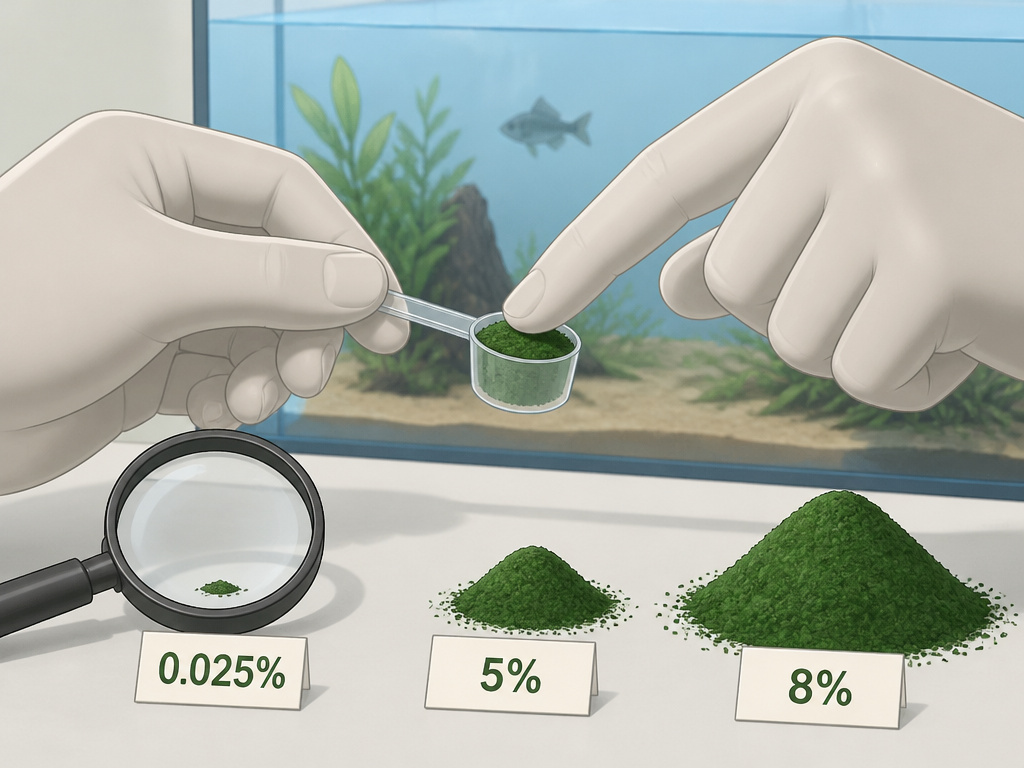
Ask three research groups for the right inclusion rate and you get three numbers that do not reconcile. This is the single most useful thing to understand before you buy anything.
The pooled meta-analysis found benefits at replacement levels as low as 0.025%, which is essentially a dusting. The FAO review recommends 5% for commercial barramundi, because survival declined significantly above that level. And one trial in Caspian brown trout juveniles put the optimum at 8%, or 52.8 g/kg.
| Inclusion level | Species or context | Who published it | Caveat |
|---|---|---|---|
| 0.025% | Pooled across 26 finfish species | Meta-analysis, 50 studies | Lowest level with a detectable effect |
| 5% | Barramundi, commercial setting | FAO review | Survival fell significantly above 5% |
| 8% (52.8 g/kg) | Caspian brown trout juveniles | Single trout trial | One species, one trial, small fish |
Three numbers, three different questions being answered. The 0.025% figure answers “what is the minimum that shows up in a pooled statistic.” The 5% figure answers “what is safe at commercial scale for one species.” The 8% figure answers “what optimised growth in one laboratory population.”
None of them answers “what should I put in my tank.”
Here is the part the front of the tub will not tell you. There is no single correct inclusion rate, because the correct rate depends on species, life stage, and what the spirulina is replacing. Anyone quoting one number as universal is quoting a study title, not a finding.
Common mistake: Reading “beneficial at 0.025%” as “more is better.” The barramundi work found survival dropping above 5%, which is the opposite conclusion from the same ingredient.
The FAO document is a long read but the feed section is where the practical numbers live: FAO Spirulina production review.
If you want to hedge against getting the rate wrong, the simplest move is not to build a diet around one ingredient. Feeding fish a varied diet spreads the risk across formats rather than betting everything on one powder.
What Spirulina Does to Omega-3 and Fillets
The meta-analysis is blunt about one boundary: Spirulina handles protein, and Schizochytrium handles oil. They are not interchangeable, and the numbers show why.
Schizochytrium maintained fillet omega-3 content compared with fish fed fish or plant oils, at an SMD of 0.62 with a 95% confidence interval of -0.51 to 1.76. That interval crosses zero. In plain terms, the maintenance effect is not statistically proven.
The meta-analysis also found no dose-dependent relationship for Schizochytrium on omega-3 content. Adding more did not reliably add more.
Then there is the catfish result, which points the other way. In a total fishmeal replacement catfish trial, full substitution produced significantly lower EPA (C20:5n3, p < 0.001) alongside higher C16:0 and C18:2n6 and lower C24:0.
So one analysis says omega-3 is maintained but cannot prove it, and one trial says EPA dropped measurably. Both are in the literature. Neither is wrong.
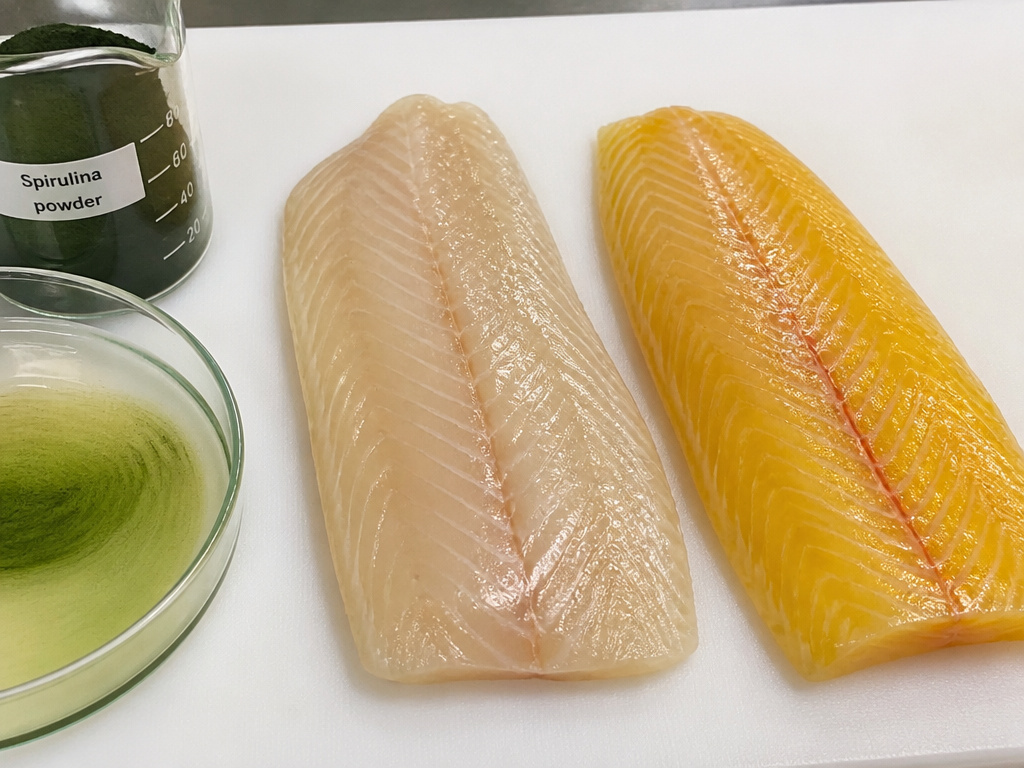
The same catfish trial recorded a more intense yellow skin and fillet colour at full replacement (p < 0.001). That is the trade hobbyists rarely hear about: the colour improvement and the EPA loss came from the same feeding regime.
If colour is the goal, there are more targeted routes than pushing spirulina to 100%. Color-enhancing fish food covers the pigment sources that do that job directly.
The visual tell is easy to spot in a tank. A spirulina-heavy feed can leave a green tint, and the water may carry a faint green cast under white light. That is pigment passing through, not pigment being retained.
The Safety Flag Almost Nobody Mentions
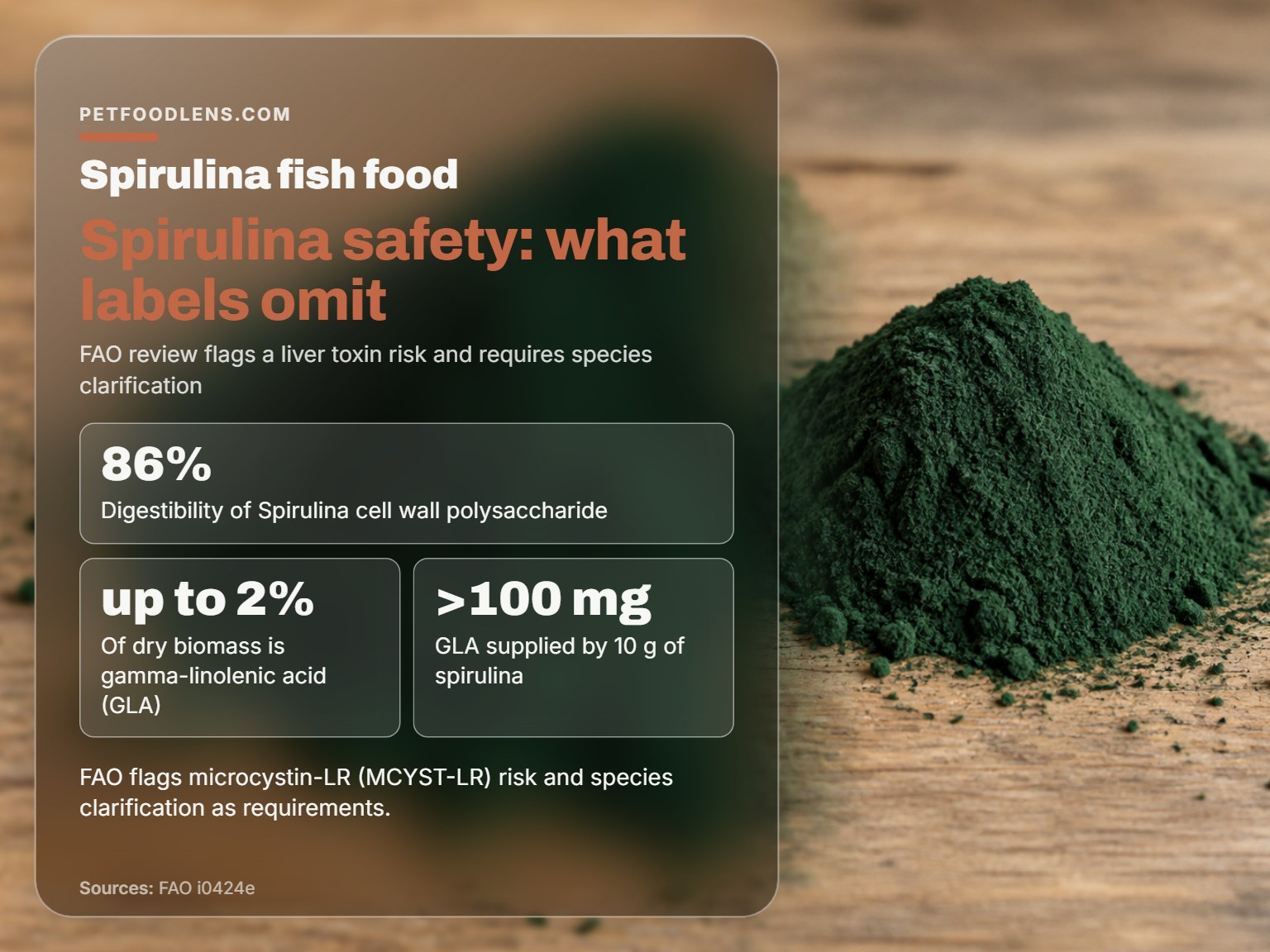
The FAO review raises a hazard that no bag on the shelf will mention: microcystin-LR (MCYST-LR) as a food-safety risk, alongside a requirement that the species be clarified.
Microcystin-LR is a liver toxin produced by some cyanobacteria that can contaminate Spirulina cultures. Species clarification means confirming you have Arthrospira platensis and not a lookalike grown under conditions nobody documented.
The FAO document treats both as requirements. That tells you neither is automatic.
Worth knowing before you start: A green powder with no species name is an unknown. The risk is easy to overlook.
There is a second, quieter limitation worth flagging. The meta-analysis recommends that future feeding trials run under commercially relevant conditions, which is an admission that most of the existing evidence came from controlled tanks rather than real systems.
That does not make the growth finding wrong. It makes the size of the effect uncertain in your tank specifically.
On the nutritional side, the FAO review does supply useful specifics. Spirulina’s cell wall polysaccharide has a digestibility of 86%, which is the mechanical reason the protein is available at all: no cellulose wall to break down. Spirulina platensis also carries up to 2% of dry biomass as gamma-linolenic acid, and 10 g of spirulina supplies over 100 mg of GLA.
Worth knowing. Not worth paying a premium for if protein is what you actually need.
How Spirulina Compares to Everything Else in the Drawer
Spirulina is one format among several, and the honest comparison is not spirulina versus nothing. It is spirulina versus the other things already in your cupboard.
- Spirulina flake: a dry format that degrades in water faster than a bound pellet, and the dose is easy to overshoot because it is light.
- Algae wafer: sinks and holds together, which makes it the better delivery route for bottom feeders than a floating flake.
- Frozen food: a format that supplies fatty acids that spirulina does not, with the mess and freezer space to match.
- Freeze-dried: a dry format that rehydrates fast and costs more per feeding than either.
- Homemade mix: full control over the inclusion rate, which allows you to hit a specific percentage with confidence.
For bottom feeders specifically, algae wafers do the job spirulina flake cannot: they stay on the substrate long enough to be eaten.
On the fatty acid gap, frozen fish food is the format that covers what a protein powder does not. Freeze-dried fish food sits between frozen and flake on both retention and convenience.
And if you want to control the percentage rather than guess at it, homemade fish food is the only route that allows you to weigh the spirulina instead of reading a label.
The part nobody mentions: A flake and a wafer with the same spirulina percentage may not deliver the same amount to the fish. Water stability can affect how much reaches the fish and how much dissolves into the filter.
A Practical Way to Add It Without Guessing
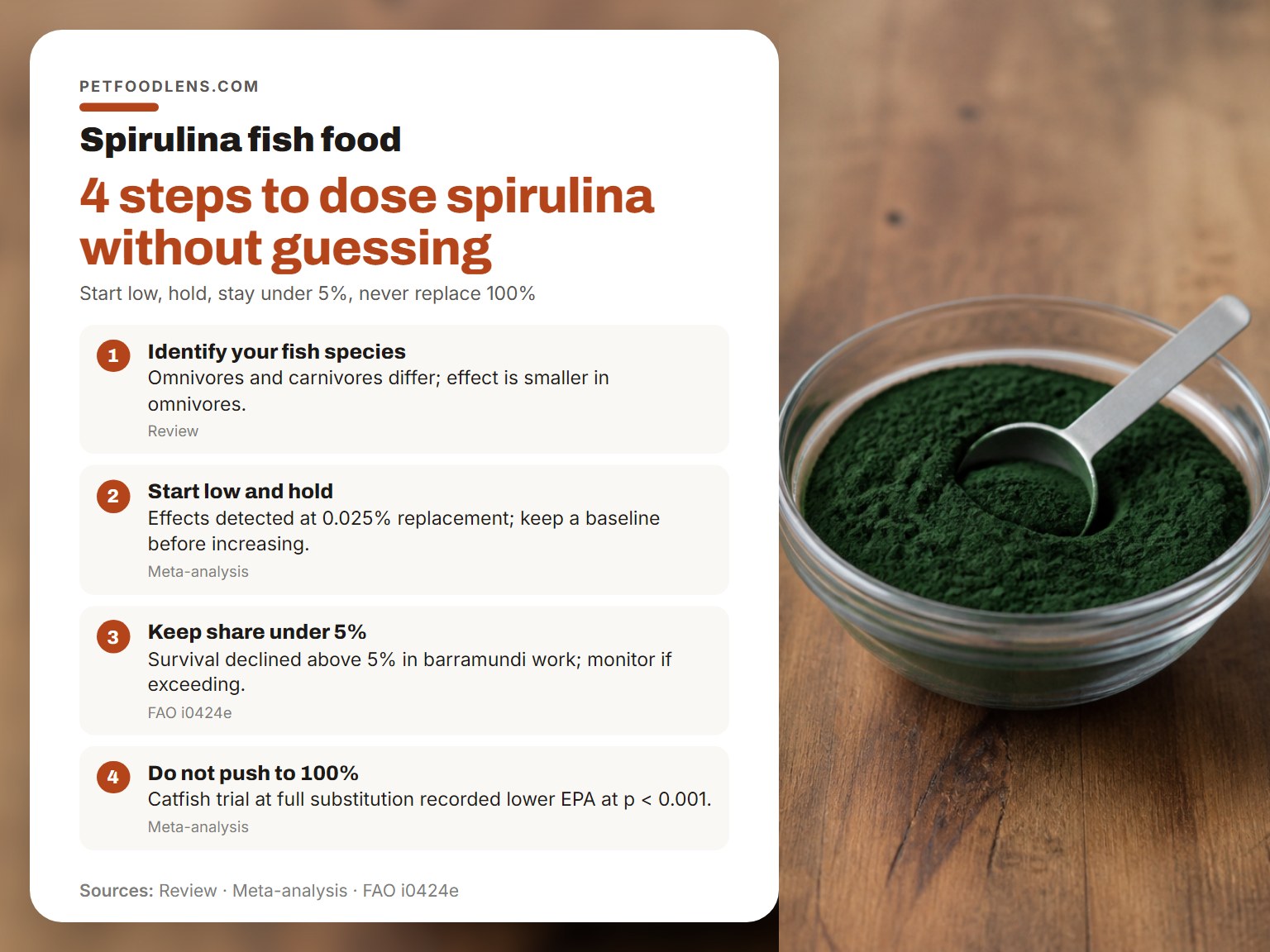
Four steps, in order. Skipping any of them is how people end up with cloudy water and no measurable benefit.
- Identify the species you keep before choosing a rate. An omnivore and a carnivore do not get the same answer, and the review evidence says the effect is smaller in omnivores than in carnivores. Skip this and you are dosing blind.
- Start at the low end and hold it before increasing. The pooled data detected effects at 0.025%, so the floor is genuinely low. Jumping to a high inclusion immediately gives you no baseline to compare against.
- Keep the spirulina share under 5% until you have a reason to go higher. The barramundi work found survival declining above 5%, a ceiling tied to a mortality outcome. Exceed it without monitoring and problems may go unnoticed.
- Do not push replacement to 100%. The catfish trial that did recorded lower EPA at p < 0.001. Full substitution is a research condition, not a feeding plan.
Easy to miss: Spirulina is a protein source. If your fish food already delivers adequate protein, adding more does not stack. It just shifts the ratio.
Frequently Asked Questions
Is spirulina good for all aquarium fish?
The evidence says it helps broadly but unevenly. The pooled meta-analysis found significant growth improvement across 26 finfish species, while a separate review found the effect is smaller in omnivores than in carnivores. Treat it as useful for most fish and clearly more useful for some.
How much spirulina should be in fish food?
Published figures range from 0.025% to 8%, and they answer different questions. The 0.025% is the lowest level with a detectable pooled effect. The 5% figure is a commercial ceiling for barramundi, above which survival declined. The 8% figure comes from a single trout trial.
Does spirulina improve fish colour?
It can. A catfish trial using total fishmeal replacement recorded significantly more intense yellow skin and fillet colour (p < 0.001). That same trial also recorded lower EPA, so the colour gain and the fatty acid loss arrived together.
Can spirulina replace fishmeal completely?
Not safely. The meta-analysis states Spirulina cannot replace fish oil, and the catfish trial that pushed replacement to 100% found lower EPA (p < 0.001) alongside the fatty acid changes. Partial replacement is the only well-supported use.
Is spirulina the same thing as algae wafers?
No. Algae wafers are a delivery format that may or may not contain spirulina. Spirulina is the ingredient. A wafer’s value depends on how much spirulina it carries and how long it holds together on the substrate.
What is the safety concern with spirulina?
The FAO review flags microcystin-LR, a liver toxin from contaminating cyanobacteria, and stresses that the species must be clarified. Both are treated as requirements in that document, which means neither is guaranteed by default.
The Bottom Line
Here is the threshold that decides it for most people. If your current food already lists a named protein and your fish are eating well, adding spirulina buys you a growth effect you may struggle to see. If your food is plant-heavy and the protein is vague, spirulina is a protein source worth considering at a low inclusion rate.
The first thing to do is not buy anything. Flip the tub you already own and look for a species name and an inclusion percentage. If neither is there, you have learned something more useful than any review could tell you.
One concession, because it matters. Everything above assumes a home aquarium with a mixed community. If you are running a commercial system, the FAO numbers and the barramundi survival ceiling apply to you directly.
I read fish food ingredients first, packaging last. The front of the tub is marketing. The panel is the specification. Show me the numbers, and the food’s composition is clearer.
