
Homemade Fish Food Guide: Moisture, Ratios, Storage
This post contains affiliate links. As an Amazon Associate, we earn from qualifying purchases.
A homemade fish food guide starts with three numbers: grind ingredients to 0.4-0.6 mm, aim for 45-55% mash moisture (25-45% if you use wet ingredients like trash fish), and dry below 60°C to 10% moisture or less. Miss those and the pellet either crumbles in the water or grows mold in the bag.
Those three numbers come from the same problem. A pellet is a binding test. The grind sets how much surface area the particles expose, the moisture sets how those particles stick, and the dry-down locks the structure before anything spoils.
What follows walks the numbers in order, then covers the ingredient panel, the storage limits, and the point where a homemade fish food guide says buying a commercial food beats making your own.
Key Takeaways
- Grind to 0.4-0.6 mm. Mixed particle sizes produce an unstable pellet that breaks apart in water.
- Mash moisture is 45-55% per the ACIAR/AwF manual, but FAO puts wet pellets at 35-40%. The gap is real and it matters.
- Dry below 60°C to 10% moisture or less so heat-sensitive vitamins survive the oven.
- Freezer-stored feed is good for 6 months. A room-temperature container goes at 2 months after opening.
- Skip the plastic bag if the feed can sweat. Mold is toxic to fish and to the person handling the feed.
What Moisture Target Actually Holds a Pellet Together?
Two credible manuals give different answers, and both are right for their own process. The ACIAR/AwF farm-made feed manual targets 45-55% total moisture for a pellet and drops that to 25-45% when you use moist ingredients like trash fish or minced poultry. The FAO Practical Fish Diets chapter specifies 35-40% for wet pelleted diets, and it explains the failure on both sides: too much moisture makes the extruded material too sticky to break up for feeding, and too little reduces binding.
Mash moisture decides whether a pellet binds or smears. The ACIAR/AwF manual targets 45-55% total moisture and drops to 25-45% when moist ingredients are used. The FAO practical diets chapter specifies 35-40% for wet pellets, noting that excess moisture makes the extruded material too sticky to break up.
| Source | Target moisture | Process |
|---|---|---|
| ACIAR/AwF manual | 45-55% | Dry-ingredient mash |
| ACIAR/AwF (moist ingredients) | 25-45% | Trash fish, minced poultry |
| FAO Ch. 22 | 35-40% | Wet pelleted diets |
| Trout by-product study | ~5% final | Dried pellets |
The reason the numbers differ is that they describe different stages and different ingredient bases. A dry mash needs more added water to reach a workable dough. A mash built on wet fish waste already carries water, so the target drops. If you blend the two rules without thinking, you get a sticky paste that clogs the die.
Grind Size and Die Size: The Two Numbers That Decide Pellet Stability
The grinder setting is the first thing a homemade fish food guide warns goes wrong in a home batch. The ACIAR/AwF manual calls for a particle size of 0.4-0.6 mm, and it states plainly that dissimilar sizes result in an unstable pellet. That is the whole mechanism. Fine particles gelatinize and bind; coarse chunks sit inside the pellet like gravel and split it on contact with water.
Die size comes next. The manual lists 1, 2, or 3 mm dies and advises using the largest diameter pellet the fish will readily eat. Pellet length should roughly equal the pellet diameter, so a 2 mm die gives you pellets about 2 mm long.
Here is the sequence I would follow for a first batch:
- Grind every dry ingredient to 0.4-0.6 mm. Run the coarse bits through a second pass rather than accepting a mixed grind.
- Pick the die by fish size. Small-mouthed fish get the 1 mm die; larger fish get 2 or 3 mm.
- Cut pellets to length equal to the die diameter. Long pellets foul the water and the fish struggle to swallow them.
- Dry before you bag anything. Wet pellets in a sealed container are a mold culture.
The why-layer here is surface area. Smaller particles expose more starch and protein to water and heat during extrusion, and that exposure is what lets the pellet hold together as it dries. Skip the fine grind and no amount of extra moisture will rescue the batch.
Which Ingredients Belong in a Home Batch
Flip the bag over. The front of a commercial fish food is the paint and the chrome; the ingredient panel is the engine specs. You would not buy a truck because it came in a nice shade of green, and you should not buy fish food because a salmon is printed on the front.
A home batch needs three things: a protein base, a binder, and a micronutrient source.
The protein base
Fish meal is the standard. The ACIAR/AwF Fiji formulation 3 uses 82.0% fish meal at 52% crude protein with 16.5% rice pollard and 1.5% vitamin/mineral premix. For a home batch, fish meal plus a plant protein like soybean meal is the usual build. Soybean grain needs proper processing to remove anti-nutritional factors, which is why the WorldFish manual flags it as a step you cannot skip.
The binder
Cooked starch and fresh animal tissue are the natural binders the FAO chapter names. Beef heart has traditionally been used as both a protein source and an effective binder in farm-made feeds, per UF/IFAS Circular 97. Wheat flour and rice bran also help the pellet hold.
The micronutrients
Pre-blend the vitamin/mineral premix into about 10% of the batch first, then mix that into the whole batch. The ACIAR/AwF manual mandates this step; UF/IFAS and the American Samoa recipe give no pre-blending instruction, which is one of the places the sources part ways. Vitamin C is the one to watch. The ACIAR manual notes that many vitamins, especially ascorbic acid, are easily damaged by heat, light, and humidity.
What most people get wrong: Tossing the premix in dry at the end. It clumps, half the batch gets none, and the fish that eat the unfortified pellets show the deficiency first.
If you want the wider menu before you commit to a recipe, the range of types of aquarium fish food covers pellets, flakes, gel, and live options. A varied diet is worth building toward, because the Merck Veterinary Manual notes that feeding a single type of food is rarely complete or balanced.
Drying and Storage: The Limits That Keep Feed From Going Toxic
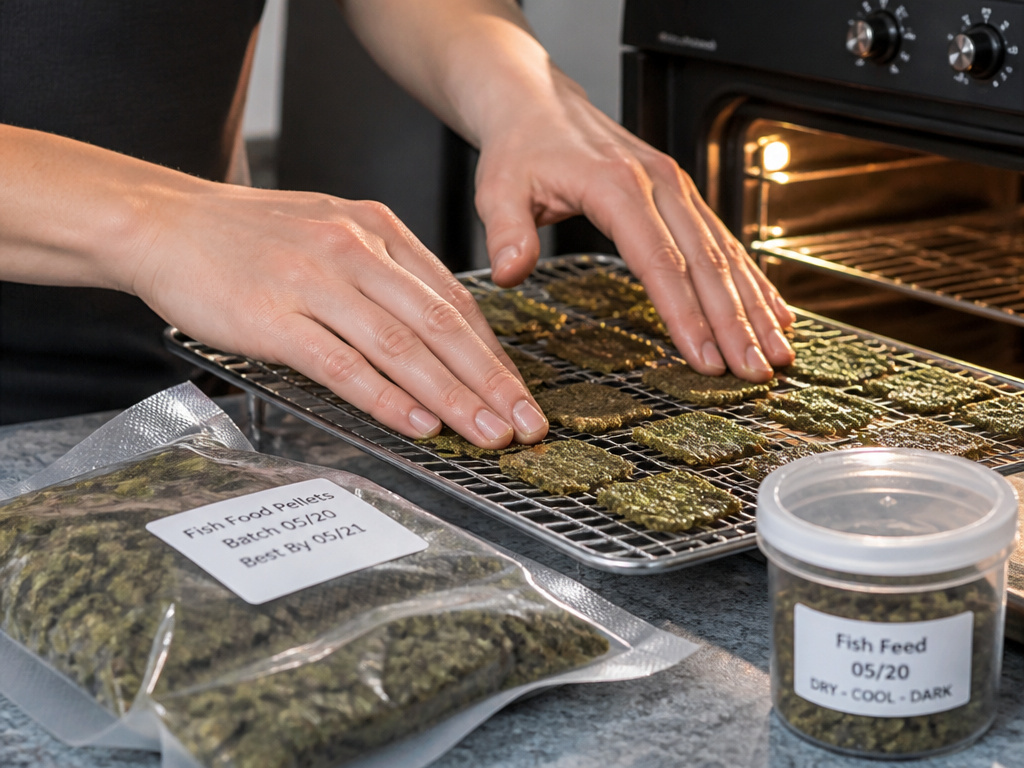
Drying is where a batch turns into a bad one. The ACIAR/AwF manual says to dry pellets to 10% moisture or less and to dry below 60°C to preserve heat-sensitive vitamins. A fan-forced oven or a solar dryer works. The University of Wisconsin trout by-product study dried pellets to approximately 5% moisture in a conventional oven for 45 to 49 minutes, which is a useful benchmark for how fast a thin pellet actually dries.
Before you start: Raw fish by-products can carry aerobic loads of 6.7×10^5 to 5.7×10^6 CFU/g, so keep raw material cold and wash tools with 70-80% ethyl alcohol for 10-30 minutes. Never mix dry feed with water hotter than 92°C. And treat any mold on finished feed as toxic to both fish and humans, not as something to brush off.
Storage is where the sources genuinely disagree, and you should see both positions rather than one rule sold as universal.
| Feed type | Limit | Source |
|---|---|---|
| Room-temperature container | 2 months after opening | Merck Veterinary Manual |
| Freezer-stored commercial feed | 6 months | Merck / UF/IFAS |
| Dried larval feed (refrigerated) | 3 months, do not freeze | UF/IFAS Circular 97 |
| Frozen brine shrimp or bloodworms | 1 year, do not refreeze | Merck Veterinary Manual |
| Vitamin mix stock | Turn over every 6 months | ACIAR/AwF manual |
UF/IFAS endorses freezer bags and vacuum sealing for storage. The ACIAR/AwF manual says to avoid plastic bags because feeds can sweat, which encourages mold growth. Both are describing real conditions: a vacuum-sealed bag in a freezer is a different regime than a tied-off bag on a shelf. Match the container to the storage, and do not merge the two rules.
For a deeper walk through the container and shelf-life side, the fish food storage breakdown covers the practical setup.
Why Homemade Fish Food Spoils Faster Than You Think
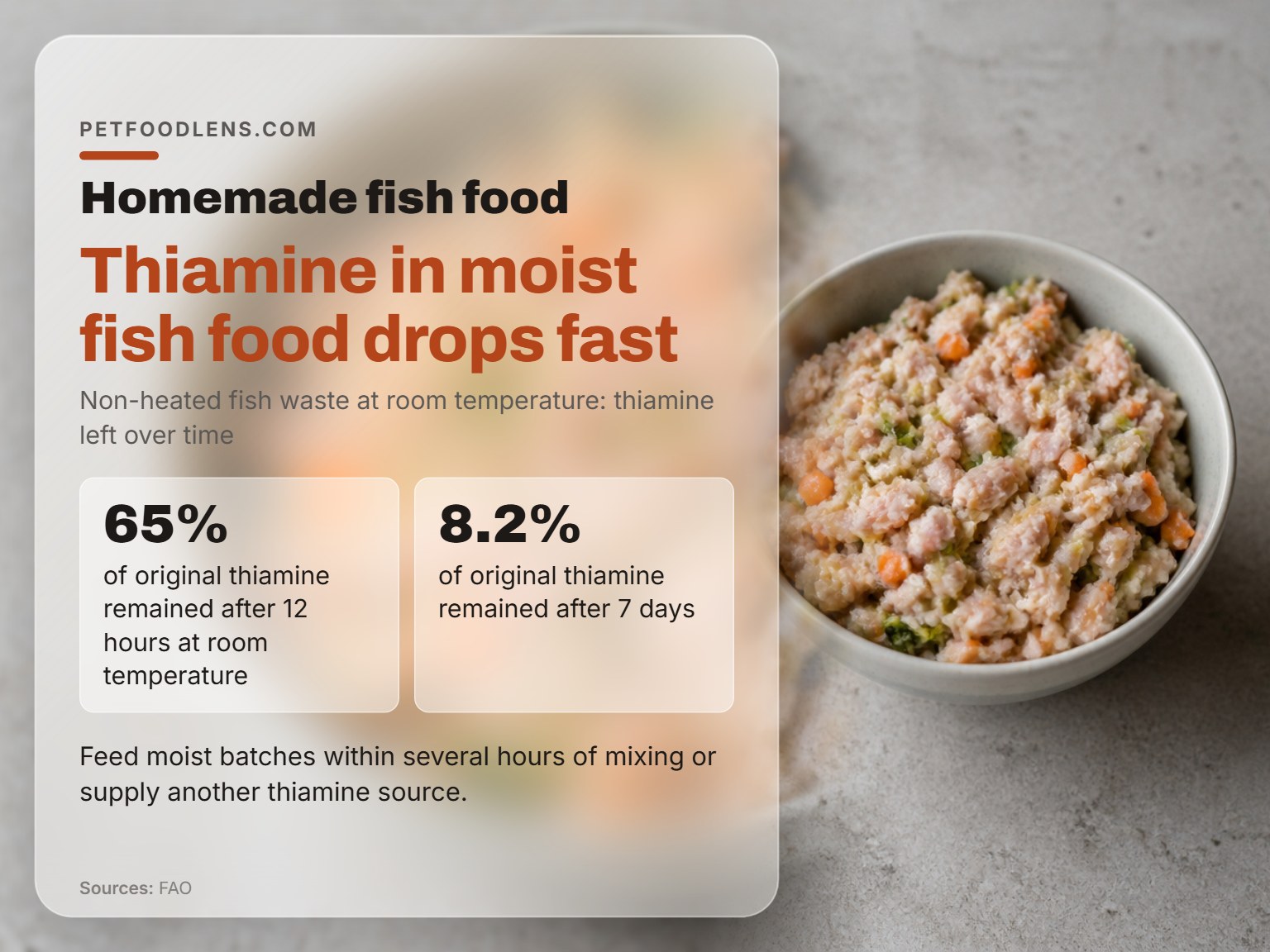
Moist food made with non-heated fish waste loses thiamine fast. The FAO chapter measured it: 65% of the original thiamine remained after 12 hours at room temperature, and 8.2% remained after 7 days. That is the mechanism behind the “feed it fresh” advice. If you store a moist batch, you have to supply another thiamine source or accept the loss.
Rancidity is the second clock. Fish oil should only be bought with antioxidants added at manufacture, and the ACIAR manual names ethoxyquin, BHA, and BHT as the standard ones. UF/IFAS gives the dosing: BHA or BHT at 0.005% of dry weight of the diet or no more than 0.02% of the fat content, and ethoxyquin at 150 mg/kg of the diet. Myocurb is named as a mold inhibitor. In tropical conditions, compounded feeds must be used quickly because heat accelerates heat-labile vitamin loss and lipid rancidity.
The part nobody mentions: A bag that smells faintly of old paint or crayons has already gone rancid. The fish may still eat it. That does not mean it is doing them any good.
If you are storing a moist batch, the homemade food storage guide covers freezing and portioning, and the cloudy water piece explains why a crumbly homemade pellet fouls a tank faster than a dense commercial one.
When You Should Skip Homemade and Buy a Commercial Food
Here is the honest limit. The Merck Veterinary Manual states that nutritional requirements are known for only a handful of fish species, and it warns that it is dangerous to assume what suits one fish suits a similar but unrelated fish. A home batch built on a farm manual is a reasonable starting point, not a precision formula for your particular fish.
I have reviewed a lot of homemade pet food recipes over the years, and most of the ones that crossed my desk were missing something or had it out of balance. Homemade fish food has the same problem, only more so, because the requirement data is thinner.
Skip this if: You keep a mixed community tank. The Merck manual notes that several types of feed items may be required to meet the needs of different species, and one homemade pellet will not cover a surface feeder, a mid-water fish, and a bottom-dweller at once.
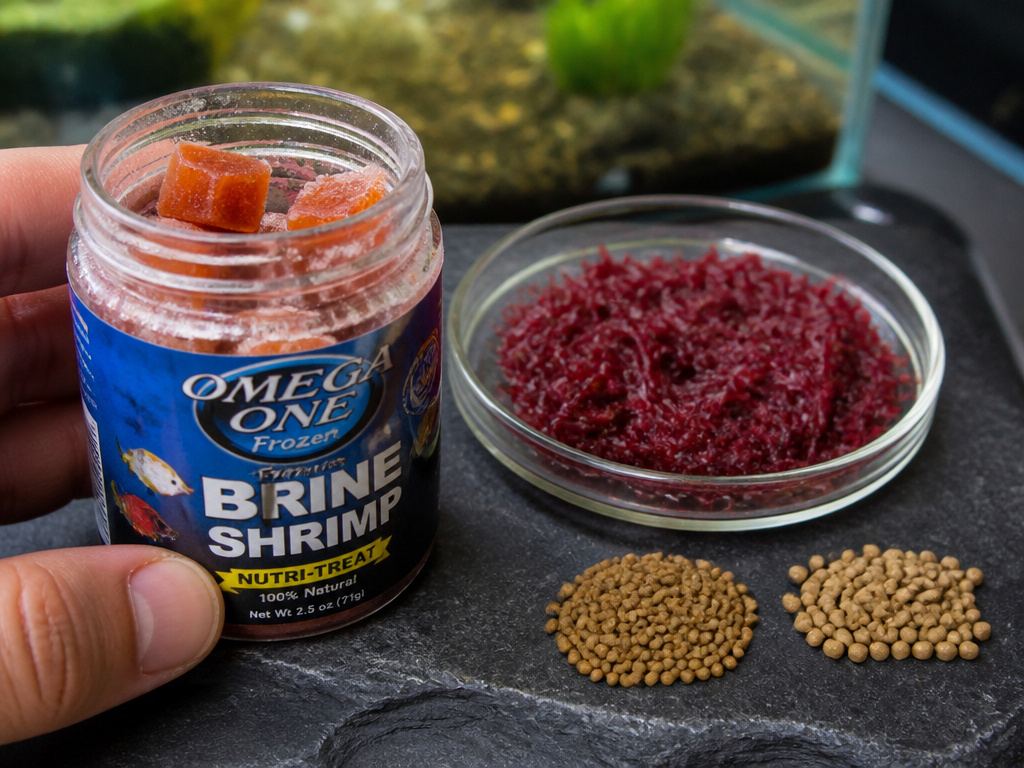
When a commercial food is the better call, reach for a named one. Commercial frozen feeds such as brine shrimp and bloodworms are a reliable protein supplement, and they are the kind of frozen feed Merck says to discard after 1 year and never refreeze. Sinking and floating pellets match feeding position, which matters because surface feeders need floating feed and bottom-dwellers need items that sink fast. For fry, a dedicated fry food is easier to control than a crumbled adult pellet.
Common mistake: Feeding a bottom-dweller like a Corydoras on leftovers. The Merck manual is direct that loricariids and Corydoras should receive targeted feeding, not survive on what the other fish miss.
Feeding quantity is its own number. Merck puts adult maintenance at 3% of body weight daily, and fry and fingerlings at up to 5%. Most aquarium fish should be fed at least daily, except carnivorous fish that take large meals, which may be fed once or twice a week.
Frequently Asked Questions
Can I make fish food without a pelleting machine?
It depends on the source: the FAO Practical Fish Diets chapter states that a pelleting machine is not needed and a food grinder will suffice, while the ACIAR/AwF manual recommends passing the mash through a mincer with a 1, 2, or 3 mm die. The ACIAR/AwF manual still recommends passing the mash through a mincer with a 1, 2, or 3 mm die, so a grinder with the right plate gets you most of the way there.
How much homemade food should I feed my fish?
Merck puts adult maintenance at 3% of body weight daily, with fry and fingerlings up to 5%. Weigh a portion once, then feed by eye against that benchmark. Overfeeding fouls the water faster than any ingredient choice will.
How long does homemade fish food last?
Room-temperature container should be discarded 2 months after opening, per Merck. Freezer-stored feed goes at 6 months. Moist batches made with non-heated fish waste lose most of their thiamine within days, so feed those fresh.
Is homemade fish food better than commercial food?
Not automatically. The Merck manual notes that requirements are known for only a handful of species, and a single-ingredient diet is rarely complete. A homemade batch built to a documented formulation can work; a random blend of scraps usually will not.
Why did my homemade pellets crumble in the water?
Usually the grind or the moisture. The ACIAR/AwF manual ties an unstable pellet to dissimilar particle sizes, and it sets the grind at 0.4-0.6 mm. Too little moisture also reduces binding, which is the failure the FAO chapter describes.
The Bottom Line
If you take one number away, take the grind: 0.4-0.6 mm, no coarse chunks. That single spec does more for pellet stability than any additive you can buy. Get the grind right and the moisture target becomes a dial you can tune; get it wrong and no moisture level saves the batch.
My honest advice for a first attempt: make a small batch, dry it hard below 60°C, and store it in the freezer rather than a bag on the shelf. If the fish ignore it or the water clouds within an hour, the problem is almost always the bind, not the fish being picky.
And if you keep a mixed tank or a fish with known health issues, buy a commercial food and supplement with frozen feed. A homemade recipe is a project, not a shortcut, and the fish do not grade you on effort.
