
Types of Aquarium Fish Food: Six Forms and Who They Feed
This post contains affiliate links. As an Amazon Associate, we earn from qualifying purchases.
Types of aquarium fish food fall into six practical forms: flakes, pellets, frozen, freeze-dried, live, and gel foods. The form decides how fast the food sinks, how much your fish can physically eat, and how long the tin stays usable after opening. Match the form to the fish first, then read the label.
Sinking rate decides who gets fed. A flake that rides the surface feeds the danios and leaves the Corydoras working the sand underneath. A slow-sinking pellet crosses all three levels of the tank on the way down, which is why most setups end up running two forms instead of hunting for one perfect one.
What follows is the form-by-form breakdown, the pellet sizes the manufacturers actually print on the tin, and the storage numbers that Merck, UF/IFAS, and the brands do not agree on. You’ll be able to pick a food off the shelf with confidence.
Key Takeaways
- Form beats brand. A flake and a pellet with the same protein number behave nothing alike in water, so pick the form that reaches your fish’s mouth first.
- Pellet size follows ease of ingestion, per UF/IFAS FA159, not how wide the fish can open its mouth.
- The daily ration is genuinely disputed. Merck says 3% of body weight, UF/IFAS FA096 says 0.5-1.0%, and ICAR-CMFRI uses 2-3%.
- Opened dry food runs on a short clock. Merck says discard at 2 months at room temperature; UF/IFAS FA096 says never keep feed more than 3 months.
- Never refreeze thawed frozen food, and do not refrigerate dry pellets, per UF/IFAS FA096.
What Counts as a Complete Diet for Aquarium Fish?
Four properties decide whether a product is a complete ration or a garnish: balance, palatability, water stability, and size.
FA097 defines a complete fish diet by four properties: nutritionally balanced, palatable to the target species, water stable enough to hold shape until eaten, and correctly sized and textured for the fish’s mouth. Fail any one of those four properties and the product is a supplement rather than a complete ration.
That definition matters because plenty of foods sold as staples clear only two or three of the four. UF/IFAS FA097 is blunt about the underlying problem: with few exceptions, feeding a single food is neither complete nor balanced, and two or more ingredients should be mixed into a formulation. preparing your own fish feeds walks through what that looks like in practice.
There’s a second constraint that gets less attention. The Merck Veterinary Manual points out that nutritional requirements are known for only a handful of fish species, so any claim that one food suits everything in your tank is a marketing position rather than a nutritional one. UF/IFAS FA159 says the same thing: no single feed suits all species, and food should be chosen with the fish’s developmental stage in mind.
Labels are the one place you can check any of this. All imported fish foods are required to carry nutrition labeling unless the manufacturer, packer, or distributor meets specified FDA exemptions, so interpreting fish food labels is a skill worth having before you spend anything.
The Six Types of Aquarium Fish Food and Who Each One Feeds
Most tanks need two forms, not six.
That’s an observation about how feeding works in a glass box with fish occupying three different depths and three different feeding styles. Here’s the shorthand version before the detail:
| Form | Best For | Main Limitation |
|---|---|---|
| Flakes | Top and mid-water feeders | Too large for small mouths; messy for big cichlids |
| Pellets | A complete daily ration | Sinks fast unless extruded |
| Granules | Small fish and juveniles | Tiny sizes only suit tiny mouths |
| Frozen | Large meals for carnivores | Cannot be refrozen after thawing |
| Live | Larvae and finicky species | Parasite and disease risk |
| Gel | Bottom feeders and grazers | Placed by hand, not broadcast |
Flakes: Universal on Paper, Awkward in Practice
Tropical calls flakes the most universal form and suitable for fish living in all parts of the reservoir. Merck Veterinary Manual disagrees on the edges, and both are describing the same product.
The Merck objection is mechanical. Flaked feed may be too large for a small-mouthed fish to ingest easily, which is why the manual suggests crushing flakes for those fish. At the other end, feeding flakes to a large cichlid like an oscar produces a messy tank, because a big fish can’t take in enough flake volume to meet its requirements.
UF/IFAS FA096 adds the detail that catches people out. Flakes are soft enough for very small fish and they sink very slowly, but the volume needed to meet nutritional needs may be deceptively high. The recommendation is to weigh the diet rather than eyeball it, which is the difference between feeding your fish and sprinkling your tank.
Watch a flake that nobody eats. It breaks down at the surface, and that is food you paid for.
If you want the full comparison, flakes vs pellets covers the trade-off in more depth.
Pellets and Granules: The Most Complete Form, If They Sink Right
Pellets are typically the most complete diets on the shelf, per UF/IFAS FA096. The catch is sink rate. A standard pellet drops fast unless it’s extruded, and a fast drop means the surface feeders never see it.
Extrusion is the fix, and it’s why “slow-sinking” shows up on so many labels. ICAR-CMFRI produces its marine ornamental pellets through twin-screw extrusion specifically to get that slow sink.
Size is where the brands separate. Tropical’s granule line runs 1.4-6.0 mm for standard granules, 0.8-1.2 mm for mini, and 0.5-0.7 mm for micro, with pellets at 3.5 mm (size S) and 5-6 mm (size M).
Ocean Nutrition’s Formula Two Pellets come in roughly 1.2 mm, 3.1 mm, and 8 mm. Hikari Cichlid Staple runs 1.7-2.0 mm at Baby, 3.0-3.4 mm at Mini, 5.0-5.5 mm at Medium, and 7.2-8.2 mm at Large.
For a community tank with mid-water fish, Ocean Nutrition Formula Two Pellets are one option. They’re soft, moist, and slow-sinking, and the size steps map to fish length in a way you can check against your own stock. Formula Two pellets are described as soft and moist, while Hikari Cichlid Staple is a dry stick.
If you keep cichlids, Hikari Cichlid Staple is one option, and the four pellet sizes let you match the fish you actually have.
The bottom half of the water column has its own set of trade-offs, covered under sinking pellets.
Frozen and Freeze-Dried: Convenience With a Thaw Rule
Merck gives frozen feeds a specific clock: commercial frozen brine shrimp, bloodworms, mysids, and glassworms should be discarded after 1 year. Thawed frozen feed should not be refrozen.
That single rule helps prevent tank problems. A thawed cube should not go back in the freezer.
freeze-dried fish food sits in a different category, and live food vs frozen food covers where the two overlap.
Live Food: Best Nutrition, Biggest Biosecurity Risk
Live food does something no dry product replicates. UF/IFAS FA096 notes that cultured live foods can provide high-quality nutrition, but care must be taken to avoid perpetuating infectious disease, and wild-caught items carry the same risk through disease introduction.
Size matters for larvae. Rotifers, copepods, and ciliates are among the smallest live feeds used routinely in larval rearing, with newly hatched brine shrimp larger but still quite small.
Maslanka, writing for the National Aquarium industry body, is firmer about the risk: when live foods are used, biosecurity measures must be in place to confirm the items are free of parasites and diseases. If you can’t verify the culture, the disease risk is a real concern.
Gel Food and Algae Wafers: Where Bottom Dwellers Get Fed
Merck is direct about this one. Popular bottom-dwelling fish such as loricariids and Corydoras catfish are often expected to survive on leftovers from the other fish, and the manual calls that unacceptable. These fish should receive targeted feeding.
Gel formats and wafer formats can help with targeted feeding for bottom feeders. gel food can be placed where a bottom feeder will find it, and algae wafers do the same job for grazers.
How Do You Pick the Right Pellet Size?
A 1.2 mm pellet and an 8 mm pellet differ greatly in size, and only one of them gets eaten.
UF/IFAS FA159 gives the rule that should govern the choice: pick pellet sizes and shapes according to how easily they can be ingested, instead of how wide your fish can open its mouth. The same publication adds that shape and size should be uniform across the pack.
Ocean Nutrition takes a different route on its own product page, sizing by fish length: small pellets for fish up to four inches, medium for four to twelve inches, and XL for twelve inches and larger. Both approaches are in use, and they may not always agree.
Here’s what the brands actually print:
| Brand or Line | Sizes Available | Stated Basis |
|---|---|---|
| Ocean Nutrition Formula Two | ~1.2 mm, ~3.1 mm, ~8 mm | Fish length: up to 4 in, 4-12 in, 12+ in |
| Hikari Cichlid Staple | 1.7-2.0, 3.0-3.4, 5.0-5.5, 7.2-8.2 mm | Baby, Mini, Medium, Large |
| Tropical granules | 0.5-0.7, 0.8-1.2, 1.4-6.0 mm | Micro, mini, standard |
| Tropical pellets and sticks | 3.5 mm, 5-6 mm, 4 mm, 6 mm | Size letter and stick format |
For fry and larvae the numbers get much smaller. UF/IFAS FA096 notes that a complete ration should be nutritionally uniform in each particle down to 50 microns or less, and ICAR-CMFRI sells marine ornamental pellets at 250 microns, 750 microns, and 1.0 mm.
Common mistake: Buying one pellet size for a mixed tank and assuming the small fish will nibble at the big pellet. They won’t, and the big fish will eat all of it while the small ones lose condition.
How Much Should You Feed, and How Often?
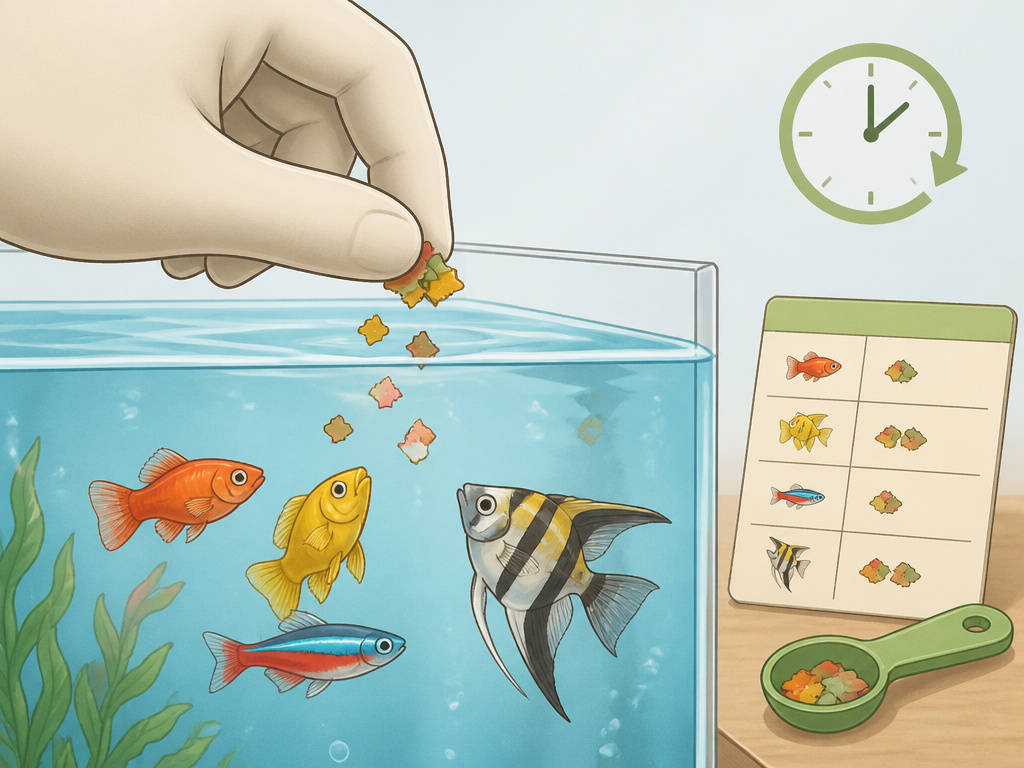
You can follow an authoritative feeding chart and still underfeed your fish.
Merck puts adult maintenance at 3% of body weight daily, with fry and fingerlings up to 5%. UF/IFAS FA096 puts maintenance at 0.5-1.0% of body weight per day. ICAR-CMFRI uses 2-3% as a thumb rule and tells you to adjust based on consumption, with no feed left over. The lower figure comes from the UF/IFAS fish nutrition guide, which also sets the storage rules covered below.
That’s a wide spread at the extremes. Start low and watch the fish rather than picking a number and defending it.
Frequency has its own spread:
- Merck: at least daily for most aquarium fish, with the exception of carnivores that take large meals, which may be fed once or twice a week.
- UF/IFAS FA096: at least 5 days per week.
- Tropical: 2-3 small portions a day, with one fasting day a week that doesn’t apply to fry.
- Ocean Nutrition: one to three times a day.
- Hikari: two to three times daily.
The consumption window is where the labels get specific. Tropical says an amount that can be eaten within 2-3 minutes. Ocean Nutrition says no more than can be eaten in five minutes. Hikari says the amount fish will completely consume in a few minutes, and to remove anything left.
Those three windows differ, so pick one and stay consistent. Pick a single window and apply it consistently.
One timing note that rarely makes it onto a label: Tropical advises feeding fish that are active at night in the evening with the lights turned off. If your nocturnal species look thin, feeding timing may be worth checking.
A varied fish diet is worth building once the quantity is right, but quantity comes first.
Storage: Why “Cool and Dry” Is the Most Misread Line on the Tin
Open a tin that’s spent a long time in a warm kitchen cupboard and the smell arrives before the label does. Rancid fish oil has a flat, acrid edge that fresh food never has.
That smell is the reason the storage advice exists. UF/IFAS FA096 explains the mechanism: fish feeds usually contain high amounts of fish meal or fish oil, which makes them very susceptible to rancidity, and ascorbic acid is highly volatile. Both degrade on a clock that starts the moment the seal breaks.
The Merck Veterinary Manual adds what happens when humidity and heat get involved: degradation of the diet, mold growth, potential mycotoxin production, and rancidity. That’s the difference between food that has lost potency and food that can make a fish sick.
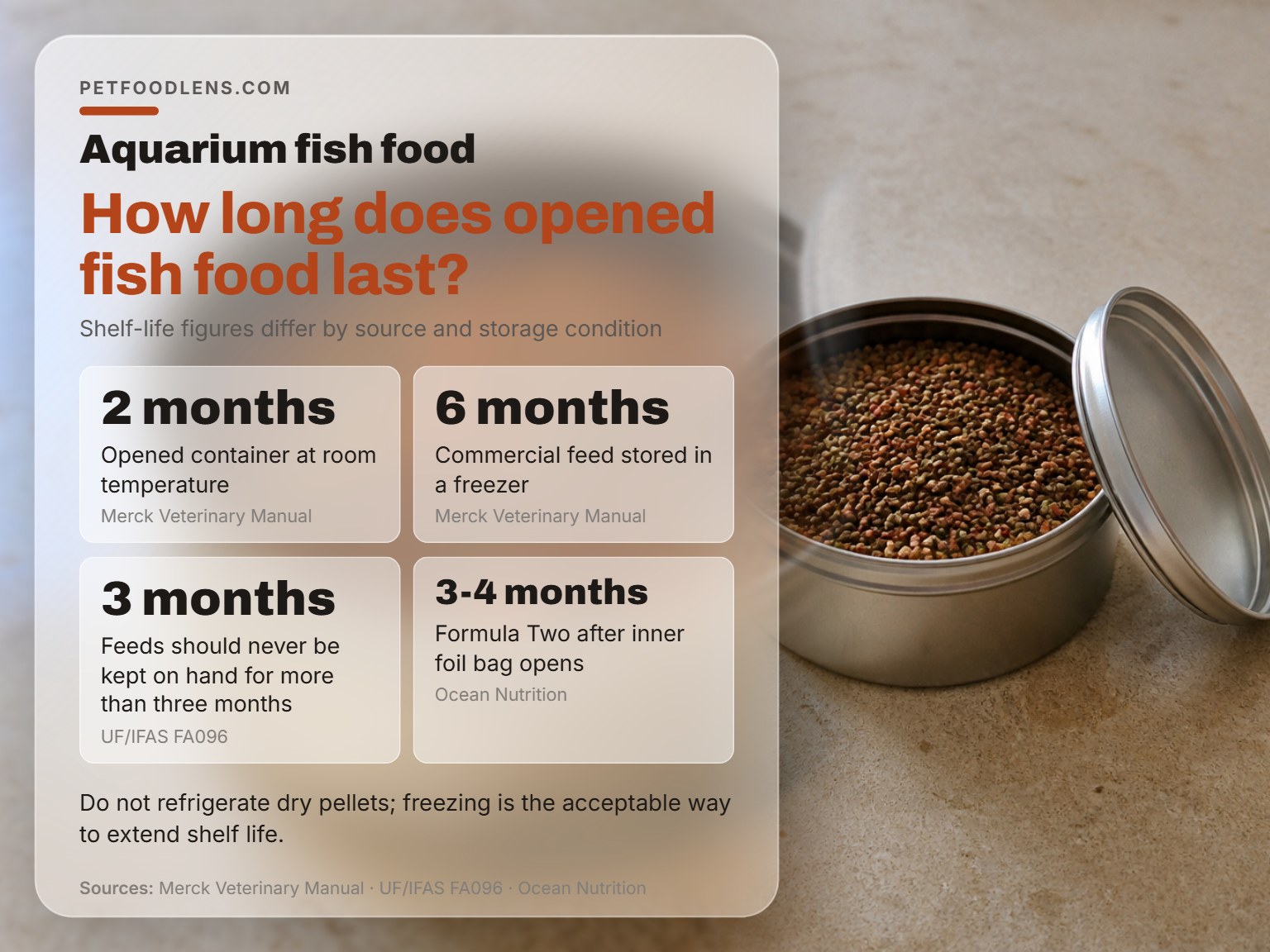
The shelf-life numbers don’t line up across sources, so here they are side by side:
| Source | Stated Storage Life | Conditions |
|---|---|---|
| Merck Veterinary Manual | 2 months | Opened container at room temperature |
| Merck Veterinary Manual | 6 months | Commercial feed stored in a freezer |
| UF/IFAS FA096 | Never more than 3 months | Any dry feed on hand |
| UF/IFAS FA159 | At least 90 days from manufacture | Dry pellets, ~13% moisture or less |
| Ocean Nutrition | 3-4 months | Formula Two after the inner foil bag opens |
| ICAR-CMFRI | 12 months | Varna and Varsha, cool and dry, out of sunlight |
| ICAR-CMFRI | 3 months | Broodstock feed at room temperature |
The refrigeration question splits the sources too. UF/IFAS FA096 says refrigeration of dry feeds is not recommended because of the high moisture content of that environment, and points to freezing as the acceptable way to extend shelf life. ICAR-CMFRI states that storing broodstock feed at 4°C in a refrigerator is preferable to preserve quality, against a 3-month room-temperature shelf life.
Where this goes sideways: Following the “keep it cool” half of the advice and putting dry pellets in the fridge. UF/IFAS FA096 specifically warns against that environment because of the moisture, and a damp pellet clumps and molds faster than one kept in a dry cupboard.
Before you start: Two hazards live in a fish food tin. Mold and mycotoxins develop in high humidity and heat, per Merck, and they are not visible on every affected pellet. Rancid oil develops from the fish meal and fish oil content, per UF/IFAS FA096, and it smells sharp and flat rather than fishy. Discard anything that fails either test, and never refreeze thawed frozen feed.
A storage routine that covers all of it:
- Write the open date on the lid. Every shelf-life figure above counts from opening or manufacture, and nobody remembers a date from four months ago.
- Keep dry food in a pest-proof container at low humidity and low temperature, which is Merck’s wording and a stricter standard than “in the cupboard.”
- Freeze what you won’t finish inside the shortest clock, since UF/IFAS FA096 lists freezing as the acceptable extension method. Merck gives freezer-stored commercial feed 6 months.
- Never refrigerate dry pellets, per UF/IFAS FA096. Refrigerate semi-moist feeds if the label asks, since UF/IFAS FA159 notes they often require it.
- Throw out thawed frozen feed rather than refreezing it. Merck is explicit on this one.
If you’re making food yourself, two temperatures matter. UF/IFAS FA097 says to avoid storing diet ingredients at or above 70°C (158°F) and not to prepare dry feeds with water hotter than 92°C (198°F), because proteins and especially vitamins are seriously affected by high heat.
What Do Bottom Feeders and Mixed Tanks Actually Need?
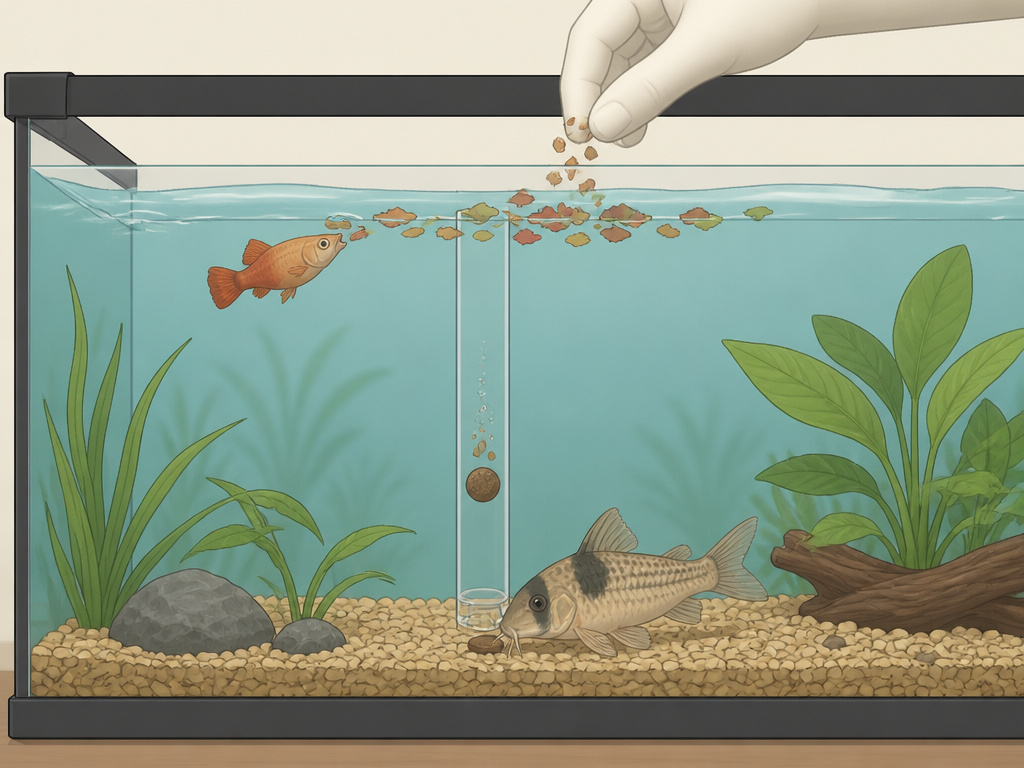
Corydoras do not live on leftovers.
Merck already said as much, and Maslanka explains why the failure is so common in a mixed tank. Animals that forage on the bottom may not have access to food broadcast on the surface, and without special provision, less aggressive bottom feeders can remain underconditioned while more aggressive top feeders take everything.
The fix is delivery. Volume rarely solves it. In systems 5 meters or deeper, Maslanka describes delivering food to the bottom through a PVC tube and venturi system, or placing it directly by a diver. In shallower systems, targeted delivery methods can help ensure quieter bottom feeders get fed.
Tropical raises a related point that’s easy to ignore: avoid introducing fish with different nutritional demands into one tank, because you cannot ensure a diet that meets the needs of herbivorous and carnivorous fish at the same time.
For a home tank, that translates into a short list:
- Feed the bottom deliberately, with a sinking pellet or a wafer placed where the bottom feeders actually work.
- Feed the top separately, so surface feeders don’t clear the water column before anything sinks.
- Watch body condition by species, not by tank. A thin Corydoras alongside well-fed top feeders in the same water is a delivery problem.
Reading the Label Before You Buy
The guaranteed analysis is the part of the package with a labeling rule behind it, and it’s where a comparison actually starts.
UF/IFAS FA159 notes that all imported fish foods are required to have some form of nutrition labeling unless the manufacturer, packer, or distributor meets specified FDA exemptions. The label also has to carry a description of the product and directions for proper use.
Beyond the numbers, three things on the panel are worth checking every time:
- Stabilized ascorbic acid. UF/IFAS FA096 states that ascorbic acid added to fish foods should be phosphorylated to stabilize the vitamin and increase storage time, and that feeds without stabilized ascorbic acid are not recommended for fish. Merck describes what a deficiency looks like: broken back disease, with severe scoliosis in affected fish. Hikari Cichlid Staple lists L-ascorbyl-2-polyphosphate on its panel, which is the stabilized form.
- Vitamin E, when crustacean by-products appear. UF/IFAS FA096 recommends vitamin E supplementation when crustacean by-products are used, because of their high oil content.
- Pigment sources. UF/IFAS FA097 notes that if natural foods aren’t incorporated into the diet, the feed must be supplemented with natural or synthetic pigments.
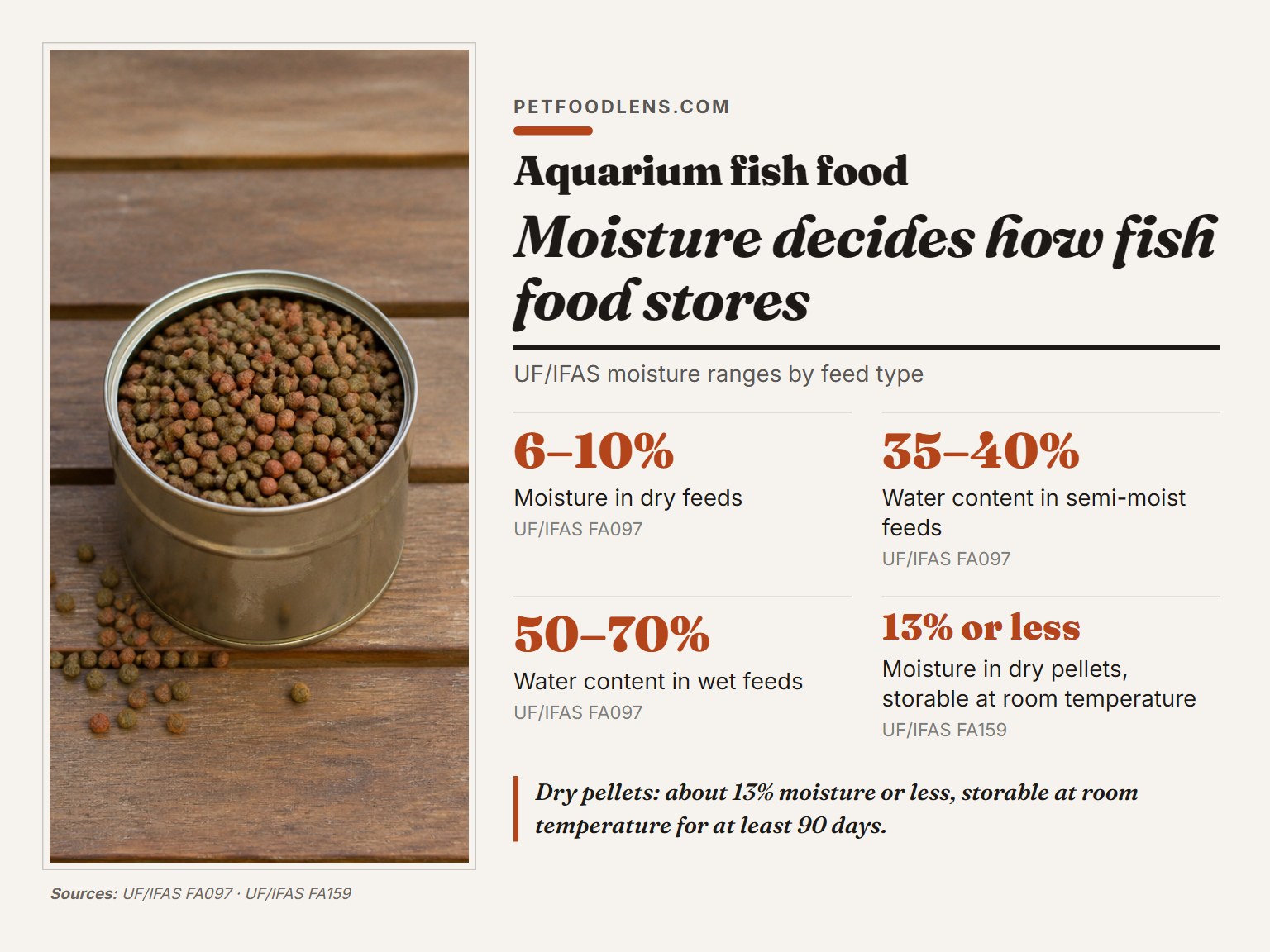
Moisture content is the number most people skip, and it changes everything downstream. UF/IFAS FA097 gives the ranges: dry feeds at 6-10% moisture, semi-moist at 35-40% water, and wet feeds at 50-70% water. UF/IFAS FA159 puts dry pellets at approximately 13% moisture or less, which is why they store at room temperature at all.
I read the ingredient list before I read the front of the tin, because that’s where a lot of the fine print hides. The front of the package is a mood. The ingredient list is the evidence.
If you want to control the formulation completely, homemade fish food is the route, and UF/IFAS FA097 lists kale, dandelion greens, parsley, and turnip greens among the relatively nutritious vegetables for ornamental fish diets.
Frequently Asked Questions
Can I feed my fish only flakes?
For a tank of small surface and mid-water feeders, flakes may be an option, though UF/IFAS FA096 recommends weighing the portion because the volume needed may be deceptively high. The problems start with small-mouthed fish, where Merck notes flakes may be too large and need crushing, and with large cichlids, where flakes produce a messy tank.
How long does opened fish food last?
It depends which source you follow. Merck says discard an opened container kept at room temperature after 2 months, UF/IFAS FA096 says never keep feed on hand more than 3 months, and Ocean Nutrition puts its Formula Two at 3-4 months after the inner foil bag is opened. Writing the open date on the lid is the only way to apply any of them.
Do I need to refrigerate dry fish food?
UF/IFAS FA096 says no, because the high moisture content of a refrigerator works against a dry feed. Freezing is the acceptable way to extend shelf life. Semi-moist feeds are the exception, since UF/IFAS FA159 notes they often require refrigeration and last less than 90 days after opening.
What size pellet should I buy?
Start with ease of ingestion, which is the rule UF/IFAS FA159 gives, rather than the width of the fish’s mouth. Manufacturer charts help as a starting point: Ocean Nutrition sizes Formula Two by fish length, with small for fish up to four inches and XL for twelve inches and up.
Can I mix different types of fish food?
Yes, and UF/IFAS FA097 suggests you probably should, since feeding a single food is rarely complete or balanced. The caution is about mixing species rather than foods: Tropical advises against keeping fish with different nutritional demands in one tank, because herbivore and carnivore diets can’t be met at the same time.
Is live food better than frozen?
Live food can provide high-quality nutrition, per UF/IFAS FA096, but both cultured and wild-caught live items carry disease and parasite risk. Maslanka is firm that biosecurity measures must confirm live foods are free of parasites and diseases before they go in the tank. Frozen avoids that risk but must never be refrozen after thawing.
The Bottom Line
Here’s the trigger I’d actually use. If the tin has been open longer than the shortest shelf-life figure you can find for that product, it’s done, regardless of how full it looks. That’s 2 months for an opened container at room temperature under Merck’s schedule, and 3 months as an outer limit under UF/IFAS FA096.
One concession worth stating plainly: none of this tells you whether a specific food suits a specific sick fish. If your fish is showing scoliosis, wasting, or a refusal to eat, that’s a veterinary question and not a label question.
For everything else, start with the form. The types of aquarium fish food worth buying are the ones that reach your fish at the depth your fish actually feeds. Buy a size you can verify against the chart on the tin, and write the date on the lid the day you open it.
Do that and the rest of the shelf stops being a guess.
