
Sinking Pellets for Fish Pros and Cons: When They Win
This post contains affiliate links. As an Amazon Associate, we earn from qualifying purchases.
Sinking pellets for fish have three measurable advantages: higher density (520-820 kg/m3 versus 350-400 for floating feed), better durability (98-99% versus 96-97%), and far less water uptake after 8 minutes (60-70% versus 140-220%). The trade-off is that you cannot see the feed, so uneaten pellets drop out of sight and rot.
Not seeing the feed is where the trouble starts, and it is the core of the sinking pellets for fish pros and cons. A floating pellet that goes untouched tells you something in ten minutes. A sinking pellet that goes untouched tells you nothing until the bottom of the pond turns sour and the water goes off.
What follows: the manufacturing reason pellets sink at all, the 174-day catfish trial that favored sinking feed on every production measure, the 75-day carp trial that went the other way, and the label lines that actually tell you which feed you’re holding.
Key Takeaways
- Density is the whole difference: 520-820 kg/m3 for sinking feed against 350-400 kg/m3 for floating, which is why one drops and one rides.
- Sinking pellets hold together better in water: 98-99% durability versus 96-97%, and 60-70% water uptake after 8 minutes versus 140-220%.
- A 174-day channel catfish trial favored sinking feed on yield, feed conversion, survival and cost, while a 75-day common carp trial favored floating feed, and OSU South Centers still calls floating feeds preferable for most applications. Species and system decide.
- Hardness is a separate question from buoyancy, and the harder failure is worse: hard pellets can rupture a stomach, soft ones fall apart and cause digestive problems.
- Feed is more than half of production cost, so a feed conversion gap of 0.4 outweighs a small difference in bag price.
What Actually Makes a Pellet Sink
Bulk density is decided at the mill. A pellet mill compacts ground feed through a die under moisture, heat and pressure, and it cannot blow the material up, so what comes out is dense and drops. That’s why shrimp and trout feeds have traditionally come off a pellet mill.
Extrusion works on a different principle. The feed is cooked rather than just compressed, and the gelatinized starch expands as it leaves the barrel. Buoyancy becomes a dial you can turn with temperature, moisture, screw profile and screw speed.
A pellet mill compacts ground feed under moisture, heat and pressure, but cannot reduce the bulk density of the raw material, so the pellet leaves the die dense and sinks. Extrusion cooks the starch under more moisture and pressure, and the expanded starch sets buoyancy. Starch level drives buoyancy: roughly 10% for a sinking feed, 20% for a floating one.
The starch figure is the one worth memorizing. Under tight process control, an extruder can go below 10% and still produce a sinking pellet.
| Property | Floating feed | Sinking feed |
|---|---|---|
| Diametric expansion | 1.2-1.6 | 0.98-1.02 |
| Apparent density | 350-400 kg/m3 | 520-820 kg/m3 |
| Durability | 96-97% | 98-99% |
| Water absorbed after 8 min | 140-220% | 60-70% |
Read that table left to right and the sinking pellets for fish pros and cons trade-off is plain. The sinking pellet is denser across the entire range and holds together slightly better. The floating pellet is mostly air by comparison, which is exactly why it floats and exactly why it drinks so much water.
Sinking Pellets for Fish Pros and Cons: The Honest Ledger
Four things sinking pellets do better, and three they do worse.
What sinking pellets do better
- They get down through the water column. Wind chop, current and surface-feeding birds stop mattering once the pellet is below the top foot.
- They survive handling. Durability runs 98-99% against 96-97%, and that figure covers bagging, transport and the scoop in your hand.
- They keep their nutrients inside the pellet. After 8 minutes, floating feed has taken on 140-220% water and sinking feed 60-70%. Whatever leaches out is feeding the pond, not the fish.
- They’re cheaper to produce. A sinking feed can come off a pellet mill, which costs less to buy and runs more capacity per motor than an extruder.
What sinking pellets do worse
- You can’t see feeding. That single fact drives most of the real problems further down this page.
- In a pond with a soft bottom, an uneaten pellet is simply gone.
- Fish that feed at the surface won’t chase one down.
I spend my working day reading guaranteed analyses, and this is the one place where the panel genuinely can’t help you. No ingredient list tells you whether a pellet drops or rides.
Why Did Sinking Feed Beat Floating Feed in One Catfish Trial?
2,417 pounds per acre against 2,074. That’s the yield gap from a 174-day channel catfish trial run in 0.1-acre ponds roughly 4 feet deep, fed 3% of body weight seven days a week.
The rest of the numbers moved the same direction. Feed conversion was 1.5 on the sinking ration against 1.9 on the floating one. Survival came in at 97.8% versus 90.8%, and average recovered weight was 1.24 lb against 1.14 lb. The sinking ration also cost less per acre of pond.
Here is the part that gets dropped when this trial is quoted. The two rations weren’t the same formula. The floating feed was tagged at not less than 32% crude protein and not more than 8% fiber; the sinking feed at not less than 30% protein and not more than 10% fiber. So the study compared two bags that differed in formulation as well as buoyancy.
That doesn’t make the result useless. It makes it a comparison of two real commercial feeds, which is what a farmer actually buys.
I’d rather quote a trial with its formulation table attached than quote the headline number and hope nobody asks. Show me the numbers, then show me what else was different.
Which Fish Actually Need Sinking Pellets?
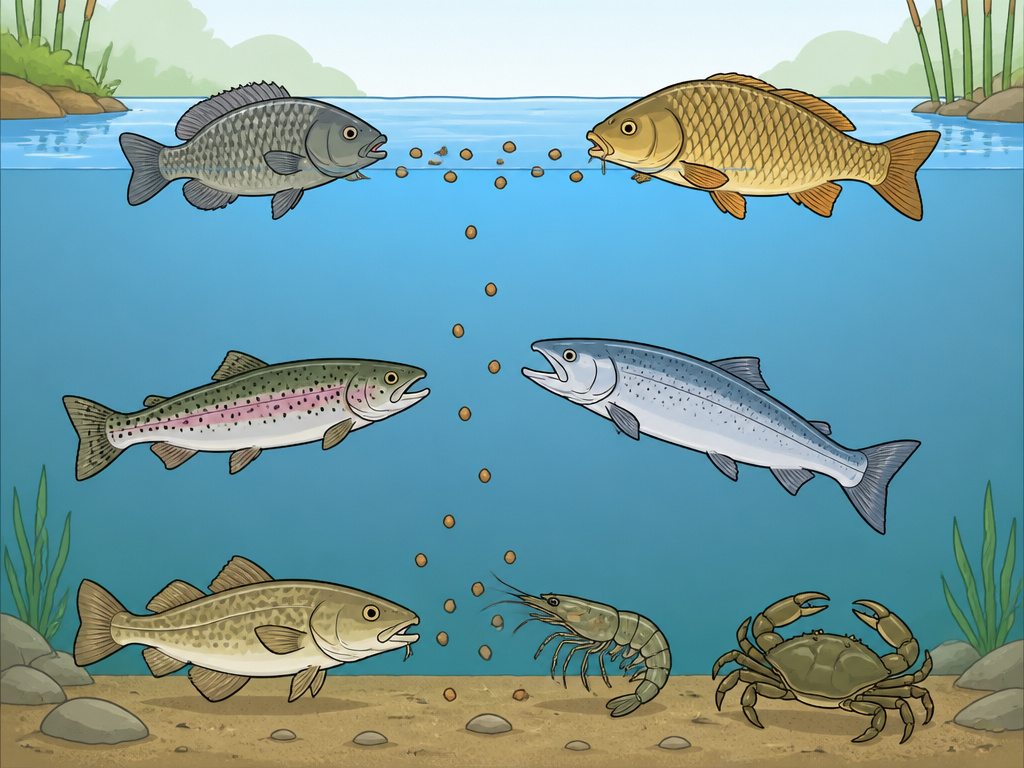
Shrimp and cod don’t come to the surface, which is why NC State Extension lists them as sinking-feed species, though the carp trial shows the rule has exceptions.
- Floating feed: tilapia, carp, catfish.
- Slow-sinking feed: trout, salmon, yellowtail.
- Sinking feed: cod, shrimp, river crab.
The carp result that breaks the rule
Six hundred and twenty-four common carp averaging 175 g went into round concrete ponds for 75 days, fed to apparent satiation four times a day at four-hour intervals. Growth came out at 122.63 g on the extruded floating feed against 77.43 g on the pelleted sinking feed, with weight gain, specific growth rate and protein efficiency ratio all significantly higher on the floating diet and feed conversion significantly lower. Survival was 97-99.5% on both.
Carp is a bottom feeder. The tidy rule says match the feed to where the fish eats. The trial says the bottom feeder did better on the feed that floated.
Water Stability: The Number the Tub Never Prints
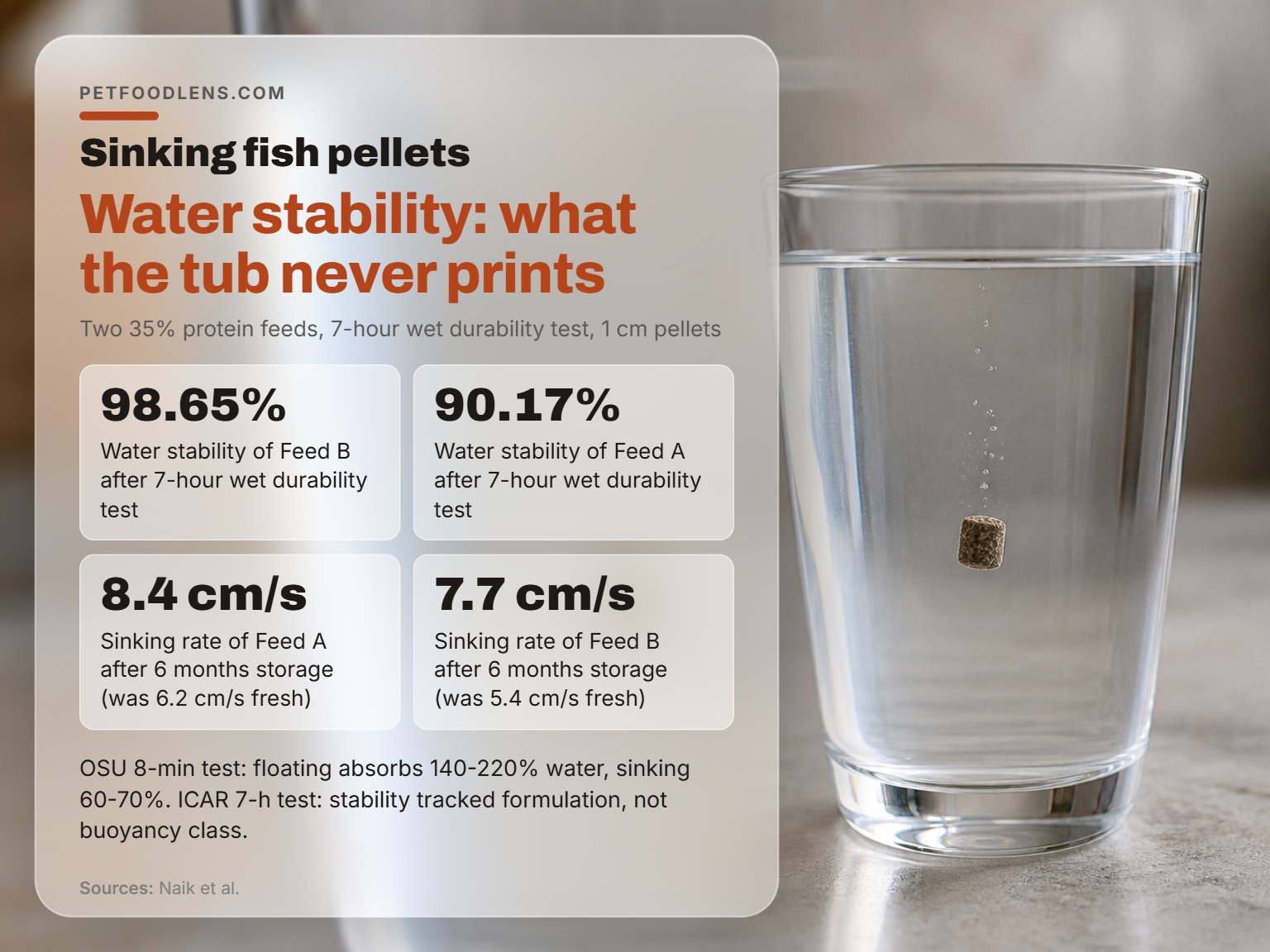
A pellet that holds together in the bag can still come apart in the pond.
Two formulated feeds, both at 35% protein, were tested with a 7-hour wet durability method in a 1.25 x 0.5 x 0.5 m tank using uniform 1 cm pellets. Feed B held 98.65% stability and Feed A held 90.17%. Sinking rate was 6.2 cm/s for Feed A and 5.4 cm/s for Feed B when fresh.
Then the pellets sat in storage for six months. Sinking rate climbed to 8.4 cm/s and 7.7 cm/s respectively. Age makes a pellet drop faster.
Where the sources disagree, they disagree about method. The OSU figures come from an 8-minute rehydration test, and on that test floating feed absorbs 140-220% water against 60-70% for sinking. The ICAR work used a 7-hour immersion test and found stability tracked the formulation rather than the buoyancy class. Two different tests, two different answers about which class is more stable.
Drop a pellet in a glass of tank water and watch it for ten minutes. A stable one goes down in a straight line and the water stays clear. A poor one starts shedding a milky cloud before it reaches the bottom.
| What you see | What it usually means | What to do |
|---|---|---|
| Water clouds minutes after feeding | Pellet is leaching fines and solubles | Change feed or check stability data |
| Pellets still hard after 10 minutes | Over-hard pellet, rupture risk | Pre-soak or switch pellet |
| Tub smells flat and oily | Oil has gone rancid in storage | Discard and store sealed, cool, dry |
| Dust in the bottom of the tub | Poor durability, breaking in the bag | Return it, dust feeds nothing |
I can’t measure digestibility in my kitchen. What I can do is read a published stability figure and drop one pellet in a glass, and those two checks catch most bad tubs.
How Do You Read a Sinking Pellet Label?
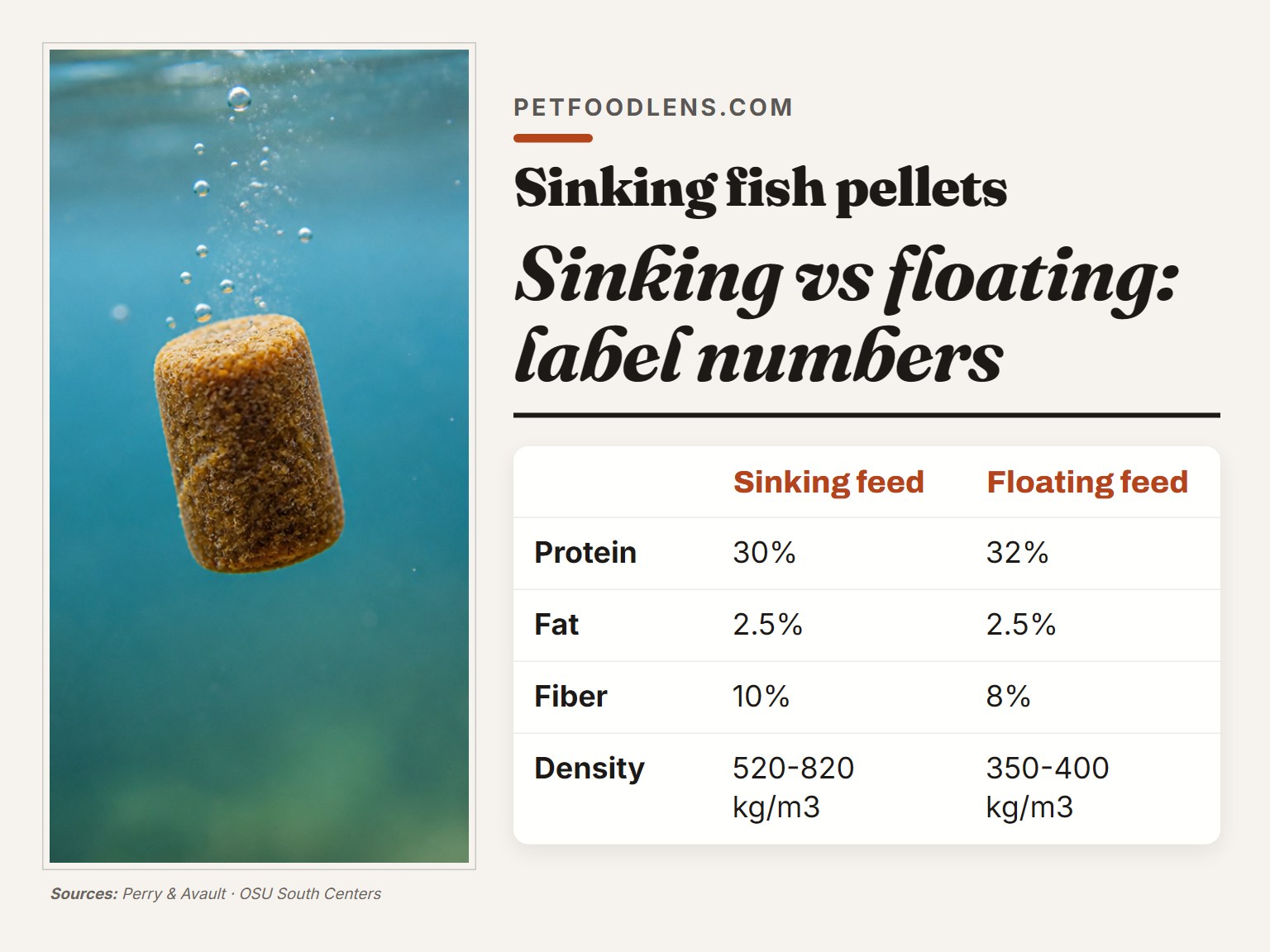
The guaranteed analysis gives you protein, fat and fiber. It gives you nothing about buoyancy.
Look back at the catfish trial rations: 32% protein, 2.5% fat, 8% fiber against 30% protein, 2.5% fat, 10% fiber. Nearly the same panel, completely different behavior in water. If you’re comparing two tubs, run them on the same basis and account for moisture, because differing moisture shifts every number on the panel once you correct for it.
The three numbers that matter
- Protein, because it’s the expensive part and the first thing a front label shouts about.
- Fat, because the pellet mill route is generally used where fat requirements sit below 12%.
- Fiber, because it binds the pellet and it’s the number that quietly differs between two otherwise identical rations.
Starch is the hidden variable
That’s why two tubs with identical protein can behave nothing alike.
A tub that has sat in a warm stockroom for a season smells like old cooking oil, flat and faintly rancid. That smell is the fat going over, and no amount of label reading fixes it.
Where Sinking Pellets Go Wrong
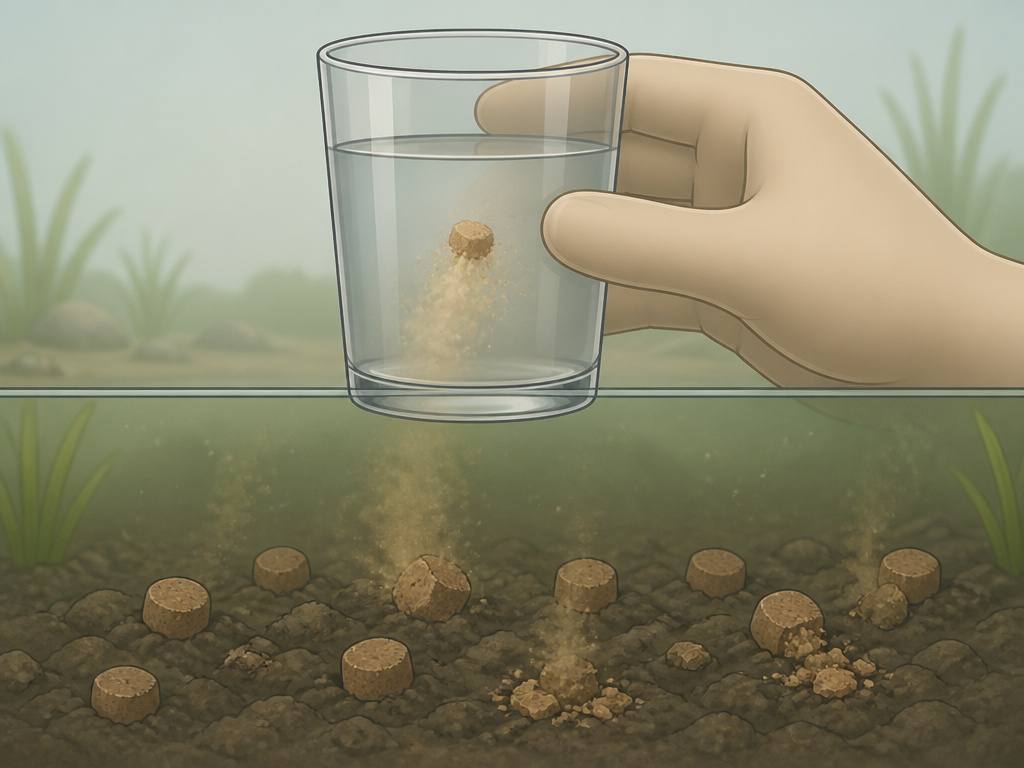
A pond with a soft bottom, a full tub of sinking pellets, and no way to see what’s being eaten.
That’s the failure setup, and it plays out the same way every time. Here’s how to switch a system over without donating feed to the mud.
- Test one pellet in a glass first. If it clouds the water or breaks apart before it reaches the bottom, the tub is telling you something before the pond does.
- Feed a weighed amount you can account for. With sinking feed, an unmeasured scoop is a guess, and guesses sink.
- Watch the water, not the fish. Cloudiness within minutes means leaching, and that’s a feed problem rather than a feeding problem.
- Check the bottom on a schedule. Uneaten sinking pellets collect where you can’t see them, and the water quality tells you before the fish do.
- Adjust on response, not on calendar. Cut the ration when leftovers show up, and don’t restore it until the water clears.
Common mistake: Buying sinking feed for a pond you can’t see the bottom of. You’ll overfeed for a few weeks, the sediment load climbs, and by the time the water discolors you’ve already paid for the feed twice.
Pellet hardness is the other trap, and buoyancy tells you nothing about it. Hard pellets can rupture a stomach; soft pellets fall apart and cause digestive problems. Crumbles are less durable again and more prone to leaching than a whole pellet. A sinking pellet that’s too soft is worse than a floating one that’s merely mediocre.
Where this goes sideways: Feeding a sinking pellet to a species that won’t leave the surface. The feed goes down, the fish don’t follow, and within a few days you’re running a slow nutrient drip into the water column.
Match the pellet to the mouth that will chase it, then match the feed rate to what the water can absorb. A cheap pellet nobody eats is the most expensive feed in the pond.
Frequently Asked Questions
Do sinking pellets make aquarium water cloudy?
They can, and the cause is leaching rather than buoyancy. A pellet with poor water stability sheds fines and solubles into the water within minutes of going in. Test one pellet in a glass first, and if the water clouds before the pellet reaches the bottom, the feed is the problem.
Are sinking pellets better for bottom feeders?
Not automatically. Cod, shrimp and river crab are listed as sinking-feed species, but common carp, a bottom feeder, grew significantly better on floating pellets in a 75-day trial. Match the feed to what the fish will actually chase, then adjust based on what gets eaten.
How do I tell if a pellet is a sinking feed before I buy it?
The guaranteed analysis won’t tell you. Look for the words sinking, slow-sinking or floating on the packaging, and if the tub doesn’t say, ask for the spec. Failing that, drop one pellet in a glass of water and time how long it takes to reach the bottom.
Do pellets change during storage?
Yes. In one study, sinking rate rose from 6.2 to 8.4 cm/s and from 5.4 to 7.7 cm/s after six months of storage. Older pellets drop faster and hold together less predictably, so rotate stock rather than hoarding it.
Can I feed sinking and floating pellets in the same pond?
Yes, and mixed-species systems often have to. The catch is that you can’t judge the sinking portion by watching the surface, so you need a feed rate you can account for and a habit of checking the bottom. Otherwise the floating feed looks fine while the sinking feed is quietly overfed.
Is a harder pellet better?
No. Hard pellets can rupture a stomach and soft ones fall apart and cause digestive problems, so the target sits between the two. Durability in the bag is a separate measurement from hardness in the water, and you want both.
The Bottom Line
If you can’t see the bottom of the pond, don’t buy sinking feed by the sack. Buy one tub, feed it measured, and watch the water for a couple of weeks before you commit to a pallet.
This all changes if you’re feeding a species that won’t come up for food. Then sinking isn’t a choice, it’s the only option, and the work shifts to feed rate and bottom monitoring rather than feed selection.
So test the pellet, read the panel, and keep your own records. A cheap pellet you can watch beats an expensive one you can’t.
