
Floating Pellets for Fish Pros and Cons: Why Species Wins
This post contains affiliate links. As an Amazon Associate, we earn from qualifying purchases.
Floating pellets for fish pros and cons split on species and buoyancy: floating feed suits tilapia, carp, and catfish and you can watch intake, while sinking feed reaches cod, shrimp, and river crab. Floating pellets also rehydrate to 140-220% of their dry weight after eight minutes in water, against 60-70% for sinking pellets.
That rehydration gap is the whole floating pellets for fish pros and cons trade-off in miniature. A floating pellet gets puffed full of air during extrusion, and all that internal surface area is what lets water pour straight in. The same structure that keeps it up top gives it a head start on falling apart.
What follows: the physical numbers side by side, the species map, where floating wins and loses, and why the feeding trials don’t line up the way the bag copy suggests.
Key Takeaways
- Buoyancy is a species decision first. Tilapia, carp, and catfish take floating feed; cod, shrimp, and river crab need sinking.
- Floating pellets rehydrate 140-220% in eight minutes versus 60-70% for sinking, so water-soluble nutrients leave faster.
- Sinking pellets are the tougher pellet at 98-99% durability against 96-97% for floating, which is backwards from what most people assume.
- The carp trial that favored floating compared extruded feed to pellet-milled feed, so processing is tangled up with buoyancy in the result.
- Crumbles are the weak point, not the pellet. Trushenski flags them as less durable and more prone to leaching than whole pellets.
What Floating Pellets Actually Do in Water
Drop an extruded floating pellet into a tank and two things happen at once. It sits at the surface, and it starts drinking.
Extrusion cooks a starch-rich mix under moisture, heat, and pressure, then forces it through a die. The pressure drop flashes off water and puffs the pellet. Gelatinized starch sets the structure as it cools, and the trapped air pockets hold apparent density between 350 and 400 kg per cubic meter.
A fresh floating pellet lands with a small tick and leaves a thin oil slick spreading around it. That slick is your first clue about what’s inside. Extruded feeds carry surface oil, and oil is the fraction most likely to oxidize once the bag is open.
The visible part is the selling point. Floating feed lets a pond manager watch whether fish are actually eating, how fast they come up, and how much gets left behind.
Which Fish Actually Need Floating Feed?
The species map is the part worth memorizing, because it overrides almost everything else here. NC State Extension lays it out plainly:
- Tilapia, carp, and catfish get floating feed.
- Trout, salmon, and yellowtail get slow-sinking feed.
- Cod, shrimp, and river crab get sinking feed, and no amount of surface feeding will change that.
- Pike perch wants slow-sinking or semi-floating, because it isn’t an aggressive feeder.
Feeding a floating pellet to a benthic species is a category error, not a preference. A crab isn’t going to commute.
Then there’s the wrinkle. Carp is a bottom-feeder by habit, and the Iranian trial still found it grew better on floating pellets. That’s the tension running through this whole topic, and it’s worth sitting with rather than resolving too fast.
If you’re running bottom feeders alongside surface fish in the same system, the buoyancy question stops being a single answer. You end up feeding two classes of pellet on two schedules.
The Numbers Behind the Buoyancy Difference
Sinking pellets run 520 to 820 kg per cubic meter. Floating pellets run 350 to 400.
That’s the Melcion 1999 table reproduced in the OSU feeds and feeding BMPs document, and it’s the cleanest numeric comparison of the two feed types anywhere in the extension literature.
| Property | Floating | Sinking |
|---|---|---|
| Diametric expansion | 1.2-1.6 | 0.98-1.02 |
| Apparent density | 350-400 kg/m3 | 520-820 kg/m3 |
| Durability | 96-97% | 98-99% |
| Rehydration after 8 min | 140-220% | 60-70% |
Read the durability row twice. The sinking pellet wins, and that surprises people who assume the puffed-up pellet must be the fragile one. Expansion doesn’t make a pellet weak. Bad starch binding does.
The apparent density spread is the widest number on the table, and it’s the one that decides where the feed ends up, though processing also shapes how the pellet performs. A pellet at 350 kg/m3 floats. A pellet at 820 kg/m3 goes down and stays down.
The sinking pellets pros and cons case is really a durability and delivery case, not a nutrition case. You’re buying a pellet that survives the trip to the bottom.
Floating Pellets for Fish Pros and Cons: Where They Win
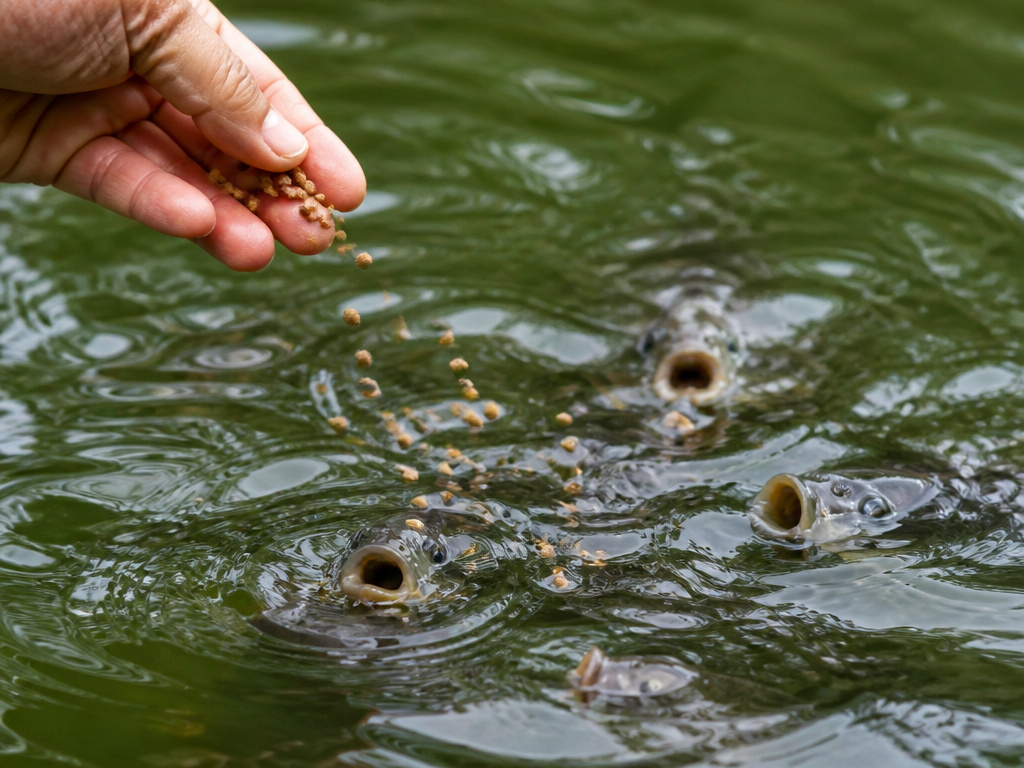
This one earns its place in most ponds, and the growth data is the reason.
The carp trial ran 624 fish from an average starting weight of 175 g, fed to apparent satiation four times a day at four-hour intervals for 75 days. Growth came out at 122.63 g on the extruded floating feed against 77.43 g on the pellet-milled sinking feed. Weight gain, specific growth rate, and protein efficiency ratio all came up, and feed conversion ratio came down, all significant at p < 0.05. Survival ran 97-99.5%.
The tilapia work points the same direction. A 70-day trial in 300 L tanks, 50 fish per tank, both feeds at 30% protein, found significant differences in percent weight gain, specific growth rate, hepatosomatic index, and feed conversion ratio. Chemical composition came out the same except for lipid content.
Palatability is part of the explanation. The tilapia paper cites Craig and Helfrich describing floating pellets as more palatable and more uniform than sinking pellets, and notes that non-uniformity and low palatability in sinking feed may push feed conversion ratio up.
A pellet you can watch is a pellet you can audit. When feed runs more than half of production cost, the surface is the cheapest monitoring tool you own.
There’s a second win nobody puts on the bag. Floating feed lets you spot a sick or off-feed group before it shows up in a weight sample.
Where Floating Pellets Fall Short
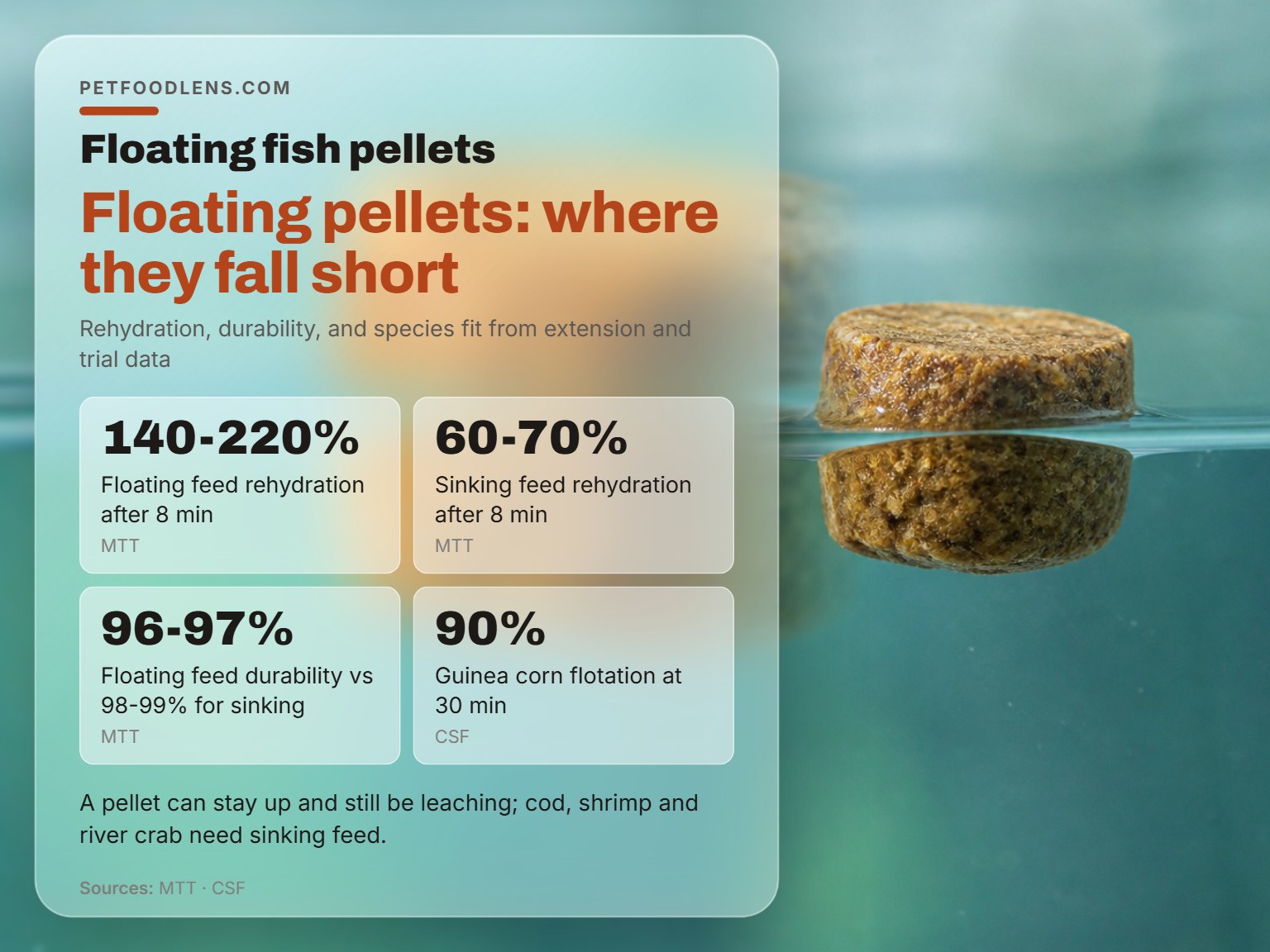
Floating pellets lose the water-soluble fraction first, and the eight-minute rehydration figure is the clock.
Anything that dissolves, dissolves into the pond rather than into the fish. Vitamins, free amino acids, and small peptides go first. That’s the cost of a pellet designed to sit in the water column where you can see it.
Common mistake: Treating flotation as a proxy for water stability. The 2019 carbohydrate trial found guinea corn held 90% flotation at 30 minutes while wheat held the highest stability at 87.8%. A pellet can stay up and still be leaching.
Durability is the second gap. The 96-97% figure against 98-99% for sinking is small on paper and larger in a bag that’s been hauled around a farm.
Cost is the third. NC State Extension notes that extruded pellets cost more to manufacture, because extruder equipment costs more to acquire than a pellet mill and production capacity for the same motor capacity is lower.
Then there’s the benthic problem. For cod, shrimp, and river crab, a floating pellet is feed that never arrives.
If leaching and fines are your main worry, the same habits that keep a tank clear apply here, and feeding without clouding water covers the mechanics of getting pellets in without turning the water milky.
Why the Feeding Trials Don’t Agree
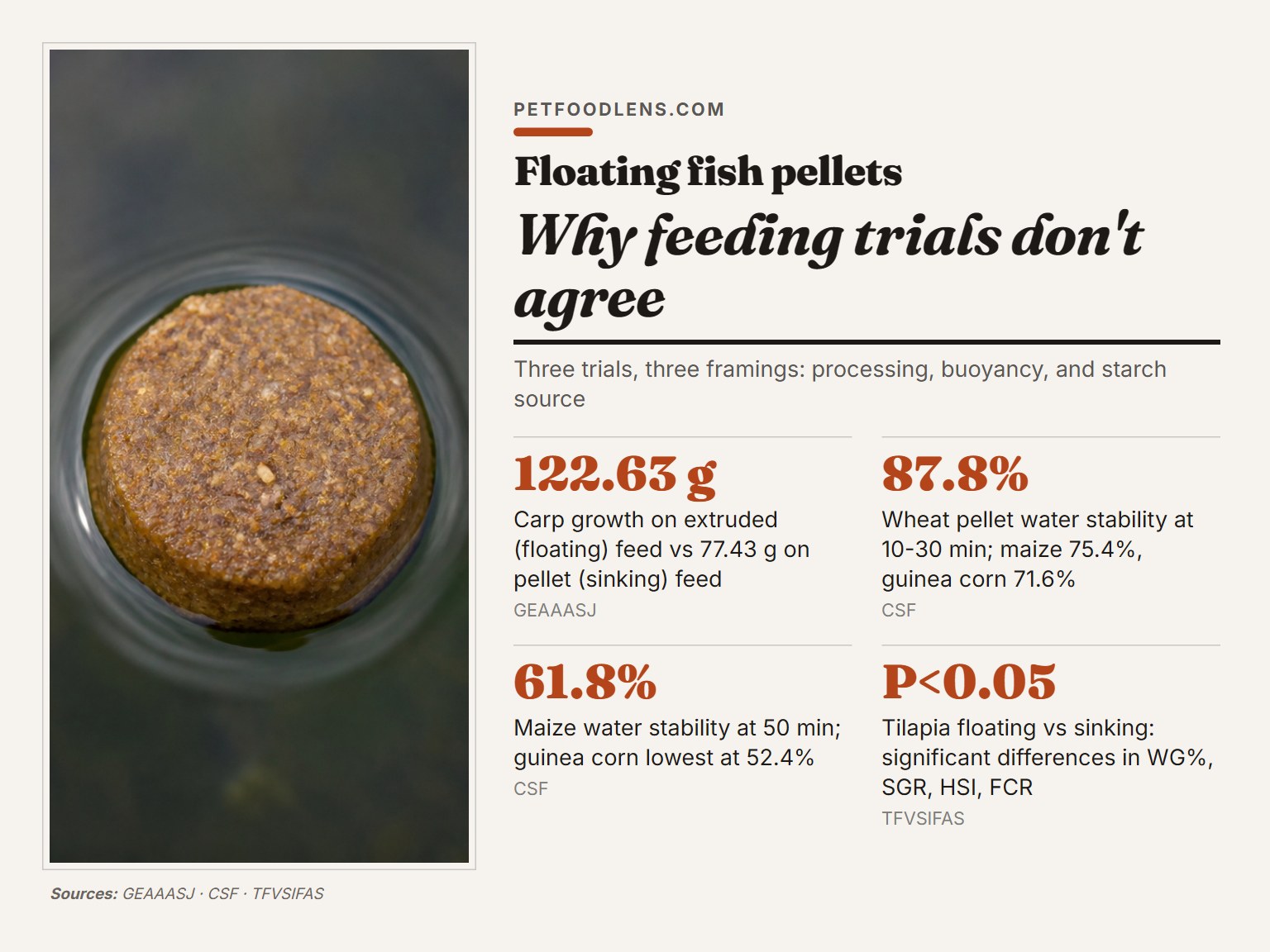
Three credible sources, three different framings, and the split is more interesting than the headline.
| Trial | Subject | Compared | Result |
|---|---|---|---|
| Ghorbani et al. 2018 | Common carp | Extruded vs pellet-milled | Floating grew faster |
| Tilapia aquaponic 2016 | Nile tilapia | Floating vs sinking | Significant differences in WG%, SGR, FCR |
| Carbohydrate study 2019 | Pellet formulation | Maize, wheat, guinea corn | Stability tracked starch source |
Start with the carp trial, because the wording gives the game away. The paper describes the two feeds as “extruded and pellet feeds.” That’s a processing comparison wearing a buoyancy costume. Extrusion gelatinizes starch, and NC State Extension is explicit that gelatinized starch acts as a glue that raises feed integrity during storage, handling, and when cast in water.
So the floating feed in that trial was also the cooked feed. You can’t separate the buoyancy from the cook.
The water stability question splits the same way. The 2019 carbohydrate trial found stability depended on the starch source: wheat highest at 87.8% between 10 and 30 minutes, maize at 75.4%, guinea corn lowest at 71.6%. By 50 minutes maize led at 61.8% and guinea corn trailed at 52.4%. NC State points at processing instead, noting that gelatinized starch from extrusion drives integrity regardless of buoyancy.
Both are right about different things. Starch source sets the ceiling. Processing decides how close you get to it.
I’d stop asking which buoyancy wins and start asking which process made the pellet. A pellet-milled sinking feed and an extruded sinking feed sit further apart than most people expect.
I read labels for a living and I still had to go to the processing literature to understand why the trials split. The bag won’t tell you any of this.
There’s a pond trial on largemouth bass pellet characteristics study that looked at exactly this pairing of pellet traits and feed conversion, and a separate floating versus sinking diet stability evaluation that compared two diets matched for protein. Both are worth reading alongside the extension material rather than instead of it.
How to Read a Fish Feed Bag Before You Buy
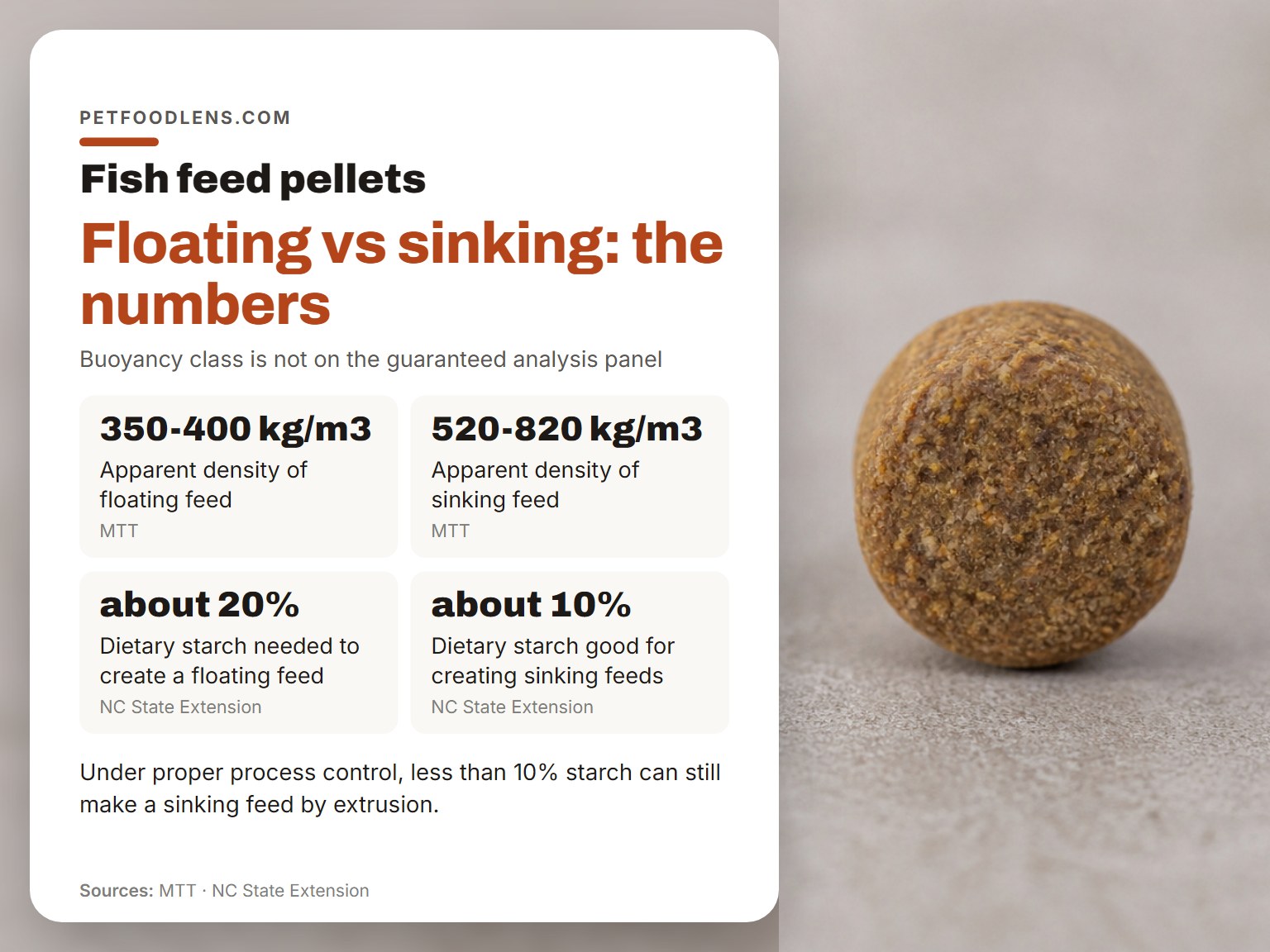
A bag on the shelf says “complete nutrition for all pond fish” in large type. Turn it over and the guaranteed analysis gives you protein, fat, fiber, and moisture. Buoyancy isn’t on there.
That’s the gap. The single most consequential thing about the pellet is the thing the panel usually omits.
The buoyancy class line
Check the bag for an explicit word: floating, slow-sinking, or sinking. If the bag doesn’t say, the pellet is whatever the process made it, and you find out at the surface.
Where the starch sits
NC State puts the threshold at roughly 10% dietary starch for sinking feed and roughly 20% for floating feed. Under proper process control, less than 10% starch can still make a sinking feed by extrusion. If you’re reading a high-protein, low-starch formula, floating was never on the table.
Crumbles and dust at the bottom of the bag
Tip a bag that’s been open a few weeks and you get a puff of fine dust and a smell that’s gone flat and slightly rancid. Trushenski flags crumbles as less durable and more prone to leaching than whole pellets, which makes the fines at the bottom of the bag the worst-performing fraction in it.
Here’s the five-step check I’d run before buying anything unfamiliar:
- Find the buoyancy word on the panel or the front, and treat its absence as a red flag.
- Match the pellet diameter to the fish’s mouth, which the pellet size guide covers size by size.
- Check the starch or grain position in the ingredient list against the buoyancy claim.
- Look at the date and the bag condition, since fines and rancidity both show up before the fish do.
- Compare the first five ingredients against a competing bag at the same tier, the same way you’d compare any two feeds.
For a pond, a floating pellet is the usual starting point, and it stays up until something eats it or you skim it. For a tank with a bottom feeder, a sinking pellet actually goes down and stays down, which is the entire job.
If you’re weighing format rather than buoyancy, the fish flakes vs pellets comparison covers where flakes still make sense. And if you’re stocking a pond rather than a tank, floating pond pellets get judged on a different set of rules entirely.
I’ve sat with a shelf of bags looking for one word that separates a tested claim from a marketing one. On fish feed, the word is usually the buoyancy class.
Does Floating Feed Cost More to Make?
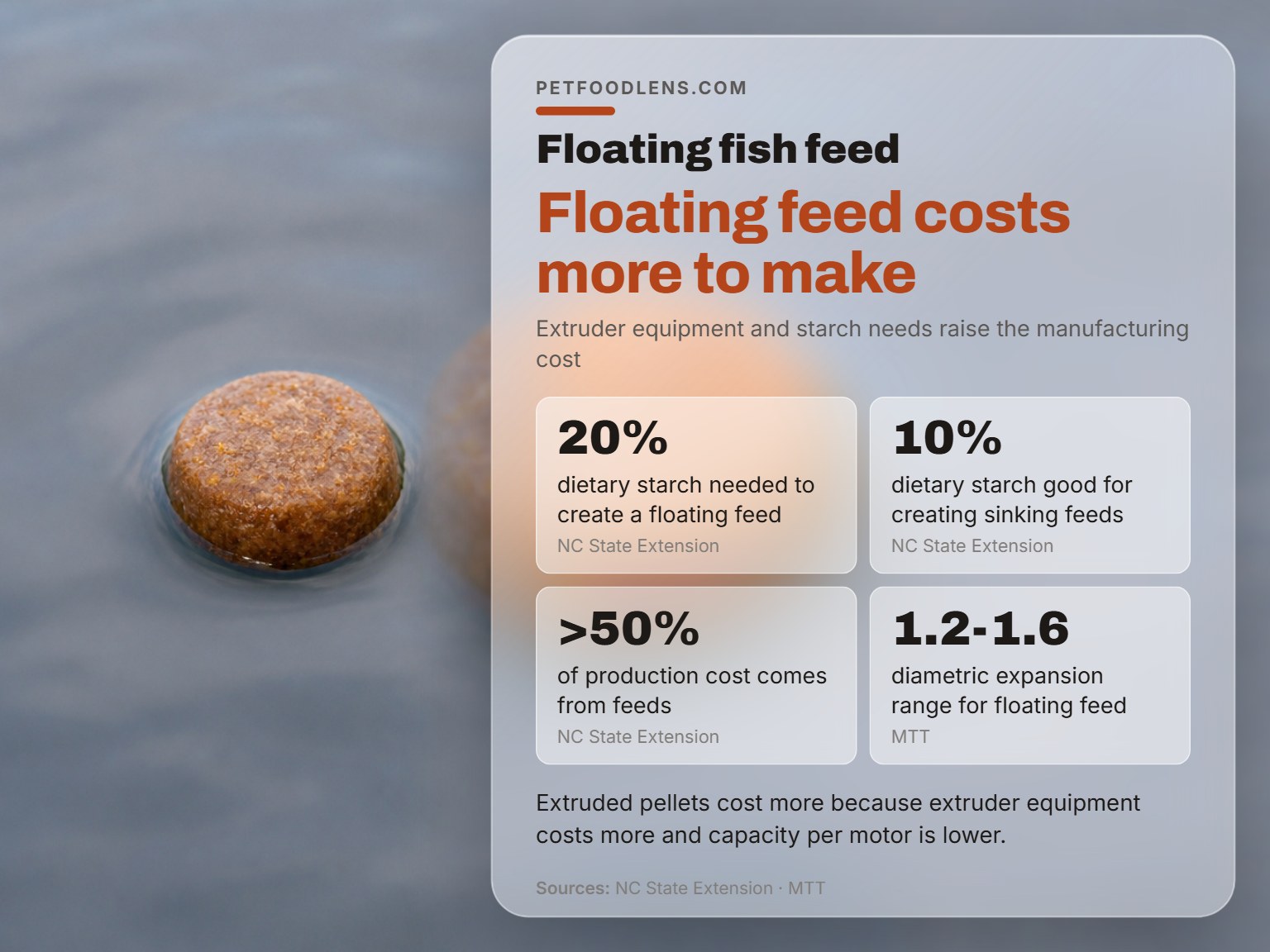
Yes, and the reason is equipment, not ingredients.
NC State Extension notes that extruded pellets cost more to manufacture because extruder equipment costs more to acquire than a pellet mill, and because extruder production capacity for the same motor capacity is lower. You’re paying for a machine that cooks as well as compresses.
The formulation constraint runs alongside it. Floating feed needs roughly 20% dietary starch to puff, so a low-starch, high-protein formula can’t float without reformulating. Sinking feed gets away with about 10%.
Size adds a third cost. A single-screw extruder handles both floating and sinking feed, but a twin-screw extruder may be needed for smaller pellet sizes. That’s the wall anyone hits when they try to make micro pellets that both float and stay small.
There’s a paper in floating pellet production research that works through the production side of this in more detail than I can here.
I work from labels and published analyses, not from tank-side trials, so I can’t tell you what your particular pond will do. What I can tell you is that the processing cost is real and it shows up in the bag price.
Frequently Asked Questions
Are floating pellets better than sinking pellets for fish?
It depends on the source: Trushenski states that floating feeds are preferable for most applications, while NC State Extension maps floating feed to tilapia, carp and catfish, slow-sinking to trout, salmon and yellowtail, and sinking to cod, shrimp and river crab. The carp and tilapia trials both found better growth and feed conversion on floating feed, while Trushenski’s extension guidance frames floating feeds as preferable for most applications rather than a settled growth verdict. The exception is benthic species like cod, shrimp, and river crab, where sinking feed is the only feed that reaches them.
Do bottom-feeding fish eat floating pellets?
Some do. The carp trial found that carp, despite bottom-feeding habits, fed easily on floating pellets and grew better on them. That doesn’t generalize to every benthic species. A crab or a shrimp isn’t built to intercept feed at the surface.
How long do floating pellets stay floating?
It depends on the starch source and the process, not on the buoyancy label alone. In the 2019 carbohydrate trial, guinea corn pellets held 90% flotation at 30 minutes while maize and wheat held 80%. By 50 minutes, water stability had dropped to 61.8% for maize and 52.4% for guinea corn.
Can I feed floating pellets to trout?
Slow-sinking is the standard class for trout, salmon, and yellowtail per NC State Extension. Trout will take feed at the surface in some settings, but the species mapping puts them in the slow-sink category rather than the floating one.
Are floating pellets more expensive?
They cost more to manufacture. Extruder equipment costs more to acquire than a pellet mill, and production capacity for the same motor capacity is lower. Floating feed also needs roughly 20% dietary starch to achieve the expansion, which constrains the formula.
The Bottom Line
Keep one number from all of this: 140-220% rehydration in eight minutes. That’s your leaching clock, and it runs whether or not the pellet is still visible at the surface.
The practical trigger is simple. If your fish are tilapia, carp, or catfish, floating feed is the default and you should be able to watch a feeding response shortly after casting. If you can’t see fish hitting the surface, something is wrong with the feed, the water, or the fish, and you’ll know before a weight sample tells you.
Here’s the concession. None of this settles the growth question cleanly, because the trials that favor floating also compared extruded feed to pellet-milled feed. If you want to know whether buoyancy or processing is doing the work in your system, you’d have to run extruded sinking against extruded floating on the same formula. Almost nobody does.
So read the panel, not the front of the bag. The front tells you the pellet floats. The panel tells you what it cost to get there.
