
Micro Pellets for Small Fish Guide: Which Brand Wins?
This post contains affiliate links. As an Amazon Associate, we earn from qualifying purchases.
This micro pellets for small fish guide starts with three numbers on the back of the tub: protein, pellet diameter, and how fast the food disappears. Hikari Micro Pellets list min 43.0% protein, Tetra publishes a 0.4 to 1.2 mm diameter, and Taiyo Pluss Discovery lists min 45%.
Pellet diameter decides which fish in the tank can actually eat the food, and the micro pellets for small fish guide starts here. Tetra publishes a 0.4 to 1.2 mm diameter, a range that covers small-mouthed fish such as neon tetras and rasboras. Hikari and Taiyo publish no diameter at all, so buyers comparing brands work from protein and feeding instructions instead.
What follows: a three-brand comparison on protein and fat, the feeding window each manufacturer recommends, and the one label detail that tells you whether the food will cloud your water.
Key Takeaways
- Protein runs 43.0% to 45% across Hikari, Tetra, and Taiyo, so protein alone won’t separate them.
- Only Tetra publishes a pellet diameter (0.4 to 1.2 mm); Hikari and Taiyo list weight only.
- Feeding windows disagree: Hikari says about a minute, Taiyo says about 5 minutes.
- Hikari’s betta rule is 6 pellets AM + 6 PM for a 1.5 inch fish, never more than 6 per feeding.
- Tetra’s recipe lists no colourants; Hikari and Taiyo Odiva both list Red 3 and Yellow 5.
What Do the Guaranteed Analyses Actually Say?
Flip the tub over and read the guaranteed analysis before anything else. That block is the only part of the label with numbers a manufacturer is legally required to hit.
Hikari Micro Pellets guarantee minimum 43.0% protein, minimum 7.0% fat, maximum 7.0% fiber, maximum 10.0% moisture, and maximum 17.0% ash. Tetra declares 45% protein, 11% fat, 2% fiber, and 8% moisture. Taiyo Pluss Discovery declares minimum 45% protein, minimum 6% fat, maximum 2% fiber, and maximum 10% moisture.
The protein spread is small, as the micro pellets for small fish guide notes. The fat spread is not. Tetra’s 11% fat is higher than Hikari’s 7.0% and Taiyo’s 6.0%. Fat is one of the guaranteed-analysis values that differs most between these brands.
Here’s the comparison on the same basis:
| Brand | Protein | Fat | Pellet size | SKUs |
|---|---|---|---|---|
| Hikari Micro Pellets | min 43.0% | min 7.0% | not stated | 22 g, 45 g, 1 kg |
| Tetra Micro Pellets | 45% | 11% | 0.4 to 1.2 mm | 100 ml / 46 g |
| Taiyo Pluss Discovery | min 45% | min 6% | not stated | 25 g, 50 g |
Read the guaranteed analysis before anything else. The guaranteed analysis is the spec sheet.
The label guarantee is a guarantee at the point of manufacture, not at the point of use.
If you’re weighing pellets against the flake food you already have, the flakes vs pellets comparison covers the trade-offs. The short version: pellets deliver more nutrition per bite and less water clouding, flakes get eaten faster by surface feeders.
Why Pellet Diameter Matters More Than Protein
Which number decides whether the food reaches the fish at all? Pellet diameter, and it’s the number most brands don’t print.
Tetra is the only one of the three that publishes a diameter: 0.4 to 1.2 mm. That range covers neon tetras, rasboras, and small barbs. Hikari and Taiyo publish weight only, which means a buyer can’t size-match across brands from label data alone.
The math on small-fish feeding is tighter than most keepers realize. Rebelein and Focken, in a 2021 MethodsX paper on fiber-supplemented pellets for small fish, put the count at 400 to 600 pellets per gram for small-fish diets.
That’s the scale you’re working at.
I’ve sized pellets by eye for years, and the eye test is still the fastest check. Hold a pellet next to the fish’s eye. If the pellet is wider, it’s too big.
Worth knowing before you start: A pellet that’s too large for the fish’s mouth doesn’t get eaten. It sinks, softens, and breaks down in the gravel, and that breakdown is what spikes ammonia. Match the pellet to the mouth before you worry about the protein number.
If you want a deeper breakdown of sizing across species, the pellet size guide covers the mouth-width math. The rule of thumb: the pellet should be no wider than the fish’s eye.
How Much Should You Feed Micro Pellets?
The three manufacturers disagree on the feeding window, and that disagreement matters more than the protein spread.
Hikari says feed two to three times daily, in the amount the fish will completely consume in about a minute. Taiyo says feed growing fish three to six times daily, in the amount they consume in about five minutes. Pets at Home, a UK retailer, prints Hikari’s feeding guide as “a few minutes” rather than “about a minute.”
| Source | Frequency | Consumption window |
|---|---|---|
| Hikari (manufacturer) | 2 to 3 times daily | about 1 minute |
| Taiyo Pluss Discovery | 3 to 6 times daily (growing); 1 to 2 times (adult) | about 5 minutes |
| Pets at Home (retailer) | 2 to 3 times daily | a few minutes |
Five minutes is a lot of food, and the excess can land in the filter.
If I’m feeding a new tank, I start with the label dose and watch. Here’s the sequence I’d use for any of the three brands:
- Start with what the label suggests. Watch how fast the fish clear it. Watch how fast the fish clear it, and adjust based on the manufacturer’s stated consumption window.
- Feed one pellet at a time for bettas. Hikari’s own instructions say to do this and to remove anything uneaten after the feeding period.
- Keep additional feedings at least two hours apart. Hikari’s rule, and it applies to any brand if you’re feeding more than twice daily.
- Stop feeding at least two hours before lights out. Food that sits overnight is the fastest route to a water quality problem.
The Betta Dosing Rule (Hikari’s Exact Numbers)
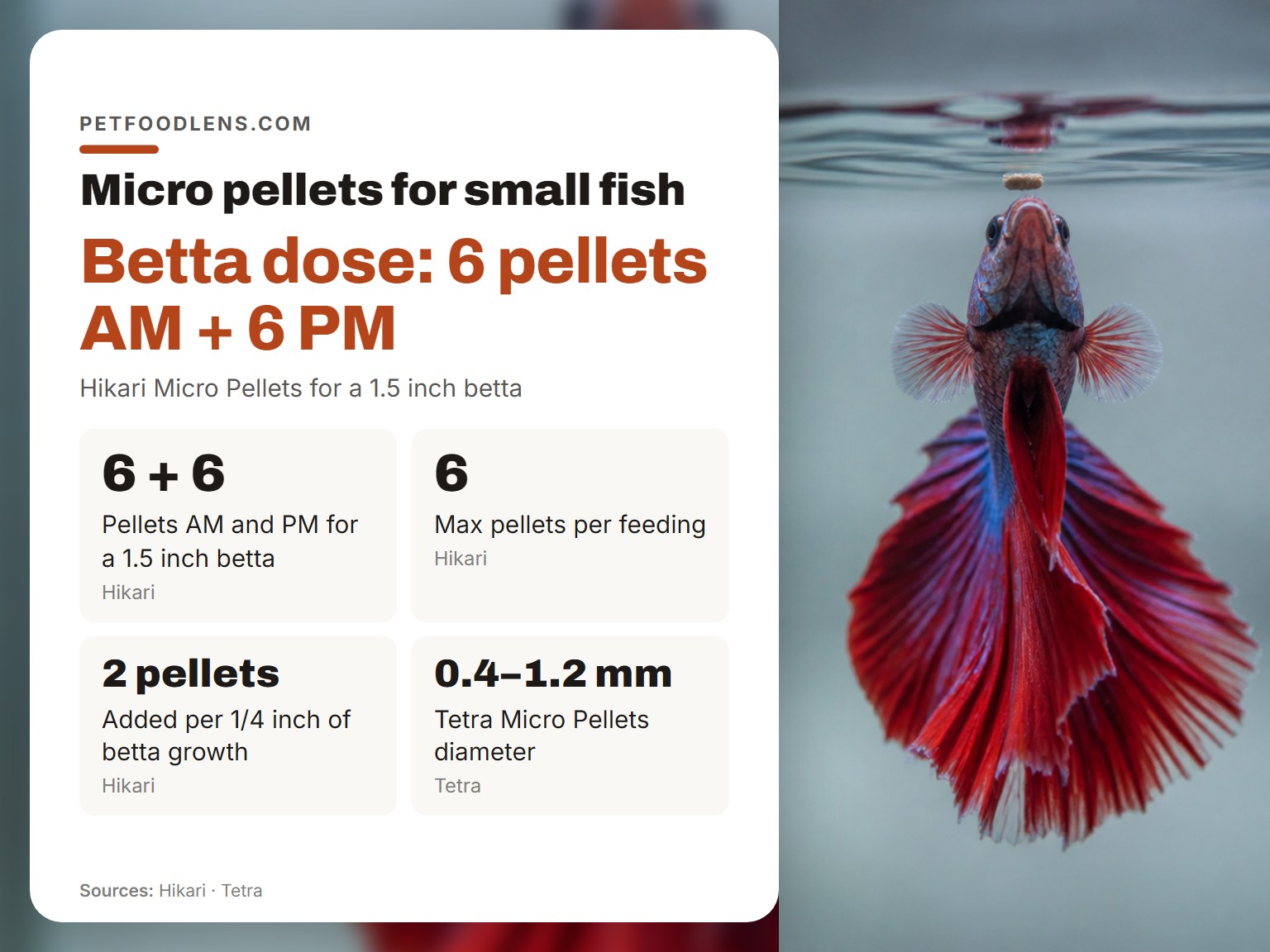
Hikari publishes a specific betta dose that most guides skip. For a 1.5 inch betta, measured nose to tail base before the fin, feed six pellets in the morning and six at night. Add two pellets per 1/4 inch of growth, and never feed more than six pellets at one feeding.
That’s a much tighter number than the “feed what they eat in a minute” guidance. A 1.5 inch betta gets 12 pellets a day, split into two feedings of 6. A 2 inch betta gets 16 pellets a day, split into feedings of no more than 6 pellets each.
If you keep bettas, the betta food breakdown covers the pellet-versus-flake question in more detail.
The Colourant Question Nobody Puts on the Front of the Tub
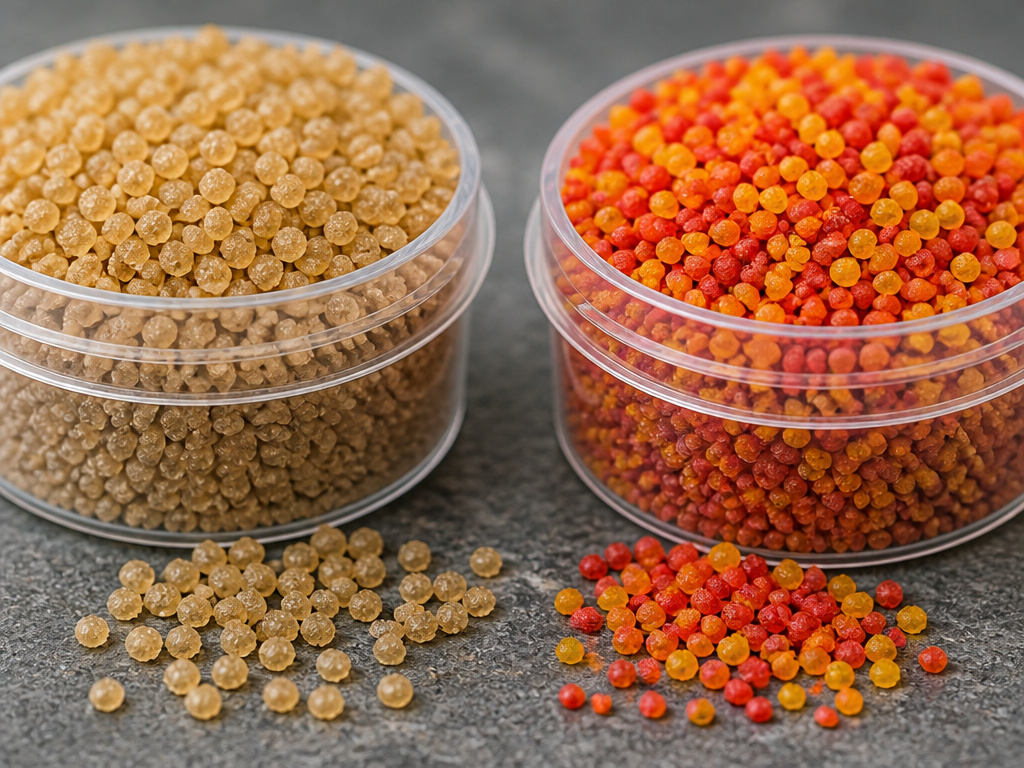
Tetra’s label says the recipe is without colourants and added preservatives. Hikari’s ingredient list includes Red 3 and Yellow 5, both artificial colours, plus astaxanthin. Taiyo’s Odiva page lists Red 3 and Yellow 5 too.
Hikari’s ingredient list includes Red 3 and Yellow 5, both artificial colours, plus astaxanthin. A coloured pellet is easier for a fish to spot, which means it gets eaten faster and clouds the water less.
Whether that trade-off is worth it depends on what you’re optimizing for. If you want a clean label, Tetra is the one. If you want maximum acceptance from a picky fish, the coloured pellet has a case.
I won’t tell you artificial colours are dangerous. The research doesn’t support that claim at these levels, and I’m not going to invent a risk to sell you a cleaner label. What I will tell you is that Tetra’s no-colourant recipe is a genuine difference, and it’s the kind of difference a label reader should notice.
Astaxanthin is worth separating from the Red 3 and Yellow 5. Astaxanthin is a natural carotenoid listed alongside the artificial colours. The artificial colours are Red 3 and Yellow 5. Those are different jobs.
If you want a deeper look at what Tetra puts in its micro pellets, the tetra food breakdown covers the full ingredient list.
Semi-Floating vs Sinking: What Hikari’s Own Page Can’t Decide
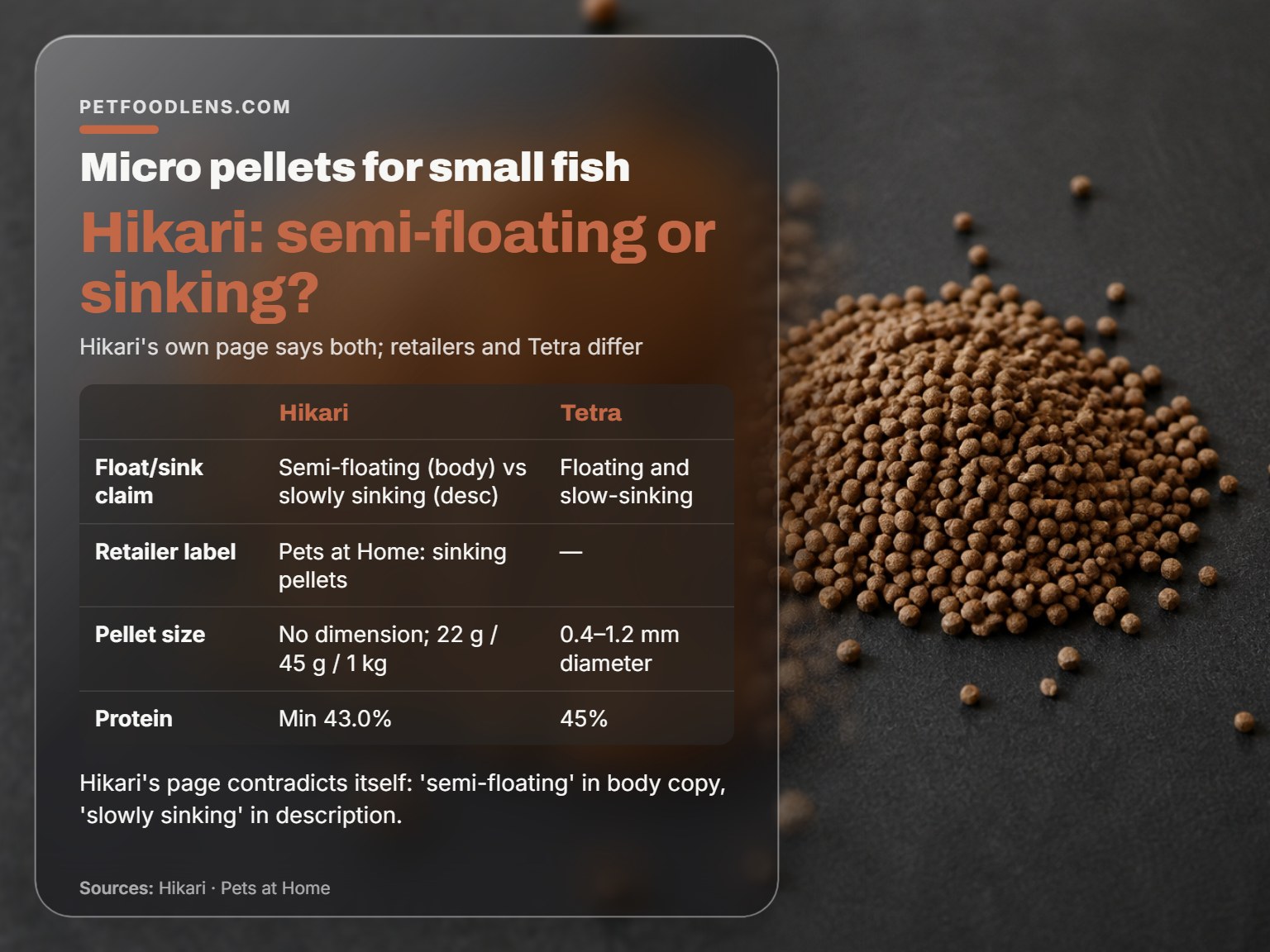
Hikari’s product page describes Micro Pellets as “semi-floating” in the body copy and “slowly sinking” in the product description. That’s an internal contradiction on the same page, and it matters for mid-water and bottom feeders.
Pets at Home resolves the contradiction by calling them “multi-coloured, granulated sinking pellets.” Tetra describes its own micro pellets as “floating and slow-sinking.”
A floating pellet sits on the surface. A sinking pellet drops below the surface.
What Each Brand Actually Prints
The practical difference: a floating pellet gets eaten at the surface, where surface-feeding fish like bettas and gouramis do most of their work. A sinking pellet reaches mid-water and bottom feeders, where tetras and corydoras actually eat.
If your tank is mixed, a semi-floating pellet is the compromise. It starts at the surface and drops slowly enough that mid-water fish get a shot at it before it hits the gravel.
Easy to miss: A pellet can be both floating and sinking depending on how long it’s been in the water. The label term describes the initial behaviour, not the whole feeding. If you’re judging by what you see after a minute, you’re judging the wrong moment.
I’d rather feed a semi-floating pellet in a mixed tank than guess which fish is getting fed. That’s a real problem for a mixed community.
The sinking pellets breakdown covers when a true sinking pellet is the better call. The short version: bottom feeders and shy fish do better on sinking; surface feeders and greedy eaters do better on floating.
If you’re choosing between the two formats, the floating pellets comparison covers the trade-offs in more detail.
The Extrusion Problem With Probiotic Claims
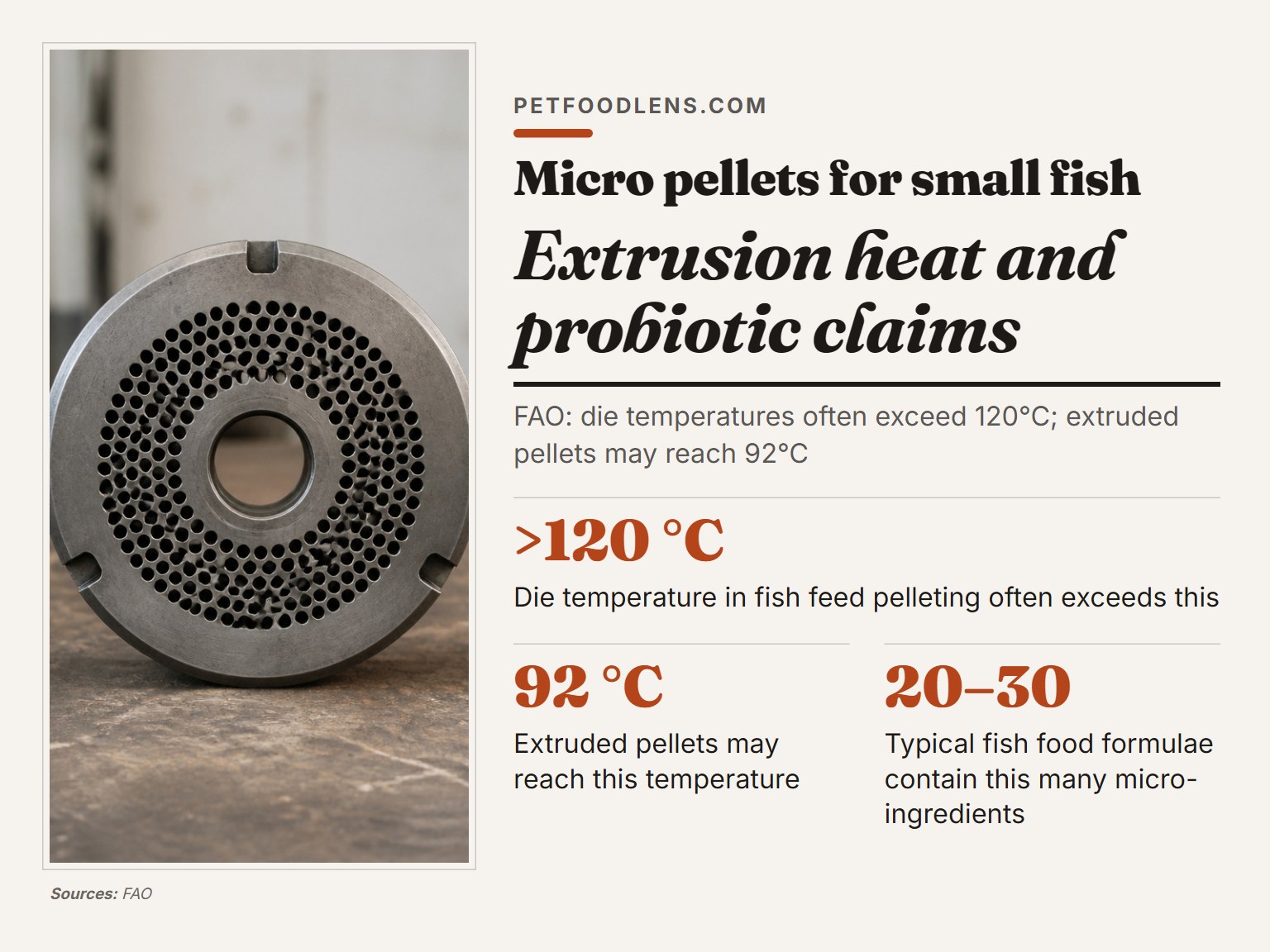
The FAO’s stability of micro-ingredients in feed chapter is blunt about the problem. Die temperatures in fish feed pelleting often exceed 120°C, and extruded pellets may reach 92°C. Those temperatures accelerate the decomposition of heat-sensitive micro-ingredients, and the process is apparently irreversible.
Probiotics are live cultures. They don’t survive 120°C.
Taiyo’s ingredient list includes probiotics and prebiotics. That’s a claim worth checking against how the pellet is actually made. What’s on the label after extrusion is an overage, not what went into the die.
Taiyo’s claim describes the finished pellet. What went into the mixer is a different question.
Where this goes sideways: Buying a pellet for the probiotic claim without checking the process. If the manufacturer doesn’t say how the probiotic is added after extrusion, assume the heat got it. The label guarantee is the post-extrusion number, not the pre-extrusion one.
The FAO chapter also notes that typical fish food formulas contain 20 to 30 different micro-ingredients. Every one of them is subject to the same heat and moisture problem.
Which Micro Pellets for Small Fish Fit Which Tank?
The right pellet depends on the fish, not the brand. Here’s the matching logic:
- Bettas: Hikari Micro Pellets, dosed at 6 pellets AM and 6 PM for a 1.5 inch fish. The pellet size fits a betta’s mouth, and Hikari publishes a specific dose.
- Neon tetras and small rasboras: Tetra Micro Pellets, because the 0.4 to 1.2 mm diameter is the only published size in the category. If you want a rasbora food that fits a small mouth, the diameter is the number to check.
- Mixed community tanks: Hikari Micro Pellets, because the semi-floating behaviour gives surface and mid-water fish a shot at the same food. The community tank food breakdown covers the mixed-tank case in more detail.
- Fry: Taiyo’s sprinkle method, or a dedicated fry food. Micro pellets are too large for most fry until they’re past the free-swimming stage.
Matching the Pellet to the Fish
The mouth-width rule is the one to remember. A pellet should be no wider than the fish’s eye. If it’s wider, the fish will mouth it, spit it out, and leave it to sink.
Match the pellet to the mouth, not the fish to the pellet. A pellet wider than the fish’s eye is gravel food.
For a tank with multiple species, feed the smallest pellet the largest fish will accept, not the largest pellet the smallest fish can manage. The big fish will eat the small pellet; the small fish can’t eat the big one.
I keep the mouth-width rule taped inside my cabinet. It beats any brand recommendation.
Frequently Asked Questions
Do micro pellets really reduce water clouding compared to flakes?
Hikari’s copy says the micro-coating reduces water clouding. Hikari’s copy says the micro-coating reduces water clouding. Both claims point the same direction: a pellet holds together longer than a flake, so less of it dissolves into the water column. The effect is real but modest. Overfeeding clouds water regardless of format.
Can I feed micro pellets to bettas?
Yes. Hikari explicitly lists bettas as an ideal fish for Micro Pellets and publishes a specific betta dose: 6 pellets in the morning and 6 at night for a 1.5 inch fish, adding 2 pellets per 1/4 inch of growth, never more than 6 per feeding. Hikari explicitly lists bettas as an ideal fish for Micro Pellets.
Why don’t Hikari and Taiyo publish a pellet diameter?
Neither manufacturer states a reason. The practical effect is that buyers comparing “micro” pellets across brands can’t size-match from label data alone. Tetra is the only one of the three that publishes a diameter (0.4 to 1.2 mm). For Hikari and Taiyo, you’re working from weight and feeding instructions.
Is Tetra’s no-colourant recipe actually better?
It’s a genuine difference, not a marketing claim. Tetra’s label states the recipe is without colourants and added preservatives. Hikari’s ingredient list includes Red 3 and Yellow 5, and Taiyo’s Odiva page lists the same two. Whether “better” depends on what you’re optimizing for. A clean label is a real value; so is faster acceptance from a picky fish.
How many pellets are in a 22 g tub of Hikari Micro Pellets?
Using the Rebelein and Focken figure of 400 to 600 pellets per gram for small-fish diets, you can estimate a tub’s pellet count from its weight. That’s an estimate, not a manufacturer spec. Hikari doesn’t publish a pellet count.
What’s the difference between Hikari Micro Pellets and Hikari Betta Bio-Gold?
The dosing rules differ. Micro Pellets call for 6 pellets AM and 6 PM for a 1.5 inch betta, adding 2 pellets per 1/4 inch of growth, never more than 6 per feeding. The formulas are different too, but the dosing is the number most keepers get wrong. The formulas are different too, but the dosing is the number most keepers get wrong.
The Bottom Line
One rule most guides skip: if your tub has been open a while, replace it before you blame the food for a fish that’s gone off its feed. Fats and vitamins degrade once air gets in, and the pellet that worked when the tub was new is a different product by the time it’s half empty. The label guarantee is a guarantee at the point of manufacture, not at the point of use.
If you want one answer and you keep small community fish: Tetra Micro Pellets, because the published 0.4 to 1.2 mm diameter is the only size data in the category. If you keep bettas: Hikari Micro Pellets, because the dosing rule is specific and the pellet fits a betta’s mouth. If you keep a mixed tank: Hikari again, because the semi-floating behaviour serves more fish in the same water.
The concession: none of this tells you whether your specific fish is getting enough to eat. That’s a body-condition question, and it needs eyes on the fish, not a label. I can read a panel; I can’t read your tank.
