
Home-Cooked Cat Food Pros and Cons: What the Data Says
This post contains affiliate links. As an Amazon Associate, we earn from qualifying purchases.
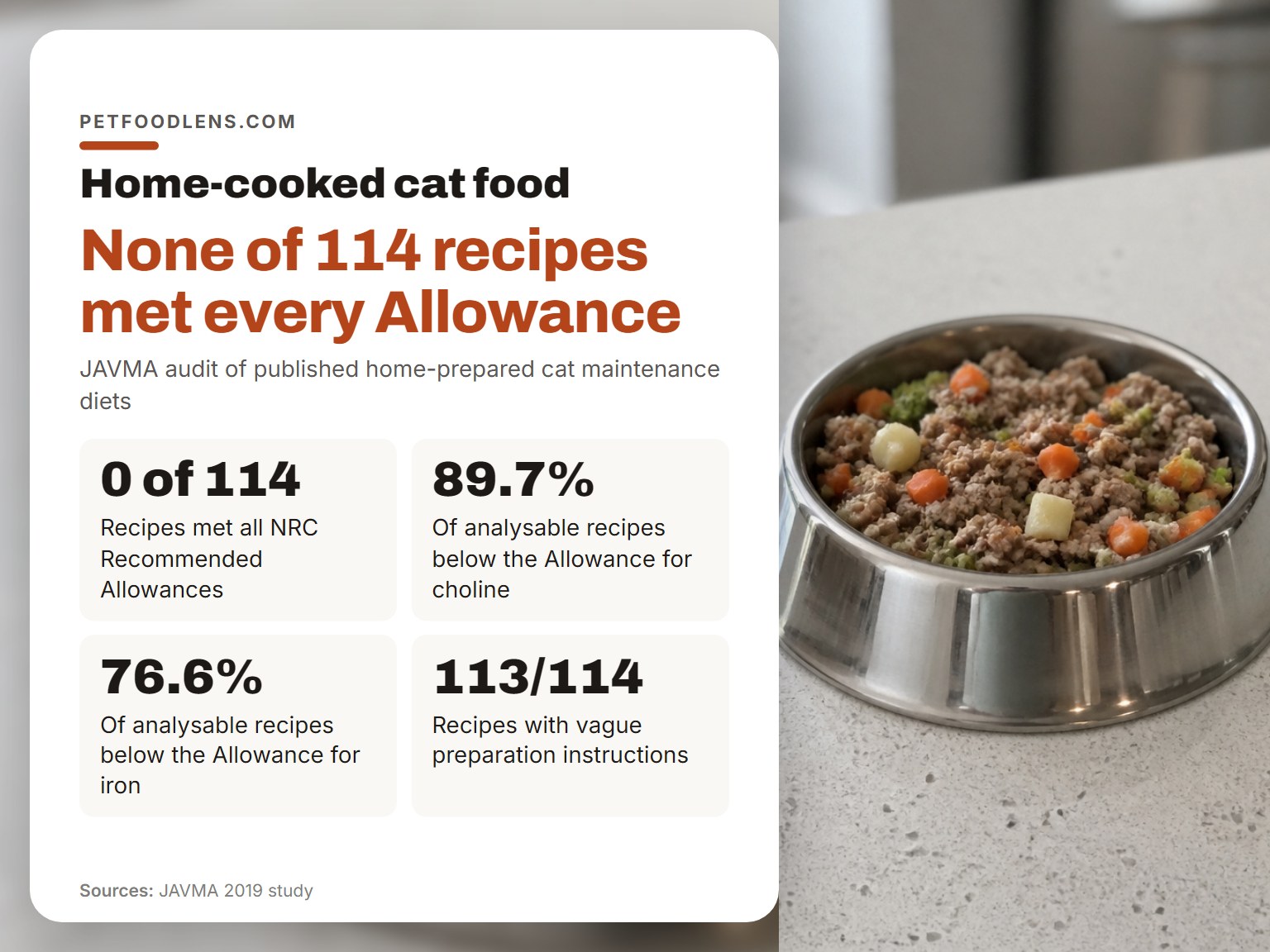
The home-cooked cat food pros and cons split cleanly: you control every ingredient, but in a JAVMA evaluation of 114 home-prepared cat recipes, none met all NRC Recommended Allowances for essential nutrients.
That gap is measurable nutrient by nutrient. Choline fell below the Recommended Allowance in 89.7% of the 94 recipes detailed enough to analyse, and iron fell short in 76.6%. A bowl can look like chicken and liver and still leave a cat short on both.
What follows covers what home cooking genuinely gets right, where the recipe audits found it falling short, how the published studies disagree with each other, and the practical checks that separate a diet from a gamble, all framed by the home-cooked cat food pros and cons.
Key Takeaways
- No recipe in the JAVMA audit was complete, veterinarian-authored or not, and choline was the nutrient that broke the best five.
- Choline, iron, thiamine, and zinc are the recurring misses, not protein, which fell short in only 6 of 94 recipes.
- Raw and bone-in recipes carry risks most published recipes never mention, including pathogen contamination and tooth fractures.
- Cost cuts both ways: industry commentary says complete homemade diets usually run above dry food but can undercut some canned diets, while the 2024 review notes a cat’s higher protein requirement may make homemade food costlier than commercial wet diets.
- Deficiencies from an unbalanced diet show up slowly, and no long-term follow-up studies exist on cats fed one.
What “Complete and Balanced” Actually Means for a Cat
NRC Recommended Allowances are the yardstick the JAVMA audit used, and they behave like a floor rather than a target. Each essential nutrient gets its own daily number for a healthy adult cat.
Recommended Allowances set the daily intake of each essential nutrient that keeps a healthy adult cat in balance. The National Research Council publishes the figures, covering amino acids, fatty acids, minerals, and vitamins. A diet gets judged against the list nutrient by nutrient, not as a whole. Choline, iron, and thiamine are the usual misses.
A nutritionally complete recipe has to clear every one of those numbers at once. That is a harder ask than hitting enough protein and fat, because the nutrients that fail are the quiet ones: choline, iron, thiamine, zinc.
The JAVMA team collected 114 published cat recipes and pushed the 94 detailed enough through computer software that scores each nutrient against the Allowances. The paper notes that computerised assessment is reasonably predictive of a diet’s nutritional profile.
What the software cannot do is measure digestibility or bioavailability, because no feeding trial ran alongside it. Keep that limitation in your pocket. It comes back later.
The Pros: What Home-Cooked Cat Food Actually Delivers
Three things home cooking genuinely gives you: a diet built around one cat’s preferences, full control of what goes into the bowl, and a reason to trust the food that a bag cannot supply.
Appetite is the first real advantage. The 2024 review in PMC is direct about it. A homemade diet can be more appetising, especially when it is tailor-made to a specific cat’s preferences, which helps thin cats and picky eaters.
Tailoring is the strongest argument in the literature. A homemade diet can be formulated around a cat’s needs, preferences, and disease management, which matters for cats carrying several conditions at once when no single commercial diet covers all of them.
Owners who want most of that control without the cooking tend to look at fresh cat food, which is formulated and cooked commercially but sold refrigerated.
The reasons owners give are worth stating plainly, because they are not nutritional:
- Mistrust of commercial pet food and food processing, which the review lists as a primary driver.
- A perception that homemade food is more healthful, whether or not the recipe supports that.
- Ingredient control, which is the reason most often voiced out loud.
- A cat that finally eats. Which is not nothing.
One caveat on palatability. The review also notes that cats raised on commercial food might prefer its texture, so a home-cooked switch is not automatically an easy one.
Where 114 Recipes Fell Short
Early in this work I compared a canned food and a dry food using the protein percentages printed on the labels, and I concluded the dry food was the richer one. The moisture gap made that comparison meaningless.
The same error hides in home-cooked feeding, just pointed the other way. A bowl of chicken and rice looks dense next to a can, and the numbers that decide adequacy are the ones nobody prints on the bowl.
The JAVMA audit found the shortfalls were not rare. None of the 114 recipes met all the Recommended Allowances, regardless of whether a veterinarian wrote them.
| Nutrient | Share of 94 recipes below RA | Nutrient class |
|---|---|---|
| Choline | 89.7% | Vitamin-like |
| Iron | 76.6% | Mineral |
| Thiamine (B1) | 62.8% | Vitamin |
| Zinc | 61.7% | Mineral |
| Vitamin E | 57.4% | Vitamin |
Choline was the worst performer, and it is the nutrient that sank the five best recipes in the set. Iron, thiamine, and zinc follow it down the list.
Protein is the number owners worry about and the one that held up. Crude protein fell below the Allowance in just 6 of 94 analysable recipes, or 6.4%.
The instructions were thin too. Preparation guidance was vague in 113 of the 114 recipes, and 46 gave no feeding directions at all. Vague prep matters because method changes nutrient content: boiling meat leaches taurine into the water, and whether you include the rendered fat changes the calorie load.
A recipe can clear protein and fat and still miss choline, iron, and thiamine. Judge a recipe by its weakest nutrient, not its headline one.
Does a Veterinarian-Authored Recipe Fix It?
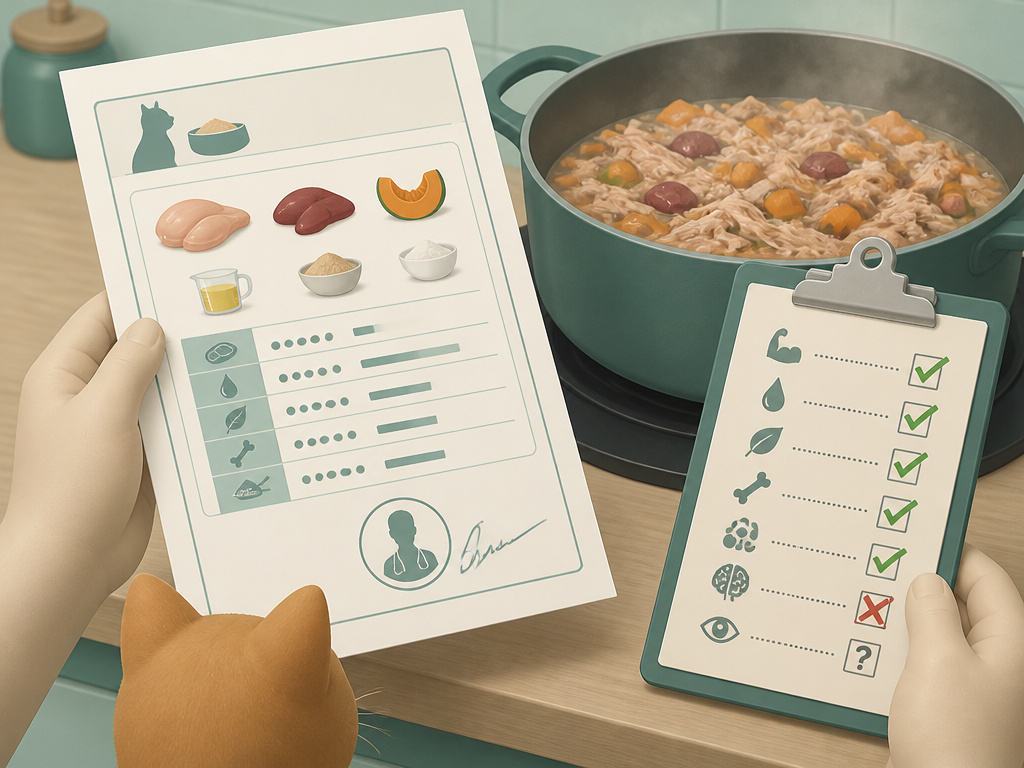
Author mattered, but not enough to close the gap.
The JAVMA data shows non-veterinarian-authored recipes carried more nutrients below the Allowance. With assumptions applied, five veterinarian-authored recipes met all assessed nutrients except choline, and in two of those five, taurine adequacy could not be confirmed.
What the recipe audit actually found
Read that carefully. The best-performing recipes in a sample of 114 still missed on one nutrient and left a question mark over another. The paper’s conclusion is blunt: no recipe met all the Allowances regardless of author.
The part nobody mentions: Taurine is heat-labile and water-soluble, so a long boil pours it down the sink. Two of the five best recipes in the audit could not be confirmed for taurine, which is the one deficiency a cat cannot route around.
What the review literature counters with
The 2024 review takes a softer position: homemade diets can feed healthy cats, provided the diet is nutritionally adequate and safe, and can be formulated more specifically for a cat’s needs, though the JAVMA audit found none of 114 recipes met every Allowance.
Both statements are true at once. The review describes what a well-built diet can do, and the audit measured what published recipes actually do.
I won’t tell an owner that a veterinarian’s name on a recipe guarantees adequacy. It narrows the gap. The JAVMA data still found choline short in the best five recipes in the set, and taurine could not be confirmed in two of them.
Are Bones and Raw Meat Worth the Risk?
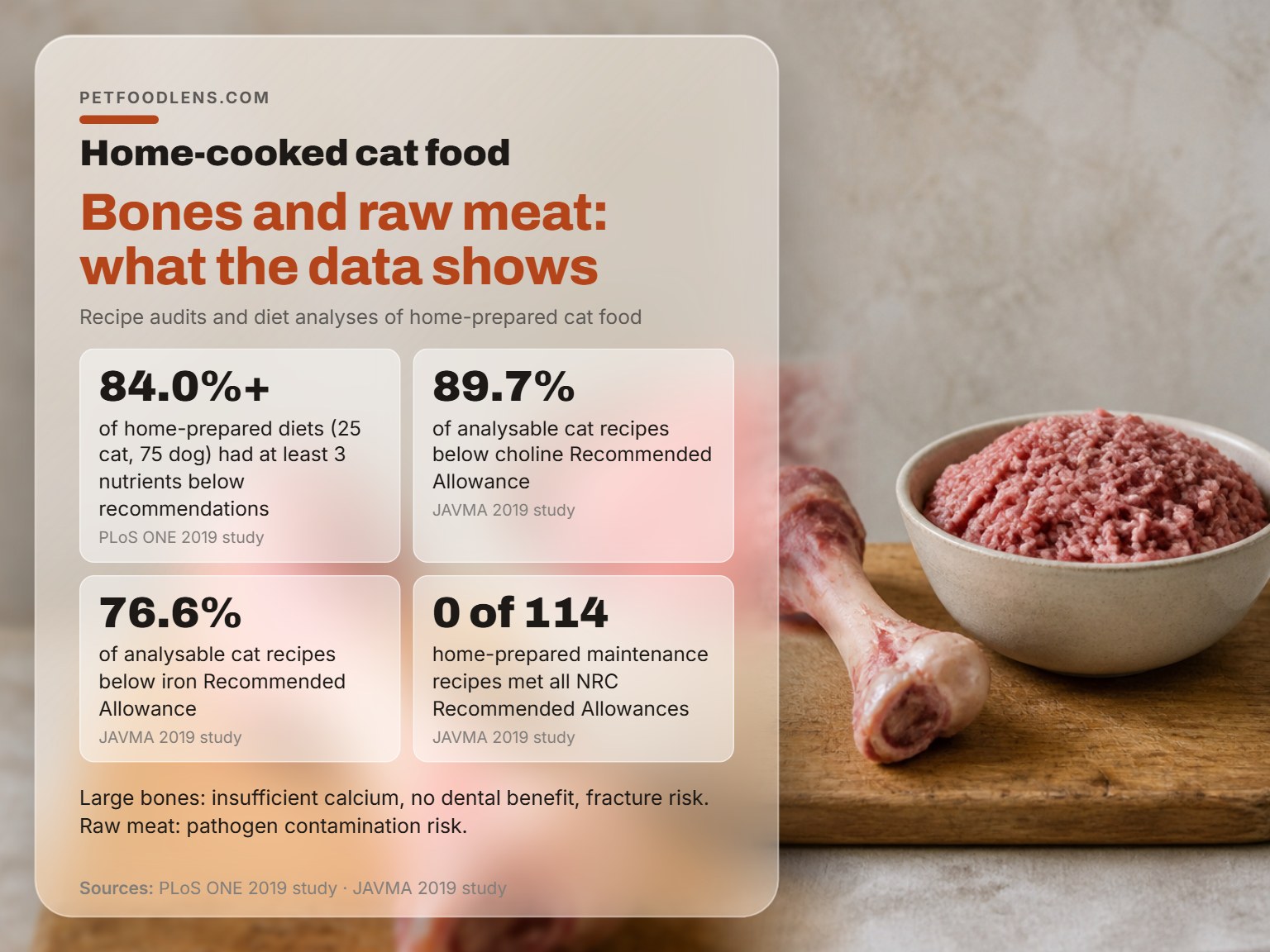
Bones are the part owners feel best about and the part most likely to hurt the cat.
Chewing on large bones does not provide sufficient dietary calcium, does not prevent dental plaque or periodontitis, and can cause tooth fractures. That is the industry summary, and it lines up with the recipe audit, which found bone-in recipes that never advised grinding the bones to cut the risk of tooth or gut injury.
Raw is a separate problem. Most recipes recommending raw animal products did not mention contamination risk at all, which leaves the reader uninformed about the main hazard of the format. If you want the full comparison of that format, the raw cat food breakdown covers it.
Heavy metals are the finding almost nobody quotes. In a PLoS ONE analysis of home-prepared diets, lead, cobalt, mercury, uranium, and vanadium exceeded FDA maximum tolerable levels in some diets. That same study found more than 84.0% of diets had at least three nutrients below recommendations.
Before you start: Raw meat carries bacteria and parasites that transfer to hands, boards, and sinks, so keep a dedicated raw board and wash it before anything else touches the counter. Bones splinter and crack teeth, so grind them or leave them out. Boiling leaches taurine into the water, so keep the cooking liquid in the bowl rather than down the drain.
Handling raw meat without turning the kitchen into a hazard
- Keep a separate board and knife for raw meat. Cross-contamination onto a salad or a child’s plate is the failure mode, and it happens in seconds.
- Grind bones or skip them. Whole bone in a bowl risks a cracked carnassial tooth or a gut obstruction, and neither shows up on the day it happens.
- Boil in as little water as you can, and keep that water. Taurine leaches into the cooking liquid, so pouring it off throws away the nutrient you were trying to protect.
- Cool fast and refrigerate in shallow containers. A deep pot of stew sits in the warm zone for hours, and that is where bacterial growth happens.
What Home Cooking Costs You in Time, Money, and Freezer Space
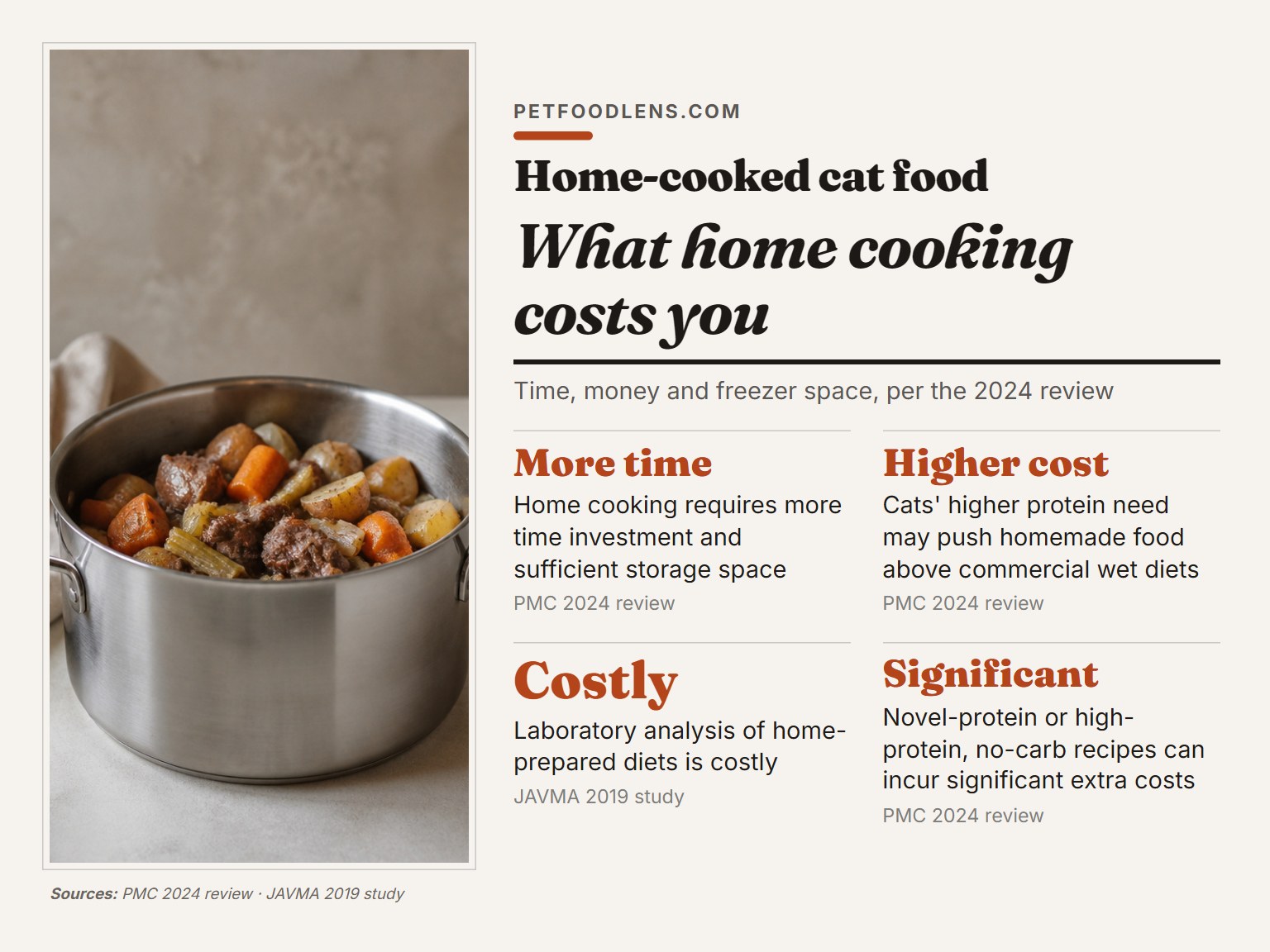
Cost is where the sales pitch and the receipts part company.
Industry commentary is specific: complete homemade diets for dogs are usually more expensive than commercial dry food, though they can be cheaper than some canned diets, while the 2024 review notes a cat’s higher protein requirement may push homemade food above the cost of commercial wet diets. The 2024 review adds a feline wrinkle, noting that a cat’s higher protein requirement compared with a dog’s may push homemade food above the cost of commercial wet diets.
The cost studies that exist are mostly canine, which is one more place cat owners are guessing. The home-cooked dog food literature is where most of the money data lives.
Time and storage are the costs nobody prices:
- Novel proteins such as venison or ostrich, where the ingredient is expensive and hard to source.
- Freezer space, which becomes a real constraint the moment you batch cook.
- Your evenings, which no cost comparison accounts for.
- Laboratory analysis, if you go that route, which the JAVMA authors describe as costly.
The freezer-space math
Home cooking requires more time investment and sufficient storage space, and the review says so directly. A large batch for one cat fills more of a freezer than most people expect on the first attempt.
Where this goes sideways: Cooling a large pot on the counter instead of splitting it into shallow containers. The middle of the pot stays warm for hours, and that is the window where bacteria multiply fastest.
If cost is the deciding factor, run your numbers against a plain pate rather than against a premium dry food, and compare wet cat food and dry cat food on a dry matter basis before you conclude anything. A splash of cat food broth over a home-cooked bowl also gets a reluctant cat started without changing the recipe.
Storing it properly is its own skill, and homemade pet food storage is worth reading before your first batch rather than after.
Home-Cooked Cat Food Pros and Cons: Where the Research Disagrees
Two of the disagreements matter more than the rest.
| Question | Position one | Position two |
|---|---|---|
| Can a home-cooked recipe be complete? | JAVMA: none of 114 met every Allowance | 2024 review: usable if adequate and safe |
| Are homemade diets more digestible? | One study: higher faecal digestibility than dry | Royal Canin: processing effects hard to isolate |
| Is commercial food independently verified? | Regulated and testable | Partly self-regulated, so not verified |
| Is lab testing a practical adequacy check? | Computerised assessment is reasonably predictive | Chemical testing is costly and impractical |
On completeness, a commercial and homemade cat diet comparison states that homemade diets can feed healthy cats as long as they are nutritionally adequate and safe, while the JAVMA audit found none of 114 recipes met every Allowance. The JAVMA home-prepared cat diet study measured what published recipes deliver, and the answer was none of them fully.
On digestibility, the review concedes that homemade food has been proposed as more digestible and cites one study showing higher apparent faecal digestibility for raw and cooked homemade diets against dry food, while Royal Canin notes these trials varied ingredients and processing together, so processing alone cannot be isolated. It also concedes there is a lack of studies, and industry commentary points out that these trials varied ingredients and processing together, so processing alone cannot be isolated.
On regulation, the review holds both positions in the same document: commercial diets are regulated and can be tested, and the industry is partly self-regulated, so regulated does not mean independently verified.
The same territory appears in a home-prepared diets for dogs and cats review indexed on PubMed, and in a veterinary journal piece on the risks and rewards of homemade diets. Neither settles the argument.
I have spent years reading ingredient panels, and a panel still cannot tell you whether the batch was mixed correctly. Nothing here fixes that.
Frequently Asked Questions
Is home-cooked food better for cats than commercial food?
It depends on whether the recipe is complete, and the published evidence says most are not. In a sample of 114 home-prepared cat recipes, none met all the NRC Recommended Allowances, and choline fell short in 89.7% of the recipes detailed enough to analyse. A properly built recipe can feed a healthy cat. A recipe from a book usually will not.
Can I just follow a recipe from a website or a book?
The audit suggests caution. Of 114 recipes, 113 had vague preparation instructions and 46 gave no feeding directions, and 93 of the 94 analysable recipes still needed assumptions about ingredients or supplements before a computer could score them. A recipe that cannot be scored is not a recipe you can verify.
Do I need to add a supplement?
Most published recipes assume one, which is part of the problem. In 93 of 94 analysable recipes, the analysis had to assume ingredient, preparation, or supplement choices that the recipe did not specify. That assumption is where a diet quietly stops matching the version that was scored.
Is a raw home-cooked diet safer or riskier?
Riskier on contamination. Raw meat-based diets, homemade or commercial, carry pathogen risk for the cat and the people handling the food, and most recipes recommending raw animal products did not mention that risk at all. Dry commercial food is processed at high temperatures and canned food is sterilised in the can, which is why contamination is far less likely there.
How would I know if the diet is working?
You would not know quickly. There are no long-term follow-up studies on cats fed unbalanced diets, and deficiencies can be subtle or show up only after years of marginal intake. A cat can look fine on a diet that is quietly short on choline or taurine.
Is home cooking cheaper than canned food?
Not reliably. Complete homemade diets for dogs usually cost more than commercial dry food, though they can undercut some canned diets, and a cat’s higher protein requirement may push homemade food above the cost of commercial wet food. Novel-protein and high-protein recipes add significant cost on top.
The Bottom Line
Here is the trigger I would give any owner. If you cannot name the person who balanced the recipe and the method they used, treat that food as a topper, not a diet. Toppers do not need to be complete. Diets do.
That line is not a knock on home cooking. It is the same standard I apply to a bag. Show me what is actually in it, and show me the math behind the numbers.
One concession, and it matters. If your cat has kidney disease, diabetes, or another condition where the diet is doing clinical work, this whole comparison changes. Recipes for cats with chronic kidney disease have been evaluated and found highly variable and often inappropriate, and therapeutic foods that carry real claims are built for exactly that job. A home-cooked version has far less evidence behind it.
For a healthy cat and an owner willing to do the work, home cooking is a legitimate path. Just go in knowing that the bowl you build is only as good as its weakest nutrient, and that nutrient is probably choline.
