
How to Balance a Homemade Cat Food Recipe Step-by-Step
This post contains affiliate links. As an Amazon Associate, we earn from qualifying purchases.
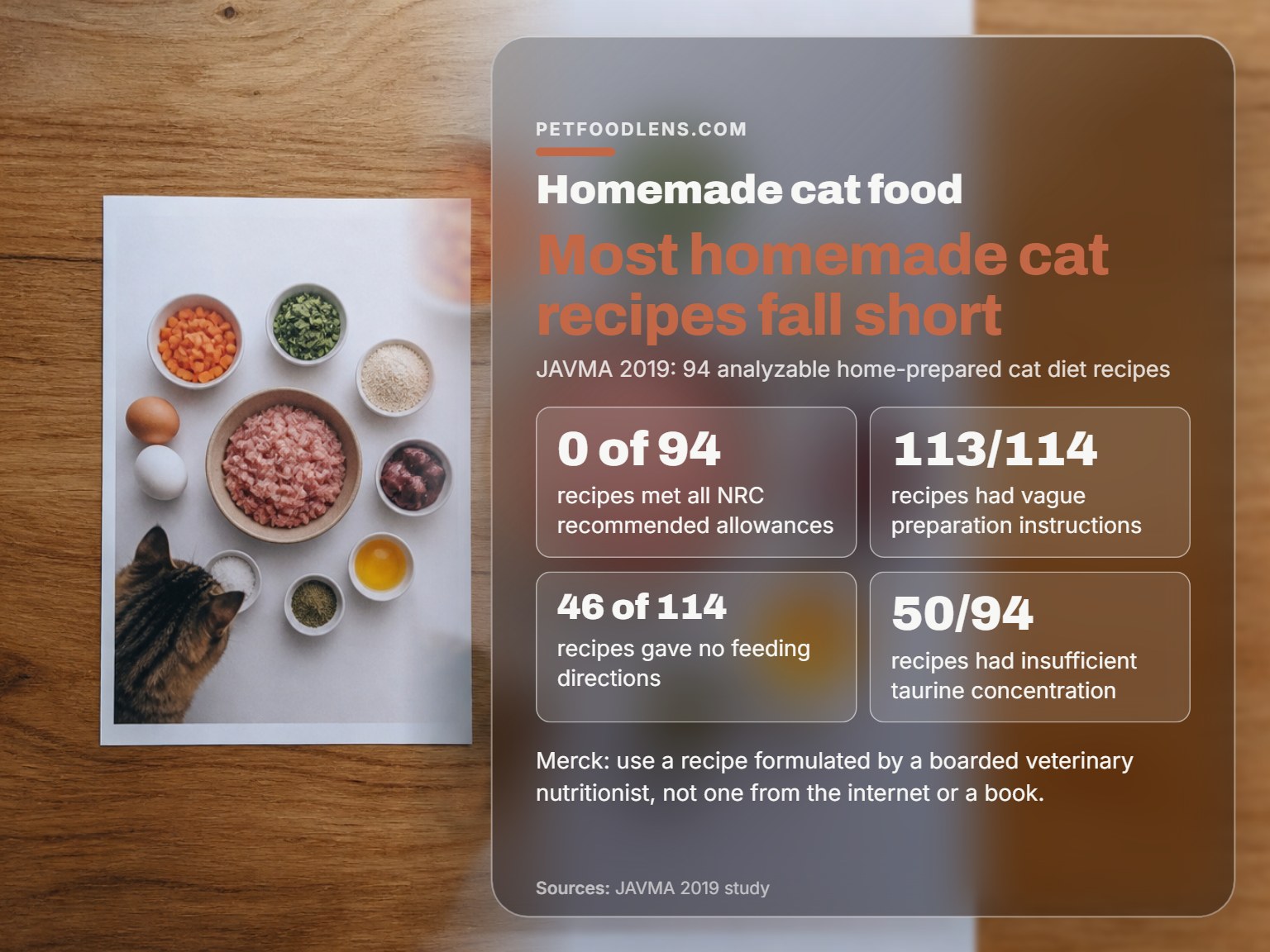
To balance a homemade cat food recipe, you have to hit every NRC or AAFCO nutrient allowance, including the micronutrients nobody photographs. In a JAVMA evaluation of 94 analyzable cat recipes, none met all NRC recommended allowances, and choline fell short in 89.7% of them.
Choline is the one that surprises people. A cat short on it loses weight while fat quietly accumulates in the liver, and nothing about the bowl looks wrong. Knowing how to balance a homemade cat food recipe matters for exactly this reason.
What follows is the six-check sequence I run on any recipe that crosses my desk, plus the places where the published standards disagree with each other and the ingredients that cause the most trouble.
Key Takeaways
- Calcium and taurine fail first in internet recipes, and neither one shows up in how the food looks.
- 0 of 94 analyzed recipes met every NRC recommended allowance; choline missed in 89.7% of them.
- A supplement doesn’t rescue a bad recipe. Every diet in one review of more than 100 was calcium-supplemented, and none met all requirements.
- NRC, AAFCO, and FEDIAF are different yardsticks, so a recipe that clears one can still fail another.
- Have a boarded veterinary nutritionist write the recipe if you want it to hold up past the first batch of chicken.
What Does “Balanced” Actually Mean for a Cat Recipe?
On a pet food label, complete and balanced has a specific meaning: the product contains all nutrients presently known to be required by a species and life stage, balanced to the energy density of the diet.
A complete and balanced claim means the diet supplies every nutrient currently known to be required by a named species and life stage, in proportions matched to the food’s energy density. AAFCO recognizes four adequacy categories: growth, maintenance, gestation or lactation, and all life stages. A label must carry one of these statements.
That definition comes from the label side of the industry, and it’s the one regulators enforce. A homemade recipe has no label, so you have to borrow the standard and apply it yourself.
Here’s where it gets awkward. The published research doesn’t grade recipes against one yardstick, which is why two papers can both be right and still reach different verdicts.
| Benchmark | Used in | What it covers |
|---|---|---|
| NRC recommended allowances and safe upper limits | JAVMA 2019 cat recipe evaluation | Adult cat allowances plus upper limits |
| NRC and FEDIAF, compared side by side | PMC6736975 diet analysis | US and European standards together |
| AAFCO nutrient profiles and NRC | PMC8499233 supplement review | Label profiles plus research allowances |
| AAFCO profiles and feeding trials | Merck Veterinary Manual | The US label standard |
The JAVMA homemade cat diet study graded 94 recipes against NRC recommended allowances and safe upper limits. A separate analysis graded diets against NRC and FEDIAF together. A supplement review referenced AAFCO alongside NRC.
Pick the standard before you pick the ingredients. A recipe built to one benchmark and checked against another will look adequate on paper and fall short in the bowl. That framing shows up in the commercial versus homemade diet comparison too: properly formulated homemade diets can work, and generic internet recipes are not recommended.
The Six Checks That Decide Whether a Recipe Holds Up
Six things, in this order: calcium source, taurine, choline, iron and zinc, vitamin E and thiamine, and the standard the recipe was written against.
Before you start: Home-cooked diets still pass through your kitchen. Keep raw poultry off the counter you’ll serve from, and cook meat to 130°C (266°F), the Merck Veterinary Manual’s minimum for killing microbes and bacterial spores. Skip onion, garlic, and salt in any broth you add, because those are the three things home cooks reach for first and the three that cause the most trouble.
- Name the calcium source by weight. A recipe that says “add calcium” without a number leaves the ratio wherever it lands.
- Check taurine, from ingredients or a supplement. Of 94 recipes, 74 (78.7%) included no taurine supplement at all.
- Check choline. It’s the single most common shortfall at 89.7%, and the deficiency signs (weight loss, fat in the liver) are easy to blame on something else.
- Check iron and zinc. In cats these were the two most-deficient nutrients across an analysis of home-prepared diets, and none of 25 cat diets in a separate study met iron requirements.
- Check vitamin E and thiamine. Vitamin E missed in 57.4% of recipes and thiamine in 62.8%, and thiamine deficiency turns neurologic if it runs long enough.
- Check the standard. Only 5 veterinarian-authored recipes met all assessed nutrients except choline, and taurine adequacy couldn’t be confirmed in 2 of those 5.
Whether any of this is worth the effort is a fair question, and the home-cooked cat food pros and cons are more even-handed than most blogs admit.
Calcium and Phosphorus: Where Internet Recipes Fall Apart First
A pound of ground chicken, a spoon of pumpkin, a multivitamin crushed over the top. That’s most of the cat recipes floating around, and the calcium is missing.
I’ve pulled apart a lot of these. A pound of ground chicken with no bone and no calcium source leaves the calcium-to-phosphorus ratio wherever it lands, which is the wrong direction.
In the JAVMA analysis, 23 of 94 recipes (24.5%) provided less than half the NRC recommended allowance for calcium. Copper was close behind at 25 of 94 (26.6%).
Calcium and phosphorus are absorbed against each other. A diet heavy in muscle meat and light on calcium pushes phosphorus ahead, and the cat draws calcium out of bone to cover the difference. The deficiency signs in the source are skeletal.
Common mistake: Adding calcium by eye or by spoon. The amount has to be weighed against the phosphorus in the rest of the recipe, and an unmeasured scoop leaves the ratio wherever it happens to land.
Choline, Iron, and Taurine: The Nutrients That Go Missing
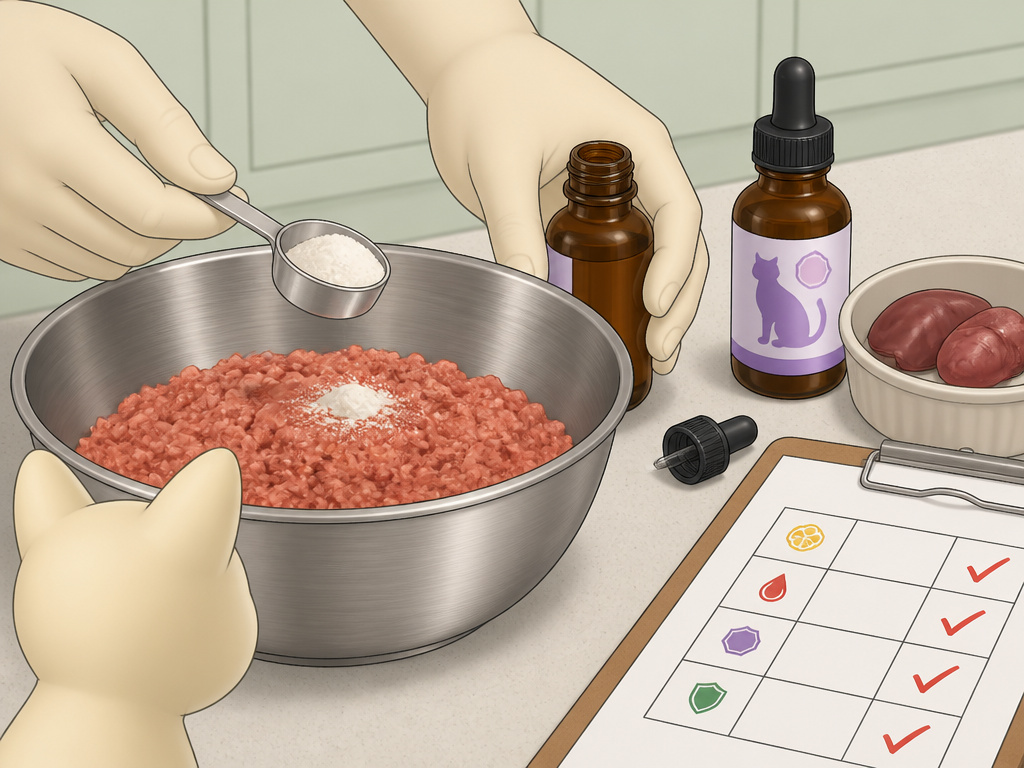
Choline landed below the NRC recommended allowance in 89.7% of the 94 recipes that could be analyzed.
| Nutrient | Below the NRC allowance | What it affects |
|---|---|---|
| Choline | 89.7% | Liver lipid accumulation, weight loss |
| Iron | 76.6% | Anemia, pallor, lethargy |
| Thiamine | 62.8% | Appetite first, then cardiac and neurologic signs |
| Zinc | 61.7% | Growth, immune function, wound healing |
| Vitamin E | 57.4% | Depression, anorexia, steatitis |
| Copper | 45.7% | Skeletal and reproductive problems, anemia |
Those are ordinary nutrients, and a recipe skips them because the ingredient list looks complete without them.
Why Taurine Numbers Are Hard to Verify
Taurine is the nutrient that makes cat formulation genuinely difficult. In the JAVMA study, 50 of 94 recipes (53.2%) had an insufficient taurine concentration, and taurine adequacy was treated as a missing value when it could not be verified from other ingredients.
The supplement question has a clean answer buried in the same data. All 20 recipes (21.3%) that included a taurine supplement-type product met the NRC allowance. Six of 94 (6.4%) listed taurine as optional or conditional, for instance when the diet had been frozen more than a week.
The sources disagree on whether a recipe needs taurine supplementation: the JAVMA study found all 20 recipes containing a taurine supplement-type product met the NRC allowance, while 6 of 94 recipes stated taurine supplementation as optional or conditional.
The Iron and Zinc Gap
A separate analysis found that more than 84.0% of home-prepared diets had at least three nutrients below recommendations, with iron and zinc the most-deficient in cats. The same paper flagged heavy metals in home-prepared diets: lead, cobalt, mercury, uranium, and vanadium all exceeded FDA maximum tolerable levels.
Thiamine is the quiet one. Weight loss and anorexia come first, and the cardiac and neurologic signs that follow can be fatal if the shortfall continues.
Crude protein was the least common failure at 6 of 94 recipes (6.4%). Owners argue about protein requirements for cats endlessly and skip the nutrients that actually miss.
Does Adding a Supplement Make a Recipe Balanced?
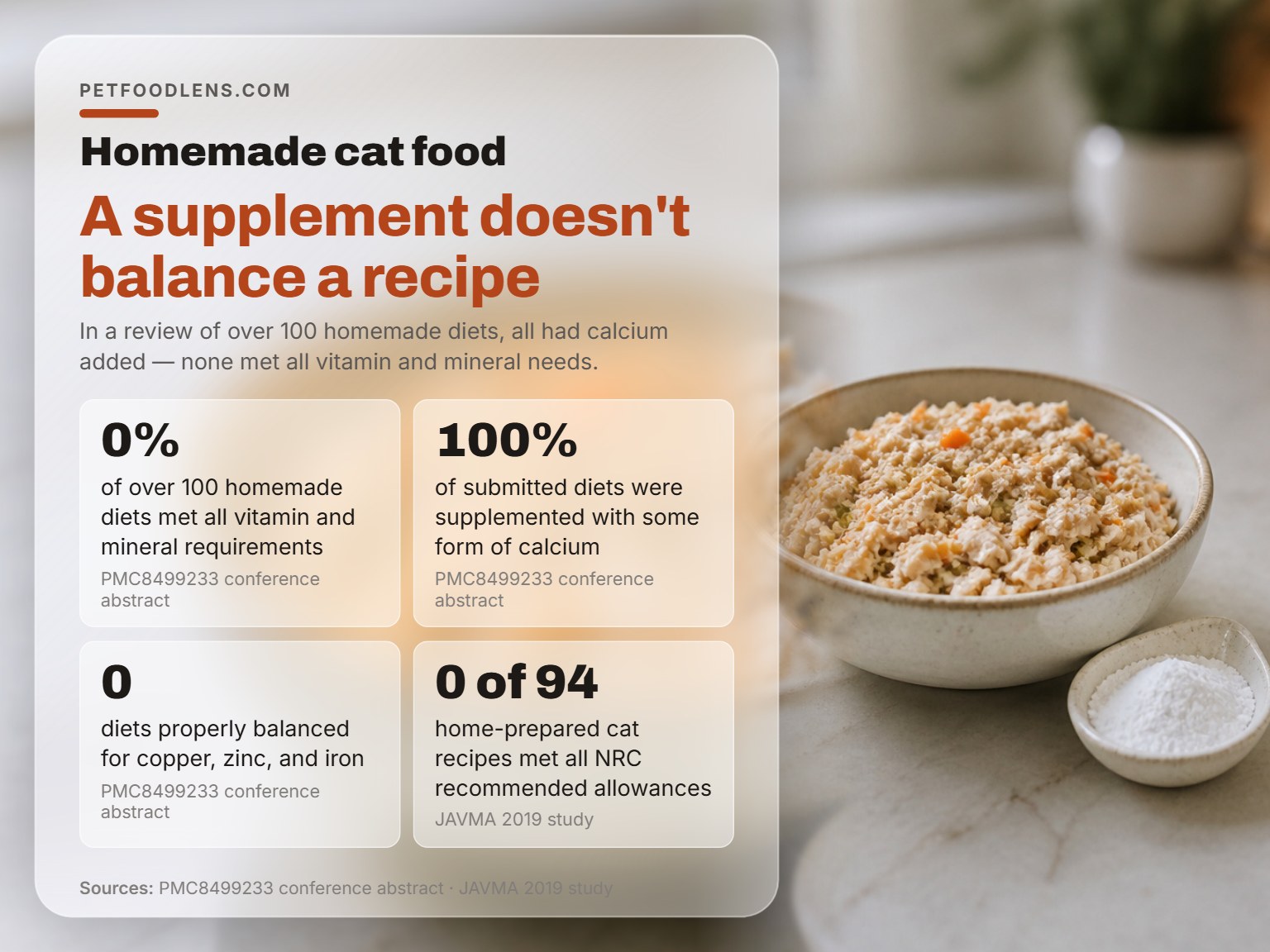
Every diet in one review of more than 100 homemade recipes was supplemented with some form of calcium. None of them met all vitamin and mineral requirements.
That result is the whole argument in one line. A supplement is an input, and how to balance a homemade cat food recipe is the outcome.
A chemical analysis of website-sourced diets put it plainly: the presence of a supplement did not ensure a balanced diet. The same study found that ingredient count didn’t guarantee adequacy either, and that feline diets meeting manganese actually had fewer ingredients.
The finding on supplement use in homemade diets runs against a very common owner assumption, which is that a powder fixes a recipe.
The homemade pet diet supplement considerations review adds the rest. None of the submitted diets were properly balanced for copper, zinc, and iron. Iodine is usually met through kelp, where quality varies enough to cause over- or under-supplementation with thyroid effects. Vitamins E and D are often under-supplemented.
I’d rather see an owner weigh a premix into a bowl than free-pour a multivitamin and hope. The premix has a number on the label. The hope doesn’t.
Clients sometimes want to boost a complete food with homemade extras. In the cases I’ve reviewed, the additions diluted the balance of a diet that was already correct, which is a strange thing to pay for.
Bones, Kelp, and Liver: Three Ingredients That Backfire
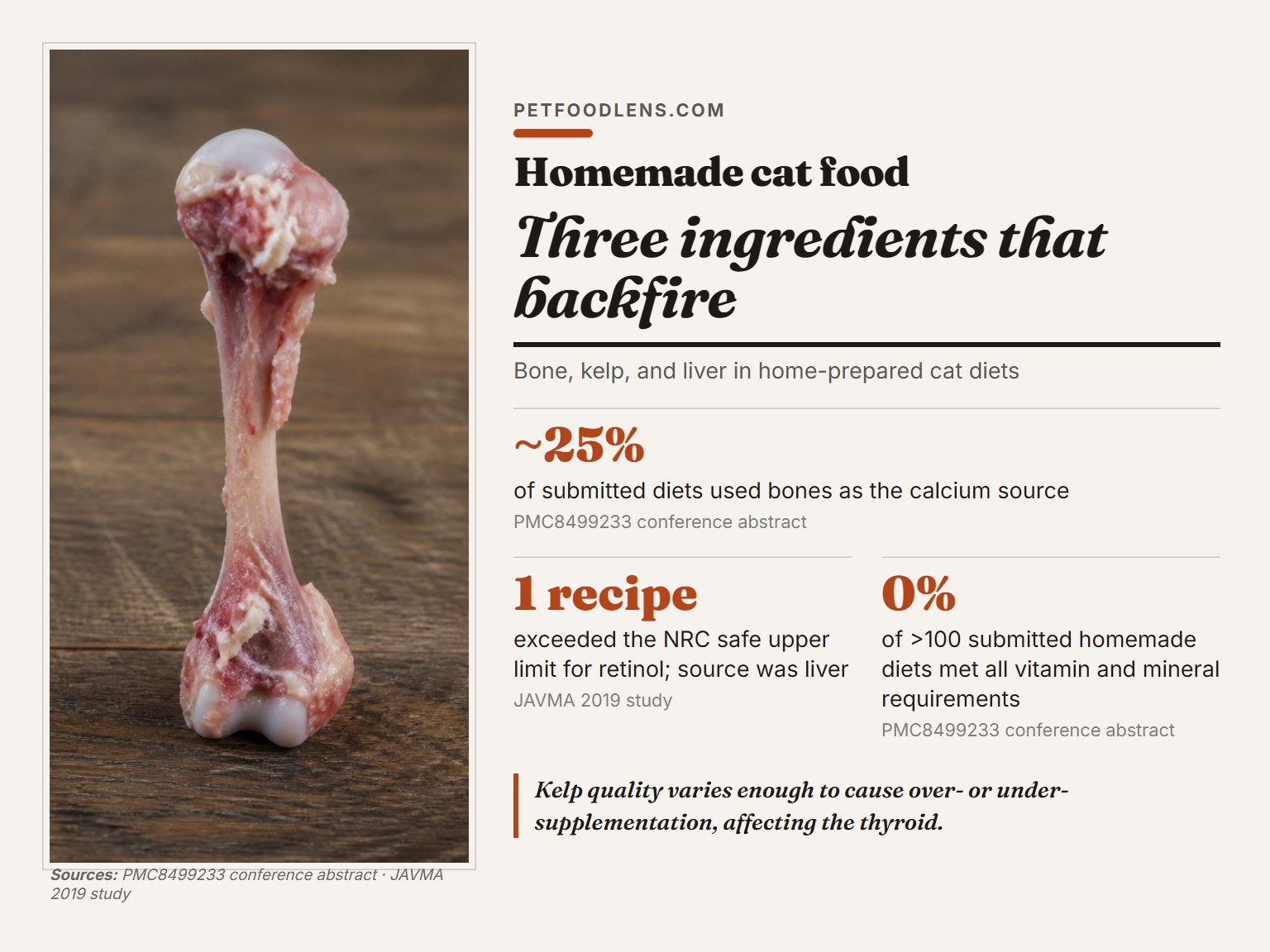
Bone is the calcium source that causes the most trouble.
Bone as a Calcium Source
Roughly 25% of submitted diets used bones as the calcium source. Bones can be problematic depending on type, particularly for digestion, for broken pieces that cause intestinal blockages, and for broken teeth.
The sources split on this one. The supplement review documents the practice and its failure modes. The Merck Veterinary Manual and the diet review both point owners toward a recipe formulated by a boarded veterinary nutritionist rather than a recipe built around bone.
Kelp and Iodine
Iodine is typically met through additions of kelp. Quality variation between kelp products is wide enough to cause over- or under-supplementation, and both directions affect the thyroid.
Liver and Vitamin A
One recipe in the JAVMA analysis exceeded the NRC safe upper limit for retinol, and the source was liver. Hypervitaminosis A has been detected in cats fed home-prepared diets high in liver, which is why the source calls for a clear understanding of liver’s nutrient profile before it goes in the bowl.
Practical rules that hold up better than the folklore:
- Weigh the calcium source. A scoop is not a measurement, and the ratio depends on the number.
- If you use bone, know the type and the grind, because the failure modes are mechanical: blockages and fractured teeth.
- Skip kelp unless the recipe names a product and an amount.
- Treat liver as a measured ingredient with a ceiling, not a base.
The same arithmetic applies if you’re formulating a homemade diet for a dog, though the allowances and the volume constraints differ.
Cooking, Moisture, and What the Guaranteed Analysis Hides
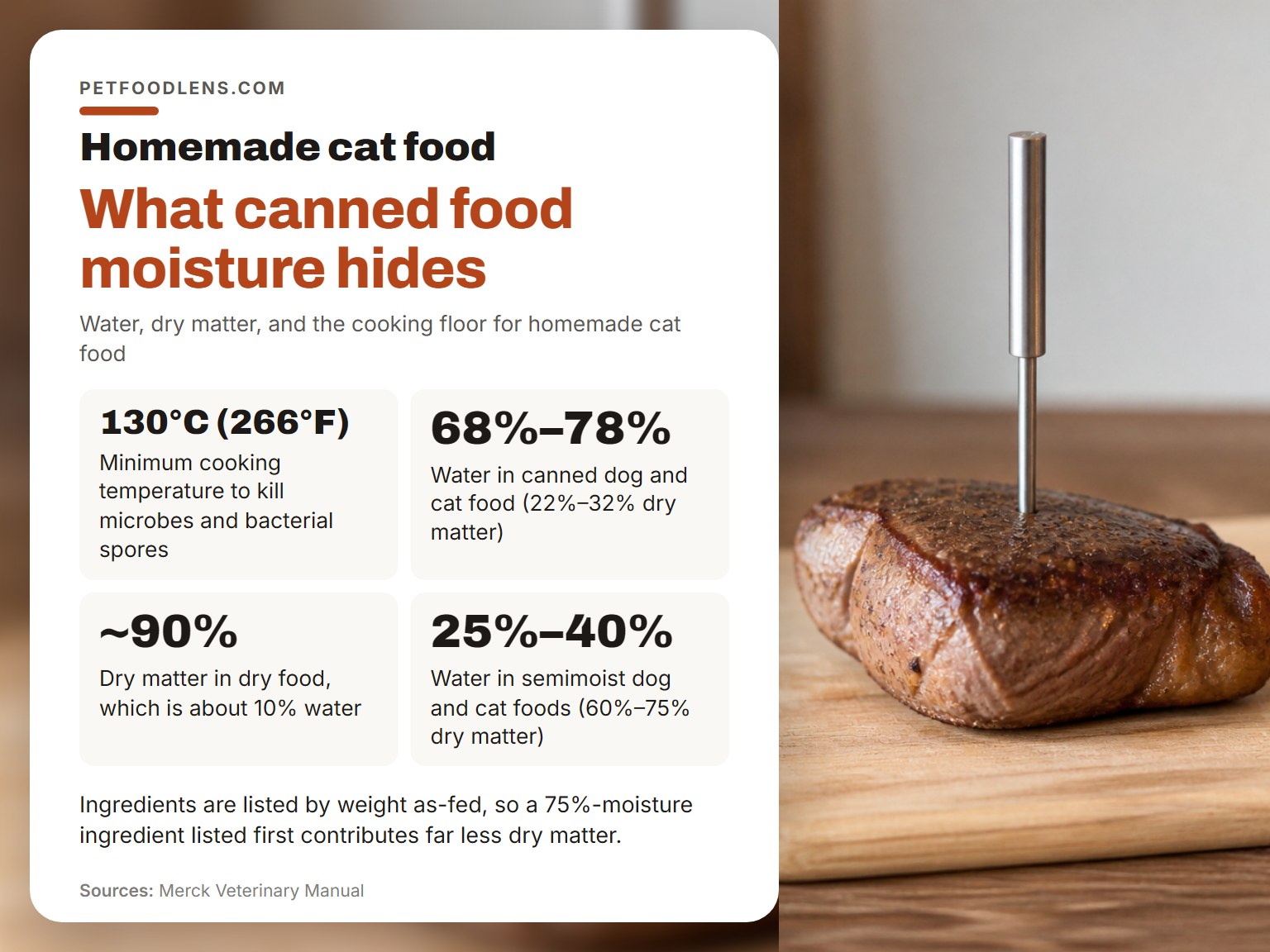
The Merck Veterinary Manual sets the minimum cooking temperature at 130°C (266°F) to kill both microbes and bacterial spores.
Treat that as a floor. Home ovens overshoot and undershoot, so a thermometer in the thickest part of the meat is the only way to know where you landed.
Moisture is the other number people misread. Canned food runs 68% to 78% water with 22% to 32% dry matter. Dry food is roughly 90% dry matter and 10% water. Semimoist sits at 25% to 40% water.
Guaranteed analysis says moisture 78% max and owners read it as a quality claim. It’s water. Canned food runs 68% to 78% water, and a stew running under that range usually means thickener doing work the meat should be doing.
A high-moisture pate slumps off the spoon and leaves a wet ring on the plate. A drier one holds a fork mark.
The useful comparison is protein and fat on a dry matter basis, which is arithmetic you can do on the back of the can. Ingredients are listed in descending order by weight on an as-fed basis, so a 75%-moisture ingredient listed first contributes far less to total nutrients than the same ingredient in dry form. Ingredient splitting hides the rest.
The Merck Veterinary Manual is blunt about the payoff: animals require nutrients, not ingredients.
Stirring warm water into a can of pate costs nothing and raises intake in most cats. Warming releases aroma, and the kitchen tells you it worked before the cat does.
Once a batch is made, storing homemade food matters more than most recipes admit, because a wet diet sitting at room temperature is a bacterial incubator. And cat food portions are the other half of the equation: a balanced recipe fed at the wrong volume still overfeeds or underfeeds.
Easy to miss: A stew or chunks-in-gravy product running below the typical canned-food moisture range is usually thickener holding the shape. The meat content is lower than the front of the can suggests.
Who Should Actually Formulate the Recipe
A boarded veterinary nutritionist is the person who formulates a recipe against a named standard and adjusts it for the individual cat.
The Merck Veterinary Manual is direct about it: if owners choose to feed a home-cooked diet, they should use a recipe formulated by a boarded veterinary nutritionist rather than a recipe found on the internet or in a book. The diet review reaches the same place from a different direction, calling generic internet recipes a source of deficiencies and imbalances.
The two sources frame the question differently. Merck allows that dogs and cats can be successfully maintained on properly formulated home-cooked diets. The review is more restrictive about where the recipe comes from.
When a Homemade Diet Is the Right Call
A properly formulated homemade diet can be customised to the patient, and it’s an option when no commercial product meets the cat’s needs. Owner preference counts too. No home-cooked diet has undergone the testing and research used to formulate some complete and balanced commercial foods, so the recipe carries more weight than it would on a can.
The Cat-Specific Constraint
Cats are the hard case. The Merck Veterinary Manual notes it is most difficult to formulate a nutritionally complete and balanced diet with sufficient nutrient density in a small volume of food that is palatable for cats. Many home-cooked diets end up high in protein and caloric density instead.
Questions worth asking before you cook anything from a recipe:
- Which standard was this built against, and which version of it?
- Who formulated it, and are they a boarded veterinary nutritionist?
- Is the calcium source named by weight, or just named?
- Does it give feeding directions at all? In the JAVMA study, 46 of 114 recipes gave none.
If you want a reference point for what a substantiated diet looks like, flip a can of a complete and balanced commercial food and read the AAFCO statement. It names a life stage and states how adequacy was determined, which is more than most homemade recipes do.
Premixes sold for homemade cat diets exist because the micronutrient side is the hard part. Follow the ratio on the package. It’s a formulation, not a serving suggestion.
If you do make the switch, switching cat food gradually matters more than most owners expect.
Frequently Asked Questions
Can I add a vitamin supplement to a meat recipe and call it balanced?
No. In one review of more than 100 homemade diets, every one was supplemented with calcium and none met all vitamin and mineral requirements. In a separate analysis, the presence of a supplement did not ensure a balanced diet. A supplement is an ingredient, and the recipe still has to be checked against a standard.
What calcium-to-phosphorus ratio should a homemade cat food hit?
There’s no number to aim for in isolation, because it depends on the rest of the recipe. What matters is that the calcium source is named by weight and the finished diet is checked against an NRC or AAFCO allowance. A pound of ground chicken with no calcium source lands well under 1:1, which is the wrong direction.
Is bone or eggshell a better calcium source?
The sources don’t settle this cleanly. Roughly 25% of submitted diets used bone, and bone carries mechanical risks: digestion problems, broken pieces that cause intestinal blockages, and broken teeth. Both the Merck Veterinary Manual and the diet review steer owners toward a nutritionist-formulated recipe rather than a home-built calcium strategy.
How long can I keep a batch of homemade cat food?
That depends on how it’s stored and what the recipe specifies, which is part of the problem: 46 of 114 recipes gave no feeding directions at all. Freezing extends the window, and a wet diet left at room temperature is a bacterial risk regardless of how well it was balanced.
Can I feed a homemade diet to a kitten?
Growth is a separate AAFCO adequacy category from adult maintenance, so a recipe built for adult maintenance doesn’t cover it. The Merck Veterinary Manual lists four categories: growth, maintenance, gestation or lactation, and all life stages. Match the recipe to the category before anything else.
Do I need a veterinary nutritionist, or will a calculator do?
Calculator tells you what a recipe contains. It doesn’t tell you whether the nutrients are bioavailable, which the Merck Veterinary Manual notes is a limitation of laboratory analysis. A boarded veterinary nutritionist formulates against a standard and adjusts for the individual cat, and that’s the recommendation in both the Merck manual and the diet review.
The Bottom Line
Here’s the trigger I’d use. If a recipe doesn’t name its calcium source by weight and doesn’t state which standard it was formulated against, stop reading it. Those two omissions predict the rest.
The second thing worth knowing: a recipe that clears one benchmark hasn’t cleared them all. NRC, AAFCO, and FEDIAF are different yardsticks, and the JAVMA study found that even 5 veterinarian-authored recipes meeting every assessed nutrient except choline still had taurine questions in 2 of them.
One concession. If your cat has kidney disease, diabetes, or another condition that needs a therapeutic formulation, none of this reaches far enough. That’s clinical nutrition, and it belongs with your vet and a boarded nutritionist rather than a kitchen scale and a blog post.
